

INTRODUCTION
Identity is a problematic concept in this postmodern world and has been questioned through numerous studies and fields. It is acknowledged and accepted more as a fluid concept which resides in an ongoing process of constructions and reconstructions (see, for example, Hall: 2000, Redman: 2000).
In the case of Indonesia, this is emphasized more by the fact that
Indonesia is a country with diverse ethnic groups and cultures that has attempted to bind the diversity by the dissemination of many unifying cultural artifacts. For example, the Indonesian eagle which is the bearer of the motto "Bhinneka Tunggal Ika". Nonetheless, the concept of a unified Indonesian identity as inscribed in the motto "Bhinneka Tunggal Ika" was literally shaken with the fall of the Soeharto regime. Demands for separation have been a lurking problem for government, and the nation. People start questioning their identity an
Indonesian and seeking the roots of their identity, whatever they are: ethnicity, religion, places. Quoting Anderson's popular coinage (Edensor, 2002), Indonesia is indeed an imagined community. It exists and is constructed in people's minds by way of discourses they live through.
One of the ways these discourses are disseminated is by the use of print media. Edensor further explains that for Anderson the advent print media such as the newspapers or magazines play a significant role in the dissemination of the idea of a nation. The nation is ―. . . reproduced and represented textually...‖ (p.6). Although Anderson's emphasis on print media has the potential to reduce the rich complexity of culture production, according to Edensor (2002), he acknowledges the popular and everyday nature of the dissemination of the nation. His argument for the role played historical narratives in the reification of textual sources through which the nation is (re-)produced resonates with Bhabha's proposition on dissemiNation.
From a postcolonial perspective, Bhabha (1994) argues for the double writing in the dissemination of the nation. He points out that ―…the concept of the ‗people' emerges with a range of discourses as a double narrative movement.‖ (p.208). In this double narrative, the people are both of objects and subjects. They are firstly the objects of a nationalist pedagogy stemming mostly from a colonial experience, but then they are also the subjects in the meaning-making process. It is a process
entailing an appropriation for ―…signs of a coherent national culture‖ (209). The double writing of the nation then entails the ambivalence of a modern society as this creates a tension between the afore-mentioned nationalist pedagogy or the pedagogic discourse of the nation and the performative discourse. The pedagogic discourse works under the project of establishing a solid unified society. While the performative discourse articulates the people's heterogeinity which might be constituted by minority discourses, cultural differences, or differing interests. Bhabha is of the opinion that these two types of discourses drive and propagate the idea of a nation.
The intertwine of these discourses creates tension rooted in the nation' historicity and the actual performativity of the people. Nonetheless, such tension might clear a space for the people to define or redefine their concept as a nation. In this particular study, the site for the (re-) defining of the nation is youth magazines which, in the realm of popular culture, survive by conforming the pressure of the capital and their comprehension of the audience.
Youth, as the intended audience or implied readers of this magazine, according to Giroux (1996), is both a social and political category. As a social and political category, youth is the ―...marker of the ethical and moral responsibilities of adults to the next generation…‖ (p. 10). By defining youth in this category, adults reserve the right to deem whatever they think necessary to uphold their assumed responsibilities.
Consequently, the need for a pedagogic discourse arises.
Pedagogic discourse might be purposefully delivered in an instructional manner in contexts such as classrooms, and they might also be covertly presented as those present in the narratives of everyday life. Everything with unifying historical significance can be discursively disseminated in the everyday life, for example in print or electronic media. Youth magazines, on one hand, have the position to be pedagogic as they are commonly run by adults who have the potentials for defining what is ―right‖, ―correct‖ or ―acceptable‖ for their youth readers. On the other hand, youth magazines are determined by the market and this calls for an understanding of what aspects to sell so, therefore, there should also be considerations on the performative discourse prevailing in the society. Performative discourses open up the possibilities of differences. It ―... repudiates ‗grand narratives' and castigates the universalizing, totalizing concepts in favour of reaffirming the importance of difference.‖ (Rojek, 2000: 49) The different nature of these discourses generate fissures where alternative meanings for the idea of nation might be built upon. It is by examining these fissures in youth magazines, the study attempts to discuss the likely ways in which dissemiNation might occur.
THE CONTEXT
The analysis looked into the August editions of different years from different
magazines for youth. They are Cosmo Girl (2002), GADIS (2006) and Hai (2003) magazines. The August edition is almost always related to, and therefore, framed within, the Indonesian Independence Day. With the Independence Day, which is on August 17, as the context, the analysis examined how the event might have been used to present and, thus, disseminate, the ideas of Indonesia the nation. The analysis attempted to answer the questions on how the concept of nation is delivered to the readers. These questions were then placed in a wider Indonesian context of the Indonesian society to discuss and analyze critically the ways the ideas of Indonesian identity are disseminated to the magazine intended readers as part of the double-writing of the nation. To do this, Bhabha's theoretical proposition on dissemination was used to frame the findings from the magazine analysis.
THE STUDY
The most recent magazine for the study is GADIS (2006). There are 16 pages in this August edition which is nuanced in red and white. Red is the dominant color of the cover. It is the color of the cover girl's dress standing at the door of a fire department truck. She's also wearing a wide white belt. However, red is more dominant than white on this page, and, with the words ―Pake Merah, Siapa Takut, is more of a fashion statement than a linkage to Indonesian Historical narrative.
There is no indication that red is related to Independence Day, except for the fact that this is the mid-August edition.
Nonetheless, pages are splashed with red. The editorial page is framed with red things such as two cherries, a national flag toy, a red thumb tack, a red VW car toy, pictures of staff in red outfits. All of which is placed on a white background which has managed to produce a striking contrast of red and white.
On the center, a letter is printed in purple letters. The letter itself states that red is the color of the edition as it is the color of the Independence Day:
―... Nah, kalau kamu lihat, majalah GADIS kali ini, mulai dari depan sampai belakang semuanya bernuansa MERAH. Keberanian warna MERAH menjadi semangat dan inspirasi tim GADIS untuk membuat edisi menyambut kemerdekaan ini. Semoga warna MERAH itu memberikan pengaruh yang positif juga buat kamu...‖
Here, the editor –Didin- establishes the pedagogic discourse for the edition. Using red as one of the symbol in the nation's historical narrative, the magazine appropriates the historical red for their youth readers by adopting red's sense of brevity, dare and courage and producing red in a performative discourse which manifests in its fashiontrend and theme.
Red appears almost everywhere as the ―It color‖ of the month. It is used to relate the many aspects of the edition to Independence Day. Red is picked up and appropriated to propagate the spirit of self-empowerment which is particularized for the cover girl in the cover girl page by entitling it ―Girl Power‖, a term popularized in the 90-s by Spice Girls, a girls' band from England. As a magazine for girls, GADIS places an emphasis on girls' achievements. In this edition, they have specially selected high-achieving girls from a variety fields. The cover girl was a Gadis Sampul (cover girl) – a modeling competition-- finalist and the girls featured in the Hot Issue are champions in fields which are relatively not as popular as modeling.
The girls' achievement is another appropriation of a pedagogic discourse which frames the spirit of bravery, struggle for independence in a more modern up-to-date struggle requiring lots of hard work and efforts to be placed in an international scale. Each girl is portrayed in light of being both ‗national' and ‗international, or both ‗local' and ‗global'. The cover girl is studying in England whereas the 12 Divas in the Hot Issue have gained various international recognitions. There is an importance placed on being/going international or global either as an achievement or a prestige.
The dynamic of the identity discourses in this edition indicates the complexities of the ways the idea of a nation is disseminated. The need to anchor these narratives in a national sign of the color red reinforces what Bhabha termed as the many as one (204). Red helps establishing a social cohesion that should demonstrate that the people is a homogenous and consensual community (209). However, red, and in this case, white are present in the texts creating tension in the discursivity of the pedagogic and performative. The narrative of color is one of the double writing underpinning the dissemination of Indonesia.
In addition, the double writing is sending messages more on what it means to be successful more than what it
means to be Indonesian. The pedagogic discourses of being Indonesian of intertwine with the performative discourses of the importance of hard work, struggle, empowerment and becoming or gaining international identity which is the location where the pride of being Indonesian is constructed. The performative discourses also indicate fluidity as the girls' achievements are labeled in two contradictory elements, for example, for (1) Anike Bowaire, the heading is ―Fisika itu Sederhana Kok‖, (2) Diatra Zulaika, it is ―Ilmuwan Rock and Roll‖, and (3) Irene Kharisma, ―Master Catur Termuda‖.
The dynamic between constructs of national and international, physics and simple, scientists and rock ‗n roll, or master and young age, although implying an essentialist tendency to oppose two different construct, has opened up a continuum where the readers might see the possibilities to position themselves. So, I believe, these performative discourses while placing significance more on the ideas of being a modern Indonesia also play a pedagogic role by offering these polar possibilities.
The same case applies to ―Gadiz, The Sax School Girl‖. Her achievement as an acclaimed saxophonist is highlighted in the discourses of hard work, struggle and success while, at the same time, she herself is portrayed as an international (She studies in Canada) and fashionable girl. Again, the distinctive message is on being identified as a successful Indonesian young lady while, at the same time, identified for the
Dissemination of Indonesia : A textual analysis on the construction of Indonesia in selected print media for youth readership

international linkage and fashionable appearance.
The discourses in these texts demonstrate the identities made available for these girls. The positional gimmick in the magazine shows how the identities are played and confirm the notion of Anderson's ―imagined community‖ as Indonesia-ness is bound merely by the presence of red and white which was once the symbols that could arouse the spirit of independence among its youth.
The play between pedagogic and performative discourses about what it means to be Indonesian is made more overt in the continual short story of ―Miss Gaul‖, a high school socialite.
Here, the issue of being Indonesian is taken up and problematized by the girl characters who discuss their unsuccessful celebration of the Independence Day. Miss Gaul questioned her fellow school mates whom she considered as lacking motivation to take part in the customary
competitions such as ―makan krupuk"1 , "balap karung2 ", etc.:
"Padahal "kan lombanya seruseru"3
"Hadiahnya nggak oke-oke sih…" potong Inet santai
"Please deh! Yang namanya Tujuh belasan itu bukan soal hadiahnya, tau… Tapi soal kebersamaannya. Seruseruannya!
This conversation has triggered the discussion among the girls on their own attitudes towards the Indonesian identity which they indicated as more superficial than it should have been. The girls admitted to being lured to buy imported products whenever possible while acknowledging the campaign to buy national products. Here we see negotiations which were not settled and the positions these fictitious girls occupy in an identity discourse in a magazine like GADIS. The pedagogic discourse
1 Crispy chip-eating race
2 Sack race 3 "The races were cool"
"The prizes were not attractive.." Inet cut her in the middle.
"17th of August is not a matter of prizes but togetherness..!"
about Independence Day is juxtaposed with performative discourses on the meaning of Indonesian Day for them and what nationalism actually is for the girls.
The questions about nationalism pointed out in this particular short story pose for the readers unresolved (pedagogic) questions on national identity and nationalism. They negotiated the significance of the Independence Day in relation to its customary competitions, their consumptive behavior and any patriotic deeds. These negotiations establish and strengthen the double writing of the nation for these girls who were made to think of and define (or redefine) their own sense of nationalism. Independence Day and the celebration that follow are rooted in a unifying historical narrative and the girls' experience, discussion and assessment construct a performative discourse on what it takes, for them, to be Indonesian.
On a similar line but different emphasis, Cosmo Girl of August 2002 constructed a different focus to relate to the Independence Day. As an international magazine, the cover does not show any reference to Indonesian Independence Day the way GADIS does with the color red and white. Cosmo Girl keeps its international stance to conform their international linkage.
The editorial page starts with a message from the vice-editor, Sarah Sechan –a popular Indonesian celebrity and former MTV VJ. Her message sets up the Indonesian element to this particular edition. Whereas GADIS has chosen the nation's historical colors to celebrate the Independence Day, ―Cosmo Girl‖ – although uses red and white in many of its pages for this edition-- settles on encouraging its readers to be proud of being uniquely Indonesian. Highlighting its version of Indonesia-ness, the message contains juxtapositions of Sechan's personal experience growing up in various countries and her personal revelation on gaining pride as an Indonesian.
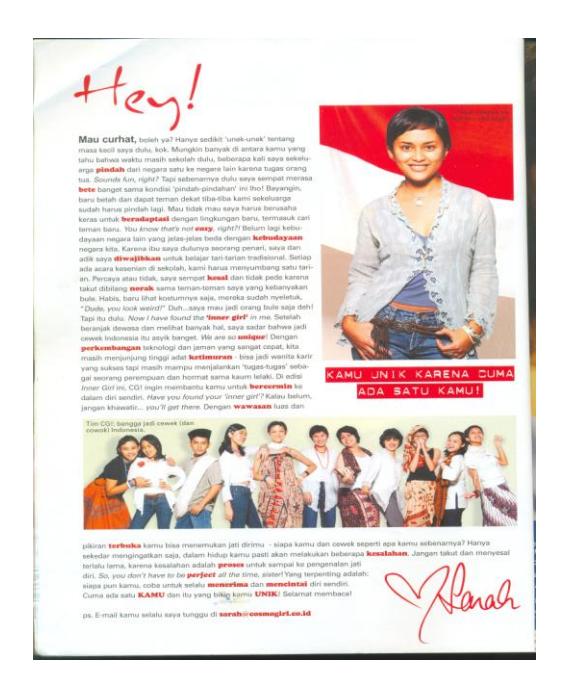
Even though, red and white are still used as part of the lay out for this August edition, compared to GADIS, ―Cosmo Girl‖s color choice shows less correlation to the historical red and white. Sechan, in close resemblance to Christina Millan at the cover, is positioned in front of a national flag. A striking similarity between Sechan's and Milan's outfit and pose, again, offered to readers the positional play in the hybrid nature of the message: a blend of local and global. Hybridity is evidenced from Sechan and Millan's poses, Sechan's outfit and the national flag background, outfits of ―Cosmo Girl‖ staff and the red words on the page. There is a foregrounding of Indonesian identity against a global backdrop.
Questions arise on Indonesia-ness taken up by ―Cosmo Girl‖ as it is evident that the most significant Indonesian aspect reinforced by this international magazine is the local values residing in the cultural artifacts such as clothing and accessories. As a unique local identity, kebaya, batik, peci and sarong are chosen as the unifying aspects for a pedagogic and performative discourse. To be Indonesian is to respect and appreciate unique culture artifacts of the country: Sechan's blouse and the staff's outfit in the group picture. Nevertheless, at another level, this stance also indicates the inferiority of these artifacts. Special emphasis on the pride of being Indonesian, repeated ‗reminders' that wearing ethnic outfits is cool are present throughout the magazine.
It is also worth reflecting the implicitly lower position of Indonesia-ness. ―Cewek Pribumi" will be a derogatory term in light of the colonization history of Indonesia. This is accentuated by a sub heading ―Gaya Cewek Indonesia asli tuh keren banget, lho!‖ A predisposition to give essential labels such as ―asli" or "pribumi" suggests the way of looking at an Indonesian construct as the ―they‖ rather than ―we‖, ―Other‖ rather than ―Self‖. This means that the Indonesian identity is fabricated in juxtaposition to another identity and – with reference to the editorial message from Sechan— this other identity is presumably the international/global identity implied by Sechan as the one who was brought up in various countries and learn later the significance of being Indonesian. These constructions of Indonesia with allusion to an aspect of Indonesian colonial history is repeated in the other page with the title ―Hidoep Aksesoris!" and its sub-heading ―Pernak-Pernik Pop dengan Kebaya, Ternyata Keren Juga Lho!‖. Similar
reading with the previous page title might come up with similar meaning, especially, when we take into considerations the use of words such as tuh and lho carry elements of surprise in them. Although there is the necessity to encourage the readers to wear ethnic outfits such as kebaya, the advice to combine the traditional and the popular and modern such as jeans is implying that kebaya, for example, on its own is not as attractive.
Both magazines have demonstrated their use of historical narratives as a means to participate and commemorate Indonesia's Independence Day. Colors with historical significance are deliberately used by ―GADIS‖ to establish a discourse on identity. The magazine picks up its symbolic meaning and makes it manifest in forms of fashion and achievement. Different from the choice made by GADIS, ―Cosmo Girl‖ chooses locality as the anchor for their identity discourse around the Independence Day. Nevertheless, this anchor is also projected into its pages of fashion, and juxtaposed to a global framework.
Beside GADIS and Cosmo Girl, the other magazine analyzed was the August 2003 edition of Hai which has boys as their market. This particular edition was chosen because of its special feature on nationalism. Again, like the other magazines, the colors red and white signifies the edition's Independence Day issue, and becomes the eye catching elements in each page. In the cover, they are used as borders and font colors.
The editorial page of Hai presents a poem on nationalism written by Indra. Using Jakartan colloquial language, Indra writes about when, how and why nationalism emerges. This is probably the question asked to Hai audience for the special feature on Nationalism in this edition.
Nasionalisme4
4 Nationalism
My nationalism arises when I am eating Indonesian food abroad.
My nationalism arises when I see Indonesian workers abused abroad. My nationalism arises when I watch the football national team play abroad (although they always lose and I become upset!)
My nationalism arises when Angelique Widjata beats a world class tennis player abroad.
My nationalism arises when I am assigned as an Indonesian delegate.
My nationalism arises when I watch an outdated foreign band, we have lots of good bands!
My nationalism arises when I see a Hai reporter as the only Indonesian reporter in a world class music festival. And there are still plenty of other things.
Happy birthday Indonesia. I pray that our generation can take care of you in the future.
Nasionalisme gue muncul kalo gue lagi makan masakan Indonesia di luar negeri.
Nasionalisme gue muncul kalo gue ngeliat TKI diperlakukan nggak senonoh di luar negeri.
Nasionalisme gue muncul kalo nonton Timnas PSSI bertanding di luar negeri (walaupun pada akhirnya selalu kalah dan gue jadi sebel!).
Nasionalisme gue muncul kalo ngeliat Angelique Widjaja menjungkalkan petenis kelas dunia di manca negara.
Nasionalisme gue muncul kalo disuruh menjadi wakil negara Indonesia di forum internasional. Nasionalisme gue muncul kalo ngeliat band asing yang penampilannya basi, abis Indonesia punya banyak band bagus sih!
Nasionalisme gue muncul kalo ngeliat wartawan Hai jadi satu-satunya wartawan Indonesia di festival musik kelas dunia.
Dan masih banyak lainnya.
Selamat ulang tahun Indonesia. Mudah-mudahan generasi kami bisa lebih mengurusmu di masa mendatang. (Indra)
In a similar perspective to Cosmo Girl, this poem delivers a positional play where Indonesian identity is repeatedly placed against an international/global backdrop: makan masakan Indonesia di luar negeri, TKI diperlakukan nggak senonoh di luar negeri, nonton Timnas PSSI
bertanding di luar negeri, ngeliat Angelique Widjaja
menjungkalkan petenis kelas dunia di manca Negara, etc. This positional play is also indicated in the following page:
The girl is a Singapore-born Indonesian who claims to love the lives in Jakarta and Paris. Here, the play between being Indonesian and international stresses the importance placed on putting Indonesianess within a global framework. The fact that she is half Indonesian and connected to cosmopolitan cities of the world signifies the present and significance of hybridity.
This positioning of Indonesia in a global framework also arises in the special features ―Nasionalisme versi Kita‖. A survey on 100 adolesencents was conducted asking what nationalism
meant for them. It is interesting to see the diversity of the responses, nevertheless these youngsters –like their magazine- tend to see nationalism in light of a global perspective. They felt stronger nationalism when Indonesia (or Indonesian people) achieves something at an international level. The survey also shows that the flag and the Independence Day celebration are the most frequent factors which can make them feel stronger nationalism.
Hai like the other two magazines uses historical narratives of the nation to establish the discourse on the nation. And, as evidenced from Hai's survey, it is indeed the colors of the flag which construct the most significant connection between the readers and the notion of nationalism in Independence Day. This historical symbol can then be appropriated to the advantage of the magazines. Pedagogical discourses need to intertwine with performativity to make room for the readers to make their own meaning of nationalism or their Indonesian identity.
DISCUSSION
Youth readers are assumed to need a sense of national identity. They are the future so that the idea of a nation should be invested on these readers. Or, quoting Giroux (1996, 10), ―...youth haunts adult society because it references our needs to be attentive to a future others will inherit.‖ Taking also Anderson's proposition, Edensor states that these investments might be generated from the print media such as these magazines.
Nevertheless, there is no denying that they are just part of the dissemiNation process of a nation.
In the framework of Bhabha's theoretical propositions, the youth readers are the objects of pedagogic discourses as evidenced from the deliberate use of red and white in each magazines. This type of discourse constitutes a major unifying signifier for the nation. For these adolescent readers, red and white are appropriated into varying performativities. GADIS keeps the historical meanings of the colors and adapts them into a more updated version of bravery and courage which is power and empowerment, whereas Cosmo Girl and Hai use the colors in a more subtle manner as a means to link the historical narrative with the needs of the particular Independence Day editions.
The choice to use colors as a link with the historical narrative of the nation creates the fissure between the pedagogic and performative. Along these fissures, the meanings for these colors multiply: the pedagogic meanings of bravery and courage of the past and the performativity of being in fashion, having power and being empowered, or using the colors as ornament for the text layout. This range of meanings construct a fluid concept of an on-going process for an Indonesian nation. In the world of the youth readers, a message is implied that a grounded meaning of bravery and courage can manifest in a variety of performativities. This also implies that to be part of the Indonesian nation means to identify with the meanings offered by these magazines.
The multiple meanings of color is not the only signifier for the nation. Cosmo Girl has chosen locality to signify the concept of a nation for their Independence Day edition. This has proven to be problematic because locality is so narrowed as to manifest only in ethnic fashion, in particular: sarong and kebaya. The problem is made complicated by the selected wordings which accompany them. The editor's choice of words has juxtaposed locality and globality (which is absent) and resulted in a sense of inferiority in part of the locals. On one hand, this use of locality might raise the young readers' interest in things which they might otherwise be looked down. On the other hand, the way the locality is textually framed constructs an Indonesian identity inferior to the absent identity which is the global or international identity. Indonesia here is identified from its exotic-ness which, in turn, has made it inferior to a global identity, a construct who has the capability to define what and which is exotic, or what and which is attractive.
This consequentially leads to the idea of positioning Indonesia in a global network. This idea sheds light on the likeliness of Indonesia as a commodity which might looked up in terms of being unique, exotic and attractive. The historical narratives present in the forms of words such as pribumi or hidoep associate the colonial aspect of the history and, from a postcolonial perspective, set up an appropriated meaning of some aspects of the colonized in a postcolonial world.
This is also strengthened by the repeated choice of the three magazines on individuals with some blends of local and global. The blends indicate the significance of hybridity in a modern Indonesian concept. Hybridity signals advantages in becoming more knowledgeable and powerful. The high achiever girls in GADIS, for example, are portrayed with some hints of hybrid identity similar to the hybrid outfits advised by Sarah Sechan in Cosmo Girl or Nessa as Cewek Hai. Hybridity, in these magazines, become the preferred identity for the dissemiNation of Indonesia.
These findings indicate that, in the dissemiNation of Indonesia, the idea of the Indonesian nation exists within a global framework which evidence the presence of two inextricably interlinked processes of globalization and nationalism. The positioning of Indonesian construction against the globalization, even though to a certain extent has commodified and thus belittling the Indonesia for the young audience, demonstrate how this global culture facilitates the unique identities of a nation to become acknowledged or gain acceptance from the readers. Such dissemiNation is proof of the pedagogic nature of performativity as well.
In the dissemiNation process, different aspects of the nation are selected in terms of their pedagogic relations or performativity. This has created tensions or fissures which indicate the dynamics of the double-writing of the nation to the youth readers. The concept/idea is negotiated in light of the aspects' utility, advantage or interest to various parties including readers, writers, publishers and corporates. The double writing also implies the positions made available for the youth readers in the discursive practices of the nation constructions and reconstructions.
END NOTES
In a globalized world like today, the place for the idea of a nation is indeed complicated. Nonetheless, the idea of a unified and coherent nation is as important as the acknowledgement of differences prevailing in the nation itself. The discourse which plays on these negotiated entities of being one and many should be more attended to.
I believe, the younger generation needs to made aware of this dynamism and to learn on the importance of handling the mixed messages in this media-saturated society. Instructional as well as informal interventions shall be of significant benefit for the youth and the society. Enabling skills and higher order thinking capabilities should be encouraged to improve for example media literacy. Subjects with possibilities of supporting and enhancing critical thinking skills such as Critical Pedagogy or Critical Literacy should be introduced and taught to those who will be involved with education.