

INTRODUCTION
Technological development leads to the changes in managing files managerial system within an organization. Every organization, both from the government, private, and even educational institution start using electronic files. Those files are archived in electronic media. Information technology allows the implementation of automatic and digitization archives as information management. These automatic and digitization files may help the manager to manage files effectively and efficiently.
For higher education institutions, information systems technology has become the need to support educational process. Information technology usage is needed to improve efficiency and productivity for educational management at colleges (Agustiani, 2010:1).
Telkom Institute of Management is one of private university where it uses information technology system in academic field. It applied by developing web-based academic information system. Web-based academic information system is built to manage archives and organized integrated academic data file. The purpose of this system is to serve students, lecturers, staff or stakeholder quickly, precisely and accurately.
Based on the explanation above, it can be seen that web-based information technology usage, especially in the field of academic field at Communication Department of Telkom Institute of Management, takes an important role in terms of services quality to the students. Web-based academic information system can create management performance and academic service. Ideally, it can create work efficiency and effectivity of academic performance and services.
The purpose of this study is to determine how the application of webbased academic information system effect to academic service at Communication Department of Telkom Institute of
Management. Furthermore, it is done to find out the extend of web-based academic information system effect to academic services quality variable.
RESEARCH PROBLEMS
Based on the background above, the writers formulate the problems into:
- a. How are the perceptions of Communication Department students in Telkom Institute of Management to web-based academic information system?
- b. How are the perceptions of Communication Department students in Telkom Institute of Management to academic services quality?
- c. How extent is the effect of web-based academic information system at Communication Department to academic services quality of Communication Department in Telkom Institute of Management?
THEORETICAL FOUNDATION
A. Information systems
Information systems can be defined as man-made system which consist of organization components to reach one goal of presenting information (Ladjamudin, 2005:13). According to Karya (2004:1), information system is a set of interrelated components that collect, process, store and distribute information to support decision making and organization controlling. Leitch & Davis in Jogiyanto (2005:11) state that the information system is a system within an organization that brings the need for daily transaction processing, support operations, managerial goal strategic and provide certain required reports .
B. Academic Information Systems
Basically, academic information system can be defined as a system in an academic institution that provide, process, store and distribute data and information to support operational activities and help to meet the goals.
Web-based academic information system is not only information resources at campus, it can also be used communication media between lecturers and students, students and students, lecturers and lecturers and campus officials in the campus. By using internet technology, communication activities can be carried outide the campus and as long as it powered by computer or other media devices. Online academic information system is a web-based information system that aims to establish knowledge based system which can be accessed by the internet. The examples are as follow: (Arifin, 2002: 154):
- a. News, contains of the latest information issued by educational institutions and technology information from the news sources.
- b. Education, contains of information related to the courses from educational institution, like curriculum, Lectures course Unit (SAP), lecturer, field study, Job Training, final work and research.
- c. Community, contains of communities in educational institutions which inform the academic events about staff, students, alumni, bulletins and so on.
- d. Personal data, contains of information related to students activity as follow;
- 1) Card Plan Study in accordance with the programmed course that has been programmed in one semester
- 2) Card Result Study to find out the results that have been achieved during the course and performances index
- e. Course Schedule, contains of schedules, student activities, lecturer schedule monitoring, and the amount of lecturers attendance
- f. Library, contains of information about book through online catalog
- g. Electronic Mail (E-mail), this facility is used to send and receive mail discussion messages at once among students, lecturers and employees in educational institutions.
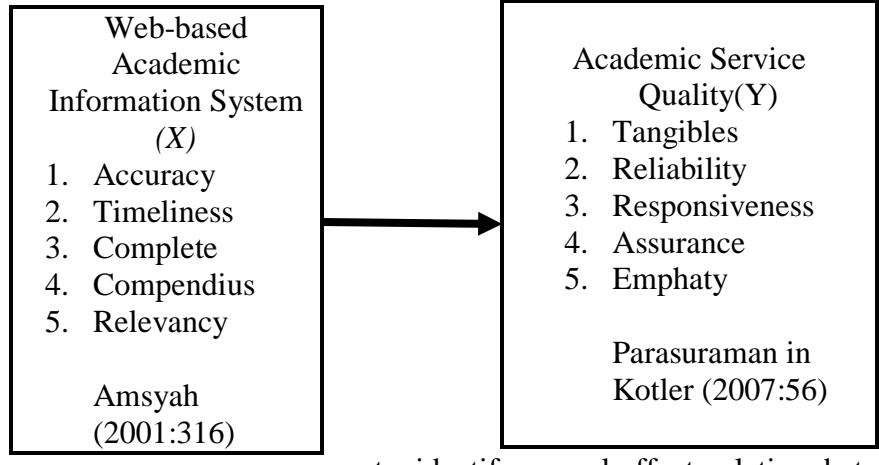
The quality of academic information system can be determined by several factors (Amsyah, 2001:316):
1. Accuracy
It means that information should be free from the errors, no bias and should not mislead. The errors can be happened by miscalculating or other damageable noises.
2. Timeliness
Information should be presented on time because it becomes a fundamental aspect in decision making. Delay information will lead to misinterpret in decision-making.
3. Completeness
Incomplete information creates the delay in decision-making
1. Compendius
Valuable information is concise and direct information to the required target
2. Relevancy
Information should be appropriate with the purposes and goals.
Those factors used as the indicator to measure the quality characteristics of academic information system at Communication Department-Telkom Institute of Management.
C. Quality of Service
Quality of service is an effort to fulfill the need of customer and accuracy to compensate customer expectations (Tjiptono, 2006:59). Oliver (1980) and Bolton and Drew (1991) in management research (2010:2) defines quality of service as the difference between actual service performance and expectation. This concept is called `The Disconfirmation of Expectations Model 'which states that the response of satisfaction / dissatisfaction is the result of the cognitive evaluation process between performance expectation /product experience before buying the product compared to the results of the performance / product experience after the product is consumed. The result of this comparison is called the expectancy disconfirmation, which varies between negative (expectation exceed the actual result), zero (expectations smilar with the actual result) to positive ( actual results exceed expectations)
Parasuraman et al, 1990 (in Kotler, 2007:56) concludes that there are five dimensions of service quality, known as Service Quality (ServQual). It is used to measure the quality of services:
- 1. Tangibles, or physical evidence. It is the ability to demonstrate its existence to external parties. Company appearance and physical infrastructure capabilities are proves to give the comfort by service provider.
- 2. Reliability, or the reliability of the company's ability to deliver as promised services accurately and reliably.
- 3. Responsiveness is a willingness to help and provide responsiveness service and precise to deliver clear information to the customer.
- 4. Assurance and certainty is knowledge, courtesy, and the ability of company employees to foster trust to the company.
- 5. Empathy, provides genuine attention and individual personal nature to customer desires. This research aimed to find the effectiveness of academic information system online usage to academic service quality. The framework in this study can be described as follows:
Figure 1.Framework
RESEARCH METHOD
This type of research includes causal research. It is a research conducted to identify causal-effect relation between variables. The nature of this study is quantitative. In this study, the writers use operational variables as follows:
a. Variable X; Online Academic Information system
b. Variable Y; Academic Quality Service The population in this study is all Communication Department student class of 2010 generation where the population number around 192 students. As for the sampling techniques, the writer uses simple random sampling technique. The sample taking use Slovin formula :
significant level at 0.05 192 n = _________ = 130
\[n = \frac{192}{1 + 192 (0.05)^2} = 130\]
By using Slovin formula, the number of samples in this research is determined into 130 students. The data analysis techniques use simple regression analysis.
Calculation sample using Slovin formula by the number of permanent employee and
RESULT AND DISCUSSION
The average percentage of web-based academic information system can be seen in the following figure:
Note:
n = Minimum Sample Measure
N = Population Measure
Α = Significant Level
Figure 2.Percentage of Web-Based Academic Information System

Based on Figure 2, it can be explained that a web-based cademic information system at Communication Department Telkom Institute of Management accordance to student perceptions stated at 'good' category.
While the percentage of academic service quality can be seen in the following figure:
Figure 3. The percentage of academic service quality
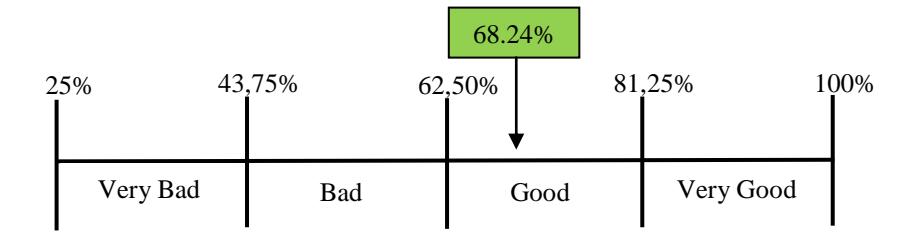
Based on Figure 3, it can be explained that the level of academic quality service at Communication Department Telkom Institute of Management accordance to student perceptions are in 'good' zone.
To see the effect of web-based academic information system (X) to academic quality service (Y) can be seen by the results of model summary calculation, particularly at R Square in the following table:
Table 1. The result of R 2 test
| Std. Error | ||||
|---|---|---|---|---|
| Mode | Adjusted | of the | ||
| l | R | R Square | R Square | Estimate |
| 1 | .891(a) | .329 | .777 | .25983 |
a Predictors: (Constant), X1
The amount of R-square (R2) is 0.329 used to calculate the extent of variable X to Y by calculating Coefficient of Determination (CD) using the following formula:
KD = R2 X 100% = 0329 x 100% = 32.9% This figure means that the effect of Academic information system online(X), the academic quality services (Y) is 32.9%. In addition, the remaining amount is (100% - 32.9%) = 67.1% from out of this research.
CONCLUSIONS AND SUGGESTION
A. Conclusion
Based on the research result, it can be seen and concluded that:
- 1. Web-based academic information system at Communication Department of Telkom Institute of Management based on student perception as the user is in 'good' category.
- 2. The academic quality services at Communication Department of Telkom Institute of Management based on student perception as service recipients is in 'good' category.
- 3. Web-based academic information system at Communication Department of Telkom Institute of Management effects to academic quality service of 32.9%.
B. Suggestion
- 1. It needs another maximal improvement for comprehending the web-based academic information system, so that it will be easier to be accessed by all academic staffs and the students.
- 2. It needs service excellence training for the staff at the secretariat of Communication Department office, in order to improve the quality of service.