

ABSTRAK
Tren dalam desain dipengaruhi oleh berbagai faktor, seperti peristiwa dunia, situasi ekonomi, pengaruh subbudaya, atau perubahan sosial. Tren juga muncul sebagai respons terhadap kondisi lingkungan secara global. Salah satu tren dalam menanggapi kondisi lingkungan alam adalah munculnya gerakan desain yang berkelanjutan. Dalam gerakan tekstil, hal ini juga ditemukan dalam bentuk tren eko-tekstil, yang diinisialisasi dengan penggunaan bahan-bahan alami dan bahan pendukung lainnya, yang memiliki dampak minimal terhadap lingkungan. Batik pesisiran adalah salah satu tradisi tekstil di Indonesia yang memiliki nilai estetika tinggi. Dua aspek pembentuknya adalah dekoratif dan warna. Warna-warna pada batik saat ini sebagian besar dihasilkan dari pewarna sintetis, menyebabkan dampak negatif pada lingkungan dan juga manusia yang terlibat dalam proses pembuatan tekstil. Penelitian ini bertujuan untuk memetakan dan mengubah skema pewarna sintetis menjadi skema pewarna alami untuk dimanfaatkan oleh perajin lokal Kabupaten Batang, yang terletak di Pantai Pesisir Utara, dalam memproduksi desain ramah lingkungan dan kain batik. Persamaan warna batik Batang dipilih sebagai objek studi dari begitu banyak batik pesisiran, yang biasanya diwarnai dengan pewarna sintetis. Keuntungan dari penelitian ini adalah untuk membuat rekomendasi pewarna alam yang dapat dimanfaatkan pengrajin lokal untuk menghasilkan batik Batang yang ramah lingkungan.
Kata Kunci: batik batang, pemetaan, pewarna alami, tren
INTRODUCTION
The movement and progress of a nation or society can be measured for the changes that take place in it. "Trend" is a term originally known in economic, mathematical, and statistical terminology, but is now a benchmark of quantification used to measure things that are considered immeasurable, such as taste, lifestyle, and recurring habits of a group of humans. The trend generally applies objectively, although in this case, the tastes and likes of many people are taken into consideration. However, trends commonly capture phenomena, so that what is "preferred" or "favored" is applicable to many people (Frings, 1987). In addition to photographing the visual culture, trend considers various factors such as world events, economic situation, sub-culture influences, social change, and it can even emerge as a response to global environmental conditions.
In the late 1990s and early 2000s, there was a state of environmental terror that began with increasing global warming followed by other natural hazards such as deforestation, seawater pollution, and so on. These conditions have led a variety of reactions. In the field of design, a trend is called sustainable design emerged. This design sought to reduce the negative impact of a production process on the environment, create a healthy workplace and comfortable, reduce the use of materials that can pollute the environment, and create a healthy and productive environment (Ratuannisa, 2016).
In Indonesia, which is rich in various traditions, one of which is in textile making, the application of sustainable and environmentally friendly principles is not new since most of the traditional textile making process in Indonesia considers that principle. In the process of making tradition textile, there is a colour element that has an aesthetically dominant role. The colour that is owned by traditional textiles is an identity of an area, which is also able to represent natural wealth, natural conditions, and other demographic characteristics of a region. The importance of colour elements, especially the natural colour that is owned by traditional textiles in Indonesia, leads to the idea of research on the natural colour, especially from traditional textiles, with a case study of batik in the north coast of Central Java, focusing on batik in Batang Regency. Batik was chosen as the initial sample because batik owned by each region represents the culture in the area, not
only what is visually visible but also the uniqueness of the area such as soil contour, climatic conditions, cultivation habits, and other unique habits .
One of the batik centres on the north coast of Central Java is Batang Regency, which is located in the east of batik town of Pekalongan. Since a long time ago, Batang has served as one of the supporting areas of batik industry through the supply of workers and as a place of batik production that is marketed or ordered by merchants from Pekalongan. Nevertheless, batik Batang is recognized to have unique design characteristics (decoration and colour) compared with the design of batik produced from Pekalongan. The design of batik of Pekalongan is generally known to grow and develop under the influence of foreign cultures' style and adaptation (e.g., China, Japan, Saudi Arabia, and Europe), while the design of batik Batang is only slightly influenced by foreign cultures.
Generally, batik centres in Batang are divided into three areas representing three visual styles, which are: 1) Proyonanggan, which is the centre of batik tulis (then) and batik cap (now), with a classical style of keratonan sogan kasaran that resembles the style of Wonogiren (a suburb of Yogyakarta); 2) Denasri, including Masin, which is the centre of batik artisans with the style of batik tulis pesisiran halusan with various colours and buketan motifs; and 3) Kalipucang Wetan, which has its own distinctive style called batik tiga negeri rifa'iyahan, with the technique of batik tulis halusan tiga negeri. Those three styles of batik in Batang were recorded in the 2012 Batik Training and Exhibition Report: Batik Craft Centre Development in Batang Regency-Central Java (Kahdar, et al., 2012).
Those three centres of batik also have distinctive significances based on the colour schemes listed on the design of batik fabrics. Unique colours in the three centres can be concluded as the unique colours of batik Batang and then the unique colour schemes of batik Batang are converted into the colour schemes based on the natural dyes. The conversion of synthetic dye schemes to natural dye schemes is expected to be an alternative design with the environmentally friendly spirit for batik artisans in Batang Regency. The colour equivalence is necessary since the slow fashion trend in the world of design, which is used by utilizing the widest potential of nature, producing more environmentally friendly products. In addition, it intends to explore the distinctive potential of Batang through the role of batik and its colours in order to raise the confidence and to be able to compete independently in batik design market at national and international level.
METHOD
This research combines the quantitative and qualitative methods that can be seen in the triangulation suggested by Martin Raymond (2010), who states that quantitative and qualitative approaches are in the following positions in figure 1.
The quantitative data were obtained through field observation by

Figure 1 Cultural triangulation of The Future Laboratory and research designs (Raymond, 2010)
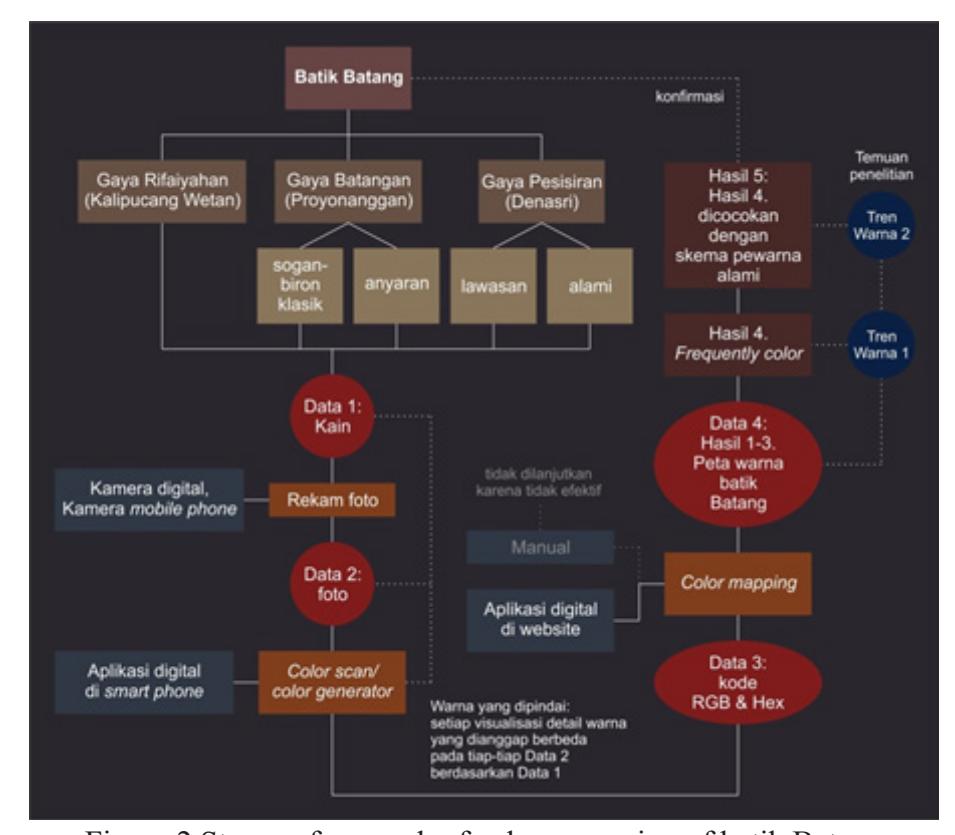
Figure 2 Stages of research of colour mapping of batik Batang
performing visual colour collection work on fabrics owned by community of artisans in three batik centres in Batang Regency. The qualitative data were obtained by ethnographic approach because it is motivated by the needs to find demographic and psychosocial factors.
Figure 2 presents how the research stages in colour mapping of batik Batang was done on three centres (three styles), which are: rifaiyahan style (done in Kalipucang Wetan area), batangan style (done in Proyonanggan area) and pesisiran style (done in Denasri area). The first data were obtained from the recording of images using digital camera and mobile phone camera. The second data in the form of images were obtained with digital applications on a smartphone in the form of colour scans and colour generators. The third data are RGB & Hex codes which then become the main data in the process, obtained from colour mapping process using digital application on a website. The fourth data of batik Batang's colour was mapped based on the emergence of frequently appearing colour considered as colour trend 1, and drew the concluding the colour trend 2 by doing the colour conversion of the fourth result to the natural dye. The third and fourth results are also considered as research findings.
RESULT AND DISCUSSIONS
Batik is a fabric of Indonesian cultural heritage that has two dimensions: visible dimension and invisible dimension, or in UNESCO terms: tangible and intangible. UNESCO shows that 19 out of 23 provinces in Indonesia use batik fabric as a daily garment that is commonly used as baby carrier in traditional and modern wedding ceremonies, and as a covering of corpses in the procession of death; 22 out of 23 provinces in Indonesia have unique
patterns, motifs, and design of decoration as the indicators of how diverse the visual style of batik decoration in Indonesia; and 18 out of 23 provinces in Indonesia have their own production workshop in each province (Tresnadi, et al., 2015). The first dimension of batik includes the visible parts or visual appearances of the fabric, which are colour, decoration, composition, and another impression that can be captured thereof. The second dimension is the invisible part or the contents of the fabric, which can be a message, meaning, or a variety of stories allegedly related to the fabric making process.
The research activity began with the collection of visual data in the form of existing colours, commonly used colours, and colours considered to be the unique identity of batik, which was done directly in three centres of batik centres in Batang Regency by collecting the fabrics, photographing the fabrics, photographing the environment, doing the observation, and conducting an initial interview to batik artisan. The photos of the fabrics became the primary data in this study. The photos have their colours sampled in detail, usually one fabric can produce 3-7 colour details. Then, the colour details have their colour values identified according to RGB and HEX coding systems by utilizing digital applications on smartphone. At this stage, the collection of colour details was very large and randomly arranged, so at this stage the data could generate assumptions to find out the distinctive impression of the colours of each style, but the main and definite conclusions had not been drawn yet.
Figure 3 shows a significantly different impression between the styles and centres of batik in Batang Regency. Generally, it can be concluded that rifaiyahan style produces many colours that are close to red or brown, batangan
style produces many colours that are close to blue, and pesisiran style produces many colours that are close to brown and blue. Specifically the colour closeness cannot get its colour value determined yet to find out its exact codes such as the intensity of red colour values on rifaiyahan style or the intensity of blue colour values on pesisiran style. Thus, further work needs to be done to process the colour collection data by placing the colours in the colour wheel to be mapped.
The mapping was done by placing or inputting the RGB or HEX code of each colour detail that has been generated in Figure 2 to the website-based software that specifically provides colour wheel generator. Each inputted RGB code or HEX code showed its position in the colour wheel automatically. Unfortunately, there was only one code in each data input. Then, the next step was to record interface (screen capture) manually. Once everything is collected then the interface record data were arranged in a single transparent layer of the image editing software. The transparent layer would display the distribution of data in the form of dots/areas of colour detail location that had been inputted. The data have been legitimately said to be the results of the initial mapping.
The initial mapping data needed to be reprocessed to see the most frequently used colours by identifying the darkest areas caused by the stacking of colour details. The darker colour means the it appears more often or is used by each batik centre. The most frequently used colour shows the actual trend for the typical colour of each batik centre in Batang Regency. The result of colour mapping of each batik centre is presented in Figure 4, which can be described in the matrix of Table I.
shows the result that the colour trends in the three batik centres in Batang Regency can be summarized as follows:
1. Batik rifaiyahan's style tended to be dominated by purplish red colour with saturation that tended to be dark. The colour trends of rifaiyahan batik could be represented by twelve colours (see the conclusion of the colour schemes in Figure 4) consisting of four primary colours (see the first line of the colour schemes) with each having two colour
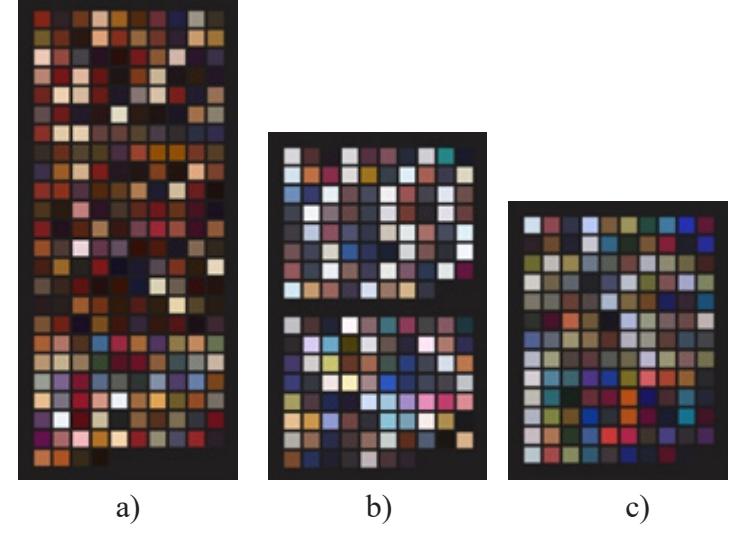
Figure 3 Detailed collections of colours produced at the initial identification stage of the fabrics into digital data: a) batik rifaiyahan of Kalipucang Wetan, b) batik batangan of Proyonanggan, c) batik pesisiran of Denasri
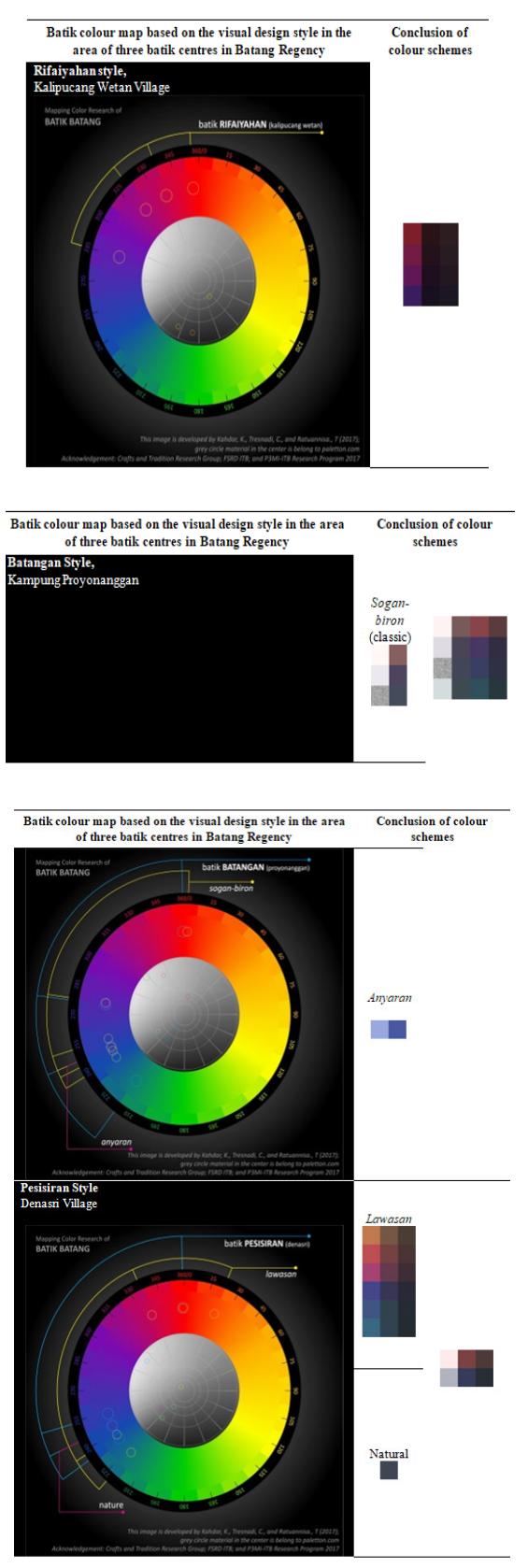
Figure 4 Conclusion and visualization differences of colour maps based on the most frequently used colour characteristics of the three styles of batik in Batang Regency
TABLE I RESULTS OF TRENDS OF COLOUR MAPPING OF THREE BATIK CENTRES IN BATANG REGENCY IN 2017 BASED ON THE MOST FREQUENTLY USED COLOUR APPROACH
| Styles of Batik Batang | ||||||||||
|---|---|---|---|---|---|---|---|---|---|---|
| Colour Tendency | rifaiyahan | batangan | pesisiran | |||||||
| sogan- biron | anyaran | lawasan | natural | |||||||
| colours | red | 315°- | 360° | 360° | 360° | 360° | ||||
| purple | 360° | 338° | ||||||||
| Ä | indigo | 285° | 218°- | 278° | ||||||
| value domination | blue | 278° | 218°- 255° | 248° | 235°- 255° | 220°- 240° | 248° | |||
| green | ||||||||||
| yellow | ||||||||||
| orange | 23° | |||||||||
| saturation | bright | |||||||||
| moderate | ||||||||||
| dark | ||||||||||
alternatives based on their saturation value (see the second and following columns) .
- 2. Batik batangan's style tended to be dominated by indigo blue colour with saturation that tended to be quite dark. The colour trends of batik batangan could be represented by fifteen colours (one colour was eliminated for having similarities with another) consisting of four main colours with each having three colour alternatives based on their saturation value.
- 3. Batik pesisiran's style tended to be dominated by blue colour with saturation that tended to be quite dark. The colour trends of pesisiran batik could be represented through nine colours consisting of two main colours with each having three colour alternatives based on their saturation value
From the three points above, it can be interpreted that the colour trends in the three centres or styles of batik in Batang
Regency consist of two colour trends. Only rifaiyahan centre and style were dominated by colour trends that tended to be dark red and the other two styles (batangan and pesisiran) were dominated by the trend of blue colour that was quite dark, with indigoish-purple colour as the companion.
The findings of the dominan tendency of these colours were still in the form of trend representation in each style or centre of batik. In other words, so far, it cannot be said to represent the trend (characteristic or unique identity) of batik Batang's colour (in Batang Regency) as a whole. Thus, the next step was to identify (the same techniques that have been done before) using the combined data source of the overall colour detail of batik rifaiyahan, batangan, and pesisiran styles. The results of the combined colour approach can then be expressed as the trend of batik Batang. The results of the most frequently used colours are presented in Figure 5.
Figure 5 shows that the colour trend in batik Batang in Batang Regency based on the mapping with the most frequently used colour approach can be described in the matrix of Table II.
Table II shows the result that colour trend in batik Batang in Batang Regency can be summarized as follows:
- 1. Tended to be dominated by indigoish red and orangish red with saturation that tended to be dark.
- 2. Was rather dominated by indigoish blue colour with the saturation that tended to be dark.
- 3. Supported by indigo colour with saturation that tended to be dark.
- 4. The colour trend of batik Batangan could be represented through thirty colours consisting of six primary colours with each having four colour alternatives based on their saturation value (see the conclusion of the colour
schemes in Figure 5).
From the four points from table II, it can be interpreted that the colour trends of batik Batang in Batang Regency consist of two dominant colour trends: rather red (towards purple and orange) and rather blue (towards indigo). Both trends have saturation that tend to be dark, and the appearance of indigoish colour as the companion.
The thirty colour items in the colour schemes of batik Batang are listed in Figure 5, which were then processed as the data to design the mood board that is commonly used as a colour trend guide in fashion and style. The mood board design was divided into two categories: the category based on the six main colours in the colour schemes of batik Batang (seen line by line) and the category based on the five primary colour alternatives (seen column by column), which can be seen in the illustration of the mood board
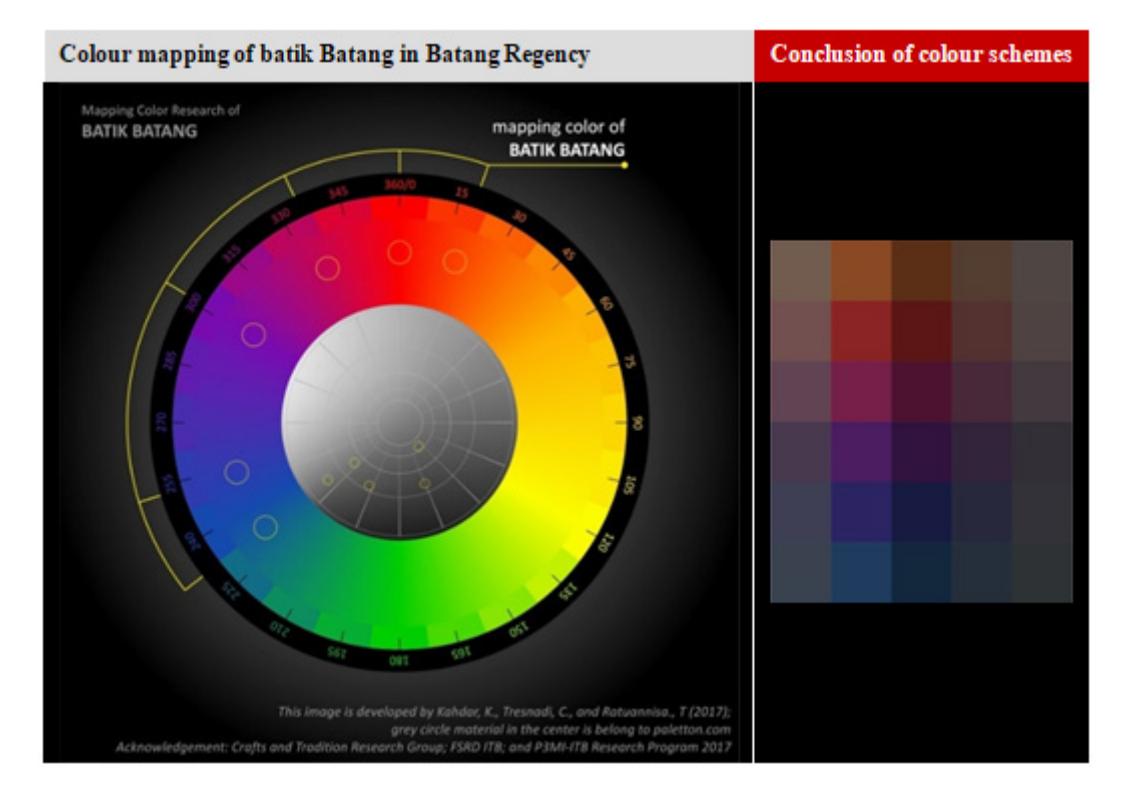
Figure 5 The results of conclusion and visualization of the final map and colour schemes of batik Batang in Batang Regency in 2017 based on the most frequently used colour approach
TABLE II THE RESULTS OF THE COLOUR MAPPING TENDENCY OF BATIK BATANG IN BATANG REGENCY IN 2017 BASED ON THE MOST FREQUENTLY USED COLOUR APPROACH
| Colour Ter | ndency | Styles of Batik Batang | ||||
|---|---|---|---|---|---|---|
| Colours | Red | 2200 2600 | ||||
| Purple | 330°-360° | |||||
| u G | Indigo | 300° | ||||
| V alue dominatiion | Blue | 232°-255° | ||||
| Green | ||||||
| Yellow | ||||||
| Orange | 20° | |||||
| Saturation | Bright | |||||
| Moderate | ||||||
| Dark | ||||||
| in | information: black cells = dominant colours | |||||
TABLE III THE CONVERSION RESULT OF THE COLOUR SCHEMES OF BATIK BATANG WITH NATURAL DYES
| Colours of Batik | Natural dyes | Mordants | Dyeing method | Colours of Batik | Natural dyes | Mordants | Dyeing method |
|---|---|---|---|---|---|---|---|
| Mangosteen peel | lotus | cold | - | ||||
| without fixation | - hot | ||||||
| calcium oxide | - | - | |||||
| Mangosteen peel cherry leaves | lotus | ||||||
| cold | cherry leaves | lotus | |||||
| teak tree (wet leaves) | calcium oxide | indigo | iotus | cold | |||
| Indian | alum | hot | indigo + brown sugar | lime betel | |||
| redwood | indigo | lotus | |||||
| teak tree (wet leaves) | calcium oxide | - cold | |||||
| cherry leaves | lotus | cherry leaves | |||||
| blackberry | citron | hot | indigo | ||||
| indigo + brown sugar | lime betel | ||||||
| , | gambier | \(FeSO_4\) | |||||
| cherry leaves | lotus | cold | |||||
design in Figure 6.
The last research activity was to convert all items in the colour schemes of batik stem into the natural dyes based colouring area. The process of colour scheme conversion was done by matching the prints of each colour on the white paper with a colour catalog of the natural dyes. The catalog used contained various colour visual samples, natural dye specifications, mordant ingredients, and dyeing methods resulting from academic
experiments at the Laboratory of Natural Fiber and Colouring under the program of Textile Craft Study Program of FSRD ITB. The conversion process was done by manual observation techniques using visual sensory in bright areas and was sustained by the ability and experience of the research team in the colour and design areas. The conversion results can be seen in Table III.
There are data left empty in Table III, which are lines in purple. In particular, the research team has not yet found a natural dye material to produce the purple colour as in the colour schemes of batik. However, theoretically, purple is a secondary colour of red and blue. Then, producing unique purple colour of batik Batang can be done by mixing the immersion of red and then overwriting it with blue or vice versa by noticing the colour guidelines.
The conversion data of the colour
schemes of batik Batang to natural dye in Table III can be summarized as follows:
- 1. In general, the colour of Batik Batang could be created by natural dyes found in plants from mangosteen peels, Indian redwood, blackberry, indigo, and gambier with various mixtures of mordant (lotus, citron, and FeSO4), and different dyeing methods (hot and cold);
- 2. The natural dyeing and mordant materials mentioned above are natural dyes which were available in traditional markets and modern markets both around Batang Regency and other areas;
- 3. The aforementioned natural dyeing and mordant materials were believed to be frequently used in training practices and in natural dyeing production practices in textile dyeing centres (both weaving and batik producing) in Indonesia (e.g. Bandung, Jakarta, Cirebon, Pekalongan, Yogyakarta, Solo, Madura, Lasem, and outside Java).
The design of mood board based on six main colours (designed by Rachmadina)
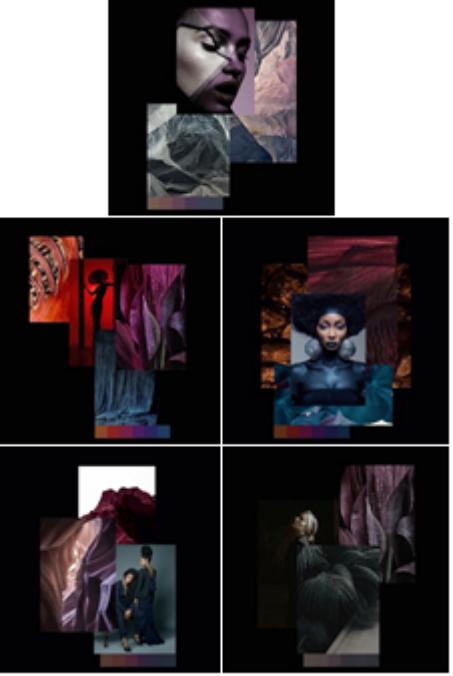
The design of mood board based on five alternatives of main colours seen from the saturation value (designed by Rachmadina)
Figure 6 The visualization of colour trend guide through mood board design based on the application of colour schemes of batik Batang 4. The data in Table III can be used as a recommendation and a design guide in terms of using natural dyes for the creative process of batik Batang's design in Batang Regency and also in batik craft centres in other areas. It can also be used as a guide in the area of art, design, and craft development with special topics related to the specific potential or related to the colour characteristics of Batang Regency.
CONCLUSION
A comprehensive study in mapping the natural colours of textiles on the north coast of Central Java with a case study of batik dyeing in Batang Regency generally yields some important data:
- 1. The data of colour were collected from three styles (rifaiyahan, batangan, and pesisiran styles) and batik centres in Batang Regency (Kalipucang Wetan, Proyonanggan, and Denasri);
- 2. RGB and HEX code data attached to point 1 were collected and compiled;
- 3. The collection of three visualization maps and colour schemes were based on the three styles (rifaiyahan, batangan, and pesisiran styles) and the final conclusion of the map and colour schemes of batik Batang.
- 4. A mood board design as a simulation of colour trend of batik Batang was established.
- 5. The conversion data of Batik Batang colour schemes to natural dyes was collected.
The results of the research has generally been re-confirmed to the figures' and the artisans' community in Batang Regency and has received a satisfactory response. Although some are considered inappropriate because of the experience differences and perceptions of the resulting colour visualization, the researchers found the difference is not very significant. However, in order to know the significance, further research
needs to be conducted with quantitative methods, which test the perception of artisans or communities in Batang Regency.
In general, the results of the research can be said as successful and in accordance with the expectations and objectives of the study. The results can be said as the guidance of the unique identity of the colours for the centres and style and for the batik community in Batang Regency. Generally, the outcomes can be said as containing the motivation of batik's unique colour trends of Batang, and can be used for colours in art, design, and crafts. Specifically, it can also be applied for those who use synthetic dyes and for those wishing to substitute it with natural dyes. This research can be used and applied to other styles and textile craft centres in Indonesia to preserve Indonesian traditional design and culture. This study can be continued later in the study area that identified the specific colour's meaning based on the design, social, and cultural aspects. Thus, future designs can refer to these research outcomes to address design challenges to sustainability and green design phenomena that are friendly to nature and environment, are unique, and have high-power businesses.
ACKNOWLEDGMENT
This paper is an effort to publicize the results of research in ITB Research Program, Community Service, and Innovation (P3MI) in the period of 2017 under the coordination of Craft and Tradition Expertise Group, Faculty of Art and Design, Institut Teknologi Bandung.