

ABSTRAK
Toda adalah masyarakat pastoral kuno yang tinggal di daerah dataran tinggi Gunung Nilgiri di Tamil Nadu, India. Perempuan Toda membuat bordir yang sangat bagus dan rumit, serta menjaganya sebagai keunikan budaya masyarakat Toda. Gaya bordir distrik ini secara lokal dikenal sebagai "Pugur" atau "Pukhoor". Pada studi terbaru, upaya telah dilakukan untuk melestarikan dan menghidupkan kembali kerajinan ini dengan fokus pada pendokumentasian, penciptaan kesadaran umum, dan peningkatan kapasitas perajin. Intervensi telah direncanakan untuk menghidupkan kembali dan melestarikan kerajinan tradisional dari komunitas ini. Sebuah video tentang kerajinan suku Toda telah dibuat untuk memperkenalkan kerajinan ini kepada khalayak untuk meningkatkan kesadaran masyarakat tentang kerajinan yang disebarkan melalui media sosial dan sesi-sesi pemutaran video. Katalog motif atau desain juga telah disiapkan untuk digunakan para perajin dan desainer. Selain itu, ditemukan bahwa pendidikan untuk para perajin di tingkat lokal adalah model yang paling efektif karena berfokus pada pendidikan secara menyeluruh kepada perajin. Dengan demikian, garis pakaian dirancang untuk pria, wanita, dan anak-anak, dan desain tata letak diberikan kepada perajin untuk memahami penempatan pola bordir.
Kata Kunci: kesukuan, toda, pugur/pukhoor, poothkuli, kebangkitan
INTRODUCTION
As long as human beings have subsisted, they required covering their body. Clothing is one of the three primary needs of humankind, the other two being food and shelter. It is not only developed for protection, modesty, and adornment but also acts as a medium of expressing art. Various techniques have been carried out for the formation as well as for adornment of fabric. Embroidery is one such technique which has been carried out by the human beings since the ancient era which made the rich Indian textile famous for two millennia.
Bhatnagar (2004) mentions that there is a fundamental unity, not only in the craftsmanship of stitch but also in the choice of designs and the colors utilized. Each region naturally has its modes influenced by its particular environmental conditions, customs, and history.
The hand-embroidery in India has kept alive many art forms that would otherwise possibly have got lost in time. The artists give expression to the beauty of life around them by creating the surrounding on threads and thus bringing out the many untold tales of love and affection.
Embroidery can be classified as folk, tribal, court and it can also be the one executed by artisans in their workshops for commercial use for earning monetary benefits. This group of embroidery is known as Trade embroidery (Bhatia,2013). Out of all the forms, Tribal Embroidery is a unique style. It is performed by women of various pastoral tribes. Their imagination and thoughts remained undamaged by urbanized lifestyles connect up with a world that flutters with life and spontaneous liveliness which is unknown to the professionals. It emphasizes bright colors and simple motifs. They are often done freehand, with no signs of being marked or necessarily symmetrical. The articles made out of them are for their own personal use, not for the commercial purpose. The use of this type of embroidery is only limited to their communities.
The Toda is a prominent tribe of the Nilgiris (Blue Mountains), which forms a part of the Western Ghats in western Tamil Nadu, Karnataka and Kerala states of South India. The history and origin of the Toda are not clear. They believe that they were created along with their buffaloes by their goddess "Thekershi". Some people believe that the Todas are originally Mediterranean people who were either Greeks or Cretan and who happened to come to India at a very early stage and settled down in the Nilgris. Research has shown some common Greek words used by the Todas. The general opinion is that from their dress and other factors some relationship exists with the Greeks (Doshi,1997). They live in their barrel-shaped huts. A collection of these forms, a small settlement called Mund. Toda settlements are found on pastoral lands (Chabbra,1999). A typical Toda village comprises of few huts, a dairy building and at least one buffalo pen (Dhamija,2004). Their costume consists of a very long piece of thick white cloth which is woven with black and red stripes at the end filled with highly decorative embroidery (Chattopadhyay,1977). Both men and women wear the same dress. Today the tribal embroideries are amidst of an identity crisis as their art of tradition are threatened because the beliefs and values that inhibited and sustained them are crumbling. The study "REVIVAL OF TODA EMBROIDERY- Needlecraft of Nilgiris" is an attempt to conserve and preserve this exquisite traditional embroidery with the focus on craft revival with the focus on documentation, creating general awareness, training, and capacity building of the artisans to create a value of the embroidery. Revival of craft can be achieved through healthy growth in market of the product. Thus, the present study has been planned with the following objectives:
- 1. To document the embroidery of Toda community with respect to technique, material, color, designs, and motifs used in it.
- 2. To plan an Intervention to revive the craft for sustainability of Toda embroidery through preparation of motif catalog, design development and clothing layout
- 3. To prepare a video document on Toda embroidery of Nilgiris to create awareness.
METHOD
The present study aimed to identify the original features of craft and the changes that had taken place to revive the craft in its conventional form and character. The following methodology was used to achieve the objectives of the study.
Area of study: According to the review of the literature, there are about 60 Toda settlements settled in the Nilgiri District. According to the 1994 report from the Tribal Research
center, the Todas have occupied 54 settlements in Ootacamund consisting of 219 households, five settlements in Kotagiri consisting of 23 households and one settlement in Coonoor consisting of 7 households. The study was limited to the settlement residing in and around Ootacamund town of Nilgiris district.
Sample selection: A sample size of 32 Toda artisan were chosen from the Ootacamund region. The sample size solely included Toda women who have been practicing this embroidery for at least 8-10 years and from the age range of 25-75 years. This homogeneity in sample selection helped in gaining an intuitiveness into the history and origin of the tribe and their art forms through their experience and knowledge.
Data collection: The primary archival material on traditions of Toda embroidery, technique, raw material, color, design, and motifs was obtained through the literary material from museum and field study. The data was sourced from museums, books, NGOs, and people associated with this tribal craft. The sources of information were: i) National Institute of Fashion Technology (NIFT) library, New Delhi, ii)The National Museum, New Delhi, iii) Aadim Jati Sanghralaya, New Delhi, iv) Lalit Kala Academy, New Delhi, v) Sanskriti Museum, Gurugram (Haryana), vi) Tribal Museum and Research Center, Muthorai Palada (Ooty) and personal collection of various people engaged in the craft.
Intervention: Intervention was taken up for the revival and preservation of this traditional craft and community. A design catalog was prepared comprising of 72 motifs. A video on the tribal craft has also been made for introducing it to the masses for increasing awareness about the craft through social media and video screening sessions. Questionnaires were conducted to record feedback.
Also, to widen the product range and profit margins of the artisans, a clothing line for men, women, and kids were developed and design layouts were made on CorelDRAW for the ease of understanding.
Data Analysis: A detailed content analysis was considered the most effective tool for understanding of responses. The data was analyzed qualitatively with the help of the information collected, and it was completed with photographs and Toda embroidered samples. The findings from questionnaire were qualitatively and quantitatively analyzed.
RESULTS AND DISCUSSION
The literature review on Toda community and their craft does not reveal its origin. However, the community and the art seems to be of considerable antiquity. According to the majority of the respondents from Ooty, it is a hereditary craft which is as old as the community itself and no one was able to pinpoint as to how this needlecraft originated. They learned to see their elders involved in this traditional craft.
Toda Embroidery
Toda embroidery is a hereditary craft which is marked by its geometric motifs and beautiful finish, and it appears like a woven cloth though in the exact form it is embroidery that is performed on off-white cotton cloth with red and black woolen threads. This distinct style of embroidery is locally known as "Pugur" or "Pukhoor."
Women solely undertake this activity of embroidery; primarily it is the hub of their social, community and cultural interaction, sharing and bonding. When household commitments are met, women in each mund get together and sit out in a common area and embroider their shawls (Fig.1). During this crucial time, not only craft skills and experiences are shared, but community and family issues are discussed and often resolved. Interestingly, although it may appear to the outsider that in Toda Society, it is the men who are in charge, in fact, it is the women who are the backbone of the community. They preserve traditional practices, ensure cultural continuity and most important of all; they are the embodiments of the females force that rules the universe of the Toda. This sharing and bonding are of such vital importance. Thus, the making of the 'Poothkuli' becomes the catalyst for this to happen.
The 'Poothkuli' is the traditional shawl of Todas (Fig.2). It is riveting red, black and white shawl bearing intricately
embroidered geometric patterns that are graphically impressive and symbolically rich. Both men and women wear a 'Poothkuli' at all important social occasions. A newly embroidered shawl is favored for the wedding, and the designs and motifs on these are all related to prosperity, fertility, and security. A newly embroidered shawl is also used as a shroud on funerals known as "Pekhadaar Poothkuli."
Raw Material: Matted and loosely woven cotton fabric, woven in single width is used as the base fabric as it facilitates the counting of threads. For the embroidery, a metal needle and thick woolen threads are used, the thickness of the thread ensures that the
Figure 1 Toda women doing embroidery
Figure 2 Poothkuli- The traditional shawl of Todas
pattern is finished with a raised look. The handwoven white base cloth and the threads were brought up from the plains of Tamil Nadu and Karnataka in the Ootacamund market. The Todas have adapted to changes in the textile industry and have also started using material produced by power looms and two-ply woolen thread for the embroidery.
Technique of Embroidery: The basic Toda embroidery technique involves counting the threads of the coarsely woven base cloth. Darning stitch is solely used in this embroidery. A Toda women starting from the back side of the cloth, embroider short distances with needle and then turn around the fabric and again the needle embroiders back. At each turn a loop is left, which forms a thick line and rich texture is created as a border.
No embroidery frame is put to use but instead they use their fingers to stretch the base cloth. By stretching the base material they are able to clearly see, count and pick up threads. The embroidery follows the warp and weft thread of the coarsely woven base cloth and the designs are emerged by the counting of threads. Therefore, the designs evolving are geometrical and appear very similar to woven patterns. What is more amusing about these indigenous Toda women is that without modern numerical literacy, they skillfully embroider patterns with geometric precision without any external aids like a scale or patterns. Another interesting aspect of this embroidery which distinguishes it from other modern embroideries is that it is reversible and one can use both sides. Naturally this requires significant time and effort but the beauty of the final product fully justifies it.
Colors Used: Toda embroidery is done with specific colors. The preferred color of the base fabric is off -white and sometimes white. The primary colors of woolen threads are red, black and occasionally blue (Fig.3). The traditional Toda embroidery does not permit any other colour except red and black. These colors are symbolic of their cultural beliefs. The white colour base indicates purity and innocence, red colour depicts adolescence and youth and the black is the symbol of maturity.
Motifs and Designs: As the Toda's traditional way of life is so closely interwoven with the natural environment, thus the motifs and patterns are also inspired by nature. The mountains of the Nilgiris have inspired the 'twehhdr', the squirrel has lent its strips to the 'peshk', the butterfly has given the 'kopaan' its chequered pattern held in the shape of a diamond, a beehive has inspired the 'Kwudrkorr', and yellow marsh flowers have given form to 'modhery' and so on (Fig.4). The designs incorporated are inspired from nature like peacock, feathers, buffalo horns, rabbit ears, wild flowers, the sun, the moon and the stars which play an important part in determining the time for the elaborate rituals of the Todas. The patterns reflect
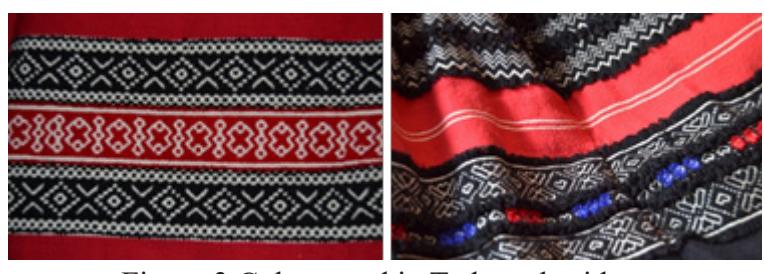
Figure 3 Colors used in Toda embroidery
the creativity of the Toda women who conjure up a pattern in their minds and then transfer it to a piece of cloth. Through practice, they have mastered this craft and create designs on the cloth without tracing the pattern or referring to any book. This can fully justify the slight change which is present in a design from the same inspiration.
Like every other art form, Toda embroidery also remains an evolving art form. Consequently, various new patterns have been developed since its origin. There are a variety of motifs which are either modified version of the traditional pattern or a new variation of the previous one.
Craft Revival
Crafts have been a livelihood option in villages for decades now. Embroidery is one of the handicrafts which helps in engaging the people in doing something. Artisans in the remote areas are limited to traditional designs and do not have formal training in design or skill development. There is a need to engage both the rural and urban audiences to spread the message of crafts and culture. The revival techniques would include workshops at both urban and rural levels - skill building, design education and entrepreneurship development in villages and art workshops and installations in urban spaces. While craft conservation includes documentation of a traditional craft, its significance and history, the revival of it is through creative and product development workshops in rural areas. In urban spaces, art and traditional craft sessions are held for the masses to spread awareness about the nuances of folk art. Film screenings, festivals, exhibitions, workshops are the aids which can be held to initiate traditional art-awareness programs in schools and colleges. Craft and cultural revival means creating a sustainable world for artisans and their craft. This begins with recognition and awareness of the craft and then providing interventions to make it a livelihood option for the craft
Figure 4 Motifs used in Toda embroidery
community. The marketing of a craft is an essential part of any craft intervention when aiming to position it into a viable market. Pupul Jayakar said, 'Craft is an economic activity before it is a cultural activity. The centre of the development process in marketing' (Tyabji, 2003).
Intervention
The research aims to revive the craft of Toda embroidery. The actions were directed at craft revival and preservation through preparation of motif/design catalogue along with the design development to widen their product range and to equip them to earn their livelihood. Besides this, video documentary is also prepared to create the awareness of the craft. Questionnaires were also conducted to record feedback.
Motif / Design Catalogue
Studies have shown that for rehabilitating any industry, design development is of key importance (Bhagat,2015). Toda embroidery too needs compiled information on the existing designs so that it can be used for further design development. In order to provide intervention in this area, it was decided to prepare a design catalogue comprising 72 designs for giving a competitive edge to Toda embroidered products. To begin this activity, the design vocabulary of Toda embroidery was observed carefully and a system of classification of designs was developed. It was decided to prepare a book of designs classified in categories like flora, fauna, architectural and miscellaneous. The preparation work of the catalogue was done in three steps
Collection of Designs: The designs of Toda embroidery were available in various forms like shawls, handbags and home textiles products. To begin, designs were collected in the form of photographs from various museums, books, and personal collections of artisans of Toda community. The designs were reproduced on actual fabric samples of size 5x5" by Toda artisans taking reference from the photographs. These were further cleaned using adobe photoshop CS5.
Criterion for Cataloguing: A cataloguing criterion of designs for the catalogue was decided after discussions with the ultimate users i.e. artisans. The categories were decided according to the design vocabulary used in the embroidery. Designs were categorized as flora, fauna, architectural and miscellaneous according to the complexity of the design in each category.
Making of a Catalogue: For this part, corelDRAW X8 and adobePhotoshop CS5, were utilized for digital catalogue (Fig.5). Along with digital catalogue, a separate catalog comprising actual embroidered samples of 5x5 inches was also prepared. There are 72 designs including the most recent ones, which are catalogued.
Design Development
One of the problems identified during the study was the existing product range which is limited to only shawls, handbags, and home textiles. Since the demand of these is limited to domestic market, it was observed that there is a strong need for product diversification for sustenance of this embroidery and assurance of long-term profits.
Studies have shown that alternative product strategy of introduction of new products always ensures the growth in sales or the market share of the product. Also, it must be able to compete with other products. The Toda embroidered articles that are available nowadays are mostly small articles like cushion covers, mobile pouches, bag tags, handbag, table runners, and mats, etc. and these articles are also not entirely embroidered. Amount paid to the artisans for these small articles is not very inspiring and motivating for the younger generation to continue with this as an income generating activity. They are paid in the range of Rs 100 to 500 for such products. Artisans show interest in articles which are more prominent in size because they know bigger the article higher the price. Empowering women through craft to benefit themselves and their families and develop in a sustainable way is the need of the hour.
Designers today are using a lot of Indian embroideries in their collections. The collaborations with designers can help local craftsmen to improve their skill, and adapt to modern times. Thus, a model where a designer can work directly with artisan can generate better incomes. If they do not source it and instead work directly with the craftsmen, in a way this will not only help these people in generating income but also teach them to provide high-quality designs.The base fabric used in Toda embroidery is cotton which is a wearable fabric in summer and winter as well. Since only threads are used for embroidery, so it can be comfortably used on clothing items. so, keeping in mind all these factors and the clean and classic form of this embroidery a clothing line is designed for men, women and kids to enhance their product range in a manner that maintains the authenticity of the craft by incorporating original stitches, motifs, designs and colors etc.
The purpose was to widen the product range of this tribal craft and make it more economically viable. The designs were manually sketched, and layouts of the garments were prepared on corelDRAW and provided to the artisans and the SHG's for understanding embroidery pattern. The designs were
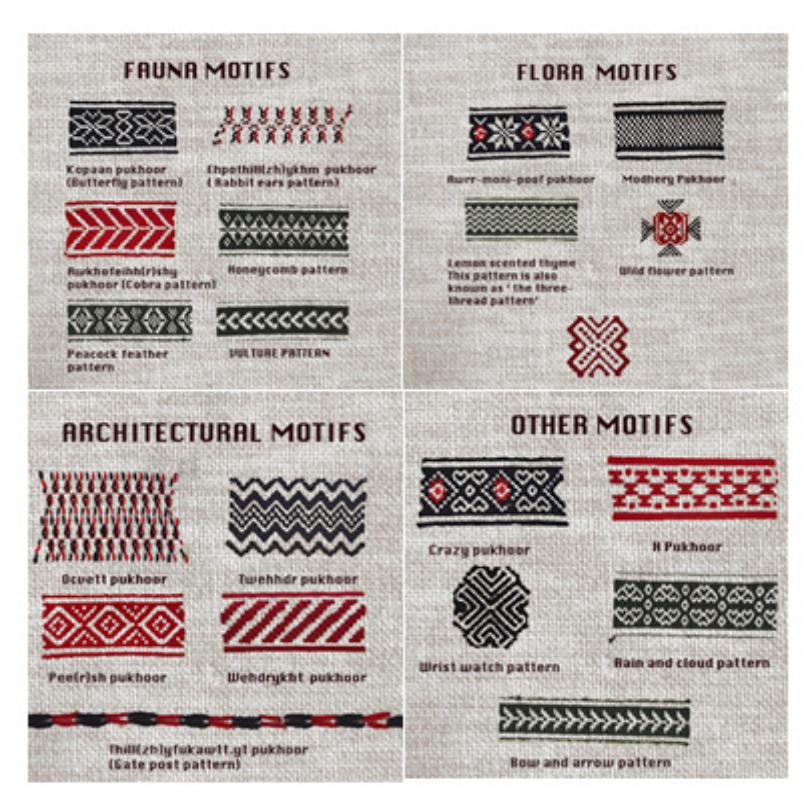
Figure 5 A part of digital design catalogue
showed during film screening and feedback was received on the basis of the developed designs and overall appearance. A clothing line was designed comprising a total of 15 designs for Men, Women, and Kids (Plate I,II,III).
The designs were manually sketched, and design layouts were prepared on CorelDRAW x8. Medium size was taken as a standard size for all the patterns. A digital catalog of designs was also prepared and provided to the SHG's
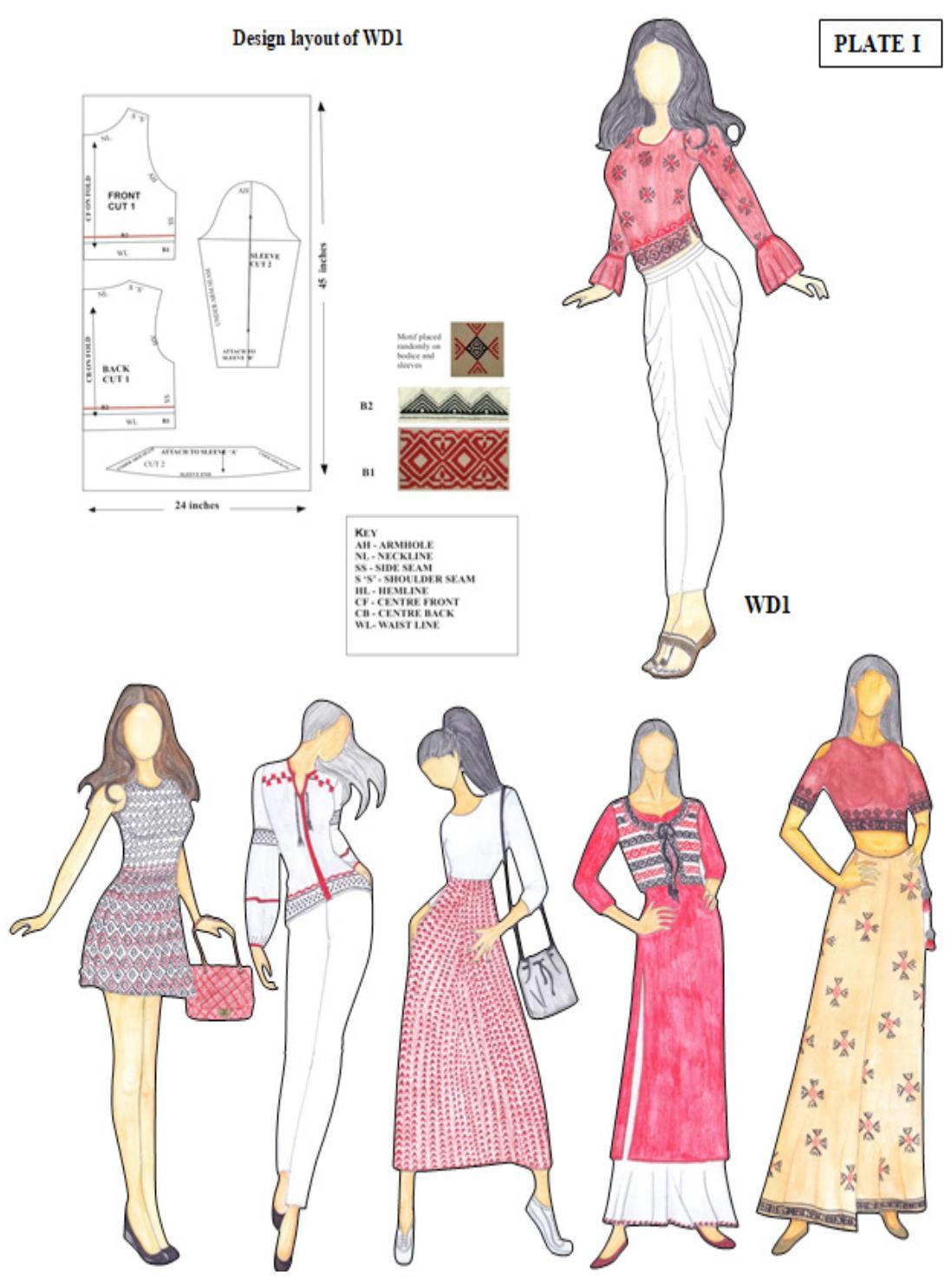
Figure 6 Plate 1
which has been working to promote this embroidery.
Video Documentary
A video on tribal craft has also been made to document the artisans, their
lifestyle and the technique, colors, and motifs of the embroidery for introducing it to the masses for increasing awareness about the craft through social media and video screening sessions. The video documentary was posted on Social media
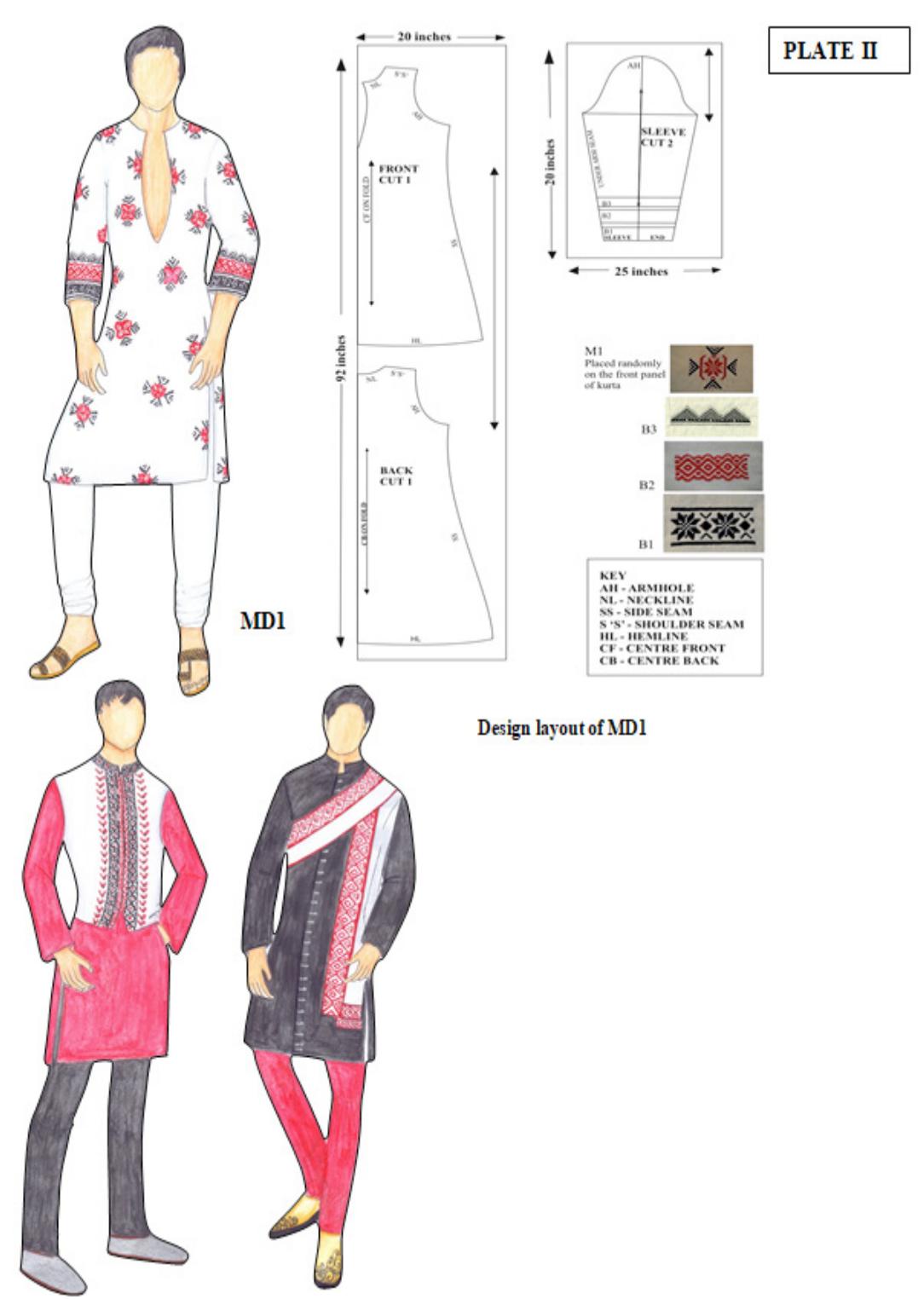
Figure 7 Plate 2
(https:// www.youtube.com/watch?v=_ X43HQdTL1s). Two film screening sessions were held in Hindi and English as a traditional art awareness program amongst youth in college premises. Posters were put up in college premises.
Bookmarks were also distributed with the information about Toda embroidery to create awareness. Video Screening session was attended by Over 150 people of different age groups. The video was screened in Hindi as well as the English
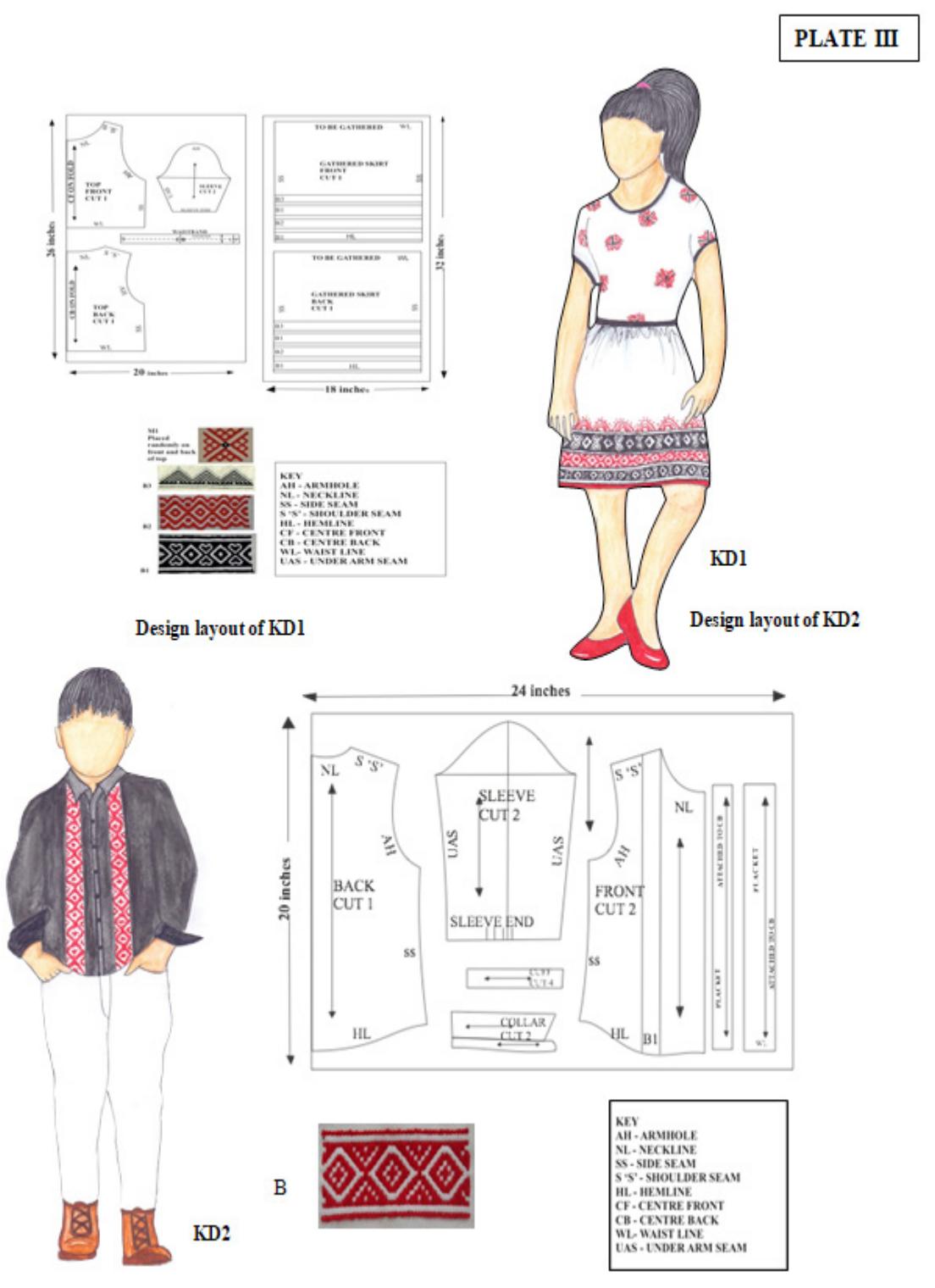
Figure 8 Plate 3
language, and it received a good response and also created awareness among youth (Fig.9). Pre and Post-test questionnaires were conducted for feedback (Fig.10). The data collected was qualitatively and quantitatively analyzed using figures and pie charts.
Pre Test Results: Although 92% had heard the term traditional textiles, they were not aware of the type of textiles. 86% of the youth could not differentiate
between woven and embroidered textiles. 72% of the respondents were not aware of Tribal embroidery and 94% had not heard about Toda embroidery. All the respondents were keen to know about the embroidery.
Post Test Results: Only 20% of the respondents had seen the film on youtube when they received the link. All the respondents liked the documentary and expressed the desire to have similar
Figure 9 Video screening sessions conducted in English and Hindi language
Figure 10 Viewers filling feedback forms after video screening session
sessions on other textiles. 98% found this medium suitable for creating awareness.
Regarding preferences on Toda embroidery, 60% liked the embroidery for its geometric form, 54% liked its embossed look while 42% preferred it for colors and 28% liked its tribal look.
It was observed that majority of the respondents liked the Toda embroidered shawls (70%) followed by handbags (50%), cushion covers (38%), scarfs(36%), table runners (28%),wallet (26%), bookmark (22%), bedsheets (18%), coin purse (14%) and stationery organizer (10%) .
All the respondents liked the clothing line designed because of the wearability of the cotton fabric, casual wear designs, modern yet tribal look and also the designs does not overpower the feel of the embroidery.
CONCLUSION
Revival Of Toda Embroidery - Needlecraft of Nilgiris is the documentation of the art of embroidery which is an expression of beauty and aesthetics which a Toda tribal women artist portrays with a needle and thread. In this craft conservation study, an effort has been made to take the craft to masses through film screening session and social media. The detailed documentation regarding its origin, socio-cultural significance, raw material, technique, colors, motifs and designs and the products helped to appreciate and understand the craft and the proficient artisans who are skillfully making an effort to preserve this rich heritage. The detailed understanding of the techniques demonstrates how the combination of hard work and creativity can result in creating such appealing and vibrant products. There exists a curiosity among artisans to know the demands of urban communities and on the other hand
urban community is keen to know about craft and artisans. The Toda embroidery has a potential to evolve into a means to earn a livelihood. Through extensive documentation and product interventions in this research, an effort has been made to bridge the gap between the two.