

ABSTRAK
Cap batik "tali air" merupakan sebuah alat untuk membuat batik yang merupakan cap garis tegak lurus dengan menggunakan lilin panas. Alat ini memiliki potensi besar untuk menciptakan berbagai ornamen utama tetapi teknik ini belum digunakan untuk merancang produk fasyen dari Bandung. Dalam penelitian ini, cap batik 'tali air' digunakan untuk memberdayakan sumber daya kreatif di Bandung. Metode yang digunakan dalam penelitian ini adalah metode kualitatif yang dieksplorasi dengan mengamati dan berdiskusi sebagai teknik pengumpulan data. Hasil pemberdayaan dalam penelitian ini adalah prototipe produk cap batik 'tali air'. Studi ini dapat dikembangkan untuk memanfaatkan cap batik 'tali air' dalam memberdayakan masyarakat nonkreatif atau sumber daya kreatif dari daerah lain selain Bandung.
Kata kunci: cap batik, 'tali air', sumber daya kreatif, Bandung
INTRODUCTION
'Tali air' batik stamp is a tool to create batik which is a single perpendicular line stamp. 'Tali air' batik stamp in current batik industry is still utilized as a secondary batik stamp to make edge line on the fabric by using hot wax. It is also used to create boundary pattern line to simplify the cutting process of a fabric.
In the previous study the potential of 'tali air' batik stamp in the craft context has been invented. It has potential to create various main ornaments in unlimited size. 'Tali air' batik stamp
can also be utilized to create main ornament, filling ornament and isenisen with perpendicular line element. The perpendicular line element which is produced by 'tali air' batik stamp results modern-styled batik products. 'Tali air' batik stamp can be applied in various textile products, such as fashion and craft products.
Due to the limited power, funds and time the study about utilizing 'tali air' batik stamp is focused on the empowering creative resource in Bandung. Bandung is selected by the researchers because the researchers are from Bandung. Bandung itself has schools with plastic art and design departement which produce creative resource. Those creative resources have potential in designing creative products in Bandung.
Bandung is also one of modern cities in Indonesia so that it has the same characteristics with modern-styled batik which is produced by utilizing 'tali air' batik stamp. Bandung as a creative city with natural wealth, culture, and its history can inspire to create creative products by utilizing 'tali air' batik stamp.
In this study 'tali air' batik stamp is utilized in designing fashion products from Bandung. The method used is qualitative by exploration. Data collection techniques used in the study is observation and discussion. Exploration is conducted toward 'tali air' batik stamp which is inspired by Bandung in order to fit the market demand.
The result of this research is fashion product prototype of 'tali air' batik from Bandung. This research can be developed for designing fashion product from other areas in Indonesia.
METHOD
The Opportunity of 'Tali Air' Batik Stamp in Empowering Creative Resource in Bandung
Creative Resource in Bandung
Bandung covers an area of about 167.29 km2 . Bandung is located in the middle of West Java province in the coordinate between 107o 36' EL and 6o 55' SL. It is surrounded by mountains so it has basin like land. Due to its strategic location, it makes Bandung not only process raw materials from its local area but it can also process the material from places other than Bandung.
Bandung is a basin area which is surrounded by mountains such as Tangkuban Parahu. Citarum and Cikapundung River are rivers that flow in Bandung. Bandung has humid climate and cool air in the morning that causes plant and animal species can live. In East Bandung there are areas that used as fields.
The scenery such as mountains and fields as well as its local plants and animals often become the object to create a product or creative works such as painting or batik patterns. Those objects go through deformation process which is influenced by the technique and the creativity of the craftsmen. The object, technique and creativity of the craftsmen will result a product or work which has
Figure 1 Bandung map
distinctive features to differentiate with the product from other areas.
Bandung as Creative City
As of the 2015 BPS Bandung census there were 2.481.469 people living in Bandung. The ratio of male and female residence was 50,51%: 49,49%. People in Bandung are dominated by young people between 15-19 years old and the largest population is people between 25-29 years old. It is because Bandung is one of destination cities for students.
In 2015, 72,04% of the total population are people with productive age. It is a potential resource for Bandung. Besides, there are also schools and academies with plastic art and designs which produce creative resource in Bandung. Its creative resource has potential in designing creative product in Bandung.
According to Ministry of Tourism and Creative Economic (2014), Bandung is registered as one of UNESCO is Creative Cities in 2013 along with Yogyakarta, Solo and Pekalongan. In December 11, 2015 Bandung is inaugurated as creative city within the design field by UNESCO Creative City Network. Bandung as creative city has an opportunity to follow events and competition along with other creative cities which is incorporated in UNESCO
Creative Cities Network.
Bandung has rapid creative industries growth. This growth is supported by creative people, place, and ideas. Creative people are Bandung people especially group of people between 15-29 years old. The place of creative activities is certainly in Bandung. The ideas are from schools of Art and design as well as creative community such as Bandung Creative City Forum (BCCF). The aspect that is developed in creative industry in Bandung is information and communication technology, gallery of art, design, promotion and brand, and Design-based creative industry.
The utilization of 'tali air' batik stamp has the opportunity to be a designbased creative industry from Bandung. The people can be empowered in the production process by utilizing 'tali air' batik stamp. The design principles and creative ideas are applied in the designing to produce creative alternative products from Bandung. The product produced is branded and promoted then marketed through information and communication technology.
Empowerment of Creative Resource
Empowerment is a process in which the people are supported in order to improve their welfare independently. In 2015, 72.04% from the total population of Bandung are people with productive
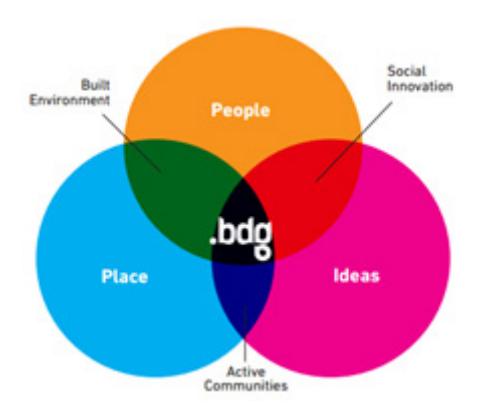
Figure 2 Diagram of Bandung creative city development
age. It is potential human resource for Bandung. There are also high quality schools and academies with plastic art and design department which produce creative resource. It is also supported by public space to exchange creative ideas such as city parks in Bandung.
The empowerment of Bandung creative resource by participating can be done within the utilization of batik 'tali air' stamp. Participation is an activity which engages someone or group or people to gain the advantages. Another advantage which is expected from the participation of Bandung creative resource in utilizing 'tali air' batik stamp is by producing Alternative creative products from Bandung. The advantage which is expected is producing 'tali air' batik stamp which can be marketed in order to gain the profit.
'Tali Air' Batik Stamp
Batik is one of Indonesian's cultures. In Indonesia batik is a process of blocking a fabric by using hot wax. Batik is clasified into traditional batik and modern batik. Traditional batik has pattern, technique and function that fit the traditional custom, while modern batik has pattern, technique and function which are the aspiration of modern culture of society.
Every design of batik has different characteristics. The characteristics of its
design is influenced by various factors, such as geographic location, its people lives, believe, and customs of the area where batik is made, as well as its relation to other areas. These factors make its pattern become identity or typical product of an area.
There are three types of batik techniques; those are batik tulis (written batik), batik cap (batik stamp), and combination between written and stamp. Batik cap recently appeared in 1920, for the purpose of accelerate production process. There are two types of stamps for batik based on their functions; those are main stamp and secondary stamp. Main stamp such as 'buketan', 'kembang temu', geometric , 'tumpal', and 'ploi' or 'sisi' stamp. Secondary stamp is like in 'susurabayaan' and 'tali air' stamps.
The Initial Function of 'Tali Air' Batik Stamp
'Tali air' batik stamp is a tool to create batik which is a single perpendicular line stamp. 'Tali air' batik stamp in batik industry is currently still utilized as secondary stamp to make edge line on the fabric by using hot wax. 'Tali air' batik stamp is also used to create boundary pattern line to simplify the cutting process of the fabric.
Potential of 'Tali Air' Batik Stamp
In the previous study the potential
Figure 3 Tali air' batik stamp
'Tali air' batik stamp has potential for making various contemporary batik pattern. 'Tali air' batik stamp can make decorations in unlimited size. 'Tali air' batik stamp can make main decorations, filler decorations, and isen-isen. Straight line elements from 'tali air' batik stamp can make various pattern for modern
batik product.
The Process of Using 'Tali Air' Batik Stamp
The process of creating batik by using 'tali air' batik stamp is not different from the process of creating batik in general, yet the difference is only in the tool to stamp. The process begins with designing, tracing, batik process, coloring and pelorodan (the process of boiling batik to release the wax from fabric).
In the designing process, the objects that will be the ornaments
Figure 4 Utilization of 'tali air' batik stamp for making primary decorations
Figure 5'Sinjang' and wall hanging of 'tali air' batik stamp products
TABLE 1 DECORATION EXPLORATION OF ALTERNATIVE PATTERNS FOR 'TALI AIR' BATIK PRODUCT
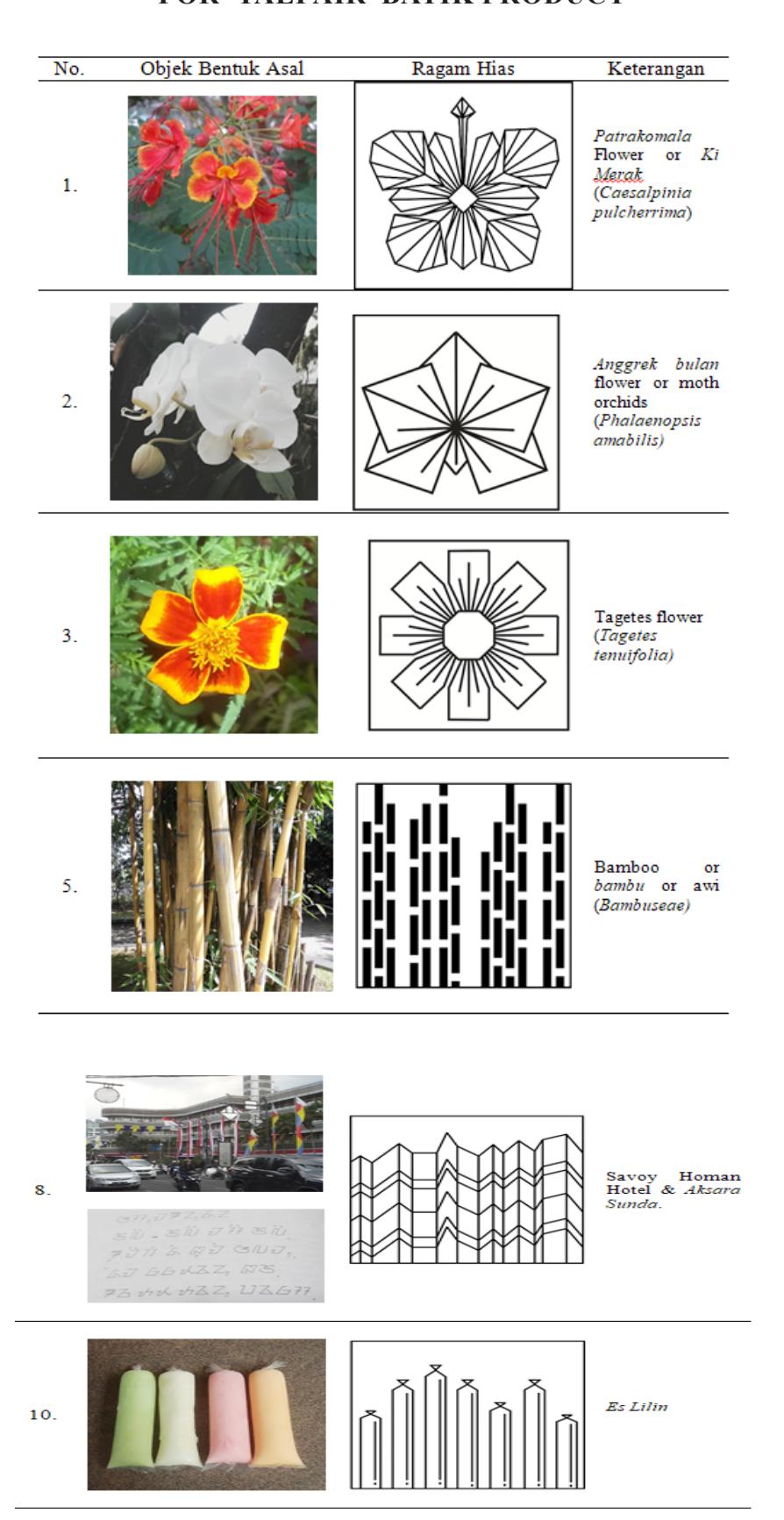
In the tracing process, the design that has then been made printed with a ratio of 1:1. The print out is put under the fabric then trace the pattern from the print out on the fabric by using lime sewing. Ruler is helpful in the tracing process because the pattern designed consists of some of perpendicular line elements.
In the batik process, the fabric that has gone through the tracing process then it is stamped using 'tali air' batik stamp and hot wax. 'Tali air' batik stamp can make the resulting line neater and firm than using batik tulis technique but it takes longer time to utilize this technique than utilizing conventional batik cap technique.
In the dyeing technique, the fabric is colored by using colet coloring or celup (dyeing) technique. Colet technique is better to be done on a narrow piece of fabric while celup (dyeing) technique is better to be done on a wide piece of fabric. There are two types of colors for dyeing batik: natural dyes and synthetic dyes.
In the lorod process, the fabric that has been dyed then it is boiled into boiling water with soda ash. The purpose of this process is to release the wax on the fabric. This process is minimally done twice, thus all the wax can release from the fabric.
Tali Air' Batik Stamp Products
Like any other batik products in general, fabric with 'tali air' batik stamp can be used either for fashion or kriya. In the previous study, the product which has been produced from 'tali air' batik stamp is geometric arabesque pattern which can be used as sinjang or hanging wall.
RESULT AND DISCUSSION
The Empowerment of Bandung Creative Resource in The Designing 'Tali Air' Batik Product Concept
The concept of the product is inspired by the objects that exist in Bandung City. These objects include history of colonial period, Sundanese culture and natural wealth both flora and fauna. The objects are deformed to produce geometric patterns that can be made with 'talia air' batik stamp.
The colors used are bright colors that are inspired by post-modernism styles artifacts in Bandung, such as the Bandung Creative Hub Building,
Figure 6 Moodboard and colorcheme
Cihampelas Terrace, and the lights in Veteran Park. This color combination also follows the Digitarian theme in "GREYZONE" Trend Forecasting 2017- 2018 by Bekraf (figure 6).
Sketch
The decoration that has been made is applied on the design which is designed in the empowerment process of creative people in Bandung. Creative people that are involved in this study are two alumnus of FRSD ITB and two
TABLE 2 PRODUCT SKETCHES
| No. | Sketches | Captions |
|---|---|---|
| 1. | Student of FSRD ITB 1 respondent | |
| 2. | Student of FSRD ITB 2 respondent | |
| 3. | Alumni of FSRD ITB 1 respondent | |
| Alumni of FSRD ITB 2 respondent |
TABLE 3 SELECTED SKETCHES
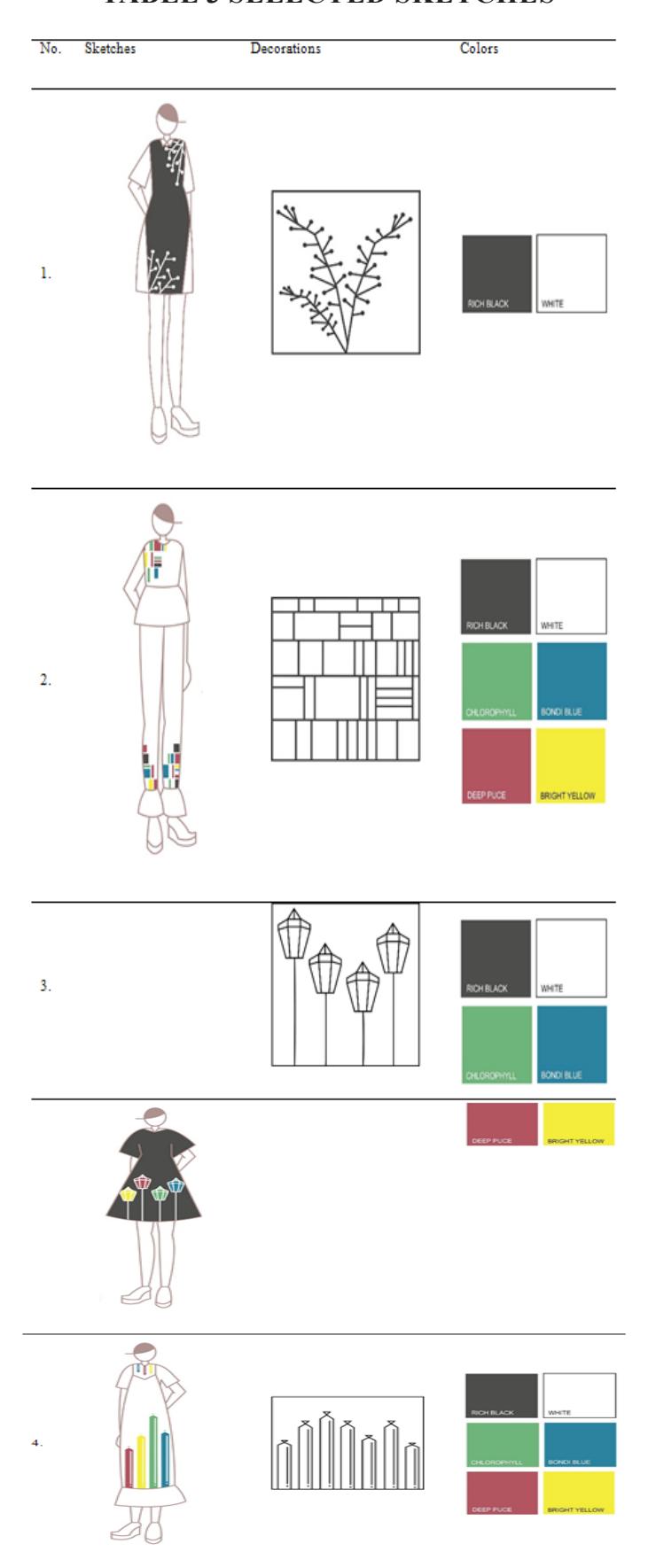
students of FSRD ITB. This experiment is conducted in ITB campus on Tuesday, May 2nd, 2017 at 13.30 to 15.00 (figure 7).
Those creative people are asked to design women ready to wear fashion product according to their own creativity. The designs created are directed based on the moodboard and decoration which has been made. In 1,5 hours, each respondent can create 12 designs, thus the total are 48 designs (table 2).
The sketches that have been made are then selected through the discussion process with the respondents. The selected sketches: are then discussed in the dyeing and the production steps. The colors are selected based on the color scheme on the moodboard. The following step is the final sketches from the discussion result in table 3.
Production
The sketches that have been made are then manifested. The steps that are carried out are creating the patterns, tracing, batik process, dyeing, pelorodan, and sewing. Creating the patterns is based on the sketches that have been made. The creation of patterns is assisted by the tailor to facilitate the process of realization of the designs. Creation of the pattern is begun by drawing the pattern of the fabric by using ruler pattern and lime sewing. After drawing the pattern, the next process is cutting the fabric based on the pattern made.
After the fabric is cut based on the pattern, the next process is tracing. The tracing process is carried out by the respondent in one day in Kriya studi, on the 4th of CADL ITB building. The tracing process uses paper with decorative picture, lime sewing and ruler. This process is carried out by putting the duration picture under the fabric then the picture is traced upon the fabric by using lime sewing. The lime sewing is used in order to dispel in the lorod batik process.
After carrying out the tracing process on the fabric, the next process is creating batik. Creating batik process is carried out by the respondents in one day in Kriya studio on the 4th floor of CADL ITB Building. The respondents are given trick to use 'tali air' batik stamp to create the main decoration of batik so, the respondents can understand the technique easily.
Batik process using batik wax, wax pan, stove, stamping table, and 'tali air' batik stamp. The batik process is started by heating the wax which is simmered inside the pan. After the wax melt, put 'tali air' batik stamp to be heated after the stamping process. The stamping process is carried out by putting wax on the canting seal. In order that the wax is not stick too much to the canting seal then sprinkling is needed by swinging the canting seal in high speed. After the wax is adequate, put the canting seal on the fabric, press the canting seal for seconds for the maximum result. The repetition of stamping starts with heating the canting seal of batik for seconds in order that the wax can stick so the wax must be in liquid condition.
'Tali air' batik stamp can create various patterns of line by using only one stamp. For making line that is longer than the stamp, it can be done by connecting the line, while for making shorter line it can be done by blocking the overline using thick cartoon or grey duplex. After carrying out batik process on the fabric, next is dyeing process. There are two techniques for dyeing batik those are colet and celup. Dyeing process by colet is carried out by the respondents in a day in Kriya studio, on the 4th floor CADL ITB building. Colet uses batik dye packaging "Fairbro', while celup uses naphtol.
After carrying out batik process on the fabric, next is dyeing process.
There are two techniques for dyeing batik those are colet and celup. Dyeing process by colet is carried out by the respondents in a day in Kriya studio, on the 4th floor CADL ITB building. Colet uses batik dye packaging "Fairbro', while celup uses naphtol.
The next process after dyeing process is lorod. Lorod is a process of realizing wax from the fabric. The process starts by boiling 3 liters of water, after boiled add 2 tablespoons of soda ash then stir until the wax release. The process is better to be carried out more than once until the wax is completely removed from the fabric.
The creative resource as respondents create sketches based
Figure 8 Batik process
Figure 9 Coloring process
Figure 10 Prototype
upon the moodboard which has been determined with their own creativity. After sketching process, the next is discussing to select the designs that will be manifested. Selected designs is then manifested by 'tali air' batik stamp technique. During this process, respondents are given some tricks in order to understand and do not have difficulty when they are creating batik.
Prototype
Batik 'tali air' product can be alternative creative product from Bandung by adding Bandung elements into the products. There are two elements of Bandung which are added into batik 'tali air'. They are pattern that inspired by the object which inside in Bandung and the creators that involves creative resource in Bandung.
Based upon the discussion with creative resources who are the alumnus of FRSD ITB, the digitarian subtheme quite expresses characteristic of Bandung. The product designs which are made in this study are created simpler in order to reach the target market that is urban female between 13-22 years old. The simple design makes the production process easier, so it can be mass-produced and affordable (figure 10).
CONCLUSION
'Tali air' batik stamp technique becomes an innovation in creating alternative creative product from Bandung. There are two elements which are put into 'tali air' batik stamp product. They are the pattern inspired by the objects inside Bandung and the creators who involve creative resource in Bandung.
'Tali air' batik stamp is easy to apply. Respondents as the creative resource in Bandung are requested to design 'tali air' batik stamp product starting from sketching to manifesting the design. Therefore, 'tali air' batik stamp can be a new opportunity to empower people especially creative resource in Bandung. The study can be developed for further empowerment of people who do not have any background in design or plastic art by utilizing 'tali air' batik stamp.