

ABSTRAK
Kebersamaan dan toleransi adalah budaya tradisional Indonesia yang sudah jarang ditemukan pada masyarakat perkotaan saat ini. Penelitian ini mencoba melacak kehidupan permukiman kampung di pusat Jakarta pada era 1960- 1990-an dan menelusuri bagaimana penduduk dengan latar belakang pedesaan membangun nilai kebersamaan di tengah kota yang tumbuh dengan cepat dan terus berubah. Penelitian ini merupakan telaah sejarah untuk mengamati metamorfosa ruang dan dampaknya pada pola kehidupan sosial masyarakat. Metodologi penelitian dilakukan melalui studi arsip dan literatur yang dilengkapi dengan observasi lapangan serta wawancara dengan para aktor terkait. Penelitian mengungkapkan bahwa di tengah ruang yang terbatas, ruas gang sebagai area publik di permukiman tidak hanya berfungsi sebagai ruas jalan maupun pembatas antarrumah, melainkan telah menjadi area perluasan rumahrumah penduduk dan ruang berbagi antarwarga. Batas-batas antara area privat dan publik telah menjadi kabur, aturan penggunaan gang ditetapkan berdasarkan azas toleransi. Pada akhirnya gang menciptakan ikatan-ikatan antarwarga dan membangun kebersamaan penduduk.
Kata kunci: sejarah, budaya, kampung, pembagian tempat, toleransi
INTRODUCTION
Human has different bonds to space in every passage of time. Fernand Braudel said human history is formed through the structures of the longue durée. A single point of time in the historical range carried a volume of space containing layers of time which are connected to one another (Tomich, 2011). Human spatial experience changes from time to time depending on social wrap that surrounds them (Hayden, 1997) (Lefebvre, 1991). Meanwhile, culture is among the factors that bind humans.
Culture as the root of the pattern of community evolved over time as humans defined their environment. Clifford Geertz saw the notion of culture as a set of control mechanisms, plans, prescriptions, rules, and instructions to regulate human behavior in social space (Geertz, 1975). On the one hand, city as a form of spatial system has the power to control and change people (Dovey, 1999; Foucault & Gordon, 1980). On the other hand, people are a factor that revives the city.
The city settled personal spaces of society, and how the space turned on. The way the community responds to the city will affect how the city works (Girouard, 1985; Mezei & Briganti, 2012). The study of urban forms can be used to read how humans respond to space and the ways in which culture is formed (Kostof, 1991; Kostof & Castillo, 1999; Rossi & Eisenman, 1982).
The study attempts to appoint Kebon Melati, one of densely kampung settlements that until the1990s was part of the city center of Jakarta. Now, like other kampungs, almost all of the Kebon Melati has been destroyed and replaced by business and commercial district. However, Kebon Melati was once a part of Jakarta's journey and helped build the city's identity. This study is a historical search, through archival and literature studies to trace some time back in the era of 1960s-1990s in which Jakarta's growth shaped the character of the population and created cultural patterns in the community.
Kebon Melati was originally an area of plantations around the Tanah Abang Market. The number of migrants passing by to the market made the surrounding area crowded by settlers. At first they lived scattered around the plantation, but the growing settlements made the plantations turn into large densely populated kampung (Abeyasekere, 1987; Chaer, 2017; Heuken, 1982; Jakarta, 1993). Kebon Melati residents who mostly came from rural background, initially lived as in the village until the city development touch their homes and made them have to move into a new pattern of living.
This study aims to observe how the space changes in line with time, took place around human life, and have an impact on the alteration of social space. The research questions are: How do kampung residents respond to the changes occuring in their environment due to urban development, and what are the impacts on people's daily life? That culture is the way of life and regulates the patterns of community. Then, how does space transformation affect the birth of new cultures?
METHOD
The study appointed Kebon Melati, one of the Kelurahan in the Kecamatan Tanah Abang. Kebon Melati is located in a strategic position right behind Hotel Indonesia, one of Jakarta's signatures, and the symbol when the city started its journey as a modern city of an independent country. The data were retrieved from archives of maps, images, and texts, which are reinforced by field observations to complete and reconfirm the initial historical records. The description of the social life of residents is obtained through interviews with the residents who mostly have lived for decades where some no longer live on location.
The focus of the research is to explore the everyday life of residents to get to know how people define their environment and build relationships with neighbors. The research challenge is that most of the kampung has been evicted. Kampung life is no longer the same as it was, still a living settlement. At present there are only a small number of vacant land and abandoned buildings, and some are only temporary housing that does not build families. There are no patterns of activity left as in the past, the activities that usually turn on the kampung throughout the day.
This paper is architecture and urbanism studies through a historical approach. The history as a foundation can be an extension of architecture discourse in reading current factual problems of human and urban space (Tournikiotis, 1999). The preliminary study through archives is to see the metamorphosis of space and the process of urban formed to obtain a picture of the circumstances faced by the population. The study aims to enrich and complement Indonesia historiography and examines how the development of architecture that takes a position in the course of socio-cultural movements. The result is an interpretative narrative by filtering archives, factual data, and memories shared by people.
RESULTS AND DISCUSSION History of Jakarta and The Formation of The Kampung
Kebon Melati is a kampung settlement under the Kelurahan Kebon Melati and part of the Kecamatan Tanah Abang. With an area of 1.26 km2 (see Figure 1), Kebon Melati was among densely populated settlements that filled the center of Jakarta. Currently due to the construction of the city, almost all of the Kebon Melati has been destroyed. Similar to other kampungs, Kebon Melati also has to give up with urban planning set by government that replaces the settlements in the downtown into business and commercial district.
Looking back, the existence of Kebon Melati is inseparable from the Tanah Abang Market. Built in 1735 by Justinus Vinck, the market is one of the triggers that revive the surrounding areas. The Tanah Abang Market originally was a vegetable market. The availability of river and railway helped people reach the market easier and made the area increasingly crowded, including by immigrants from outside the region. Along with the growth of the market, the area around which was once the plantations became populated (Chaer, 2017; Abeyasekere, 1987).
The areas around the Tanah Abang Market named Kebon Kacang (peanut plantation), Kebon Sirih (betel plantation), Kebon Jahe (ginger plantation), Kebon Pala (nutmeg plantation), Kebon Sayur (vegetable garden) initially were plantations which later turned into settlements. To remind the origin of the area, the names are taken to mark the regions (Ensiklopedia Jakarta, 2005). The map of Batavia 1682 shows clearly how the whole area outside the VOC fort was green land with rice fields and plantations (see Figure 2).
Initially Kebon Melati was part of the Kebon Kacang area. When the area was split in two due to road construction and separating the northern and southern regions, the southern region later was named as Kebon Melati. Some books wrote that Kebon Melati was originally a jasmine garden, but there are also hereditary stories told by the inhabitants that the southern area of Kebon Kacang was a cemetery area and the number of jasmine trees grew in the area made it look like a jasmine garden. The area was then even not really a garden widely referred to jasmine garden or 'kebun melati' or 'kebon melati' as pronounced by local people. Although on the map of Jakarta 1959 still does not show the existence of Kebon Melati, but it is recorded in 1954 the number of residents in Kebon Melati has reached 800 people (Gunawan, 2010).
Previously some areas of Kebon Melati were rice fields surrounded by villages. The growth of the Tanah Abang Market (see Figure 3) increased the population of Kebon Melati, but the big wave of migrants began when Indonesia entered its independence. As told by one of the residents, the speech of President Soekarno to make Indonesia a great country and build Jakarta as one of the world's lighthouses has become a magnet. People flocked to Jakarta to witness the splendor of Jakarta that began to move into a metropolitan city. From 1948 to 1949 there was a rapid rise of population of Jakarta up to 62.2%. And in 1952 the number of migrants that filled Jakarta has begun to complain (Gunawan, 2010).
The development of Jakarta not only made Kebon Melati more dense. The construction of the National Monument, Mohammad Husni Thamrin Street, and the Selamat Datang Statue, as the new axis point
Figure 1 Kebon Melati (Source: wikimapia.org)
of the city, and the establishment of Hotel Indonesia in 1962 across the Selamat Datang Statue have made Kebon Melati which is located right at the back of the hotel become in the heart of Jakarta (see Figure 4).
Kampung and People
Kebon Melati is a densely populated kampung. Since Kebon Melati was inhabited, the residents lived scattered randomly around the plantations. As in the rural area, houses did not have toilets, and people go outside to defecate. Until in the year of 1969 to improve the quality of kampung residents in Jakarta, Governor Ali Sadikin launched the Kampung
Improvement Program (KIP). The Governor with the program called the Mohammad Husni Thamrin Project (MHT Project) built roads in settlements, made gutters, and provided clean water supplies. The program made significant changes to the kampungs (Abeyasekere, 1987).
The program improved the appearance of the kampungs and transformed them into urban settlements. Including in Kebon Melati, it was built asphalts roads complete with gutters on both sides, public toilets, and residents learned to use clean water. In the early days of the program, with condition that houses still did not have toilets, some residents used gutters as a place to defecate.
Figure 2 Batavia 1682 (Source: Atlas Van der Hagen, Koninklijke Bibliotheek, Den Haag)
Figure 3 Left: Tanah Abang 1910. Right: The Market 1930 (Source: Leiden University Libraries)
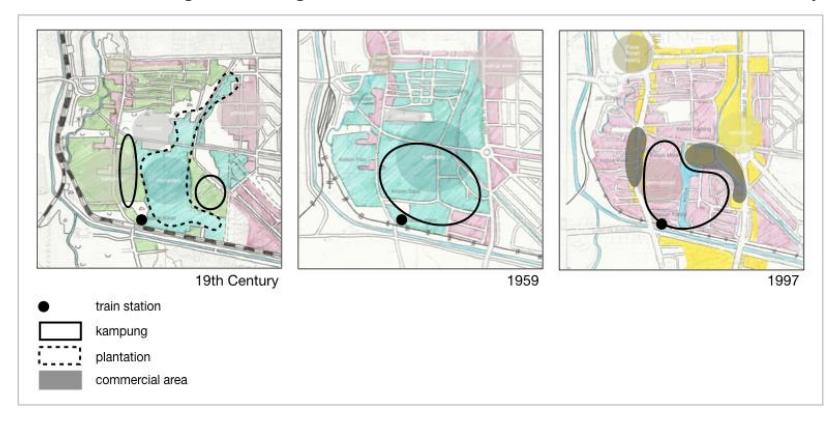
Figure 4 19th Century to 1997: from Plantation to Urban Settlement (Source: Freta, 2012)
Gradually people build toilet in the house complete with septic tank. Even until the 1980s in some places still can be seen the scenery of children crouched on the edge of gutter to defecate.
With the KIP, the kampungs became more organized. Houses which were previously scattered became neatly arranged in road sections. The area within the kampung is divided by roads that are crisscrossing the space which also the boundary between houses, although what is called a road in some places is only a small alley with 2.5 m wide.
The size of houses in Kebon Melati is relatively small. On average, residents live in one-story houses with 1-2 bedrooms.There are even houses that only consist of one open space. It is rare to find large houses and have a courtyard or two-story houses. What is usually seen is the house with the door directly facing the road. The residents often place household furniture in front of the houses, and sometimes cover gutters with a board to get more additional space. Clothe hangers, tables for selling merchandise, or even motorbikes are some items that usually fill the side of the alleys. In the remaining area of Kebon Melati the scenery is still visible (see Figure 5).
Kebon Melati residents are diverse communities from various regions in Indonesia. Besides Betawi people, the population of Kebon Melati was dominated by migrants from Java, and only a few of the other islands. The average economic level of residents was middle to lower class. Coming from different origins with different types of work, residents learn to get to know each other through the space where they live (see Figure 6).
Residents live a life in Kebon Melati. People build a family, make a house, farming, build community, go to school, and worship. Among the traces that can still be seen is the presence of several mosques scattered in the kampung. It was said by residents besides a large mosque, tucked between houses there were also several langgars (small mosques). A large mosque is located on the highway leading to Jalan Kebon Kacang Raya. In the morning the area around the mosque was transformed into a market where people bought vegetables and necessities. In the evening mosques and langgars have become a place for children to recite the Qur'an. At this time the large mosque is no longer there.
Figure 5 The Alleys in the Remaining area of Kebon Melati (Source: Freta, 2012)
The Existence of The Alley and Connectivity of People
The atmosphere in the kampung is always crowded from morning to night. Houses attached to each other allowed people to clearly follow what is happening in the neighborhood. The residents can easily see the activities of neighbors who live across their house or hear sounds from neighbors in the left and right of their homes, and watch who passes or enters another house. The residents will recognize the food cooked by other homes through the smell. In the month of Ramadan, the residents will take turns sending food they cook that day to neighbors around the house. So, not only by smelling, but the residents can enjoy food made by their neighbors. This is a rural culture that is still applied in Kebon Melati. Some areas still have the culture but are very rarely seen in cities. Among children also have rituals related to food. Once a while they will hold lunch together called 'padangan'. Each child will bring a plate of rice and side dishes from their homes, then cross the alley and go to one of their friends' houses. Everyone can see the food carried by others and understand the condition of their friends by looking at the food. Sometimes there are children who bring rice with one third of eggs because they have to share with their siblings.
Narrow spaces, and sometimes a large number of members, made not all activities are carried out by residents in the house and widen space to outside the house. Often seen children play more in the alley rather than at home. It was a common sight to see children playing in the alley all day long, and turning the alley into an infinite playground.
Meanwhile, adults make the alley as a place to work or as an option in their spare time. Chatting with neighbors, seeing people and vehicles passing by, or feeding children are some activities people do in the alley. It's very rare to see the alley empty without anyone.
Especially on Eid al-Fitr, people spill out in the alleys. As part of the ceremonies that one must apologize to one another, after Eid prayer all residents will visit all neighbors and get around from one house to another. The alleys are very crowded by people going back and forth. Coming to neighbors first before visiting relatives who live outside the kampung is a must since neighbors are the closest relatives for residents. The ties show how close the bonding between residents.
CONCLUSION
Culture: Production of Space
Space will continue to change following human development. According to Lefebvre (Lefebvre, 1991) space is produced socially through conventions established by society. Kebon Melati residents have to deal with advanced civilizations, meanwhile it brings inconsistencies between the structure laid out and people's daily. City development not only changed the formation of settlements but also triggered the alteration of the pattern of community. The residents are required to adapt the new environment; on the other hand, responses that arose when defining space make people need to reconstruct their relationship to space.
The journey of space is a collection of human environments in which various ways of life are settled (Girouard, 1985). Human respond to space is to produce a comfortable place to live. Residents in Kebon Melati show several ways in which humans cope with the
Figure 6 Houses, Langgar, and Ibu Wiwin, one of residents who lived since 1960s (Source: Freta, 2012)
environment. The space formed by city Development has changed the construction of the kampung, people tried to translate and make a personalization to new structures that surround them. The expanded function of the alley shows how people make a connection and displays the adaptability of community to space. Kebon Melati residents respond to changes in their kampung according to their own background and knowledge. People are not familiar with the term of public space. They don't recognize urban-style structured spaces such as roads and borders or alleys and sewers.
The masses feel they have authority over space. The residents bring their private activities to outside and make the alley as an extention of the house. Children defecate in a gutter near the alley is an extreme example of how private space can break through the wall. There are no clear rules in the alley. The agreement is made based on the value of togetherness and mutual tolerance among people. The absence of borderlines between public and private presents the flexibility of the alley as a shared space. An understanding of the use of the alley seems like unwritten agreements and has become a local rule. This is not because of the city rules determined by the Government, but rather than framing made by limited circle of residents. The rules then become the way of life of the population.
Under-layered Cultures
Now Jakarta is a magnificent modern city with many sophisticated things, high technologies, and advanced civilization, including modern society. Kampung settlements have increasingly removed from the city center. People have left Kebon Melati (see Figure 7). In the future, perhaps the story of the kampung of Jakarta will completely extinct, but cities need to be seen thoroughly.
In the growth of urban space, people who grow in line with the city should be observed. Culture is human responses and the bonds between people and space. Along with the journey of human, cultures keep changing and evolving. In Jakarta there are cultures of kampung settlements which were born as the city morphed into a modern city. Culture of rural people jumped into the urban structures without experiencing a gradual or natural migration. The evolution does not come from people who are trying to improve their personal qualities.
Culture is the presentation of layers of agreement that are intertwined with social space over long period of time. Part of Jakartans are villagers who instantly shifted into urban society that there are amongst citizens grew up in the kampung lifestyle. This root cannot be denied or simply disappeared. In a metropolitan wrap that covers Jakarta, some people define the city based on kampung agreements. This is to remind urban planners and the regulators to the city history and review the under-layered cultures while dealing with the community to conduct proper socialization. Some cultures may have been covered by new layers or there comes new agreements; however, there are hidden cultures that still continue to live and be part of the space.
NOTE
This research has been presented in 1st International Conference on Art, Craft, Culture, and Design ICON-ARCCADE 2017 collaboration Faculty of Art and Design Institut Teknologi Bandung with Jurnal Sosioteknologi.
Figure 7 People Left and Stayed Quiet Alleys (Source: Freta, 2012)