

ABSTRAK
Kemajuan teknologi baru-baru ini dan peningkatan kesejahteraan sosial-budaya menjadikan pengetahuan desain berada di garis depan kehidupan, karena praktiknya berkembang menjadi lebih dari sekedar 'aktivitas pembuatan. Prototipe, pencetakan 3 dimensi, internet untuk semua hal, dan beragam saluran jaringan yang berkembang dengan cepat dapat meringankan beban produksi objek. Selama 20 tahun terakhir, praktik desain telah membahas 'kegiatan penelitian' di luar pengetahuan biasa dalam membuat objek. Indonesia —khususnya program pascasarjana Fakultas Seni Rupa dan Desain, ITB— telah memasukkan kegiatan penelitian dalam pendidikan desain sejak tahun 1990-an, namun tidak ada ulasan objektif tentang bagaimana 'kegiatan penelitian desain' ini dikelola dan dipelajari. Untuk mengatasi masalah ini, penelitian dilakukan melalui tinjauan pustaka dengan menganalisis 327 tesis mahasiswa magister program desain (2015-2018) menggunakan analisis konten pada pendekatan, output, dan fokus penelitian. Analisis konten tematik diterapkan untuk mengidentifikasi hubungan yang saling terkait pada konteks pengetahuan yang dihasilkan dan pendekatan strategi dalam penelitian desain yang berasal dari tesis lulusan. Dengan menganalisis tesis mahasiswa magister program desain, penelitian ini memaparkan kelemahan dan kekuatan pendekatan penelitian di bidang desain. Hasil mendorong kami untuk belajar dari pengalaman masa lalu dalam menyelengkarakan program akademik dan mengelola penelitian di bidang desain, supaya pendidikan desain yang lebih sesuai dan cocok dengan kebutuhan masyarakat dapat dipersiapkan. Hal ini berfungsi sebagai kontribusi utama dalam penelitian ini.
Kata kunci: Penelitian desain, pendidikan desain, program pascasarjana
INTRODUCTION
Design is a fundamental human activity that evolves along human evolution. Four hundred thousand years ago, our ancestors—homo hobilis began to practice strategic thinking in making tools to assist their survivals, making them different from 'the primal living' of animals (Ochoa-Corey in Faste, 2012). They were the first manof-creation or man-of-design. From this milestone, man has evolved to enhance knowledge of design as it is known and understood today. Recent technological advancement and the betterment of socio-cultural welfare put design knowledge at the forefront of life as its practice develops into more than 'activity of making'. Rapid prototyping, 3D printing, internet-of-things, and wide array of networking channels may ease the burden of producing objects. Therefore, it is no longer enough to design a beautiful and functional object without providing objective reasoning on how, for who, and why it is made. Accordingly, exploring an object of design will require knowledge on materials and system of production, knowledge on creative process, and understanding on users' behaviour. For more than 15 years, the practice of design has addressed 'activity of research' beyond previous ordinary know-how in making object. Indonesia more specifically the Faculty of Visual Art and Design, ITB—has embedded research activities in design education since 1990s, yet there is no objective review on how these 'activities of design research' are managed and learned upon. There is no available information and/ or discussions on the past-current-andfuture state of design research, especially those of advanced postgraduate programs. To address this issue, this study is conducted through literature review by examining graduates' thesis of master's degree in Design program (2016-2018) using quantitative-descriptive type of content analysis. The paper discusses the inter-relation of context on produced knowledge—as examined on thesis' output and approaches to strategies in the design research in order to understand the recent state of the design research in educational setting.
PRACTICE OF DESIGN AND DESIGN RESEARCH Design Research in Context
It is understood that the meaning of design is not fixed. It tends to be flexible, and therefore, has no singular definition. As a result, many scholars look for the meaning of design from different angles in which it sometimes contradicts one another. For example, Guy Julier (2008, p 103) looks for 'design' as an elitist work of an individual where designer plays role as initiator. In Julier's views, design shall concern more on the signification of process with which individual role of creator is important. On the other hand, Julie Sanders (2008, p 13) looks for design as collaborative activity where designer works as a part of group. In Sanders' views, design shall concern more on the signification of result with which individual role of creator is a part of collaborative work of others. According to Frankel-Racine (2010, p 3), this seemingly contradictory meaning of design can be understood because the root of the word 'design' comes from latin 'designare' which means 'to specify' (verb) and 'signum' which means signification (noun). In Friedman (1995) views, this contradictory meanings of design shows that the discipline of design is dynamic in nature due to inter-related elements of object/artefact, human, and environment. Based on this integrated nature of design discipline, Faste (2012) points out 2 (two) dimensions of design: (a) Design as a kind of research, which means that in design practice the process to explore object
- human-environment interaction as knowledge base for creating object shall be regarded as research activity.
- (b) Research as a part of design practice, which means that in the process of designing object a designer shall apply research in order to understand knowledge of object, human, and environment.
Sir Christopher Frayling (1993) stated that "…doing science is much more like doing design", exposing views that designing is somewhat a scientific act. It implies that the word 'design' carries 2 (two) core activities—the practice of creating objects and practice of research. Cross (2007) asserts that since design activities are basically explorative, it channels both act of inquiry as well as act of producing new understandings and/or new knowledge. Therefore, one shall not clearly separate design practice from research activities. Furthermore, according to Faste (2012), there are 3 (three) research activities that are naturally embedded in design practice: (a) empirical observation on objects, human, and/or environment; (b) experiment on objects, human, and/ or environment; and (c) critics and/or theoretical reviews on object, human and/or environment. Indeed, according to Faste (2012), the work of designers in the design practice is similar to scientists practicing research activities; yet the unconventional activities of design is somewhat differ to those of 'hard-core' research in science fields. This difference can be understood, as Niedderer (2009, p 4) implies that design research has 3 (three) characteristics: (a) its multidisciplinary, (b) using creativity within research, and (c) using both experiential and tacit knowledge (associated with skills and craftsmanship with materials). Thus, to understand fully about design research, we have to embrace the variability of approaches,
'chaotic' world of creative process, and polarities of knowledge. On the following sections, the paper discusses how the approaches of the design research and its produced knowledge are exposed and learned upon.
Approaches to Strategies in Design Research
According to Frayling (1993), basically there are 3 (three) strategic approaches for Art and Design research: research into design, research through design, and research for design. This framework is based on inter-relation between the subject and object of research. Frayling's work is later elaborated by Findelli (1995) by exposing a slight different name of categories which he mentions as research about design, research through design, and research for/by design. Note that Findeli uses a term of 'about design' instead of 'into design'. Both Frayling's and Findeli's research approaches, despite using similar concept of trinities, posse a slight different foundation. According to Jonas (2007), Frayling's definition of 'research for design' is different from Findeli's definition of 'research for design', as Findeli stresses out more on work of research and development, while Frayling does not clearly explain it rather ambiguously puts them in both 'for design' and 'through design'. Therefore, according to Jonas (2007), Findeli's categorization provides much clarity in terms of epistemology and semantic compared to those of Frayling's. The following section explains 'trinity' approaches in design research with the emphasis on Findeli's work.
(1) Research into/about Design
Research work is carried out under the heading of other disciplines, such as psychology, sociology, economics, linguistics, etc. It is the most common and recognized form of design research. Research into design may
include historical research, aesthetic or perceptual research, and research into the realm of theoretical perspectives, such as those related to socio-cultural and ethical issues. According to Buchanan (2007, p58), research about design can be regarded as 'design inquiry' which searches for "the experience of designers and those who use products." The approach of research into/about design may address "the nature of design activity, design behavior and design cognition" (Cross, 2007). Thus, this approach acknowledges the importance forms of knowledge that contributes to creative skills and awareness of a designer, including the process of discovering design problem, in which Buchanan (2007, p 64) mentions as "rhetorical inquiry." Therefore, the approach of research into/about design is a work that concerns more on using design as a subject to generate knowledge, rather than using design as an object of analysis.
(2) Research through Design
Research work uses design as a vehicle of research and means of communicating the results. According to Jonas (2007, p 189-192), this approach is considered as the only genuine research paradigm within design field, as it emphasizes on creating knowledge of design not on the project solution. The work focuses on using action-reflective practice in its process of analysis, combining both practice-led research and the reflection of a design practitioner. Further, Dowtown (2007, p 63) asserts that the value of this research approach is because it provides explanation as well as becomes a vehicle in acquiring and shaping knowledge. According to Buchanan (2007, p 63), this approach is a work that emphasizes the study of form, function, and materials in relation to human activity in order to generate knowledge. Therefore, research through design may involve material research, development work (such as using a device in a new way), and action research—a description of experimental practicalwork in a studio setting, including consideration that precede the setup of experiments.
(3) Research for Design
Research work emphasizes on systematic enquiry through medium of practical action, calculating or testing new information, forms or procedures and creating communicable knowledge (Frayling, 1993). The work focuses on specific and unique design problem, pertinent to individual cases. Dowtown (2003) mentions this approach as "research to enable design", a prescriptive research method catering for specific and feasible design solution. This approach identifies data through "establishing pertinent regulation and standards, finding the appropriate formulae, finding meteorological data, finding performance specs of materials or equipment, obtaining data on human physical characteristics, and understanding human behavior" (Dowtwn, 2003, p 23-28). Archer calls this approach as "action research" (1995, p 11), while Rust mentions it as "practice-led research" (2007). In addition, Fallman names it as "designoriented research" (2005), and Kumar-Whitney explains it as "activity-based research" (2003). Notably, research for design approach is the category with which most design practitioners and design academics associate with the term 'design research', as it has potential to contribute for design outcomes.
Manzini (2009) in his writings "Viewpoint: New Design Knowledge" mentions that as design research is required to produce 'knowledge', it shall benefit all participants of design including individuals, community, or institutions. According to Manzini (2009), contents of knowledge in design research consisting of collection of cognitive artefacts about designing,
| Approach | Emphasis | Produced Knowledge | Type of Research |
|---|---|---|---|
| Research About/ Into Design | using design as subject to generate (and extend) knowledge, borrowing methods and/or research procedure from other disciplines | knowledge of designing | design history, aesthetics of object, design theory, design activity (method, critics) |
| Research Through Design | studying forms, function. and/or materials in relation to human activities | knowledge of producing visions and proposals | practice of designing, experiment of material, function or elements |
| knowledge of | |||
TABLE I INTER-RELATIONAL ASPECT OF APPROACHES IN THE DESIGN RESEARCH AND THEIR PRODUCED KNOWLEDGE
producing vision and proposal, as well as producing conceptual and operational tools. Knowledge of designing is needed to stimulate and direct further discussions and/or debates on maturing design as a discipline, knowledge in producing visions and proposals is needed to integrate general knowledge into specific ones (notably those related to object's creation or making), and knowledge in producing conceptual and operational tools is needed to assist the understanding of design process in order to provide a concrete explanation of ideas including materials and/or elements of object. All produced knowledge of design research—whether it leads to the understandings of design, producing visions and proposals, or producing conceptual and operational tools shall be delivered clearly, can be discussed, can be implemented or understood by other design researchers. It may also serve as operational knowledge to conduct further research. Interestingly by understandings both 3 (three) approaches of design research and 3 (three) types of produced knowledge as explained above, we may extract implied relation between them as follow:
(a) The approach of research about/into design emphasizes on using design
- as subject to generate knowledge. It dwelves upon the process and aspect of designing—as experienced by designers as well as those who use and consume it. By borrowing methods and/or procedures from other disciplines, this approach channels objective measure to understand design from various views, which resembles Manzini's statement on knowledge of designing.
- (b) The approach of research through design emphasizes on the study of form, function, and materials in relation to design and human activities. It dwelves upon the general knowledge of design and process of designing to understand specific knowledge about object of design. This approach channels both objective and subjective measures as it relates to creative experiment as conducted by designers and understood by those who use and apply it, which resembles Manzini's statement on knowledge of producing visions and proposals.
- (c) The approach of research for design emphasizes on practical action, calculating or testing new information, forms and/or procedures of design. It dwelves upon the comprehensive
understandings of the production of designed object, catering specific and feasible design solutions. This approach channels both objective and subjective measures as it appears as a 'prescription' of specific and unique design problems and serves as concrete explanation of design ideas, which resembles Manzini's statement on knowledge of producing conceptual and operational tools.
The inter-relational aspect of approaches of the design research and produced knowledge can be visualized in the following table (see table 1.0).
Using these notions, the study explores the outputs of master's degree thesis in design at the Faculty of Visual Art and Design ITB in the span of 2015-2019, to explore the state of design research in educational setting.
DE S I G N R E S E A R C H A T POSTGRADUATE LEVEL IN INDONESIA
(1) Overview of the development of postgraduate program in design at ITB
Master program in Art and Design was formally established at ITB in 1989, as the first postgraduate program in Art and Design related studies in Indonesia. In 2004, it was separated into 2 (two) independent programs: Master in art (M.Art) and Master in design (M.Des). Master in design offers 2 (two) thesis options: thesis by research and thesis by project. It becomes the premiere and referenced program for research activities in design related studies. Master in design program puts emphasis in the investigation, review, and identification on all related activities of design, using various available methods to understand and explore the inter-relation between man, object, and the environment. Although it channels a linear continuing program for undergraduate programs in craft, interior design, product design, and visual communication design, the program also provides non-linear opportunity for those coming from art or architecture background as well those who do not hold undergraduate program in design, yet have professional experiences and/or research interests in design.
C o m p a r a b l e t o 3 ( t h r e e ) characteristics of design-related research (see Niedderer, 2009, p 4) that are multidisciplinary, use creativity within research, and explore both experiential and tacit knowledge, master in design program is set upon 7 (seven) research focuses in order to provide guidelines on the polarities of knowledge in design research. Those 7 (seven) research focuses are:
- (1) Design and artefacts, which emphasizes on how the traditional artefacts are recognized, studied, and learned upon. This focus of research provides opportunities to borrow method and/or procedure from historical, anthropological, linguistic, and/or sociological research to produce knowledge on the interaction between man and object.
- (2) Design and materials, which emphasizes on how the design objects are created, developed, and produced. This focus of research provides opportunities to study of form, function, and materials in relation to human activities, using material research and experimental practical work in a studio setting.
- (3) Design and system, which emphasizes on how the creativity and system of object are reviewed, managed, investigated, and learned upon. This focus of research provides opportunities to study design method, processes, and production of creative ideas.
- (4) Design and visual culture, which
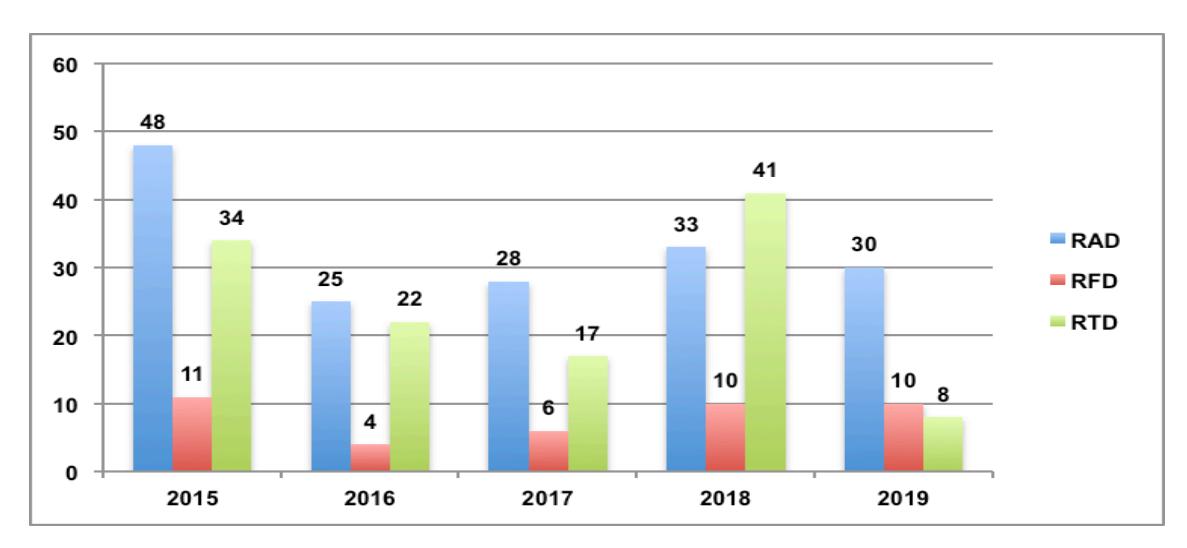
GRAFIK I APPLIED APPROACHES IN DESIGN RESEARCH (GRADUATES' THESIS 2015-2018)
Notes: RAD = Research About/Into Design, RTD=Research through Design, and RFD=Research For Design
emphasizes on how the role of object is understood, studied, and learned upon. This focus of research provides opportunities to investigate design in relation to material culture and serves as the object of discourse.
- (5) Design and environment, which emphasizes on how the intertwined of object, man, and environment is investigated, studied, and learned upon. This focus of research provides opportunities to the study scheme of sustainability, context of space, and the role of design in our environment (both physical and virtual).
- (6) Design and users' behaviour, which emphasizes on how the interaction between human (both as users and consumers) and object of design are explored, investigated, and learned upon. This focus of research provides opportunities to study design as stimuli to users' perception, attitude, and behaviors.
- (7) Design and information, which e m p h a s i z e s o n h o w t h e r o l e and element of information are explored, studied, and learned upon. This focus of research provides
opportunities to study design in relation to the flow and mechanism of information, including channels of communication, use of medium, and the role of visuals.
These 7 (seven) focuses of research serve as a foundation to explain the state of design research, as elaborated in the following section.
(2) Applied approach of research in postgraduate thesis
For the analysis, 307 master's degree thesis in design of ITB from 2015- 2019 were identified. They consist of 93 graduates' thesis of 2015, 51 graduates' thesis of 2016, 51 graduates' thesis of 2017, 84 graduates' thesis of 2018, and 29 graduates' thesis of 2019 (notably from the first period of 2019 graduation) (see table 2.0 below)
The results show that:
(a) Most graduate's thesis applied research about/into design approach (RAD) (2015: 51.6%; 2016: 49%; 2017: 54.9%; 2018: 39.3%; 2019: 62.5%; with the average of 51.6%), compared to those who applied
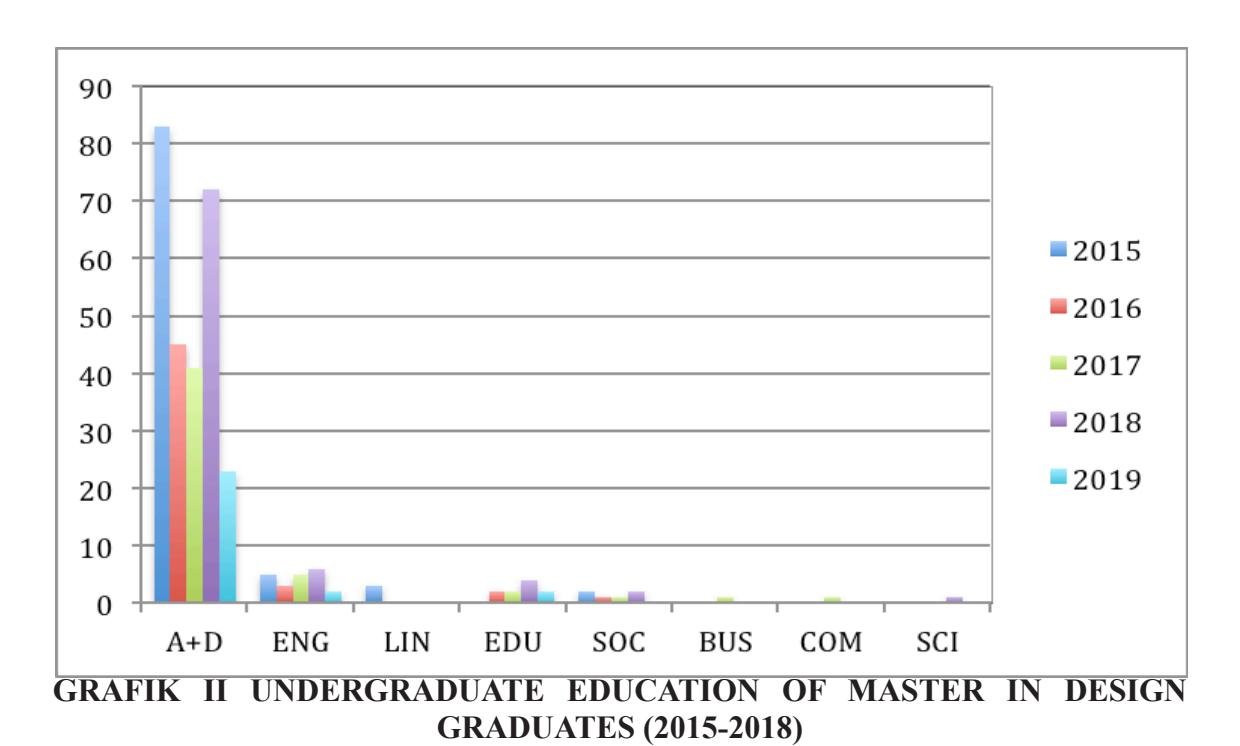
Notes: A+D = Art and Design, ENG = Engineering, LIN = Linguistics, EDU = Education, SOC = Social Sciences (including Humanities), BUS = Business and Management, COM = Communication, and SCI = Sciences
research through design approach (RTD) (2015: 36.6%; 2016: 43.1%; 2017: 33.3%; 2018: 48.8%; 2019: 20.8% with the average of 36.5%) and research for design approach (RFD) (2015: 11.8%; 2016: 7.8%; 2017: 11.8%; 2018: 11.9%; 2019: 16.7% with average of 11.9% from 2015- 2019). The results are consistent throughout 6 (six) academic years with an exception in 2018, in which graduates predominantly applied research through design approach (48.8%). This indicates that postgraduate students had comfort and confidence to apply methods and/ or procedures from other disciplines in their research. It shows that outputs of research predominantly produce knowledge of designing, which focuses on understanding the experience of designers and those who use the object of design—most notably consumers, users, and/or viewers. This result also indicates
- that master's students in design are equipped with the ability to understand and apply methods and/ or procedures of research taken from other disciplines. Considering that postgraduate students' intake come from across disciplinary spectrums, from art and design (A+D, including architecture), engineering (ENG), linguistics (LIN), education (EDU), social sciences (SOC), communication (COM), to natural sciences, the results are understandably justified (see table 3.0).
- (b) There is inclination on using research through design approach (RTD) than other approaches. In 2015, there were only 36.6% of graduates who applied RTD approach, and in 2016- 2017, there were 45.1% of graduates who applied RTD approach. Furthermore in 2018, there was 48.8% of graduates who applied RTD approach, which is higher than
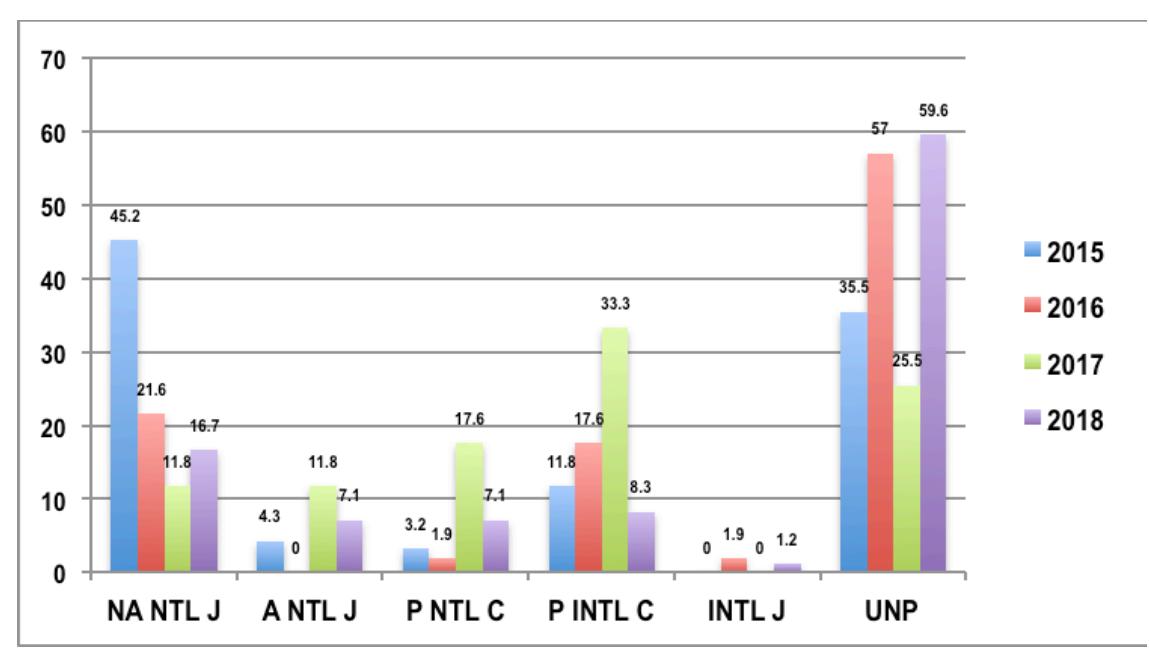
TABLE IV TYPE OF PUBLICATION (2015-2018)
Notes: NA NTL J = Non-Accredited National Journal, A NTL J = Accredited National Journal,
P NTL C = Proceeding of National Conference, P INTL C = Proceeding International Conference, INTL J = International Journal, UNP = Unpublished the average of 36.5% (2015-2019). This indicates that more and more students are willing to look upon design project as a mean to generate knowledge.
(c) The research for design approach (RFD) is gaining interests in the first period of 2019 academic year. It is applied by 16.7% of graduates, a highly significant number in comparison with 11.9% average (2015-2019). This indicates that more students are willing to use measurement tools, do empirical evaluation and incorporate testing. It is interesting, given the facts that the act of measuring, testing, and evaluating requires students to possess necessary knowledge and skills to use tools, to set experimental setting, and to apply statistical procedures.
RECENT STATE OF DESIGN
R E S E A R C H I N T H E POSTGRADUATE PROGRAM (1) Publication of Research
As previously mentioned (see sub 2.2 Approaches to Strategies in Design Research), all produced knowledge of design research is subject to discussions for other researchers. Therefore, disseminating or publishing results of research—using various channels of known publication, such as academic journals or proceedings of seminars/ conference—shall serve this purpose. For the analysis, channels of publication for graduates of 2015-2018 are identified and categorized (see table 4.0 below).
The results show that most of graduates' theses (2015-2018) are not published or disseminated to public (from 2015 to 2018, 54.8% of the graduates' theses as the average are unpublished). They are only kept at ITB library, which can be available to read upon request. Indeed, national guidelines for postgraduate education in Indonesia
state that the starting academic year of 2018, master's students are required to submit academic articles—at least in non-accredited national journal—in order to graduate. The results indicate that the graduates are only submitting their publication just to fulfil for graduation requirement per se. It seems that they do not follow through the publication process. Therefore, most of graduates' theses are exclusively kept and unknown to public in general. This will limit the extension of academic discussions and undermined the beneficial purpose of design knowledge.
In 2015, most graduates published their articles (64.5%) compared to those unpublished ones. 2016 and 2018 were the years when most graduates did not publish their articles in journal and/or proceeding of seminar, only 43% (in 2016) and 40.4% (in 2018) of graduates who published their articles. Interestingly, on those 'down' years, many graduates published their articles in the proceedings of international conferences (17.6% in 2016 and 33.3% in 2017). Further identification shows that in both 2016 and 2017, most graduates have published their papers in several international conferences:
- (1) 2017: 1st International Conference on Art, Craft, Culture, and Design (ICON-ARCADE, Bandung); 2017 International Textile and Costume Congress (ITCC, Seoul)
- (2) 2016: The International Conference INDESIGNATION (Nov 2016, Bandung)
- (3) 2015: 2015 International Textile and Costume Congress (ITCC, Istanbul Turkey); 4th International Conference on Interactive Digital Media (ICIDM, December 2015, Bandung); 2015 International Conference on New Media (CONMEDIA 2015, November 2015, Tangerang); 3rd International Human Computer Interaction and User Experience in
- Indonesia (IHCI-UXD, Jakarta)
- (4) 2014: The 12th International Conference of Asia Digital Art and Design Association (ADADA, November 2014, Jakarta)
- (5) 2013: 2013 International Textile and Costume Congress (ITCC, October 2013, Bangkok)
This indicates that graduates had eagerness to publish their researches, as long as the publication channels suit their purposes, publish date falls within their period of study, and does not have to wait for a longer period of time to know the result of the reviews, whether their papers will be published or not in which publishing in journal is usually applied. It should be note that the procedure of review to publish in a conference is relatively faster and—upon their publication—provides ample opportunities for graduates to openly discuss their findings with other colleagues.
(2) Research Focus
F o l l o w i n g t h e p r e v i o u s explanation (see 3.1 Overview of the development of postgraduate program in design at ITB), all identified graduates' theses are placed into 7 (seven) focuses of research, with the results as follow:
(a) Most of graduates' theses focus on Design and Information (2015: 46/93, 49.5%; 2016: 15/51, 29.4%; 2017: 24/51, 47.1%; and 2018: 28/84, 33.3%; with the average of 39.8%). This result indicates that most graduates' theses emphasize their research on exploring the role and elements of information either through research or design project. Given gradual trend on study of media design and design for e-culture for the past 5 years (as previously mentioned that in the past 5 years there were 5 international conferences in digital media related
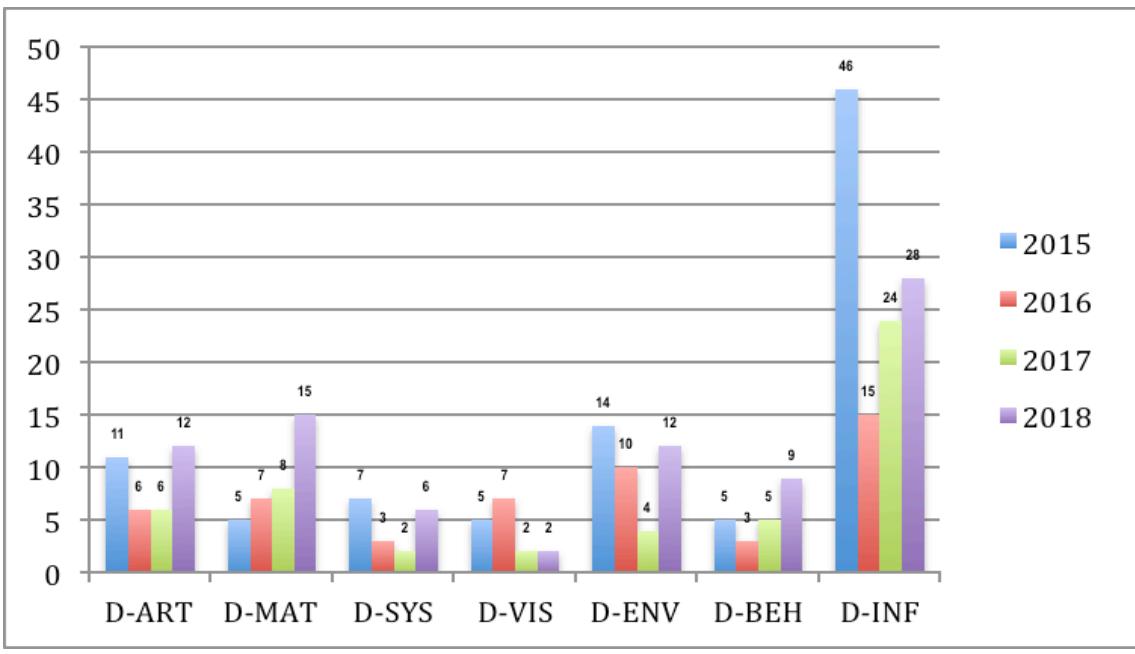
TABLE V FOCUSES OF RESEARCH IN GRADUATES' THESIS (2015-2018)
Notes: D-ART = Design and Artefact, D-MAT = Design and Material, D-SYS = Design and System, D-VIS = Design and Visual Culture, D-ENV = Design and Environment, D-BEH = Design and Behaviour, and D-INF = Design and Information
- topic), it is certainly understood that more graduate students incline their focus of research on the use of digital medium and amplifying the role of visuals in digital production, even when their background of undergraduate study are not linearly comparable.
- (b) The least graduate theses focus on Design and System (2015: 7/93, 7.5%; 2016: 3/51, 5.9%; 2017: 2/51, 3.9%; and 2018: 6/84, 7.1%; with the average of 6.10%), although it is not significantly different with other theses with focus on Design and Visual Culture (with 6.35% average). The result indicates that graduates tend to 'shy' away from research that put emphasis on the rigor of reading references and comprehensive understandings of social, environmental, and cultural phenomena.
LEARNINGS AND DISCUSSIONS
Based on the content analysis of research approach, publication, and focus of graduates' theses (2015-2018), there are several identified learning to discuss:
- (a) As research through design approach (RTD) gains more interests, the program shall provide necessary courses to support students' journey in conducting research beyond what have been offered before, most notably courses that provide procedural knowledge in doing design exploration, material experiments, and object's evaluation. Those courses shall put emphasis in providing methodological understanding to conduct research on function, form, and elements of object in relation to human activities.
- (b) While maintaining students' interests on research about/ into design approach (RAD) is necessary, it also needs to amplify research interests with research for
- (c) Students are encouraged to publish paper as part of his/her postgraduate studies yet due to the limit number of publication, it is necessary to rethink the purpose and benefit the 'traditional' way of publishing paper. If it aims to enhance academic discussions and speed up the reach of knowledge, it will be beneficial to create a regular academic exhibition and/or conference in which students are not only encouraged but obliged to publish and discuss their findings, instead of requiring students to publish their papers in a journal. Having a regular graduates' exhibition and/or conference with which students can publish and discuss their research, will certainly beneficial for design knowledge to outreach general public. At the end, this will create deeper understandings and acknowledgment on design as a discipline that stands beyond a mere 'object-making' activity.
- (d) It shall be noted that between 2015 and 2018, several 'new' lecturers were added to involve in master program
CONCLUSIONS
Recent technological advancement in rapid prototyping, 3D printing, digitalmeans, and wide array of networking channels change how design should be look for—beyond a mere of making object. Through discussions, the study exposed and directed our understanding on design as a discipline that can channel research activities and production of knowledge. By exploring master's degree thesis in design program, the paper shows that through exposition on the approach of research and research focus, we may enhance the state of research in educational setting. The study solely focuses on the postgraduate study in ITB, one of 2 (two) available postgraduate programs of design in Indonesia. Yet, postgraduate program in design at ITB is the first and foremost advanced knowledge hub of design research in Indonesia. Although the results are somewhat too narrow in scope and further studies on other institutions are needed, the study shows that we can learn from our past experiences in conducting academic program and managing research in design to prepare for more suitable and designated postgraduate education in design in the future.