

ABSTRAK
Penelitian ini bertujuan untuk menganalisis strategi dalam mengekspresikan belasungkawa yang diungkapkan anggota dari satu grup dosen di Indonesia sebagai respons terhadap berita duka yang diumumkan melalui grup WhatsApp. Penelitian ini mengkaji jenis dan urutan strategi belasungkawa tersebut. Karena data diambil dari komunikasi bermedia komputer, yaitu pesan instan, pendekatan netnopragmatik digunakan dalam kajian ini. Netnopragmatik yang diambil dari metode netnografi merupakan pendekatan yang menganalisis penggunaan bahasa pada komunitas daring. Studi ini menunjukkan anggota grup WhatsApp sering mengekspresikan belasungkawa dengan mengucapkan ayat Al-Quran yang dilanjutkan dengan mendoakan almarhum agar dosanya diampuni Tuhan YME. Hal ini terjadi karena agama yang dianut mayoritas anggota grup tersebut adalah agama Islam yang mengajarkan pemeluknya untuk berdoa saat mendengar kabar buruk. Hasil penelitian menunjukkan ekspresi belasungkawa dipengaruhi oleh agama yang dianut pemberi belasungkawa, bukan dipengaruhi agama yang dianut almarhum.
Kata kunci: Komunikasi bermedia komputer, Belasungkawa, Netnografi, Netnopragmatik, Pragmatik
INTRODUCTION
Technological advancement has brought about changes in communication. Those changes include distant communication replacing and/or preceding face-to-face communication. Several tools used for distant communication include, but not limited to, corded phones, mobile phones, and computers. With technological inventions, computers have even been integrated to mobile
phones, making what is called 'smartphones'.
This distant communication using smartphones is named computer mediated communication or CMC. CMC is a type of communication taking place using a computer or network (Kozinets, 2010). CMC can be conducted using not only smartphones, but also personal computers or laptops. However, smartphones are preferred because of their simplicity, practicality, and compactness.
Smartphones have intrigued inventors to create smartphone applications to even ease users to communicate. There are abundant applications for users to use for communication, ranging from mobile version social media apps to instant messengers. Some of these apps even allow users to create online groups so that they can broadcast information fast and easily. These online groups, also known as virtual communities, do not depend upon time, place, physical or material environments (Dijk, 2006).
When people join online groups on their instant messengers, they can receive and send information right away. They can even forward the information they receive to other online groups which they participate in. Information which people broadcast through messenger groups varies from news to announcements. Nowadays, people choose to broadcast announcements via messenger groups instead of social media groups, simply because people open their instant messengers more often than their social media accounts. In Indonesia, giving announcements through messenger group broadcast such as obituaries has become a common activity. Moreover, giving responses to such obituaries via the same messenger group is as usual as broadcasting the obituaries. Indonesians favour giving both obituaries and the responses through messenger groups because it is faster than putting the obituaries on the newspapers and/or social networking sites such as Facebook. As Indonesians are majority Muslims, it is recommended that they spread death announcements to people who are close to the deceased. Those who hear the announcement usually respond to them immediately.
The responses given to obituaries are known as condolences. Condolences are expressed in response to death announcements. Although offering condolences is common in every language and culture, each culture might express the condolences differently. In Indonesia, with the vast majority of Muslims, condolences may be given to the relatives of the deceased ones, or simply expressed on the media that the obituaries are announced. The expression of condolences, in a pragmatic point of view, is categorised into the speech act of expressive, because it is used to explain psychological behaviour of the speaker towards one occasion (Searle, 1969).
In offering condolences, there are certain strategies used such as praying for God's mercy and forgiveness (Al-Shboul & Maros, 2013). Upon hearing death announcements, most Indonesian speakers will automatically pray that God forgive the deceased to express their condolence. This research seeks to find out the speech act of expressive in a WhatsApp group, focusing on Indonesian condolences given by the members of the WhatsApp group as responses to obituaries, with the following research questions.
- 1. What kind of condolence strategies do group members use?
- 2. What strategy sequence do group members give in expressing their condolences?
- 3. What other classifications of speech acts given within the condolence strategies?
There are several studies on obituaries and condolences to respond to obituaries. One of the studies on obituaries conducted by Aremu (2011) was aimed to find out the socio-pragmatic usage of language in obituaries in Nigerian English (NE). Aremu concluded that obituaries of NE are mostly characterised by idioms, hedges, euphemisms, code-mixing, code-switching, metaphors, and lexical borrowings. Studies on condolences, on the other hand, are mostly aimed to find out the interjections and intensifiers used in expressing condolences (Moghaddam, 2012) and analyse the strategies in giving condolences (Al-Shboul & Maros, 2013; Farnia, 2008; Lotfollahi & Eslami-Rasekh, 2011). Different from the three previous research mentioned, this study investigates the sequence of strategies used by Indonesians whose profession is lecturer in expressing condolences in response to obituaries published in their WhatsApp group. This study takes condolence strategies proposed by Al-Shboul and Maros (2013). Moreover, this study explores the other classifications of speech acts consisting within the condolence strategies, which belong to the speech act of expressive.
This research contributes to the field of pragmatics, especially interactions conducted on the network. The study is beneficial in enriching the variety of analyses of speech acts on the Internet and stimulating interest among language observers to continue conducting similar study. In addition, this research is also practically useful in familiarising Indonesian condolences to learners of Indonesian language and proposing a new approach of data collection through interactions, which is more reliable than DCTs, role plays, and/or questionnaires.
METHOD
Since this study examines an existing phenomenon, i.e. the language use between participants of an online group through CMC, the best method to use is ethnography. Some terms on ethnographic studies conducted to online participants are, but not limited to, 'virtual ethnography' (Hine, 2000), 'Computer Mediated Discourse' or CMD (Herring 2001), and netnography (Kozinets, 2010). Meanwhile, the term used in this study is Kozinet's netnography or network ethnography because it is the most relevant with this research.
Since netnography can also be used to study "people's linguistic practices online –the ways they are actually interacting and conversing with each other" (Thurlow et al. 2004, p. 120)(theory, the most suitable approach to use is netnopragmatics, short from netnographic pragmatics (Putri, 2016). This approach is opted because it is in line with Kozinet's pragmatic interactionist approach in which the unit of analysis includes the speech act or utterance. Netnopragmatics adapts Kozinet's research steps, they are 1) planning and entree, 2) data collection, 3) data analysis, 4) research ethics, and 5) representation and evaluation. Netnopragmatics also relates participants' utterances to their types of participation and the ties between members.
Data were collected from a WhatsApp group consisting of 38 participants. All members are lecturers at Sekolah Tinggi Bahasa Asing Yapari-ABA whose religions are Islam, Protestantism, and Catholicism, with majority Muslim participants (33 Muslims, 3 Protestants, and 2 Catholics). The members' religions affect the choice of strategies they use to express condolences. There are 6 obituaries collected within five months and 68 responses in total. In order to keep the confidentiality of participants' identities, WhatsApp numbers are hidden and names are written in initials.
Observation and screen capture were used to collect the data. Data are named orderly from the dates the conversation took place. They were then coded using the coding manual proposed by Saldaña (2009), which consist of three steps: 1) open coding, 2) axial coding, and 3) selective coding. Condolence data are openly coded based on the research questions to find out the patterns in the utterances. Afterward, the coded data are elaborated using explanatory paragraphs referred to theories.
Speech Acts and Politeness
An action carried out through an utterance is called speech act. The term 'speech act' was first introduced by Austin (1962) who claimed that there was a specific purpose or act beyond an utterance given by the speaker. Austin proposed three levels of speech acts: (1) locutionary act, which is the actual utterance made up of syntactic and semantic features; (2) illocutionary act, which is the true meaning of the utterance consisting of acts performed via that utterance; and (3) perlocutionary act, which is the utterance's actual effect on the hearer. Nevertheless, the study of speech acts basically focuses on the second level, i.e. illocutionary act.
There are five classifications of speech acts proposed by Searle (1969) which are the improvements of Austin's: (1) representatives, which commit the speaker to what he believes to be true or false such as concluding and suggesting; (2) directives, which expect the hearer to perform an action such as ordering, requesting, and questioning; (3) commissives, which commit the speaker to some future actions such as promising, inviting, and offering; (4) expressives, which express an attitude like thanking, welcoming, congratulating; and (5) declaratives, which change the world by declaring that it is changed such as blessing, marrying, and firing (p. 240). Those performative acts mean nothing when they are not uttered or performed at the right time, at the right moment, with the right contexts, by the right speaker, and to the right hearer. Moreover, speech acts are inseparable from politeness, owing to the cultural values of the community the speech acts are performed.
Speech act strategies are determined by the relationship between the speaker and the hearer. The language choice the speaker uses prior to expressing the utterance varies, since the speaker wants to maintain a good relationship between him and the hearer. Politeness phenomena are put into practice because they are the "exercise of language choice to create a context intended to match the addressee's notion of how he or she should be addressed" (Grundy, 2000, p. 145). Brown and Levinson add that speech acts potentially threaten both the speaker and the hearer's faces because somehow they violate either the speaker or the hearer's deference (in Ogiermann 2009, p. 11). It is therefore important to know what kind of politeness and what kind of face implemented in one culture.
Indonesian culture is one of many others applying negative politeness in interactions, which can be shown from the length of an utterance given by a speaker. Indonesians use different addressing systems to people who are older or younger, in a higher or lower level, and closer or more distant level of solidarity. Addressing systems such as Bapak 'Mr.', and Ibu 'Ms.' are still expected to use despite the use of first name. The addressing systems are still mostly used even though the speakers have known each other for some time. There are two types of politeness implementation in Indonesian speech acts: linguistic politeness and pragmatic politeness. Linguistic politeness is realised from the length of an utterance, the order of an utterance, the intonation or kinaesthetic signs of an utterance, and the use of politeness markers such as tolong 'please', coba 'why not...', ayo 'let's' etc. (Rahardi 2005, pp. 118-125). On the other hand, Rahardi adds that in pragmatic politeness, different sentence forms are given in the realisation of imperative utterances. For instance, the speech act of command may be realised in an interrogative form of utterance.
Over the past 30 years, studies on speech acts and politeness have been conducted on various kinds, in numerous languages, communities and cultures, and on many communication media. However, only a few have studies on speech acts of obituaries and condolences been done; whereas in fact, obituary announcements and giving condolences are culturally different and made up of complex linguistic features. In Indonesian culture itself, giving condolences is one of the most awkward moment the speakers and hearers encounter. It is even more awkward when the condolences are expressed through a text message; because most of the time, when the death announcement is broadcasted especially through a mailing list or group, people tend to give their condolences to the mailing list or group, not directly to the bereaved.
Speech Act of Obituaries
For approximately a decade, the definition of obituaries has expanded to not only a notice of a person's death published in a newspaper, but also a death announcement in general. Hence, obituaries may be broadcasted in any media, including social media and instant messengers. As a country which citizens are majority Muslims, it is obligatory that Indonesians announce someone's death to others fast.
Since obituaries are aimed to announce someone's death, changing the state of the world immediately, it is then categorised into Searle's declaratives speech act (Searle, 1969). There are certain linguistic features used in declaring death news, which are influenced by the cultural beliefs of one community. In Indonesia, when the deceased was a Muslim, the obituary announcement typically starts with Inna lillahi wainnailaihi rajiun which means 'Indeed we belong to Allah, and indeed to Him we will return', followed by the announcement of death.
On the other hand, when the deceased was a Christian or Catholic, the obituary frequently starts with Telah berpulang ke rumah Bapa di surga which means 'Returning safely to Heavenly Father', or simply with 'Rest in Peace'. The three beginnings of an obituary show that there is a religious influence in giving a death notice, aimed to show the religion of the deceased. This is in line with Aremu who states that obituaries consist of shared religious, socio-cultural, and linguistic background knowledge (2011, p. 133).
Nevertheless, today's obituaries in Indonesia are not only broadcasted on newspaper, radio, or television; but they are also announced on social media and instant messenger groups in order to spread the news immediately. Announcing death news through instant messengers are preferred because it is faster and cheaper than putting it on a newspaper. Besides, it usually takes less than a day for the deceased to be buried. Thus, his death needs spreading right away so that his friends and relatives can say their last goodbyes.
Speech Act of Condolences
It is customarily expected that whoever hears death news express their grief through condolences. The word 'condolence' is derived from Latin com, which means 'together'; and dolere, which means 'to grieve' (Zunin & Zunin 2007, p. 4). As previously mentioned that condolences belonged to Searle's expressive speech act, there is an emotion carried by the utterance.
Condolences, from social point of view, are given to maintain the relationship with the bereaved. Expressing sympathy to the bereaved may be given both verbally and non-verbally. Giving condolences can make the situation awkward because the giver might not prepare
what to say or do. Kuang (2015) points out that expressing condolences verbally are private and personal, therefore it is vital to properly opt the words (p. 3). Should the condolences be given verbally, Zunin & Zunin (2007) suggest that the utterance must contain COM-FORT, which stands for:
- a. Comments on the loss and mention the name of the deceased
- b. Offering sympathy
- c. Mentioning one or two significant traits of the deceased (eulogise)
- d. Finding a favourite memory of the person
- e. Offering help or provide company to the bereaved
- f. Reminding the bereaved of the outstanding qualities and strong personalities of the deceased
- g. Thoughtfully closing with some final comforting words (in Kuang 2015, p. 3)
One of Zunin & Zunin's COM-FORT strategies, offering help or provide companionship, can only be given directly to the bereaved; the rest might also be expressed without the presence of the bereaved. In response to obituaries posted on social media or instant messengers, most condolences are not directly given to the grieving; on the other hand, people reflexively express their sympathy on the same place the obituaries are notified. As a follow up, those who are notified may send a personal message to the person who is mourning. The indirect condolences, according to Al-Shboul & Maros (2013), are expressed using seven major different strategies.
- a. Praying for God's mercy and forgiveness Giving expressions to pray for God's mercy and forgiveness for the deceased
- b. Reciting Quranic verses
- Reciting certain Quranic verses for the deceased
- c. Enumerating the goodness of the deceased Expressing the deceased's positive virtues, qualities, traits, and works
- d. Expressing shock and grief Using expressions of regret, grief, shock over the loss of the deceased
- e. Offering condolences Using words to express condolences and sympathy
- f. Realising that death is a natural part of life Using expressions indicating that death is inevitable
- g. Using proverbs and saying Using proverbs and sayings in expressing the condolences
The closeness of the person with the deceased determines the use of condolence strategies. Similarly, the power that the deceased had over the person also influences the choice of strategies. This is actually in line with Brown & Levinson's (1987) degree of solidarity, relative power, and/or absolute ranking of impositions as influencing aspects in opting out the strategies.
RESULTS AND DISCUSSION
Data analysis is categorised into four sections: 1) obituaries, 2) condolence strategies, 3) sequence of condolence strategies, and 4) speech act classifications within condolence strategies. The first section discusses obituary announcements and how many people responded to those obituaries. The second section analyses condolence strategies used by group participants in responding to the obituaries. The third section elaborates the orders of condolence strategies given by participants. Finally, the last section explains non-expressive speech acts contained in condolences.
| OBITUARY | RESPONSES |
|---|---|
| Obituary 1 | 17 |
| Obituary 2 | 4 |
| Obituary 3 | 7 |
| Obituary 4 | 11 |
| Obituary 5 | 5 |
| Obituary 6 | 11 |
| Obituary 7 | 2 |
| Obituary 6 and 7 | 5 |
Total 62
TABLE I OBITUARY AND NUMBER OF RESPONS
Obituaries
There are seven obituaries announced in WhatsApp group of lecturers in three months. The first obituary, a death announcement of one colleague, invited 17 responses from participants. The second obituary which announced a celebrity's death had 4 responses from members of the WhatsApp group. The third obituary announces the death of an art tutor, one of the members' colleagues. 7 condolences are given as responses to the obituary. Next obituary about the death of a participant's relative had 11 responses and 5 condolences are expressed in response to a death announcement of an Indonesian senior celebrity. The sixth death news got 11 responses. It was the death of a member's grandfather. Lastly, obituary on the wife of a colleague invited 2 responses. Obituaries and the numbers of their responses can be seen in Table I.
The data collected also show that condolences were given to two obituaries, i.e. obituary 6 and 7 all at once. It is because both obituaries were broadcasted almost at the same time; more precisely, obituary 7 was given by a participant
after he read obituary 6. There were 5 condolences given to both obituaries. This is not impossible to happen because instant messaging is both interactive and instantaneous, which means the message is read right after it is written (Bodomo 2010, p. 200).
Most obituaries were announced preceded or followed by Arabic expression Inna lillahi wainnailaihi rajiun 'Indeed we belong to Allah, and indeed to Him we will return'. From the expression, it can be clearly seen that either the deceased or the participant announcing the news was of Islamic faith. However, from the utterance, there is a slight difference between the preceding position of the Arabic expression and the expression that follows the announcement. When the expression is given before the news, it actually anticipates other members that an announcement of death is going to be told. On the contrary, the announcer's condolence is shown when the Arabic phrase Inna lillahi wainnailaihi rajiun or simple Innalillahi is uttered after the news. The followings are the 7 obituaries announced in the WhatsApp group.
Obituary I
Berita duka: Ibu N. meninggal dunia. INNA LILLAHI Obituary: Ms. N. passed away. INNA LILLAHI
'An obituary: Ms. N passed away. Inna lillahi.'
Obituary II
Selamat jalan, Olga Syahputra.. INNA LILLAHI WAIN-ALLAHUMAGFIRLAHU
NAILAIHI RAJIUUN… WARHAMHU WAAFIHI
WA'FU ANHU…
Goodbye, Olga Syahputra.. Indeed, we belong to O Allah! Forgive him,
Allah, and indeed to Him we will return…
bestow mercy upon him, pardon him, accord him a noble provision…
'Goodbye, Olga Syahputra. Indeed, we belong to Allah, and indeed to Him we will return. Allah! Forgive him, bestow mercy upon him, pardon him, accord him a noble provision.'
Obituary III
Baru dari salah pelatih kesenian STBA: Aris Supena, meninggal…
baca FB, seorang
Just from one of coach art and STBA: Aris Supena passed away…
read FB music
Saya merasa kehilangan sekali. INNA LILLAHI. I feel loss terrible INNA LILLAHI.
Dulu waktu saya di GS selalu bareng + ngobrol.
past infl. when I in GS always together and talk.
Obituary IV
Adik almarhum ayah nya Pak T. meninggal. Brother Late father possessive pronoun Mr. T passed away.
'The brother of Mr. T's late father passed away.
Obituary V
Inna lillahi wainnailaihi rajiun… TELAH BERPULANG KE Rahmatullah Indeed, we belong to Allah, and indeed to Him we will return… present perfect returning To Allah
INSAN FILM… GURU BESAR, SENIMAN INDONESIA, AKTOR SENIOR, worker film industry Professor, artist Indonesian actor Senior
'I just read from Facebook that one of art and music coaches of STBA, Aris Supena, passed away. I feel a terrible loss. Inna lillahi. When I was in GS, we were always together and talk.'
Didi "Emon" Petet… HARI JUMAT PUKUL 5 PAGI SETELAH SALAT SUBUH. Didi "Emon" Petet… Day Friday time 5 a.m. after prayer Fajr. RENCANA PEMAKAMAN ba'da JUMATAN Inshallah Khusnul Khatimah. plan Funeral after Friday prayer if Allah wills it die in peace.
Aamiin Ya Rabb.
Ameen O Allah.
'Indeed, we belong to Allah, and indeed to Him we will return. Returning to Allah, a film industry worker... A professor, an Indonesian artist, a senior actor, Didi "Emon" Petet on Friday at 5 a.m. after Fajr prayer. The funeral is planned to be held after Friday Prayer. If Allah wills it, he died in peace. Ameen, O Allah.'
Obituary VI
Inna lillahi wainnailaihi rajiun… TELAH BERPULANG KE Rahmatullah Indeed, we belong to Allah, and indeed to Him we will return… present perfect returning to Allah
KAKEK DARI IBU I. TADI SIANG PUKUL 12:10. grandfather Of Ms. I. past afternoon time 12:10.
MUDAH-MUDAHAN DITERIMA IMAN ISLAM NYA, Hopefully (passive) accepted faith Islamic his
DIBERI KESABARAN UNTUK KELUARGA (passive) given forbearance to Family
YANG DITINGGALKAN NYA AAMIIN. who (passive) left him Amin.
'Indeed, we belong to Allah, and indeed to Him we will return. Returning to Allah, Ms. I's grandfather this afternoon at 12:10. Hopefully, Allah accepts his Islamic faith, and gives forbearance to the bereaved. Amin.'
Obituary VII
Inna lillahi wainnailaihi rajiun… TELAH BERPULANG KE Rahmatullah Indeed, we belong to Allah, and indeed to Him we will return… present perfect returning to Allah
IBU ERNI ISTRI Prof. Fakri MANTAN REKTOR UPI. Mrs. Erni Wife Prof. Fakri former rector UPI.
Allahumagfirlaha warhamha waafiha wa'fu anha.
O Allah! Forgive him, bestow mercy upon him, pardon him, accord him a noble provision.
'Indeed, we belong to Allah, and indeed to Him we will return. Returning to Allah Mrs. Erni, Prof. Fakri's wife, a former rector of UPI. O Allah! Forgive her, bestow mercy upon her, pardon her, accord her a noble provision.'
Of all the 7 obituaries, only one obituary was announced without being preceded nor followed by the phrase Inna lillahi wainnailaihi rajiun, that is Obituary 4. The other 6 actually show that both the deceased persons and the obituary givers were Muslims. Except Obituary 4, participants who broadcasted the obituaries in the WhatsApp group also expressed their condolences within their announcements. The most common condolence strategy given by the participants in their death announcements is 'praying for God's mercy and forgiveness for the deceased'. In Indonesia, it is not uncommon for people who broadcast an obituary to give their condolence as they announce the death.
Condolence Strategies
From 65 responses to 7 obituaries, there are as many as 101 condolence
strategies found within those responses. Not one was 'using proverbs and saying' condolence strategy found in the data. The total number of condolence strategies can be seen in the following figure.
It can be clearly seen from the figure that 'reciting Quranic verses' condolence strategy (e.g. Inna lillahi wainnailaihi rajiun 'Surely we belong to Allah and to Him shall we return') is the most used by the participants of the WhatsApp group, with a total of 48. The second most common strategy used by the group members for 27 times is 'praying for God's mercy and forgiveness' (e.g. Semoga amal ibadahnya diterima Allah SWT 'May the good deeds be accepted by Allah SWT' and ALLAHUMAGFIRLAHU WARHAMHU WAAFIHI WA'FU ANHU 'O Allah! Forgive him, bestow mercy upon him, pardon him, accord him a noble provision'), followed by the third most frequent strategy 'offering condolences' (e.g. Turut
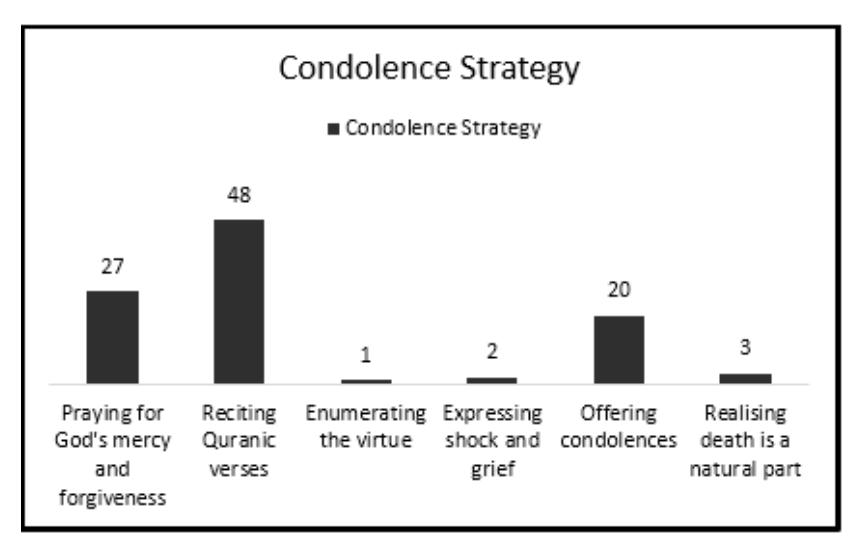
Figure 1 Total number of condolence strategies
berduka cita 'My deepest condolence') which was used 20 times. Majority of the participants opted the two most common strategies because it is of Islamic teaching, and one of the Prophet Muhammad's Sunnahs to express certain Quranic verses and recite any prayer for the deceased (Gul, 2013).
The 'enumerating the virtue of the deceased' strategy is used by one participant to express her condolence on the death of a celebrity announced in that group. On the other hand, 'expressing shock and grief' strategy is found to be used on the death announcements of both a colleague and a celebrity. In a WhatsApp conversation, emoticons can be used to express the writer's emotions. The use of an emoticon in expressing sadness or grief is also found in the data.
In addition, the condolence strategy 'offering condolences' is typically given to the bereaved participating in the WhatsApp group. Members of the group sent their condolence to the grieving participants through the group conversation, not by private chats to the mourning. It is also found that one participant expressed his condolence using a mixing of Sundanese and Indonesian language with the 'realising death is a natural part of life' strategy (Ari dugi tos waktosna dipundut yuswa. Teu aya anon atanapi sepuh. KE-MATIAN BISA DATANG TIBA-TIBA. 'When the time comes for us to leave this world. No matter when we're young or old.
Death can come anytime.') preceded by the strategy of 'praying for God's mercy and forgiveness' (Mugia almarhum kenging ampunan sareng rohmat Alloh SWT. 'May Allah grant the lamented His mercy and forgiveness.').
Since Indonesians are multilingual speakers, it is common to find people interact with each other using mixed languages. In the case of expressing condolences, Indonesian speakers, especially those who are Muslims, frequently use Arabic phrases such as Inna lillahi wainnailaihi rajiun and Allahumagfirlahu warhamhu waafihi wa'fu anhu to pray for the deceased mixed with condolence expressions in Indonesian or local dialects. Thus, people usually assume that Indonesian speakers who do not use such Arabic phrases when expressing their condolences do not have Islamic belief. They may be Protestant, Catholic, Buddhist, Hindu, or other faiths.
Sequence of Condolence Strategies
Condolence strategies are not always expressed on their own; chances are one condolence strategy can be preceded or followed by another strategy. Of all 101 condolence strategies found in the data, not all strategies stand by themselves. Some are combined with other strategies forming a sequence. The following table shows sequences of strategies given by the participants in their condolences.
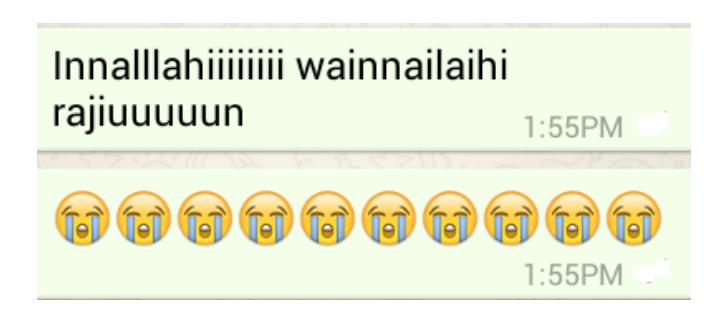
Figure 2 Emoticon used to express grief
TABLE II CONDOLENCE STRATEGY SEQUENCES
| No. | Strategy Sequence | Number |
|---|---|---|
| 1 | Reciting Quranic verses | 26 |
| 2 | Reciting Quranic verses + praying for God's mercy and forgive | 10 |
| ness | ||
| 3 | Offering condolences + praying for God's mercy and forgiveness | 6 |
| 4 | Reciting Quranic verses + offering condolences | 5 |
| 5 | Offering condolences | 4 |
| 6 | Reciting Quranic verses + offering condolences + praying for | 3 |
| God's mercy and forgiveness | ||
| 7 | Reciting Quranic verses + praying for God's mercy and forgive | 2 |
| ness + offering condolences | ||
| 8 | Praying for God's mercy and forgiveness | 2 |
| 9 | Reciting Quranic verses + expressing shock and grief | 1 |
| 10 | Enumerating the virtue of the deceased + praying for God's mercy | 1 |
| and forgiveness | ||
| 11 | Expressing shock and grief + praying for God's mercy and for | 1 |
| giveness | ||
| 12 | Praying for God's mercy and forgiveness + realising death is a | 1 |
| natural part in life | ||
| Total | 62 |
There are 12 condolence strategy sequences found in 62 responses to 7 obituaries. The most frequent sequence consists of only one condolence strategy, i.e. 'reciting Quranic verses'. As many as 26 responses comprise with the strategy. The Quranic verse given is all the same, i.e. Inna lillahi wainnailaihi rajiun. Despite the meaning of the Quranic verse, i.e. 'We belong to Allah and to Him we shall return'; in Islamic belief, the verse can also be used when hearing a tragedy happening to someone that may involve any risks. Therefore, it is customarily accepted to express that only Quranic verse upon someone's death news.
To add up, it is an expected custom in Islam to say a prayer for God's acceptance of the deceased's good doings. Hence, the second most common sequence found in the data is 'reciting
Quranic verses' followed by 'praying for God's mercy and forgiveness'. As a group with majority Muslim participants, it is not unusual to find responses to obituaries with such strategy sequence. Two most common responses using the sequence are Inna lillahi wainnailaihi rajiun. SEMOGA AMALNYA DITERIMA ALLAH SWT. 'Surely we belong to Allah and to Him shall we return. May the good deeds be accepted by Allah SWT' and Inna lillahi wainnailaihi rajiun. Allahumagfirlahu warhamhu waafihi wa'fu anhu. 'Surely we belong to Allah and to Him shall we return. O Allah! Forgive him, bestow mercy upon him, pardon him, accord him a noble provision.'
From the data on condolence strategies found, it can be pointed out that participants whose religious faith was Islam commonly indicated their faith
TABLE III NON-EXPRESSIVE SPEECH ACTS WITHIN CONDOLENCES
| No. | Utterance | Strategy | Speech Act |
|---|---|---|---|
| 1 | Semoga amalnya diterima Allah SWT May the good deeds be accepted by Allah SWT | Praying for God's mercy and forgive ness | Directive |
| 2 | Allahumagfirlahu warhamhu waafihi wa'fu anhu O Allah! Forgive him, bestow mercy upon him, pardon him, and accord him a noble provision. | Praying for God's mercy and forgive ness | Directive |
| 3 | Di Trans TV lagi in memoriam Olga Syahputra,,,, waas sok dibully wae dia teh,,,, dia juga yang mengangkat derajat keluarganya,,, terus sensiti fan Olga teh. | Enumerating the virtue of the deceased | Representa tive |
| There is a show 'In Memoriam Olga Syahputra' on Trans TV. He was so poor because there were many people bullied him. He was also the one who brought his family up. He was sensitive as well. | |||
| Insya Alloh sakitnya melunturkan dosa2na, Aamiin yra | Praying for God's mercy and forgive | Directive | |
| Inshallah his sickness rids his sins. Amin. | ness | ||
| 5 | Mugia almarhum kenging ampunan sareng rohmat Alloh SWT. | Praying for God's mercy | Directive |
| May Allah grant the lamented His mercy and forgiveness. | and forgive ness | ||
| 6 | Ari dugi tos waktosna dipundut yuswa. Teu aya anon atanapi sepuh. KEMATIAN BISA DATANG TIBA-TIBA. | Realising death is a natural part of life | Representa tive |
| When the time comes for us to leave this world. No matter when we're young or old. Death can come anytime. | |||
| 7 | Semoga almarhum KHUSNUL KHATIMAH. May the deceased rest in peace. | Praying for God's mercy and forgive ness | Directive |
| 8 | Semoga arwahnya diterima oleh Tuhan YME. May his soul be welcomed by the Almighty God. | Praying for God's mercy and forgive ness | Directive |
through the condolence strategy and strategy sequences they expressed. On the other hand, participants who were not of Islamic belief did not use any Quranic verse recitation to express their condolences, such as Pak T turut belasungkawa ya. Semoga arwahnya diterima oleh Tuhan YME. 'Mr. T my deepest condolence. May his soul be welcomed by the Almighty God.' However, not all strategy sequences which do not consist of Quranic verse recitation were expressed by the non-Muslim members. Some Muslim participants insisted on using Indonesian language in order to show their negative politeness to those who mourned. For instance, there is a condolence given by a Muslim member to a mourning participant using full Indonesian simply to pay respect of the mourner's position in the workplace (Bu H, saya mengucapkan turut berdukacita atas berpulangnya ibu NH. Mohon maaf tidak bisa melayat. 'Ms. H, please accept my condolence on the death of Ms. NH. I apologise for not being able to make a visit.')
All in all, there are some condolence strategy sequences which expressed the emotions of the condolence givers. It can be assumed that majority of participants who used Quranic verse recitation, prayers, and/or condolence offer in their sequences simply expressed the sympathies because they felt obliged to do so. On the contrary, when members added the sequence with expression of grief and sadness and also with enumeration of the deceased's virtue, they actually conveyed their emotional feelings on the deceased.
Speech Act Classifications within Condolence Strategies
Even though condolences belong to the speech act of expressive, the utterance expressing grief can consist of several other speech acts. This speech
act within speech act under one speech event commonly occurs in utterances. Data shows that most condolence strategies do fall into expressive speech act category; however, some strategies can be categorised into other classifications of speech act.
It is obvious that reciting Quranic verses such as Inna lillahi wainnailaihi rajiun is classified into expressive speech act. Offering condolence as well as expressing shock and grief also belong to expressive speech act. However, praying for God's mercy and forgiveness falls into the directive speech act. This is due to the request contained in the utterance; in other words, the speaker requests that God grant mercy to the deceased.
Other condolence strategies, enumerating the virtue of the deceased and realising death is a natural part in life, are categorised into representative speech act because they contain a truth-value which the speakers believe. Table 3 shows utterances in condolences which correspond to speech act other than expressive (table III).
CONCLUSION
A condolence is given as a response to an obituary. Even though expressing sympathy on someone's death can be a part of everyday interactions, it is not an easy thing to do. When someone offers his sympathy, it can lead both the mourner and the condolence giver to an awkward moment. It is even more awkward when the condolence is given via a text message. Thus, it is expected that whoever lives in one community be familiar with the customs of responding to obituaries.
Nowadays, it is a usual thing in Indonesia to publish obituaries online through a group broadcast. Indonesians take part in more than one instant messaging group, hence they tend to send
death announcements through instant messaging because it is faster and people must read the broadcasts immediately, which in turn respond to them also immediately. Because Indonesians are majority Muslims, it is not uncommon to find obituary responses consisting of a Quranic verse recitation. It is what Muslims are taught –saying a prayer right after hearing or experiencing a tragedy. Expressing condolences using a Quranic verse actually indicates a person's religion, i.e. Islam. The Quranic verse recitation does not somehow show the condolence givers' emotions. Therefore, in order to pay respect to either the mourners or the deceased and to maintain the use of politeness in their condolences, some Indonesians including those who are Muslims still choose the use of Indonesian language. Moreover, the condolence strategies they prefer to use also point out their emotions.
This study of condolence strategy introduces data collection technique taken from instant messaging interactions. WhatsApp messenger is chosen as data source. This research also promotes a pragmatic analysis using netnography method, involving members of online community, named netnopragmatics.
However, this study is limited to one WhatsApp group consisting of only 38 participants. Most members are Muslims and of Sundanese descendants, so they tend to use Indonesian, Sundanese, or a mix of both Indonesian and Sundanese languages with certain Arabic expressions. Therefore, it is expected that the next studies expand the community to not only Sundanese, but also all ethnics in Indonesia. Other researchers interested in pragmatics, especially language use in computer-mediated communication, are also expected to conduct similar research to online communities from various religious backgrounds.