

ABSTRAK
Upaya pelestarian kawasan pusaka yang terletak di pusat kota tidak mudah. Dalam studi kasus ini, Perumahan Darmo memiliki beragam masalah, mulai dari pajak tanah yang tinggi, masalah pemeliharaan gedung, dan perubahan fungsi karena tekanan ekonomi. Meskipun telah ada peraturan untuk melestarikan kawasan tersebut, namun kecenderungan mengubah bangunan lama menjadi baru terus terjadi.Penelitian ini menggambarkan proses pelestarian di area yang cukup luas, terletak di kota Surabaya, Indonesia. Pelestarian pada tingkat kawasan bukanlah prioritas dibandingkan dengan pelestarian bangunan yang telah mendapatkan lebih banyak dukungan dari Pemerintah Kota Surabaya, meskipun baik warga dan pemerintah menganggap Perumahan Darmo sebagai bagian yang sangat penting dari kota. Oleh karena itu, penelitian untuk mengeksplorasi kesadaran penduduk menjadi penting. Kawasan Darmo adalah salah satu daerah perumahan yang dirancang tertua di bagian timur Indonesia dan telah dinominasikan oleh Kota Surabaya sebagai kawasan pusaka yang perlu dilestarikan. Bagi warga Surabaya, permukiman Darmo dianggap sebagai daerah perumahan lama yang memiliki karakteristik khusus yang tidak dapat ditemukan di bagian kota yang baru dibangun. Untuk melestarikan kawasan cagar budaya; penting untuk menjaga penampilan arsitekturnya, lingkungan alam, faktor sosial, karakter historis, kualitas lingkungan umum dan morfologi tetap utuh tetapi adaptif. Oleh karena itu, penelitian ini berfokus pada tanggapan warga Darmo terhadap perencanaan, dan apa pendapat dan tantangan penghuni tentang daerah tersebut. Ppenelitian empiris dilakukan pada penduduk yang tinggal pada bangunan yang berfungsi sebagai rumah dan tempat komersial. Temuan tantangan oleh warga usia lanjut dalam membiayai pemeliharaan. Juga ditemukan kebutuhan untuk menyesuaikan sistem utilitas bangunan dan mendesain
ulang kamar di bangunan komersial.
kata kunci: konservasi kawasan cagar budaya, kesadaran penghuni, perencanaan dan kebijakan dalam pelestarian kawasan cagar budaya
INTRODUCTION
The problems within urban heritage areas are mostly borne by its inhabitants. A research focused on peoples' opinion toward aims, objectives and benefits of conservation heritage area in Surabaya has not yet been done. The heritage area can also be considered new constraint in the city policy, for instance density, zoning and building height regulation. The first problem is financial challenges, the second problem is the preference for modern buildings, and the third is changing activities within the cities. Along with the growth of the city from 750 thousand inhabitants in the year 1950 to around 3 million people in year 2010, it is also expected to effect spatial changes, the growth of the city and economical changes.
This research observes Darmo area, a mixed use residential area that is located close to the city center of Surabaya, consisting of 24 Streets. Within this old environment many buildings changed and recently in 2008 local authorities decided to conserve 600 buildings that have been considered as a significant representative of heritage buildings. By being located closed to the city area, this area is highly contested. The buildings in the arterial streets have changed its function from houses to commercials. Other buildings which are located in the smaller street scale have remained as houses. The response of the people as owners of private building and tenants toward conservation planning needs to get more attention. There are changing activities that implies to the changing in function of the buildings. It was found that several buildings follow and others do not follow the heritage regulation. It raises the question whether people are aware if
Darmo area is a heritage site and whether they understand the purpose of the urban heritage conservation.
The logic in the unique features of the old buildings in Darmo area has benefits for the city as a lung and oasis. This is a place for citizens to enjoy the old part of Surabaya city. The area maintains uniqueness and the image of the historic environment of Indonesian independence. To achieve this purpose, in 2005 the Surabayan government declared the regulation of urban heritage conservation. This policy mentioned that the criteria for listing sites is based on age, authenticity, historical significance, rareness, and the contribution to scientific knowledge. The heritage expert team consisted of architects, urban planners, historians and academician to assess all of built heritage and sites in the Surabaya city. Darmo area was designed as a residential area together with eight other residential areas in Surabaya in around 1906-1940, by the Municipality as the developer to overcome the housing shortage (Dick in Nas 2002, p. 115).
METHODS
This paper uses case study method, in order to learn from the case of Darmo area. The research aims to develop the concept of conservation planning in a mixed use residential heritage area. In a rapidly growing economic of the Indonesian cities implies to the changing of the heritage buildings and areas. The current approach uses urban design regulations to control the buildings and areas, but does not take into account the opinion of the owners and occupiers as inhabitants. Semi structured questionnaires and interviews were conducted with 64 respondents as owners and occupiers of the listed buildings in Darmo in 2014. The field work aimed to find the challenges faced by the inhabitants. The decisions and policy in the urban heritage area that has been done does not explore the problems of the inhabitants.
The research examined problems and potentials of urban heritage area. It also observes the form of communication between the local authority and the local people as to whether the inhabitants are aware of the regulations. Previous study on people attitude toward conserving urban heritage area
The research began by questioning why it is important to take into account the people. Since the city is a unique entity, Amundsen in Hague and Jenkins (2005, p.10) identifies factors that determined the differences from one place to other. The identified factors are firstly spatial qualities that include communication and infrastructure. The second factor is that, the characteristic of the inhabitants is embedded in their values, customs, and physical appearances. The third factor is social conditions and social relations between the inhabitant and the final aspect is culture and or history.
Inhabitants's response toward conservation planning is not yet broadly researched, their perception of the purpose, advantage and disadvantage of the conservation of urban heritage area has not yet been widely studied. (Pendlebury, 2009, p.139). Local peoples' participation is considered essential in urban heritage conservation. Planning based on a places' character will raise more participation. (Townshend and Pendlebury (1999), Malpass (2009), Hague and Jenkins 2005):
- Successful management of urban heritage conservation is determined by the owners and occupiers concern
- Urban heritage area is part of identity of the city therefore the
Heritage areas: four case studies
Previous studies have also focused on people's involvement in urban heritage areas. The challenges, motivation factors and perceptions of the peoples have been discussed in the UK by Tim Townshend and John Pendlebury since in 1999, in Egypt by Dalia A. Elsoradi in 2011, in Hongkong by Esther J.K. Yung and Edwin H.W. Chan and in Thailand by Wannasilpa Peraapun in 2011. All of them are cases of residential heritage, built after the 1940s, almost in the same year as the Darmo settlement in Surabaya, the focus of the research's case study. These scholars have studied the inhabitants' awareness of their place. They have found similar aspects that indicate the approaches of engaging people and community-driven development within urban heritage conservation. Indicators of a successful heritage programme can be seen in the conservation of façades, cleanliness, improvements in the area, satisfactory living and working conditions, understanding of how heritage conservation works through the process of community participation and the type of participation. The cases also indicate several aspects that contribute to a process of participatory planning in urban heritage conservation.
The first case is a study of two residential areas in North-East England conducted by Tim Townshend and John Pendlebury in 1999. Within the setting of the residential area, built in the 1950s, it seeks to find out residents' opinion on the impact of the listing programme. The research
| Case-study aspect | UK – North-East En gland residential area | Hong Kong – Queen's Pier heritage | Egypt – Rosetta city conservation | Thailand – Amphawa community |
|---|---|---|---|---|
| Context of case study | Listed residential heritage by the gov ernment | Served as a landing point for British colonial gov ernors, royalty, and other state visitors during the colonial period | Focus on integrat ing the needs of the inhabitants living environment in the urban heritage area | Traditional settlement as heritage |
| Methods and data collection | Survey of the in habitants about their perception of the advantages and disad vantages of living in the heritage area | Interview with experts and stakeholders | Survey was given to the inhabitants | Stakeholders analysis and question naires to inhabitants |
| Sense of place aspect | – | Some inhabitants (land lords) wanted to preserve the area because it has childhood memories | Quality of life and social well-being | Shows the process of construct ing a sense of place based on the traditional settlement |
| Socio-eco nomic aspect | Inhabitants perceived the heritage area as having an economic advantage | Economic aspect plays an important factor. The recession in 1998 affected people's perception that urban heritage is not a priority | Economic revival and development. This is measured by considering invest ment in new and existing develop ment. The usage of the buildings, local business activity and the role and involvement of the local groups | Economic aspect plays an important role |
| Socio-cul tural aspect | There is a social fac tor that shows in the existence of the social network | There is a different view from the inhabitants about conserving the Queen's Pier. Some of them said that the site was an ugly and unwant ed relic from colonial days, but others' opinion was that the site was full of childhood memories, which needed to be con served | – | – |
| Case-study aspect | UK – North-East En gland residential area | Hong Kong – Queen's Pier heritage | Egypt – Rosetta city conservation | Thailand – Amphawa community |
|---|---|---|---|---|
| Remarks | Results reveal that the aspects the inhabitants liked about their area were: architectural appearance, natural environment, social factors, historical characters, general environment quality and morphology | This research reveals that public consultation and workshops to inhabitants during the conservation project were not transpar ent and were ineffective. In 2007 the Queen's Pier was finally demolished to make way for a four-lane highway | – | Amphawa floating market is a UNESCO cultural site |
findings reveal aspects about the interest of the inhabitants, namely: architectural appearance, natural environment, social factors, historical characters, general environment quality and morphology.
The second case, Queen's Pier Heritage on the northern waterfront in Hong Kong, shows that it is important to identify the different stakeholders involved in the conservation attempt to integrate public participation in conservation and to offer a planning policy that is beneficial to all parties. This research by Esther H.K. Yung and Edwin H.W. Chan in 2011 examines the different interests and conflicts. The heritage site served as a landing point for British colonial governors, royalty and other national guests during the colonial period. There is a different point of view from the stakeholders, in this case; some of the opinions mentioned that the site is an unwanted relic from colonial days, but others see that the site is full of childhood memories that need to be conserved. The most important lesson learned from this case is that the public consultation and community-based workshop during the conservation project needed to be transparent and followed by visible results, in order to influence the conservation case. In 2007, the site was finally demolished to make room for a four-lane highway. In the third case, in Egypt, a case study of Rosetta city conservation was conducted by Dalia A. Elsorady in 2011. She put the research focus on the needs of inhabitants in the heritage area, and found four indicators of community involvement: the maintenance of urban fabric, economic revival and development, the quality of life and social well-being, and community satisfaction within the heritage transformation process.
As the fourth case, the work of Wannasilpa Peerapun (2012) in Amphawa community, Thailand, was selected. This is an example of an action research approach. Peerapun uses this approach to discover the factors considered by the inhabitants in their problematic heritage conservation. Then, the results were integrated into the planning system. In spite of the fact that the research setting was in a traditional settlement, remarkably, the factors for building participation and the issues of heritage areas remain the same. This means that for conserving urban heritage areas, the different type of settlements, such as traditional–vernacular settlements, modern estates (1950s), and postcolonial settlements may have the same aspects that should be considered, namely socio-cultural aspects, sense of place and socio-economic aspects.
This empirical research demonstrates intermediate conjecture about urban heritage. The concepts of sense of place and socio-cultural and socio-economic aspects are the contributory ele
ments to urban heritage conservation. It demonstrates also that economic problems occurred in the four case studies with four different contextual settings, even though these were in different circumstances. It reveals the dynamic tensions in urban heritage, mainly between the socio-cultural versus socio-economic development. This results in common problems managing heritage areas, namely: the problem of maintenance, drawing resources from the city, and policy. Therefore, those considerations will serve as a basic principle of sustainable conservation. In addition, the indicators of conserving a historical urban area can be measured with several physical indicators: i) maintenance of urban fabric or physical improvement; ii) economic revival and development; iii) the quality of life and social well-being; and iv) the transformation process within heritage conservation.
The regulation
Spatial regulations have not always worked harmoniously with conservation planning. This leads to an unsuccessful heritage conservation program. As a starting point to understand heritage regulations, the scheme below describes Indonesian spatial plans and building regulation. Indonesian regulation for the built area environment refers to the National system; the hierarchy is- general spatial plan (RTRW), detailed spatial plan (RDTR) and detailed engineering designed (RTRK). This scheme below shows the hierarchy of the building and spatial planning regulation.
The problem started when Heritage Regulation in National level did not accord with the Spatial Planning System. Consequently, any functional and architectural transformations would require permission. When the regulation does not provide clear statement about scope and aspects for preservation, the loss of urban heritage objects would continue.
The heritage area has already become a concern within the national heritage system. Indonesia has had a national cultural heritage regulation since 1992. The heritage area regulation started from The Republic of Indonesia Law Number 11 in 2010 on Heritage. It mentioned that the government must taking into account communities in the planning and development process. It has a tendency to take into account inhabitants not merely an object in development process, but also actively participate in the process.
The heritage charter
Developing ideas of on a heritage charter (Indonesian Charter for Heritage Conservation) is considered new in Indonesia. In South East Asia countries the conservation concept is new (Kwanda, 2009, p. 2). The issue of cultural heritage was raised in 2003, which was initiated by BPPI (Badan Pelestarian Pusaka Indonesia) to focus mostly on archeological artifacts. The consensus on the architectural object was initiated by Indonesian architects and heritage experts based in Yogyakarta. This charter focuses both on the tangible and intangible heritage.
Thus, Table 2 below shows values as basic conservation tendencies in Asia. I assume that the Indonesian charter was inspired from these principles.
The new malls and shopping centers on the one hand are a utility in the city, which services both basic daily need and urban lifestyle. People spending time in malls has become a trend in Surabaya. But on the other hand it has led to the rising taxes of the area, since the function also changed from residential to mixed use. This changing taxation is slowly making local people move to other places with lower tax. Darmo Surabaya, a former residential area that was previously located in the periphery of the Surabaya city (Dick in Nas 2003, p. 116),
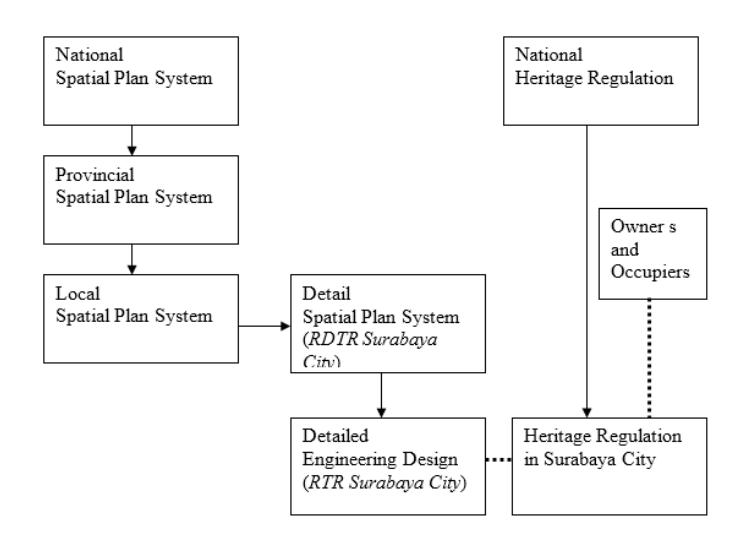
Scheme 1. The conceptual relation of the spatial planning, building and heritage regulation
| TABLE II THE HERITAGE VALUES AS IN ASIAN CHARTER | |||
|---|---|---|---|
| Authenticity cri | Uniqueness | Age criteria | Local people |
| Charter | Authenticity cri teria | Uniqueness criteria | Age criteria | Local people involvement |
|---|---|---|---|---|
| Nara (1990) | can be renew | preserve the form as its origin | can be redevel op | informed |
| Chinese Principles (2000) | can be renew | principle of antiques | not known | not known |
| Hoi An Protocols (2009) | not to change | preserve the form as its origin | based on value | as perquisite |
| Indonesian Charter (2003) | not to change | preserve the form as its origin | based on value | should participate |
through these changes in the city, has become one of the city center.
Tension between the city planning and heritage policy
There isn't yet synchronization between core planning and detail planning. Problems have been occurring in the implementation of the heritage regulation, which can be seen in the newly built buildings in place of the demolished heritage buildings (Soemardiono 2004, p. 18).Based on the decision of heritage experts in the Surabaya city, the distinctive features within the buildings are the qualities intended to be preserved. The inhabitants in Darmo area were passive participants; they received an explanation by letter mentioning that their buildings were listed. Here, I argue that the opinions of Darmo area inhabitants about the conservation planning process need to be considered as well. The heritage regulation despite several tries to be implemented is yet to succeed fully.
Criteria for conserving heritage buildings
Below is the explanation of heritage regulation in Darmo area. First is the historical value related to the changes in this city, then heroism, and finally social
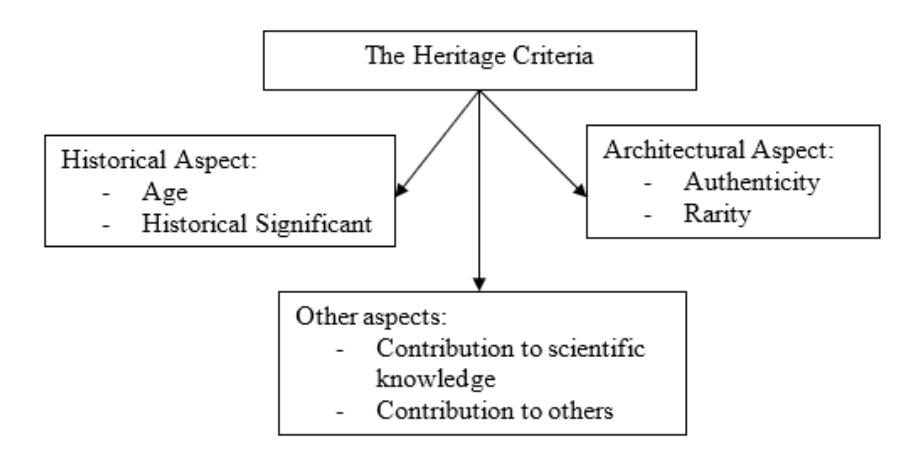
Scheme 2. Basic regulation in the heritage criteria Surabaya (2005)
and political aspects that are significant to the city. Surabaya regulation on Cultural Heritage (Perda Cagar Budaya Surabaya) in 2007 mentioned that Darmo residential area is one of heritage site. This large conservation area is a site amongst several buildings which contributed to the Indonesian war on independence in 1945 (Kwanda, 2009, p. 7). There are several other buildings as marked as heritage objects, for example RKZ hospital and Darmo hospital which served as military hospitals. Understanding the context of these established criteria, which became later the objectives of conservation in Surabaya, explains relative new building in this area – built in 1920-1950. The heritage criteria are explained as following:
a. The age value
The regulation set the age at criterion 50 years. This was based on a consensus within the heritage expert in Indonesia. This conception also shows that heritage value in Indonesia can be seen tending more towards the social value compared to the material value. This agreement on the fifty-year limit is consensus of the Indonesian planning community, in the case of historic buildings in the whole nation; the booming conservation movement was around the year 1995 – 2000 . It makes a sense because at that time if calculated from Indonesian Independence Day from the year 1945 the building built around those years would be 50 years old.
b. The authenticity value
The authenticity is derived from physical aspects of the buildings like the form of the roof, doors, ventilation etc which are mention in the classification by the Department Culture and Tourism. In order to fit with the newly renovated buildings, they often change the main door to a larger one and new materials. The changes in these buildings elements is because of their new function as commercial buildings.
Within the area scale, the pattern of street has remained the same, but the open space of the buildings has changed, due to new functions and activity. The local authorities stated in the guideline that old houses should preserve the main shape. The authenticity definition here is the heritage building is in still based on the complete condition of the building.
c. The rarity aspect-significant to the place
The terminology 'rarity' has a meaning which is equal to the rareness of the current object compared to others buildings and areas. The building within Darmo area shows the characteristics of architectural houses which were in trend in 1960. The buildings have a large set back which is one third of the whole layout. The area was designed by Henri Maclaine Pont (Jessup, 1985, p.157). These are typical sub urban houses which designed as a aim to give privacy to the owner and for automobile age ( Dick in chapter Nas 2003, p. 116). This rarity is well recognized by the inhabitants, some of them even mentioned that they are proud of these houses. They are associated with a section of upper middle up class in the society. This heritage area was owned by an important person in Surabaya city.
d. The knowledge aspect
The knowledge aspect relates to how the building will have a significant contribution for the upcoming generation. It is based on the hope that the younger generation will appreciate the work of their ancestors. In the case Darmo housing areas, the buildings area mixed between western and traditional building.
The inhabitants of Darmo area: the owners and tenants
Even though most Darmo inhabitants have been informed about the conservation policy regulation, the inhabitants as private house owners perceive the heritage area regulation as not as a regulation that benefits them. The heritage program to list the heritage buildings in Darmo area has been initiated. This inventory can be considered as a preliminary process of conservation planning. Inhabitants receive a letter with instructions to preserve their building. It mentions that they will have tax deductions up to 50%. However, in the inhabitant's opinion; this amount is still too high. While answering the interview questions, the inhabitants expressed a positive perception of the regulation but still some of them did not have a clear idea regarding what they had to do. The inhabitants expected more advantages from the heritage regulation like tax relief. Also the heritage conservation in this area has not yet became a priority for funding. It also seems that they are not yet clear about what to do and how to participate as many buildings have changed without following the Surabaya heritage regulation. For the inhabitants who have been living there for two generations in Darmo area; they perceived the tax as too high as most of them are pensioners and senior citizen. The problem for senior citizens is very complex: it is challenging for them to pay high taxes (around 500 – 2.000 US Dollars per year) as based on the fieldwork, their income is only around 60 million rupiah equal to 4000 EUR per year.
Following the discussion on inhabitants, herewith the tabulation of the questionnaires. The number of respondents from the residential category is 41 and from the commercial category is 23. Bar Chart 1.1 shows that most of the inhabitants know the terminology of the conservation and also recognize that they live in a heritage area. In recent years, conserving heritage buildings has become a trend in Surabaya city with citizens developing a group dedicated to preserve old Surabaya. The fact that the urban heritage became a trend with the citizen can be said to be a starting point for conservation planning. But, for the private building owners, they mention that even though they know the purposes of the heritage conservation, they perceive that the conservation area regulation in Surabaya to have no advantages for them.
Bar Chart 1. The Heritage Area Information
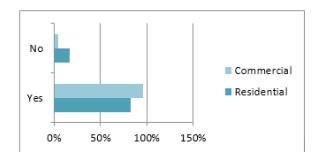
1.1 Do you know or have heard of the term conservation of built heritage?
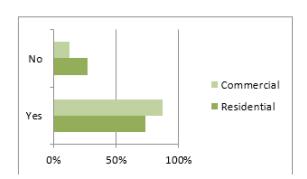
1.2. Do you know if your building is located in the conservation area ?
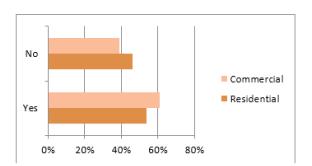
1.3. Have you heard of Surabaya Regulation number 5 from year 2005 about conservation of cultural heritage
Source: Author (2014)
The inhabitants as occupiers in Darmo area seemed to have a positive impression toward the idea of conserving heritage area or buildings. One respondent as tenants of a residential building in Darmo area mentioned that she preferred to live in a new building with modern architecture.
The occupiers whose buildings function as commercial areas mostly had no problems with the implementation of the program. For the commercial buildings which were mainly located in the arterial streets in Darmo area, they put a heritage plaque as a sign of a listed building. They managed to keep their portion of the building; however the entire commercial building owner did not have the same opinion. Some of them completely ignored the regulations by changing the façade of the building or redesigning the building into more than two storied buildings. This phenomenon is a classic problem in conserving heritage area in the city where preserving the existing functions or adapting the function has become a consequence of modernity.
The households tend to not transform the building due to their need of the original function being residential. However changes in the old houses are minor like constructing additional bathroom inside the main building. One owner responded that as a household they rarely put the heritage plaque in their homes. During the interview they also mentioned that there isn't much advantage from the listed program.
Problem in conserving mixed used residential heritage area
The inhabitants have been able to conserve the area without support from the government. Since the establishment of the heritage area and building list, the inhabitants as owners mentioned that they expected support from the government regulation. Bar Chart 2 below explores the challenges faced by the inhabitants of private building owner in aspects like: maintenance of the buildings, land and building taxation and additional room. These three aspects represent ways of participating in heritage regulations. It is mentioned in the letter from the government that the owner of the building needs to keep the building roof and façade as it is, but the function can be changed.
Bar Chart 2. The inhabitants challenges in conserving their heritage buildings
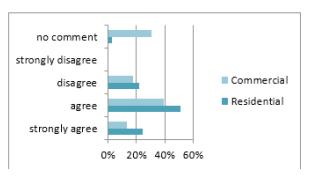
2.1 Do you face problems in maintaining your building?
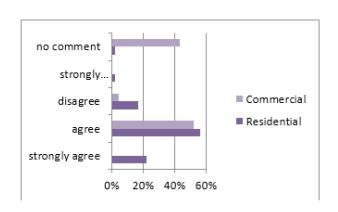
2.2 Do you face a problem paying the land and building taxes?
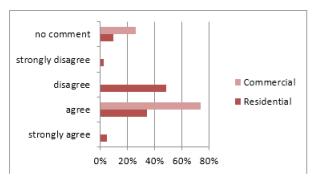
2.3 Do you need an additional room for a new function?
Source: author (2014)
In the above mentioned Bar chart 2.1 , it is shown that inhabitants of residential building have challenges in maintaining their building. There are problems due to the house being large and voluminous required them to paint it at the same time brings up the difficulty in managing costs. Other problems are in repairing the plumbing system and the wooden structure in the roof which will also require huge amount of money. These problems are contributing to the transformation in the function from residential to commercial. Bar chart 2.2 and 2.3 show that as commercial buildings, the old building can bear the maintenance cost and taxes. The high percentages of no comments of Chart 2.1. and 2.2 mostly came from commercial building owners. This explains how they can keep the heritage features in the façade of their building, but they need to redesign rooms and space. In the buildings that remained residential, the heritage feature remained the same.
The need to learn how to communicate the conservation planning program and the regulations to the peoples is the first step of urban heritage conservation (Worthington and Bond, 2008; Pendlebury and Townshed, 1999). A residential area requires a specific form of conservation. A method to handle people who live and work within the area needs a special approach. It is interesting that they have a purpose to be in that area and also like the area but not have financial source to finance themselves. Maintenance of the urban heritage area needs the involvement of people.
CONCLUSION
In general, by comparing the change in the land use as recorded by the government spatial planning, the majority of changes happened in the arterial street. Firstly, when the conservation program was announced by the government, the policy aimed to create a space for the expansion of the area. However, the government program was designed to prevent the building to change. The results are varied in the different streets. The major streets show a different pattern of change compared to smaller scale streets. Based on the fieldwork, most of the buildings might remain the same, and also the street pattern. However, the functions and activities show a different pattern. The driven factor for this phenomenon is the regulation for tax deduction that does not yet meet residential owners. From the perspective of government support, heritage is not a priority but the government needs to preserve it as a part .
of city amenities. In some references, support from the government should ideally benefit the owners. However, these theories are not enough when faced with big investment for commercial building, i.e. malls - complex shopping stores which may consolidate multiple parcels of old housing. Secondly, in response to this trend, Surabaya Municipality tries to impose the need of heritage area by establishing the law, defining a heritage conservation area over the city land-use, a clear sign that the area is protected. In addition, the implementation, as also happened in most of all Indonesian cities, enforcing the law and regulation of city planning was never an easy task. Based on the analysis presented above, it is obvious that engaging people in urban heritage conservation is crucial. Moreover, a specific approach needs to be given to residential heritage as there is a need to keep the ambience of the city.
To sum up, the authorities need to start the concept of community-based driven in conservation engagement, for a sustainable conservation planning toward urban heritage area. Better communication between government and residents to explain objectives and strategies of conserving the urban heritage area is necessary. The capacity building may develop from several stages. The initial step is the achievement of understanding of both sides: the community and the government in the process of sharing the aim of the area conservation. This does not mean that the inhabitants are not aware of the importance of the conservation program, but how to invite them to be involved in the conservation process? Even though in the regulation is already a strong recommendation for participation – the implementation gives not actively voice to the inhabitants. However, the process is on the empirical level not smooth. It is also not to say that the government has not been taking the proper
initiative to invite the owners and held consultation meetings with them. But, I would argue that more effort is needed to foster the participation in this program, because of the tension between the heritage conservation versus the dynamic investments in the city.
The regulation on conservation in Surabaya needs to pay more attention to the private owners and the residents with a detailed scheme for each of them, based on their financial ability to preserve the buildings. The inhabitants, who have lived for two generations in Darmo area, perceive the tax to be too high. This raises a problem for senior citizens, who can´t afford to pay high taxes. Therefore heritage regulation in Surabaya needs to classify through the range of ages of the inhabitants and consider this fact as a consequence of heritage regulation.
These details can also include how the owner of the commercial buildings can see the regulation as a duty and to show the fact that the rest just think that this heritage program is a necessary issue. The starting point of this research was the question if people perceive the heritage regulation as an advantage or a burden. It is obvious that people highly appreciated the idea; however the challenge is still on the level of the implementation, based on functional use and maintenance.
The findings in this research identify gaps between the conceptual ideas in heritage conservation and their implementation, namely within the aspects of finance and maintenance. The heritage program has not yet become a priority of the government due to many significant problems in Surabaya city. But people living in a heritage area can be powerful tools for the sustainability of the heritage program. This research hence can be useful for developing conservation policy based on the inhabitants' preferences.
Acknowledgement
This research is funded by Directorate of Higher Education (DIKTI), Indonesian Ministry of Research and Technology (Kemenristek). I would like to thank the Research Design Group in the School of Architecture, Planning and Policy Development, Institut Teknologi Bandung (SAPPK ITB) for the opportunity to continue research in urban heritage, and to the Laboratory for Housing and Human Settlements- Institut Teknologi Sepuluh Nopember (ITS) for their generous support during my fieldwork.