

ABSTRAK
Undang-Undang Informasi dan Transaksi Elektronik (UU ITE) di Indonesia masih dalam bentuk teks dan belum efektif dalam penyebarannya, sehingga kurang menarik bagi publik, terutama kaum muda. Berkaitan dengan hal tersebut, perlu adanya media pembelajaran dalam memahami UU ITE. Penelitian ini bertujuan untuk memvisualisasikan isi UU ITE menjadi media pembelajaran yang menarik. Model pengembangan yang digunakan adalah Multimedia Development Life Cycle (MDLC). Subjek penelitian ini mahasiswa Universitas Pendidikan Ganesha yang tertarik mempelajari Hukum ITE. Dari sudut pandang ahli, isi penelitian ini telah dinyatakan valid, media yang digunakan telah dinyatakan praktis, dan uji normalitas memperoleh nilai N-Gain sebesar 0,71 yang merupakan kategori tinggi. Penerima penelitian ini sebanyak 20 responden dengan menghasilkan 40% memberikan tanggapan sangat tinggi dan 60% memberikan tanggapan tinggi. Hasil penelitian menunjukkan bahwa visualisasi konten UU ITE telah valid, praktis, dan efektif untuk pembelajaran. Aplikasi ini diharapkan dapat meningkatkan pemahaman mahasiswa Undiksha khususnya terkait UU ITE sehingga mahasiswa dapat berperilaku bijak dan cerdas di media sosial.
Kata kunci: visualisasi, Undang-Undang Informasi dan Transaksi Elektronik (UU ITE), media pembelajaran, MDLC, Undiksha.
INTRODUCTION
.
The development of IT (Information and Technology) in Indonesia has experienced very rapid development. The enthusiasm of the people in using technology as a medium of communication especially the internet and social media is very good. This certainly has a good impact on the lives of the Indonesian people. Many people today are using the internet and social media as a means of business or a means of communication.
Today, the use of social media in the community has experienced a significant increase. The emergence of new technologies and applications in people's lives today supports the emergence of social interaction through social media (Hao, 2016). Later media institutions also began to look at computers to present media publications in the online form. This has led to an affirmation that computers have formed a mass audience of users increasingly crystallized by the presence of mainstream media readers via the internet (Nasrullah., 2018).
The existence of social media such as Facebook, Twitter, Path, or Instagram has helped the community to get the latest information regarding events in the surrounding environment or the wider environment (Muhammad, 2018). According to Bawden, digital literacy or also called digital information literacy is a concept that explains the concept of literacy in the digital era. This concept of digital literacy has emerged since 1990 (A'yuni, 2015). Gilster (in A'yuni, 2015) explained that the concept of literacy is not only about the ability to read but also to read with meaning and understanding. Digital literacy includes mastering ideas, not keystrokes. Gilster (in A'yuni, 2015) emphasizes the process of critical thinking when dealing with digital media rather than technical competence as a core skill in digital literacy, and emphasizes critical evaluation of what is found through digital media rather than the technical skills needed to access digital media.
The fourth Industrial Revolution was a digital revolution, which was marked by the proliferation of computers and the automation of records in all fields. Automation in all fields and connectivity is a tangible sign of the industrial revolution. The current trend also shows the start of all digital-based jobs. This is indeed a new challenge in technological developments in the industry. Yet, these rapid technological developments have led to the use of technology that has grown very quickly, not balanced by the user's knowledge of the legal rules that apply in the use of technology.
Especially at this time there are rampant various acts that violate the law such as the spread of HOAX news and share issues that contain racist content, or even pornography. However, prohibited actions in cyber law and criminal provisions are still not widely understood by users. Things that deviate from the use of this technology lead to the formation of cyber law or rules concerning activities in cyberspace. Another problem is that this regulation, which is in the form of text, is less attractive to users.
Referring to the phenomenon that exists today, researchers provide solution by developing a media innovation that can visualize the contents of the ITE Law.Technological developments are really needed because every innovation is created to provide positive benefits for human life and provide many conveniences in human activities (Andam, 2018). According to Computer Technology Research (CTR), multimedia is a means to develop sensory abilities, attract attention and interest, and is very effective in becoming a tool in the teaching and learning process (Rosmansyah, 2018). The benefits of this study aim to determine the usefulness of the media in generating the ITE Law from abstract to concrete.
METHOD
The method used in this research is Multimedia Based Software Development Methodology (Figure 1), namely, Multimedia Development Life Cycle (MDLC). This model was chosen because the stages of the process are more appropriately used in multimediabased Animation Development as an Information Media for Electronic Information and Transaction Law. MDLC consists of 6 stages, which are concept, design, collecting materials, assembly, testing and distribution (Luther, 1994).
The concept is the stage for analyzing the content to be developed. The design stage is the stage of creating scenarios from the media to be developed, including designing the animation character. The material collecting stage is the data collection stage that supports the media, including the results of interviews with experts in their fields as simulation materials. The assembly stage is the implementation phase through coding. The testing stage is the product testing phase of the resulting application to be valid, and distribution is the last stage after the application is considered valid and ready to be distributed to the intended target. In detail, the steps of MDLC are presented in the results and discussion section.
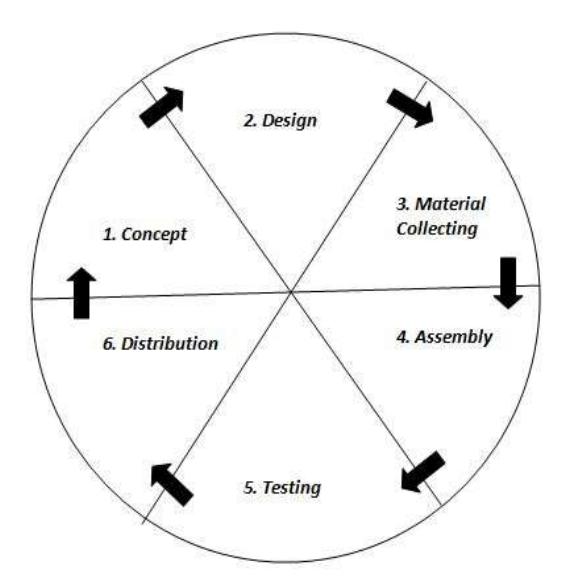
Figure 1 Multimedia Development Life Cycle
RESULTS AND DISCUSSION
Visualizing the contents of the ITE Law for this learning uses the MDLC (Multimedia Development
Life Cycle) method. This method is used because the objects used in this project consist of multimedia elements, such as: text, images/graphics, animation and audio. MDLC consists of 6 stages, namely concept, design, collecting materials, assembly, testing, and distribution. This model was chosen because the stages of the process are more appropriately used in animation development, with multimedia bases as the Information Media for Electronic Information and Transaction Law.
In the concept stage, researchers conduct data collection to find out the desired and interesting media according to the user's target, so that the resulting media can attract users. The interesting application media are those which media that can change something abstract into concrete so that they are easily understood by users (Agustini, 2018)
The next stage is observation, which consists of collecting data by interviewing expert inerviewees in Business Law and Legislation. According to the observation result that the main obstacle is that generally, the learning does not see the characteristics of the targeted level. He also explained it will be good if we combine regulations with something interesting to attract people. The researcher also interviewed an ICT teacher at Vocational School 1 Singaraja in order to get an explanation of the school's efforts to socialize the regulation and the causes of many students who did not yet know about the ITE Law. He also explained that the school also had not been specifically informed about the ITE Law. However, some productive ICT teachers occasionally mentioned a little about the ITE Law during the learning process. He added that there are several obstacles such as the form of the ITE Law which consisted of theory and writing, which was less interesting for the students. Thus, it would be difficult to be captured or infused by the students. He stated that most of the students are attracted to media such as animation & video because they can gather their attention with something interesting to see. This will result in them getting the information while watching something they like. He also argued that text or lectures are not that attractive to students.
The next step was distribution of initial knowledge questionnaires with to the students in Junior High School 2 Singaraja and the Vocational School, and also reviews of the problems taken.
The design stage includes designing the media before it is developed. During this stage, the script or synopsis is written generally as the big outline. The animation media is made by adjusting to the discussion about the Information and Electronic Transaction Law. The designed character includes those who are generally involved in legal activities as well as some supporting characters.
The next stage is material collection. The design in making animation media has been explained in the previous stage. For the next development process, the researchers collect several supporting materials in the development of animations such as audio support; and also 2D objects.
As in the assembly stage (Figure 2), the creation of animation starts according to previously made designs such as following the storyboard, character design, making
2D objects, animating and rendering, editing the additional materials that have been collected in the previous stage, and adding sound effects so that the animation becomes more interesting. The following are some of the animation displays as the result from the assembly stage:
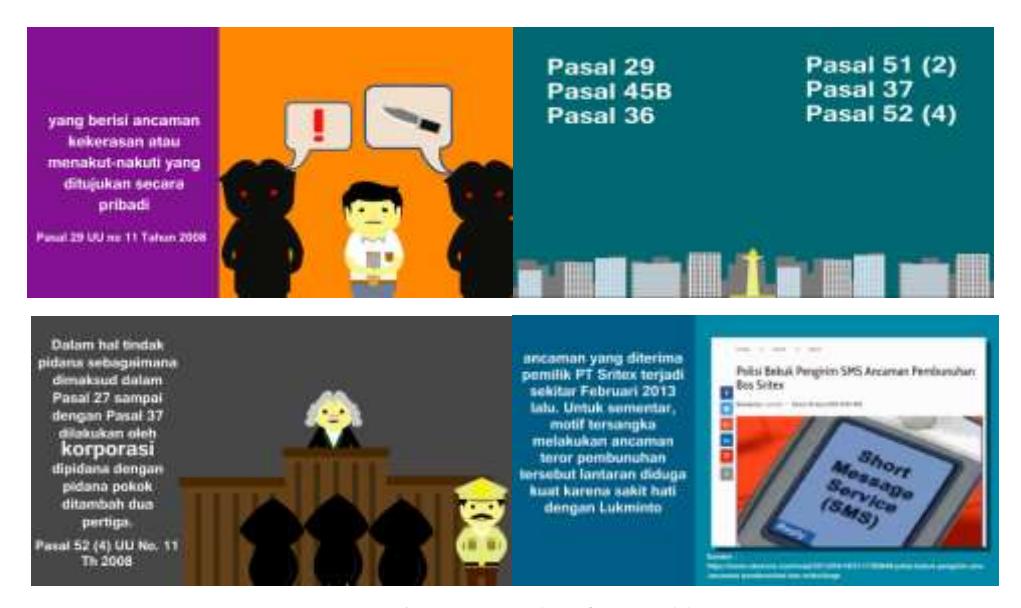
Figure 2 Results of Assembly
In the testing stage, animation media testing was carried out. This test is about running and evaluating an animation media to test whether the animation media has met the requirements or not and also to determine the difference between the expected results and the actual results.
The first test was the Expert Test which aims to determine the compatibility of the contents of the media with the ITE Law (CHAPTER VII & XI). This test was carried out by involving business and legislative law experts as well as criminal law experts because they were the content supervisor of the content visualization of the ITE Law for learning. The Expert Test was conducted on Thursday, July 12th 2018. The first iteration of the animation was corrected to add additional display of cases because it only showed the case point only. In some animated scenes, some that have the same discussion were asked to be changed to avoid it from becoming monotonous. The animated narratives are also edited with more interesting dialects. The appearance of the ITE Law explanatory text which was too long needed to be separated as such, not to summarize or change the meaning. Improvements were also made to the animation by correcting article writing and clarity of the Law in the intended article. The previously summarized explanations of the animations were changed to suit the explanations of the existing laws and to use simpler languages. Here is the recapitulation of the test results in the second iteration.
Content Validity :
\[\frac{D}{A+B+C+D} = \frac{28}{28} = 1.00\]
The coefficient validity of the content of the tested instrument is 1.00 (Very High). After the animation was repaired in accordance with the revision, the second iteration was tested once again where the animation was appropriate and the result was very high.
The second test was carried out by the media expert which aimed to determine whether there are or not the elements in the animation media, such as the suitability of music, image quality, animation quality and others. Media expert testing was carried out by involving multimedia technology and media design experts because they had long been in the field of technology and media. Media expert test was conducted to evaluate the Quality of an animation media. The test was conducted on Thursday, July 12th, 2018.
The first iteration was told to add titles to each article elucidation, and the intro was changed to credit. The news explanation was changed into news point only. The volume of the narration was also increased. There were also some changes in the layout (text and images) of the content because the researchers needed to pay attention to the principle in focus. If the text was focused, it should be placed on the left. The explanation had to be separated if it was too long to fulfill the visual aspect. The contents of the story needed to be added with concrete visuals in the form of cases of violations of the ITE Law. After the animation has been repaired in accordance with the revision, it underwent the test one more time. Here was the result of the second iteration.
Content Validity :
\[\frac{D}{A+B+C+D} = \frac{10}{10} = 1.00\]
Thus, the coefficient validity of the content of the tested instrument is 1.00 (Very High). After the animation was repaired in accordance with the revision, the second iteration was tested once again where the animation was appropriate and the result was very high.
A number of tests were applied to 20 respondents. In determining the number of respondents "Agustini et al (2017) states that some of the following guidelines can be used to determine the sample number, which are: first, the sample number should be between 30 to 500 elements; second, if the sample is broken down into subsamples categorized on (male/female, elementary/junior/senior high school, etc.), the minimum number of subsamples must be 30; third, in multivariate research (including multivariate regression analysis) the sample number must be several times (generally 10 times) of the number of variables to be analyzed; fourth, for simple experimental research, with strict controls, the sample number can be between 10 and 20 elements (Pradipta, 2013)." According to Sugiyono in (Rustina, 2016), the number of the sample for experimental research is 10-20. The 20 respondents were chosen using simple experiment research with strict controls.
Normality test was conducted to avoid mistakes when interpreting the value from the respondents. It was expected that after understanding the ITE Law (Chapter VII & XI) animated learning media, the respondents who were curious about ITE Law would know about the prohibitions that is applied in Indonesia.
The Normality Test Phase was held on Tuesday, July 17th, 2018. This test was conducted on 20 Respondents with pretest and posttest to measure the level of insight regarding the ITE Law (CHAPTER VII & XI). Case studies were carried out on Ganesha University Education students who did not yet understand the ITE Law, with the hope that after seeing this application they would be more understanding and alert in social media. The result showed that the learning outcome was in High criteria.
Gain was obtained from the difference between the results of the pretest and posttest. N-gain is a normalized gain. N-gain is calculated using the following formula (Hake, 1999).
− = − −
From the tests conducted on 20 respondents, the researchers found out that the average value in the pretest was 2.35 and the average value in the post test was 7.8 so that the average value increases by:
The amount of average increase
= Average value of the posttest – The average value of the pretest
\[= 7.8 - 2.35\]
= 5.45
Increase percentage
Amount of increase Pretest average value \[\times 100 \%\] \[= \frac{5.45}{2.35} \times 100 \%\] \[= 2.3 \%\]
Next was to calculate the values of N-Gain.
\[N - Gain\] \[= \frac{Posttest\ Score - Pretest\ Score}{Maximum\ Score - Pretest\ Score}\] \[= \frac{7.8 - 2.35}{10 - 2.35}\] \[= \frac{5.45}{7.65}\] \[= 0.71\]
Then the categories were seen based on the criteria of the normalized gain tables (Hake, 1999)
TABLE I NORMALITY GAIN CONVERSION
| Index | Criteria | ||
|---|---|---|---|
| 0.70 | High | ||
| < g < 1.00 | |||
| 0.30 | Medium | ||
| ≤ g ≤ 0.70 | |||
| 0.00 | Low | ||
| < g < 0.30 | |||
(Source: Hake, 1999)
Then the increasing rate of the learning outcomes of 0.71 was in the high criteria.
Therefore, the results of the pre-test and post-test analysis conducted on 20 students in the Faculty of Engineering and Vocational experienced increased percentage of 2.3% from the beginning with an average pretest value of 2.35 to 7.8 which was the average value of the post-test. After that, the researchers tried to find out the N-Gain to know about the increase percentage of the post-test. The N-Gain value was 0.71 meaning that the increase percentage of the post test results was in the medium criteria of the Normalized Gain Conversion table by Hake (1999). Based on these results, the ITE Law (Chapter VII & XI) animated learning media can improve user's understanding.
With this media, capturing information is better because it involves two senses, which are the sense of sight and sense of hearing. Learning media in the learning process can arouse new desires and interests, generate motivation and stimulation of learning activities, and bring psychological influences. Media can also make learning more interesting and fun. The practical value of learning media includes being able to arouse student interest and motivation (Kusumadewi, 2010),
(Haryoko, 2009), (Joni Purwono, 2014), (Herdiannanda, 2010) (Agustini, 2017).
The use of media in the learning process regarding the ITE Law (CHAPTER VII & XI) has proven effective. According to Dale's Cone of Experience, the influence of media in learning can be seen from the level of learning experience that students will receive. Dale describes the shape of a cone, a person's learning outcomes are obtained starting from direct experience (concrete), reality that exists in one's life environment then through artificial objects, up to verbal symbols (abstract) (Ali, 2009).
The users' response test was done to find out the response of the users after seeing the media developed. The test was done by giving the opportunity for the users to watch the entire learning media of the ITE Law (CHAPTER VII & XI) based on animation that has been developed. This test was carried out on 20 respondents and the results of the calculation of the users' response were obtained from the data which stated that respondents felt interested in watching and listening to the animation.
Based on the results of the user response test conducted on 20 respondents, a summary of the respondents' test results can be seen from the table below.
TABLE II CALCULATION OF THE ASSESSMENT
| Criteria | Score |
|---|---|
| Smax | 50 |
| Smin | 10 |
| Mi | 30 |
| Sdi | 6,67 |
| Mi+1.5Sdi | 40 |
| Mi+0.5Sdi | 33.3 |
| Mi-0.5Sdi | 26,7 |
| Mi-1.5Sdi | 20 |
TABLE III THE SUMMARY OF USER RESPONSE TEST RESULT
| Range of Score | Categories | Frequency | Percentage |
|---|---|---|---|
| X>= 45 | Very high | 8 | 40 % |
| 45 > X >= 35 | High | 12 | 80 % |
| 35 > X >= 25 | Medium | 0 | 0 % |
| 25 > X >= 15 | Low | 0 | 0 % |
| X < 15 | Very low | 0 | 0 % |
| TOTAL | 10 | 100 % |
Based on the results above, it showed that the respondents felt very interested in watching and listening to the animation. Hamalik argues that the use of learning media in the learning process can generate new desires and interests, generate motivation and stimulation of learning activities, and even bring psychological influences to students (Arsyad, 2011). Various studies conducted on the use of instructional media in the teaching and learning
process have come to the conclusion that student's learning processes and results show significant differences between learning without media and learning using media. Therefore the use of learning media in the teaching and learning process is highly recommended to enhance the quality of learning including computer media (Rivai, 2011). According to respondents, animation is very useful in providing information about the ITE Law (CHAPTER VII & XI).
They also added that the content of the animated story was also very clear and easy to understand. In terms of usefulness, respondents felt animation was very useful. According to Lee & Owens (2004), the use of animation and special effects is very good and effective to attract the attention of students in learning situations both at the beginning and the end of the lesson series. After watching and listening to the animation, respondents felt that they understood the content of the animation very well. They got new knowledge after watching this animation. With today's technological developments, animated films are able to provide stronger visual displays of various phenomena and abstract information that are instrumental in improving the quality of process and learning outcomes (Hegarty, 2004). They also stated that they were more interested in watching than reading about the ITE Law. Moreover, they got an overview of actions that are prohibited and they strongly support the use of ITE Law (Chapter VII & XI) animated learning media, as a medium for delivering information about the ITE Law (CHAPTER VII & XI) applicable in Indonesia. The following are the results of calculations obtained from the user response test (Figure 3):
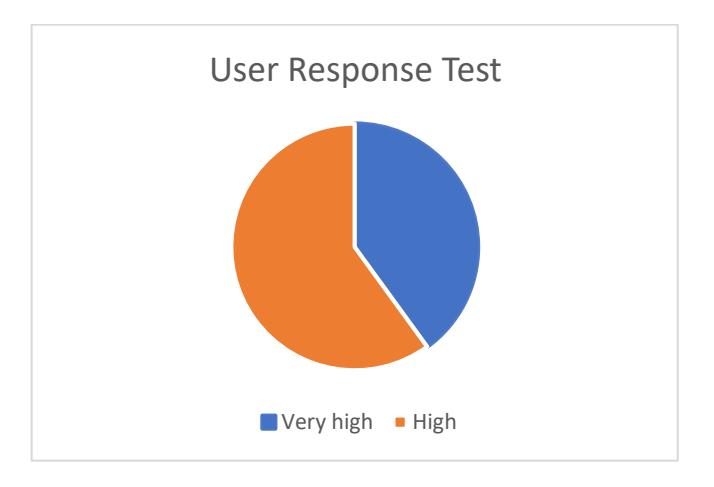
Figure 3 Result of user response test
It was known that 40% of respondents responded very high; 60% of respondents stated high because they felt the clarity of the story content in animation was lacking and they did not really understand it. None of the respondents was in medium, low, and very low. The content visualization of the ITE Law for learning has not yet reached the implementation stage. Therefore, it is necessary to conduct further studies on the effectiveness of using the ITE
Law (Chapter VII & XI) animated learning media, related to measuring the level of understanding of using this product through experimental research.
Next stage is distribution. Animated media was placed on media storage. Media distribution was done by using DVD media (digital versatile discs). DVD was chosen because the VCD data layer is located below and was in direct contact with the label, while the data layer on the DVD is located in the middle of the disc. This might result in the data on the VCD being lost if the label on the VCD was peeled off by scratches of the hand or other objects. Besides that, the DVD has a smaller pit size than the CD. Pits are small holes slightly above the surface of the disc that allow laser pickups to distinguish between logic 0 and 1 digital condition. DVDs that has a single side can store about seven times more than CDs. Most of these additions come from pits and tracks on smaller DVDs.
CONCLUSION
The novelty of this research is the production of a media which is able to change abstract content into concrete and easily understood. Content visualization of the ITE Law for this learning resulted in an ITE Law learning media. During testing, this media had passed the content expert test, media expert test, normality test (N-gain), and last the user response test.
The content expert test was conducted to determine the level of validity of the material used and also the suitability of features in the media. Normality test was done to determine the level of effectiveness of the media as a learning medium. The user response test was done to find out the user's response after using the media. The results of this study are Valid, Practical and Effective to be used for learning.
Based on an analysis of the results obtained and for the future research, it is recommended to consider the following: content visualization of the ITE Law for learning has not yet reached the implementation stage. Therefore, it is necessary to conduct further studies on the effectiveness of using the ITE Law (Chapter VII & XI) animated learning media, in relation with measuring the level of understanding of using this product through experimental research.