

INTRODUCTION
Exploitation of natural resources as an impact of modernism starts the conventional thought believing humans as the main actors of the history (anthropocentrism) (Supriatna, 2016: 2). The philosophy of anthropocentrism regards humans as the center of the universe. Keraf (2010: 47) conveys that this ideology believes that humans along with their needs are considered to be the most decisive in the ecosystem order and in any regulations made pertaining to the nature, either directly or indirectly. The highest value reference used in this ideology is humans and their interests. Everything that exists in this world is worthless unless it can be used as humans' standard and for their benefit. Therefore, nature is only seen as an object, as a device and medium to satisfy human needs and give them benefits.
Anthropocentrism believes that humans exploit and progressively use the nature up to fulfill their interests and daily needs, neglecting the preservation of nature. Keraf (2010: 49) explains that the (human's) exploitative, destructive and ignorant behaviors towards nature is considered to be rooted from their human-centered viewpoint which then leads to a greedy behavior making them take all their needs from nature while neglecting its preservation (nature exists only for the benefit of humans).
Humans' awareness on caring for nature as a part of the nature ethics should still be developed, i.e. by leading the anthropocentrism point of view to the more appropriate one. One should understand that humans, land, water, air, trees, mountains and everything on earth should be managed by humans and used sensibly and continually.
Capra (1997) delivers a more appropriate point of view in countering the anthropocentric viewpoint, i.e. through a new holistic and ecologic one using a new scientific term that can depict all relations among psychological, biologic, physic, social and cultural phenomena and life system called the web of life. This holistic systemic point of view towards life offers a notion that the basis of the construction is web. At every single phase of life in the metabolism web, i.e. from the cell to the food web in an ecosystem, as well as in the communication web of human society, there are the elements of life system interrelated in a web. This belief respects all species' unique values, which deserve to be respected, that all of these elements are united and interrelated. There should not be any dominant elements as all are interrelated. When an element is broken, the other elements will also be affected.
One of the important aspects in education is that it can make students aware that they (the students) belong to a society that can take any decisive decision in any single day. Each decision will lead to an effect passing the time and space when and where the decision is made. One's decision, for instance, to not throw any litter into a river and to use public transportation instead of using his/her private vehicle are two decisions that may have a wide effect.
The understanding towards the interrelation among different
areas and nature management that belongs to geographic literacy that may grow eco-friendly character should always be delivered in social studies learning. Considering that one of the objectives of the curriculum of social studies learning is to educate students to be aware and to have a positive mental attitude as well as some skills in interacting with nature that cannot be separated from their life, the learning should then be led to the efforts that may grow eco-friendly character. Social studies learning is focused on not only cognitive ability but also the development of attitude, values and skills. These can build an eco-friendly character which may then be the way of thinking and acting as a unique character the students have in living their life either in their family and school life or in the society and country. This is deemed as the answer towards the challenge the modernization poses.
Social studies learning should be the right way to build eco-friendly character. Supriatna (2016: 33) says that social studies learning should be integrated, value based, problem based and contextual. To build ecofriendly character in social studies learning requires a meaningful learning. A learning process may be meaningful if the materials the students learn are useful for their daily life. A social studies teacher through the geographic literacy based learning can take any initiatives and roles in facilitating the students to be a part of eco-friendly society.
In order to have a design that can give learning experience that can grow an eco-friendly character, this study is focused on the development of geographic literacy based social
studies learning in building the ecofriendly character of Junior High School Students.
METHOD
This study adopts the theory from Borg, Gall, and Gall (2003: 572- 573), with the model development design of Plomp (1997: 5). The phases of the Research and Development adapted from the model development design of Plomp operationally comprise:
(1) collecting research and information (2) planning, (3) developing preliminary form of product, (4) Preliminary field testing, (5) Main product revision, (6) Main field testing, (7) Operational product revision, (8) Operational field testing, (9) Final product revision, and (10) Dissemination and implementation.
The phases of Borg, Gall, and Gall are adapted into 8 phases, without taking the essence of the phases for granted namely 1) Need Assessment; 2) Initial Model Development, including Planning, Expert Judgment and Revision; 3) Limited Trial; 5) Analysis and Model Revision After Limited Trial; 5) Extensive Trial; 6) Analysis and Model Revision After Extensive Trial; 7) Effectiveness Test; 8) Final Model.
The study took Bandung as the research site with all Junior High School students in the city as the subject. The site and subject were chosen using an assumption that Bandung is a city in West Java which, in terms of teaching learning, may grow eco-friendly character that is still not in optimum category (The Ministry of Environment, 2014). This assumption is based on the data of the
Ministry of Environment in 2014 that there were only 3 schools in Bandung (at Elementary School, Junior High School and Senior High School levels) have successfully obtained Adiwiyata Mandiri reward. Besides, Bandung may represent schools in municipality level that belongs to Indonesia where, in Indonesian context, the access, media and learning sources, as well as the quality of education are assumed to be above the average.
Junior High Schools in Bandung taken as the research subject are 54 schools, divided into 4 clusters. The sampling technique conducted in this study is as follows:
1. Sampling in Needs Assessment Phase/Preliminary Study; samples for survey purpose were taken from all school population (total sampling) and 4 schools were taken randomly for the interview purpose, i.e. in
- order to dig further information required for the needs assessment.
- 2. Sampling in Model Development and Model Effectiveness (Validation) Test; samples were determined by the Cluster Random Sampling/Multi Stage Area Sampling. The technique was taken to show the heterogeneity of the samples. The clustering shows that clusters are heterogeneous, and the schools within a cluster are homogenous; therefore, the schools used in the research sampling were then used in the model development and validation. There are 2 schools for the limited trial, 4 schools for the extensive trial and 1 school for the model effectiveness test.
TABLE I CLUSTERS AND THE LIST OF RESEARCH SAMPLES OF JUNIOR HIGH SCHOOLS IN BANDUNG
| Cluster | School Name | Limited Trial | Extensive Trial | Effectiveness Test |
|---|---|---|---|---|
| 1 | SMPN 1, 2, 3, 5, 7, 8, 12, 13, 14, 28, 30, 34, | SMPN 14 | ||
| 2 | SMPN 4, 9, 11, 15, 16, 17, 18, 27, 43, 44, | SMPN 15 | SMPN 27 | |
| 3 | SMPN 10, 20, 24, 25, 26, 31, 36, 37, 39, 40, 41, 49, 50, 51, | SMPN 40 | SMPN 7 | |
| 4 | SMPN 6, 19, 23, 29, 32, 33, 35, 38, 42, 45, 46, 47, 48, 52, 53, 54 | SMPN 52 | SMPN 23 |
Source: Clusters in accordance with PPDB (School Enrollment Selection) in Bandung 2014
The data collection used in the model development is as can be seen in the following table:
TABLE II DATA COLLECTION TECHNIQUE AND RESEARCH INSTRUMENT
| Phase | Data Collection Technique | Research Instrument |
|---|---|---|
| Need Assessment | Test, Survey, Interview, Observation | Written Test, Questionnaire, Interview Sheet/Guide, Observation Sheet/Guide |
| Model Development | Test, Observation, Survey, Performance Test, and Interview | Written Test Sheet-Group Work Sheet (Knowledge Aspect), Attitude Observation Sheet, Questionnaire, Performance Test Sheet (Participation-Skill-Project Assessment Sheet and Interview Sheet/Guide |
| Model Validation Test | Pre and Post Test (Quasi Experiment) | Written Test Sheet- Group Work Sheet (Knowledge Aspect), Attitude Observation Sheet, Questionnaire, Performance Test Sheet (Participation-Skill) |
Data Analysis
The data analysis in this study and the development were conducted in reference to the following research phases:
- a. Preliminary Study; using a qualitative approach by studying theories, concepts, and relevant studies. However, the field study was conducted through quantitative and qualitative analysis.
- b. Model Development; since the data obtained were comprised by the scores of knowledge aspects, questionnaire, observation record and performance test result, the data pertaining to
- using the T-Test Independent Sample Test.
- c. Model Test (Validation); similar to the data analysis in the extensive trial, the model validation (test) or model effectiveness test was conducted by comparing the average scores of the experimental group and the control group, i.e. before and after the treatment by initially preparing the pretest and posttest score table of the students in experimental and control classes, continued by calculating the increase of the score after the implementation of the model (gain). After that, normality test and homogeneity test on the pretest, posttest and gain were performed. This test was taken to decide the next data analysis, i.e. determining the t test (parametric/nonparametric).
RESULTS AND DISCUSSION A. The Initial BLG-KPL Model Design
Geographic literacy based model of social studies learning in building the eco-friendly character (Model Pembelajaran Berbasis Literasi Geografi-Karakter Peduli Lingkungan), then abbreviated as BLG-KPL Model, is derived from the requirements in growing and developing eco-friendly character. This model is developed by adapting the theories of Henry (1994) and Edelson (2012), pertaining to the way to describe one's basic geographic knowledge, which includes the ability to (i) know a location/place, (ii) know the human and environment interrelatedness, and (iii) manage the space (environmental management). Therefore, this BLG-KPL Model is developed by (1) showing a location on a map, (2) explaining the interrelatedness of human and environment and (3) the management of environment/ecology through recycling process. Eco-friendly character developed in BLG-KPL Model is in line with Keraf (2010: 166-184) stating that eco-friendly character is an attitude and act of consistently trying to prevent any environmental destruction as well as to develop any attempts to fix the destruction, including, (1) maintaining the cleanliness, (2) maintaining the class facilities (keeping the desks and wall clean from any writing), and (3) reusing unused items.
The main goal of the model is to build the students' eco-friendly way of thinking and acting (character). The initial model only consists of the background, the aims and the advantages of the study, as well as the model design including (1) syntax, (2) social system, (3) reaction principles, (4) support system, and (5) instructional and side effects as explained below.
The Syntax of BLG-KPL Model
The syntax of the initial BLG-KPL Model was developed into 6 phases, namely: Phase 1- Formulating, Phase 2- Grouping, Phase 3- Tasking, Phase 4-Do-ing, Phase 5- Presenting, Phase 6- Reflecting.
The Initial BLG-KPL Model in social studies learning consists of 6 main phases, started with the teacher's identifying a topic (formulating) and ended with the reflection (reflecting). The following is the syntax of the Initial BLG-KPL
Model modified from the Group Investigation model of Slavin (2009: 218).
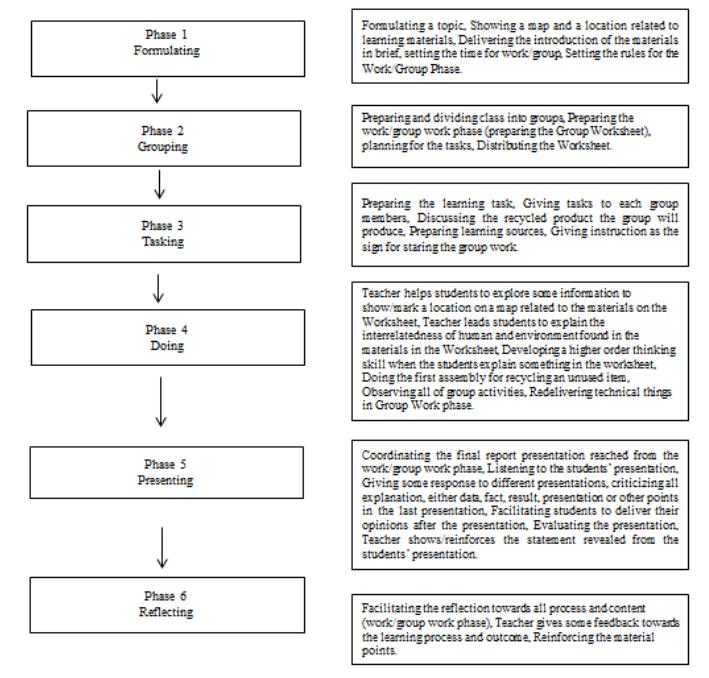
Figure 1 Syntax of the Initial (Hypothetical) BLG-KPL Model
B. Revised BLG-KPL Model
After the extensive trial, the construction of the model was still similar to the construction of the extensive trial (having been revised from the limited trial), i.e. including (1) syntax, (2) social system, (3) reaction principles, (4) supporting system, and (5) the instructional and side effects, which means that the model has not got any changes in terms of the number and the names of the construction parts. The changes taken in the model development following the extensive trial were not as much as after the limited trial. The improvement within the extensive trial was only in the reinforcement in each learning activities to be in accordance with the phases in the syntax (1) there should have been some reinforcement in the activities conducted in this phase; the focus was presenting the topic to deliver, i.e. delivering the topic to discuss. By this, the activities in phase 1 was clearer and more systematic, as in the activity of showing a location on a map in phase 1, where it was not implicitly stated in the activity in phase 1. Therefore, the activities in phase 1 were revised to be clearer and more systematic, namely presenting the topic, setting of the time for any task/group work, determining the rules of the work/group work phase, delivering the introduction of the topic, and asking the students to show a location on a map in front of the class related to the material to discuss.
The other improvement wasin Phase 4; there were some additions in the activities to make the activities in phase 4 clearer, i.e. in the evaluation towards the presentation taken by either the teacher or the representatives of the other groups that did not do the presentation. Therefore, there was a good feedback between the teacher and the students and among the students, particularly in the activities in phase 4 (Work Presentation). In the model revision, the other constructions did not get any changes.
C. BLG-KPL Final Model
BLG-KPL Model product after the extensive trial was almost similar to the hypothetical model where social system, reaction principles, supporting system, instructional effect and side effects of the previous hypothetical model did not change. The syntax got some changes as can be seen in the revised model after the extensive trial below
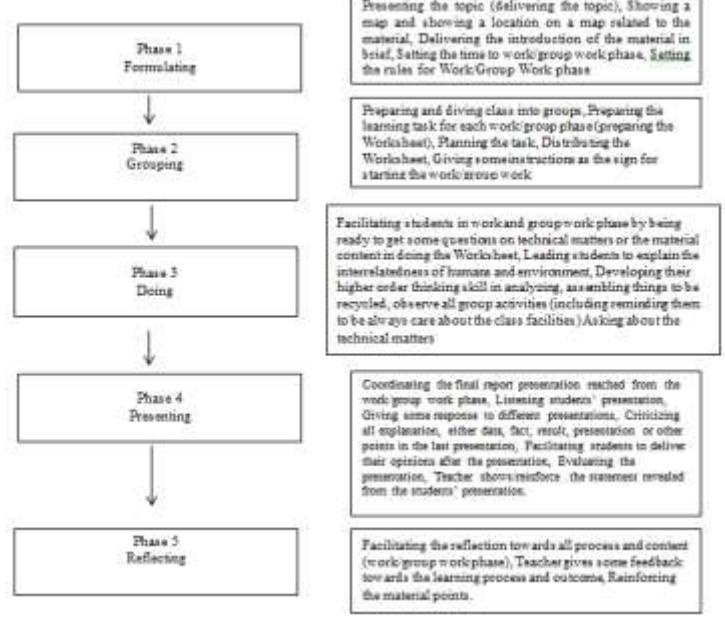
Figure 2 Syntax of BLG-KPL Final Model
The revisions of the model, starting from the initial model, hypothetical model after the limited trial revision, model product after the extensive trial revision to the final model, is as can be seen in the table of the summary of the model revisions.
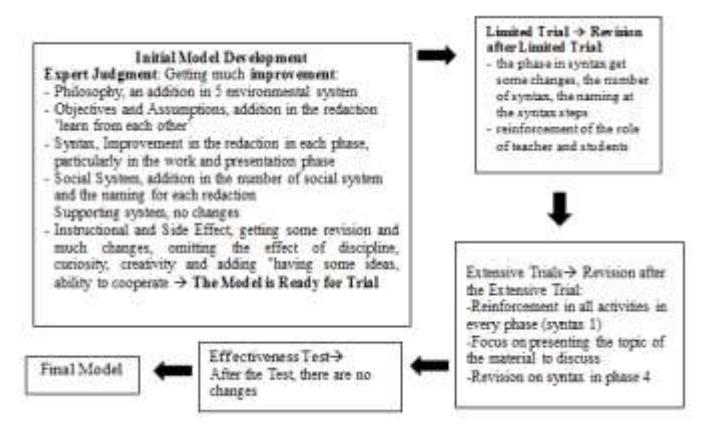
Figure 3 The Series of Model Changes-Improvement
1. Social System of BLG-KPL Model
BLG-KPL model develops the existing social system and when it is implemented in a learning process, one can work freely. This model can also encourage students and teacher to be initiative, creative and active since the students can freely do the exploration through doing their activities. It consists of showing a location on a map related to the materials in Group Work Sheet, and it provides some chances for the teacher to lead the student to explain the interrelatedness between humans and environment as stated in the materials in the Group Work Sheet.
The social interaction of the students and the teacher is well developed in this model. A good communication between the teacher and the students is systematically created. The teacher may have many roles, as a tutor, facilitator or a guide which may be seen in every phase particularly in formulating, grouping, doing, presenting and reflecting.
2. Reaction Principles of BLG-KPL Model
The reaction principles developed in BLG-KPL Model are:
a. Identifying Topic
Teacher in this first reaction principle should identify a topic based on the materials to discuss, continued by showing the students a map and introducing the location related to the material to discuss. This reaction principle shows a reaction principle different from the reaction principle in the initial phase of any learning model, particularly in terms of showing a map and location which is taken as the first principle of the geographic literacy based learning. In this orientation teacher also plays a role as a tutor delivering the introduction of a material in brief. The setting of the time for the work/group work phase and the setting of the rules in work/group work phase are the last reaction principles in phase 1 of BLG-KPL Model.
b. Organization in Grouping Students
Teacher divides students into several groups to do the group work. Each group consists of 5-6 students. Each group organizes the learning task for work/group work phase. The group composition is set based on heterogeneity, including sex, the students' average cognitive ability, and other different characteristics.
Teacher prepares the media, equipment and tools for the Task Planning and Work/Group Work Phase.
c. Work and Group Work Phase
Teacher helps students to explore some information to show a location on the map related to the materials and to do the group worksheet. In the work/group work phase, teacher helps and guides students to explain/analyze the humans and environment interrelatedness found in the materials in the worksheet. Teacher ensures that the initial step of the recycling activity has been accomplished by the students. Teacher triggers the students to develop a higher order thinking skills every time the students explain something in the worksheet; it is at the reaction principle that the teacher plays the role as a friendly critic for each groups while walking around. After that, teacher observes all group activities. The last reaction principle in this phase is the teacher delivers again all technical things related to this phase (work/group work phase).
d. Presenting the Group Work
In this reaction principle, teacher coordinates the group's learning final report. The representatives of each group presents their work on doing the worksheet (final report) while the teacher listens to the presentation. The teacher leads the students on determining points to be presented and ensures the students listen and respond to what the other students present, respond all of the explanation, either data or facts related to the human-environment interrelatedness. It is also in this phase that teacher compares
(evaluates) the students' response with the instruction as well as the objectives to do the worksheet (work phase), and then shows/reinforces the statements revealed from the presentation.
e. Reflection
Teacher performs an evaluation by observing the feedback from the students; pertaining to the group work done, the effectiveness of the learning experience, and facilitates, the students are to give their reflection towards the process as well as to give some reinforcement towards all important points of all of the learning materials.
3. Supporting System of BLG-KPL Model
Supporting media required in doing BLG-KPL Model are:
- a. Syllabus and Lesson Plan that includes the learning phases belonging to BLG-KPL Model;
- b. Geographic literacy based Learning Materials;
- c. Group Worksheet which is in accordance with BLG-KPL Model (along with unused items to be recycled).
- d. Students' Evaluation Sheet aimed at building the eco-friendly character that includes (i) evaluation towards the knowledge aspect on the concepts of the materials taught, (ii) evaluation towards the eco-friendly attitude (questionnaire and observation sheet pertaining to the students' eco-friendly attitude), (iii) evaluation towards the participation and eco-friendly skill (questionnaire and task assessment sheet to assess the performance on the participation and skill aspects);
- e. Assessment sheet towards the students' learning process, which includes: (i) Learning Process Assessment, the students' participation and motivation in learning process (Student Response Questionnaire on Learning Activities); (ii) Assessment towards the implementation of the model in the learning process (Observation sheet); (iii) Students' participation in group within the learning process (Observation Sheet of the Students' Learning Process); and the last is
- f. Teacher response questionnaire on the media and learning process
4. The Instructional and Side Effects of BLG-KPL Model
BLG-KPL model is developed with following instructional effects:
- a. Increasing the students' ecofriendly character that includes the aspects of students' knowledge, attitude, skill and participation;
- b. Providing a new learning experience so that students can show a location on a map; they can understand that there will always be an interrelatedness between humans and environment; and slowly, they can manage the environment by recycling unused material to be a useful item.
- c. Helping the students to develop their critical thinking skill.
However, the side effects of the development of BLG-KPL model are (1) being responsible as an individual and a member of a society who consistently care about the environment; (b) controlling themselves to have a character that may always be willing to maintain the cleanliness of their environment; (c) being discipline; (d) being independent; (e) being curious; (f) having cooperative skill; (g) being democratic; and (h) having positive attitude towards social studies.
All of the model development process shows that BLG-KPL model emphasizes the learning process that is aimed at building the eco-friendly character. This statement means that the awareness towards environment is introduced to students as a conceptual topic; it has brought in the implementation of the geographic literacy based learning model which is integrated and connected with the social studies learning. It is this geographic literacy base that may be taken as the unique element in the social studies learning. Geographic literacy as an integral part of the materials in social studies as the materials in social studies comprises 4 main studies including the aspects of human, place and environment chosen for building the students' ecofriendly character as well as to prevent several weaknesses, opportunities and threats in social studies learning in Junior High Schools in Bandung.
CONCLUSION
BLG-KPL Model development is designed based on the real condition in social studies learning which, in the Junior High School level in Bandung, can partly be seen from the survey, interview, observation and literature study by considering the aspects found in the research subject in the preliminary
study-need assessment. The model was then developed comprehensively through expert judgment, limited trial, and hypothetical test (the model after the limited trial revision), and was continued by extensive trial and model revision after the extensive trial.
Based on the model development through the data processing and analysis, the model can provide some lessons for the students as part of a group and a miniature of a part of society and can facilitate a new and comprehensive learning, which may then build the students eco-friendly character.