

ABSTRAK
Pengembangan Taman Sains dan Teknologi (STP) adalah salah satu implementasi kebijakan sains dan teknologi yang bertujuan mendorong daya saing nasional. Dalam Rencana Pembangunan Jangka Menengah Nasional (RPJMN) 2015-2019, pemerintah Indonesia telah menyatakan pembentukan 100 STP pada tahun 2019. Pada kenyataannya, hanya 22 STP yang memiliki peluang besar untuk diselesaikan. Pada kenyataannya, STP tersebut belum mencapai kondisi yang ditargetkan seperti STP di negara maju yang berhasil meningkatkan perekonomian. Penelitian ini bertujuan untuk menjawab pertanyaan bagaimana STP dapat menjadi habituasi budaya ilmu pengetahuan dan teknologi di masyarakat dan mengungkapkan fenomena perkembangan STP dalam konteks regional di Indonesia dan negara-negara lain. Studi ini menemukan bahwa berbagai tantangan dalam mengembangkan STP akan terus menghambat Indonesia jika masih pendekatan triple helix masih digunakan, dan mendorong pendekatan quadruple helix yang mampu membiasakan masyarakat terhadap budaya sains dan teknologi sehingga keberadaan dan fungsinya sesuai dengan ekosistem masyarakat Indonesia.
Kata kunci: STP, habituasi sains dan teknologi, quadruple helix
INTRODUCTION
Indonesia has begun a new chapter in the national development program since the entry of the industrial revolution era 4.0. Increased connectivity and interaction between humans and technology through digital economy, artificial
intelligence, big data, and robotics have become real consequences that have resulted in increasingly intense global competition. In 2018, the Global Competitiveness Report ranked Indonesia 36th in the world and the 4th in ASEAN in terms of national competitiveness against 136
world countries (Schwab, 2017). Statistics Indonesia reported that in 2018 the 5.3% economic growth and the 0.3% decrease in poverty are the government's best achievements (BPS, 2018). At present, Indonesia is also participating as a member of G-20, which shows that national economic growth has given positive contribution globally.
These facts are in line with Making Indonesia 4.0's policy, which said that in 2030 Indonesia will become the top 10 world economic powers based on GDP, by encouraging net exports up to 10% of GDP through improved productivity and application of innovations in industry (Ministry of Industry, 2018). The realization of these commitments are carried out by encouraging national priorities, i.e. by empowering SMEs which absorb 70% of the total Indonesian workforce. SMEs empowerment is pursued by the development of an innovation ecosystem with accelerated cross-sector collaboration among business actors, R&D/university and government. The innovation ecosystem was developed by creating a science and technologybased industrial zone called Science and Technology Park (STP).
STP is an area where governments, industries, and academics (university and R&D institutions) are physically close to each other. STP facilitates the transformation of knowledge to become an innovative product that has commercial value, supported by the government. STP development mechanisms commonly called a triple helix approach (Etzkowitz & Leydesdorff, 1995). Innovation
product is the face of the future science-based economy, because today economics is not only about capital and labor, but also about intelligence and technology based on science. The development of STP in various countries, such as America with Silicon Valley and Korea with Daedeok Innopolis, shows its significance for the national economic growth and global competition.
Through the Nawacita of President of Indonesia, the realization of 100 STPs stated in the National Medium Term Develop-ment Plan 2015-2019 was immediately carried out by reducing the target to 22 STPs that were ready to operate. However, until near the end of 2018, the development of STPs has not shown a significant contribution to the national economic sector. Several studies about an ongoing condition of Indonesian STPs have been conducted by various experts such as Ministry of Research, Technology and Higher Education of The Republic of Indonesia, Agency for The Assessment and Application of Technology (BPPT), and Indonesian Institute of Sciences (LIPI). In general, they tried to map the problem and offer solutions for STP development in Indonesia. They also have attempted to learn successful STP practices from other countries. However, the results of the studies have not been widely used or acted upon by the government.
According to the studies, the triple helix approach for developing STP in Indonesia are not suitable for Indonesian culture. Communities around STP area are not or have not been directly involved in STP
business process. Communities around STP area should be the first entity to be directly affected by socioeconomic activities of STP business. Through habituation of science and technology, STP can be the core in sowing the ethos of people's competitiveness and spreading science and technology culture. However, efforts to develop an essential culture of science and technology seem not included yet in STP business. Therefore, it is necessary to examine whether a quadruple helix approach will be an appropriate approach to address a question on how STP can develop science and technology habituation in the surrounding communities in the STP area. This question is certainly interesting because it is related to the formal values of STP as determined by various government regulations and the tendency of STP in various other countries. On the other hand, this question becomes an important lighter to suggest a change in the way of thinking or approach in the development of STP in Indonesia.
METHOD
STP is one of the catalysts for science and technology-based economic development. STP has a dynamic goal to keep up with the time. STP is an area where governments, industries, and academics are physically close to each other in one location, to facilitate the transformation of science and technology and economic innovation, or referred to as triple helix interactions (Etzkowitz & Leydesdorff, 1997).
The triple helix interaction as shown below explains that each actor has an interest in the realization of STP. They synergize in one big goal, which is to create innovative hightech products based on science in order to pursue a highly-competitive society. Unfortunately, in many cases, these institutional relations have not brought significant changes to the development of community science and technology as a strategic target group. Although STP has touched SMEs units, the community has not been involved in the process of creation, technology development, and transfer of technology. Simply put, STP contributes elsewhere, but does not have tangible benefits for the people around the area. As a result, structural poverty by the lack of public knowledge around STP will be a logical consequence.
Therefore, the development of STP using quadruple helix is expected to bring the role of STP science and technology to the wider community. The role enhancement is expected to be able to ignite the increase of science and technology which can then be utilized for the livelihood system that improves community's life. Analysis design in increasing the role of STP in improving science and technology culture is as follows:
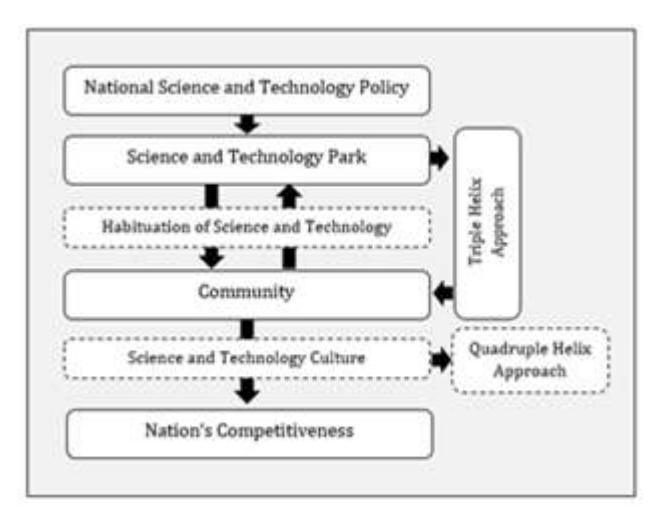
Figure 1 Analytical Framework
This study uses a qualitative research method by using descriptive research through content comparison analysis. Data collection techniques used are literature studies and observations. Observations were carried out in several STPs in South Korea, CSTP LIPI, STP Puspiptek Serpong under the Ministry of Research, Technology and Higher Education. In addition, data was collected from literature studies from several results of studies of STPs in Indonesia, and STPs in other countries.
RESULTS AND DISCUSSION
a. Development of STP Past and Present: An Implementation of Science and Technology Policy
STP in the knowledge-based economic stage is a profitable regional innovation strategy. This strategy also encourages sustainable economic activities by the commercialization of knowledge products. Therefore, a policy instrument oriented to industrial stimulation through STP is required (Oh & Masser, 1995). STP's presence in the region is an indicator of the growth and development of regional innovation system models, which are marked by the intensive synergy of triple helix in an area (Ministry Research Technology and Higher Education, 2016).
In the business context, STP becomes a media for promoting research output, developing innovations, and transferring technology between industry and R&D to the public. The purpose of STP is actually not only for economic benefits but also for social goals: an investment of science and technology habituation in the perspective of public institutions. STP plays an important role to spring up a country's economic competitive-ness and business investment land for the future. The Organizational for Economic Co-operation and Development describes three main characters of STP, including (i) Centering of high-tech industries, (ii) there is at least one university or R&D institution (material and intellectual) and (iii) activity in developing technology for industry (Guadix, Carrillo-Castrillo, Onieva, & Navascués, 2016)
In reality, many countries used the triple helix approach to develop their STP. Triple Helix assumes that the driving force for post-industrial economic development is the production and dissemination of socially regulated knowledge (Leydesdorff & Ivanova, 2016). The key actor in the triple helix plays a role in building networks (Guadix et al., 2016). According to the Ministry of Research, Technology and Higher Education of The Republic of Indonesia, triple helix approach is a partnership between science and technology networks in supporting national innovation systems, R&D institutions/universities, and industry, also governments that act as regulators to provide support in the form of (i) political economy in the industrial environment, (ii) provision of technology and its infrastructure and intellectual capital in R&D institutions and (iii) support for the world of research, infrastructure and intellectual capital in educational institutions.
Although the triple helix approach is widely used, each country has different STP characteristics. Stanford University Science Park later named Silicon Valley of the United States, built in the 1950s and was the pioneer of the development of STP in the world. Followed by Sophia Antipolis (France) in Europe in the 1960s and Tsukuba Science City (Japan) in Asia in the early 1970s. All three are the oldest and most famous STPs in the world. In 2017, there were 400 STPs from around the world, where the US has 150 regions of Science Technology Park, Japan 111 regions and China 100s regions (Patthirasinsiri & Wiboonrat, 2017).
First, Daedeok Innopolis is the oldest smart city STP in South Korea. Since 2016, every year more than 7000 technology patents are produced and the government is responsible for selling licenses (technology commercialization) to private industries through the Innopolis foundation. In its development until mid-2018, South Korea had established five innopolise, such as Daedeok, Daegu, Gwangju, Busan, and Jeonbuk (Stp.or.kr, 2016). In 2018, South Korea's GCI is ranked 26th out of 137 world countries with 4.23% of the country's GDP allocated to R&D (Tradingeconomics.com, 2018).
For forty years, Daedeok Innopolis serves as the main pillar in economic growth in South Korea by developing cellular technology and aircraft technology. Daedok Innopolis has been main South Korea's industrial growth engine. The funding allocation of Daedeok Innopolis provides 14% for R&D expenditure and 12% for improving the quality of researchers up to the Ph.D. level so as to provide the opportunity for all researchers to demonstrate their best performance in R&D. Lee Jae Goo, as the President & CEO of Innopolis Foundation, said that Daedeok is currently home to 29 governmentfunded organizations, 5 universities to foster talent and more than 1,100 companies including 500 research centers affiliated with the company. On May 2010, Daedeok Innopolis became the center of science and technology in the Northeast Asia region by hosting IASP World Conference that brought together around 1,140 people who work in STP field from 49 countries in the world (Innopolis.or.kr, 2018). Besides Innopolis, South Korea also has 6 National Techno Parks (NTP) and 12 Techno Parks (TP). All forms of STP in Korea are supported by adequate public facilities such as housing, apartments, hospitals, etc.
Second, Songdo (Incheon) National Techno Park (NTP) was founded in 1998 along with the establishment of The University of Incheon, Inha University, and the Korea Institute of Industrial Technology. The focus of the NTP field is auto parts, biotech, mechatronics, electronic-ICT, digital design and processing, and Nanotechnology. The success of Songdo NTP is supported by networks, facilities, business support, infrastructure, incentives, and strategic locations. The goal of Songdo NTP is to incubate companies and increase technological competitiveness in SMEs (Small Medium Enterprise). Some of the programs/ activities carried out in Songdo NTP include (i) technology development and application, (ii) incubation and production testing, (iii) technology transfer, (iv) education and training, (v) cluster development for the automotive component industry, and (vi) bioindustry development. The involved actors are tenants, universities, R&D institutions, local governments, and private companies (Hidayat et al., 2015).
Third, Chungnam STP was pioneered by a group of professors from various universities in 1995, officially managed by the government in 1997, and just started operating in 1999. The large industries that were present in the STP, such as Samsung, became an attraction for SMEs to enter Chungnam STP. Activities in Chungnam STP include: (i) commercializing R & D results, (ii) research incubation and generating innovation groups following the local industry, and (iii) becoming a think tank for regional development. At present, the regional industry that is driven by Chungnam STP includes the multimedia industry, electronics industry, agriculture and automobile assembly (Ministry of Research, Technology and Higher Education of The Republic of Indonesia, 2012). Chungnam STP's activities include (i) research linked with industry, (ii) funding providers through collaborative capital management, (iii) marketing services, and (iv) holding creative activities to open investment and marketing networks from local to international levels. In its implementation, Chungnam STP was led directly by the governor of Chungnam province, so that the STP policy was in line with regional policies and has never been an overlapping policy.
Fourth, China has several characteristics of Science Technology Park like Science Technology and Industry Park (STIP). In practice, STIP in China made a pattern of industrial investment, which is related to local universities around it. Economic agglomeration is carried out by STIP China to estimate the production elasticity of corporate and labor capital as well as the effects of research productivity from universities in the same city as foreign corporations as owners of capital (Zhang & Sonobe, 2011). Within just a decade STIP in China is growing rapidly. There were 53 Science
Technology Parks that consistently contributed to the growth of economic productivity, only from 1992 to 2000 (Hu, 2007).
Fifth, in Japan, STPs have been initiated since the 1980s and they are managed by local authorities who cared about regional economic development through the innovation of small local companies without involving the government (Fukugawa, 2006). They have an economic assumption that innovation product needs a transfer of knowledge from universities. The geographical distance between industry and universities requires a high transaction cost of knowledge transfer (Thapa & Murayama, 2009). Tsukuba Science City is a smart city in Japan. There are five research centers with 40 educational and research institutions, as well as 33 government and private organizations (Asmara, Oktaviyanti, Alamsyah, & Zulhamdani, 2018). STP is used to revitalize the area; improve the hightech industry sector; encourage interaction between industry, academics, and support for New Technology-Based Firms (NTBFs); and encourage academic spin-off (Henriques, Sobreiro, & Kimura, 2018). Until 2006, it was noted that 2/3 of the total Science Park in Japan was geographically established in higher education areas that aimed to maintain networks and knowledge transfer with universities. Several countries, such as the UK, Belgium, the Netherlands, Israel, Japan, Australia, Sweden, Italy, show that geographical proximity supports problem-solving with sources of knowledge (Von Hippel, 1994). Science Park contributes as a guide to effective regional policy making and becomes an important instrument for policy making and developing industrial agglomeration from city to village. The law is made as a legal basis for promoting the agglomeration and intensifying the knowledge-based regional economy. There are 65% of Science Park based on national policies and 80% based on local policies through joint publicprivate ventures. Local universities and R&D institutions focus on local problems (rural and urban areas) only, so that most likely the policy has a high value to contribute in building the local economy.
In other STP condition, according to the European Commission in 2014, a total of 366 STPs existed in European Union countries. In the 28 million square meters of total existing buildings, STP has accommodated 40,000 diverse companies and employed 750,000 workers between 2000 and 2012 with a total transaction of around 11.7 billion Euros. Three billion euros is used for professional business support and innovation services for technology-based companies in the STP region.
Last, the establishment of STP in Spain itself began in the mid-1980s as a regional development strategy without formal relations with the university or the central government. STP in Spain has the goal of not only fixed economic and social and cultural benefits. STP is driven by the promotion of research, development and innovation and technology transfer which is a collaboration of public-government and private institutions. STP's role is to promote start-up companies and technology
transfer agreements with universities and R&D institutions, opening jobs, attracting companies that are already engaged in technology to play a role in driving economic competitiveness of a region/country and as new land for business investment (Guadix et al., 2016).
Based on the lessons learned from various STP/SC/TP/Innopolis, it shows that every country and even every STP has different characters such as (i) Financial supporting by Government for RnD, (ii) Historical background to establish their STP, (iii) Business system, (iv) Homogeneity of society and awareness of the importance of STI (Science, Technology, and Innovation) minimizes inequality and conflict, (v) The government encourages the culture of innovation through the STI policy, (vi) Giant industries does not compete with SMEs industries, (vii) Open access funding for improving quality of the researcher, innovation, etc., (viii) Strong networking with local and global STP policy in line with regional policy (never been an overlapping policy). This makes every existing practice hard to be directly adopted by other countries with different cultural and resource backgrounds. Many countries in the world can be a learning material for Indonesia in the development of STP area, although not all lessons can be applied in Indonesia.
b. Quadruple helix: A Transformation of STP Development Approach
Triple helix approach explains that every actor who has an interest in STP is able to synergize in achieving
one big goal, which is to create innovative high-tech products based on science in order to accomplish competitiveness. R&D entities and universities play a role as new sources of knowledge and technology. Corporations, in this case, industry, serve as producers and providers of demand and community needs, while the government, as a source of contractual relations, can guarantee the interaction and exchange of knowledge and technology through regulation by industry and scientists (Sunitiyoso, Wicaksono, Utomo, Putro, & Mangkusubroto, 2012).
Japan's National Institute of Science and Policy (NISTEP) in 1995 describes Science Technology Park as a zone that provides incubation facilities to support the creation of new companies and expand new business activities that are physically close to universities and research institutions (Myoken, 2011). Several STP studies have been conducted by experts in Indonesia to describe the problems and offer solutions for STP improvement.
First, Praktik Pengelolaan Terbaik STP (STP Best Practices Management) was conducted in 2015 by Innovation Center of Indonesian Institute of Sciences (Hidayat et al., 2015). They learned the practices of Solo Techno Park, Bandung Techno Park, Puspitek, Techno Park Ganesha Sukowati Sragen, and STP Cibinong. Based on the study, (i) STP Indonesia must be managed semi-privately, (ii) the Triple Helix approach needs to be carried out, (iii) SMEs become the target of STP, (iv) the Central & Regional Government must provide capital, (v) Complete Infrastructure, (vi) Ease of access to the area, (vii)
need to evaluate policies by creating new policies that facilitate and eliminate old policies that hinder.
Second, Pengembangan Science Techno Park sebagai Katalis Penguatan Iptek dan Inovasi di Indonesia (Development of Science Techno Park as Catalyst for Strengthening Science, Technology, and Innovation in Indonesia) was implemented in 2016 by Research Center for Development of Science and Technology, Indonesian Institute of Sciences (Oktaviyanti, Alamsyah, Mulatsih, & Zulhamdani, 2016). The locations of the research are Solo Techno Park, Techno Park Tasikmalaya, Balai Diklat Industri (BDI) Kota Denpasar, Puspiptek Serpong, Cibinong Science Center-Botanical Garden (CSS-BG) LIPI, Bandung Techno Park, Digital STP Jawa Tengah/Inkubator Kreasi & Inovasi Telematika Semarang (IKITAS), and Balai Besar Tanaman Padi Subang Jawa Barat. This study shows that (i) the current condition of STP development in Indonesia has not followed the actual STP rules because it is generally still a center for dissemination, (ii) the division of the roles of actors must be clear and coupled with increased competency in making policies, research and good leadership, (iii) knowledge development must involve ABGC network elements (Academy, Business, Government, Community), and (iv) STP has not optimally become a catalyst for science and technology and innovation in Indonesia.
Third, Development of Science and Technology Park (STP) in Indonesia to Support Innovation-Based Regional Economy: Concept and Early Stage Development by Ministry of Research, Technology and Higher Education of The Republic of Indonesia was conducted in 2013 (Soenarso, Nugraha, & Listyaningrum, 2013). This research was located in Solo Techno Park, Bandung Techno Park, and STP Puspiptek Serpong. The results conclude that Indonesia faces many problems related to the development of STP, including (i) there is no triple helix collaboration in developing STP, (ii) there is no industry innovation, and (iii) R&D institutions still play a small role in industry's innovation. While there is a government believes that (iv) economic growth can occur if the triple helix runs, (v) STP will foster a supportive environment for technopreneurship community, (vi) STP creates jobs for local communities, and (vi) government incentives will encourage STP success.
Fourth, there is research on the Important Role of Science and Technology Park Towards Indonesia as a Highly Competitive and Innovative Nation in 2015 by Agency for The Assessment and Application of Technology (BPPT) (Kusharsanto & Pradita, 2016). This paper examines the five regions in Indonesia that STP will be built and managed by BPPT. There are the districts/ cities of Pelalawan, Cimahi, Grobogan, Pekalongan, and Bantaeng. Based on studies in these five regions, (i) Indonesia has many useful things that can encourage the establishment of STP, (ii) STP is very useful to improve economic growth, (iii) STP has the role of connecting all stakeholders or as a connecting point to create growth innovative economy, and (iii) until this day, the community has relied on natural resources as an economic resource, but with science, the economy will be able to rise better.
Based on several existing studies, the development of STP in Indonesia still has many problems. The approach in the development of STP does not consider socio-cultural conditions of Indonesian society that has limited access to science and technology, Specifically, (i) Indonesian people do not have science and technology culture yet, (ii) best practices from other countries cannot be directly adapted considering the diversity of human and natural resources, (iii) Indonesia's economy is not based on conglomeration industries as in the United States or South Korea; it is still dominated by SME-based economy with local knowledge, local needs, and local resources orientation, (iv) SMEs have limited access to knowledge to utilize technological innovation due to the gap between academics, business people and the community, so utilization of research results for economic interests is still low.
On this analysis, the triple helix approach can be transformed into a Quadruple helix approach that involves the community in the STP development process. STP requires the role of local knowledge that is only owned by local communities. STP business process can be oriented to the needs and development of the community. As an example of the practice in Japan, the focus of regional economic development is driving the national economy so that each STP is directed to solving local economic problems. Solving local economic problems will indirectly reduce the burden of national economic problems. Quadruple helix is the development of the triple helix concept by integrating the role of academics, entrepreneurship, government, and civil society in the activity that is based on creativity and knowledge (Oscar, 2012).
PAPPIPTEK-LIPI (2015), through a study of the Perceptions of Indonesian Society of Science and Technology, states that partial information makes public understanding of science and technology still far behind (Amelia, Laksani, Handayani, & Hardiyati, 2015). The survey results show that the three major definitions of science and technology by the public are science and technology as a major discovery (76%); science and technology are related to the improvement of human life (62%), and science and technology is a tool for making changes (46%). Meanwhile, the field of science and technology that is understood by the public only targets three major fields, namely education, health, and food. However, in the next 25 years, the community recognizes the fields of science and technology that have the most roles in people's lives are education (59%), information and technology (57%), health (44%), economy and business (34%), and food (30%). The water and defense and security sectors, meanwhile, are considered as fields of science and technology that do not play a significant role in the next 25 years, with percentages of 5% and 9%, respectively.
Society has the same belief that science and technology will be integrated into everyday life. Looking at people's perceptions of science and technology, science and technology culture has not grown and developed in the lives of Indonesian people in a comprehensive manner; so far the knowledge possessed by the community is only partial and limited by their proximity to science and technology objects around their daily lives. The importance of relationships between actors in the helix system has now grown an era of innovation where the linkages between actors (academician, government, business sector plus civil society) will result in the new ideas of the high level of innovative products and services. Therefore, the Quadruple helix approach is very important to facilitate the transfer of knowledge of science and economic conditions in the future (Ranga et al., 2013). The quadruple helix offering is a breakthrough in the country's development which has so far only made the community as consumers (downstream) to enjoy development and not be involved. Indeed, if the community is involved, even though the process will be longer and more complicated, it will instead build their human capital and utilize the diversity of available resources.
c. Science and Technology Habituation for Sustainable Development
In many cases, the development of STP has only focused on the actors in the triple helix development model and ignored the community as the target entity despite the fact that society is very important in the development and habituation of science and technology to realize prosperity. Science and technology habituation becomes urgent to build a culture of science and technology in society. So far, the community has only become consumers of science and technology. There is a need for a mechanism to encourage public participation to be actively and productively involved in the STP business process. This effort can be done by making science and technology a common daily life of the community which is called habituation of science and technology. Habituation referred here is in line with the concept of Habitus offered by Pierre Bourdieu in 1977.
Bourdieu highlighted the dialectical relation of individual (actor) behavior to structure. Bourdieu paid attention to the practice which is the result of his relationship. Some important concepts which are Bourdieu's thoughts about dialectical relations of individual behavior with the structure are the concept of habit (habitus), the concept of capital (capital), and the domain (field). According to Bourdieu the social structure that is internalized and realized in real life is the product of habitus itself. Habitus is a description of the structure occupied by the actor, in this case, habitus also becomes a collective phenomenon because it takes place over a long period of time as a historical product of actors. Bourdieu explained that Habitus produces and is produced by social life and reproduces "practice", which means that practice is created and creates the habitus (Adib, 2012).
In the context of science and technology policy, science and technology habituation carried out by the people in Bourdieu's thinking is not a habit/habit that is only based on a momentary desire or a baseless and unconscious momentary activity. By using the concept of Bourdieu's habitus, we can assume that the background to the emergence of science and technology/habituation of daily activities with "conscious" science determines the tendency of people to choose science and technology as a paradigm of behaving/acting in their lives (Bourdieu, 2010). The social conditions of people who are close to science and technology through the development of the STP area are hierarchically organized fields/ environments covering social, economic, educational, cultural and other environmental conditions. Science and technology habituation requires capitals consisting of economic capital and social capital. Science and technology habituation may be able to be done if the community is involved in the field, namely STP. It is, however, implausible to claim that cultural factors are the only determinant of technical and industrial development. Certain values and characteristics of the cultural system prepare specific pre-conditions for technological development (Latif, 2014). Meanwhile, science and technology habituation can be a long-term STP business agenda as one of the roles of STP in realizing community competitiveness through a capacity building which will have implications for improving community welfare
through sustainable development schemes.
In the 1970s there was a welfare paradigm that promised to improve community welfare and social equity by encouraging development programs with the shortest possible time, through direct channels, and by increasing public access to public services and counseling. However, this approach tends to view society as an object of policy through (charity strategy), patronizing, nurture, and protection approaches, which further increases community dependence on the bureaucracy and becomes an obstacle to the achievement of sustainable development (Korten & Alfonso, 1983). In terms of development management, welfareoriented development or equityoriented development contains two weaknesses. The program is designed, financed and managed centrally and it requires large cost to succeed, more than what can be borne by the bureaucracy. In addition, this kind of welfare program is too beneficial for its implementation in bureaucratic management that is not flexible, does not have the ability to provide services as needed by the community. Conversely, the community must adjust to what is given by the bureaucracy (Korten & Alfonso, 1983).
The concept of conventional regional development rests on a number of assumptions that: (i) the level of community's welfare will increase with economic growth, (ii) economic growth will be achieved through accelerated industrialization, (iii) this acceleration in industrialization will occur in urbanmetropolitan economy which is the focal point of economic relations, that from this urban-metropolitan economy the fruits of development will spread to other parts of a country, (iv) the process of globalization and liberalization will link this urbanmetropolitan economy to growth centers at the global level and will accelerate economic growth, and therefore need a plan to develop a centralized region to encourage growth, industrialization, and urbanization (Tjokrowinoto, 1996). Centralized area means that there is an area mapped to meet the requirements for infrastructure development to attain the ideal conditions of industrialization.
However, in the process and management of infrastructure provision and utilization, the problems of social and economic change that grow and develop in the community are the consequence and have a direct impact on society (Kohsaka, 2007). The development of this region must be interpreted as an effort to increase the productivity of the community through optimal utilization of resources, sources of funds, and local natural resources and thus will be able to reduce social disparity. Subsequently, a new paradigm emerged, namely community-based resource management with a focus on human development (human growth), wellbeing, equity and sustainability (Tjokrowinoto, 1996).
Paulo Freire (1972) mentions that raising awareness as a key component of development, and the belief that development must relate to programs that are grounded in experience, and real-life aspirations from the community as voiced by the community itself. At the same time, this subjective experience must be linked to an analysis of broader social, economic and political structures (Ife & Tesoriero, 2008). Experts with special knowledge to be brought to the community and used to "help" in a way. Special expertise, among all things, is the only claim for the validity that public workers can have: for what reason do they enter other people's lives? Why should community members pay attention to them, except because they have something special to "bring" to the community? Community workers often really have specialist knowledge, but privilege this knowledge, and thus devalue local knowledge of the community is the antithesis of community development. Respecting local knowledge is an essential component of any community development. This can be summarized by the scheme of 'the people who know best'. The community has experiences and knows the needs and problems, the advantages and disadvantages they have in their culture. Therefore, community development can be done on the basis of local knowledge. In every problem the community has knowledge, wisdom, and expertise from the community to describe it. The role of the entity that wants to develop the community needs to hear and learn from the community, not to teach the community about their problems and needs (Blackburn & Holland, 1998).
The researcher brings his own knowledge and expertise and appreciates local knowledge. Therefore, the knowledge and expertise of researchers must not be ignored. An important principle is an idea of sharing knowledge: researchers bring certain skills and wisdom, as well as community members. This means that each party can learn, and the community feels valued and endorsed. If the knowledge and wisdom can be shared by the researcher, and the community can be enriched by the process, it is hoped that he can cooperate and practice the science and technology correctly, both in terms of his thoughts or actions related to livelihood, solution resolution, and so on.
This part emphasizes that Indonesia has no history of STI policies that can be used to adopt STP practices from various countries. However, there are opportunities to make modifications even though not in STP terms. The strength of Indonesia's diversity is so great that it needs to be put as one of the strong considerations in creating policies. Therefore, the quadruple helix is expected to be a platform for formulating policies that touch the diversity of resources so that STI can be embedded in the culture of society. In the end, it is not imitating STP in developed countries or countries that have successfully carried out leapfrogging through STP, but the formulation of STI policies that involve the public to build the country together and sustainable.
CONCLUSION
The development of the Science and Technology Park (STP) area in Indonesia has become one of the policy products contained in the presidential Nawacita, formulated as a science and technology policy, and is included as a development priority in the 2015-2019 RPJMN. Practically this policy has an important meaning and gets strategic proportions in the national development. Currently, STP in Indonesia is in Quo Vadis status. This happens because STP in Indonesia has not found an ideal concept that is in accordance with the ecosystem of Indonesian society. Therefore, until now all practitioners who have expertise in developing STP are having a lot of dialogues so that this policy can be a stepping stone for accelerating the development of a globally competitive society.
The use of the triple helix system concept in the development of STP networks between government, corporations, and academics, has not shown significant results. The problems that occur are allegedly due to the stakeholders in STP who do not put community presence as the entity in STP, especially in building the science of science and technology in order to encourage the benefit of science and technology for the community and sporadically give impact by spreading the science of science to the society. Through Habituation theory by the sociology thinker Bourdieu, this study will look for an ideal concept of developing STP that is appropriate for the Indonesian people. Incorporating the culture of science and technology is deemed the biggest task in the diffusion of science, technology, and innovation into the society in any social layer. Being able or not able to spread the science of science and technology in both small and large scale, STP has a role in sustainable development where there is a community as the target entity of this policy formulation. Until the formulation is found, the triple helix approach needs to be changed to quadruple helix system where community presence is involved.