

ABSTRAK
Beberapa literatur terdahulu telah mengulas bahwa kemampuan berinovasi sangat tergantung pada kapasitas penyerapan pengetahuan (absorptive capacity). Penelitian ini bertujuan untuk menguji pengaruh absorptive capacity terhadap inovasi di ruang lingkup industri kecil dan menengah di provinsi Jawa Barat. Untuk melihat apakah faktor sumber daya manusia memegang peran terhadap kemampuan absorptive capacity, penelitian ini menguji apakah human capital berperan sebagai mediator. Hasil penelitian menyimpulkan bahwa ruang lingkup industri kecil dan menengah berbeda dengan industri multinasional, di mana human capital ternyata tidak berperan sebagai mediator absorptive capacity terhadap inovasi.
Kata kunci: kewirausahaan, strategi bersaing, inovasi.
INTRODUCTION
Knowledge plays a very important role in the progress of a company. There is an argument that only companies that can produce new knowledge sustainably are able to achieve a better position to have a competitive advantage (Wang & Zatzick, 2018). However, knowledge itself lies with individuals and is created by individuals (Fakhri et al., 2014). Knowledge will provide a role for absorptive capacity when there is an activity of exchanging knowledge among its employees (Pradana et al., 2018).
According to Edquist (2009), this competitive advantage can be used for various things, and what is most needed in a dynamic environment is achieving success in innovation. To be able to innovate, companies must have the ability to gain knowledge, assimilate, and apply it to obtain commercial results (Liu et al., 2013). Innovation is the process of exploring and exploiting complex knowledge (Camisón & Villar-López, 2014). Companies need to integrate their internal results with other companies and research organizations in innovation systems (Edquist, 2009).
Zahra & George (2002) expressed a reconceptualization model so much connected between absorptive potential and innovation, as leads to company's ability in accordance with production competitive advantage. Lopez-Cabrales (2009) also believes that when such innovative capability is executed through ethnical capital aspects, often practices such as interpersonal knowledge yet education activities, and value determinations will primarily be based regarding employees' potentials.
Knowledge depends on absorptive capability among employees, since knowledge is also seen as investment on particular human asset (Stucki, 2016). Human capital is often seen as assets according to its scope regarding applicability (Pangarso, et al., 2017). Fakhri et al. (2014) points out that to build better human capital, people may additionally take part within certain forms of education: configuration study (e.g. excessive school or college education), informal instruction (e.g. work experience) or non-formal instruction (e.g. grown-up education) or via experiential learning (e.g. administration experience, industry experience).
According to Petrović & Krstić (2011), absorptive capacity (or abbreviated as ACAP) determines the ability of a company's innovation. Therefore, the goal of this research is to test empirically how absorptive capacity influence behaviour of expertise-sharing among employees, which in the end can lead to their capabilities to innovate. This study aims to empirically examine how the relationship between knowledge sharing capability focuses on activities and knowledge sharing behaviour of employees, absorptive capacity, human capital and innovation.
There have been a lot of studies connecting to the phenomena of absorptive capacity to human capital in their relations to innovation. However, most research on absorptive capacity outcomes still lacks elaborations regarding innovation and the interrelationships between all of them (Petrakis et al., 2015). This study will empirically elaborate how the relationship between knowledge sharing capability focuses on activities and behaviour of knowledge sharing among employees, ACAP, and formal mechanisms of innovation.
Absorptive Capacity (ACAP)
Aside from Zahra & George (2002) as the most prominent literature, many publications of ACAP have agreed organizational routines and processes by which the company accepted, assimilated, changed and exploited knowledge for producing organizational capabilities that are dynamic (Noblet et al., 2011); (Pradana & Perez-Luno, 2017). Furthermore, Noblet et al. (2011) explains that this capacity of absorption, namely the ability of a company to accept new values and useful information, assimilate, and apply them, are very important for innovative capabilities. Zahra & George (2002) reconceptualise absorptive capacity by way of proposing 4 dimensions, namely: acquisition, assimilate, transform, and exploitation. For this research, we are going to use the four dimensions.
Human Capital
In order to make sure innovation takes place, companies may also maximize human capital to develop organizational strategies in innovation (Petrakis et al., 2015). Bornay-Barrachina et al. (2017) pointed out the association between firm's investment and human capital, which in this case also involves social capital.
Human capital is deemed the combination between skills, knowledge, and attitude of the workforce (Mathis & Jackson, 2011).. A decent human capital is not only born from intellectual intelligence, but also through the process of reciprocal determinism, in terms of reciprocal determinists or interrelated concepts, that produce experience, skills based on the willingness to learn and one's motivation to do the work to give maximum results (Wang and Zatzick, 2018). In the examination of the effect of absorptive capacity on development, the association's human capital and the preparation speculations through which it is developed have been rather less explored (Pradana and Perez-Luno, 2017).
Human capital, according to (Franco et al., 2014), is somewhat for the most part regarded as an extra intermediary of absorptive capacity, which works alongside research and development to give outer learning a chance to achieve the company. For this research, we use the dimensions of human capital proposed by Lopez-Cabrales (2009).
Innovation
There is an assumption that the company's performance will increase if the employees share insights, experiences, and related knowledge (Lozano, 2014). Knowledge sharing activities among human capital will bring effect to absorptive capacity of employees (Roper et al., 2017). Through knowledge sharing, the knowledge held by employees to work together can form new understanding which in the end trigger innovation (Saragih et al., 2018).
In the process of successful knowledge transfer, the activity of donating knowledge and gathering can bring new understanding as the ability of companies to acquire and assimilate
knowledge (Fakhri et al., 2014). Knowledgeable employees tend to be more willing to be creative and apply new knowledge (Pangarso et al., 2017). Therefore, to achieve product innovation, a company requires unique and valuable human capital. For innovation as the last construct, we use scales by (Zhang et al., 2015) to build the questionnaire.
For the purpose of providing deeper explanation on how absorption capacity, human capital and innovation are connected, the following part will be talking about the development process of hypotheses in this study. The other purpose is to facilitate empirical testing of the relationship between absorptive capacity, human capital and innovation.
Hypothesis 1: absorptive capacity has a positive relation with the firm's human capital.
It is impossible for a company to exploit knowledge without acquiring it first (Noblet et al., 2011). Therefore, human capital practices are required for better direction of human assets to the firm's core capabilities (Lozano, 2014).
Hypothesis 2: human capital has a positive relation with the firm's innovation.
The company's research and development strategies essential aims are generating knowledge and contributing to the company's activities in generating more knowledge (Liu et al., 2013), The following hypothesis is compiled from the above description.
Hypothesis 3 and 4: Absorptive capacity has a positive relation with innovation (hypothesis 3) and mediated by human capital (hypothesis 4)
This research will explore more on how human capital plays an important role on absorptive capacity and its relationship towards innovation. This leads us to the research model, in which absorptive capacity, human capital and innovation are the three main focuses. The model can be seen as below:
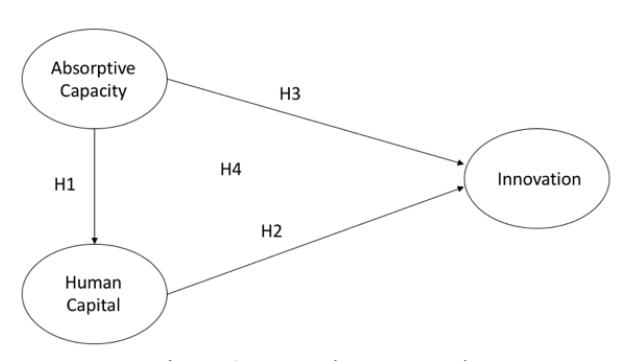
Figure 1 Research Framework
METHOD
Our questionnaire primarily focused on questions regarding ACAP, human capital aspects and innovation. According to Malhotra et al. (2008), the construct should be determined so that it becomes a variable that can be measured. All question items use five-point Likert- type scale. The lowest response is indicated by the score '1', meaning strongly disagree, while the highest response is indicated by the score '5', meaning strongly agree.
For the empirical part, quantitative research design was adopted. This type of design allows for the use of structured questionnaire surveys, enabling researchers to generalise their findings from a sample of a population (Hair et al., 2016). We collected data from small-medium companies (SMEs) in West Java, Indonesia, using available
archives, interviews with managing officers, and data from industry actors before conducting our analysis. The questionnaire was distributed online to 111 small companies based on the survey we have conducted.
The end sample of 111 SMEs is the result of extraction from the total population of SMEs in 2018. According to the data on the West Java Province Statistics), there are 24057 SMEs spread all over the province. By using Slovin formula, we must survey minimum 100 samples to get maximum result. In the end, we received responses from 111 SMEs.
Constructs Validation
We use factor analysis in identifying associated factors with research through the use of key component analysis. The sampling adequacy was measured by the Kaiser-Mayer-Olkin (KMO). For this purpose, KMO value was used as a measure whether the data was sufficient to carry out factor analysis. The corresponding element-to-total ratio shown in the table below shows that we found two main indicators.
The following are the results of the factor analysis of the initial data. The risk value for each variable is greater than 0,7, but there are several indicators with a total element correlation value that is lower than the limit, so that it must be removed from the model.
TABLE I: FACTOR ANALYSIS
| Indicators | Factors | Item total | Cuanhaah?a almha | |||
|---|---|---|---|---|---|---|
| Indicators | 1 | 1 2 | correlation | Cronbach's alpha | ||
| AC1 | 0,566 | 0,529 | 0,758 | |||
| AC2 | 0,544 | 0,459 | ||||
| AC3 | 0,559 | 0,488 | ||||
| AC4 | 0,382a | -0,278 | ||||
| AC5 | 0,668 | 0,673 | ||||
| AC6 | 0,609 | 0,518 | ||||
| AC7 | 0,514 a | -0,268 | ||||
| AC8 | 0,741 | 0,544 | ||||
| AC9 | 0,737 | 0,533 | ||||
| AC10 | 0,744 | 0,636 | ||||
| AC11 | 0,722 | 0,559 | ||||
| AC12 | 0,628 | 0,489 | ||||
| AC13 | 0,781 a | -0,033 | ||||
| AC14 | 0,663 | 0,543 | |||
| AC15 | 0,627 | 0,458 | |||
| AC16 | 0,630 a | -0,046 | |||
| AC17 | 0,606 | 0,501 | |||
| AC18 | 0,601 | 0,379 | |||
| AC19 | 0,393 a | -0,271 | |||
| AC20 | 0,579 | 0,394 | |||
| HC1 | 0,676 | 0,512 | 0,899 | ||
| HC2 | 0,653 | 0,487 | |||
| HC3 | 0,730 | 0,539 | |||
| HC4 | 0,735 | 0,556 | |||
| HC5 | 0,620 | 0,473 | |||
| HC6 | 0,637 | 0,493 | |||
| HC7 | 0,704 | 0,525 | |||
| HC8 | 0,684 | 0,55 | |||
| HC9 | 0,776 | 0,657 | |||
| HC10 | 0,838 | 0,695 | |||
| HC11 | 0,637 | 0,545 | |||
| HC12 | 0,668 | 0,591 | |||
| HC13 | 0,638 a | 0,181 | |||
| HC14 | 0,614 | 0,595 | |||
| HC15 | 0,657 | 0,383 | |||
| HC16 | 0,676 | 0,505 | |||
| HC17 | 0,611 | 0,455 | |||
| HC18 | 0,609 | 0,261 | |||
| HC19 | 0,613 | 0,402 | |||
| HC20 | 0,748 | 0,35 | |||
| HC21 | 0,546 | 0,556 | |||
| HC22 | 0,519 | 0,549 | |||
| HC23 | 0,557 | 0,522 | |||
| HC24 | 0,591 | 0,637 | |||
| I1 | 0,671 | 0,609 | 0,928 | ||
| I2 | 0,790 | 0,744 | |||
| I3 | 0,845 | 0,810 | |||
| I4 | 0,856 | 0,812 | |||
| I5 | 0,784 | 0,723 | |||
| I6 | 0,732 | 0,669 | |||
| I7 | 0,752 | 0,687 | |||
| I8 | 0,755 | 0,679 | |||
| I9 | 0,817 | 0,753 | |||
| I10 | 0,833 | 0,773 | |||
| Variance explained (%) | 60,516 | 67,227 | 71,757 | ||
| Eigenvalue | 6,921 | 7,915 | 6,167 | ||
a. Excluded indicators
Because there are indicators with a loading factor value that is lower than 0.5, the indicator is removed from the model, namely HC1 - HC12. The following is the result of analysis with a loading factor that is greater than 0,5.
Based on the Table II, the AC variable has a lower AVE value than 0,5 but the composite reliability is high.
TABLE II: SCALE VALIDATION
| Variabel | Indicators | λ | AVE | Composite Reliability |
|---|---|---|---|---|
| AC1 | 0,622 | |||
| AC2 | 0,601 | |||
| AC3 | 0,634 | |||
| AC5 | 0,748 | |||
| AC6 | 0,675 | |||
| AC8 | 0,657 | |||
| AC9 | 0,643 | |||
| Absorptive | AC10 | 0,697 | 0,410045 | 0,911912 |
| Capacity (AC) | AC11 | 0,684 | ||
| AC12 | 0,615 | |||
| AC14 | 0,650 | |||
| AC15 | 0,659 | |||
| AC17 | 0,608 | |||
| AC18 | 0,516 | |||
| AC20 | 0,565 | |||
| HC14 | 0,452 | |||
| HC15 | 0,751 | 0,905967 | ||
| HC16 | 0,834 | |||
| HC17 | 0,770 | |||
| HC18 | 0,688 | 0,472974 | ||
| Human Capital | HC19 | 0,721 | ||
| (HC) | HC20 | 0,746 | ||
| HC21 | 0,549 | |||
| HC22 | 0,581 | |||
| HC23 | 0,653 | |||
| HC24 | 0,728 | |||
| I1 | 0,675 | |||
| I2 | 0,738 | 0,609300 | ||
| Innovation (I) | I3 | 0,803 | ||
| I4 | 0,819 | |||
| I5 | 0,761 | |||
| I6 | 0,731 | 0,939511 | ||
| I7 | 0,801 | |||
| I8 | 0,787 | |||
| I9 | 0,833 | |||
| I10 | 0,842 |
TABLE III: MULTICOLLINEARITY TEST
| Model | Collinearity Statistics | |||
|---|---|---|---|---|
| Tolerance | VIF | |||
| AC | 0,970 | 1,031 | ||
| 1 | HC | 0,970 | 1,031 | |
We found that the result shows satisfactory validities of the model, either convergent and discriminant validity. Afterwards, the next step is to review the relationship coefficients of the constructs.
Finally, we followed the Sobel Test procedure as shown by (Fiedler et al., 2011) to test the mediating effects of human capital on ACAP and innovation.
0.297176
| Original Sample | Standard Error | T-Statistics | |||
|---|---|---|---|---|---|
| H1 | AC -> HC | 0,213170 | 0,114077 | 1,868656 | |
| H2 | \(HC \rightarrow In\) | -0,135709 | 0,103053 | 1,316881 | |
| H3 | 4 C . I | 0.005156 | 0.000076 | 2.401200 | |
0.080076
TABLE IV: COEFFICIENT TABLE
The results show that ACAP has significant effect on human capital, the direction is positive, so the hypothesis is accepted (\(\beta\)=0,213, t stat = 1,868 > t-stat(1,64)). However, human capital shows no significant effect on innovation since the direction is negative, so hypothesis 2 is rejected (\(\beta\)=-0,135, t stat = 1,317< t table (1,64)). Talking about ACAP's significant effect on Innovation (hypothesis 3), the direction is positive, so hypothesis 3 is also accepted ( \(\beta\)=0,297, t stat = 3,481 > t table (1,64)).
\(AC \rightarrow In\)
The difference of chi-square between saturated and direct models aims to see whether the human capital variable acts or does not act as a mediating variable. Hence, we conducted Sobel test to see the result.
After calculating the Sobel Test, the result is obtained as depicted in Table V.
are not really advanced in education. The human capital aspects in the context of labours in SMEs are different if seen in the context of multinational companies or public institutions. Hence, the absorptive capacity is not guaranteed as an antecedent of innovation when the human capital factor is involved as a mediator.
3,481288
RESULTS, DISCUSSION AND CONCLUSION
Previous literatures have proven that absorptive capacity (ACAP) usually has close relationship with the knowledge sharing process of human capital and innovation as the end-product of a learning organization. The ability of employees conduct knowledge acquisition dissemination with their peers or fellow group members has a significant effect on the company's
TABLE V: MEDIATION TEST RESULT
| Н | Relationship | Path coefficient | Error standard | t-stat | Conclusion |
|---|---|---|---|---|---|
| H4 AC | \(\rightarrow\) HC \(\rightarrow\) IN \(\frac{\text{AC-HC}}{\text{HC-IN}}\) | 0,213 -0,136 | 0,114 0,103 | -0,986 | Not significant |
Based on the table above, the calculated t value (-0.986) is greater than the t-table (-1.64). This finding shows that in this case, the HC variable does not act as a mediating variable, thus hypothesis 4 is also rejected.
This rather disappointing finding can be explained by the probability that mostly the respondents of the SMEs are not conceptually established human capital. Most of the labours of the SMEs are trained workers in terms of practical tasks or physical activities, but they
ability to acquire and assimilate knowledge. When a company has optimized innovation, it will perform better in their activities.
In this case, the companies which know best way to maximize their human capital knowledge in the implication of ACAP can reap the benefits in innovation. Past literatures support this finding, noting that management levels of companies with maximum ability to turn ideas into action also perform better in disseminating knowledge. This research aimed to explore more on how human capital plays important role on absorptive capacity and its relationship towards innovation.
However, our result has shown that in the case of West Java SMEs' labours, the human capital factors do not act as a mediator between ACAP and innovation. Absorptive capacity might act as an antecedent of innovation and human capital factor is involved as a mediator if we see it in the environment of big companies, but within our research, this hypothesis was not supported in the SMEs environment. This result somehow corresponds with the results shown by Lozano (2014) , but contradicted the results by researches believing ACAP as an important factors for innovation in SMEs as well (Fernhaber & Patel, 2012) and (Tzokas et al., 2015).
As every research has its drawbacks, this research also has its limitations. Here, the limitations can be seen in its homogenous scope of study. We focused the research only in SMEs and merely within a province in Indonesia, so the results may differ due to differences in culture and environment. Therefore, one of our recommendations is to expand the study to other work environments. Various types of respondents can better explain the result on how a company provides a stimulus to employees to want to share knowledge to their peers, in absorptive capacity context.
Another limitation of this research is that perceptions that should be obtained from parts that are directly related to the measured variables cannot be met due to constraints or limitations in the field. Another suggestion for further research is it can be done in a specific focused group or individual analysis unit. It can improve the effectiveness of research and development corresponding to human capital aspects in innovation.
REFERENCES
- Bornay-Barrachina, M., López-Cabrales, A., & Valle-Cabrera, R. (2017). How do employment relationships enhance firm innovation? The role of human and social capital. International Journal of Human Resource Management, 28(9), 1363– 1391. https://doi.org/10.1080/09585192.2 016.1155166
- Camisón, C., & Villar-López, A. (2014). Organizational innovation as an enabler of technological innovation capabilities and firm performance. Journal of Business Research, 67(1), 2891–2902. https://doi. org/10.1016/j.jbusres.2012.06.004
- Edquist, C. (2009). Systems of Innovation: Perspectives and Challenges. The Oxford Handbook of Innovation, (January 2006). https://doi.org/10.1093/ oxfordhb/9780199286805.003.0007
- Fakhri et al. (2014). Factor analysis of work motivation using Maslow's hierarchy of needs: Case study on civil servants at Banten Province's Office of Agriculture and Livestock. International Conference on Emerging Trends in Academic Research, 258–274.
- Fernhaber, S. A., & Patel, P. C. (2012). How do young firms manage product portfolio complexity? the role of absorptive capacity and ambidexterity. Strategic Management Journal, 33(13), 1516–1539. https://doi. org/10.1002/smj.1994
- Fiedler, K., Schott, M., & Meiser, T. (2011). What mediation analysis can (not) do. Journal of Experimental Social Psychology, 47(6), 1231–1236. https://doi.org/10.1016/j. jesp.2011.05.007
- Franco, C., Marzucchi, A., & Montresor, S. (2014). Absorptive Capacity, Proximity in Cooperation and Integration Mechanisms. Empirical Evidence from CIS Data. Industry and Innovation, 21(4), 332–357. https://doi.org/10.1080/13662716.2014.9 42083
- Hair et al. (2016). A primer on partial least squares structural equation modeling (PLSSEM). Sage Publications.
- Liu, H., Ke, W., Wei, K. K., & Hua, Z. (2013). The impact of IT capabilities on firm performance: The mediating roles of absorptive capacity and supply chain agility. Decision Support Systems, 54(3), 1452–1462. https://doi.org/10.1016/j. dss.2012.12.016
- Lopez‐Cabrales. (2009). Knowledge as a mediator between HRM practices and innovative activity. Human Resource Management: Published in Cooperation with the School of Business Administration, The University of Michigan and in alliance with the Society of Human Resources Management, 48(4), 485–503.
- Lozano, R. (2014). Creativity and organizational learning as means to foster sustainability. Sustainable Development, 22(3), 205– 216. https://doi.org/10.1002/sd.540
- Malhotra, J. D., Miao, H., Zhang, K., Wolfson, A., Pennathur, S., Pipe, S. W., & Kaufman, R. J. (2008). Antioxidants reduce endoplasmic reticulum stress and improve protein secretion. Proceedings of the National Academy of Sciences of the United States of America, 105(47), 18525–18530. https://doi.org/10.1073/ pnas.0809677105
- Mathis and Jackson. (n.d.). Human resource management: Essential perspectives. Cengage Learning.
- Noblet, J. P., Simon, E., & Parent, R. (2011). Absorptive capacity: A proposed operationalization. Knowledge Management Research and Practice, 9(4), 367–377. https://doi.org/10.1057/ kmrp.2011.26
- Pangarso, A., Syarifuddin, S., Pradana, M., Moeliono, N., & M.Fazrido, B. (2017). The Influence Of Transformational Leadership Style On Employee's Performance PT PLN Cabang Pekanbaru Rayon Panam. 40(Icame), 1–16. https://doi.org/10.2991/ icame-17.2017.1
- Petrakis, P. E., Kostis, P. C., & Valsamis, D. G. (2015). Innovation and competitiveness: Culture as a long-term strategic instrument during the European Great Recession. Journal of Business Research, 68(7), 1436–1438. https://doi.org/10.1016/j. jbusres.2015.01.029
- Petrović, B., & Krstić, B. (2011). The Role Of Knowledge Management In Developing Capabilities For Increasing Enterprise's Absorptive Capacity. Economics and Organization, 8(3), 275–286.
- Pradana and Perez-Luno. (2017). Factors of Absorptive Capacity at Spanish Beverage Companies. ISCLO.
- Pradana, M., Fakhri, M., Gilang, A., & Khairin, P. (2018). Determinants of Organizational Citizenship Behavior: The Case of an Indonesian Insurance Company. Jurnal Bisnis dan Manajemen, 19(2), 88–100. https://doi.org/10.24198/jbm.v19i2.170
- Roper, S., Love, J. H., & Bonner, K. (2017). Firms' knowledge search and local knowledge externalities in innovation performance. Research Policy, 46(1), 43–56. https://doi. org/10.1016/j.respol.2016.10.004
- Saragih, R., Fakhri, M., Pradana, M., Gilang, A., & Vidjashesa, G. A. (2018). Ethical leadership's effect on employee discipline: Case of an Indonesian telecommunication company. Proceedings of the International Conference on Industrial Engineering and Operations Management, 2018(NOV).
- Statistics, W. J. (n.d.). Badan Pusat Statistik Jawa Barat.
- Stucki, T. (2016). How the founders' general and specific human capital drives export activities of start-ups. Research Policy, 45(5), 1014–1030. https://doi. org/10.1016/j.respol.2016.02.010
- Tzokas, N., Kim, Y. A., Akbar, H., & Al-Dajani, H. (2015). Absorptive capacity and performance: The role of customer relationship and technological capabilities in high-tech SMEs. Industrial Marketing Management, 47, 134–142. https://doi. org/10.1016/j.indmarman.2015.02.033
- Wang and Zatzick. (2018). Human Capital Acquisition and Organizational Innovation: A Temporal Perspective. Academy of Management Journal, 62(1), 99–116.
- Zahra, S. A., & George, G. (2002). Absorptive capacity: A review, reconceptualization, and extension. Academy of Management Review, 27(2), 185–203. https://doi. org/10.5465/AMR.2002.6587995
- Zhang, M., Lettice, F., & Zhao, X. (2015). The impact of social capital on mass customisation and product innovation capabilities. International Journal of Production Research, 53(17), 5251–5264. https://doi.org/10.1080/00207543.2015.1 015753