

ABSTRAK
Penelitian ini menggunakan teknik fundamental untuk melakukan evaluasi terhadap preferensi ekspresi verbal pengguna ruang interior dengan cara menghimpun kata-kata asosiatif kesan mendalam pengguna (user's in-depth impression). Peneliti menggunakan perangkat lunak visualisasi Pajek untuk analisis data jaringan yang sangat besar yang dibantu dengan penggunaan kamus USF Word Association; perangkat lunak dan kamus ini digunakan untuk memvisualisasikan struktur dan kedalaman jaringan makna asosiatif yang terbentuk. Hasil pengumpulan kata-kata asosiatif kemudian dikelompokkan secara kualitatif berdasarkan pengelompokan taksonomi kata menjadi 13 dimensi kualitas lingkunganinterior berdasarkan persepsi: Terkait rumah (House-related), Territorial (Territorial), Impresi (Impression), Kegiatan (Activity), Unsur Aktif Alam (Active Element of Nature), Alam (Nature), Bahan Bangunan (Building Material), Teman serumah (Companion), Dasar Rumah Tangga (Household Basics), Warna (Color), Lokasi (Location), Komposisi (Composition), dan Periode Waktu (Time Period). Selanjutnya,dengan menggunakan analisis faktor, sejumlah kata terpilih yang memiliki nilai sebaran kata asosiatif yang tinggi (Out-Degree Centrality/ODC score) divalidasi menjadi 5 faktor yang berpengaruh terhadap kenyamanan pengguna ruang interior. Hasilnya, 5 Faktor dan 13 Dimensi ini menjadi dasar yang objektif dalam menentukan komposisi pasangan kata adjektif pada Semantic Differential method (SD) yang dapat membantu desainer/arsitek mengevaluasi preferensi pengguna ruang interior.
Kata Kunci: dimensi spasial interior, kenyamanan pengguna, konsep asosiatif, analisis jaringan
INTRODUCTION
Cognitive psychology experts generally agree that it is difficult to evaluate individual preference responses (Taura et al., 2010). This is because such preferences are based on impressions, and thus involve complex cognitive processes and emotions (i.e., the mental state) that may result in vague (i.e., nonspecific or multi-valued) assertions. The act of processing verbal responses to create numerical data also ignores their essential nature (i.e., the verbal expression). The current methods of evaluating affective preferences in built environments (interior design) tend to employ a numerical-scale approach base on both Osgood, Suci, and Tannenbaum's (1957) study on the Semantic Differential (SD) method and Küller's (1972) Semantic Environmental Description (Semantisk miljöbeskrivning) (SMB). Here, a numerical scale based on several pairs of bipolar adjectives relates to spatial quality categories. Bipolar adjectival word pairs are listed without considering the rich word impressions contained in verbal expressions. Linguistic cognition and computer science researchers agree that this is important when expressing or responding to events. For instance, a word as a response to emotions and preferences represents a cognitive response that contains both implicit and metaphorical associations (Taura et al., 2010; Nagai, 2011a; Georgiev, 2011). Associations and metaphors become increasingly complex when the connotative, collocative, affective, reflective, and thematic contents are considered (Mwihaki, 2004).
METHOD
Criticisms of Semantic Model Measurement Method
A combination of the statistical factor analysis and SD method has become the standard testing procedure for developing hypotheses about the correlations between individual preferences for built environments. Although these methods utilize verbal responses from subjects, such individual expressions cannot sufficiently be converted into numerical codes. In regard to measuring human impressions, the SD method has been criticized for ignoring verbal
expressions, which contain many cognitive and affective aspects and meanings that are not easily determined. Processing verbal data directly into a numerical code or scale (e.g., the Likert scale) thus seems to ignore the latent essence of verbal information as a measure of true experience. The SD method seeks to measure user artifact impressions by focusing on frequency values on a scale of 1 to 5 or 7. It is therefore useful for explaining different object impressions, albeit ad hoc (at that time). Wikström (2002) revealed significant differences in evaluating user impressions when viewing and using a stove. Such differences indicate that the SD method is not sufficient for exploring latent sensitivity or indepth impressions, nor is it useful for capturing structures from impressions. Yamamoto et al. (2009) thus hypothesized that the SD method was only useful for exploring surface impressions. The fuzzy rough set theory was developed to more specifically examine impressions, but is still insufficient for comprehensive exploration (Bellman, 1970; Pawlak, 1991).
As with most SD methods, the choice of adjective pairs (e.g., comfortable-uncomfortable) is interpretative of words containing the evaluation, potency, and activity (EPA) dimension. Here, evaluation is a comparison of good/bad, potency is a comparison of strong/ weak, and activity is a comparison of the active/ passive stimulus. The selection process for adjective pairs common to the SD method only tends to involve subjective surface impressions. Adjective pairs should be used as scoring/ rating attributes among words derived from indepth object impressions obtained during the stage just before implementing SD techniques (Figure 1). The investigated impression words are selected for use as bipolar adjective-pair variables in conducting the SD evaluation after determining the in-depth impression. It thus seems unreliable to measure emotional responses or feelings if the applied bipolar adjective pairs are interpretatively chosen, even if they refer to the EPA dimensions used in the SD method. For example, interpretive word pairs used to measure the attribute of "love for one's mother" might include gentle-rough, frugal-wasteful, diligent-lazy, and responsible-negligent. Furthermore, the Associative Concept Network Analysis (ACNA) (which was introduced in this research) is more useful for obtaining attributes that are much more sensitive and appropriate for dealing with impressions and emotions. For instance, the essential words in dealing with a child's verbal opinion of his mother are those that represent deeper impressions (e.g., caring, accommodating, and protecting). These words are more appropriate for use in pairs (e.g., caringneglecting, accommodating-unaccommodating, protecting-abandoning) designed to rate concepts such as love for one's mother through the SD method. Bipolar adjective pairs in SD evaluations thus become true representations of the deepest impressions, which can then be measured against artifacts, humans, and space.
Another popular method of quantitatively measuring affective preferences for built environments is the SMB (commonly referred to as the semantic model measurement method), which is used to describe perceived environments (Janssens, 1986; Küller, 1972, 1975, 1979, 1980, 1991). SMB refers to properties containing eight dimensions of environmental quality, as follows:
- Pleasantness: The environmental quality of being pleasant, beautiful and secure.
- Complexity: The degree of variation, intensity, contrast, and abundance.
- Unity: Whether the environment fits together into a coherent and functional whole.
- Enclosedness: A sense of spatial enclosure and demarcation.
- Potency: An expression of power in the environment and its various parts.
- Social status: An evaluation of the built environment in socioeconomic and maintenance terms.
- Affection: The quality of recognition that creates a sense of familiarity (often related to the age of the environment).
- Originality: The unusual and surprising elements in a given environment.
It is thought that these eight dimensions can easily be applied to evaluate user preferences for the environment or space in a measurable
manner. SMB expands the measurable (i.e., EPA) dimensions of the SD method to include the eight dimensions of Pleasantness, Complexity, Unity, Enclosedness, Potency, Social status, Affection, and Originality (PCUEPSAO). However, these dimensions have not previously been used to represent deep user impressions of and experiences in any given space.
The Associative Concept Network Analysis (Acna)
The current method of evaluating verbal expressions is the Associative Concept Network Analysis (ACNA). This technique is advantageous because it increases understanding about the essence of verbal expression. Nagai et al. (2011b) first introduced the ACNA technique in evaluating human responses to the color of hospital nurse uniforms. Georgiev et al. (2012) then tested driver responses to interfaces in vehicle interiors. However, the ACNA has not been applied to the overall human experience in interior spaces. More specifically, it has not been used to research solidarity. The data obtained through research on individual impressions of space are based on verbal responses. These responses are the primary data analyzed through associative correlations. Unexpressed (i.e., latent) individual comfort can thus be detected and explained using this method (Figure 1).
A great number of associative words apply to any human experience. There are also stimulus words, such as "green," "house," and "mountain." "Green" has a high ODC score in Figure 1 because it expresses the highest distribution of associative meanings. The words "hill" and "carpet" show the same distribution of certain word associations. The word "landscape" also emerged. This was surprising because it was not verbally expressed but, instead, contained several associative meanings that were directly related to the spoken words "hill" and "carpet." The unspoken word "landscape" was thus confirmed to be a stimulus concept/ word (i.e., in-depth impression), which ignited and was strongly associated with "green." At the same time, it was associated with "house" and "mountain." This explains how the word
"landscape" plays a role in cognition during production of the utterance "I am enjoying the hill and feeling carpet under my feet."
The method of evaluating individual responses to spatial experiences (interior design) using SD techniques in conjunction with a factor analysis while measuring through multivariate statistic principles has not been useful in revealing latent responses as they relate to impressions. These methods are only useful for describing the numerical tendencies of a preference. Thus, the essence of a given surface impression is not comprehensively revealed. This study therefore used the principles of affective computing to propose an ACNA method for identifying user comfort in interior spaces. This research is novel in its use of an application to identify user impressions about a built environment, especially those related to architecture and interior space. A network analysis aids in visualizing the associative network connections of an expression or word. Interpretation of the association structure is further facilitated by visualization of a worded response and its connection to other worded responses. The ACNA technique was developed by a Japanese research team in 2008 (Yamamoto et al., 2009). It has been used to evaluate human and product preferences. This study therefore applied the ACNA technique to evaluate user comfort during a culinary experience in a café environment.
Assessing Individual Verbal Expressions During Spatial Experiences
Quantitatively measuring a qualitative spatial experience is generally only useful for producing a bipolar scale. That is, it reveals the positive and negative aspects of an event. It is difficult to express the true human experience related to spatial comfort in this manner. This is because the verbal expressions used to express feelings and reveal latent impressions are not examined during the process. This research thus examined individual verbal expressions during a spatial experience. A network analysis of a verbal expression can reveal very complex feelings that are not explicitly mentioned by the individuals who experience them. However, the ACNA can be used to reveal deep expressions during spatial experiences. It is thus useful as a new method of evaluating the human response to spatial quality. In short, this technique can be used to identify user comfort in an interior space by examining verbal expressions, which are then processed to produce associative words (i.e., keywords) that are rooted in the deep cognitive impressions of users (i.e., comprehensive impressions). These keywords then become true references to the emotions and preferences of users. They can further be interpreted during the process of developing interior-architectural designs that are more appropriate for clients or when instructing students.
Techniques for Identifying Interior Spatial Dimensions Based on User Preferences
This study's word database was derived from an associative dictionary titled The University of South Florida Word Association, Rhyme and Word Fragment Norms (Nelson, McEvoy, & Schreiber, 2004). It was used to detect verbal inputs prior to generating word associations based on an Out-Degree Centrality (ODC) scoring system from a large network analysis application (Pajek software) (De Nooy et al., 2011). The procedure was structured as follows:
- A. A total of 15 random respondents (i.e., 12 men and 3 women) were interviewed after visiting four different cafés. Interviews were conducted just after respondents ate meals. The intent was to maintain respondent moods while providing them with sufficient time to enjoy their interior experiences.
- B. Each interview was intentionally completed in less than six minutes to ensure that questions remained simple. This design was chosen to avoid altering interviewee moods as much as possible. Respondents were asked three to four relatively similar basic questions about comfort. Their verbal responses were taped with a sound recorder. Although there were four total questions, each focused on one concept (i.e., the visitor's impression
- 1. Can you tell me about your experience here, including your impressions of the outside area, entrance, and seating process? (Answered in two to three minutes)
- 2. Do you find anything interesting about the area/layout of this café's interior? (Answered in two to three minutes)
- 3. Do you find anything interesting about the interior architectural elements in this café? (Answered in two to three minutes)
- 4. Can you tell me what impressed you about the café's interior? (Answered in two to three minutes)
- C. Audio recordings were taken and transcribed in Indonesian before being translated into English. The transcriptions were then sorted to create sentence segments only consisting of nouns. This was done because nouns typically contain more lexical associations than adjectives.
D. Finally, sorted words were generated using the associative dictionary.
Example:
"I am enjoying the hill and feeling carpet under my feet."
The words "hill," "carpet," and "feet" were selected and processed through the matrix equation so that the value of the degree of centrality (i.e., the In-Degree Centrality (IDC) and Out-Degree Centrality (ODC)) was obtained through the gars/arc connection between explicit words (utterances) and word stimuli (in-depth impressions/associative words).
IDC refers to explicitly spoken words that only supply surface impressions. IDC is interpreted as the initial expression or one that is still limited to the surface of the mind; these have the potential to expand into variable associative words. ODC indicates the amount of associative word distributions generated through the word source or stimulus. Once the associative word distributions have been produced, many subsequent words from the matrix formulations can collect and extract themselves into associative word sources or indepth impressions (Figure 1).
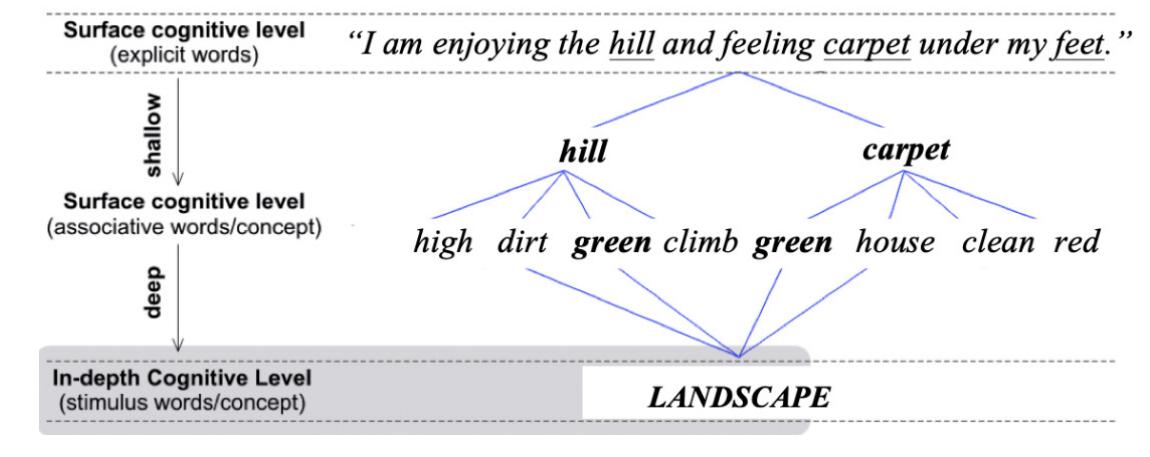
Figure 1. Example of capturing an associative response through an Associative Concept Network Analysis (ACNA) based on the short sentence "I am enjoying the hill and feeling carpet under my feet." The ACNA method uses a computational system to generate unspoken words as links to associative words describing deep feelings. For example, associations between the words "hill," "carpet," and "feet" contain the word association "landscape" (Junaidy & Nagai, 2013).
"hill" => climb, dirt, green, high, mountain, slope, valley, etc. "carpet" => clean, floor, green, house, tile, red, rug, vacuum, etc. "feet" => hands, inch, legs, shoes, smell, toes, walk, etc.
ODC can be used to describe the strengths and weaknesses of a spoken word association within the word stimulus. The matrix equation in the ODC and IDC network graphs can reveal both weak and strong word relationships where the words "hill," "carpet," and "feet" contain the distributions of their respective word associations. The matrix equation formula can facilitate the detection of associative words that lead to the source word or the explicitly spoken words (i.e., "hill" and "carpet,"). The generated word stimulus source is a true representation of an in-depth impressions that have high ODC scores and are considered strong and a very relevant references in the context of interior design.
Procedure
This study identified qualitative responses based on individual spatial experiences, especially those relating to one's comfort when inside a building. To do this, interviews were conducted among 15 new visitors to a culinary service facility (café) once they had finished their meals. Each respondent was asked to discuss their comfort and the factors they believed influenced their decision to visit the culinary service facility. The culinary (food) factor was ignored. Thus, the obtained expressions solely related to spatial experiences. The surveys were variously conducted inside the four culinary service facilities (which represented both outdoor and indoor experiences) used in this study.
RESULTS AND DISCUSSION
This study obtained the perceptions of 15 users of four cafés. The results were then transcribed to English. The words in each sentence were then sorted (noun words) according to the associative concept theory, in which perceptions that are revealed through spoken words are considered superficial information (or surface perceptions) (Georgiev et. al., 2011). This theory entails that the word contents of each sentence contain a variety of meanings that are not explicitly revealed.
For example, consider the following question:"Can you tell me what impressed you about the café's interior?"
The following are examples of verbalized user expressions indicating the quality of the interior space:
"When you get here, the atmosphere is pretty good, open and nice. There's a gallery. There's a natural atmosphere, too."
"Compared to other cafés, it may be the natural atmosphere. In other cafés, the natural atmosphere is only a view. But here, it really feels like having coffee in nature. In addition, each group [of visitors] gets a hut. So it feels like it is ours."
"Here, what is interesting on the second floor is that there is a bar. Downstairs there is a large meeting room. So, this place accommodates visitors only and is for meetings because the area is large."
Words such as "green," "cool," and "wood" are strongly associated with words such as "tropical," "forest," "young," "fresh," "leaf," and "bright" through another set of associative words. The next analytical step involves interpreting words with the strongest ODC scores in comparison to occurring phenomena. For instance, associative words like "tropical" and "forests" contain high scores.This type of interpretation will therefore confirm the intent of the main sentences or statements. The associative word with the highest score is interpreted as an implicit expression (i.e., one that is not uttered) in relation to user comfort within a given space. Table 1 shows a list of nouns from the respondents' sorted utterances.
TABLE 1. LIST OF NOUNS FROM SORTED UTTERANCES
Sorted utterances of 15 respondents according to the sorting rule procedure
Subject 01:
place, scenery, city, view, atmosphere, material, wood, building, visitor, steel, layout, area, parking, cafe, plaster, concrete, natural, comfort, selfie, spot, plan, coziness, crowd, mood, togetherness
Subject 02:
friend, coffee, hangout, upstairs, outdoor, tree, nature, cool, coziness, traditional, custom, java, house, modern, exhibition, café, atmosphere, downstairs, relaxing, exhibition, furniture, solid, wood, unfinished, natural, impression, material, iron, usual, stress, village, scenery, area, floor, gallery, family, guest, place, city, selling, calm, serenity, shade
Subject 03:
upstairs, parent, downstairs, parking, trip, signage, renovation, atmosphere, open, gallery, nature, outdoor, renovation, side, scenery, place, café, space, compact, visitor, shopping, area, exhibition, furniture, chair, table, ordinary, bar, spot, uniqueness, material, stone, plant, art, joy
Subject 04:
parking, downstairs, place, surprise, upstairs, quietness, colleague, meeting, friend, space, serenity, atmosphere, nature, place, spot, narrow, wide, seating, view, plants, wind, refresher, guy, smoke, café, order, normal, people, home, serenity, tranquil, bar, couple, area, furniture, table, side, antique, paint, remnant, condition, wood, bamboo, house, architecture, traditional, modern, gallery, area, concept, joy
Subject 05:
place, friend, access, parking, space, surprise, seating, stall, welcome, spot, melt, nature, inside, smoker, open, smoke, table, privacy, scenery, wind, table, plant, concept, favorite, joy, struggle, share, ordinary, experience, joke, house, homecoming, wood, collection, calm, melt, color, uniqueness, corner, animal, distant, shade, melt
Subject 06:
place, suggestion, family, working, spot, pleasure, fun, parking, motorcycle, cashier, village, furniture, home, plug, rest, gazebo, outdoor, experience, side, corner, restaurant, hangout, transaction, finish, whole, view, culture, coffee, shop, cross-legged, café, seating, facility, recall, memory, modest, calming, atmosphere, uniqueness, traditional, local, new, international, beverage
Subject 07:
random, shape, chair, various, grouping, table, hut, café, spot, chat, pleasure, privacy, hangout, guard, post, village, comparing, cafe, nuance, nature, view, coffee, group, possession, atmosphere, user, modest, architecture, furniture, style, outdoor, bold, element, interior, local, value, drink, west, order, home, comfort, longing, wealthy
Subject 08:
evening, pathway, spot, view, distance, empty, bench, hut, cashier, barista, building, element, wood, shape, uniqueness, cold, weather, tree, layout, cool, open, space, edge, front, grass, concept, uniqueness, table, city, village, morning, atmosphere, comfort, refresher, cold, lighting, indoor
Subject 09:
surrounding, cashier, area, seating, back, comfort, empty, around, glance, spot, atmosphere, cold, hut, warmth, wind, concept, nature, unity, building, layout, spread, jam, coziness, near, unknown, person, space, reuse, element, facility, industry, locality, old, furniture, random, shape, material, thick, chair, waste, fundamental, front, view, interior, outdoor, dominant, wood, locality, wisdom
Subject 10:
large, first, impression, cashier, menu, hangout, coffee, snacks, meal, spot, outdoor, fun, view, indoor, location, relaxing, backrest, rest, hangout, area, garden, table, space, hut, eye, side, center, block, architecture, modern, cottage, comfort, furniture, chair, fun, aura
Subject 11:
expectation, concept, outdoor, spot, customer, privacy, chat, friend, scanning, condition, shade, nature, tree, fun, refresher, air, layout, collision, cozy, hut, people, covered, isolated, family, material, trunk, wood, inconsistency, iron, color, red, hangout, location, man, road, serenity, architecture, ordinary, special, calming, distant, hustle, bustle, city
Subject 12:
outdoor, concept, wood, seating, bonfire, hut, electric, hangout, entrance, front, door, order, place, pathway, place, open, air, chat, people, privacy, upstairs, corner, straw, tile, brick, layout, parking, green, shade, tree, distraction, back, visitor, garden, green, place, family, design, roof, size, electric, trash, bin, weaving, trash, bag, bicycle, tree, atmosphere, coffee, latte, manual, brew, architecture, large, parking, area
Subject 13:
relaxing, cozy, drink, coffee, atmosphere, calming, cool, tree, system, order, payment, spot, place, nuance, green, tree, comfort, calming, space, charging, shade, resting, traditional, wood, hut, privacy, architecture, pond, nuance, green, water, tree, refresher, visitor, jog, fish, house, furniture, wood, outdoor, nature, monotone, sofa, modern, uniqueness, open, air, pathway, downhill, forest, mindset, concept, motorcycle, noise, urban, shade, imitation
Subject 14:
café, spot, comfort, upstairs, view, area, downstairs, fun, cool, chair, table, wood, iron, fad, friend, roof, straw, low-level, experience, interior, lamp, natural, romantic, common, curiosity, evening, cold, afternoon, monotone, simple, cover
Subject 15:
`
traditional, furniture, nature, wood, comfort, shade, architecture, traditional, lighting, glimmer, furniture, concept, yellow, evening, element, natural, chair, table, roof, straw, downstairs, material, iron, industry, floor, stone, kitchen, front, material, cold, hill, atmosphere, comeback
Source: Data Adapted from Junaidy 2019
The collection of nouns forms the surface expressions found in user opinions on interior spaces in the form of selected noun fragments. According to the Associative Concept Network theory developed by Georgiev & Nagai (2011), these nouns contain comprehensive meanings that cannot be directly revealed. The dimensions of pleasantness, enclosedness, social status, affection, and others were obtained based on stated respondent experiences in the interior spaces (Kuller, 1975 & 1979).
Once all respondent utterances were recorded and translated, they were sorted based on a procedure designed to solely obtain nouns. A total of 628 were obtained during this process (Table 1). The nouns were then processed using the matrix graph formula. The more connections a word had to another associated word, the higher the ODC score was, and vice versa. The words were then processed based on an associative dictionary that was formulated using the graph matrix formula. As a result, the 628 nouns revealed 5,849 associative meanings. These 5,849 generated associative words were not easily obtained during conversation because of the complexity of the formed network. The generated associative words were first classified according to the words obtained from the interview responses. The words of each respondent then began to exhibit strong associative meanings according to the highest scores from a similar taxonomy of words (Table 2).
TABLE 2. SORTED GENERATED ASSOCIATIVE WORDS (SHOWN IN PART, ORDERED BY HIGHEST ODC SCORE)
| House-related | Territorial/ Distance | Impression/ Adjectives | Activity | Active Element of Nature | ||||||
|---|---|---|---|---|---|---|---|---|---|---|
| 127 sorted | 84 sorted | 73 sorted | 49 sorted | 51 sorted | ||||||
| associative words | associative | associative | associative | associative | ||||||
| (90% reduction out | words (90% | words (90% | words (90% | words (90% | ||||||
| of 5,849 generated | reduction out of | reduction out of | reduction out of | reduction out of | ||||||
| associative words) | 5,849 generated | 5,849 generated | 5,849 generated | 5,849 generated | ||||||
| associative words) | associative words) | associative words) | associative words) | |||||||
| 26 | 0.333 | 23 | 0.185 | 91 | 0.194 | 28 'work' | 0.161 | 16 | 0.147 | |
| 'house' | 'place' | 'good' | 'water' | |||||||
| 127 | 0.300 | 16 | 0.143 | 113 | 0.190 | 173 | 0.154 | 1 'air' | 0.138 | |
| 'house' | 'space' | 'hard' | 'work' | |||||||
| 36 | 0.263 | 33 | 0.132 | 132 | 0.154 | 93 'walk' | 0.148 | 30 'air' | 0.118 | |
| 'room' | 'place' | 'hard' | ||||||||
| 14 | 0.259 | 2 'area' | 0.129 | 96 'nice' | 0.143 | 76 'cut' | 0.138 | 70 | 0.107 | |
| 'room' | 'water' | |||||||||
| 45 | 0.238 | 158 | 0.115 | 6 'hot' | 0.143 | 240 'stop' | 0.129 | 44 'air' | 0.105 | |
| 'house' | 'top' | |||||||||
| shown in part. | shown in part. | shown in part. | shown in part. | shown in part. | ||||||
| 14.342 | 6.817 | 6.473 | 4.090 | 3.917 | ||||||
| Nature | Building Material | Peer/Companion | Household Basics | Color | |||||
|---|---|---|---|---|---|---|---|---|---|
| 42 sorted associative words (90% reduction out of 5,849 generated associative words) | 26 sorted associative words (90% reduction out of 5,849 generated associative words) | 29 sorted associative words (90% reduction out of 5,849 generated associative words) | 25 sorted associative words (90% reduction out of 5,849 generated associative words) | 22 sorted associative words (90% reduction out of 5,849 generated associative words) | |||||
| 150 'tree' | 0.147 | 68 'building' | 0.190 | 152 'man' | 0.105 | 167 'money' | 0.115 | 47 'black' | 0.129 |
| 178 'mountain' | 0.143 | 12 'wood' | 0.148 | 59 'people' | 0.100 | 176 'clothes' | 0.115 | 50 'green' | 0.129 |
| 151 'mountain' | 0.138 | 12 'wood' | 0.133 | 75 'people' | 0.097 | 208 'cloth' | 0.115 | 43 'black' | 0.121 |
| 271 'forest' | 0.133 | 9 'wood' | 0.115 | 41 'people' | 0.097 | 213 'paper' | 0.115 | 46 'green' | 0.121 |
| 300 'tree' | 0.129 | 104 'gold' | 0.115 | 141 'person' | 0.097 | 76 'car' | 0.111 | 43 'black' | 0.118 |
| shown in p | shown in part | shown in part | shown in part | shown in part | |||||
| 3.815 | 3.815 | 1 | 2.149 | 2.140 | 2.004 | ||||
| Location | Composition/ Element | Time Period | Security* | Undefined** | |||||
|---|---|---|---|---|---|---|---|---|---|
| 26 sorted | 23 sorted | 21 sorted | 4 sorted | 5 sorted associative | |||||
| associat | ive | associative | associative | associa | ıtive | words (90% | |||
| words (9 | 0% | words (90% | words (90% | words ( | 90% | reduction | out of | ||
| reduction o | out of | reduction out of | reduction out of | reduction | reduction out of | erated | |||
| 5,849 gene | rated | 5,849 generated | 5,849 generated | 5,849 generated | associative | words) | |||
| associative words) | associative words) | associative words) | associative words) | ||||||
| 50 'country' | 0.100 | 1 'art' | 0.111 | 49 'time' | 0.111 | 102 'security' | 0.067 | 119 'thing' | 0.115 |
| 2 'city' | 0.095 | 30 'square' | 0.111 | 152 'night' | 0.103 | 178 'dog' | 0.067 | 308 'different' | 0.097 |
| 7 'map' | 0.095 | 1 'circle' | 0.105 | 180 'life' | 0.100 | 182 'police' | 0.067 | 38 'letter' | 0.067 |
| 47 'school' | 0.095 | 276 'form' | 0.100 | 9 'life' | 0.097 | 185 'rail' | 0.067 | 146 'thing' | 0.067 |
| 66 'sidewalk' | 0.095 | 54 'square' | 0.097 | 9 'life' | 0.097 | 12 'horse' | 0.061 | ||
| shown in part | shown in part | shown in part | shown in part | shown in part | |||||
| 1.889 | 1.62 | 9 | 1.605 | 0.267 | 0.467 | ||||
A qualitative categorization was then conducted based on the taxonomy of groups created using the generated associative words. A total of 15 categories were obtained. The 15 following dimensions of perceived interiorenvironmental quality were then determined: House-related, Territorial/ Distance, Impression/ Adjectives, Activity, Active Element of Nature, Nature, Building Materials, Peer/ Companion, Household Basics, Color, Location, Composition, Time Period, Security, and Undefined. The security category was excluded from discussion due to its relatively small number of sorted associative words. A number of sorted associative words also had vague definitions. These words were thus categorized as undefined and excluded from further discussion. The 13 remaining dimensional categories indicated deep associations among café visitors when perceiving interior spaces. Here, weighting was focused on personal issues related to residence and personal attributes (e.g., "cats," "beds," and "couches"). Other attributes (e.g., "distance," "location," "positive feeling," "timing," "periods," "kinship," and "household basic needs") were also of concern. The following list includes the 13 dimensions based on similar taxonomic attributes:
- House-related attributes (e.g., house, home, room, bed, couch, and cat)
- Territorial/ Distance attributes (e.g., place, space, area, top, spot, and close)
- Impression/Adjectives attributes (e.g., good, hard, nice, happy, love, cool, warm, and pleasure)
- Activity attributes (e.g., work, walk, cut, sit, party, swim, play, fall, and laugh)
- Active Element of Nature attributes (e.g., water, air, light, pollution, fire, and sunset)
- Nature attributes (e.g., tree, mountain, forest, earth, star, leaf, bark, and oak)
- Building Material attributes (e.g., wood, gold, brick, concrete, and cement)
- Peer/Companion attributes (e.g., man, people, person, child, friend, family, and mother)
- Household Basics attributes (e.g., money, clothes, paper, car, sex, bean, paper, and garbage)
- Color attributes (e.g., black, green, blue, white, and yellow)
- Location attributes (e.g., country, city, map, school, sidewalk, city, and town)
- Composition/Element attributes (e.g., art, square, circle, form, square, body, tall, and line)
- Time Period attributes (e.g., time, night, life, day, evening, late, old, and ancient)
It was quite difficult to determine patterns or structures by viewing the associative network graph. This was because of the large number of generated associative words (i.e., 5,849). A reduction was thus conducted in which the number of associative words was pared by as much as 90%. This was done with the aim of obtaining observable network diameters (Leskovec, 2008). Hence, it was easier to see representations of vertices with high and low values or associative meanings (i.e., the ODC scores) by looking at 10% of the generated associative words (Table 3, Figures 2 and 3).
TABLE 3. GENERATED OUT-DEGREE CENTRALITY SCORE OF 13 DIMENSIONS FOR PERCEIVED INTERIOR-ENVIRONMENTAL QUALITY
| House-related | Territorial / Distance | mpression / Adjectives I | Activity | Nature ment of Active Ele | Nature | Material Building | mpanion Peer/ Co | Household Basics | Color | Location | ment mposition/ Ele Co | me Period Ti | |
|---|---|---|---|---|---|---|---|---|---|---|---|---|---|
| 1 | 0.333 | 0.185 | 0.194 | 0.161 | 0.147 | 0.147 | 0.190 | 0.105 | 0.115 | 0.129 | 0.100 | 0.111 | 0.111 |
| 2 | 0.300 | 0.143 | 0.190 | 0.154 | 0.138 | 0.143 | 0.148 | 0.100 | 0.115 | 0.129 | 0.095 | 0.111 | 0.103 |
| 3 | 0.263 | 0.132 | 0.154 | 0.148 | 0.118 | 0.138 | 0.133 | 0.097 | 0.115 | 0.121 | 0.095 | 0.105 | 0.100 |
| 4 | 0.259 | 0.129 | 0.143 | 0.138 | 0.107 | 0.133 | 0.115 | 0.097 | 0.115 | 0.121 | 0.095 | 0.100 | 0.097 |
| 5 | 0.238 | 0.115 | 0.143 | 0.129 | 0.105 | 0.129 | 0.115 | 0.097 | 0.111 | 0.118 | 0.095 | 0.097 | 0.097 |
| 6 | 0.233 | 0.111 | 0.143 | 0.115 | 0.103 | 0.121 | 0.115 | 0.097 | 0.111 | 0.118 | 0.095 | 0.079 | 0.091 |
| 7 | 0.231 | 0.111 | 0.143 | 0.111 | 0.103 | 0.118 | 0.095 | 0.095 | 0.107 | 0.115 | 0.095 | 0.079 | 0.091 |
| 8 | 0.222 | 0.111 | 0.143 | 0.111 | 0.100 | 0.115 | 0.095 | 0.095 | 0.107 | 0.111 | 0.074 | 0.079 | 0.079 |
| 9 | 0.206 | 0.111 | 0.133 | 0.111 | 0.097 | 0.115 | 0.095 | 0.083 | 0.097 | 0.111 | 0.074 | 0.074 | 0.071 |
| 10 | 0.200 | 0.111 | 0.133 | 0.107 | 0.097 | 0.115 | 0.095 | 0.079 | 0.097 | 0.100 | 0.074 | 0.074 | 0.071 |
| 11 | 0.194 | 0.107 | 0.133 | 0.105 | 0.095 | 0.111 | 0.083 | 0.079 | 0.095 | 0.100 | 0.069 | 0.069 | 0.071 |
| 12 | 0.194 | 0.107 | 0.129 | 0.105 | 0.091 | 0.103 | 0.074 | 0.079 | 0.083 | 0.100 | 0.069 | 0.067 | 0.071 |
| 13 | 0.190 | 0.105 | 0.129 | 0.100 | 0.088 | 0.100 | 0.074 | 0.074 | 0.083 | 0.083 | 0.067 | 0.067 | 0.071 |
| 14 | 0.185 | 0.105 | 0.121 | 0.100 | 0.088 | 0.100 | 0.069 | 0.069 | 0.083 | 0.065 | 0.067 | 0.067 | 0.069 |
| 15 | 0.184 | 0.103 | 0.118 | 0.100 | 0.083 | 0.100 | 0.069 | 0.067 | 0.079 | 0.065 | 0.067 | 0.065 | 0.065 |
| 16 | 0.179 | 0.097 | 0.111 | 0.100 | 0.079 | 0.100 | 0.067 | 0.067 | 0.067 | 0.065 | 0.067 | 0.059 | 0.065 |
| 17 | 0.172 | 0.097 | 0.107 | 0.097 | 0.077 | 0.097 | 0.067 | 0.065 | 0.067 | 0.065 | 0.067 | 0.056 | 0.065 |
| 18 | 0.167 | 0.097 | 0.105 | 0.088 | 0.077 | 0.095 | 0.065 | 0.065 | 0.067 | 0.065 | 0.065 | 0.056 | 0.059 |
| 19 | 0.167 | 0.097 | 0.105 | 0.088 | 0.077 | 0.088 | 0.061 | 0.065 | 0.065 | 0.061 | 0.065 | 0.056 | 0.053 |
| 20 | 0.161 | 0.095 | 0.105 | 0.077 | 0.074 | 0.088 | 0.059 | 0.065 | 0.065 | 0.056 | 0.065 | 0.056 | 0.053 |
| 21 | 0.161 | 0.095 | 0.103 | 0.077 | 0.074 | 0.088 | 0.059 | 0.065 | 0.065 | 0.056 | 0.065 | 0.053 | 0.053 |
The ACNA technique was then used to obtain a graphic visualization of the conceptual networks based on individual verbal expressions. Conceptual networks describe the human memory as an associative system in which ideas may be polysemous (i.e., contain many meanings). The conceptual networks are produced through a computational model designed to reproduce the observable aspects of expressions that are related to an individual's mental state. This is a suitable tool for associative analysis because it can be used to explore latent links that exist between concepts. The University of South Florida Word Association, Rhyme and Word Fragment Norms database was used in this study's conceptual network; it is the largest database of free associations ever collected in the United States (Nelson et al., 2004; Maki & Buchanan, 2008). In-depth associative impression words that related to groups of surface impressions were then produced using the Pajek 5.06 software for exploratory large network analysis. The Fruchterman Reingold 3D algorithm was also chosen to produce an associative concept network structure based on user evaluations of interior spatial quality. An example is the visual graph in Figure 2, which is based on the answers of respondent No. 1. Here, generated associative words with ODC scores of < 0.100 are contained within the ellipse (i.e., those with low associative values), while items with ODC scores of > 0.100 are shown outside the ellipse (i.e., those with highly weighted ODCs). In conclusion, this analysis was able to derive items that respondents thought about but did not verbally reveal when evaluating the café's interior space, as follows: house (ODC of 0.238), room (ODC of 0.190), building (ODC of 0.190), hard (ODC of 0.190), space (ODC of 0.142), home (ODC of 0.142), nice (ODC of 0.142), and mountain (ODC of 0.142) (Figure 2).
Figure 2. An example of a generated associative word structure visualization produced from respondent no. 1. It was created with the 3D Fruchterman Reingold (Pajek software). Generated associative words with low associative values are marked with ODC scores < 0.100 inside the ellipse, while high ODC scores > 0.100 are outside the ellipse.
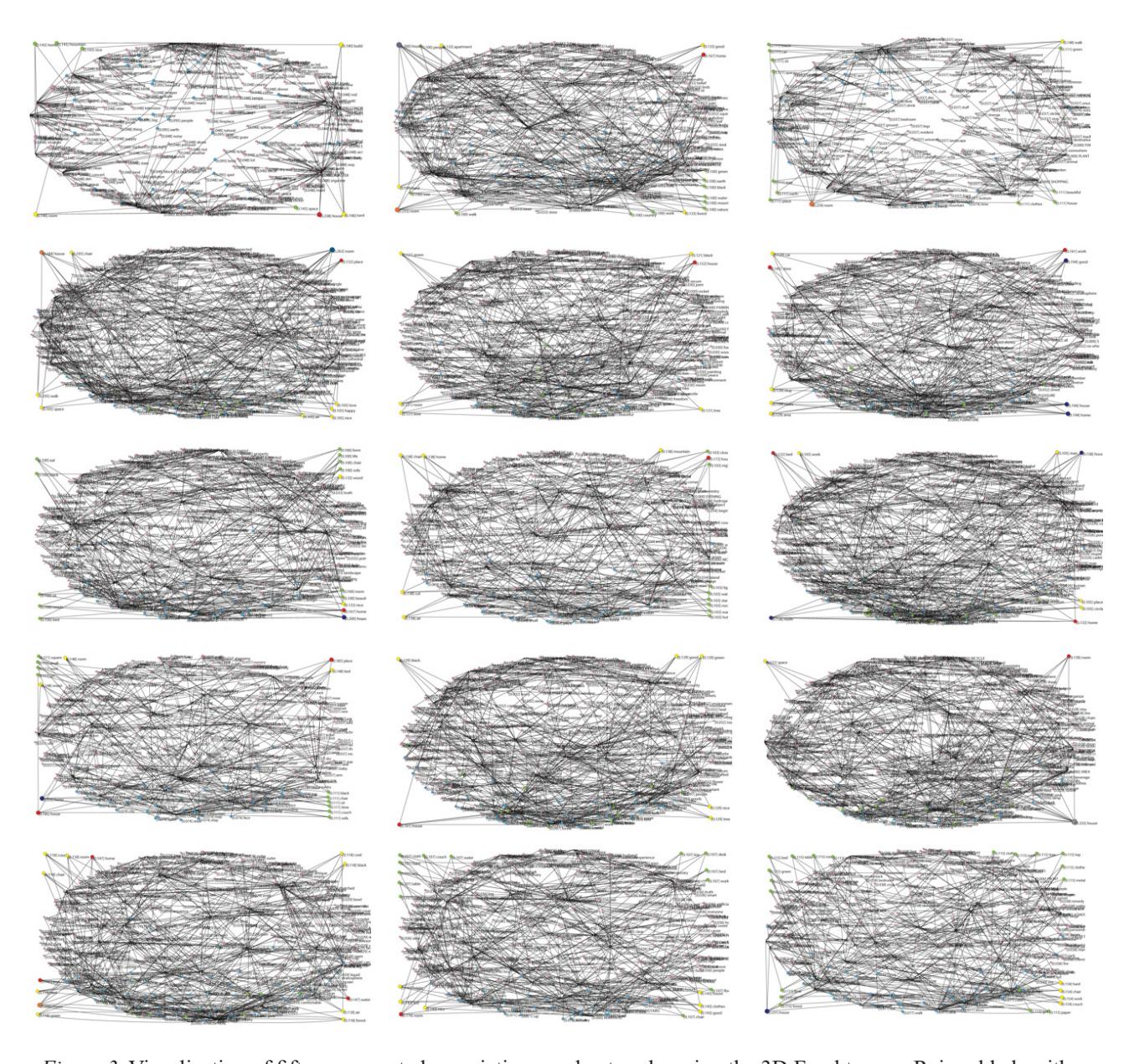
Figure 3. Visualization of fifteen generated associative word networks using the 3D Fruchterman Reingold algorithm (Pajek software) to reveal weak and strong associative meanings (in-depth user impressions) based on the verbal expressions of interior space users.
The 15 graphs shown in Figure 3 were creating using associative word networks based on 3D algorithms that revealed associative meanings (in-depth user impressions) ranging from the weakest to strongest; these were obtained from verbalized user expressions about the interior spaces. The ODC scores achieved through the factor analysis reaffirmed all dimensions that were included in the excitatory determinants against the 13 generated dimensions of perceived interior-environmental quality. The exploratory factor analysis (EFA) is an approach used to find patterns in data through a variable reduction technique that can identify both the number of latent constructs and the underlying factor structure of a set of variables. This final analysis was conducted to examine the nature of the 13 dimensions. Factors were split into five categories (i.e., F1, F2, F3, F4, and F5) indicating human impressions about interiorenvironmental quality. These were confirmed using a Principal Component Analysis with Kaiser Normalization (Table 4). A KMO and Bartlett's Test revealed a score of 0.502 among the five extracted factors, as follows:
- A. Factor 1: Color & Household Basics
- B. Factor 2: Active & Nature
- C. Factor 3: House-Related & Location
- D. Factor 4: Building Material, Peer/ Companion, & Active Element of Nature
- E. Factor 5: Territorial/Distance & Time Period
The dimensions related to Composition/ Element did not meet the eigenvalue requirement of ≥ 0.500. This category was thus excluded.
TABLE 4. ROTATED FACTOR MATRIX
| Component | |||||||
|---|---|---|---|---|---|---|---|
| No | Dimensions | 1 | 2 | 3 | 4 | 5 | Factor |
| 1 | Color | .827 | 264 | 096 | .116 | .091 | Factor 1. Color & |
| 2 | Household Basics | .780 | .007 | .139 | .093 | .179 | Household Basics |
| 3 | Active | 334 | .808 | .001 | .079 | 243 | |
| 4 | Nature | .026 | .772 | .173 | .094 | .039 | Factor 2. Active & Nature |
| 5 | House-Related | 131 | .001 | .850 | .083 | .131 | Factor 3. House-Related |
| 6 | Location | .423 | .320 | .771 | .099 | 074 | & Location |
| 7 | Building | .146 | .193 | .068 | .779 | .068 | Factor 4. Building |
| 8 | Peer/Companion | .533 | .155 | .310 | .587 | 176 | Material, Peer/ |
| 9 | Active Element of Nature | 510 | 271 | .287 | .545 | 079 | Companion & Active Element of Nature |
| 10 | Composition/Element | 058 | 449 | .306 | 453 | .025 | |
| 11 | Territorial/Distance | .225 | .001 | .297 | .154 | .793 | |
| 12 | Time Period | 027 | 189 | 255 | 279 | .733 | Factor 5. Territorial/ |
| 13 | Impression/ Adjectives | .279 | .522 | .262 | .283 | .530 | Distance, Time Period, and Impression/Adjective |
Source: Data Adapted from Junaidy 2019
CONCLUSIONS AND SUGGESTIONS
This article provided a detailed explanation of a fundamental technique used to evaluate the verbalized preferences of interior space users. This involved capturing associative words related to their in-depth impressions. A total of 13 dimensions were derived based on a taxonomic set and sorting process designed to reveal highscore associative word stimuli. These dimensions were related to user-expressed interiorenvironmental quality perceptions, which were derived during an interview designed to evaluate solidity while visiting a café. The dimension of comfort consisted of hundreds of interconnected vertices indicating in-depth user impressions. These provided a stimulus for verbal utterances and became an objective basis for determining the composition of bipolar adjectives generated using the SD method, which helps designers and architects evaluate user preferences in interior spaces. The popular SD method has thus far been used to identify the stated preferences of users regarding artifacts or spatial quality, which only refers to the broad EPA dimension. Such results are thus limited to surface impressions and are also subjective in nature. However, this research succeeded in deriving three dimensions from in-depth user impressions of interiorenvironmental quality. These were validated into four factors through a factor analysis. The revealed dimensions were as follows:
- House-related: environmental quality that provides indulgence, personal feelings, and freedom
- Impression: related to the release of positive energy in the self
- Activity: realized in the form of enthusiasm and productivity
- Active Element of Nature: realization of a dynamic and livable design system
- Nature: awareness of the importance of utilizing natural elements
- Building Material: promoting the material honesty principal
- Companion: the feeling of socializing and partnership
- Household Basics: fulfillment of needs and security
- Color: visual awareness of beauty and appropriateness
- Location: issues of limits, closeness, and reach
- Composition: maintaining a balance between visual and operational aspects
- Time Period: open and accessible to anyone at anytime
The technique of revealing individual preferences in relation to cognitive responses has been thoroughly investigated by researchers in the field of creative cognition and computer science (Taura et al., 2010). These researchers attempted to develop techniques using a similar pattern to that employed while structuring conceptual spaces, including Linkography or the Virtual Impression Network (Taura et al., 2010; Nagai et al., 2011b; Goldschmidt, 1990; Goldschmidt, 2014). The Associative Conceptual Network and Linkography techniques have thus far been linked to the following applications:
- A. Thinking process (conceptual process)
- B. Impression of artifact (object)
The ACNA technique has not yet been applied to the spatial/architectural experience, in which the potential for capturing user impressions is very relevant. This technique has thus far only been applied to the human visual experience related to objects. Spatial experiences that are identical to large-scale dimensions and individual user experiences can help derive new theories for evaluating spatial experiences. The ACNA technique used in this research will thus aid in the development of new theories and methods for evaluating individual experiences or preferences for built-in spaces relevant to interior design principles.
This study also has some limitations. First, the SD method uses adjective pairs, while the ACNA method that we proposed uses a selection of nouns. Thus, the in-depth meanings that we captured and categorized into the comfort dimension require further rationalization for relevant use with the adjective pairs derived from the SD method. The ACNA can be used to identify user convenience in a given interior
space through its functionality in examining verbal expressions, which are then processed to produce associative words derived from user-generated keywords that reveal deep impressions. These keywords then become true references for the emotions and preferences of users. In this way, we ultimately captured and categorized the user expressions derived in this study into 13 interior spatial dimensions of comfort.
In deriving associative keywords, this study used The University of South Florida Word Association, Rhyme and Word Fragment Norms database, which is the most comprehensive collection of associative words available. However, as it was compiled in 1973, with the most of the norms being collected during the 1990, the database is a relatively old resource. It thus does not reflect many modern lifestyle, technological, or cultural concepts. While most were likely appropriate, these word associations may have been less relevant to the Millennial respondents in this study. Future studies should make efforts to include modern vocabulary terms.
In our future research, we will design a basic computational visualization of verbalized responses about a given space using 3D interior scenes. To do this, we will employ text-mining techniques within the associative networks. This will address the disparity in our current understanding of word association meanings during user ideation. We believe such an improvement will aid in the critical design process between the client and designer or student and supervisor.
ACKNOWLEDGEMENTS
We would like to thank the Institute of Research and Community Service, Institut Teknologi Bandung (ITB) for International Research Grant (RI 2018). We are also grateful to the Center for Ubiquitous Computing, ITEE, and the University of Oulu and to the School of Art and Design, Nottingham Trent University for providing technical support.