

ABSTRAK
Pada penelitian ini dikaji perilaku konsumen halal dengan menunjukkan hasil empiris dari lingkungan Usaha Mikro, Kecil, dan Menengah (UMKM) di Bandung, Indonesia. Data dikumpulkan dari 161 wisatawan muslim yang telah berpengalaman mengunjungi Bandung, Jawa Barat, Indonesia, dan mengonsumsi produk kuliner yang dihasilkan oleh UMKM di kota tersebut. Metode regresi linier sederhana diterapkan untuk mengevaluasi hubungan antara sikap konsumen terhadap keputusan pembelian. Penelitian ini bertujuan untuk memberikan pemahaman yang lebih dalam tentang pengaruh sikap wisatawan terhadap label halal dan keputusan pembelian, dilihat dari perspektif konsumen muslim yang memiliki pengalaman mengonsumsi produk makanan yang diproduksi oleh Usaha Mikro, Kecil, dan Menengah (UMKM) di Bandung, Indonesia. Penelitian ini mengungkapkan bahwa sikap terhadap label halal merupakan faktor penting yang mempengaruhi keputusan pembelian makanan halal konsumen.
Kata Kunci: pemasaran halal, perilaku konsumen halal, keputusan pembelian
INTRODUCTION
Today, halal products have a vast and attractive market, not only for Muslims but also for non-Muslims (Wilson et al., 2013). Being a country with the largest Muslim population in the world Indonesia is overgrown with this phenomenon (Sudarmiatin et al., 2020). This opportunity makes producers compete to get halal certificates as an advantage for their products, including small and medium enterprises (MSME) contributed 57% of Indonesia's GDP (Pradana et al., 2020).
The Global Islamic Economy report acknowledges Indonesia as the largest halal industry market in the world, with an average growth ratio increasing from five to six percent per year (Bashir et al., 2018). Records show that Indonesia is currently one of several countries whose economic growth is deemed preeminent. The latest report of the World Bank affirms that the archipelagic country is experiencing a 5.1% economic growth in 2020 (Pradana, et al., 2020). Indonesia is also ranked 10th out of 15 highest countries in the development of the Islamic economy (Suhartanto et al., 2019). The increase in Indonesia's halal industry market is driven by several industrial sectors, including banking industry, food and beverage industry, Muslim fashion industry, health industry and cosmetics industry (Madiawati & Pradana, 2016).
For the reason above, Indonesia has a full authority to issue halal certification in Indonesia. However, there are still rumors and issues regarding the services. Applicants are still complaints about the certification fee and duration being too expensive and timeconsuming (Madiawati & Pradana, 2016; Pradana et al., 2020). The halal label itself is included in the purchase decision procession, precisely in the product's information search stages. If product information is clear and complete, consumers will not doubt the product they will buy and then decide to buy it (Briliana & Mursito, 2017).
To protect the rights of Muslim consumers, as well as to implement Islamic law by ensuring only halal products circulating in the market, certification bodies have emerged in several
Islamic countries. One such institution emerged in Indonesia, namely LPPOM, which exists under the auspices of the Islamic Council (MUI). The position of LPPOM MUI as an examiner and provider of halal certificates is getting stronger and obtaining juridical legitimacy from the state with the issuance of the Decree of the Minister of Religion (KMA) Number 519 of 2001, concerning the Halal Food Inspection Implementing Agency which appointed the Indonesian Ulema Council (MUI) as the implementing agency for the halal-declared food inspection (Madiawati & Pradana, 2016).
The desire to fulfill the obligation to eat halal food will influence consumer purchasing decisions (Nurhayati & Hendar, 2019). Hence, the main task of LPPOM is to certify different foods, drinks, and medicinal products that are free from haram components.
Many consumers in Indonesia, especially tourists, keep buying food at shops or food stalls without halal labels (Madiawati & Pradana, 2016). Therefore, entrepreneurs find it difficult to get a halal certificate so that it is difficult to market their products hence they are motivated to get it (Sudarmiatin, et al., 2020).
Halal certification given by LPPOM has certified various kinds of food, drugs, and cosmetic producers, both at home and abroad. In order to reach producers at the regional level, LPPOM MUI has developed its existence through the establishment and empowerment of Regional LPPOM MUI in various regions. Regional LPPOM MUI issues halal certificates for local food products in their regions, such as slaughterhouses, small and medium business products, and other regional products. At the global level, LPPOM MUI actively collaborates with international halal certification bodies. LPPOM MUI initiated the World Halal Food Council (WHFC) or the World Halal Food Council. The 2004 WHFC Congress confirmed the steps with the issuance of an agreement between halal certification bodies to create the same halal inspection standards for all member countries of the World Halal Council, and a continuation of the results of this in 2018, WHFC held an annual general meeting to evaluate the program for one year and discuss various contemporary issues related to global halal products. In this meeting there were at least three themes related to halal products produced during 2018, fatwas related to the use of alcohol in food, medicinal and cosmetic products, fatwas related to blood plasma, and fatwas related to Kangaroo consumption.
Therefore, this study aims to observe the extent to which the inclusion of halal labels can influence Muslim tourists' purchasing decisions; thus, business actors who own medium and small enterprises (MSME) can measure to what extent the products are required to include a halal label.
METHOD
Halal concept is growing to be an important concept in marketing studies in Indonesia. Consumers in this country tend to pay attention to halal labels listed on the product sold in the market (Suhartanto et al., 2019). The state of being halal is the main principle for Muslims in their eating habit since it is written in the Quran and hadith (Pradana et al., 2020).
According to Fahmi (2017), halal labeling is the inclusion of written halal statement on the packaging or product to show that the product is certified halal, and halal label contained in food packaging will attract the desire for Muslims to buy it. In Indonesia, a product can only be circulated in the market if the product has received a halal certificate by LPPOM MUI (Madiawati & Pradana, 2016). Halal certification and labeling aim to provide legal certainty and protection for consumers and increase the domestic products' competitiveness to increase national income (Suhartanto et al., 2019).
According to Salehudin & Muklish (2012), halal certification significantly affects consumer interest in purchasing food products. This result contradicts our pre-survey which was done to 30 Muslim consumer respondents. Our result stated that 26 respondents stated they did not buy a product based on the halal label on the product packaging. Based on this preliminary information, we began to pose a question whether halal certification is not always a consideration for Muslim consumers to buy a product, especially in a dynamic Muslim society of Indonesia.
According to Sayogo (2018), Muslim consumers prefer products that are already certified halal compared to those that are not. They deem the certification body is flawless because those who maintain halal standards are reputable Islamic scholars. Awareness of consuming halal products among consumers who are Muslims is a result of their understanding about religion and information regarding halal certificate of the product. This result will impact the increasing number of consumers who care about halal label certificate on products, because currently there are so many consumers who are increasingly critical and own good product knowledge before making a purchase decision.
The establishment of halal brand awareness can be done by proving that the product already has a certain halal quality or characteristic. However, a product can be widely known by the community depending on the existence of the brand in the market (Madiawati & Pradana, 2016). The brand of a product must be communicated appropriately and form a new brand hence it can be successful (Pezoldt et al., 2019).
In this case, Muslim awareness about the knowledge of food and beverage ingredients from a halal process (Nurhayati & Hendar, 2019). Food and processed products are only halal if raw materials have been treated in accordance with Islamic beliefs. To assure the control of halal food processing and halal supply chain practices, many regulations and standards have been established (Khan et al., 2019).
Purchasing decisions are influenced by the value of the product and the perceived value is lower (Calvo-Porral & Lévy-Mangin, 2017). The urge to buy is higher when the advantage perceived is greater than the sacrifice (Madiawati & Pradana, 2016). Purchase interest is the stage of the tendency to act prior to purchase decision occurs. Interest in buying a product can be in the form of transactional interest, which is the tendency to purchase, referential interest, which is the tendency in referring products to others, preferential interest, which describes the behavior of someone who has a significant preference for these products, and exploratory interest, which indicates the behavior of a person that is making inquiry of a product information or the positive qualities of the product (Kotler & Armstrong, 2018).
According to Kuvykaite et al., (2015), the factors that influence purchase intention are related to feelings and emotions. In this case, it is the condition when a person is satisfied after purchasing goods or services. Consumer behavior is the knowledge that pursues personal, class, or population-related characteristics of consumers in order to investigate, sort, determine and use a good or service to teach marketers what consumers actually need or want (Dewi & Mohaidin, 2016).
Schiffman et al. (2010) argues that customer decision-making methods can be seen as three equally important and reinforcing stages, namely: the input, process, and output stages. Purchase interest is something obtained from the learning process and the thinking process that forms a perception (Kartawinata et al., 2020). A motivation is created with this buying interest, which continues to be recorded in a consumer's mind and turns into an intense desire. Eventually, when he or she has fulfilled the needs, the consumer will actualize what is in his or her mind (Pradana & Novitasari, 2017).
To answer the research questions, the following is the scheme of this research.
- H0: There is no positive effect of attitude towards halal label on halal food purchases decision
- H1: There is a positive effect of attitude towards halal label on halal food purchases decision.
The model in this research can be described in Figure 1 below:
Based on the background, the formulation of the problem and the objectives of this study can be categorized as quantitative research using descriptive and associative causal analysis methods. Simple linear regression analysis technique is used in this study with the help of SPSS version 24 as a supporting tool in data processing (Ghazali, 2016). Hypothesis testing uses the T test to determine how much influence the variable X has on the Y variable. The variables in this study are attitude towards halal label as an antecedent which has influence on halal food purchase decision as the dependent variable.
The measuring scale in this study used the ordinal measuring scale. According to Sugiyono (2017) ordinal data is data in the form of a ranking. Measurements were made using a questionnaire with five (5) answers (Strongly Agree, Agree, Fairly Agree, Disagree, and Strongly Disagree) which the respondents must choose to respond to each question given. The assessment of each variable X and variable Y uses a questionnaire with a Likert scale, which will be indicated as 1 for 'strongly disagree' answers and 5 for 'strongly agree' answers.
We used a non-probability sampling technique for this research. The non-probability sampling technique used is purposive sampling which Sugiyono (2017) defines as a sampling technique with certain considerations. According to Sekaran and Bougie (2017), purposive sampling is to obtain data from a more specific target group and can provide the desired information. They are the only ones who have this information or are in accordance with several criteria made by the study. The respondents we observed were 161 MSME owners in Bandung, Indonesia. Further description about the respondents' profiles can be seen on Table 1.
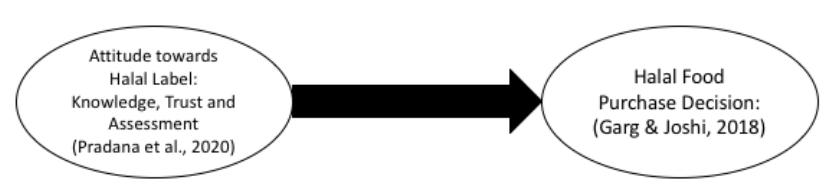
Figure 1 Research Framework
TABLE I RESPONDENTS' PROFILE
| Variables | Categories | Frequency | Percentage |
|---|---|---|---|
| Gender | Male | 96 | 59.63 |
| Female | 65 | 40.37 | |
| Total | 161 | 100.00 | |
| Education | High School | 75 | 46.58 |
| Bachelor | 71 | 44.10 | |
| Graduate | 15 | 9.32 | |
| Total | 161 | 100.00 | |
| Age | < 20 Years | 6 | 3.73 |
| 20-29 Years | 53 | 32.92 | |
| 30-39 Years | 62 | 38.51 | |
| 40-49 Years | 31 | 19.25 | |
| > 50 Years | 9 | 5.59 | |
| Total | 161 | 100.00 | |
| Employee Status | Contract | 46 | 28.57 |
| Permanent | 69 | 42.86 | |
| Others | 46 | 28.57 | |
| Total | 161 | 100.00 | |
| Income | < 2 Millions/ month | 41 | 25.47 |
| 2-5 Millions/ month | 90 | 55.90 | |
| 5-10 Millions/ month | 27 | 16.77 | |
| > 10 Millions/ month | 3 | 1.86 | |
| Total | 161 | 100.00 | |
| Expenses | < 2 Millions/ month | 45 | 27.95 |
| 2-5 Millions/ month | 95 | 59.01 | |
| 5-10 Millions/ month > 10 Millions/ month | 19 2 | 11.80 1.24 | |
(Source: Authors' own elaboration)
RESULTS AND DISCUSSION
According to Ghazali (2016) to test whether, in the regression model, the independent variable and dependent variable or both have a normal distribution or not, the normality test is carried out. If the variables are not normally distributed, the results of statistical tests will decrease. There are two possible bases for the decision making, i.e., (1) if the data spreads around the diagonal line and follows the direction of the diagonal line, the regression model meets the normality assumption; (2) if the data spreads far from the diagonal line or does not follow the direction of the diagonal line, the assumption of normality is not met by the regression model.

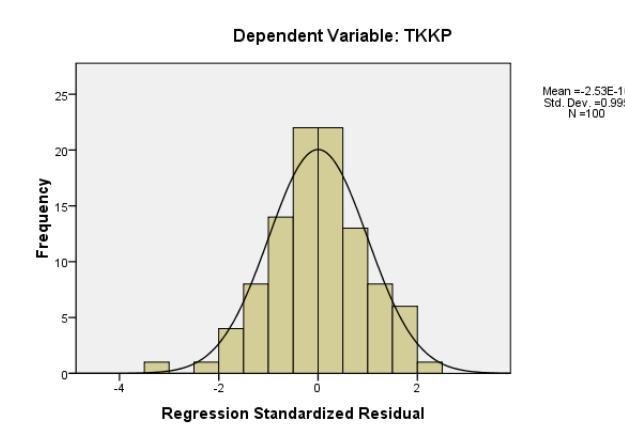
Figure 2 Normality Test Result
Figure 2 above shows that the histogram mostly follows a normal curve. It can therefore be said that the data distribution is normally distributed. Based on the results of the normality test (Normal P-Plot of Regression Standardized Residual), Figure 3 below indicates that the dots spread around the diagonal line, and the distribution follows the diagonal line. If the points in the image spread around the diagonal line, and the direction follows the diagonal line, then it is evident that the regression model is feasible as it has met the normality assumption of normally distributed data.
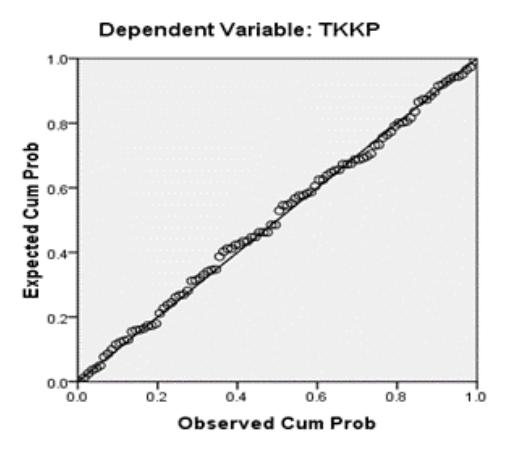
Figure 3 Graph of Normality Test Results on P-Plot
This test aims to assess whether in a regression model there is a variant discomfort from the residuals between one observation and another. It is stated that if the variants are different, they are deemed heteroscedasticity. If the independent variables are statistically significantly > 0.05, there is no heteroscedasticity problem. One way to determine whether or not heteroscedasticity is in a multiple linear regression model is to analyze the scatterplot graph or the predictive value of the associated variable (Ghazali, 2016). The following are the results of the heteroscedasticity test using the scatterplot test:
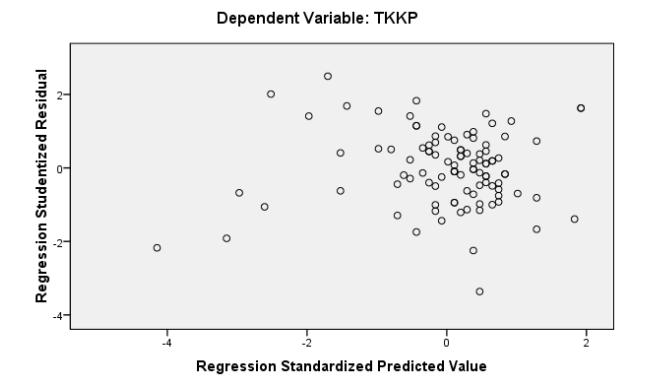
Figure 4 Heteroscedasticity Test Results on the Scatterplot
Figure 4 shows that the Scatterplot diagram spreads and does not form a certain pattern; hence, the regression does not experience heteroscedasticity disorders. Based on the data analysis using the help of the SPSS application software version 25 and a discussion of the effect of the halal label on MSME purchasing decisions in the city of Bandung described in the previous chapter, the following conclusions can be drawn. Based on the results of data management from 100 respondents, the respondents' responses regarding the attitude towards halal label variable obtained a total score of 7674 with an average of 76.74%. Respondents regarding purchasing decisions at Bandung City Culinary MSMEs obtained a total score of 6,365 with an average of 74.88%. It means that Bandung City Culinary MSMEs have already been paying attention to consumers' demand for halal certification.
The classical assumption test results show that multiple regression tests can be performed to analyze the data, because the data is normally distributed. It is indicated that there has been no multicollinearity and heteroscedasticity that happen. A simple linear regression equation based on the processing of the SPSS 24 software can be seen on Table 2.
Based on the results of data processing in Table 2, the constant values and regression coefficients are obtained so that a simple linear regression equation can be formed as follows:
\[Y = 21,512 + 0.552 (X)\]
\(a = 21.512\)
It means that if the attitude towards halal label (X) is worth 0, then the purchase decision (Y) will be worth 21.512 units. b = 0.552, which means if the attitude towards halal label (X) is worth 0, then the purchase decision (Y) will increase by 0.385 units.
The magnitude of the influence of the halal label on purchasing decisions at Bandung City Culinary MSMEs on the t value obtained by the t-value of 10.253 and t-table 1.984. Due to the value of t > t table, then H0 is rejected and H1 is accepted. It means that there is a significant influence of attitude toward halal label on halal food purchase decision.
The results of partial hypothesis testing (t test) are shown in Table 2 and described as follows:
TABLE II T-TEST RESULT
| Model B | Unstandardized Coefficients | Standardized Coefficients | T | Sig. | ||
|---|---|---|---|---|---|---|
| Std. Error | Beta | |||||
| 1 | (Constant) | 21.512 | 4.176 | 5.151 | .000 | |
| TKLH | .552 | .054 | .719 | 10.253 | .000 | |
(Source: Authors' own elaboration)
TABLE III R-SQUARE RESULT
| Model | R | R Square | Adjusted R Square | Std. Error of the Estimate |
|---|---|---|---|---|
| 1 | .719a | .518 | .513 | 5.915 |
(Source: Authors' own elaboration)
With the value of t-table for n = 161 (df = n-k-1), with a significant level (α) of 5%, t table 1.984 was obtained. From the calculation of the data in Table 4.4, the t value is 10.253, and the t table is 1.984. Due to the value of t count> t table, then H0 is rejected and H1 is accepted. It means that there is a significant influence of attitude toward halal label on halal food purchase decision.
In Table 3, it can be seen that R is 0.719 and R square (R¬2) is 0.518. The magnitude of the influence of the attitude towards halal label on purchasing decisions is indicated by the coefficient of determination (KD) using the following formula:
\[KD = r2x100\% = 0.7192 \ x100\% = 51.6\%\]
In the analysis of the coefficient of determination, the result shows that the coefficient of determination (KD) is 51.6%. This shows that the attitude toward halal label on halal food purchase decision has an effect of 51.6%, while the remaining 48.4% is influenced by other variables not examined in this study.
CONCLUSION
We would like to present conclusion by discussing the research hypothesis. In our result, we found that our hypothesis arguing that halal certification has a positive impact on purchase decision has been supported. This result corresponds with the findings of Abdullah & Razak (2019) and Madiawati & Pradana (2016).
As proven by this study, there is a significant influence of halal label on consumer purchasing decision. Therefore, local MSMEs producing food products are expected to register or apply for halal label to LPPOM-MUI. The producer must also maintain the quality the food product by maintaining the halal principles in the processing of the product. It is especially related to its hygiene, Islamic production method and availability of halal labels.
We acknowledge some of the limitations found from this study. First, this research is not an experimental or longitudinal study (longterm research) but an explanatory study and is short-term. Hence, the result should not be taken to the dynamics of the study when compared with other research on consumer behavior with the relationship with purchase decisions. Second, this research only focuses on the SMEs in Bandung, West Java, Indonesia. The research results cannot be generalized to the studies conducted in other locations, since it can limit the wider perspective of the research results.
Last but not least, this research only focuses on the influence of the halal label on purchasing decision of food products. For further research, if other researchers want to explore similar or related topics, it is suggested to add other variables that may affect purchasing decisions, such as brand equity, subjective norm, and consumer behavior. It is also recommended to involve religious involvement as a variable, as shown in the studies of Jamal & Sharifuddin (2015).
ACKNOWLEDGEMENT
We would like to thank LPPM Telkom University to support this research.
REFERENCES
Abdullah, R., & Razak, L. A. (2019). The effect of halal foods awareness on purchase decision with religiosity as a moderating variable. Journal of Islamic Marketing.
Aziz, Y. A., & Chok, N. V. (2013). The role of Halal awareness, Halal certification, and marketing components in determining Halal purchase intention among non-Muslims in Malaysia: A structural equation modeling approach. Journal of International Food & Agribusiness Marketing, 25(1), 1-23.
Bashir, A. M., Bayat, A., Olutuase, S. O., & Abdul Latiff, Z. A. (2019). Factors affecting consumers' intention towards purchas- ing halal food in South Africa: A structural equation modelling. Journal of Food Products Marketing, 25(1), 26–48. https://doi.org/10.1080/10454446.2018.1 452813
- Briliana, V. and Mursito, N. (2017), "Exploring antecedents and consequences of Indonesian muslim youths' attitude towards halal cosmetic products: a case study in Jakarta", Asia Pacific Management Review, Vol. 22 No. 4, pp. 176-184, doi: 10.1016/j.apmrv.2017.07.012
- Calvo-Porral, C., & Lévy-Mangin, J. P. (2017). Store brands' purchase intention: Examining the role of perceived quality. European Research on Management and Business Economics, 23(2), 90-95.
- Dewi, C. K., & Mohaidin, Z. (2016). Motivations of Online Opinion Seeking and Its Effect on the Online Purchase Intention. Advanced Science Letters, 22(12), 4073-4076
- Fahmi, S. (2017, July). Halal labeling effect on Muslim consumers attitude and behavior. In 2017 International Conference on Organizational Innovation (ICOI 2017) (pp. 150-156). Atlantis Press.
- Ghazali, Imam. (2016). Aplikasi Analisis Multivariete Dengan Program IBM SPSS 23 (Edisi 8). Cetakan ke VIII. Semarang : Badan Penerbit Universitas Diponegoro
- Jamal, A. and J. Sharifuddin. (2015). Perceived value and perceived usefulness of halal labeling: the role of religion and culture. Journal of Business Research 68(5): 933- 941.
- Kartawinata, B. R., Maharani, D., Pradana, M., & Amani, H. M. (2020). The Role of Customer Attitude in Mediating the Effect of Green Marketing Mix on Green Product Purchase Intention in Love Beauty and Planet Products in Indonesia. In Proceedings of the International Conference on Industrial Engineering and Operations Management.
- Keller, K. L. (2016). Unlocking the power of integrated marketing communications: How integrated is your IMC program? Journal of Advertising, 45(3), 286-301.
- Khan, S., Khan, M. I., Haleem, A., & Jami, A. R. (2019). Prioritising the risks in Halal food supply chain: an MCDM approach. Journal of Islamic Marketing.
- Kotler, P., & Armstrong, G. M. (2018). Marketing Mix: Selected Chapters From: Principles of Marketing, Philip Kotler and Gary Armstrong. Pearson.
- Kuvykaite, Rita, Aiste Dovaliene, and Laura Navickiene (2015). "Impact of package elements on consumer's purchase decision." Economics and Management, 441-447.
- Madiawati, P. N., & Pradana, M. (2016). Celebrity and halal certificates factors influence on customers' buying interest. Актуальні проблеми економіки, (3), 109-116.
- Nurhayati, T., & Hendar, H. (2019). Personal intrinsic religiosity and product knowledge on halal product purchase intention: Role of halal product awareness. Journal of Islamic Marketing.
- Pradana, M., & Novitasari, F. (2017). Gap analysis of Zalora online application: Indonesian users' perspectives. International Journal of Learning and Change, 9(4), 334-347.
- Pradana, M., Huertas-García, R., & Marimon, F. (2020). Muslim tourists' purchase intention of halal food in Spain. Current Issues in Tourism, 1-5. https://doi.org/10. 1080/13683500.2020.1797647
- Pezoldt, K., Correns, A., & Zajko, M. (2019). Preannouncement of New Products: Overcoming Individual Adoption Barriers. Romania. Salehudin, I. dan Mukhlis, B.M., Pemasaran Halal: Konsep, Implikasi, dan Temuan di Lapangan, in Ikatan Alumni FEUI (Ed.), Lembaga Penerbit FEUI, Jakarta, 2012
- Sayogo, D. S. (2018). Online traceability for halal product information: perceptions of Muslim consumers in Indonesia. Journal of Islamic Marketing.
- Sekaran, U., & Bougie, R. (2016). Research methods for business: A skill building approach. John Wiley & Sons.
- Schiffman, L. G., Kanuk, L. L., & Wisenblit, J. (2010). Consumer Behavior. Global Edition. Pearson Higher Education, London, 12(2), 113-120.
- Sudarmiatin, S., Anam, F. K., & Wafaretta, V. (2020). The Intention of Halal Certification by Micro Business. KnE Social Sciences, 141-155.
- Sugiyono. (2017). Business Research Methods: Quantitative, Qualitative, and R&D Approaches, fifteenth ed. Alfabeta. Bandung.
- Suhartanto, D., Helmi Ali, M., Tan, K.H., Sjahroeddin, F. and Kusdibyo, L. (2019), "Loyalty toward online food delivery
- service: the role of e-service quality and food quality", Journal of Foodservice Business Research, Vol. 22 No. 1, pp. 81- 97, doi: 10.1080/15378020.2018.1546076.
- Wilson, J.A., Belk, R.W., Bamossy, G.J., Sandikci, Ö., Kartajaya, H., Sobh, R. and Scott, L. (2013), "Crescent marketing, muslim geographies and brand Islam", Journal of Islamic Marketing, Vol. 4 No. 1, pp. 22- 50, doi: 10.1108/17590831311306336