

Keywords: batik, formalist, kacu ratio
ABSTRAK
Batik adalah salah satu seni yang mengandung keseluruhan keyakinan deskriptif tentang bagaimana orang Jawa memaknai kehidupan mereka. Hal ini terdapat pada batik klasik yang masih kental dengan unsur standar keraton sebagai pusat pelestarian budaya Jawa. Dengan mempelajari batik klasik, penulis menemukan konsep perbandingan kacu yang digunakan dalam membatik. Bagi penulis, kacu merupakan bentuk local genius yang dimiliki oleh masyarakat Jawa. Gagasan kesadaran akan kehampaan absolut meresapi semua bentuk materi yang ada di alam semesta. Kepercayaan ini juga diterapkan pada proses mendesain kain batik. Bagi orang Jawa keindahan terletak pada keseimbangan makro dan mikro kosmos. Keseimbangan yang sejati terletak pada titik paradoks. Melalui penelitian ini persamaan dalam angka dari rasio kacu yang dipercaya sebagai rasio emas masyarakat Jawa pada zaman dahulu akan dicari. Kemudian persamaan tersebut akan diterapkan pada karya seni. Penelitian ini menggunakan metode kualitatif dengan beberapa sumber pustaka untuk membedah konsep kacu dan menerapkannya ke dalam karya seni. Melalui pendekatan formalis, penulis menggunakan konsep kacu sebagai metode menyusun objek visual sebagai skala dan menyeimbangkan komposisi. Konsep tersebut akan direpresentasikan melalui teknik batik dan sablon di atas kain. Oleh karena itu, penulis perlu mengkaji rasio kacu lebih lanjut untuk dapat memahami makna rasio kuno ini dalam kepercayaan msyarakat Jawa.
Kata kunci: batik, formalis, rasio kacu
INTRODUCTION
Batik is an art that contains a fundamental belief about how the Javanese interpret the life they experience. It is found in classical batiks, which are still complying with the standard elements from Keraton as the center for preserving Javanese culture. Some of the classical batik styles still preserved in the Keraton Yogyakarta include Parang rusak, Semen, Rujak senthe, Parang-parangan, Cemungkiran, Kawung, and Huk. Some of these motifs are called motif larangan or prohibition motifs.
Batik with motif larangan reflects how the Javanese view a reality in a comprehensive unity. The Parang Motif, for example, does not only describe the beauty of the waves, but also other values in the philosophy of the waves, such as strength, greatness, and continuity. The symbolic value is an immaterial, spiritual, and transcendental matter behind the physical form. However, due to human limitations, a symbol needs to be created as a cultural medium like batik and its motifs. (Layungkuning, 2018)
In addition to the philosophical meaning of the motif, the author also finds the existence of these immaterial values in processing the batik, especially in conventional technique, batik tulis. The batik tulis technique creates a motif on a fabric by resisting the dye from seeping into the fabric fibers. For resisting the color, it uses hot wax, Malam, that is inscribed with a specific tool called Canting, so the area of the fabric that is etched by the wax will resist the dye to create negative space which in the end becomes the primary motifs.
The reversed working pattern as discussed above, namely resisting or blocking the dye first to create a negative field, illustrates how important the meaning of emptiness is in the mindset of the Javanese people. This awareness of emptiness is also implemented in how a classical batik motif is made, namely by Kacu ratio. Javanese people use it to measure and compose batik motifs. Kacu, in Javanese, means handkerchief, which is intended as a ratio in the form of a square. Kacu became a unit in measuring the length of batik cloth, the size of the ornament, and the direction of the motif
The consciousness of the emptiness that permeates all material forms in the universe is understood as absolute space, which is the basis for human's relative space, and becomes loaded with extensions of absolute time that pervades all events. This absolute time-space determines humans' relative time-space in life (Yusuf, 2009). Through the Kacu calculation that forms the basis for making classical batik, it is an effort to harmonize the humans' relative space-time and the absolute space-time.
From the background above, the writer is interested in studying how the relation between absolute time-space and human's relative timespace through how the Kacu ratio is applied in composing batik motifs. Through a formalist approach, the author wants to take this idea as an inspiration for artwork. Formalism is a study in art that focuses solely on forms and how they are created, such as brush strokes, shapes, lines, and composition. In formalist works, the visual aspect is more important than the narrative aspect or the content contained in the artwork (Art Term Formalism, 2021). The writer uses the Kacu concept as a method in composing visual objects. Therefore, the writer needs further study of the Kacu composition to understand how it was applied in classical Batik and the relation with the belief of the absolute time-space in Javanese and how the relationship is formed when it collides with the relative humans' timespace.
The Use of Kacu Ratio in Batik
Calculations in batik initially did not use a numerical scale, but instead used a Kacu ratio. Kacu, also called udeng, is a unit of measurement that can show the length and width of the headband (ikat kepala). Usually, the headband is 1 Kacu, while the batik cloth used to cover the body is 2 1 / 2 Kacu (Pringadie, 2017). One Kacu is a square with a side length equal to the length of the batik cloth (Mori). The use of this Kacu ratio is done by folding the Mori cloth before making the batik motif. Pujiyanto in his thesis on Surakarta batik says that in the old manuscript no. 568 at the National Library explains that one Kacu is a fold of cloth in the form of a square that has a side width of Mori cloth (Nagoro cited in Pujiyanto 1997: 147). This method of folding cloth is intended to create a square scheme as an initial measure in determining the pattern of batik motifs. Usually, the fabric is folded diagonally to form an isosceles triangle so that when it is unfolded, it will get a size of 1 Kacu according to the length of the width of the fabric. In addition, after one measure of the cloth is obtained, it is then folded again to determine the structure of the batik motif pattern, whether the motif is diagonal, vertical, horizontal, or central.
Figure 1 Some structures of batik motifs based on Kacu folds (Reproduced by Pujiyanto, 1997).
For example, if you want to make a diagonal motif such as a Batik Parang, the tilt is determined by folding one piece of cloth into an isosceles triangle (see example 3 in figure 1). Meanwhile, to determine the central motif, 1 Kacu is folded diagonally twice in the opposite direction (see example 5 in figure 1).
Besides that, to determine the size of one ornament in a batik motif, the batiksters also use the Kacu ratio. A source from an internet page describes how Kacu ratio is used to determine the size of an ornament. In this explanation, the term structure means a batik motif made on Mori cloth with a specific size. There are two kinds of structures used in making batik. Namely, structure A and structure B. Structure A is a motif as wide as Mori cloth. Structure B is a motif with a length of \(\frac{1}{3}\) mori or \(\frac{1}{3}\) of structure A. For example, if structure A is \(\frac{1}{4}\) Kacu, then structure B is \(\frac{1}{12}\) Kacu. If structure A is \(\frac{1}{2}\) of Kacu then structure B is \(\frac{1}{6}\) Kacu (Perlengkapan yang diperlukan, 2018)
Based on the description above, the size of an ornament in a batik motif is also determined using the Kacu ratio. Since the batik motif is a series consisting of repetition of one or more ornaments, the size of one ornament is influenced by the structure. For example, in the Parang Barong motif, one kacu is used as the prohibition motif, and this parang barong ornament has the most significant size among other Parang motifs, which is more than 10 cm. Therefore, the size of each motif is the result of using structure A or \(^{1}/_{4}\) of Kacu. In general, batik cloth (kain mori) has a width of 115 cm so that with approximately a ratio of Kacu it will produce the size of a parang ornament of 28-30 cm.
The Concept of Javanese Aesthetics in The Kacu Ratio
A piece of batik cloth has at least 2 ½ or 2 ¼ of Kacu. One Kacu for the front body and another for the back part, the remaining ½ or ¼ of the Kacu is used to make Wiron, namely the folds of cloth that are in the front. (Sumardjo, 2014: 341).
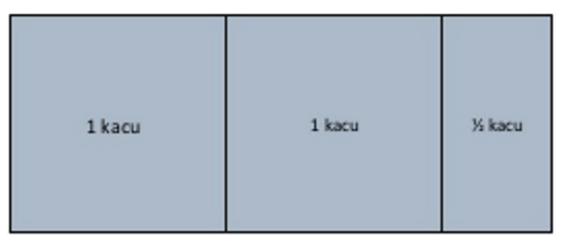
Figure 2 The division of the kacu scheme is applied to the length of the batik cloth (Reproduced by Sumardjo, 2014).
Kacu in Javanese means a handkerchief which in terms of batik is a square ratio. If an imaginary diagonal line is drawn from each corner in the square, a central axis can be described as an imaginary circle. So Kacu can also be referred to as a mandala.
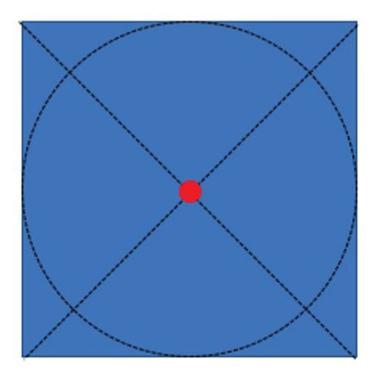
Figure 3 Mandala in the Kacu (Private Document, 2021)
Epistemologically, mandala comes from Sanskrit, which means a disc; then it is translated as a circle, so mandala often refers to a circle diagram. Mandala is derived from the words Manda, which means essence, and La which means container or owner (Grey, 2001). Mandala is interpreted as a mystical symbol of the universe in a circle on a square that Hindus and Buddhists usually use during meditation (Dellios, 2003). The circle is a symbol of time, while the square is a symbol of space (Sumardjo, 2002). For a broader understanding, the mandala is a circle that symbolizes an essence, namely something infinite or transcendent inside a square, which is a symbol of a container that has boundaries or is immanent.
In the Javanese aesthetics, this Kacu ratio divides the mandala into one batik motif. For example, if one Kacu is made vertical and horizontal lines, there is a mandala of 4 parts. This mandala can be divided into 8 parts by dividing each part by the same as the initial division. A mandala of 4, 8, 16, 32, 64 can be formed with this division method.
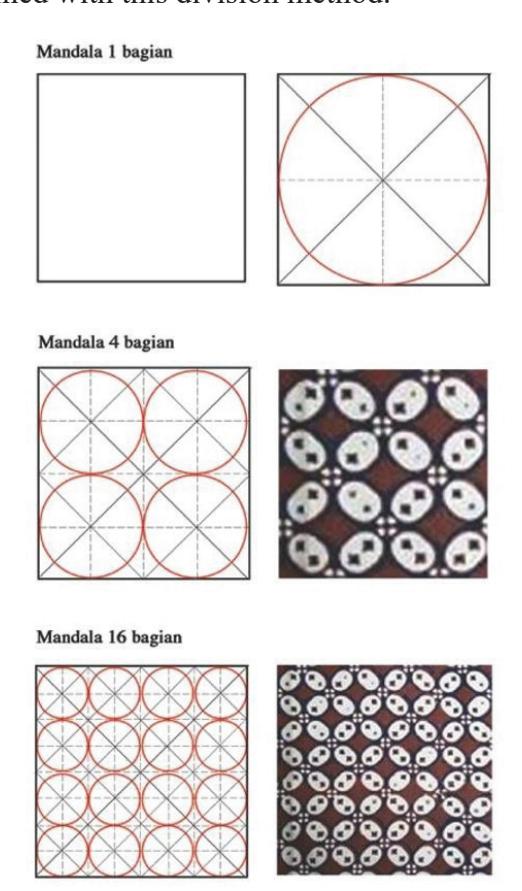
Figure 4 The division of the mandala in one Kacu (Reproduced by Sumardjo, 2014).
In addition to the division of the mandala with a circle scheme in batik, batik Parang motif is also known to use diagonal lines. In Javanese society, the mandala, depicted with a diagonal line, is understood as a fusion between vertical and horizontal lines.
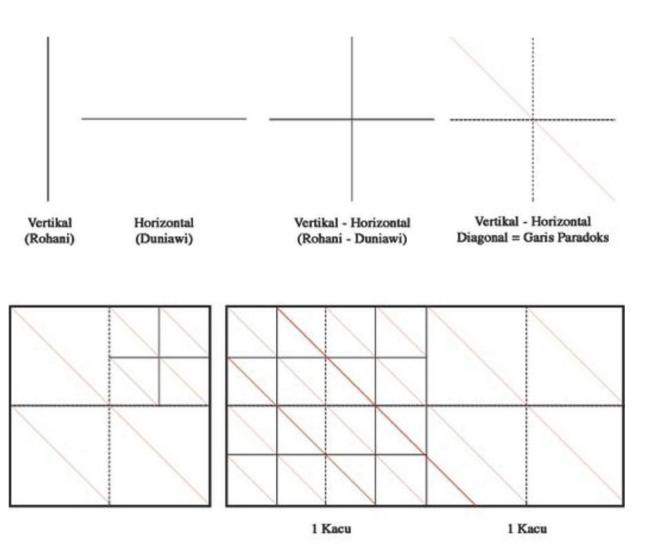
Figure 5 Mandala in diagonal line on batik Parang (Reproduced by Sumardjo, 2014)
The concept of dividing the mandala contained in batik is a social and cultural construction. Based on the palace-centric Javanese culture, the mandala on batik is a political effort to emphasize a centralized system of government, namely the king. The concept of Indian religion strongly influences mandala in Javanese culture. The mandala concept, which is believed to be a religious pie chart in Southeast Asia, is merely a construction. European historians in the twentieth century believed that mandala in ancient Indian politics was to avoid concept of the state in the conventional sense, namely a territorially defined area with fixed borders and state apparatus and bureaucracy. In the mandala concept, the center determines the government, not from its boundaries, to expand the territory and form a colonial government without any administrative fusion (Dellios, 2003). Gesick describes this kind of government system as a patchwork construction to achieve greater power. There are secondary and tertiary governments where the central government gives autonomous power with full recognition of the central spiritual authority (Gesick, 1983: 3 cited in Dellios 2003).
The mandala concept as an affirmation of this hierarchy is found in batik, for example, batik kawung and batik parang. The bigger the kawung motif, the higher the position, for example, as a king. Likewise, for batik parang, the larger the parang ornament is the more it emphasizes that someone who wears this motif has a high position. Thus, the political construction in batik is related to the size of the Kacu ratio used. The more powerful a king, the bigger the ratio used, so that, the smaller the number of inner mandalas the closer his essence is to the absolute substance (Sumardjo, 2014: 343-346).
METHOD
Kacu Ratio Composition Study
In Javanese aesthetics, the essence of Kacu is not only used to measure the material or something that exists, but also to measure the immaterial. In the pre-modern Javanese aesthetics, it is called mataya or nothingness, because in the nothingness there is a spiritual energy (Sumardjo, 2014:100).
The Concept of The Kacu Ratio in Batik Parang Rusak Barong
The Parang Rusak Barong motif is the most popular one in the development of batik. In this subchapter, the writer uses this motif to describe the application of kacu ratio concept. According to the batik standard, the Parang Rusak Barong motif can only be used by the king and the crown prince. However, this motif has the largest parang ornament size when compared with the other various parang motifs, which is more than 10 cm. In addition, this motif has a diagonal pattern, so this batik uses the concept of a mandala with a diagonal line scheme.
Figure 7 The division of the Kacu on the Batik Parang Rusak Barong (Fardhani, 2019).
Figure 6 The Scheme concept of Kacu ratio on batik (Fardhani, 2019).
Based on the distribution of the scheme above, the length of this Parang Rusak Barong batik is \(2^{1}/_{4}\) kacu long. When following the kacu ratio, each Parang ornament uses a size of 1/4 of the structure or 1/4 of kacu. The following scheme illustrates the structure:
Figure 8 The Scheme of 1 Kacu (Fardhani, 2019).
Figure 9 The Scheme of ½ Kacu (Fardhani, 2019)
Figure 10 The Scheme of 1/4 Kacu (Fardhani, 2019).
The application of kacu ratio to the Parang Rusak Barong motif shows that the motif uses one kacu or one large square divided into 16 small squares. According to the concept of Javanese aesthetics, it can also be interpreted that in this one batik kacu has 16 parts of mandala.
The Concept of The Kacu Ratio in Batik Kawung Kelengan
The Kawung motif is relatively ancient. In this observation, the writer uses Kawung Kelengan batik. The word kelengan here refers to the dyeing process, which is only done once, so that this batik only has one color.
Figure 11 The division of the Kacu on the Batik Kawung Kelengan (Private Document, 2019).
This batik Kawung is 2 ½ Kacu long. If you follow the Kacu ratio, each Kawung ornament has a size of \(\frac{1}{13}\) A structure or \(\frac{1}{13}\) kacu. The use of the <sup>1</sup>/<sub>13</sub> kacu can be described by drawing an imaginary line along the row of one Kawung vertically or horizontally in one kacu so that in one large square there are 169 small squares. Therefore, batik Kawung has a mandala of 169 parts.
Figure 12 The scheme of 1 Kawung (Private Document, 2019).
Figure 13 The 1 / 13 kacu ratio in batik Kawung Kelengan (Private Document, 2019).
Golden Ratio
Understanding the Kacu ratio will begin with a discussion on the Golden Ratio concept. The Golden Ratio measures the comparison of numbers that are believed to have a high level of aesthetics that can provide comfort to the eye in viewing a visual. This ratio is 1: 1,618, which is known as phi. According to Pythagoras (570- 475 BC), everything in the universe, such as snail shells, pineapple strains, and the size of the human upper body compared to the lower human body, is almost certainly close to the golden ratio figure (Raharja, 2020).
Following the opinion of Pythagoras that nature is perfect, numbers are also a manifestation of the laws of beauty, natural beauty, or the beauty of human creation. These numbers are obtained by comparing the length of a line, which is divided into two parts. If the long line is divided by the short line, the ratio will equal the long line plus the short one, then. if divided by the long line, it will become 1,618. This number is called the Golden Number or phi. Phi is denoted by Φ or φ. (Widagdo, 2005: 92)
Figure 14 Golden ratio formula (twinkl.fr., 2021)
Figure 15 Golden Ratio Schematic (Thoughtco.com, 2021).
Besides being determined through the formula above, this golden number can be determined by a golden rectangle. The nature of this golden rectangle is unique. If the golden rectangle is subtracted from a square, the remainder will form a golden rectangle. The golden rectangle proportions are very balanced and aesthetic. (Raharja, 2020)
Figure 16 The Golden Rectangle (Raharja, 2020).
Golden Ratio in Geometric Shapes
Phi or this golden number can also be demonstrated in the Fibonacci numbers 0,1,1,2,3,5,8,13,21, and so on. This Fibonacci number sequence is obtained by adding up the previous two numbers. Ancient Greeks used to apply this number sequence to create a visual pattern as a benchmark for a good design. The method is done by converting the Fibonacci
number into an object with a geometric shape, namely a square. it is then placed side by side to form a rectangle that can be made into a square again to draw a spiral line. (Golden Ratio, 2021) In depicting each side of this square, the unit of length (meters) is not used; instead, it is adjusted to the side of the rectangle made earlier.
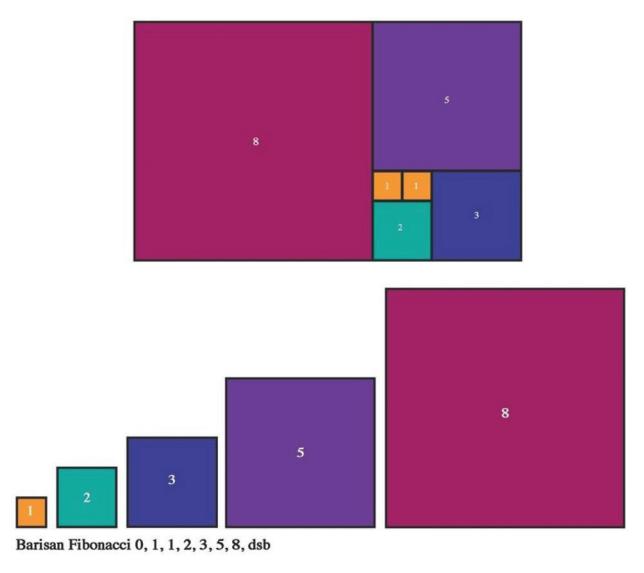
Figure 17 Squares in Fibonacci numbers (Private Document, 2021).
After getting the configuration of the rectangular arrangement, we get several square sizes which, when compared in size, will get a difference in numbers of about 1.5 - 1.6 or what can be referred to as phi.
Kacu Composition Description
Adapted the configuration of the golden ratio that can be translated into Fibonacci numbers, the kacu ratio can also be translated into square numbers. Based on the description of several sub-chapters above, the writer tries to solve a composition produced by the kacu ratio into a mathematical equation. For example, suppose the <sup>1</sup>/<sub>4</sub> kacu ratio will produce a square of 16 parts and a <sup>1</sup>/<sub>13</sub> kacu ratio will make 169 parts. In that case, this kacu ratio has mathematical operations named a square number sequence. The square number sequence is a series of numbers arranged according to the formula n<sup>2</sup> where n is a rational number. The square number sequence is shaped like this: \(1^2, 2^2, 3^2, 4^2, 5^2, 6^2, 7^2\), 82, n<sup>2</sup>, so that if the mathematical operations are carried out, this square number sequence will be like this: 1,4,9,16,25,36,49,64,... \(n^2\).
If the square number sequence is translated into geometric objects as in the translation of the golden ratio into Fibonacci numbers, the following configuration is obtained.
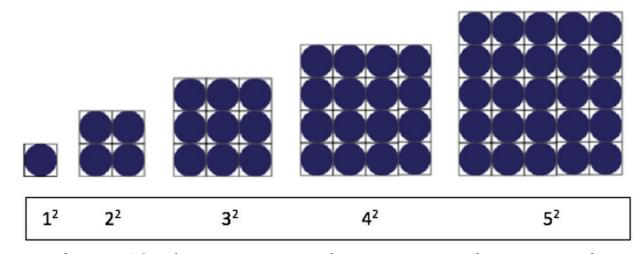
Figure 18 The square number sequence in geometric pattern (Private Document, 2019).
Based on the formula n<sup>2</sup> using the geometric form, the writer finally got the basic arrangement of the kacu ratio by forming a grid. One grid represents 1n without having a fixed size in length (meters) units because 1 grid considered as a unit of measure. Thus, the grid can be interpreted as a kacu reference unit. The number of grids is limited based on the medium used.
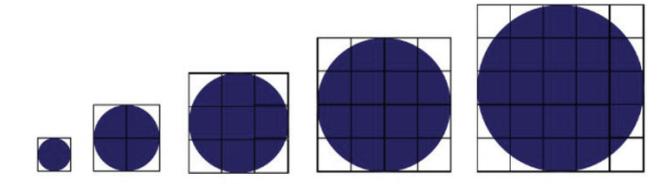
Figure 19 Circles with different grid sizes. Circle 1 grid, 4 grid, 9 grid, 16 grid and 25 grid (Private Document, 2019).
From the equation of the square number formula n<sup>2</sup> and the grid above, the writer uses it as a basic configuration in the arrangement and size of formalist work.
Forms Study
Below are some visual explorations of digital sketches. The author makes grid n<sup>2</sup> first to be used as a benchmark for the size of the object. The author uses textile media with a length of 115 cm and a height of 115 cm. In this size field, the writer makes a grid with a size of 32<sup>2</sup> to create 1024 squares.
Figure 20 Grid with size 32<sup>2</sup> on cloth with a length of 115 cm and a height of 115 cm. (Private Document, 2019)
Based on the grid, the writer then composes some formal compositions of circles and squares.
Figure 21 Square and circle sketches in grid (Private Document, 2019)
Figure 22 Sketch of squares and circles with sizes of 1 grid, 4 grid, 9 grid and 16 grid. (Private Document, 2019)
Figure 23 Sketch of squares and circles of size 1 grid, 4 grid, 9 grid and 16 grid with \(\frac{1}{1}\), \(\frac{3}{4}\), \(\frac{1}{2}\), and \(\frac{1}{4}\) circles (Private Document, 2019).
Color Study
The writer uses red and blue primary colors in this work, which are often used in Pekalongan batik. For this batik coloring, the writer uses Naphthol synthetic batik dye. In addition, the writer also uses dyes in the screen-printing industry, which has a contrasting intensity with batik dyes.
Figure 24 Naphthol color palettes (Fitinline.com, 2019).
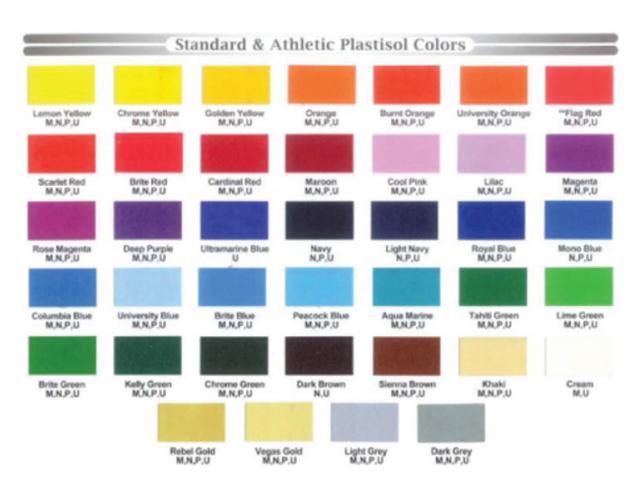
Figure 25 Screen Printing water base color palettes (Houstonscreenprint.com, 2019).
Work Process
TABLE I WORK IN PROCESS
No Picture Description 1. Tracing the sketch on cloth according to the grid 2. The process of batik using canting and hot wax. This process is the longest process. 3. The coloring process uses naphthol dyes with dyeing techniques. 4. The process of penglorodan is breaking down the hot wax that has frozen on the cloth using boiling water to create a motif according to the desired sketch. 5. The final process is adding visuals with the screen-printing technique.
(Reproduced by Fardhani, 2019)
RESULT
The process that took nearly 12 months is to find the meaning of the kacu composition obtained from applying the concept of the kacu ratio in classical batik and exploration of form by using the composition in the writer's work as an artist. During the process, the writer finally obtained five works representing the theme that the writer brought. The following is an overview of the five works.
Figure 26 Preliminary results of the shape composition exploration (Fardhani, 2019).
Figure 27 Lumut Kuning (1st Line on 1 / 32 Kacu) 110 x 110 cm. 2019 (Fardhani, 2019).
Figure 28 Sawang Biru (2nd Line in 1 / 32 Kacu) 110 x 105 cm. 2019 (Fardhani, 2019).
In the works above, the writer uses a line arrangement that repeats itself according to a grid size of 32. Thus, repeating lines arranged to form a square creates a spatial effect. This 1 / 32-wide grid line in white (the base color of the fabric) becomes a negative figure that occupies space. Thus, the red line becomes the natar or the area that surrounds the figure.
The white fields neither look rigid, nor solid, or perfect with the cracking color. The white line is the result of color blocking using wax/ hot wax against red dye. The lines created through this wax are not perfectly formed. There are some broken parts, which are leaking or seeping the dye. These imperfections create the impression of gaps, brittle lines, and often imperfect corners. However, because the line is repeated, it still makes the impression of a boundary, which ultimately creates the impression of space.
On the top of the line, images made with the batik technique, the author adds screen printing paint that is in contrasts with the background color. The screen-printing paint randomly covers the imperfect lines so that a specific pattern appears. The interruption of the addition of this screen-printing paint color gives a slightly disturbing impression. The combination of geometric and irregular shapes creates a paradoxical composition that balances orderly in a chaotic sense.
Figure 29 Bulan Layung (Circles in 1 / 8 kacu) 110 x 110 cm. 2019 (Fardhani, 2019)
In this third work, the author composes the shape of a circle with a dark blue background. The circles' size is 1/8 kacu, which is the width of the side of the fabric divided by eight grids. There are two kinds of circles: circles with a cloth base color (white slightly gray) and orange circles. Circles with a white base color are neatly arranged to fill the fabric space. In contrast, the orange circles are arranged irregularly and sometimes overlap each other.
Circles with a white base color that are neatly arranged are made with batik technique. In this batik technique, the writer deliberately makes the wax imperfect so that it creates some broken circles shape, which is not full, and creates a specific pattern in each circle. Unlike the orange circles, which are arranged randomly and overlap each other, the shape of the circle is complete. This composition also wants to emphasize the balance of the paradoxical nature created by merging order and chaos composition.
CONCLUSION
From the research above regarding kacu as a traditional ratio in classical batik making, the author concludes the following.
Firstly. there is a rule in the making of classical batik, especially in determining the length of the batik cloth and the size of the ornament on a motif. This rule is known as Kacu, the reference which is used as the scale standard. Technically, there are two structures used to make batik motifs: structure A and structure B. Structure A is usually 1 / 2 kacu in size, and structure B is 1 / 3 kacu in size. The use of this kacu ratio also has specific rules. For example, if a motif is intended for a king or his descendants, the number of kacu used will be even more significant, so the motif created will be large as well. Likewise, the length of the batik cloth will be longer than the length of the regular batik cloth, which is more than 2 1 / 2 kacu.
Secondly, the rules for using this kacu ratio are related to Javanese beliefs, regarding the mandala contained in batik cloth as an affirmation of the hierarchy of a Javanese king. Therefore, the more powerful a king is, the significant kacu ratio is used. The smaller the number of inner mandalas, the closer his essence is to the absolute substance. Therefore, the batik motif will be created bigger than the regular motif.
Lastly, a kacu ratio is a square number, a series of numbers arranged according to the formula n2 where n is a rational number. From the row of the square numbers, its schematic shape can be made into a grid. Then from the grid, I was inspired to create works through a formalist approach.