

INFO ARTIKEL
Kata kunci:
budaya organisasi klan, kepemimpinan demokratis, loyalitas karyawan, UKM
ABSTRAK
Penelitian ini menguji secara empiris bagaimana budaya organisasi dan kepemimpinan demokratis memengaruhi loyalitas karyawan pada Usaha Kecil dan Menengah (UKM) studio musik. Metode yang digunakan yaitu metode kuantitatif dengan pendekatan deskriptif kausal. Sampel penelitian diambil dari populasi karyawan pada UKM studio musik di Bandung. Teknik analisis data yang digunakan analisis deskriptif dan regresi berganda . Penelitian ini memiliki batasan pada sampel yang digunakan dan pengumpulan data yang terbatas pada UKM. Hasil penelitian ini mengindikasikan bahwa budaya klan dan kepemimpinan demokratis secara positif dan signifikan memengaruhi loyalitas karyawan secara parsial dan simultan. Hubungan antarbudaya klan dan kepemimpinan demokratis terhadap loyalitas karyawan menunjukkan angka hubungan 70 persen, sementara 30 persennya dipengaruhi oleh faktor lain.
https://doi.org/10.5614/sostek.itbj.2022.21.1.3
Introduction
Coronavirus pandemic (COVID-19) has impacted various sectors, especially the world's economy (Fendel et al., 2021). The impact also shows a downtrend in investment, balance payments, and consumption, which generally affects growth in the macroeconomic sector (Fang et al., 2021). In the meantime, the microeconomic sector deals with the same impact during pandemic, which is reduced people consumption, lower purchase interest and income, and job losses (Dang & Nguyen, 2021). The vague situation caused by pandemics makes the consumer more careful to make unnecessary expenditures (Celik et al., 2020). Indonesia is one of many countries affected by pandemic situation, which created a major shock and affected supply and demand during the implementation of stay at home policy. It has restricted many economic movements that mainly impacted the Small-Medium Enterprises (SMEs) (Ratnawati & Kholis, 2021). The situation will impact SMEs activity, not only causes slower growth but also demises of the SMEs. For this reason, SMEs have to respond appropriately with a different strategy to survive (Juergense et al., 2020).
Organizational culture has been an attention for the researcher to be studied in various ways (Denison et al., 2004), for example, research in organizational culture shape and organizational culture preservation (Hatch & Cunliffe, 2012). Human resources are primary factors that influence an organization to accomplish their goals. Hence, the human resource must be treated carefully in order to raise organization's productivity in achieving its objectives (Northouse, 2019). Aligning human resources alongside with organizational culture is proven as a challenging situation. A great deal of attention has been given in recent times to the importance of organizational culture. A basic example of cultural ideas that share the same set of values or a mission can harmonize employees to work as a single unit (Robbins & Judge, 2018). For the most part, previous studies have shown that the organizational culture has an important influence on the company's sustainable performance, and that the organizational culture evolves as an indicator whether the organization can be successful or fails as a company in the upcoming decades (Elsbach & Stigliani, 2018; Warrick, 2017). Organizational culture embedded deeply inside members' values can increase motivation for the organization members to move forward (Fakhri et al., 2018; MacQueen, 2020). The foundation, invention, and evolution of organizational culture within an organization is required to create a powerful and useful organization in order to achieve organization vision and mission. The stronger the business atmosphere is, the higher is the added value for the employees to optimize their knowledge and their resources, to fulffil the organization objectives (Augustrianto et al., 2019; Silvianita & Tan, 2017).
Clan culture is an organizational culture type that portrays the values and beliefs of organizational life and organizational flexibility (Stock et al., 2007). Clan culture is also defined as a relationship among members and leaders as if they unite in one big family wherein the members are creating a friendly atmosphere within the organization (Sulastri et al., 2017). The particular leadership style also influences how the clan's ethics can be enforced within the organization. Family-owned organizations use participatory leadership to provide collective values, less corporate control, and less formalized company culture (Ogbonna & Harris, 2000). Clan culture simultaneously reflects the human relations model of organizational theory and corporate governance (Sanchez-Marın et al., 2015). It is also safe to say that cultural values are related to tradition in small businesses with deep heritage roots. If we are talking about small and medium-sized enterprises (SMEs), mostly the SMEs are still holding on their original value of their business heritage because they believe their value somehow makes their business survive (Kartawinata et al., 2020; Nuryakin, 2020). This situation can lead to a perception that people still respect local customs and behavior within the situation suitable with what the organizational literature defines as a clan culture (Claes, 2019).
Leadership in SMEs is described as the capability of an individulas to behave or act as an advisor at the top of an organization. Due to the limitation structure of small and medium enterprises, their productivity is determined by the leadership's nature. Leadership plays a crucial position in the company's
strategy of maximizing sales and having a successful flow of operations; however, more often than not, leadership actions can affect every layer at the company due to SMEs' size (Bojadjiev et al., 2019). Small and medium-sized enterprises are likely to implement a democratic leadership style (Bojadjiev et al., 2019). Observations have shown that many applications of using a democratic style leadership, such as distributing tasks, empowering subordinates, and involving members in the decision-making process (Gastil, 1994) are practiced within the company. Leaders tend to share responsibilities equally between team members (Mihrez & Thoyib, 2014). The status of the employee does not affect whether the employees are family or non-family members. This leadership style is likely to result in respectful behavior from every employees.
Organizations become more effective when each member is willing to act creatively (Deckop et al., 1999). Difficulties that will emerge from an organization are how the organization maintains a level of talent within employees and inspires them to exceed organizations' expectations. Some of the organizations build on the spirit and dedication of their workers to improve their success. Global rivalry makes employee commitment scarce. The generation of devoted workers who have spent their working life with one or two employers in their entire career is rare. Nowadays, employees neglect their dedication as soon as they have a better financial incentive from another corporation (Briscoe & Hall, 2006). Employee dedication, personal investment, and ongoing contribution to the company are the primary factors for organization's long-term success (Bakker & Schaufeli, 2008). Highly engaged and dedicated workers give a beneficiary to the company by increasing efficiency and reducing employees' turnover (Vance, 2006).
Apart from the initial observation of the SMEs' organizational clan culture and application of democratic leadership and employee loyalty applied in this SMEs business, it is necessary to examine further how an organizational clan culture and democratic leadership style can influence employee loyalty within SMEs.
Method
The definition of organizational culture always develops through the ages. The idea of corporate culture must be separated from common concepts such as corporate identity, organizational environment, or even a national culture (Scholz, 1987).
The first idea in learning organizational transfer the transfer of from multiplantages arch about nationality and ethnicity within social science, anthropology, and psychology majors. Researchers, in the beginning, try to combine organizational theory and culture as a metaphor to create a new perspective in social interactions within an organization. Afterward, the idea of culture grows from a metaphor into a variable. The 1950s interactions within an organization. Afterward, the idea of culture grows from a metaphor into a variable. The 1950s interaction power. Many concepts for culture became an early positive for organization been suggested during these development stages (Wilson 1900s). Wilson (2004) indefines the ideas of culture as follows: if it is the principles in the organization rewards, supports, and expects. The postation guidance normalists or un organization population, activities and procedural retaining of the organization apply these values and norms in the organization (Schneider, 1988).
Second, culture tends to be embedded as an invisible core value shared between the organization's members, even when membership changes. Culture also shares a visible value through member's behavior, in every layer of an act or behavior, and it can influence other members.
Third, the group culture can be defined as a shared system of standard procedure which is commonly understandable between members to answer internal and external problems, which is proven enough to be considered as an accurate way and, therefore, to be seen by the new members as the best way to interpret, think, and feel regarding to those problems (Schein, 1997).
H1: Organizational culture has an effect against employee loyalty.
Leadership is one of the oldest issues in the world (Bass, 1990). Developing countries believed that managers and leaders were similar and had no differences. However, for the most recent management and leadership study, there are connections between those issues, and most of them also show differences. Nevertheless, it is difficult for those countries to understand the difference. Leadership is a bit more common concept than the manager. We can see the differences between these two products. A leader may strongly support their employees, but the manager gives their subordinates more freedom to commit an act.
Certain cultural factors discourage leaders from taking responsibility and making improvements. In 1988, in his book "Leadership, Organization and Culture," Smith and Peterson saw processes leading within a cultural point of view. The actors must understand a company's culture to be effective, especially whin the organization which has not written its rules, customs, principles, and ways of doing things. The "difference" between the manager and the leader is still debated in recent situations, and most experts agree that leadership is different from management (Smith & Peterson, 1988).
Leadership sets a new course or vision for a community to follow. Management monitors or guides people/resources within a community on the basis of concepts or values that have already been defined. The distinction between leadership and management can be explained by looking at what happens when you have one without the other.
Leadership without management: sets out the course or vision that others will pursue, without considering too much how the new direction will be accomplished. Other people then have to work hard on the track that has left behind, pick up the bits and make it work. Management without leadership: manages resources to preserve the status quo or to ensure that things happen in compliance with alreadyestablished plans. Leadership combined with management does both; it sets a new course and controls the tools to accomplish it.
H2: Leadership has an effect against employee loyalty
Employee loyalty or engagement has been a problem to learn at the beginning 1960s (Ibrahim & Al Falasi, 2014), as businesses can benefit from employee loyalty (Linz et al., 2015). Organizational sustainability existence depends on the level of employee loyalty (Narteh & Odoom, 2015). Member's devotion depends on three factors: confidence in the organization, accountability of the organization, and a passion for working for the organization. This helps to describe the difference between loyalty building and organizational commitment wherein both situation tend to be identical and can reflect as organizational activities (Niehoff et al., 2001). However, sometimes in other situations, it can be different. Loyalty could be explained as an eagerness to remain inside an organization, enthusiasm in doing more effort, a feeling of being part of an organization, and a determination to be more responsible (Yee et al., 2010). Employees who are loyal and committed to the organization can easily understand how the organization works its values and its strategy (Yu et al., 2017).
H3: Clan culture and democratic leadership have an impact on employee loyalty.
The research applied a quantitative approach and descriptive with multiple regression analysis, wherein the data were processed using SPSS software. Sampling method used was a non-probability sampling technique with 100 respondents. Likert scale was used to measure responses within five range scales. The questionnaires were distributed to multiple respondents to collect the data (Sekaran & Bougie, 2016). The research model can be described in Figure 1 below:
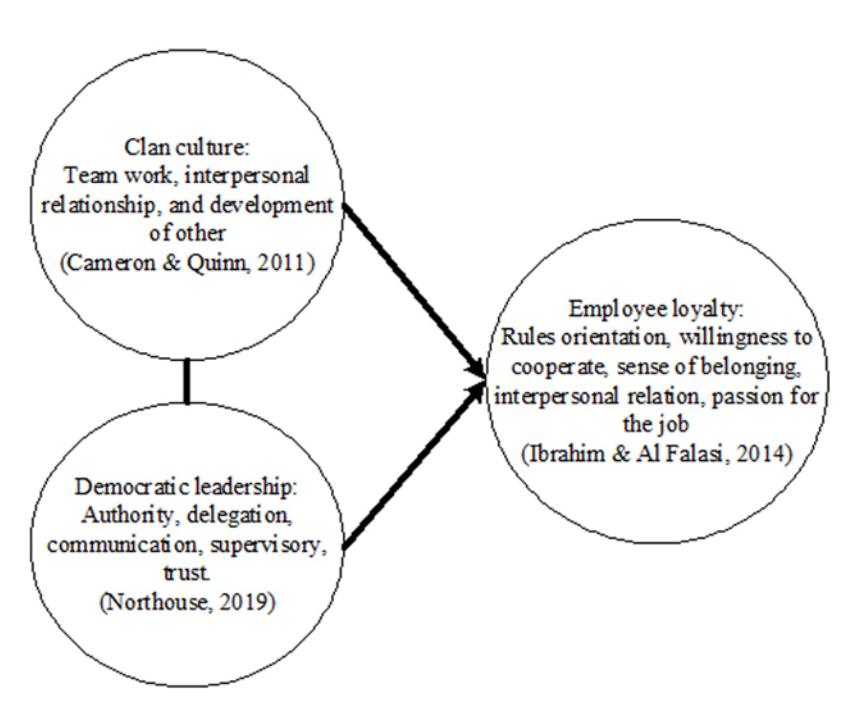
Figure 1 Research Framework
Result And Discussion
Descriptive Result Toward Organizational Clan Culture
This study used multiple respondents who were distributed to SMEs music studio employees. Based on the test results, it is known that the position of the organizational clan culture is within the Good category with 75.2 percent. The questionnaire's highest response is that employees believe that the organization is a place for improving their skills. The employee has the freedom given by the organization as long as the employee completed their duties. Meanwhile, the lowest response from the questionnaire is that the employee only gets limited opportunity to earn newer knowledge regarding music skills or music knowledge. It appears that the organization is focusing on knowledge specifically to support work itself.
Descriptive Result Toward Democratic Leadership
This study used multiple respondents who were distributed to SMEs music studio employees. Based on the results of the tests carried out, the position of the democratic leadership is within the Fair category with 61.6 percent. The questionnaire's highest response is that the leader's atmosphere indicates equality among the employees, and the leader pays attention to the responsibilities at work. Meanwhile, the lowest response is that the employee feels that the order from the leader tends to be a mandatory command and non-negotiable.
Descriptive Result Toward Employee Loyalty
This study used multiple respondents who were distributed to SMEs music studio employee. Based on the test results, it is known that the position of employee loyalty is within the Good category with 77.4 percent. The highest response from the questionnaire is employee participant. It Indicates that employees are closely engaged and committed to the organization activity and policy. Meanwhile, the lowest response is that the employee tends to ask a certain reward for special assignment given. Multiple Regression Results can be seen on Table 1.
Based on the calculation in the Table 1, it is stated that the organizational clan culture and democratic leadership style have significant effect on employee loyalty either partially or simultaneously. Coefficient determination shows that the organizational clan culture and democratic leadership style affect employee loyalty by 0.701 or 70 percent. This indicates that the organizational clan culture and democratic leadership style influence 70 percent on employee loyalty at SMEs music studio. While the rest, which is 30 percent, is influenced by other variables which are not researched. The relationship that exists between organizational clan culture, democratic leadership style, and employee loyalty is strong.
Partial hypothesis testing was simulated to determine the effect of each variable. The variable of organizational clan culture shows a significant effect on employee loyalty with a coefficient determination equal to 0.460 or 46 percent. On the other hand, the democratic leadership style variable shows a significant effect on employee loyalty with a coefficient determination equal to 0.241 or 24.1 percent. Both of organizational clan culture and democratic leadership style individually indicate positive correlation with employee loyalty.
Hypothesis testing also shows the correlation between variables simultaneously. The conclusion resulted that the organizational clan culture and democratic leadership style significantly affect employee loyalty simultaneously and show a positive connection between variables.
Table 1 Multiple Regression Analysis
| Model B | Unstandardized Coefficients | Standardized Coefficients | Correlations | ||||
|---|---|---|---|---|---|---|---|
| Std. Error | Beta | t | Sig. Zero-order | ||||
| 1 | (Constant) | .182 | .303 | .601 | .553 | ||
| Organizational Clan Culture | .576 | .145 | .574 | 3.982 | .000 | .801 | |
| Democratic Leadership | .330 | .143 | .333 | 2.308 | .029 | .725 | |
(Source: Author's own elaboration)
Conclusion
Based on the results of the research conducted, the following conclusions can be drawn. First, the application of organizational clan culture is within Good category. It is implied that employee can be adjusted to organizational clan culture. Second, democratic leadership is within fair category. It shows that employees only follow leadership because it is mandatory. The small number of employees can affect how leadership perform in the organization. Third, employee loyalty is within good category. The employees bonding within the small group of people influence how the work atmosphere is formed. The familiness becomes the factor of how this bonding occurs. Likewise, the concept of doing activities together and supporting each other mount the relationship between employee and the organization. Fourth, evidence suggests the positive correlation between variables, simultaneously each variable affects each other. The employee appreciates the relationship between a member of the organization and acceptably supports the leadership, and it proves to strengthen the loyalty among employees.
We acknowledge limitations of this study. First, this research is based on short-term observation. Second, the research focuses on specific businesses in SMEs , and it cannot be generalized nor compared to other SMEs studies. Last but not least, this research only focuses on the effect of clan organizational culture and democratic leadership toward employee loyalty. If other researchers want to explore similar topics, it opens for further research with other variables such as motivation, quality of work life, work stress, etc.
Acknowledgment
We want to thank the Telkom University Research Department for supporting this research.
References
- Augustrianto, A., Silvianita, A., & Ferari, E. (2019). Hofstede's organization culture on deviant workplace behavior (Case study on workers at plaza Toyota Bandung). Journal of Advanced Research in Dynamical and Control Systems, 11(3), 720-725.
- Bakker, A. B., & Schaufeli, W. B. (2008). Positive organizational behavior: Engaged employees in flourishing organizations. Journal of Organizational Behavior, 29(2), 147-154.
- Bass, B. M. (1990). Bass and Stogdill's handbook of leadership: A survey of theory and research. New York: Free Press.
- Bojadjiev, M., Hristova, S., & Mileva, I. (2019). Leadership Styles in Small and Medium Sized Business: Evidence from Macedonian Textile SMEs. Journal of Entrepreneurship and Business Innovation, 6(2), 1-22.
- Briscoe, J. P., & Hall, D. T. (2006). The interplay of boundaryless and protean careers: Combinations and implications. Journal of Vocational Behavior, 69(1), 4-18.
- Celik, B., Odzen, K., & Dane, S. (2020). The effects of COVID-19 pandemic outbreak on the household economy. Journal of Research in Medical and Dental Science, 8(4), 51-56.
- Claes, M. T. (2019). Pizza hut vietnam: adapting a global code of conduct. In C. Prange, & R. Kattenbach, Management Practices in Asia (pp. 153-166). Switzerland: Springer International Publishing.
- Dang, H. A., & Nguyen, C. V. (2021). Gender inequality during the COVID-19 pandemic: Income, expenditure, savings, and job loss. World Development, 140, 105296.
- Deckop, J. R., Mangel, R., & Cirka, C. C. (1999). Getting more than you pay for: Organizational citizenship behavior and pay-for-performance plans. Academy of Management Journal, 42(4), 420-428.
- Denison, D. R., Haaland, S., & Goelzer, P. (2004). Is Asia different from the rest of the world. Organizational Dynamics, 33(1), 98-109.
- Elsbach, K. D., & Stigliani, I. (2018). Design thinking and organizational culture: A review and framework for future research. Journal of Management, 44(6), 2274-2306.
- Fakhri, M., Pradana, M., Gilang, A., & Ekaristi, H. A. (2018). Occupational Health and Safety and Practical Code of Safety at An Indonesian Agrochemical Company. MIMBAR, Jurnal Sosial dan Pembangunan, 34(2), 341-350.
- Fang, J., Collins, A., & Yao, S. (2021). On the global COVID-19 pandemic and China's FDI. Journal of Asian Economics, 74, 101300.
- Fendel, R., Neugebauer, F., & Zimmermann, L. (2021). Reactions of euro area government yields to Covid-19 related policy measure announcements by the European Commission and the European Central Bank. Finance Research Letters, 42 , 101917.
- Gastil, J. (1994). A definition and illustration of democratic leadership. Human Relations, 47(8), 953-975.
- Hatch, M. J., & Cunliffe, A. L. (2012). Organization Theory: Modern, Symbolic and Postmodern Perspectives, 3rd Ed. Oxford: Oxford University Press.
- Ibrahim, M., & Al Falasi, S. (2014). Employee loyalty and engagement in UAE public sector. Employee Relations, 36(5), 562-582.
- Juergensen, J., Guimón, J., & Narula, R. (2020). European SMEs amidst the COVID-19 crisis: assessing impact and policy responses. Journal of Industrial and Business Economics, 47(3), 499-510.
- Linz, S., Good, L. K., & Busch, M. (2015). Promoting worker loyalty: an empirical analysis. International Journal of Manpower, 36(2), 169-191.
- MacQueen, J. (2020). The Flow of Organizational Culture. Switzerland: Palgrave Macmillan.
- Mihrez, A. A., & Thoyib, A. (2014). The importance of leadership behavior and motivation in creating employee performance:(A study at the faculty of economics and business, University of Brawijaya). APMBA (Asia Pacific Management and Business Application), 3(2), 86-105.
- Narteh, B., & Odoom, R. (2015). Does internal marketing influence employee loyalty? evidence from the Ghanaian banking industry. Services Marketing Quarterly, 36(2), 112-135.
- Niehoff, B. P., Moorman, R. H., Blakely, G., & Fuller, J. (2001). The influence of empowerment and job enrichment on employee loyalty in a downsizing environment. Group and Organization Management, 26(1), 93-113.
- Northouse, P. G. (2019). Leadership Theory and Practice 8th Edition. Thousand Oaks: SAGE Publications. Nuryakin, N. (2020). Exploring SMEs Marketing Performance Through Networking Capacity and Relational Capability. APMBA (Asia Pacific Management and Business Application), 9(2), 143- 162.
- Ogbonna, E., & Harris, L. (2000). Leadership organizational culture & performance: Evidence from UK. International Journal of Human Resource Management, 11(4), 766-788.
- Pawirosumarto, S., Sarjana, P. K., & Gunawan, R. (2017). The effect of work environment, leadership style, and organizational culture towards job satisfaction and its implication towards employee performance in Parador Hotels and Resorts, Indonesia. International Journal of Law and Management, 59(6), 1337-1358.
- Ratnawati, A., & Kholis, N. (2021). Developing Innovation Capability to Improve Marketing Performance in Batik SMEs During the Covid-19 Pandemic. Complex, Intelligent and Software Intensive Systems. CISIS 2021 (pp. 309-323). Springer, Cham.
- Robbins, S. P., & Judge, T. A. (2018). Organizational Behavior. England: Pearson.
- Sanchez-Marin, G., Danvila-del-Valle, I., & Sastre-Castillo, M. (2015). Entrepreneurship and family business: Does the organization culture affect to firm performance? In M. Peris-Ortiz, & J. M. Sahut, New challenges in entrepreneurship and finance (pp. 169-179). Switzerland: Springer International.
- Schein, E. (1997). Organizational Culture and Leadership (2nd edn). San Fransisco: Jossey Bass.
- Schneider, B. (1988). Notes on climate and culture. In Managing Services, Lovelock C (eds). Englewood Cliffs, NJ: Prentice-Hall.
- Scholz, C. (1987). Corporate culture and strategy: the problem of strategic fit. Long Range Planning, 20, 78-87.
- Sekaran, U., & Bougie, R. (2016). Research Methods For Business: A Skill Building Approach. Chichester, UK: John Wiley & Sons.
- Silvianita, A., & Tan, C. -L. (2017). A model linking the knowledge management (KM) enabler, KM capability and operational performance in indonesian automobile industry. Advanced Science Letters, 23(1), 640-642.
- Smith, P. B., & Peterson, M. F. (1988). Leadership, organizations and culture: An event management model. Sage Publications, Inc.
- Stock, G. N., McFadden, K. L., & Gowen III, C. R. (2007). Organizational culture, critical success factors, and the reduction of hospital errors. International Journal of Production Economics, 106(2), 368- 392.
- Sulastri, S., Andriani, C., & Fitria, Y. (2017). he Factors Formıng Formal and Non Formal Leadershıp Based on Mınangkabau Culture in Padang. APMBA (Asia Pacific Management and Business Application), 6(1), 15-28.
- Vance, R. J. (2006). Employee engagement and commitment. SHRM Foundation.
- Warrick, D. D. (2017). What leaders need to know about organizational culture. Business Horizons, 60(3), 395-404.
- Wilson, A. (2001). Understanding organisational culture and the implications for corporate marketing. European Journal of Marketing, 35, 253-267.
- Yee, R. W., Yeung, A. C., & Cheng, T. C. (2010). An empirical study of employee loyalty service quality and firm performance in the service industry. International Journal of Production Economics, 124(1), 109-120.
- Yu, Q., Yen, D. A., Barnes, B. R., & Huang, Y. A. (2017). Enhancing firm performance through internal market orientation and employee organizational commitment. The International Journal of Human Resource Management, 30(6), 964-987.