

Keywords:
productivity, digital skill, collaboration, POS
For controlling the negative impact of Covid-19 outbreak, Indonesian government instructs the citizens to work from home. Unfortunately, the productivity of work from home has been questioned. This article is an attempt to elaborate work productivity and the effect of digital skill, digital collaboration, and perceived organizational support (POS) as the drivers. For supporting the arguments, this article has conducted a quantitative study which involved 824 working citizens as the respondents from all over Indonesia. The respondents are mostly the first timers in doing work from home, either in governmental institution or private organizations. The gathered data were structured by PLS SEM and analyzed by SmartPLS application version 3. The result reveals that digital skills play serve as a mediator in the linkage between work productivity and digital collaboration. Digital skills and POS affect directly on work productivity, but digital collaboration impacts indirectly.
INFO ARTIKEL
ABSTRAK
Kata kunci:
produktivitas, keterampilan digital, kolaborasi, POS
Dalam rangka mengendalikan dampak negatif dari wabah Covid-19, pemerintah Indonesia menginstruksikan warganya untuk bekerja dari rumah. Sayangnya, produktivitas bekerja dari rumah masih disangsikan. Artikel ini berupaya untuk membahas produktivitas kerja dan pengaruh dari keterampilan digital, kolaborasi digital, dan perceived organizational support (POS) sebagai faktor-faktor penyebab. Untuk memperkuat argumentasi yang dikembangkan, artikel berisi studi kuantitatif yang melibatkan 824 pegawai dari berbagai wilayah di Indonesia sebagai responden. Responden sebagian besar adalah pegawai yang pertama kali bekerja dari rumah di instansi pemerintah dan organisasi swasta. Data yang dikumpulkan distrukturisasi
menggunakan PLS SEM dan dianalisis dengan aplikasi SmartPLS versi 3. Hasil analisis menunjukkan keterampilan digital memainkan peran mediasi dalam hubungan antara kolaborasi digital dan produktivitas kerja. Keterampilan digital dan POS berpengaruh langsung pada produktivitas kerja, Akan tetapi, kolaborasi digital berdampak tidak langsung terhadap produktivitas kerja.
https://doi.org/10.5614/sostek.itbj.2022.21.1.8
Introduction
In the interconnecting world, the multiplier effect of morbidity and mortality from a disease has become threatening during the pandemics (McKibbin & Fernando, 2020), with its obvious impacts being the slowing down economic growth. The economic indicators have been dropping down significantly. It depends on the population proportion that gets ill, the fatality level, and the number of citizens who do not go to the office to avoid the disease (Wren-Lewis, 2020). The pandemic has altered various aspects of human civilization profoundly. It forces the workplace migration from work centrally at office into remotely at homes. Working from home was stimulated by the fast growth of the number of Covid-19 victims and is deemed a successful way to knock down the victim curve. The Indonesian authority commanded all working citizens to apply work from home during the pandemics.
It is only about 37 percent jobs that may be conducted at home entirely in the USA (Dingel & Neiman, 2020). Immediate instruction for working at home makes employee productivity, business survivability, and growth of national economy drop. The job composition that can be accomplished at home is a necessary contribution for assessing the commercial accomplishment during the period of social distancing (Dingel & Neiman, 2020). Work productivity may differ individually and substantially when it is conducted from home rather than from the company location as a conventional workplace. Considering this point of views, work productivity during pandemics becomes an important issue in the perspectives of micro and macroeconomic.
When it is compared to the conventional work arrangement, work from home was projected to earn various advantages (e.g., had less sick days, took fewer time off, took shorter breaks, diminished carbon releases) and overcoming many obstacles such as job position, skill level, space, level of income, and gender (Bakker et al., 2019). The empirical research discovered that the higher skillfulness level, the larger composition of qualified staffs in the workplace, the more probable is work from home arrangement to be endorsed as fixed employment choice (Felstead et al., 2002). The work productivity is triggered by having a personal setting, which makes employee easier to accomplish the works. Offices become distracting places for working. The productivity of work from home is produced by the fact that citizens worked from home in the extended periods rather than at office (Bloom, 2014).
As an optional working scheme, the work productivity tends to be distrusted by the companies, particularly for the companies that implement work from home broadly at the first time. Various studies have explained that work from home provides many advantages for organizations and workers. Regrettably for the organizations, it is difficult to comply with. They need to study work productivity and to scrutinize impact of the influential drivers. Lots of studies also explained that there are various influential factors impact on the work productivity. Work hour is an influential driver. Doing work from home which is less than 18 hours a week makes a higher encouraging effect on productivity rather than of a fulltime setting (Kazekami, 2018). The trust and support from the supervisor, lessened communication with co-workers, the readiness of the working resource at home, opportunity to provide family care were identified as the influential factors of work productivity at home (Nakrošienė et al., 2019).
This article has utilized organizational behavior theory (Uhl-Bien et al., 2020) as the main conceptual framework. Work productivity is considered as individual behavior in the context of organization. As a behavior, productivity of workers is triggered simultaneously by individual, group, and organizational factors. This study determines that digital skill is a personal driver of work productivity which arises from the internal of people. Digital collaboration is a group driver of work productivity which is derived from people who directly interact in daily organizational activities. Ultimately, POS is considered an organizational driver which happened and is provided by the organization. According to all previous explanations, this study attempts to elaborate the work productivity and to examine its impactful drivers. Are digital skill, digital collaboration, and POS the influential factors for work productivity during COVID-19 pandemics?
Work Productivity
Since 1990's, work from home was already known as virtual or remote working, teleworking, or telecommuting which is specified as a remote work scheme that tolerates employees working remotely from various locations rather than from office conventionally in permanent or transitory basis (Maruyama et al., 2009). Work from home as an unconventional work arrangement is used for developing social presence by enabling people with particular constraints for contributing to the labor force (Bosua et al., 2017). Regarding the case of Covid-19, work from home is considered an option which offers chances for safeguarding people from being infected by viruses in unrestricted areas. Work from home is organized on was temporary base at the beginning of the pandemics in Indonesia.
Previous studies reveal that work from home provides temporal-spatial flexibility (Baruch, 2000), improves work-life harmony, while it also lessens traffic blocking (Maruyama & Tietze, 2012), lower stress level and infrastructure costs, and improves productivity (Troup & Rose, 2012). The empirical research in eleven Malaysian oil and gas companies had exposed that WFH results on work-family balance, job self-government, increasing occupational level and work productivity (Khan et al., 2018).
The other research paper uncovered that work from home has a vulnerable but constructive association with fit work quality. It indicates that there are other influential factors on work quality other than work productivity (Onyemaechi et al., 2018). This article defines the work productivity as a personal accomplishment of working during pandemic, which is compared with conventional arrangement. This article used self-reported productivity based on worker's perception whether she or he achieved better outcome objectively (faster, more quantity, and more accurate) and subjectively (happier, more focused, more creative). It is adapted from "how effective is telecommuting" (Allen et al., 2015).
Digital Skill
Based on organizational behavior (Uhl-Bien et al., 2020), an ability or a skill or a competence is one of the important factors that make an impact on work productivity. In the work from home context, digital skills are needed. A previous study demonstrates that the advanced digital skills will activate work performance effectively and efficiently. Digital skills are applicable not only for workers in ICT related or high-tech job, but also to all conventional businesses. The increasing digital technology utilization has been boosting the productivity in every economic sectors (Funes et al., 2018). Digital skills become important for business organization. Profit growth and increased productivity in fascinating business outcomes, are going to be achieved by the companies which have implemented digital technology. Conventional businesses which do not adopt an integrated approach and develop workers with digital skills, are failing to seize a significant opportunities digital workplace could convey (Attaran et al., 2019).
Digital skills cover various abilities related to digital technology from the basic digital literacy as a generic digital ability for the workers, and the specific digital mastery for the ICT professionals. Digital skills required by the workforce are possible to differ across sectors, there will be several least requirements related to information processing that will be applicable for all over sectors (Motyl et al., 2017). This article adapted concept developed by a previous study (Van Deursen et al., 2016) about measuring digital skills. Digital skills cover four dimensions: digital mindset, digital technical, digital communication, and digital analytics. According to OECD Economic Policy Paper (Sorbe et al., 2019) digital technology can leverage firm productivity. The gains from digital resources have been concerted
among the most industrious firms, which benefit from the organizational and human capital. Based on the report, this article tries to formulate hypothesis that digital skills impact on work productivity positively and significantly.
H1: Digital skills have positive impact on work productivity significantly.
Digital Collaboration
Based on the perspective of organizational behavior, work productivity as personal capability is affected by group or societal factors. Personal capability to cooperate with each other is also a necessary factor of work productivity (Uhl-Bien et al., 2020). Collaboration is a well-defined and mutual-beneficial connection among two or more entities for reaching common goals. Collaboration is frequently utilized as a vehicle for dealing with complex issues (Green & Johnson, 2015). In the context of working from home, collaboration is performed through internet connection. This article employs digital collaboration as the construct and is explained as collaboration by utilizing digital technology among employees with external partners or internal peers for accomplishing tasks (Kock, 2009). By considering the previous study (Easley et al., 2003), digital collaboration is measured based on four aspects: technology usage, collaboration quality, job type, and team characteristics.
Another previous study explains that collaboration influences productivity. In academic research, scientists who had collaboration with industry produced more publications rather than scientists without industrial collaboration. Collaboration made scientists' productivity higher (Bikard et al., 2019). In partnership-based supply chain, collaboration impact on commitment, innovation, and performance of the firms (Shin et al., 2019). Based on those tested facts, this article makes hypothesis that digital collaboration influences work productivity.
H2: Digital collaboration has positive impact on work productivity significantly
Several empirical studies have proven that collaboration make a significant effect on personal skill development. In education, collaborative learning approach had a positive impact on the students' performance as compared to the conventional learning approach. Ability to learn collaboratively impact on student's ability to solve statistical cases (Allan, 2018). In manufacturing, quality circle programs influence positively on skill improvement. Skills can be improved through planned interventions in collaboration on the job (Kim et al., 2016). Relating to the evidence, this article tries to arrange hypothesis that digital collaboration has positive impact on digital skill significantly.
H3: Digital collaboration has positive impact on digital skill significantly
Perceived Organizational Support
Relating to the principles of organizational behavior, work productivity is affected by multi-layer personal, group, and organizational factors. This article assumes that perceived organizational support (POS) as an organizational factor. POS is a general perception of the employees about the extent to which the company appreciates the employees' contributions and well-being (Kurtessis et al., 2017). An employee who believes that the company considers him or her fairly and care about his or her welfare will think obligated to come back with raised commitment, loyalty, and performance (Eder & Eisenberger, 2008). When the company delivers support to the employees and appreciates contributions of the employees, they will react with constructive behaviors at work (Lyubovnikova et al., 2018) such as enhanced performance and effort (Kim et al., 2017).
For assessing POS, the previous research used questionnaire with 32 indicators, but then apply only eight indicators with sufficient psychometric properties in which each respondent is requested to indicate the response on a seven-point scale (Eisenberger et al., 1986). This current article assesses POS in terms of four aspects, such as: employee welfare, working conditions, development, and rewards. Earlier empirical study has proven that work productivity and POS reciprocally affected each other. In laundry plants, wellness and post-program health participation make significant effect on work productivity. POS in well-being of the employees has positive effect about 10% on work productivity (Gubler et al., 2018). The empirical study on 88 teams from 13 health care organizations in the United Kingdom proved that POS influenced collective and personal work productivity (Lyubovnikova et al., 2018). Relating to the empirical facts, this article will test the hypothesis: POS impacts on work productivity.
H4: POS has positive impact on work productivity significantly
Prior empirical study on 916 nurses from seven public medical facilities in Japan concluded that good relationship with the organization is an influential factors of clinical competency improvement for the nurses with five or more years of experience (Sasaki et al., 2019). The empirical study on 224 teachers from 36 urban elementary schools in USA concluded that "CARE for Teachers' program as POS intervention in educational organization had impacted on teachers' social and emotional competence and the quality of classroom learning (Jennings et al., 2017). In Italy, POS influenced self-competence of nurses in two hospitals (Battistelli et al., 2016). Based on those empirical facts, this article proposes a hypothesis to test:
H5: POS has positive impact on digital skill significantly
Empirical study about impact of POS on collaboration is still limited. This article found impact of POS on team effectiveness (Howes et al., 2000), knowledge sharing behavior (Le & Lei, 2019), and team learning behavior (M. Kim, 2017). Based on the empirical facts, this article makes hypothesis:
H6: POS has positive impact on digital collaboration significantly
This article employed organizational behavior theory (Uhl-Bien et al., 2020) as a central conceptual theory. Work productivity is considered as behavior in a certain organization. As a behavior, work productivity is stimulated by various factors in personal, group, and organizational scopes. This article considered that digital skill as a personal factor of work productivity which emerges from the internal of employee. Digital collaboration is a group factor of work productivity which derived from others who directly or indirectly interact in daily routine activities. Finally, POS was defined as an organizational factor that happened and provided by company as the organization. According to all previous explanation, this article attempts to examine the influence of organizational, group, and personal factors on work productivity. Are digital skill, digital collaboration, and POS influential factors on work productivity?
Method
This article was conducted on a quantitative study about Indonesian citizens who work for the organization at the office previously. Data were gathered by spreading online questionnaires through the social media to personal and professional network of the researcher team. The researchers came from eight higher educational institutions, such as Universitas Bina Nusantara (Jakarta), STMIK Indonesia (Padang), STIE Pariwisata Indonesia (Semarang), Universitas Trunojoyo (Madura), Universitas Islam Malang (Malang), Universitas Riau (Pekanbaru), Universitas Widya Mataram (Yogyakarta), and Universitas Jember (Jember).
This article involved about 824 working citizens as the respondents. Most of the respondents are working for an organization permanently (75%), and the rest of them are serving for many organizations independently. The biggest group of respondents are working for private companies (40%) and governmental institutions (28%). Based on organizational structure, the respondents are divided into functionalists who are responsible for functional positions as a specialist, an expert, or an advisor (37%) and generalists who have structural position in their organization (63%). The generalist's category is distributed into individual contributors (36%) and as structural managers (27%). The respondents experience work from home as work arrangement in the first-time about 69%. Only 19% of them ever conduct work from home before Covid-19 pandemics.
This article involved working citizens from all over Indonesia, from 32 provinces in Indonesia. Based on demographical indicators, the respondents are categorized by gender equally – male and female. Most of them (64 %) are with the age of older than 30 years old, with work experience longer than five years in the organization (72%). They have master or bachelor's degree as educational background (70%). Most of the respondents (81%) came from six provinces (Jakarta, Yogyakarta, Jawa Barat, Sumatra Barat, Jawa Tengah, and Jawa Timur). Generally, they came from two biggest Indonesian islands: Sumatera (21%) and Java (70%). For further information about the respondent profile is displayed in Table I.
Table I The Profile of Respondents
| Description | ||||
|---|---|---|---|---|
| Male | 415 | 50% | 50% | |
| Gender | Female | 409 | 50% | 100% |
| Until 20 | 12 | 1% | 1% | |
| 21 – 30 | 283 | 34% | 36% | |
| 31 – 40 | 259 | 31% | 67% | |
| Age | 41 - 50 | 169 | 21% | 88% |
| 51 – 60 | 91 | 11% | 99% | |
| > 60 | 10 | 1% | 100% | |
| Diploma | 67 | 8% | 8% | |
| Bachelor | 249 | 30% | 38% | |
| Education | Master | 330 | 40% | 78% |
| Doctoral | 79 | 10% | 88% | |
| Others | 99 | 12% | 100% | |
| 0 - 2 years | 94 | 11% | 11% | |
| 3 - 5 years | 135 | 16% | 28% | |
| 6 - 10 years | 174 | 21% | 49% | |
| Years of service | 11- 20 years | 231 | 28% | 77% |
| 21- 30 years | 135 | 16% | 93% | |
| > 30 years | 55 | 7% | 100% | |
| First timer | 572 | 69% | 69% | |
| Ever before | 53 | 6% | 76% | |
| WFH Experience | Usually before | 153 | 19% | 94% |
| Others | 46 | 6% | 100% | |
| Government | 230 | 28% | 28% | |
| State owned | 38 | 5% | 33% | |
| Institution | Private | 327 | 40% | 72% |
| Multinational | 22 | 3% | 75% | |
| Others | 207 | 25% | 100% | |
| Staff | 295 | 36% | 36% | |
| Supervisor | 84 | 10% | 46% | |
| Manager | 53 | 6% | 52% | |
| Position | Senior Manager | 25 | 3% | 55% |
| Director | 40 | 5% | 60% | |
| Owner | 24 | 3% | 63% | |
| Others | 303 | 37% | 100% |
| East Java | 284 | 34% | 34% | |
|---|---|---|---|---|
| Central Java | 113 | 14% | 48% | |
| West Sumatera | 110 | 13% | 62% | |
| West Java | 56 | 7% | 68% | |
| Jakarta | 54 | 7% | 75% | |
| Location | Yogyakarta | 48 | 6% | 81% |
| Rest of Java | 23 | 3% | 83% | |
| Sumatera | 60 | 7% | 91% | |
| Borneo | 44 | 5% | 96% | |
| Sulawesi | 20 | 2% | 99% | |
| Papua | 12 | 1% | 100% |
Because this article is based on exploratory research, PLS SEM or partial least squares structural equation modeling is applied for statistical analysis by using SmartPLS application version 3. The second order constructs are developed for formulating the research model. All variables are revealed into several aspects or dimensions and each dimension is measured by several indicators.
The instrument for measuring work productivity is adapted from the previous study (Allen et al., 2015). The instrument described work productivity in two dimensions: (1) objective outcome, which was indicated by WFH03, WFH02, and WFH01 and (2) subjective outcome which was represented by WFH06, WFH05, and WFH04.
For measuring digital skills, this article used the instrument adopted from other studies (Van Deursen et al., 2016) In this article, digital skill is explained into four dimensions, such as digital technical (DIS01, DIS02); digital communication (DIS03, DIS04); digital analytics (DIS05, DIS06), and digital mindset (DIS07). Meanwhile, the instrument for capturing digital collaboration is adapted from the concept of technological used in the collaboration (Easley et al., 2003).
Digital collaboration is reflected into four dimensions, such as: characteristics (KOL02, KOL01), job type (KOL04, KOL03), quality (KOL06, KOL05), and technology use (KOL08, KOL07). Finally, POS is measured by the instrument from other studies (Lynch et al., 1999) that is reflected into four dimensions, such as appreciation (POS02, POS01); development (POS04, POS03); working condition (POS06, POS05) and well-being (POS08, POS07).
Measurement Model
Figure 1 shows the measurement model. Table II and Table III provide the results of reliability and validity analysis on the measurement model. Validity analysis on indicators uses scores of outer loading factor or loading (OL), meanwhile validity analysis on variables and its dimensions uses convergent and/or discriminant validity. Reliability analysis is established on internal consistency and/or composite reliability. Table II presents the scores of average variances extracted (AVE), composite reliability (CR), Cronbach's alpha (CA), and outer loading (OL). Table III presents the discriminant validity. For validity analysis on indicators, OL score is used as a parameter. An indicator or item is valid when the OL score is higher than 0.60 for exploratory study, or higher than 0.70 for confirmatory (Henseler et al., 2014). Because this article is based on exploratory study, an indicator is valid when OL score is more than 0.60. Table II informs that OL score of all indicators of all variables are more than 0.60, and even more than 0.70. It means that all indicators of the measurement model are valid.
Table II Validity and Reliability Analysis
| DIMENSION | ITEM | OL | CA | CR | AVE |
|---|---|---|---|---|---|
| WORK PRODUCTIVITY | 0.893 | 0.920 | 0.654 | ||
| WFH01 | 0.864 | ||||
| Objective Outcome | WFH02 | 0.906 | 0.779 | 0.877 | 0.700 |
| WFH03 | 0.724 | ||||
| WFH04 | 0.853 | ||||
| Subjective Outcome | WFH05 | 0.904 | 0.852 | 0.909 | 0.772 |
| WFH06 | 0.877 | ||||
| DIGITAL SKILL | 0.873 | 0.903 | 0.571 | ||
| DIS01 | 0.915 | ||||
| Digital Technical | DIS02 | 0.887 | 0.769 | 0.896 | 0.812 |
| Digital | DIS03 | 0.816 | |||
| Communication | DIS04 | 0.878 | 0.611 | 0.836 | 0.718 |
| DIS05 | 0.918 | 0.913 | |||
| Digital Analytics | DIS06 | 0.915 | 0.810 | 0.840 | |
| Digital Mindset | DIS07 | 1.000 | 1.000 | 1.000 | 1.000 |
| DIGITAL COLABORATION | 0.874 | 0.901 | 0.534 | ||
| KOL01 | 0.857 | 0.829 | |||
| Characteristics | KOL02 | 0.824 | 0.587 | 0.707 | |
| KOL03 | 0.839 | ||||
| Job Type | KOL04 | 0.850 | 0.598 | 0.833 | 0.713 |
| KOL05 | 0.898 | ||||
| Quality | KOL06 | 0.904 | 0.768 | 0.896 | 0.812 |
| KOL07 | 0.937 | ||||
| Technological Use | KOL08 | 0.929 | 0.852 | 0.931 | 0.871 |
| PERCEIVED ORG. SUPPORT | 0.935 | 0.946 | 0.688 | ||
| Appreciation | POS01 | 0.907 | 0.792 | 0.906 | 0.828 |
| POS02 | 0.911 | ||||
| POS03 | 0.898 | 0.769 | 0.896 | 0.812 | |
| Development | POS04 | 0.904 | |||
| Working Condition | POS05 | 0.950 | 0.891 | 0.949 | 0.902 |
| POS06 | 0.950 | ||||
| POS07 | 0.919 | 0.824 | 0.919 | 0.850 | |
| Well-Being | POS08 | 0.926 |
Note: OL = Outer Loading, CA = Cronbach's Alpha
CR = Composite Reliability, AVE + Average Variance Extracted
Table III Discriminant Validity Analysis
| 1 | 2 | 3 | 4 | 5 | 6 | 7 | ||
|---|---|---|---|---|---|---|---|---|
| 1 | Appreciation | 0.91 | ||||||
| 2 | Characteristics | 0.46 | 0.84 | |||||
| 3 | Digital Analytics | 0.29 | 0.42 | 0,9 | ||||
| 4 | Digital Communication | 0.25 | 0.41 | 0.68 | 0.85 | |||
| 5 | Development | 0.76 | 0.45 | 0.31 | 0.23 | 0.90 | ||
| 6 | Digital Mindset | 0.25 | 0.36 | 0.62 | 0.56 | 0.29 | 1.00 | |
| 7 | Digital Technical | 0.25 | 0.35 | 0.57 | 0.59 | 0.25 | 0.51 | 0.90 |
| 8 | Job Type | 0.41 | 0.63 | 0.40 | 0.37 | 0.38 | 0.38 | 0.34 |
| 9 | Objective Outcome | 0.26 | 0.32 | 0.39 | 0.30 | 0.27 | 0.28 | 0.31 |
| 11 | 0,4 | 0,41 | 0,47 | 0,38 | 0.38 | |||
|---|---|---|---|---|---|---|---|---|
| Subjective Outcome | 0.24 | 0.29 | 0.39 | 0.32 | 0.28 | 0.30 | 0.31 | |
| 12 | Technological Use | 0.37 | 0.53 | 0.59 | 0.60 | 0.39 | 0.52 | 0.57 |
| 13 | Well-Being | 0.75 | 0.46 | 0.29 | 0.26 | 0.69 | 0.26 | 0.27 |
| 14 | Working Condition | 0.73 | 0.46 | 0.30 | 0.26 | 0.76 | 0,26 | 0.22 |
| 8 | 9 | 10 | 11 | 12 | 13 | 14 | ||
| 1 | Appreciation | |||||||
| 2 | Characteristics | |||||||
| 3 | Digital Analytics | |||||||
| 4 | Digital Communication | |||||||
| 5 | Development | |||||||
| 6 | Digital Mindset | |||||||
| 7 | Digital Technical | |||||||
| 8 | Job Type | 0.84 | ||||||
| 9 | Objective Outcome | 0.27 | 0.84 | |||||
| 10 | Quality | 0.56 | 0.28 | 0.91 | ||||
| 11 | Subjective Outcome | 0.25 | 0.78 | 0.28 | 0.88 | |||
| 12 | Technological Use | 0.51 | 0.34 | 0.61 | 0.35 | 0.93 | ||
| 13 | Well-Being | 0.40 | 0.31 | 0.42 | 0.27 | 0.38 | 0.92 | |
| 14 | Working Condition | 0.26 | 0.38 | 0.80 | 0.26 | 0.38 | 0.80 | 0.95 |
For validity analysis on variables or dimensions, this article used squared root of AVE for discriminant validity and AVE score for convergent validity. A dimension or variable is convergent valid when score of AVE is higher than 0.5. Table II presents AVE scores of all variables and its dimension which are more than 0.5; it means that all dimensions and variables are convergent valid. Table III presents all squared root of AVE (diagonally bold blue colored scores) which are higher than 0.7. It concludes that all dimensions of all variables are discriminant valid. Considering on validity analysis on item, convergent, and discriminant; measurement model of this article has valid indicators, dimensions, and variables.
For reliability analysis of variables or dimensions, this article used CA scores for internal consistency reliability and CR scores for composite reliability. Table II demonstrates all variables and its dimension have CA scores higher than 0.7, except characteristics and job type. It means that all variables and dimension are internal consistently reliable, except characteristics and job type. Table II displays CR scores of all dimensions and variables are more than 0.7. It concludes that all dimensions and variables are composite reliable. According to the result of reliability analysis, this article uses research model with reliable variables and dimensions as a whole for measurement and hypothesis testing.
Results And Discussion
In the second order model, the variable is reflected into several dimensions and dimension is measured by several indicators. Table IV displays p-Values, t-Statistics, and path coefficient of all variables to its dimensions. All of p-Values scores are 0.000 and t-Statistics scores are ranging from 35.61 to 241.36. If p-Values scores less than 0.05 or t-Statistics scores more than 1.96; those mean that all path coefficients from variables to its dimensions are reflected significantly. All variables of measurement model are reflected significantly on its dimensions.
| Table IV Analysis of Measurement Model |
|---|
| VARIABLE | DIMENSION | PATH COEF. | t STATISTICS | p-VALUE | REMARK |
|---|---|---|---|---|---|
| Work | Objective Outcome | 0.95 | 183.03 | 0.00 | Significant |
| Productivity | Subjective Outcome | 0.94 | 241.36 | 0.00 | Significant |
| Digital Technical | 0.81 | 49.48 | 0,00 | Significant | |
| Digital Communication | 0.86 | 68.84 | 0.00 | Significant | |
| Digital Skills | Digital Analytics | 0.88 | 85.69 | 0.00 | Significant |
| Digital Mindset | 0.76 | 35.61 | 0.00 | Significant | |
| Characteristics | 0.83 | 55.26 | 0.00 | Significant | |
| Digital | Job Types | 0.81 | 42.85 | 0.00 | Significant |
| Collaboration | Quality | 0.86 | 72.31 | 0.00 | Significant |
| Technology Use | 0.82 | 53.65 | 0.00 | Significant | |
| Appreciation | 0.91 | 96.76 | 0.00 | Significant | |
| Development | 0.89 | 88.53 | 0.00 | Significant | |
| POS | Working Condition | 0.97 | 118.02 | 0.00 | Significant |
| Well-Being | 0.91 | 105.42 | 0.00 | Significant |
Work productivity is reflected into objective outcomes (0.94) and subjective outcomes (0.95) equally and significantly. Digital skills are described into digital technical (0.81), digital communication (0.86), digital analytics (0.88) and digital mindset (0.77) significantly. Digital collaboration is explained into characteristics (0.83), job type (0.80), quality (0.87), and technology use (0.82) significantly and equally. POS is explained by appreciation (0.91), development (0.89), working condition (0.92), and well-being (0.91) significantly.
The research model is shown in Figure 1 which describes structural and measurement model. Measurement model demonstrates the connection variables and its dimensions and indicators. Meanwhile, structural model explains the association among variables. Hypothesis testing was conducted for examining the structural model. The result of hypothesis testing is displayed in Table V.
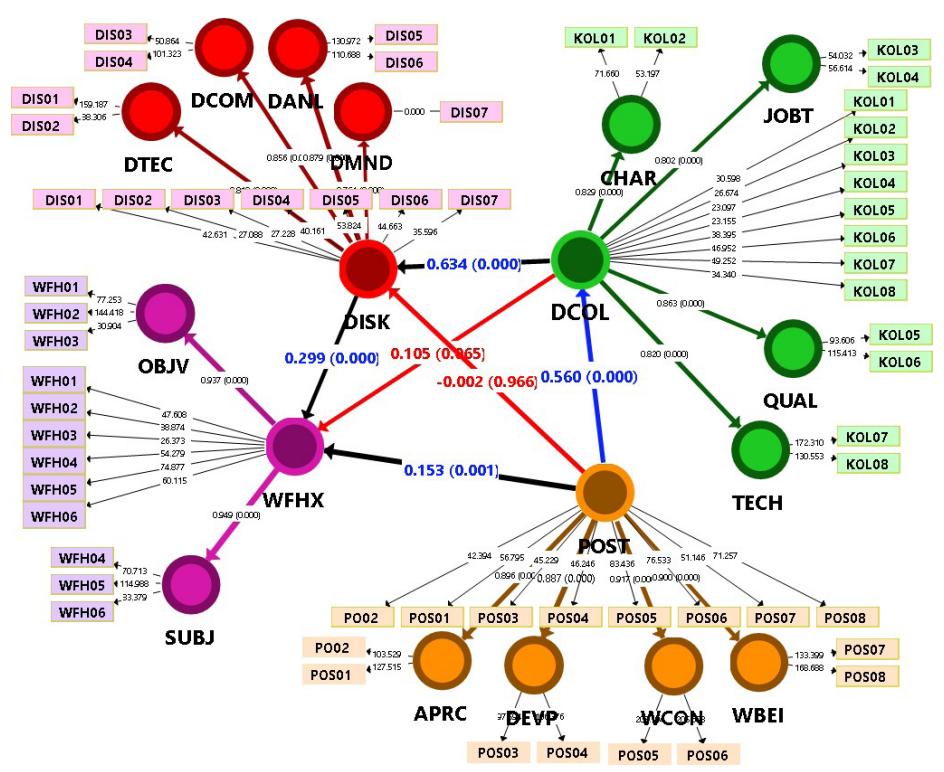
Figure 1 Tested research model
Because its path coefficient, with t-Statistics more than 1.98 or p-value less than 0.05, four out of six hypothesizes (H1, H3, H4, and H6) are accepted. It means that the path coefficients are not significant. There are significant impacts from one variable to others. Meanwhile, two hypothesizes (H2 and H5) are rejected. Because its path coefficients are not significant statistically. The paths have t-Statistics less than 1.98 or p-Values more than 0.05. The result of testing hypothesizes explains that work productivity is influenced significantly by digital skill and POS significantly. Digital collaboration does not influence work productivity significantly.
Table V Hypothesis Testing
| Hypothesizes | Path Coef. | t-Statistics | p-Values | Conclusion | |
|---|---|---|---|---|---|
| H1: | Digital Skill ==> Work Productivity | 0.30 | 5.84 | 0.00 | Accepted |
| H2: | Digital Collaboration ==> Work Productivity | 0.11 | 1.84 | 0.07 | Rejected |
| H3: | Digital Collaboration ==> Digital Skill | 0.63 | 15.64 | 0.00 | Accepted |
| H4: | POS ==> Work Productivity | 0.15 | 3.34 | 0.00 | Accepted |
| H5: | POS ==> Digital Skill | -0.00 | 0.04 | 0.97 | Rejected |
| H6: | POS ==> Digital Collaboration | 0.56 | 19.11 | 0.00 | Accepted |
The results explain that work productivity is affected positively and significantly by digital skills and POS significantly. Digital collaboration does not affect work productivity directly. It impacts work productivity indirectly. Digital skill is a mediator on the relationship between digital collaboration and work productivity. On the other side, POS also makes positive and significant impact on digital collaboration. Digital collaboration affects digital skills directly and then digital skills affect work productivity. POS impacts on digital skills indirectly, by affecting digital collaboration first, then digital collaboration affects digital skills. Digital collaboration plays a mediating role in the relationship between POS on digital skills.
POS as organizational factor may affect work productivity directly and indirectly. Because the direct impact (0.153) is higher than indirect impact (0.106), digital skills and/or digital collaboration are not mediated in the relationship between POS and work productivity.
This article strengthens the principles of organizational behavior theory that work productivity as behavior in the organizational context is affected by various factors, such as personal, group, or organizational factors. This article proved that work productivity is influenced by digital skills as personal factor. The ability of employees to utilize digital technology in terms of technical, communication, analysis, and mindsets will have a direct, positive, and significant impact on work productivity in conducting work from home as an alternative work arrangement.
Digital skill development for eliminating digital inequality among employees should be prioritized. Digital skill development may be boosted by facilitating digital collaboration as group factor on work productivity. The use of digital technology on certain job types and personal characteristics of employees is expected to improve the quality of work. Through digital collaboration, employees who conduct work from home as alternative work arrangement will experience a positive and a significant impact on their digital skill development directly.
Meanwhile, POS as an organizational factor has a direct, positive, and significant effect on work productivity. The organizations that provide a serious attention on appreciation, development, working conditions, and well-being of their employees will experience the positive impact on increasing work productivity if employees work from home. During working from home, they do not make a direct contact with their peers and do not experience the atmosphere or sense of "as part of the organization", in the long term, it was predicted that it will erode organizational engagement. Therefore, appreciation on contribution of the employees and attention on their well-being are something meaningful and impactful. On the other sides, commitment of the organization on development and working conditions will help employees to get the equal support for working from home as well as working from office.
Therefore, for maintaining or leveraging work productivity during work from home, the organization is suggested to pay attention on the four main dimensions of POS: (1) providing appreciation on contribution of employees from the remote locations, (2) development on digital skills and digital collaboration, (3) attention on the availability of digital resource at home as the standardized working condition, and (4) well-being of employees at home.
Conclusion
Work productivity of working citizen in conducting work from home is affected by digital skills and perceived organizational support. Digital collaboration affects work productivity indirectly. For maintaining and leveraging work productivity, the organization is suggested to pay attention to four dimensions of POS. By providing appreciation, development, working condition, and well-being for the employees; the organization will experience positive and direct impact on work productivity and digital collaboration.
For the future study, it is recommended to examine other influential factors such as working motivation, leadership of the superior, and performance management in the organization. Because there is digital inequality among islands in Indonesia, data collection should be proportionated and intensified, especially in Kalimantan, Sulawesi, and Papua for elaborating the difference result among the islands.
References
- Allan, B. G. M. (2018). Impact of the 21 ?? Century Skill (Collaboration Skills) on Students' Academic Performance in Nature of Statistics at Mukuba University. International Journal of Innovative Science and Research Technology, 3(7), 738–744.
- Allen, T. D., Golden, T. D., & Shockley, K. M. (2015). How effective is telecommuting? Assessing the status of our scientific findings. Psychological Science in the Public Interest, 16(2), 40–68.
- Attaran, M., Attaran, S., & Kirkland, D. (2019). The need for digital workplace: increasing workforce productivity in the information age. International Journal of Enterprise Information Systems (IJEIS), 15(1), 1–23.
- Bakker, A. B., Du, D., & Derks, D. (2019). Major life events in family life, work engagement, and performance: A test of the work-home resources model. International Journal of Stress Management, 26(3), 238.
- Baruch, Y. (2000). Teleworking: benefits and pitfalls as perceived by professionals and managers. New Technology, Work and Employment, 15(1), 34–49.
- Battistelli, A., Galletta, M., Vandenberghe, C., & Odoardi, C. (2016). Perceived organisational support, organisational commitment and self‐competence among nurses: a study in two I talian hospitals. Journal of Nursing Management, 24(1), E44–E53.
- Bikard, M., Vakili, K., & Teodoridis, F. (2019). When collaboration bridges institutions: The impact of university–industry collaboration on academic productivity. Organization Science, 30(2), 426–445.
- Bloom, N. (2014). To raise productivity, let more employees work from home. Harvard Business Review, January–February.
- Bosua, R., Kurnia, S., Gloet, M., & Mendoza, A. (2017). Telework impact on productivity and wellbeing: An Australian study. In Social inclusion and usability of ICT-enabled services (pp. 187– 207). Routledge.
- Dingel, J. I., & Neiman, B. (2020). How many jobs can be done at home? Journal of Public Economics, 189, 104235.
- Easley, R. F., Devaraj, S., & Crant, J. M. (2003). Relating collaborative technology use to teamwork quality and performance: An empirical analysis. Journal of Management Information Systems, 19(4), 247–265.
- Eder, P., & Eisenberger, R. (2008). Perceived organizational support: Reducing the negative influence of coworker withdrawal behavior. Journal of Management, 34(1), 55–68.
- Eisenberger, R., Huntington, R., Hutchison, S., & Sowa, D. (1986). Perceived organizational support. Journal of Applied Psychology, 71(3), 500.
- Felstead, A., Jewson, N., Phizacklea, A., & Walters, S. (2002). Opportunities to work at home in the context of work‐life balance. Human Resource Management Journal, 12(1), 54–76.
- Funes, J. M., Aguirre, F., Deeg, F., & Hoefnagels, J. (2018). Skill for tomorrow: How to address the digital skill gap. Policy, 3.
- Green, B. N., & Johnson, C. D. (2015). Interprofessional collaboration in research, education, and clinical practice: working together for a better future. Journal of Chiropractic Education, 29(1), 1–10.
- Gubler, T., Larkin, I., & Pierce, L. (2018). Doing well by making well: The impact of corporate wellness programs on employee productivity. Management Science, 64(11), 4967–4987.
- Henseler, J., Dijkstra, T. K., Sarstedt, M., Ringle, C. M., Diamantopoulos, A., Straub, D. W., Ketchen Jr, D. J., Hair, J. F., Hult, G. T. M., & Calantone, R. J. (2014). Common beliefs and reality about PLS: Comments on Rönkkö and Evermann (2013). Organizational Research Methods, 17(2), 182–209.
- Howes, J. C., Cropanzano, R., Grandey, A. A., & Mohler, C. J. (2000). Who is supporting whom?: Quality team effectiveness and perceived organizational support. Journal of Quality Management, 5(2), 207–223.
- Jennings, P. A., Brown, J. L., Frank, J. L., Doyle, S., Oh, Y., Davis, R., Rasheed, D., DeWeese, A., DeMauro, A. A., & Cham, H. (2017). Impacts of the CARE for Teachers program on teachers' social and emotional competence and classroom interactions. Journal of Educational Psychology, 109(7), 1010.
- Kazekami, S. (2018). Does teleworking improve labor productivity. 27th Eurasia Business and Economics Society Conference on January 11th.
- Khan, F. F. P., Mohammed, N., & Harith, N. H. M. (2018). The relationship between the impacts of telecommuting engagement and employee performance in oil and gas industry in Kuantan, Pahang. Malaysian Journal of Social Sciences and Humanities (MJSSH), 3(5), 1–9.
- Kim, H.-J., Hawley, J. D., Cho, D., Hyun, Y., & Kim, J.-H. (2016). The influence of learning activity on low-skilled workers' skill improvement in the South Korean manufacturing industry. Human Resource Development International, 19(3), 209–228.
- Kim, H. J., Hur, W.-M., Moon, T.-W., & Jun, J.-K. (2017). Is all support equal? The moderating effects of supervisor, coworker, and organizational support on the link between emotional labor and job performance. BRQ Business Research Quarterly, 20(2), 124–136.
- Kim, M. (2017). Effects of team diversity, transformational leadership, and perceived organizational support on team-learning behavior. Social Behavior and Personality: An International Journal, 45(8), 1255–1269.
- Kock, N. (2009). E-Collaboration: Concepts, Methodologies, Tools, and Applications: Concepts, Methodologies, Tools, and Applications. IGI Global.
- Kurtessis, J. N., Eisenberger, R., Ford, M. T., Buffardi, L. C., Stewart, K. A., & Adis, C. S. (2017). Perceived organizational support: A meta-analytic evaluation of organizational support theory. Journal of Management, 43(6), 1854–1884.
- Le, P. B., & Lei, H. (2019). Determinants of innovation capability: the roles of transformational leadership, knowledge sharing and perceived organizational support. Journal of Knowledge Management.
- Lynch, P. D., Eisenberger, R., & Armeli, S. (1999). Perceived organizational support: Inferior versus superior performance by wary employees. Journal of Applied Psychology, 84(4), 467.
- Lyubovnikova, J., West, T. H. R., Dawson, J. F., & West, M. A. (2018). Examining the indirect effects of perceived organizational support for teamwork training on acute health care team productivity and innovation: The role of shared objectives. Group & Organization Management, 43(3), 382–413.
- Maruyama, T., Hopkinson, P. G., & James, P. W. (2009). A multivariate analysis of work–life balance outcomes from a large‐scale telework programme. New Technology, Work and Employment, 24(1), 76–88.
- Maruyama, T., & Tietze, S. (2012). From anxiety to assurance: Concerns and outcomes of telework. Personnel Review.
- McKibbin, W., & Fernando, R. (2020). 3 The economic impact of COVID-19. Economics in the Time of COVID-19, 45.
- Motyl, B., Baronio, G., Uberti, S., Speranza, D., & Filippi, S. (2017). How will change the future engineers' skills in the Industry 4.0 framework? A questionnaire survey. Procedia Manufacturing, 11, 1501–1509.
- Nakrošienė, A., Bučiūnienė, I., & Goštautaitė, B. (2019). Working from home: characteristics and outcomes of telework. International Journal of Manpower.
- Onyemaechi, U., Chinyere, U. P., & Emmanuel, U. (2018). Impact of telecommuting on employees' performance. Journal of Economics and Management Sciences, p54–p54.
- Sasaki, S., Fukada, M., Okuda, R., & Fujihara, Y. (2019). Impact of organization and career commitment on clinical nursing competency. Yonago Acta Medica, 62(2), 221–231.
- Shin, N., Park, S. H., & Park, S. (2019). Partnership-based supply chain collaboration: Impact on commitment, innovation, and firm performance. Sustainability, 11(2), 449.
- Sorbe, S., Gal, P., Nicoletti, G., & Timiliotis, C. (2019). Digital dividend: Policies to harness the productivity potential of digital technologies.
- Troup, C., & Rose, J. (2012). Working from home: Do formal or informal telework arrangements provide better work–family outcomes? Community, Work & Family, 15(4), 471–486.
- Uhl-Bien, M., Piccolo, R. F., & Schermerhorn Jr, J. R. (2020). Organizational behavior. John Wiley & Sons.
- Van Deursen, A. J. A. M., Helsper, E. J., & Eynon, R. (2016). Development and validation of the Internet Skills Scale (ISS). Information, Communication & Society, 19(6), 804–823.
- Wren-Lewis, S. (2020). The economic effects of a pandemic. Economics in the Time of COVID-19, 109–112.