

INFO ARTIKEL
Kata kunci:
pekerja, Labour Process Theory, pengawasan, platform ojek daring, eksploitasi
ABSTRAK
Studi ini menganalisis proses kerja para pekerja angkutan umum daring (ojek online) dan kontrol oleh perusahaan platform terhadap mereka. Riset ini menggunakan Labour Process Theory (LPT) untuk menyelidiki proses dan control kerja secara kritis. Berdasarkan wawancara mendalam dengan pengendara ojek online yang bekerja di bawah Go-Jek dan Grab, antara Juni 2020 dan Juni 2021 di Yogyakarta, Kediri, dan Jakarta, riset ini menemukan bahwa para pekerja ditransformasikan menjadi komoditas dimana pasokan dan kebutuhan pekerjaan dimediasi oleh platform digital. Manajemen algoritsmis yang digunakan dalam industri ini memainkan peran penting dalam industri ini, termasuk penggunaanya sebagai point of production, dan mekanisme control dan pengawasan di tempat kerja. Penggunaan sistem feedback, rating, dan rating oleh platform sebagai konsekuensi dari pekerjaan emosional telah digunakan manajer untuk mengawasi para pekerja mereka. Lebih jauh, studi ini menunjukkan bahwa bentuk-bentuk pengawasan dengan platform merepresentasikan relasi kuasa yang tidak setara, yang melahirkan ketidakpuasan dan konflik. Kami berargumen bahwa proses kerja dalam pekerjaan ini menggambarkan "eksploitasi algoritmis" dimana perusahaan platform secara sengaja menggunakan teknologi dan memaksakan proses pengawasan atas kerja para pekerja untuk mencapai standar layanan yang tinggi, sementara para pekerja terjebak di dalam status ketenagakerjaan yang sangat lemah sebagai "mitra."
https://doi.org/10.5614/sostek.itbj.2022.21.2.5
Introduction
The emergence of sharing economy platforms transforms the business process from traditionally mediated to digitally mediated service delivery. This trend includes the operationalization of the ridehailing industry, such as Go-Jek and Grab. On the one hand, this industry continues to revolutionize urban transport in Indonesia. It has reached triple-digit growth in 2018 and offers a targeted GPS service that reduces travel time and cost, and is easy to ride than traditional motorbikes, ojek, and taxis (Cornock, 2018: 189). However, on the other hand, it offers weaknesses for the driver, such as poor job security and insufficient compensation for the operating costs (Shokoohyar, 2018, p. 96). This study questions the work dynamics of the workers during the crisis and the platform control strategy in the transportation service business and the delivery of goods.
This article analyzes the most relevant section of gig work in Indonesia by focusing on platformmediated food delivery and transport services. Application-based transportation services for motorcycle taxis, food delivery, and couriers are a type of technology innovation that differs from traditional motorcycle taxi services and product delivery. This type of work organization is an innovation from the traditional company organization in order to address organizational issues such as labor division and business integration (Puranam et al., 2014, p. 168). Go-Jek and Grab are Indonesia's two largest ride-hailing platforms, offering delivery services for passengers as well as goods and food through their digital ecosystem, matching and coordinating interactions between workers, consumers, and restaurants or shops while maintaining a flat organizational structure.
The growth of the new labor market workers is accompanied by expanding jobs as a driver in the ride-hail sector. In 2016, the transportation sector, especially online transport, helped to absorb 9.78% of the workforce (Afrina et al., 2017, p. 43). This business offers attractiveness to the workers. Based on the results of a survey conducted by Perkumpulan Prakarsa to online motorcycle taxi drivers in 2016, it was stated that the three highest reasons for drivers to join the ride-hailing platform were flexible time (24.2%), followed by reasons for seeking additional income (19.2%), and high bonuses (10.9%) (Afrina et al., 2017, p. 46). The flexibility and autonomy to the worker have been highlighted as a vital advantage of the sharing economy scheme (Newlands et al., 2018, p. 2) and simultaneously pursuing other activities (Shah & Tripsas, 2007, p. 133).
However, the issue of flexibility, which is a compelling motivation to become a driver, must be measured against the industry's challenges. This type of platform raises difficulties such as the blurring of workers' identities as partners in an established contractual relationship as well as the inhumane employment allocation approach utilizing an autonomous computer system. Contractual connections are blurring organizational borders, while job allocation mechanisms are becoming increasingly cruel using computer systems that run independently (Isbah, 2019, p. 230). Workers are designed to be "just-in-time" workers who are compensated on a "pay-as-you-go" basis; in other words, they are paid only after they have completed the assignment for a client (De Stefano, 2015, p. 4), rather than having a permanent or long-term job (Vallas, 2019, p. 53). The income received by the driver depends on how long they work on the road.
The relationship between the platform and the driver as a partner relationship and not as a worker and employer, makes the platform party the beneficiary. Companies classify workers as self-employed because of the worker status's ambiguity (Isbah, 2019, p. 233; Todolí-Signes, 2017, p. 194). Veen et al. (2020, p. 2) assume that the structured employment contract relationship via triangular or non-standard participation in the sharing economy scheme transfers workers' economic risks to workers, where workers must contribute to provide production assets to participate in the production process. Consequently, workers are frequently excluded from job protection, are underpaid, have little guarantees to continue working, and face employment insecurity (Forde et al., 2017).
Over the last decade, scholarly studies have been attracted to discuss digital platform jobs. They have discussed the history of this business model and its position in the capitalist economy (e.g., Vallas, 2018), the emergence of the "partnership" concept in employment relations (e.g. Cherry & Aloisi, 2016; e.g. Malos, Lester, & Virick, 2018), and "the governance gap" between existing regulation and the changing nature of work and its consequence for the welfare of workers (e.g. Collier, Dubal, & Carter, 2018; Natour, 2016; Stewart & Stanford, 2017). To the best of our knowledge, there has been no study focusing on the labor process with particular attention to the way algorithms operate and their consequences for workers.
This paper examined the process of capital-labor interactions and the managerial and work organization practices imposed by digital platforms, as well as to comprehend the platform's role in the commodification of power. LPT investigates the "conversion movement" that changes labor into a commodity to provide explanations for managerial and supervisory methods enforced by digital platforms and the role of technology and digital data in the transformation of work into a commodity (Gandini, 2019, p. 1040). As a result, this paper investigates the labor-capital interaction in apps based on the online motorcycle taxi, with a particular focus on Go-Jek and Grab operations in Indonesia. LPT can integrate many aspects of employment, labor and industrial relations, and the proclivity to oppose fragmentation (Thompson & Smith, 2009, p. 916). Furthermore, the LPT contains a theoretical narrative of job deterioration resulting from new forms of capitalist production and administration (Thompson & Smith, 2009, p. 916).
We argue that the labor process in this job resembles what we coined "algorithmic exploitation," which means that the platform companies are deliberately using technology and obscuring the control process over the operations of the workers to instill high standards of service, while the workers are trapped in a very weak employment status as "partners." Furthermore, the use of feedback systems and ratings represents an unequal power relationship, which weakens the bargaining position and welfare of the workers.
Method
This qualitative research draws on in-depth interviews with at least fifteen motorcycles taxi drivers, Go-Jek and Grab drivers, who operate passenger ride-hailing and goods/food delivery services in Yogyakarta, Kediri, and Jakarta. The primary data were collected by conducting face-to-face semi-structured interviews using open-ended questions. The data collection is conducted with careful attention to the health protocol of the pandemic COVID-19 between June 2020 and June 2021. The author was unable to pick gender-based interviews due to the COVID-19 pandemic and large-scale restriction measures, such that all informants were drivers for men. All interviews were audio recorded and afterwards transcribed with the agreement and consent of the participants.
The selection of the three different cities is expected to contribute to a broader knowledge of the topic of the research debate. All the cities within our investigation conformed to the policy of large-scale social constraints (PSBB/ PKM) over time. The decision of the city of Jakarta was owing to a policy of
PSBB that had an extremely remarkable impact, combined with the high cost of living in the capital city, on closing offices and educational facilities. The pandemic has had a major influence on the Yogjakarta tourist and education business, where both sectors play a leading role in online drivers. Although living costs are inexpensive in Yogjakarta, research must be undertaken across the city to provide broader results. Finally, Kediri city was selected to provide an overview of a neutral city, where the living costs of the town is affordable, with no excessive influence of the pandemic on schooling, business, and tourism.
Labour Process Theory: A Conceptual Framework
Labour Process Theory (LPT) is concerned with the organization of work, as well as the creation and distribution of profits. LPT critically examines the antagonistic relationship between capital and labor (Thompson, 1989), and the challenges of converting labor into profitable employment (Marx, 1887, pp. 187–188) and related managerial tactics for regulating labor processes (Braverman, 1998). Work processes can be traced back to the struggle for autonomy, and they can be opportunistic or even supportive of managerial objectives (Heiland, 2021, p. 5). Control and resistance have a dialectical relationship, and 'various types of conduct are typical artifacts of various administrative regimes' (Ackroyd & Thompson, 1999, pp. 74–75).
The labor process, as defined by Marx's political economy, is a transformation or conversion movement in which workers' labor-power is used to carry out the production process to produce concrete commodities or services containing use values and exchange values for the benefit of employers or capitalists (Smith, 2015, p. 224). The concept is utilized to establish a viewpoint that blends interests in employee behavior, employment relations, job design, and organizational organization (Watson, 2011, p. 69). In the capitalist system, work is supposed to be primarily exploitative in terms of extracting "value" from workers, with managers/employers demanding continual attention due to the capital invested in enslaving labor to derive maximum advantage from it (Watson, 2011, p. 69).
LPT can be applied to the sharing economy in a variety of ways. LPT provides several tools that can be used to analyze various forms of capital appropriation, including the use of digital technology as a mechanism of control and monitoring in the workplace (Chai & Scully, 2019, p. 946). Gandini (2019) selects deskilling and emotional labor as concepts that can assist people realize their limited options for progress and coping mechanisms.
How does control help to understand labor? The company must control workers to ensure they do as is instructed. Company requires people to transform raw materials into finished goods with added value using production tools. The capitalist uses labor, tools, and capital to make a profit in a capitalist society. The employee-employer relationship is adversarial. Workers want higher pay, job security, better working conditions, and career advancement; employers want to maximize profit through labor productivity and efficiency (Orakwue et al., 2006, p. 16). Conflict of interest is key to understanding labor management rules in employment partnerships.
According to Labour Process Theory, one of the primary priorities of management in the capitalist economy is labor. Management works to convert workers to productive activity and to allow the extraction of surplus value through its hierarchical control structure (Reid, 2003, p. 564). In labor analysis, the most important question is how management translates work potential (labor power) into work effort (labor) (Reid, 2003, p. 564). As a result, in the capitalist system, it is vital to govern the working relationship between workers and bosses. According to Edwards (1979, p. 17), control is the power of management of the firm to force employees to operate in the manner intended by the organization. These controls will be adjusted based on the relative strengths of employees and employers (Reid, 2003, p. 564).
LPT analysis enables us to critically assess the labor-capital relations within capitalist industry, notably in terms of control, resistance, and exploitation (Smith, 2015, pp. 225–226). In this way, LPT reaches out under institutional and formal patterns to find and investigate the hidden or informal domains of industrial relations and workplace conflict in workplace research (Thompson & Smith, 2009, p.
916). Because of the considerable autonomy of the labor process in capitalist production, there is still confusion about how structural elements affect the outcome of the labor process (Veen et al., 2020, p. 4). The relationships that appear on the production surface result from several logics that emerge from concepts like involvement, historical associations, and other contextual elements (Knights & Willmott, 1990, p. 126). While LPT emphasizes the production connection as a focus of analysis, it allows academics to examine the labor-capital battle for labor extraction, profit distribution, and the demand for reproduction while also putting workers and their experiences at the analysis center (Smith, 2015, p. 224). In conclusion, LPT can be utilized as an analytical and empirical instrument to maintain historical interest in the dynamics of employment relations and the interaction between the workplace and the more extensive social system (Thompson & Smith, 2009, p. 916).
Gandini (2019) examined three characteristics as part of the labor process tradition, which allow for a closer examination of some of the most intriguing (and problematic) aspects of the sharing economy platform. In terms of the first element, the point of production is a mainly structured and controlled workplace environment with a predetermined set of rules and a sequence of hierarchical administrative connections (Thompson & Smith, 2009, p. 918). On the other hand, Gandini (2019, p. 1044) contends that labor-process research can be broadened by incorporating information and communication technologies in satisfying work from a single physical place and extending work to any site with communication facilities. The platform in the sharing economy system leverages digital-based production as a channel for linking actors and converting it into a production relationship (Gandini, 2019, p. 1044). The platform's presence as a mediator, whose purpose is to connect meetings or work between consumers/tenants and workers, has resulted in a non-standard working relationship. As a result, the platform has served as an environment in which the capital-labor connection is activated over workers, as well as a location where the social process of production is brought under the logic of managerialization and work for an organization in a single, clearly delimited setting (Gandini, 2019, p. 1043).
Second, Gandini (2019, p. 1047) further claims that the gig economy platform has regulated social interaction between emotional labour, the platforms, and consumers through the use of feedback, rating, and ranking systems. These systems perform, particularly feedback and rating systems, quality assurance purposes, which has a substantial impact on a person's salary and prospects to continue working (Gandini, 2019, p. 1046). For example, to receive a high rating, personnel must give the most satisfactory service possible while also exercising emotional control by presenting themselves professionally following the firm's demands. As a result, gig economy workers, particularly those in the ride-hailing business, are intimately associated with emotional labor.
Emotional work is described as regulating feelings by putting on a public face and body to obtain a reward (Hochschild, 1983, p. 7). Employees use their dynamic work systems to manipulate the emotions of others to attain work objectives. Emotional workers, such as online motorcycle taxi drivers, insist on always behaving favorably in their encounters with customers to win customers' hearts and obtain positive reviews. Platform corporations impose control on personnel by using a rating system in which passenger or customer ratings are utilized as performance evaluations. The firm will assess drivers with poor ratings for their performances, and their accounts may be disabled if their ratings are meagre. A rating system functions as a behavior management tool because it is designed to encourage positive behavior among drivers (Lee et al., 2015).
Third, the use of feedback, rating, and ranking systems as a form of management control is used to evaluate the performance of its employees (Gandini, 2019). The LPT offers many instruments that can be used to investigate forms of capital appropriation that occur outside traditional workplace definitions and in which digital technologies are employed for workplace control and monitoring (Gandini, 2019, p. 1043). LPT examines how capital attempts to represent and govern labor from an economic platform, using direct, labor, normative, and computer controls (Veen et al., 2020, p. 4). These controls have a proclivity to be used in complementary, interconnected, and blended ways (Thompson & van den Broek, 2010, p. 4). For example, in many sectors, computer control is utilized as a consistent technique by employing software to automate numerous management dimensions such as directing, monitoring, or evaluating personnel in the workplace (Elliott & Long, 2016, p. 1). Similarly, normative controls must be considered alongside other rules because all control procedures have a normative dimension (Veen et al., 2020, p. 4).
Results and Discussion
Our examination of the work processes of the two platforms, Go-Jek and Grab, indicated that while they are extremely similar, there are minor variations in their work processes. The platform's control regime is built around three unique features: technological infrastructure, intentionally created information asymmetry that limits workers' options, and the obscured nature of performance management systems. As a result, a highly uniform service with a geographically scattered workforce is produced. Despite the limitations of workers' abilities to alter the work process, an expression of the agency was discovered.
The Point of Production
The main factor in ride-hailing platforms is application use. The program is utilized as a point of production for completing tasks, social interaction between all parties, both workers, and third-party platforms, as well as monitoring and controlling performance instruments for employment (Gandini, 2019, p. 1045). The application facilitates the processes of registration, work, and communication for employees (interviews 1, 2, 3, 6, and 8). The platform's role is to provide an integrated framework for these operations (Gandini, 2019, p. 1045).
Registration
The registration process to become a platform partner has several stages. The first step is to register potential partners using the online registration application displayed in Figure 1. The registration quota for prospective driving partners is not limited; these barriers are determined by the service needs of each region (Annur, 2019). There is no provision in the cooperation agreement for collecting registration fees from the platform. The driver-partner must, however, pay for the company's qualities in the form of their partner's helmet and jacket, which can be paid in instalments by reducing the driver's daily revenue (Interviews 1, 2, 4, 6,7).
Figure 1 Go-Jek and Grab System Online Registration Screen
The requirements set by both platforms are fairly simple. Neither platform requires any special abilities nor qualifications. The examination was only conducted on the background of prospective drivers related to criminal records, examination of driver license ownership, and age requirements for transportation modes (interviews 1, 4, and 7). The last step the partner must take is to install the platform app, which will be utilized as a production tool for the driver's work. The app is used to manage all processes in manufacturing, communication, and control.
The incorporation of technology into the workplace has attracted a younger workforce. Because of their proficiency with electronics, younger age groups dominate employment in the online transportation industry (Kamim & Khandiq, 2019, p. 63). They frequently cite flexible working hours and liberty in choosing working hours, a desire for additional cash, and a high income as justifications. Because it fits within their work schedule, some drivers initially pursued this vocation as a supplement to their regular job. Anshori, a Go-Jek driver from Kediri City, said,
"… my prior employment was in auto sales and leasing; the reason for switching to Go-Jek driver was (when worked at previous job) stress, lack of time, and inability to do anything else..." (interview 1).
Meanwhile Arief, a Grab driver from the city of Kediri said,
"I've been with Grab for a long time, but I only started working (on the side) in 2017. I tookit since there was a staff reduction. I used to work in the private sector, and Grab was simply a sideline, but there were less employees due to the pandemic. And now, beginning in 2020, I'll be working full-time on Grab." (Interview 6).
Getting orders
The apps used by Go-Jek and Grab drivers are considered the 'point' at which the labor process occurs, because the platform facilitates encounters between workers and consumers through that application. When drivers make themselves available to consumers or clients to undertake labor, they log into an app. Using management algorithms, as shown in figure 2, the platform organizes their activities, finds customers, and compensates them for their efforts. As a result, in this setting, social relations of production take place only with the platform and not with outsiders.
Figure 2 Screenshot of Order in the Go-Jek and Grab System
The selection of consumers and types of work will be carried out by the platform itself based on algorithmic elaboration that is specifically inaccessible to workers (Gandini, 2019, p. 1046). Workers are unable to intervene in the algorithm's calculating process and can only accept or reject job offers from the site (interview 1 & 6). When the driver activates the application to receive a ride request, delivery order, or purchase of products via the system, the application notifies the driver of the destination and fare. The driver has only a few seconds to accept or reject the request. The decision to refuse the order will affect the driver's rating. According to Galih from Kediri, East Java, who has been with Grab since 2017,
"When my cell phone rang, indicating that there was an order, then I accepted all of the orders, even though they were far away, because refusing the order will affect my rating" (Interview 7).
When there is an issue with the application when obtaining a work order, technical problems with the application itself, or the means of communication between the driver, the platform, and the customer will be handled using the application's chat function. The most common chats that drivers have with customers via the app are about order problems. Anshori said
"…the chat feature is most often used to ask questions regarding the customer's position or to make sure the order type is appropriate or not. Sometimes when there is a traffic jam or the restaurant has a delay in preparing food, we will inform the customer through the chat feature. Problems like this happen quite often, and the (Chat) feature is very helpful" (interview 1)
Furthermore, the COVID-19 pandemic has affected work with reduced service orders and some customers prefer not to have a direct contact with drivers regarding food ordering services. Hari said
"Since the covid pandemic period, we leave food orders (from customers), we leave it at the door, so we don't have to make a direct contact with customers, and we just tell them that the food has been delivered, then we leave" (Interview 4).
Evaluation
Driver assessment is a very important thing to pay attention to because it affects the continuity of work for the driver concerned. A high rating can affect how easy it is to get orders, while a low rating can lead to the termination of partner relationships. As a result, drivers are required to maintain their rating so that it does not deteriorate. The parameters that must be met for the driver to keep his rating or performance include no driver cancellations, no order rejections, and constantly responding to requests.
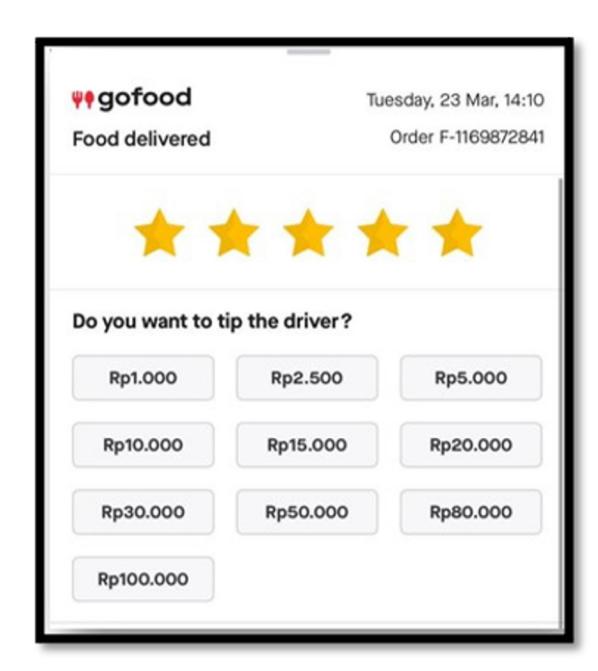
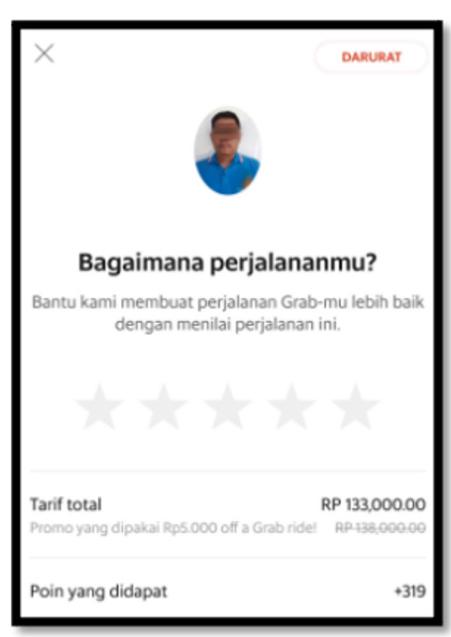
Figure 3 Screenshot of driver's rating in the Go-Jek and Grab system
The assessment of the driver is dependent on the evaluation of the consumer. The platform's algorithm system automatically calculates the assessment based on the total number of orders executed via the driver application. The rating, or star scale, ranges from 1 to 5, as it is shown in figure 3. The maximum rating of 5 indicates that the driver has an excellent predicate. In terms of the 1-star effect, Gojek has been suspended or disconnected from partners. If the rating is less than 4, the driver will be issued a warning and suspended. The driver provides bad service, according to the platform's code of ethics. If this persists, employment will be terminated.
Emotional Labor in Gig Work
Working as an online motorbike taxi is a service career that involves serving consumers. Driver activity is frequently performed by workers on a service employment basis, referred to as "emotional work" (Hochschild, 1983). Emotional work, according to Hochschild, is a process in which employees are required to control their emotions by following organizationally determined standards and guidelines (Sersia & Singh, 2020, p. 94). The nature of work has changed a worker's emotional life to meet employer and customer expectations. After the trip, social interaction is limited and the driver's friendliness stops, so it is important to boost their rating.
In this subsection, we show how feedback, ranking, and rating systems regulate social relationships between workers and consumers/clients on the Go-Jek and Grab platforms, embedding an emotional type of work at the heart of the work process. Each driver's performance is evaluated by the company. Online motorcycle taxis use ratings, unlike traditional ones. Passengers rate drivers on service and behavior. Lower ratings indicate deteriorating service and dissatisfied customers. The number of orders is influenced by the rating system, including consumer feedback on driver services. Drivers must maintain emotional control to earn positive customer feedback. Drivers must be polite to customers. This is the driver's partial compensation for the platform's failure to communicate the driver's evaluation function to passengers (Rosenblat & Stark, 2016, p. 3775). Drivers must control their conduct and words, even when dealing with harsh customers, according to our respondents. Unintentionally, the driver must meet company service standards (Fatmawati et al., 2019, p. 40). Indirectly, they have entered the "game rating" (Chan, 2019) system, where a driver's rating affects work continuity. As Andi said,
"…actually, we have been given training on how to behave in front of customers, and when completed (the tasks) we will say thank for using the service and remind them to give five stars (through the application). Because it affects on my high rating and ease of getting orders (in the future)" (Interview 10).
Many factors outside the driver's control can affect the driver-passenger interaction, complicating the rating system. Drivers must do more than get customers from A to B; they must also be pleasant. Customers' reactions to good service can vary. This sometimes raises questions about a failing grade. Drivers have little control over traffic or their customers' moods, so they must rely on their bodies and emotions in an uncontrollable environment. Ikhsan had the worst experience, receiving a rating of two because his jacket and passengers' helmets smelled of the sun and a rating of one for being late due to traffic (interview 8).
As previously stated, the rating system is required for drivers working on the Go-Jek platform to make it easier to obtain orders. The rating system on the Grab platform has little influence in determining these priorities. However, if the driver receives a low score (1 star) or a negative comment, it can be fatal, resulting in a temporarily suspended or ended partner relationship. As a result, in addition to being responsible for the safety of passengers or products, drivers must be able to respond to the social and emotional needs of clients. Due to the expectation that each customer will rate the driver using the Go-Jek or Grab application, the drivers have expressed a perceived need to meet their customers' social and emotional requirements (Raval & Dourish, 2016, p. 99). Working as an online motorbike taxi prioritizes customers, and it is critical to capture the hearts of customers through excellent service. As a result, emotional labor may act as a link between perceived behavioral control and job satisfaction within gig economy workers.
Labour Control
Both platforms employ the same approach and management mechanism to ensure that the hiring process operates successfully. At least three control elements that emerged from the interview data are: control technology infrastructure, information asymmetry, and the obscured nature of the performance management system.
Control Technology infrastructure
In ride-hailing, computer control ensures everything is controlled as required by the platform. Management controls employees through applications that use algorithmic management (Ens, 2019, p. 3). The control contains GPS data from drivers' phones, worker-app interactions, and consumer ratings (Veen et al., 2020, p. 9). Geospatial GPS data informs consumers about their locations and destinations, helps with navigation, and monitors workers in real time during work execution (Veen et al., 2020, p. 9). This makes the driver's work process transparent to the organization, allowing tracking of measurable indicators like average speed and time spent performing duties. Go-Jek and Grab track drivers with smartphone apps. Digital apps use "algorithmic management" to regulate the digital workforce (Wood et al., 2019, p. 62). The app tracks all driver and customer services and cancellations. The program will also notify the driver if they fail to heed safety concerns, such as exceeding 50 km/h (interviews 1 and 7).
Go-Jek and Grab have added features to protect driver-partners from digital security threats since 2020. Go-Jek and Grab use face verification when a driver logs in, when a driving partner activates the app, or when they respond to platform requests. The platform secures partner accounts to prevent thirdparty use. The platform protects passengers from the identity of the driver who will take them to their destination (Go-Ride and Go-Car) or deliver food (Go-Food) (Go-Send). Face-verification logins are the solution to Go-Jek driver-partner account abuses. Buying and selling, leasing, or borrowing accounts is prohibited on the platform because the driver manipulated driver-partner account data without knowledge. Go-Jek's Face verification is an effort to prevent this from happening before they start working.
In addition to face verification, the platform requires partners to fill out health declarations and validate masks before initiating activities. Driver-partners will receive a daily checklist of practices, such as checking body temperature, washing/disinfecting cars, washing hands, keeping a distance, and wearing masks (interviews 1, 7, and interviews 10). This measure ensures driver safety.
The platform requires partners to use masks correctly during their activities by using the mask verification tool. Masks are essential for suppressing coronavirus. Partners must wear masks and face the camera to validate mask use. Partners must verify orders before fulfilling consumer needs. Per Anshori,,
"If on Go-Jek, facial verification is almost done every day but not routinely, occasionally if you change devices, you are generally requested for face verification every 3 hours, but if the cell phone is fixed, (face verification) is only done once. However, if the mask verification is performed in order (turning on the application). So, if youswitches off the application and then reactivates it, you must verify the mask again." (Interview 1)
Go-Jek driver Heri also conveyed the same thing from Kediri,
"If there is no corona like currently, there is no obligation to wear a mask and monitor your body temperature like that every morning when you want to go on (the application), and a facial verification will be done randomly depending on a request from the firm." (Interview 5).
The platform has gaps in its controls for protecting partner data. This gap is shown by impostor accounts or non-partner accounts. Both Go-Jek and Grab's face verification can be bypassed. The first method uses a photo of the account owner as a face mask. Because verification takes time, the second
option is to find the account owner. When face verification is requested, the impostor driver can find the account owner (interview 3). The Go-Jek app doesn't recognize face masks well. The program can distinguish between the original owner's face scan and a face mask (interview 2). The Grab platform's face verification program can distinguish between real and mask faces (interview 7). In addition, the penalties for drivers caught wearing a face mask are harsher than on the Go-Jek platform: suspension (interview 6).
The response to this algorithm-based workforce control is highly ambivalent. Some drivers agree with the algorithm's control rules since they are more comfortable with the engine's operation and do not need to be watched by their superiors (interviews 2 and 4). Many other drivers, on the other hand, believe that algorithmic management makes it harder for them. They feel that they are both under surveillance. The difference is that if they use the system, they do not need to interact with humans directly (interview 1).
Another distinction between direct human and machine supervision is that application supervision is more rigorous, while human supervision still takes humanity into account in determining decisions (interview 6). Control and coordination responsibilities previously performed by a human supervisor have been taken over by the application system. Because the system simply provides contextual information, there is typically limited explanation of an issue or how each decision is made.
Information Asymmetry
Information asymmetry is purposefully produced as a sort of control mechanism from management to workers to impact the work process. When one party has more knowledge than the other about the goals of the activity and the quality of the goods or services exchanged, there is information asymmetry (Dehlen et al., 2014, p. 195). The platform gathers data from the entire ecosystem, which is then utilized to uncover patterns and build and deploy learning algorithms for platform governance and management (Choudary, 2018, p. 10). The workers do not have access to information about how the algorithm system is built, putting them at a disadvantage. This data is used by the platform to boost revenues by optimizing their workforce to satisfy customers at the expense of workers. The Platform can create a system with restricted information that drivers can access as they see fit. The platform creates this information asymmetry in order to enable "soft control" over workers' routines (Rosenblat & Stark, 2016, p. 3761) and restrict workers' free agency by limiting them from accessing information that might assist them in making service selections (Choudary, 2018, p. 10).
The distribution of work obtained by drivers is an example of the platform's asymmetric information practices. Due to a lack of expertise or information on how to obtain an order, drivers frequently inquire whether orders are provided based on proximity or ratings. As Arief previously stated, he had no idea how job orders on the Grab platform were received (interview 6). Furthermore, as Heri discovered, obtaining an order swiftly should be accomplished by halting somewhere or by continuing to move (interview 5). Even if they decide to wait in one location and there are several riders in one location, the system cannot discriminate and identify who arrived first to be selected to receive the order. As a result, there is a requirement for information openness or an agreement on a fair mechanism between the platform and the driver.
The information asymmetry is purposefully constructed as a type of control mechanism in the work process to avoid partners from just choosing activities that they consider profitable.
The Disguised Performance Management System
The platform's performance management system is yet another method of controlling the workforce. This type of system is an example of techno-normative control over employees. This control is demonstrated in two ways: customer management and the application of gamification methods (Gandini, 2019, p. 1049).
The feedback, ranking, and rating system is a type of "customer management" control that the platform employs as a tool to evaluate the performance of emotional employees (Gandini, 2019, p. 1049). The system proposes normative control because it aims to covertly instill corporate behavior through worker norms. This method separates good from mediocre performers. The system codifies and records actions taken against platform partners to establish partner behavior patterns and abuses (Choudary, 2018, p. 5). Every time a transaction is completed, the platform invites the customer to rate the driver-partners' service. Positive feedback will help partners acquire clients more easily, while negative feedback will do the opposite. On other platforms, the rating/reputation system is used to identify bad partners without rewarding good ones (Choudary, 2018, p. 5).
The platform's rating system has ramifications for the workers. Provisions for granting market access to partners who meet certain requirements will generate a positive feedback loop for partners, with increased job possibilities leading to greater services provided by drivers. This mechanism is an important element of a meritocratic market system that can help platforms identify and retain the finest employees (Choudary, 2018, p. 5). Meanwhile, if worker performance falls short of a predetermined norm, the platform will impose sanctions on the drivers (Duggan et al., 2019, p. 119).
There are system differences between the two platforms, Go-Jek and Grab, resulting in differing labor process dynamics. Go-Jek employs the "Performance History" function, which depicts partner performance over a one-month period (BangJek, 2020). The platform uses this feature as a benchmark when receiving orders in the order distribution system via a priority mechanism. Drivers will be given priority for orders based on their excellent performance ratings. The ease with which orders can be received and the quantity of daily bonuses available to Go-Jek drivers are influenced by Go-Jek performance indicators. Several elements determine the high-performance value or driver rating, including accepting incoming orders, order rejection and cancellation, and consumer ratings (interview 1).
The second type of control is one that employs "gamified" methods geared toward encouraging the best in each individual in order to boost the creative disposition of workers (Gandini, 2019, p. 1049). The platform produces jobs that are referred to as "missions" for drivers to perform, much like a game, and workers will go to any length to complete missions. If the mission is successful, the corporation will generate a new mission for the driver, and so on. It is similar to a strategy game in which the player must work hard to complete the mission.
Gamification can also cause worker problems. Burawoy (1979) defines labor process as a game in Manufacturing Consent: Changes in the Labor Process under Monopoly Capitalism. Gamification is a process in which employees create their own rules (often in the form of personal goals) to motivate themselves and reduce the stress of following company regulations (Kamim & Khandiq, 2019, p. 63). Setting a personal goal may motivate workers to work harder to meet the next goal. All company regulations are converted into points, tasks, targets, or other forms to increase employee control. Moreover, gamification can be used to retain workers, as drivers who work below a predetermined target or receive a low rank will receive fewer orders and be replaced (Hidajat et al., 2021, p. 242). Due to the considerable number of drivers and desire for bonuses, they must compete for passengers. Some rogue drivers commit fraud to get passengers and meet targets. Fraudulent drivers use a fake GPS and fake orders (interviews 1, 6, and 7).
Some platforms disguise performance evaluation as labor control. Grab does not exploit a high rating's performance function to get more orders. The Grab job allocation system favors the driver who is closest to the order (interview 1) and uses the app most often (Interview 6). Some Grab drivers object to job distribution based on the closest system because it equates the online motorcycle taxi system with the traditional one. Instead of looking for passengers, the system encourages drivers to wait in urban areas, malls, or restaurants. The Grab rating system has minor impact on order ease. As Arief stated,
" ...if the system is on Go-Jek, the convenience of getting an order is determined by the best rating within a 5 km radius, but if the system is on Grab, even if the rating is good, the closest one is still
chosen. I'm also unsure what ranking is utilized for. Yes, perhaps when Grab receives an order, the closest one is chosen first, followed by the one with the highest rating..." (Interview 6).
Ikhsan, Grab's driver from Yogjakarta went on to say,
"With the rating system, it shows that the driver is a good driver, but if you use the closest system, even bad drivers can do order. It is more optimal for servicing the customer if the rating is considered" (Interview 8).
Grab's performance appraisal method excludes customer ratings, demonstrating that "customer management" is not a general aspect of the platform economy (Gandini, 2019, p. 1049).
The platform's rating mechanism, which is viewed as a tool to create and strengthen the platform's trust and responsibility, has another impact on job opportunities. Consumer comments, complaints, and ratings might diminish the driver's performance value. The platform responds quickly to consumer concerns and frequently fines the driver without any prior clarification or explanation. Drivers risk is being "punished" by being suspended or permanently removed from the system if they regularly cancel unprofitable orders and get client complaints. This problem was reported by drivers in all the places where we conducted the study. For example, Irfan, a Yogyakarta Go-Jek driver, said that,
" I had an incident with a code of ethics notice that resulted in me being suspended for three days. The code of ethics is a protest of not wearing a mask. Even though I wore it at the time, and when it poured, I also donned the mask. When it comes to issues like that, Grab is adamant. Only the customer are prioritized. Finally, I couldn't work for three days" (Interview 9).
Meanwhile, Andi, a Go-Jek driver from Jakarta, recalled
"Upon receiving an order for food, the location was far away, the queue was long, and the customers were occasionally impatient. We are in a rush when we use the Go-Jek system, which automatically picks up drivers from a long distance. If it's already got a bad rating for long waiting time because of the previous driver or the driver had stopped to work, a negative rating is given, and the following day's order is usually reduced. Normally, you can obtain 15 orders every day, but now you only get 5" (Interview 10).
There is a distinction between the treatment of drivers who are suspended by Go-Jek and Grab. Go-Jek drivers can still file an appeal to reopen the suspension by visiting the corporate office at the registered branch and offering clarification. If clarification is received, the account will be reopened, and the driver will be able to resume his duties. If, on the other hand, the clarification is not obtained, they must face a suspension or, in the worst-case scenario, the termination of the relationship. Meanwhile, the Grab platform is not covered by the appeals procedure. The company does not explain or clarify the mechanism when the driver gets a complaint or one star from the customer. As explained by Arief,
"If the appeal is in Go-Jek, the Grab platform still doesn't pay more attention to the driver. Go-Jek has an appeal system, so if there are bad ratings they can explain to them. The driver in Grab is at a loss since the drivers are bewildered (to explain) and who are they going to complain to (when there is a problem like this)?" (Interview 6).
As a result, drivers must work and be extremely cautious when serving customers to avoid receiving negative ratings or complaints that can affect them.
Alienation of the Work Process
Marx's notion of alienation focuses on controlling the working process, the structure, and the quality of the process (Stanfield, 1979, p. 295). The algorithmic control utilized by the platform as a tool to link tasks from the platform to the worker demonstrates the worker's helplessness. As a result, the status of the connection as a partner can be called into question. On the contrary, the platform maintains strong control over the workforce. Non-standard work arrangements were linked to driving partner work, as evidenced by lower worker autonomy and worse mental health (Glavin et al., 2020, p. 18).
Online transport employment procedures are tricky. This approach does not equate ojek drivers with the organization; therefore, companies' policies often come unilaterally and are not transparent. This condition is due to the company's online workforce's employment concerns not referring to work agreements regulated by the Indonesia Job Creation Act. A working arrangement is not a partnership but a job agreement between the company and the motorcycle taxi drivers. Because of the partnership relationship, the workers have no bargaining power against the company.
The partnership agreement enforced by the app company leaves the driver and his/her family having to deal with work-related risks on their own. This partnership exempts companies from the obligation to meet minimum wages, overtime pay, social security (health, pensions, and employment), and religious holiday allowances (THR).
The company claims that the concept of partnership in the economic ride-hailing sector can support a work paradigm that provides partners the opportunity to select working hours and become independent, different from traditional forms of work. However, as it is usual in the interaction between workers and management, the application company controls the drivers. The algorithm management distances the worker from the platform.
This control function is meant to penalize the conductor, requiring him to operate more rigorously, over longer durations, and more difficult.
The principle of a partnership relationship is a relationship that adheres to the principle of equality between the parties concerned. Individuals, organizations, or institutions that are willing to form partnerships must pay attention to the principle of equality, or equal position with others in achieving the agreed goals, along with the principle of openness. In addition to the principle of mutual benefit, individuals, organizations, or institutions that have established partnerships benefit from those partnerships following their respective contributions. However, driver participation is infrequent and therefore, it is not accommodated.
The corporation promotes labor exploitation under the rhetorical frameworks of freedom, flexibility, and partnership. While this online platform categorizes its workers as self-employed by stressing flexibility and autonomy, online motorbike drivers do not have freedom. When entering as drivers, enterprises decide work patterns. In addition, the company unilaterally sets the order pattern by managing algorithms, establishing the commission and bonus systems, and offers penalties for drivers who are not working excessively. According to Nastiti (2017, p. 33), the ride-hailing platform creates conditions that dictate needs while also eliminating worker rights through the use of "travel" and "bonus" games to mask the practice of new-style exploitation.
The maximum working hours should not be regulated in the partnership model. Minimum journeys force drivers to responsibly fulfill commitments. In practice, the two parties' partnerships differ. Mostly an employer-employee relationship. Overtime in this industry can harm workers' health and working conditions. According to the Job Creation Act, more than 40 hours per week is considered long, while ILO conventions (No. 1, 1919, and No. 30, 1930) consider more than 48 hours per week excessive (Afrina et al., 2017, p. 50). Several online motorcycle taxi drivers claim to work more than 10 hours a day with no days off (interview 1,5). This shows that flexible hours mean drivers work more. This often leads to a lack of rest, which reduces their revenue.
Furthermore, the revenues of drivers like Go-Jek and Grab have fallen since the COVID-19 pandemic. The interviews suggest that the number of employment applications was reduced and the daily admissions decreased throughout the pandemic. In lockdown, known as Large-Scale Social Restrictions (PSBB) and Community Activities Restrictions Enforcement (PPKM), policies in many areas impact decreasing demand for services and their income. Furthermore, Korreck (2020, p. 2) claimed that the pandemic had impacted financial risks, revenue decreases, and health hazards due to infection with the extremely contagious coronavirus on ride-hailing platforms. Due to economic issues, many drivers have no choice but to take to the streets, sacrificing their safety and health without the platform's protection.
The COVID-19 outbreak has worsened driver conditions, both in terms of the income received by drivers and policy changes related to the commission and bonus sharing scheme that was carried out unilaterally by the platform. The enactment of PSBB/PPKM has had a huge impact on the income of online drivers. The income of online motorcycle taxi drivers decreased by 60-70 percent during the pandemic compared to pre-pandemic income (Interviews 1, 6, 12, 14, and 15).
For the commission scheme, Go-Jek and Grab use an 80% distribution for drivers and 20% for platforms for profit sharing (interviews 2, 7, and 15). The driver's income is further taken for the application service charge in advance of Rp. 1000 (interview 2, 7, and 15).
During the pandemic, the bonus distribution scheme also changed in drivers' favor. Before COVID-19, the platform's bonus policy was based on ratings or performance. The driver gets a bonus or incentive if the daily passenger target is exceeded. Bonuses are based on total trips. After COVID, the company changed the bonus calculation. When a driver meets standards, they receive bonuses. The bonus is calculated by subtracting the set amount from the driver's daily income. The driver won't get a bonus if his daily income exceeds the limit. Go-Jek requires 12 points to get a bonus, and the standard bonus value is 80,000. (interview 1, 3, 4, 10, and 14). If a driver gets 12 points but doesn't make Rp. 80,000 per day, the platform will give the difference (interview 1, 4, 10 and 14). Grab offers standard points for 11 jobs and a Rp. 125,000 bonus (interview 11, 12, and 13).
The initial findings demonstrate that platform workers suffer alienation in the powerless and meaningless dimensions, demonstrating their inadequacy over authority and power on behalf of their companies. Algorithmic management and workers' role as partners exacerbate their alienation from their employment.
The platform's algorithmic management represents a workforce monitoring technique and guides the platform's behavioral requirements. In contrast with the concept of direct control in traditional firms, the use of software management algorithms that dictate platform workers' orders and opportunities is a contemporary innovation using digital technologies. Go-jek and Grab use rating services to impose standards of labor rules that suggest hierarchical relationships of power. Furthermore, the strength of platforms to determine the salaries and bonuses systems for platform workers significantly undermines workers' strength. Therefore, we conclude that alienation due to lack of power is the main problem limiting the welfare of workers in the gig economy.
Furthermore, drivers have issues with the meaning of work. A condition in which a worker's role in the task is so limited that it has no impact on the manufacturing process.
The system of cooperation generates a situation of insignificance. Drivers who are partners do not know their job in the organization with the partner system. The driver's attitude as a partner in delivering passengers and commodities according to orders and the position as a mediator of the firm demonstrates the driver's and businesses' different separate duties. The two parties should, nevertheless, have a complementing connection. Companies cannot function without drivers as partners, and drivers cannot exist without the platform's assistance in finding work. Drivers continue to be unaware of their function in the organization, leading them to believe they are not a part of it.
Based on the research results above, it is explained that ride-hailing platform workers experience the same pattern, namely the pattern of exploitation in the form of work alienation in the form of powerlessness and meaninglessness, which is higher than those who work for regular wages. Dissatisfaction stems from the alienation of those online transportation drivers who lack the same power over company regulations.
Changes in the form of work that occurred initially in a partnership agreement but in reality, it showed a hierarchy of power. For Marx, the concept of work alienation can be used to review the degradation of humanism, where alienation is directly proportional to capitalism (Wendling, 2009, p. 6). According to Marx, workers work following the aims and objectives of the economics system imposed by the capitalists as the dominating actors (Wendling, 2009, p. 10). The meaning of work is reduced by capitalism to an important part in achieving the desire to obtain the greatest amount of material. Therefore, regulations that regulate order between the owners of capital and workers need to be made so that driver exploitation does not occur and continue to encourage drivers to get their rights.
Conclusion
This study has found that the labor process using digital platforms found in Go-jek and Grab resembles "algorithmic exploitation" of workers. With the employment of the Labor Process Theory, the exploitation process is identified in the utilization of digital apps as a 'point of production' limiting the social interactions between managers and workers and between workers and consumers. Furthermore, the usage of feedback, rating, and ranking systems on the apps is a type of normative control employed by the platform to ensure that driver-partners work as the company desires.
References
- Ackroyd, S., & Thompson, P. (1999). Organizational Misbehaviour (First). Sage Publications. https:// doi.org/10.4135/9781446222232
- Afrina, E., Peters, R., Fanggidae, V., & Lauranti, M. (2017). Go-Jek: Kemacetan, Informalitas dan Inovasi Transportasi Perkotaan di Indonesia (1st ed.). Perkumpulan PRAKARSA.
- Annur, C. M. (2019, June 27). Ribuan Calon Pengemudi Ojek Online Mendaftar ke Gojek—Katadata. co.id. https://katadata.co.id/pingitaria/digital/5e9a51831819a/ribuan-calon-pengemudi-ojekonline-mendaftar-ke-gojek
- BangJek. (2020, October 16). Memahami Fitur Ringkasan Kinerja Mitra GoPartner | Blog Ojek Online. https://gojekblog.com/fitur-ringkasan-kinerja-gopartner/
- Braverman, H. (1998). Labor and monopoly capital: The degradation of work in the twentieth century (25th anniversary ed). Monthly Review Press.
- Collier, R. B., Dubal, V. B., & Carter, C. L. (2018). Disrupting Regulation, Regulating Disruption: The Politics of Uber in the United States. Perspectives on Politics, 16(4), 919–937. https://doi. org/10.1017/s1537592718001093
- Cherry, M. A., & Aloisi, A. (2016). "Dependent Contractors" in the Gig Economy: A Comparative Approach. SSRN Electronic Journal. https://doi.org/10.2139/ssrn.2847869
- Chai, S., & Scully, M. A. (2019). It's About Distributing Rather than Sharing: Using Labor Process Theory to Probe the "Sharing" Economy. Journal of Business Ethics, 159(4), 943–960. https://doi. org/10.1007/s10551-019-04210-y
- Choudary, S. P. (2018). The architecture of digital labour platforms: Policy recommendations on platform design for worker well-being (pp. 1–49). International Labour Organization.
- Cornock, O. (2018). The Report: Indonesia 2018. Oxford Business Group.
- De Stefano, V. (2015). The Rise of the "Just-in-Time Workforce": On-Demand Work, Crowd Work and Labour Protection in the "Gig-Economy." SSRN Electronic Journal. https://doi.org/10.2139/ ssrn.2682602
- Dehlen, T., Zellweger, T., Kammerlander, N., & Halter, F. (2014). The role of information asymmetry in the choice of entrepreneurial exit routes. Journal of Business Venturing, 29(2), 193–209. https:// doi.org/10.1016/j.jbusvent.2012.10.001
- Duggan, J., Sherman, U., Carbery, R., & McDonnell, A. (2019). Algorithmic management and app‐work in the gig economy: A research agenda for employment relations and HRM. Human Resources Management Journal, 114–139.
- Edwards, R. (1979). Contested Terrain: The Transformation of the Workplace in the Twentieth Century. Basic Books, Inc., Publishers. http://library.lol/main/5510A2E5A1219D95409AEBC837C1D592
- Elliott, C. S., & Long, G. (2016). Manufacturing rate busters: Computer control and social relations in the labour process. Work, Employment and Society, 30(1), 135–151. https://doi. org/10.1177/0950017014564601
- Ens, N. (2019). Shaming, Striving and Partying: Normative Control in Platform Work. ICIS 2019 Proceeding, 4, 10.
- Fatmawati, D., Isbah, F., & Kusumaningtyas, A. P. (2019). Pekerja Muda dan Ancaman Deskilling-Skill Trap di Sektor Transportasi Berbasis Daring. Jurnal Studi Pemuda, 8(1), 29–46. https://doi. org/10.22146/studipemudaugm.45301
- Forde, C., Stuart, M., Joyce, S., Oliver, L., Valizade, D., Alberti, G., Hardy, K., Trappmann, V., Umney, C., & Carson, C. (2017). The Social Protection of Workers in the Platform Economy. The Social Protection of Workers in the Platform Economy, 128.
- Gandini, A. (2019). Labour process theory and the gig economy. Human Relations, 72(6), 1039–1056. https://doi.org/10.1177/0018726718790002
- Glavin, P., Bierman, A., & Schieman, S. (2020). Über-Alienated: Powerless and Alone in the Gig Economy.
- Heiland, H. (2021). Controlling space, controlling labour? Contested space in food delivery gig work. New Technology, Work and Employment, 36(1), 1–16. https://doi.org/10.1111/ntwe.12183
- Hidajat, T., Kusuma, A. H., & Sulchan, A. (2021). Gamification in Ride-Hailing: What Drives a Driver to Drive. 241–244. https://doi.org/10.2991/aebmr.k.210311.047
- Isbah, M. F. (2019). Workers Rights in the Digital Economy: Assessing the Impacts of Technology Usage by Go-Jek and Grab in Indonesia. Exploring the Nexus between Technologies and Human Rights: Opportunities and Challenges in Southeast Asia, 210–235.
- Kamim, A. B. Muh., & Khandiq, M. R. (2019). Gojek dan Kerja Digital: Kerentanan dan Ilusi Kesejahteraan yang Dialami Oleh Mitra Pengemudi Dalam Kerja Berbasis Platform Digital | Anggalih Bayu Muh Kamim—Academia.edu. Jurnal Studi Pemuda, Vol. 8(No. 1), 59–73.
- Knights, D., & Willmott, H. (1990). Labour Process Theory—Google Buku (1st ed.). The Macmillan Press Ltd. https://books.google.co.id/books?hl=id&lr=&id=vuW-DAAAQBAJ&oi=fnd&pg=PR6 &dq=Labour+Process+Theory&ots=2aosEIjjic&sig=N6bHUU1qPmC5DEGI5v5umwghTZs&re dir_esc=y#v=onepage&q=Labour%20Process%20Theory&f=false
- Korreck, S. (2020). COVID-19 and India's Gig Economy: The Case of Ride-Hailing Companies. 377, 14. Lee, M. K., Kusbit, D., Metsky, E., & Dabbish, L. (2015). Working with Machines: The Impact of Algorithmic and Data-Driven Management on Human Workers. Proceedings of the 33rd Annual ACM Conference on Human Factors in Computing Systems, 1603–1612. https://doi. org/10.1145/2702123.2702548
- Malos, S., Lester, G. V., & Virick, M. (2018). Uber Drivers and Employment Status in the Gig Economy: Should Corporate Social Responsibility Tip the Scales? Employee Responsibilities and Rights Journal, 30(4), 239–251. https://doi.org/10.1007/s10672-018-9325-9
- Marx, K. (1887). Capital ... Bordollo.
- Natour, F. (2016). Respecting Human Rights in the On-Demand Economy: Closing the New Governance Gap. Business and Human Rights Journal, 1(2), 315–320. https://doi.org/10.1017/bhj.2016.7
- Nastiti, A. D. (2017). Worker Unrest and Contentious Labor Practice of Ride-Hailing Services in Indonesia. 1–41.
- Newlands, G., Lutz, C., & Fieseler, C. (2018). Between Pressure and Flexibility: Provider Scheduling in the Sharing Economy. SSRN Electronic Journal. https://doi.org/10.2139/ssrn.3241689
- Orakwue, E., Gyambrah-Adaefie, N., & Hammond, A. K. (2006). Employment Relationship and Management Control of Labour Process. Journal of Business and Retail Management Research (JBRMR), 1(1), 14.
- Puranam, P., Alexy, O., & Reitzig, M. (2014). What's "New" About New Forms of Organizing? Academy of Management Review, 39, 162–180. https://doi.org/10.5465/amr.2011.0436
- Raval, N., & Dourish, P. (2016). Standing Out from the Crowd: Emotional Labor, Body Labor, and Temporal Labor in Ridesharing. Proceedings of the 19th ACM Conference on Computer-Supported Cooperative Work & Social Computing, 97–107. https://doi.org/10.1145/2818048.2820026
- Reid, A. (2003). Understanding Teachers' Work: Is there still a place for labour process theory?: British Journal of Sociology of Education: Vol 24, No 5. British Journal of Sociology of Education, Vol. 24(No. 5), 559–573.
- Rosenblat, A., & Stark, L. (2016). Algorithmic Labor and Information Asymmetries: A Case Study of Uber's Drivers. International Journal of Communication, 10, 3758–3784. https://doi.org/10.2139/ ssrn.2686227
- Sersia, K., & Singh, N. K. (2020). (PDF) Labour Control, Informalisation and Policy Implications: The Case of Uber Drivers in the Platform Economy | Kanikka Sersia—Academia.edu. Labour & Development, Vol. 27(No. 1), 93–108.
- Shah, S. K., & Tripsas, M. (2007). The Accidental Entrepreneur: The Emergent and Collective Process of User Entrepreneurship. Strategic Entrepreneurship Journal, 1, 123–140. https://doi.org/10.1002/ sej.15
- Shokoohyar, S. (2018). Ride-sharing platforms from drivers' perspective: Evidence from Uber and Lyft drivers. International Journal of Data and Network Science, 2, 89–98. https://doi.org/10.5267/j. ijdns.2018.10.001
- Smith, C. (2015). Continuity and Change in Labor Process Analysis Forty Years After Labor and Monopoly Capital. Labor Studies Journal, 40(3), 222–242. https://doi.org/10.1177/0160449X15607154
- Stanfield, J. R. (1979). MARX'S SOCIAL ECONOMICS: THE THEORY OF ALIENATION. Review of Social Economy, 37(3), 295–312.
- Stewart, A., & Stanford, J. (2017). Regulating work in the gig economy: What are the options? Economic and Labour Relations Review, 28(3), 420–437. https://doi.org/10.1177/1035304617722461
- Thompson, P. (1989). The Nature of Work: An introduction to debates on the labour process (2nd edition). Palgrave Macmillan. https://books.google.co.id/books?hl=en&lr=&id=-kBdDwAA QBAJ&oi=fnd&pg=PR13&dq=The+nature+of+work:+An+introduction+to+debates+on+t he+labour+process.&ots=6lNFesV_2f&sig=r7zR3Tvmb2klHWfKEZNnORa97yM&redir_ esc=y#v=onepage&q=The%20nature%20of%20work%3A%20An%20introduction%20to%20 debates%20on%20the%20labour%20process.&f=false
- Thompson, P., & Smith, C. (2009). Labour Power and Labour Process: Contesting the Marginality of the Sociology of Work. Sociology, 43(5), 913–930. https://doi.org/10.1177/0038038509340728
- Thompson, P., & van den Broek, D. (2010). Managerial control and workplace regimes: An introduction. Work, Employment and Society, 24(3), 1–12. https://doi.org/10.1177/0950017010384546
- Vallas, S. P. (2019). Platform Capitalism: What's at Stake for Workers? New Labor Forum, 28(1), 48–59. https://doi.org/10.1177/1095796018817059
- Veen, A., Barratt, T., & Goods, C. (2020). Platform-Capital's 'App-etite' for Control: A Labour Process Analysis of Food-Delivery Work in Australia. Work, Employment and Society, 34(3), 388–406. https://doi.org/10.1177/0950017019836911
- Watson, T. (2011). Sociology, Work and Organisation: Seventh Edition (6th ed.). Routledge. https://doi. org/10.4324/9780203805268
- Wendling, A. (2009). Karl Marx on Technology and Alienation (First). Springer.
- Wood, A. J., Graham, M., Lehdonvirta, V., & Hjorth, I. (2019). Good Gig, Bad Gig: Autonomy and Algorithmic Control in the Global Gig Economy. Work, Employment and Society, 33(1), 56–75. https://doi.org/10.1177/0950017018785616