

Keywords:
digital art space, artist, social interaction, art exhibition, metaverse
With the help of several websites and smartphone application platforms, the number of digital visual arts performances and exhibitions is expanding. This indicates that social relationships have migrated into the virtual realm, offering artists more communication flexibility with a larger audience. This research investigates the social interaction between artists and viewers during an art exhibition and performance in a digital art environment. As actual space transforms into virtual space, the creation of digital art space signals a shift in the way art actors and viewers interact with art exhibitions. Digital art spaces allow users to connect and communicate as they see fit in the virtual world. Art exhibitions in the digital art space may be defines as taking place in a 3D environment arena with sophisticated interaction between organizers, artists, and spectators using a variety of communication method.
INFO ARTIKEL
Kata kunci:
ruang seni digital, seniman, interaksi sosial, pameran seni, metaverse
ABSTRAK
Pameran dan pertunjukan seni visual yang bersifat digital semakin berkembang, dengan adanya dukungan dari berbagai platform aplikasi berbasis website dan smartphone. Fenomena ini menjadi indikasi bahwa dalam dunia seni, interaksi sosial yang terjadi sudah masuk ke dalam ranah virtual yang memungkinkan para pelaku seni menjadi lebih leluasa dalam mengekspresikan produk karya seni sehingga dapat dinikmati oleh masyarakat secara luas. Artikel ini membahas tentang interaksi sosial antaraktor, yakni seniman dan audiens yang terlibat dalam sebuah pameran dan pertunjukan seni menggunakan ruang seni digital. Kehadiran digital art space menjadi tanda terjadinya transformasi aktivitas yang saling melebur dari ruang realitas ke ruang virtual. Digital art space memberikan keleluasaan bagi seniman untuk berinteraksi dan berkomunikasi dengan caranya sendiri. Pameran seni yang dilakukan di digital art space dapat dikategorikan sebagai arena 3D environment dengan kompleksitas interaksi dan beragam cara komunikasi antara penyelenggara, seniman dan audiens.
Introduction
Globalization has accelerated change in all realms of life at a time when society is experiencing the fourth industrial revolution, typified by the dominance of system digitalization. Changes in this era's economic and industrial systems have indirect effects on the school system, the workplace, and even society. This is evidenced by the growing number of physical and digital technologies that are combined through analytics, artificial intelligence, cognitive technology, and the Internet of Things (IoT) to create a "digital company" that is interconnected and capable of producing speed and accuracy in transactions, so that it can communicate, analyze, and use data to drive smart actions in the physical world. In summary, this revolution is integrating intelligent and linked technology into not just businesses, but also daily living.
The development of information and communication technology in the digital age necessitates several advances. Since the COVID-19 epidemic, the public's need for the internet and digital access has increased. This trend continues to the present day. The epidemic has had a significant detrimental influence on society. Nonetheless, the epidemic has also had a beneficial effect on the advancement of digital technology, particularly in the setting of public spaces, where there are more virtual interactions than ever before. The development of information and communication technology has had an impact on a number of industries, including the creative industry. Whether consciously or not, the creative business has become a sector that is profoundly affected by the industrial revolution 4.0. Among the fifteen subsectors that comprise the creative industry, performing arts and culture are the most impacted.
Digital exhibits and performances of the visual arts are expanding with the help of several websites and smartphone application platforms. This shows that the virtual development of performing arts visualization will continue. Virtual space enables users to discover new methods to participate in terms of economics, politics, and other spheres. In the postmodern period, digital technology developed and used by humans has produced virtual space. This shows that humans, with their adaptable traits, are beginning to evolve into beings who can exist in both virtual and physical environments. In this context, reality space is simulated into hyper-reality by engaging, exchanging, and trading into a commodity that treats users as if they are adapting and making it look genuine; therefore, reality space and virtual space are limited only by the screen (Piliang, 2011). The fusion of reality and virtual space creates a body, mind, and spirit interaction. The experience, according to Freud (2009), is created by 10% of the brain's awareness and 90% of its unconsciousness. This indicates that when a person enters a virtual place, their subconscious drives them to drift into it, as if they were in a reality world.
This phenomenon indicates that contact in the art world has entered the virtual domain, allowing artists more flexibility in expressing their creative works, which may be appreciated by a larger audience. Additionally, each person or group meets and interacts without requiring their actual presence. Numerous artists currently organize art exhibits and performances in virtual spaces due to the advent of digital art space platforms. For instance, utilizing ArtSteps to host exhibits in virtual spaces makes it simple for artists to construct exhibitions according to their preferences and encourages the audience to see their works by simply giving a link to the digital exhibition space that has been built. On the other hand, art connoisseurs may readily view and admire works of art on display anywhere using just their mobile devices and can connect with artists using the platform's chat function.
The existence of the digital art space platform indicates that artists and viewers have shifted their interactions from reality space to virtual space at an event. This is the concept of the metaverse as a virtual public arena that may support human activities for commerce and social interactions, such as more realistic performances of art. In other words, the metaverse will create a virtual environment that gives experiences that will make people feel as if they are in the actual world. Thus, the pattern of social interaction will experience diverse alterations and continual adjustments, and this digital art space will become a "playing field" for artists in conducting an exhibition.
Method
This study employed qualitative methodology with descriptive analytic data presentation and a literature review approach derived from social science and cultural technology that focuses on social interactions between actors, specifically artists and audiences participating in an art exhibition and performance using a digital art space. This study's social science methodology focuses on social interaction, which includes interactions in the dimensions of space and time, as suggested by Robert T. Hall, and W.I. Thomas' Situation Definition. Hall classifies social interaction space into four distance limits: intimate distance, personal distance, social distance, and public distance (Setiadi, 2006). Observations of the Life After Pandemic virtual display, which ran from 25 June 2021 to July 7, 2021, provided the data. It was a national exhibition with forty-five participants from 11 institutions in Indonesia, and the Global Artworks and Idea Showcase (GARIS) exhibition ran from 21 December 2021 to 21January 2021, with digital art space users from Indonesia, Malaysia, Thailand, the Philippines, and Morocco as participants.
Result and Discussion
Art Exhibition Digital Space Technology
Human existence depends heavily on technological advancements. Today, every element of life is dependent on the fast development of technology. During the current COVID-19 epidemic, the arts and performances are among the industries most impacted by the reliance of humanity on this technology. Artists may hold an exhibition or art performance using the internet and digital realm as an alternate method, and digital art space is one example of the alternative technology.
The art world is linked with live exhibits and performances that include artwork and are attended by art enthusiasts. Conventional exhibits, which are hosted in physical exhibition rooms, have been replaced by digital (virtual) display spaces by exhibition organizers who have devised a new way for organizing exhibitions. The virtual art space is an alternative for continuing exhibition activities by connecting art enthusiasts to the show. The organizers of the virtual show have built it so that viewers may still experience the exhibition's ambiance and see the artists' works, just as they would at a physical art gallery.
Virtual digital space technology is built on existing website technology; the only difference is that the design and features are rendered in a three-dimensional environment that can envision the space's look, similar to being in an art museum. This technology is often referred to as a virtual 3D environment. The definition of a 3D virtual environment is "an online electronic environment that graphically imitates a complex real place, where individuals may interact with one other and virtual items and communicate through avatars—digital representations of themselves" (Bainbridge, 2007). The creation of the digital art space as an interactive exhibition space was accomplished in phases, notably through the web and the opening of the show via Zoom.
Figure 1 Example of a virtual art exhibition page view Source: Personal documentation, 2020
Creators of exhibits or performing arts may create digital art venues using the application platform. The design phases for each platform are essentially same, beginning with logging in into the program, selecting the kind and size of the gallery, creating it, and stocking it with artwork. The result is then saved and provided in the form of a link so that the audience may view it. To create an interactive digital art space, many digital platforms, such as video conferencing and social networking, must be included. Ultimately, integrating many digital platforms to support this interactive digital art space demands a virtual space that can serve as a home for various digital platforms to communicate with one another. In this instance, the technology is a website that may still be used as an entrance to the interactive digital exhibition rooms.
The built website technology must be capable of integrating many digital platforms required to design an interactive virtual exhibition. Figure 2 below shows the web interface and menu features that can be used to integrate several digital platforms.
Figure 2 Interactive digital art space web design for virtual exhibition Source: private documentation, 2021
Social Interaction in Virtual Space
Humans are social beings that depend on one another for survival. Consequently, it is unavoidable that people will always interact with one another. Social interactions are human partnerships with other people, human relationships with groups, or group relationships with other groups (Sarwono, 2010). According to Ahmadi (2002), social interaction is a connection between two or more people in which the conduct of one person influences, modifies, or enhances the behavior of another person, or vice versa. Thus, social interaction may be regarded as social ties that are dynamic. These social interactions might be in the form of relationships between people, groups, or individuals and groups. In the interaction, there are also symbols, which are understood as something whose value or meaning is ascribed by people who use them. According to Gerungan (2006), social interaction is the process of a person's auto-adjustment to another individual, where he or she is impacted by the other. One person may also undergo alloplastic adaptation to another individual, in which the second individual is first impacted by the first individual and then supplied to him by people who employ it.
If these prerequisites are not satisfied, social interaction will not be feasible. According to Louis (Toneka, 2000), social interaction is possible if the following conditions are met: a) the existence of a time dimension that includes the past, present, and future, which determines the nature and continuation of action; b) the number of behaviors performed by more than one individual; and c) the existence of a specific purpose that must be the same as what the observer believes. Other than these three elements, social interaction results through social interaction and communication. Social interaction may occur in three different ways (Soekanto, 2005): between individuals, between a person and a human group or vice versa, and between groups. In the meanwhile, communication in this instance facilitates collaboration between people and/or organizations.
Humans as individuals and groups, the presence of space and time, and the existence of an arena that serves as the domain of interaction are all engaged in social interaction, according to the explanation provided before. Individuals and organizations often engage in direct physical touch while communicating. Nonetheless, the fast growth of technology promotes social interaction without requiring the physical presence of every person or group. The Internet, which is responsible for the existence of social media, enables contact without the need for in-person meetings. Eventually, virtual interaction spaces will emerge as a consequence of the acceleration of technology's digitalization. Thus, the process of social interaction between people or groups in virtual space indirectly creates a virtual community, which in the future will become the component parts of a virtual environment. According to Jacobson (1994), the virtual environment or virtual world is the consequence of the interaction between the human cognitive level, also known as a mental map, and the visual and audio pictures created by the computer. Humans actively create virtual worlds to depict actual or abstract locations in which items exist and are regulated by rules specified for the world they occupy.
Individuals inhabit a digital world in a virtual environment, where they may explore and change items. Real-time pictures and noises (sometimes three-dimensional) are sent to the user's senses to create a sense of immersion. It is possible to organize, represent, and modify multidimensional data using the virtual environment. They may be seen as 2.5-dimensional planar images or three-dimensional spaces in immersive settings. The virtual environment may include information with more than three dimensions, including a temporal dimension.
Social interactions that occur in virtual environments are essentially identical to those that occur in the real world and satisfy the criteria for touch and communication. However, persons who connect in virtual space must comprehend and adapt to a number of distinct interaction patterns and modes. This implies that the social structure established as a result of social interaction in the virtual space has its own features, including a larger area or arena for engagement, a technological foundation, self-organization, strong interaction and communication, and an increase in virtual activities.
Based on this explanation, there are several changes and shifts in social interaction patterns between real space and virtual space, as illustrated in the following table:
Table I Comparison of Social Interaction Patterns in Real and Virtual Spaces
| Real Social Interaction | Virtual Social Interaction |
|---|---|
| perfectly real time | have time lag |
| voice verbality | written verbality |
| emotional clarity | emotional ambiguity |
| physically limited | without limit |
| physical clarity, identity, and existence | obscurity of physical, identity and existence |
| normal trust | highest trust or lower trust |
| low/normal confidence | high confidence |
The table indicates that the pattern of social interaction in virtual space has been mapped for a long time and then provides a number of criteria indicating that real space is still the top priority in the social interaction process for humans. However, the acceleration of technology in the 4.0 era is now attempting to eliminate the restrictions and disadvantages that exist in virtual space so that it resembles actual space as closely as possible. The emergence of the Metaverse discourse, which can create a virtual environment that is deemed 'more real' than ever, enabling humans to interact through devices such as Virtual Reality or Augmented Reality. This technological acceleration is supported by post-pandemic conditions that require all levels of society to use digital technology and virtual spaces for activities, therefore creating a new culture via social interaction.
This description suggests that virtual space may give people or groups with a new feeling of interaction. Virtual space may allow unrestricted access to an infinite amount of data. Everyone may behave as if they were imagined, such that the virtual world perceives the presence of a being based on the depiction of the individual's imagination. This aspect requires complete focus so that people do not get locked in an absurd condition where they cannot differentiate between actual and virtual space. This implies that every person must recognize that, as social creatures, they still need direct engagement in physical space to ensure their continued survival as humans.
Social interaction in the digital space in art exhibitions
An exhibition is a meeting venue for artists and art enthusiasts to exchange creative creations. The exhibition offers a forum for artists and art enthusiasts to exchange ideas, information, and comments about the shown artworks. This suggests that the majority of contact between the artist and art connoisseurs takes place in the exhibition venue. During the present epidemic, the exhibition has essentially transitioned into a digital art space. Changes in exhibition practices are necessary and will need gradual adaptation, as well as modifications to social interactions between artists and art enthusiasts in the virtual space. The circumstances for social interaction in the digital art space are identical to those for social interactions in the real world, yet the touch and communication that takes place have distinct features. The following table illustrates the interaction process in the digital art space based on the data collected and synthesized under the assumption that social interaction happens.
Table II Social Interaction Process in Digital Art Space
| social interaction requirements | Digital art space interaction indicator process |
|---|---|
| more than one person interaction subject | the number of participants in the digital art space can be more and the scope is wider |
| The space-time dimension | Interaction takes place in a more flexible space time dimension. |
| The communication among actors using symbols | communication uses language symbols more in the form of writing and images. Verbal communication is carried out face-to-face virtually via video conferencing platforms |
Based on the table, the digital art space provides flexibility for artists and audiences to interact and communicate in their own way that is deemed appropriate in the virtual space. However, users of this digital art space need to realize that virtual space is not the same as traditional media types in holding an exhibition, nor is it the same as the traditional sense of public spaces in real life. Digital art space as a cyber space provides facilities for users to find new ways of interacting in terms of economic, political, social, and so on (Camp & Chien, 2000). This reality in cyberspace makes the internet an open space for anyone to interact or just construct themselves; yet, according to Castells (2001) and van Dijk (2006), whoever makes a connection will automatically become part of or a member of the network society.
Art exhibitions conducted in digital art spaces may be classified as 3D environment arenas. This is understandable as the virtual space readily prepared has a complex interaction that occurs between the organizers, artists, and audiences with various ways of communicating. The communication process that occurs in the digital art space can be described in the following chart model.
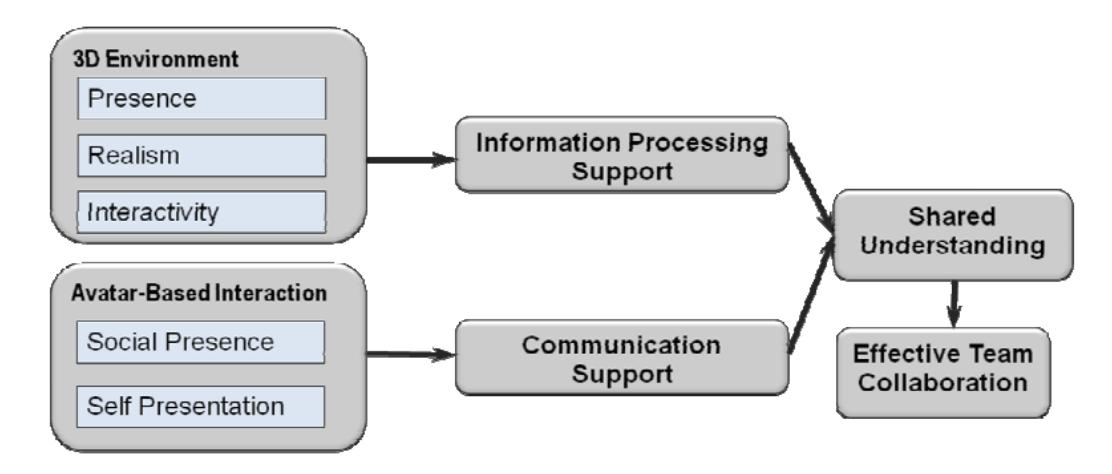
Figure 3 Theoretical model depicting how capabilities of 3D virtual environments affect information processing and communication processes, leading to shared understanding
(Source: Sarah van der Land, Alexander P. Schouten, Bart van den Hooff, Frans Feldberg, 2011)
Referring to the chart, digital art exhibitions may be seen as 3D settings with three characteristics: presence, realism, and interaction. 'Presence' indicates the existence of every element of the exhibition, including artists, exhibition rooms, artworks, curators, and engaged audiences. in the virtual realm. In this application, realism implies that every current element is a genuine, existent thing that can be physically brought together in the reality space. Interactivity refers to the activities and interactions that take place between exhibition parts that are interrelated.
The second graph represents Avatar-based Interaction. The virtual realm enables the presence of artists, curators, and audiences to be portrayed via images depicting their own personalities. Social presence and self-presentation are two significant features of this relationship. Social presence refers to the social context of each subject in the exhibition, while self-presentation is shown more visibly via the portrayal of persons in the art exhibition. The notion of avatar-based engagement may be regarded as the physical presence of the exhibition's subjects in this virtual realm, which can be depicted as a visual presence through social or digital media platforms utilized during the exhibition. However, this Avatarbased interaction will be achievable in the future metaverse period with the help of more comprehensive virtual equipment for staging an art show.
The digital art space as a 3D environment functions as a support for processing diverse information in the exhibition space, while the social presence of the subjects participating in the show generates communication support. In the end, these two aspects merged and worked together to provide a knowledge of the successful interactions between items in the virtual exhibition space.
The issue that often arises with virtual exhibitions is that the artist or exhibition organizer is unable to give adequate supervision and receive feedback on the display. Although a communication space in the form of a chat room is offered, the genuine state of the audience's enjoyment of the exhibition is not conveyed totally and properly expressed via the desire for voicing remarks or criticism. Self-awareness of the entities participating in the digital art space will allow for the anticipation of this issue. This implies that each entity in the virtual space is aware that they are behaving as members of the virtual space, and that each entity may foresee that there will be distinctions between online and offline forms of communication with which they must get acquainted. Communication symbols grow increasingly diverse because they are a blend of written, spoken, and visual language symbols that may be interpreted in a variety of ways. In order to construct a digital environment that can accurately portray the true circumstances of social interaction in a digital art space, it is necessary that all participants in an exhibition in a virtual space possess digital literacy skills.
Conclusion
The presence of a digital art space is a sign that there has been a transformation of activity between artists and audiences who have merged from reality space to virtual space and interacted in an art exhibition. The digital art space enables artists and audiences to participate and communicate as they see fit in the virtual realm. Art exhibits presented in the digital art space may be described as 3D settings with intricate interaction between organizers, artists, and spectators engaging in a variety of ways. In order for everyone to be able to portray the actual circumstances of social interaction in art exhibits in the digital art space, digital literacy skills are required.
References
Ahmadi, A. (2002). Psikologi Sosial. Edisi Revisi, Penerbit Rineka Cipta. Jakarta
Beinbridge, W. (2007). The Scientific Research Potential of Virtual Worlds. Sciencemag, 472.
Camp, Jeand & Chien, Y.T. (2000). The Internet as Public Space: Concepts, Issues, and Implications in Public Policy, in ACM SIGCAS Computers and Society, Volume 30 Issue 3, September 2000, p.13 - 19 <http://www.ljean.com/files/ spaces.html
Castells, M. (2001). The Internet Galaxy. Oxford: Oxford University Press
Freud, S. (2009). Pengantar Umum Psikoanalisa. Pustaka Pelajar: Yogyakarta
Gerungan, W.A. (2000). Psikologi Sosial. Bandung: Refika Aditama.
Jacobson, R. (1994). Virtual worlds capture spatial reality. GIS World (December): 36–9.
Lee, Lik-Hang & Braud, Tristan & Zhou, Pengyuan & Wang, Lin & Xu, Dianlei & Lin, Zijun & Kumar, Abhishek & Bermejo, Carlos & Hui, Pan. (2021). All One Needs to Know about Metaverse: A Complete Survey on Technological Singularity, Virtual Ecosystem, and Research Agenda. 10.13140/RG.2.2.11200.05124/8.
Piliang, Y. A. (2011). Dunia yang Dilipat. Bandung: Matahari
Sarwono, S. W. (2010). Psikologi Sosial Individu dan Teori-Teori Psikologi Sosial. Jakarta: Balai Pustaka.
Senoprabowo, N.H.A. (2019). Perancangan Ruang Pamer Digital dalam Media Virtual Reality Sebagai Upaya Menyediakan Ruang Pamer Interaktif. GESTALT Vol.1, No.1, Juni p.103-112
Setiadi, E. M. (2006). Ilmu Sosial Budaya Dasar. Jakarta: Kencana Prenada Media Group
Smart, E.J., Cascio, J. & Paffendorf, J. (2007). Metaverse Roadmap Overview.
Soekanto S. (2005). Sosiologi Suatu Pengantar. Rajawali, Rajawali Press, Jakarta
Toneka, B. S. (2000). Struktur dan Proses Sosial. Jakarta: Penerbit Erlangga
van Dijk, J. (2006). The Network Society. London: SAGE Publications
van der Land, S., Schouten, Alexander P., van den Hooff., Feldberg Frans, 2011. A Theoretical Model of Effective Team Collaboration in 3D Virtual Environments. Journal of Virtual Worlds Research Vol. 4, No. 3. ISSN: 1941-8477.