

INFO ARTIKEL
Kata kunci:
keputusan pembelian, minat, bauran pemasaran, smartphone, konsumen, Surabaya
ABSTRAK
Industri teknologi telah berevolusi kencang. Di samping itu, perkembangan smartphone menjadi daya tarik tersendiri di hati konsumen. Tujuan studi ini untuk memvalidasi efek komponen bauran marketing dan minat terhadap keputusan pembelian smartphone merek Samsung di Kecamatan Tambaksari (Kota Surabaya). Sebanyak 498 informan bersedia menjadi sampel dalam interview untuk dimintai informasi terkait harga, promosi, distribusi, minat, dan keputusan pembelian di kios seluler dan toko elektronik. Setelah data dihimpun, lalu dianalisis dengan metode regresi linier berganda. Berdasarkan prosedur kelayakan model, ketujuh hipotesis telah diterima (p <0,05). Pada efek langsung, setiap kenaikan harga, promosi, distribusi, dan minat mampu meningkatkan keputusan pembelian. Pada efek tidak langsung, terbukti bahwa
minat sebagai mediator yang konsisten dalam meningkatkan pengaruhnya antara harga, promosi, dan distribusi terhadap keputusan pembelian. Saluran marketing yang diterapkan oleh pihak penjual sangat memengaruhi keputusan konsumen melalui minat. Pendekatan studi ini harus dikembangkan melalui atensi konsumen secara konstruktif.
https://doi.org/10.5614/sostek.itbj.2022.21.2.6
Introduction
The aim of this study is to analyze the effects of three marketing mixes, including price, promotion, distribution, and interest in purchasing decisions on android smartphones (Samsung brand) in Tambaksari District, Surabaya City.
Various smartphone brands have filled the wide market in Indonesia with various types and features that are increasingly complete and giving rise to tight competition among them (Sudarman et al., 2021). The creation of various emerging product innovations is becoming more attractive and having higher quality (Efrata et al., 2019; Chaochotechuang et al., 2015). This is a producer's attempt to get consumers to become interested in and purchase the products they manufacture (Ramadania et al., 2021). From a consumer's perspective, this phenomenon provides broad opportunities for them as the availability of a variety of brands and product kinds will provide them with a variety of product alternatives that suit their needs and desires (Zainurossalamia et al., 2021; Dwivedi et al., 2021).
Other signals show that consumers have a strong position in determining purchasing decisions for the products and brands they want, not least in terms of interest and purchase decisions (Hanaysha, 2018; Oke et al., 2016; Helversen et al., 2018). They are enthusiasts or customers of Samsung brand smartphones, which become the objectivity of this study. However, while the COVID-19 pandemic is still ongoing until now, it has also resulted in a decline in the parent's turnover company (Putra et al., 2020; Garrett et al., 2021), especially its sales units.
One of the concrete efforts to implement policies on the "marketing mix", which emerged as "4 (four) Ps", then transformed to 7" (seven) Ps", and even now expanded to "10 (ten) P" (as in the example of Thabit & Raewf, 2018; Dally et al., 2021). From the new concept, the "10 (ten) Ps" includes performance, pressure, power, public, people, professional, promotion, price, place, and product, which are the keys to success and are determined by the understanding of the entire company to respond consumer behavior (Lim, 2021). Therefore, they are required to uncover what factors can influence consumer interest and decisions in using a service or a product. By identifying these dimensions, companies will implement marketing strategies effectively, precisely, and efficiently.
Surabaya is one of three big cities in Indonesia besides Jakarta and Bandung, which is home to 2.8 million people, with 50.42% female and 49.58% male. Referring to this total, 214.97 thousand people are in Tambaksari, making this sub-district as the area with the highest population density among other areas (BPS, 2021). Looking at this percentage, it becomes an exclusive market share and has the potential to be a consumer of Samsung products (such as mobile phones). Also, the millennial era and the digital generation now have to adapt to the intelligence of the world of information and technology (IT). Wijayanti et al. 2021) define branding and marketing as a unit that works together to attract customers.
The researcher does not discuss thoroughly the 10 (ten) pillars of the marketing mix, but we only focus on 3 (three) parts, namely price, promotion, and distribution, which are vital elements, without diminishing the role of the product. Here, the researcher emphasizes that all three are also vital factors that are taken into consideration by a consumer at the beginning of buying a product. Distribution is a dimension that is rarely investigated by various researchers in marketing management, so it is worth examining how much impact it has on interest and purchasing decisions.
We explore this study through five mechanisms, of which the essence of the first is preliminary. The literature review and methods are in the second and the third sections. The fourth section includes results and discussions while the conclusion can be found in the fifth section.
Literature Review
Buying Decision
In the increasingly fierce competitive arena, the success of companies is largely determined by their accuracy in taking advantage of opportunities and identifying individual activities in their efforts to get and use goods and services (Adams & Swanson, 2017), including the purchasing decision process. The decision to purchase a product by consumers is a unilateral decision after evaluating the feasibility of the product concerned (Sari et al., 2020).
Consumers often involve more than one party in making their purchasing decisions (White et al., 2019). The five engagements include initiators, influencers, deciders, buyers, and users. These components have their respective roles. The initiator is the individual who first has an idea and suggests buying a product. Second, influencers act as advisors and have views on influencing purchasing decisions. For the decider, they determine the decision to buy. On the one hand, buyers are those who transact or make a real purchase. Finally, the user as the user of the product. Joshi & Rahman (2015) view that consumer decision making is a very varied and complex process.
Price
According to Ashraf et al. (2017), price is defined as the amount of money charged for a service or product. From another perspective, a product's price is the sum of the value that consumers exchange for the benefits derived from using/owning a product (Olajide et al., 2016). Meanwhile, Weyl (2019) commented that price is the amount of money that companies determine in exchange for services and goods they trade with a function to satisfy consumers.
Price quantity has a positive effect on purchasing decisions, but not on consumer interest in PT. Tiga Serangkai–Riau Province (Arianto et al., 2018). Levrini & Santos (2021) consider that price is the most important attribute in supporting consumer interest. In his findings, consumer perceptions provide new insights about their purchase intentions, which are influenced by price awareness. The results of Herawati et al. (2019), Mbete & Tanama (2020), and Albari & Safitri (2018) support the hypothesis that the price variable has a significant relationship with interest and purchasing decisions. This description has led us to propose the following two hypotheses:
Hypothesis 1 (H1): The increase in price plays a role in supporting purchasing decisions positively. Hypothesis 5 (H5): The role of price positively influences purchase decisions through interest.
Promotion
Arthantri (2021) highlights promotion as a one-way channel of persuasion and information to direct certain individuals and groups through actions that create exchanges. Porcu et al. (2012) emphasize to promotional tools so that what the seller wants meets expectations and targets through four techniques, including private sales, publicity, advertising, and short-term-based incentive sales.
Dolita et al. (2021) illustrate that students' interest in opening an account at Bank Muammalat (Indonesia) is significantly influenced by promotions. In line with this study, promotion is the variable that has the most dominant impacts among others in increasing consumer interest in PT. Sumber Cipta Multiniaga (Juhaeri, 2020). Regarding purchasing decisions, Suryani & Syafarudin (2021) state that to encourage and stimulate aggressive purchasing decisions, promotional factors are needed. In addition, promotion is a vital aspect of marketing management to trigger consumer transactions to purchase certain products. Wahyudi & Melinda (2018) explained that the promotional mix such as public relations, personal selling, and advertising had a systematic impact on purchasing decisions by customers at Warung Ndeso Jancuocok. It is logical to underlie the above description to build the following hypothesis:
Hypothesis 2 (H2): The increase in promotion plays a role in supporting purchasing decisions positively.
Hypothesis 6 (H6): The role of promotion positively influences purchase decisions through interest.
Distribution
L̆az Aroiu et al., (2020) respond to distribution (i.e., location) as part of the consideration for consumers before making decision. Distribution is close to the center of the crowd and easily accessible by consumers (Di Crosta et al., 2021). This is the right thing, so that the distribution process of the company's production is more integrated.
Deng & Li (2017) describe the relationship between distribution and interest where 'supply chain management theory' applies to the meaning of relevant interests among current management. The pattern of benefits is combed overseas, so that consumer interests are tested comprehensively. Both Pramudita et al. (2020) and Azzadina et al. (2012) found that decision making in renting a hotel is influenced by distribution channels. They also showed a positive correlation with industrial growth in the city of Bandung. The movers from fashion stores, such as distributions, are very popular because distribution factors measure the customer's personality in purchasing decisions. Equally important, it drew the attention of Putra et al. (2020). Tight competition in the 2 (two), 3 (three) stars and guest house industries in Surabaya is a challenge for managers to keep loyal customers and attract new ones. To pursue business continuity, they apply marketing tactics by increasing distribution. As a result, it can influence consumer decisions in choosing hotels through the location aspect. It makes sense to design the following two hypotheses.
Hypothesis 3 (H3): An increase in distribution plays a role in supporting purchasing decisions positively.
Hypothesis 7 (H7): The role of distribution positively influences purchase decisions through interest.
Interest
Setyorini & Indriasari (2020) defined the 'interest theory' as individual behavior and the level of a user's tendency to consume a service and goods at a certain time. In its development, Ajzen (1991) and Davis (1989) have introduced 'theory of planned behavior' and 'theory of reasoned action' as new concepts that actualize consumer behavior by reflecting intentions (Krapp, 2002). Emotional, social, and internal factors support interest. They grouped these four factors into four sets, which are illustrated in Fig. 1.
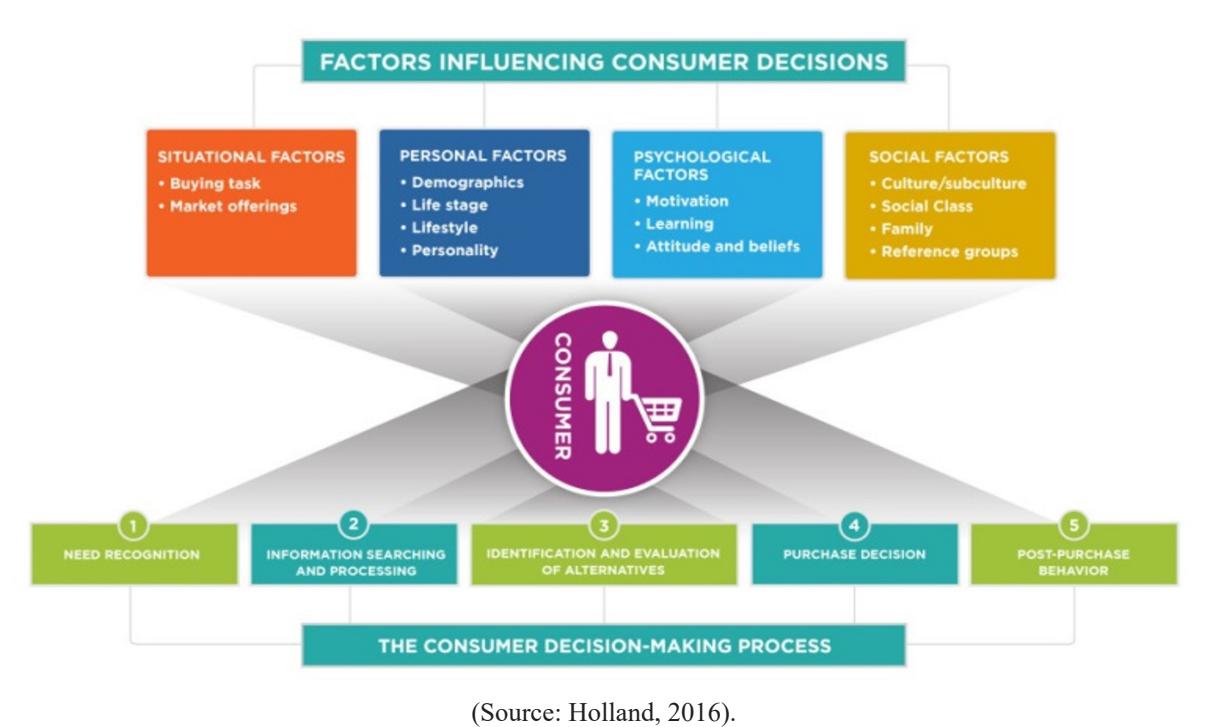
Figure 1 The essence of consumer decisions
A study conducted by Sari (2020) concluded that interest has a significant impact on consumer decisions to buy "amplang" crackers at Toko Karya Bahari (Samarinda). The higher the interest, the higher the purchase decision will be. In Indonesia, the rise of the internet users is increasingly out of control and has caused the e-commerce industry to sprout. Although many of consumers are hesitant to shop online because of their lack of trust in the service providers and sellers, online applications have at least attracted their interest and are influencing their purchasing decisions (Hidayat et al., 2021). The final hypothesis is as follows:
Hypothesis 4 (H4): The increase in interest plays a role in supporting purchasing decisions positively.
Framework
It shows the flow of the study in Fig. 2. From here, we based the orientation and expectations of the entire path on seven hypotheses. The composition of each variable has a 'positive' prediction according to the hypothesis design and it needs to be reviewed in depth.
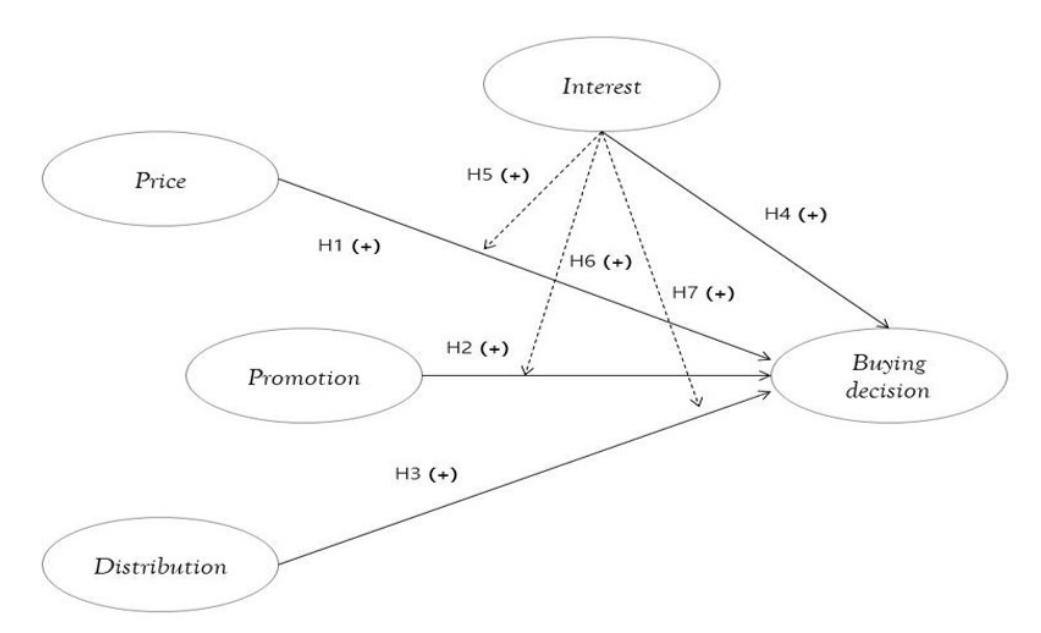
Figure 2 Sketch and expected conception
The emphasis of the two arrows has a different meaning. The 'connected line' is a direct line, and an indirect line (mediator) is symbolized by a 'broken line'. Two-step testing on direct effects and indirect effects. First, the independent variable to reveal real evidence of price, promotion, distribution, and interest in purchasing decisions. Starting from here, we specify interest as an independent variable. Second, the interest variable is also an evaluation tool in mediating between price, promotion, and interest in purchasing decisions. Third, we verified purchasing decisions as the dependent variable, so that it channeled all variables to this variable.
Method
Demarcation
The study materials are based on a quantitative-verification approach (e.g., Apuke, 2017; Shahper & Richter, 2017). For social experiments, the design was developed to answer the objectives and proposed hypotheses through a series of empirical identifications (Mohajan, 2021).
Table I Classification of Variables
| Variable & item | Role | Hypothesis | Expanded by | |
|---|---|---|---|---|
| Purchasing decision: after-purchase behavior, suitability of needs, seeking information, recognizing problems | Dependent | - | Ćorić et al. (2017); Orou Seko et al. (2020); Ratnasari et al. (2020) | |
| Interest: explorative, preferential, referential, transactional | Independent & mediator | H4, H5, H6, H7 | Eze & Lim (2013); Maria et al. (2019); Malik & Saleem (2017) | |
| Price: price benefits, price uniformity, price flexibility | Independent | H1 | Arthur et al. (2019) | |
| Promotion: promotion selling, mass selling, personal selling | Independent | H2 | Fam et al. (2017); Elrod & Fortenberry (2020); Fam et al. (2007) | |
| Distribution: location accessibility, product availability, facilities & infrastructure | Independent | НЗ | Gonzalez-Feliu et al. (2014); Baraklianos et al. (2018) | |
We grouped them into 5 (five) variables with price limits, promotions, distributions, and purchasing decisions that have different contributions. We summarize the framework for variable range see Table 1.
Research Targets
Technically, data collection is collected by involving several samples that represent the entire population. The informants in question are those who were buying Samsung brand mobile phones at cellular kiosks and electronic stores in Tambaksari (Surabaya) in November 2021. We conducted the interview to assess their knowledge of the Android smartphone.
The characteristics of the two sample locations are medium scale (annual profit > US $15 million, have +200 employees, and asset ownership > US $15 million), so that it does not limit them to regular customers or incidental consumers.
Table II Informant Unit
| Place | Population | Sample (5%) | Distribution | |
|---|---|---|---|---|
| Mobile kiosk | 2,478 | 124 | 116 | |
| Electronic store | 8,905 | 445 | 382 | |
The random sample technique supports the selection in the survey, where the researcher only groups in the two survey locations above the 5% threshold (Banerjee & Chaudhury, 2010). Simply put, something statistically assigned a random sample preference to a predetermined sub-set of individuals from the larger cluster. All have equal probabilities (see Table 2). The total population was 11,383 participants. Of these, 569 samples were collected, but only 498 were willing and eligible to be interviewed.
Analysis Tools
We categorized perceptions of informants based on alternative answers in the order of 1 (one) to four (4), comprising: 4-strongly agree; agree-3; disagree-2; and strongly disagree-1. Exploration of perception is as a regression method. Then, the data processing instrument used IBM SPSS and Sobel test software.
Results and Discussion
Table 3 displays descriptive statistics as reflected in the mean acquisition. The attributes of the five variables are 17 (seventeen). The purchasing decision variable and the interest variable have the most indicators, namely 4 (four), while the price variable, promotion variable, and distribution variable are divided into 3 (three) indicators. Perceptions marked by the experience of informants revealed that transactional was the most dominant item among the others and the value was 3.92. There are items that get the lowest mean value, namely price benefits, where the result was 2.21. The two differences were still classified as disagree–strongly agree.
The SPSS output also describes the average score for all variables. The purchase decision was 3.69 (the highest), while the lowest was the price of 3.13. This figure is a 0.01-point difference from the promotion variable. Ideally, the calculated reliability test refers to Cronbach's alpha (CA) supported by maximum results because the overall CA > 0.7. The highest CA is from consumer purchases and, vice versa, the lowest is interest. The correlation coefficient (R) measures other traits that interpret the validity of an indicator. In Table 3, the results met the criteria (R > 0.6). It was clear that two items that achieved the maximum R and the lowest R, where seeking information obtained 0.696 and price benefits were classified as the largest indicator because they were at the 0.840 level.
Table III Informant Responses and Model Feasibility
| Attribute | Mean | Average score | CA* | R** |
|---|---|---|---|---|
| After-purchase behavior; suitability of needs; searching for information; recognize the problem | 3.87; 3.09; 3.53; 3.83 | 3.58 | 0.837 | 0.713; 0.760; 0.696; 0.752 |
| Explorative; preferential; referential; transactional | 3.17; 3.88; 3.80; 3.92 | 3.69 | 0.745 | 0.771; 0.772; 0.745; 0.750 |
| Price benefits; price uniformity; price flexibility | 2.21; 3.55; 3.64 | 3.13 | 0.826 | 0.840; 0.779. 0.768 |
| Promotional selling; mass selling; personal selling | 3.45; 3.50; 2.47 | 3.14 | 0.797 | 0.705; 0.728; 0.776 |
| Location accessibility; product availability; facilities & infrastructure | 3.71; 3.60; 3.55 | 3.62 | 0.834 | 0.722; 0.716; 0.739 |
(Notation: *CA> 0.7 & **R> 0.6)
Figure 3 represents the interaction of the four independent variables on purchasing decisions. In the actualization, the ability to price, promotion, distribution, and interest explains purchasing decisions by 86.1% (very strong). Although all components have a significant impact on purchasing decisions, partially, the causality between interest in purchasing decisions is the most dominant part (p = 0.001). When it was compared, it expressed the price of purchasing decisions as causality with the lowest contribution (p = 0.006).
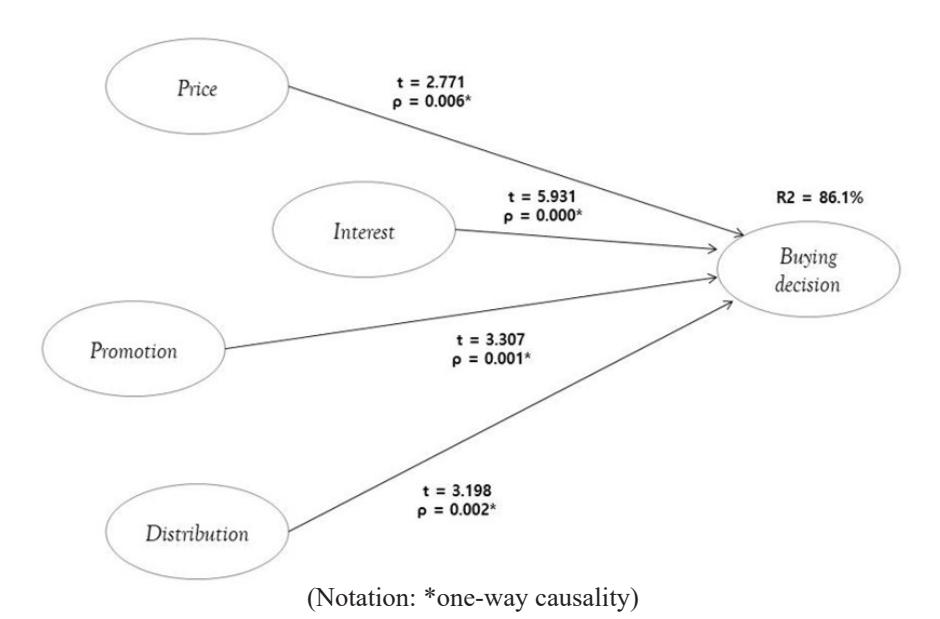
Figure 3 Determination of the partial effect
It shows bidirectional causality in Fig. 4. The urgency of the interest variable to mediate its effects on price, promotion, and distribution ends with a significant path. Performance on causality is indirectly at the level of a 'strong' relationship because the coefficient of determination (R2 ) ensures the achievement of 74.3%. We interpreted arguments in terms of the three relationships. Therefore, it was emphasized that promotion had the most significant effect on purchasing decisions through interest (p = 0.004). Interest also played a vital role in confirming the other two hypotheses, namely price and distribution of purchasing decisions (p = 0.013 and p = 0.005).
The buying decision-making process begins with looking at fulfillments needs. They are related this to several alternatives, so it is necessary to carry out an evaluation aimed at obtaining adequate alternatives (Masic et al., 2008). Consumers must selectively collect first information that can give clues about the product to be purchased (Benn et al., 2015), whether it will provide benefits as promised or vice versa. They carry an alternative evaluation out when they already have various information about products and brands referring to their information research (Jiang & Zhang, 2021).
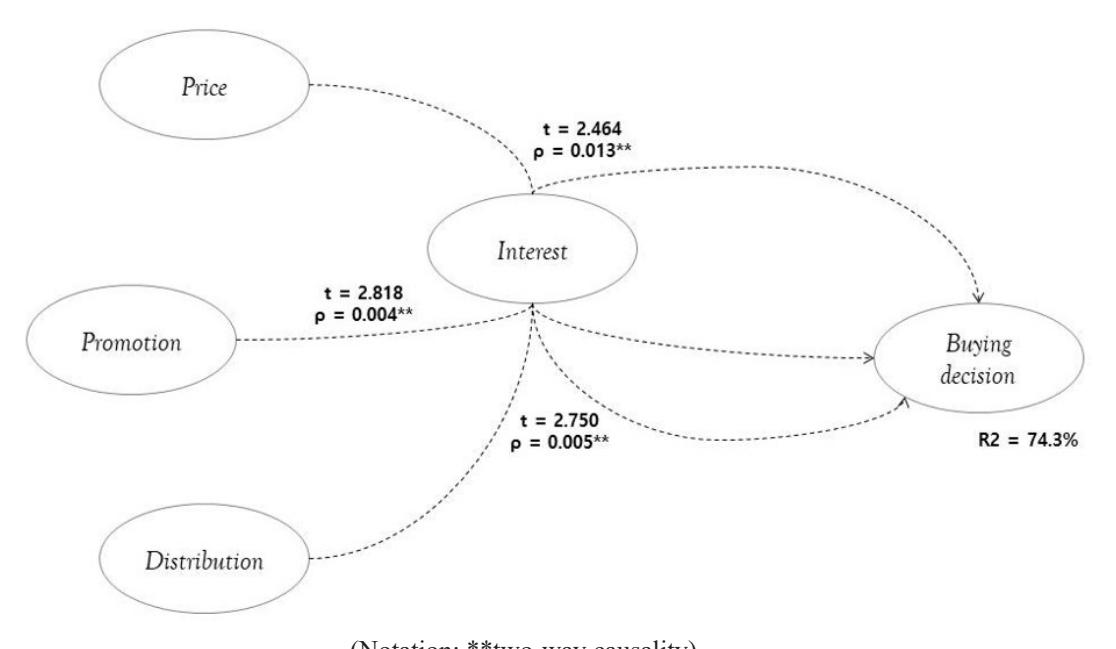
(Notation: **two-way causality). Figure 4 Determination of the mediator effect
Zhang et al. (2017) popularized promotion as the most influential channel on consumer buying intentions on the internet. There is a positive interaction between price promotions and complementary products on consumers' purchase intentions. They proved consumers to prefer discounts over certain units of purchase. We suggest promotional benefits for products that are not complementary. On another occasion, Yusuf & Sunarsi (2020) concluded that the greater the promotion and price, the greater the buying interest will be. In addition, the emotional bond between sellers and customer needs to be strengthened by distribution, promotion, and prices that apply to their income levels (Al Badi, 2018).
Furthermore, the relationship between price, promotion, and distribution of purchasing decisions were also identified by Lee & Chen-Yu (2018) and Supriyanto et al. (2021). They extend the pricing model and the role of discounts in mediating consumer purchase intentions. The experimental results prove that discounts price can stimulate consumers' perception in their decision to buy apparel products at online stores. Likewise, the decision to buy a car is showed by the promotion and price variables, which have a partially significant effect. Winarno & Oktiani (2020) assume that the decision to buy soft drink products is more dominantly determined by distribution rather than promotion. However, Schneider et al. (2013) confirm that purchasing decisions in Western society, especially for homosexual couples, are significantly determined by distribution.
Conclusions
This study concentrates more on the impact of price, promotion, and distribution on interest-moderated purchasing decisions. Based on the empirical reality in the first structure that price, promotion, and distribution partially advance purchasing decisions. Interest that successfully moderates price, promotion, and distribution is also influenced other supporting evidence in fostering purchasing decisions.
Limitations on the relationship among price, promotion, and distribution of interest were not investigated, so it needs to be re-examined. We are also aware of the weakness of this work, which does not include the element of service. Unfortunately, this aspect is interesting to be studied in the analysis. Further considerations recommend that practical and theoretical implications have given the increasingly fierce competition in the smartphone business world. They consistently committed the managerial idea to maintaining product quality. We cannot separate another extra effort from the crucial insistence on product excellence through more proportional price effectiveness.
In term of universal perspective, the academic studies tradition also reflects on the attribution of technological knowledge, social structure, and marketing reputation.
Acknowledgement
This work has not been funded or received grants from anywhere other than internal authors. We are very grateful to the reviewers and the editorial teams from Jurnal Sosioteknologi, who have gone to great lengths to provide professional comments for the improvement of this manuscript.
References
- Adams, J. R., & Swanson, L. A. (2013). Information processing behavior and estimating accuracy in operations management. Academy of Management Journal, 19(1), 98-110.
- Ajzen, I. (1991). The theory of planned behavior. Organizational Behavior and Human Decision Processes, 50(2), 179-211.
- Al Badi, K. S. (2018). The impact of marketing mix on the competitive advantage of the SME sector in the Al Buraimi governorate in Oman. SAGE Open, 8(3), 1-10.
- Albari, A., & Safitri, I. (2018). The influence of product price on consumers' purchasing decisions. Review of Integrative Business and Economics Research, 7(2), 328-337. Retrieved from https:// buscompress.com/uploads/3/4/9/8/34980536/riber_7-s2_k18-165_328-337.pdf
- Apuke, O. D. (2017). Quantitative research methods: a synopsis approach. Kuwait Chapter of Arabian Journal of Business and Management Review, 6(11), 40-47.
- Arianto, B., Zulkarnain, Z., & Samsir, S. (2018). The effect of product quality, price, promotion towards purchase decision and consumer loyalty of Tiga Serangkai books in Riau Province. International Journal of Economics, Business and Applications, 3(1), 1-10.
- Arthantri, D. (2021). The effect of marketing mix on students' loyalty towards instant noodles with the brands of Indomie, Sedap, and ABC with moderated variety seeking. Journal of Management Science, 4(3), 83-92.
- Arthur, K. M., Asmara, A., & Simanjuntak, M. (2019). The effect of marketing mixon "KPR Xtra Bebas" decision making in Bank X Regional I. Journal of Consumer Sciences, 04(01), 1-12. Retrieved from https://journal.ipb.ac.id/index.php/jcs/article/view/25405/16515
- Ashraf, S. F., Li, C., & Mehmood, B. (2017). A study of premium price brands with special reference to willingness of customer to pay. International Journal of Academic Research in Business and Social Sciences, 7(7), 619-639.
- Azzadina, I., Huda, A. N., & Sianipar, C. P. (2012). Understanding relationship between personality types, marketing-mix factors, and purchasing decisions. Procedia - Social and Behavioral Sciences, 65, 352–357.
- Banerjee, A., & Chaudhury, S. (2010). Statistics without tears: populations and samples. Industrial Psychiatry Journal, 19(1), 60–65.
- Baraklianos, I., Bouzouina, L., & Bonnel, P. (2018). The impact of accessibility on the location choices of the business services. evidence from Lyon urban area. Region et Developpement, 48, 85-104. Retrieved from https://regionetdeveloppement.univ-tln.fr/wp-content/uploads/6_Baraklianos.pdf
- Benn, Y., Webb, T. L., Chang, B. P., & Reidy, J. (2015). What information do consumers consider, and how do they look for it, when shopping for groceries online? Appetite, 89, 265-273.
- BPS. (2021). Jumlah penduduk Kota Surabaya menurut Kecamatan di tahun 2020 [The population of Surabaya Ciyt by sub-district in 2020]. Retrieved from https://databoks.katadata.co.id/ datapublish/2021/10/07/jumlah-penduduk-kota-surabaya-287-juta-jiwa-pada-2020
- Chaochotechuang, P., Daneshgar, F., & Sindakis, S. (2015). Innovation strategies of new product development (NPD). International Journal of Knowledge and Systems Science, 6(2), 57-75.
- Ćorić, D. S, Anić, I.-D., Piri Rajh, S., Rajh, E., & Kurnoga, N. (2017). Organizational buying decision approaches in manufacturing industry: developing measures and typology. Journal of Business & Industrial Marketing, 32(2), 227-237.
- Dally, D., Sinaga, O., & Saudi, M. H. (2021). The impact of 7p's of marketing on the performance of the higher education institutions. Review of International Geographical Education Online, 11(3), 235-252.
- Deng, A., & Li, Y. (2017). A review of research on interest distribution of supply chain based on game theory. World Journal of Research and Review, 4(6), 52-57. Retrieved from https://media.neliti. com/media/publications/262789-a-review-of-research-on-interest-distrib-1bae7a9d.pdf
- Di Crosta, A., Ceccato, I., Marchetti, D., et al. (2021). Psychological factors and consumer behavior during the COVID-19 pandemic. PloS ONE, 16(8), e0256095.
- Dolita, G., Malarangan, H., & Malkan, M. (2021). The effect of promotion on interest in opening an account at Bank Muamalat, Palu Branch. AL-ARBAH: Journal of Islamic Finance and Banking, 3(1), 37-46.
- Dwivedi, Y. K., Ismagilova, E., Hughes, D. L., et al. (2021). Setting the future of digital and social media marketing research: perspectives and research propositions. International Journal of Information Management, 59, 102168.
- Efrata, T. C., Radianto, W. E., & Marlina, M. A. (2019). Identification of innovation process on new product development in small and medium enterprises. Jurnal Aplikasi Manajemen, 17(4), 662– 667.
- Elrod, J. K., & Fortenberry, J. L. (2020). Personal selling in health and medicine: using sales agents to engage audiences. BMC Health Services Research, 20(1), 819.
- Eze, U. C., & Lim, Y. Y. (2013). Indicators in the purchase of housing properties. Southeast Asian Research, 2013, 432043.
- Fam, K-S., Simpson, L., Yang, L., & Chung, K. Y. (2007). Relationship building in small businesses the case of linking personal selling with collectivism. In Asia Pacific Marketing Conference (Vol. 2, pp. 1-7). Retrieved from http://hdl.handle.net/10523/709
- Garrett, P. M., White, J. P., Lewandowsky, S., et al. (2021). The acceptability and uptake of smartphone tracking for COVID-19 in Australia. PloS ONE, 16(1), e0244827.
- Gonzalez-Feliu, J., Grau, J. M., & Beziat, A. (2014). A location-based accessibility analysis to estimate the suitability of urban consolidation facilities. International Journal of Urban Sciences, 18(2), 166-185.
- Hanaysha, J. R. (2018). An examination of the factors affecting consumer's purchase decision in the Malaysian retail market. PSU Research Review, 2(1), 7-23.
- Helversen, B., Abramczuk, K., Kopeć, W., & Nielek, R. (2018). Influence of consumer reviews on online purchasing decisions in older and younger adults. Decision Support Systems, 113, 1-10.
- Herawati, H., Prajanti, S. D., & Kardoyo, K. (2019). Predicted purchasing decisions from lifestyle, product quality and price through purchase motivation. Journal of Economic Education, 8(1), 1-11.
- Hidayat, A., Wijaya, T., Ishak, A., & Catyanadika, P. E. (2021). Consumer trust as the antecedent of online consumer purchase decision. Information, 12(4), 145.
- Holland, S. (2016). Marketing to women quick facts. Retrieved from http://she-conomy.com/report/ marketing-to-women-quick-facts
- Johnson, K., & Richter, S. (2017). Quantitative verification of social media networks: the case study of Twitter. BDCAT '17: Proceedings of the Fourth IEEE/ACM International Conference on Big Data Computing, Applications and Technologies (pp. 53–62).
- Jiang, D., & Zhang, G. (2021). Marketing clues on the label raise the purchase intention of genetically modified food. Sustainability, 13(17), 9970.
- Joshi, Y., & Rahman, Z. (2015). Factors affecting green purchase behaviour and future research directions. International Strategic Management Review, 3(1–2), 128-143.
- Juhaeri, J. (2020). Effect of promotion and price on customers' purchase interests at PT Sumber Cipta Multiniaga, South Jakarta Branch. Jurnal Ilmiah Ilmu Administrasi Publik, 10(1), 35-44.
- Krapp, A. (2002). An educational-psychological theory of interest and its relation to SDT. In Deci, E. L., & Ryan, R. M (Eds.), Handbook of self-determination research (pp. 405–427). University of Rochester Press.
- L ̆az ̆aroiu, G., Neguri ̧t ̆a, O., Grecu, I., Grecu, G., & Mitran, P. C. (2020). Consumers' decision-making process on social commerce platforms: online trust, perceived risk, and purchase intentions. Frontiers in Psychology, 11, 890.
- Lee, J.E., & Chen-Yu, J.H. (2018). Effects of price discount on consumers' perceptions of savings, quality, and value for apparel products: mediating effect of price discount affect. Fashion and Textiles, 5(1), 13 (2018).
- Levrini, G., & Santos, M. J. (2021). The influence of price on purchase intentions: comparative study between cognitive, sensory, and neurophysiological experiments. Behavioral Sciences, 11(2), 16.
- Lim, W. M. (2021). A marketing mix typology for integrated care: the 10 Ps. Journal of Strategic Marketing, 29(5), 453-469.
- Malik, S., & Saleem, M. (2017). Interest indicators in structured scientific articles. Procedia Computer Science, 116, 158-165.
- Maria, S., Pusriadi, T., Hakim, Y., & Darma, D. C. (2019). The effect of social media marketing, word of mouth, and effectiveness of advertising on brand awareness and intention to buy. Jurnal Manajemen Indonesia, 19(2), 107-122.
- Masic, I., Miokovic, M., & Muhamedagic, B. (2008). Evidence based medicine new approaches and challenges. AIM: Journal of the Society for Medical Informatics of Bosnia & Herzegovina, 16(4), 219–225.
- Mbete, G. S., & Tanamal, R. (2020). Effect of easiness, service quality, price, trust of quality of information, and brand image of consumer purchase decision on shopee online purchase. Jurnal Informatika Universitas Pamulang, 5(2), 100-110.
- Mohajan, H. K. (2021). Quantitative research: a successful investigation in natural and social sciences. Journal of Economic Development Environment and People, 9(4), 50-79.
- Oke, A. O., Kamolshotiros, P., Popoola, O. Y., Ajagbe, M. A., et al. (2016). Consumer behavior towards decision making and loyalty to brands. International Review of Management and Marketing, 6(4S), 43–52.
- Olajide, S. E., Lizam, M., & Olajide, E. B. (2016). Understanding the conceptual definitions of cost, price, worth and value. IOSR Journal of Humanities and Social Science, 21(9), 53-57.
- Orou Seko, M., Ndour, A. P., Ossebi, W., et al. (2020). Consumer perception on purchase decision factors and health indicators related to the quality and safety of meat sold in dibiteries in Dakar, Senegal. Sustainability, 12(18), 7428.
- Porcu, L., Barrio-García, S. D., & Kitchen, P. J. (2012). How integrated marketing communications (IMC) works? a theoretical review and an analysis of its main drivers and effects. Comunicacion y Sociedad, 25(1), 313-348.
- Pramudita, A. S., Bisma, M. A., & Guslan, D. (2020). The distribution channel preferences in purchase decision-making of backpacker hostel customers. Binus Business Review, 11(2), 129-139.
- Putra, R. B., Limakrisna, N., & Fitri, H. (2020). Measurement model: interests of buying a samsung brand smartphone with celebrity endorser as an antesedent variables in the era of Covid-19. Dinasti International Journal of Management Science, 2(2), 353-365.
- Putra, Q. E., Tarigan, Z. J., Sitepu, R. B., & Singh, S. K. (2020). The impact of marketing mix on the consumer purchase decision in the Surabaya - Indonesia Hotel Residence. SHS Web of Conferences, 76(1), 01038.
- Ramadania, R., Rosnani, T., Fauzan, R., Darma, D. C. (2021). The study of perceived risk and e-service convenience towards satisfaction and trust of online academic users in Indonesia. International Journal of Media and Information Literacy, 6(2), 387-395.
- Ratnasari, S. L., Rahmawati, R., Haryani, D. S., Tanjung, R., & Basuki, B. (2020). Workplace bullying causing negative employee behaviours: a case from the Indonesian banking sector. International Journal of Innovation, Creativity and Change, 10(11), 441–458.
- Sari, S. D., Widyanti, R. N., & Listyorini, I. (2020). Trust and perceived risk toward actual online purchasing: online purchasing intention as mediating variable. Integrated Journal of Business and Economics, 4(1), 61-70.
- Sari, S. P. (2020). Hubungan minat beli dengan keputusan pembelian pada konsumen [The relationship between buying interest and purchasing decisions on consumers]. Psikoborneo, 8(1), 147-155.
- Schneider, H., Schönenberg, I., & Ferié, F. (2013). The distribution of influence in purchase decisions by male homosexual couples. Journal of Consumer Behaviour, 12(5), 345-357.
- Setyorini, N., & Indriasari, I. (2020). Does millennials have an investment interest? theory of planned behaviour perspective. Diponegoro International Journal of Business, 3(1), 28-35.
- Sudarman, E., Madiistriyatno, H., & Sudarman, I. (2021). Investigations of customer loyalty: strengthening product quality, brand image and customer satisfaction. MIX: Jurnal Ilmiah Manajemen, 11(1), 78- 93.
- Supriyanto, S., Ronal, R. A., & Melisa, M. (2021). Effect of price and promotion on car purchase decisions at PT Encar Daihatsu Lubuklinggau. International Journal of Community Service & Engagement, 2(1), 42-49.
- Suryani, I., & Syafarudin, A. (2021). The effect of sales promotion on purchasing decisions. Ilomata International Journal of Tax and Accounting, 2(2), 122-133.
- Thabit, T. H., & Raewf, M. B. (2018). The evaluation of marketing mix elements: a case study. International Journal of Social Sciences and Educational Studies, 4(4), 100-109.
- Wahyudi, A. E., & Melinda, T. (2018). The effects of promotion mix on customers' buying decision. Journal of Entrepreneur and Entrepreneurship, 7(2), 63–70.
- White, K., Habib, R., & Hardisty, D. J. (2019). How to shift consumer behaviors to be more sustainable: a literature review and guiding framework. Journal of Marketing, 83(3), 22–49.
- Wijayanti, T. C., Kurniawan, D. A., Darma, D. C., & Hakim, Y. P. (2021). Evaluation on social media marketing from customers. Webology, 18(2), 598-615.
- Winarno, S. H., & Oktiani, N. (2020). Effect of products, promotion, and distribution of purchasing decisions on fighting brand. Widya Cipta: Jurnal Sekretari dan Manajemen, 4(2), 161-168.
- Weyl, E. G. (2019). Price theory. Journal of Economic Literature, 57(2), 329-384.
- Yusuf, A., & Sunarsi, D. (2020). The effect of promotion and price on purchase decisions. Almana: Jurnal Manajemen dan Bisnis, 4(2), 272-279.
- Zainurossalamia, S., Tricahyadinata, I., Robiansyah, R., et al. (2021). Storytelling marketing, content marketing, and social media marketing on the purchasing decision. Budapest International Research and Critics Institute: Humanities and Social Sciences, 4(3), 3836-3842.
- Zhang, Y., Deng, J., & Xu, Y. (2017). The effect of different price promotion ways on consumers' purchasing intention. American Journal of Industrial and Business Management, 7(10), 1192-1208.