

INFO ARTIKEL
Kata kunci:
chatbot, difusi inovasi, layanan pelanggan, hubungan masyarakat, studi media
ABSTRAK
Chatbot adalah salah satu teknologi untuk meningkatkan pelayanan informasi. Di dalam chatbot, tidak terjadi komunikasi antara manusia dengan manusia, tetapi antara manusia dengan mesin atau robot meskipun masih menggunakan bahasa manusia. Di Indonesia, literatur tentang chatbot lebih banyak mengenai aspek teknologi, sedangkan aspek komunikasi masih kurang. Penelitian ini merupakan studi difusi inovasi untuk menjelaskan adopsi chatbot di Indonesia. Data dikumpulkan melalui teknik wawancara kepada lima narasumber dengan latar belakang yang berbeda, yakni instansi pemerintah, pelaku usaha mikro, penyedia chatbot, dan pengguna layanan chatbot. Hasil penelitian menunjukkan alasan utama adopsi chatbot di Indonesia adalah kecepatan layanan, efisiensi sumber daya manusia, dan waktu kerja yang tidak terbatas. Hal ini sejalan dengan tujuan chatbot, yaitu untuk memudahkan penyediaan informasi, baik sebagai customer services maupun hubungan masyarakat. Kanal komunikasi media massa digunakan untuk memperkenalkan layanan chatbot, sedangkan saluran komunikasi interpersonal digunakan untuk mentransfer pengetahuan dari developer ke administrator.
https://doi.org/10.5614/sostek.itbj.2022.21.3.5
Introduction
A chatbot (short for chat robot) is an artificial intelligence program designed to be able to communicate directly with humans (Adamopoulou & Moussiades, 2020a). The limitations on mobility due to the COVID-19 pandemic have made the existence of chatbot technology increasingly popular (Miner et al., 2020). The chatbot is considered a promising technology investment in Indonesia because this artificial intelligence technology can be an option for various types of businesses there (Sanny et al., 2020). Chatbots can serve thousands of users at a time without experiencing any errors (Adamopoulou & Moussiades, 2020b). Meanwhile, human labor had maximum capabilities, but it was limited due to working hours.
Chatbots are a form of Natural Language Processing (NLP) application, one of the fields of science in artificial intelligence that studies communication between humans and computers using natural language (Jia, 2003). Not only information, chatbot is also able to do emotive expressions (Indrayani et al., 2019). This chatbot technology started trending in 2019, even though it has been around for a long time. In 2019, 80 percent of marketers plan to use chatbot technology to support their business services (Móricz & Marciniak, 2019).
Recently, the rapid development of technology in artificial intelligence (AI) has allowed the adoption of chatbots in various industrial sectors such as health, education, and tourism (Winkler & Soellner, 2018). The emergence of the COVID-19 pandemic has made chatbot technology widely adopted, especially in the healthcare sector. For instance, the World Health Organization (WHO) has created chatbot technology on the WhatsApp and Facebook networks to provide credible information for checking symptoms and disseminating COVID-19 information (Luk et al., 2022). The chatbot was able to provide health guidance. It also delivers campaigns about the COVID-19 vaccine where many people doubted its safety and effectiveness (Weeks et al., 2022). To dispel these doubts, chatbot developers take advantage of communication science by understanding audience segmentation, adjusting message content according to the target audience, and choosing appropriate communication and promotion strategies (Weeks et al., 2022).
The adoption of chatbots is also increasingly becoming a standard among businesspeople. It is because chatbots are considered capable of responding to customer messages and complaints quickly and accurately. It is also an efficient and flexible working time (Sari et al., 2020). The changes in consumer behavior that spend more time in the digital platform bring e-service agents such as chatbots as a critical part. The chatbots can interact with consumers and build relationships with them (Selamat & Windasari, 2021).
The increase in chatbot adoption can be seen in 2017 when 100,000 chatbots were used only in Facebook Messenger followed by potential global revenue of up to 32 million USD from transactions via chatbots (Zumstein, 2020). This number is estimated to continue to increase until 2027, according to the following research report:
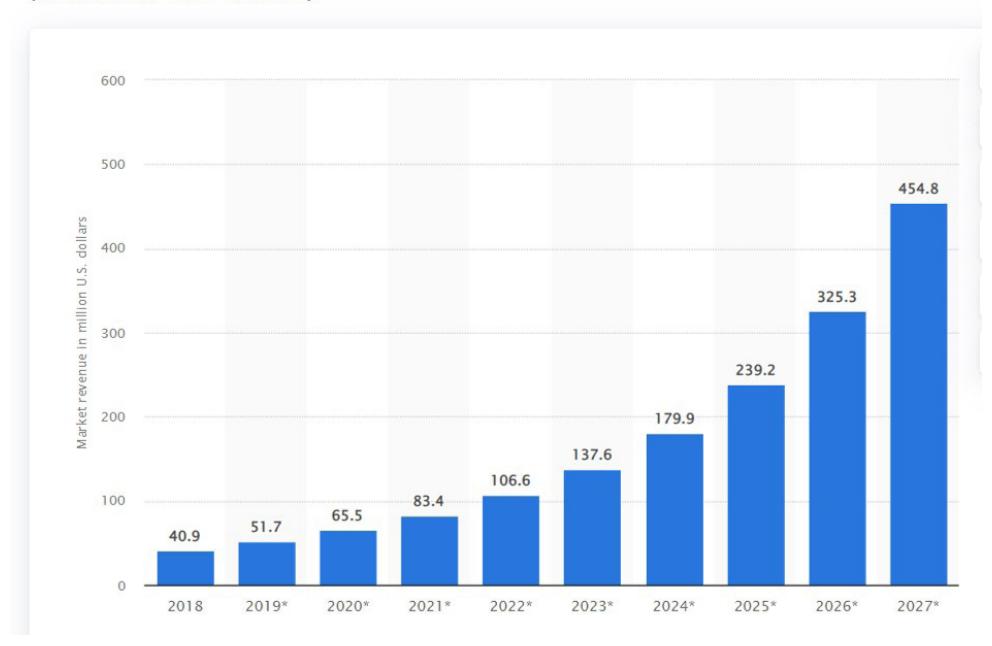
Figure 1 Chatbot market revenue worldwide from 2018 to 2027 (in million U.S. dollars) (Source: Statista, 2022)
On the other hand, the State of Conversational Marketing Drift report said that in 2020, the use of chatbots as brand communication channels jumped from 13 percent in 2019 to 24.9 percent in 2020 (Drift, 2022).
Figure 2 Usage of Chatbot as A Brand Communication. (Source: Drift, 2022)
In Indonesia, large companies have adopted chatbots to serve customers or consumers quickly and without a time limit (Sanny et al., 2020). Call it Sabrina, the name for the chatbot owned by Bank Rakyat Indonesia (BRI); Shalma belongs to Alfamart, Jemma belongs to Unilever; and Veronika belongs to Telkomsel. In addition, chatbots are also significantly beneficial for government agencies serving the community, especially during the COVID-19 pandemic. In the annual report released by the Ministry of Communication and Information (Kominfo) in 2020, the number of chatbot covid19.go.id users reached 2,728,306 and 66,947,278 million SMS had been sent (Kominfo, 2020a). Seeing the high number of chatbot users and the increasing urgency of using chatbots during the COVID-19 pandemic, this study aims to examine the process of adoption and diffusion of this chatbot technology in Indonesia from various perspectives. This study will explore deeper how chatbots are applied in Indonesia, specifically from the diffusion of innovations perspective.
Chatbot Technology
As the term "chatbot" denotes chat and robot, it refers to a computer program that uses human language with the help of a text-based dialog system (Jia, 2003; Zumstein, 2020). Chatbots are part of artificial intelligence products in the form of service agents that communicate with customers to provide the information needed using natural conversations (Wünderlich & Paluch, 2018). In their application, chatbots can also interact with users through text or audio (Sari et al., 2020). Chatbots developed in various forms, such as calendar assistants, ticket assistants, products assistants, travel assistants, news content assistants, weather forecasters, financial assistants, traffic assistants, customer assistants, and delivery assistants (Cardona et al., 2019; Jenneboer et al., 2022; Selamat et al., 2022; Zumstein, 2020).
Diffusion of Innovation
The diffusion process is essentially an exchange of information that occurs between individuals regarding an idea or several new ideas. Diffusion of innovation was defined by Everett M. Rogers as a process of communicating innovation through certain channels over a certain period, among members of a social system (Rogers, 1983). Based on this definition, there are four important elements in the innovation diffusion process. Specifically, the innovation itself, then the channels of communication, time, and social systems.
Rogers (1983) defines innovation as "an idea, practice, or object that is perceived as new by an individual or other unit of adoption" (Rogers, 1983). Innovation may have been found a long time ago, but if individuals perceive the innovation as something new, then it can still be considered an innovation (Sahin, 2006). An innovation certainly undergoes a development process that includes problem identification through research, development to commercialization of the innovation through the process of diffusion, and adoption of the innovation by users (Meydora, 2019). The decision of an individual or group to accept an innovation is influenced by five characteristics or attributes that exist in the innovation, including:
Relative Advantages
The decision to use innovation is closely related to the consideration of the benefits that will be obtained. In this case, innovation will be seen in terms of whether it has advantages over other innovations or not. If the innovation is considered to provide more benefits, then individuals will tend to adopt the innovation (Scott et al., 2008).
Compatibility
This attribute relates to how innovation is in harmony with values in society, starting from with customs, cultural values, past experiences, and community needs. The higher the compatibility level of innovation, the higher the adoption rate (Rogers, 1983).
Complexity
As a new thing, innovation must have its own level of difficulty. Innovations that have a high level of complexity (more difficult) tend to have lower levels of adoption. On the other hand, an innovation that is easier to use will have a higher adoption rate (Damanpour & Gopalakhrisnan, 2001).
Trialability
The decision to use innovation is also influenced by the extent to which the innovation can be piloted. The easier it is to try, the higher the innovation adoption rate will be (Rogers, 1983).
Observability
It is the scale of the impact of an innovation that can be seen by individuals or society. An innovation that is easy to see how it is used or the process of using it and can see the impact or benefits will attract more people to use it (Rogers, 1983).
Communication Channel
According to Rogers, the diffusion of the innovation process can use two communication channels, namely media and interpersonal communication (Rogers, 1983). These communication channels are an essential element and sometimes determine the success in the diffusion process of innovation. The messages and information about the innovation spread to the target audience through channels. The communication channel can also encourage and teach innovation to the intended audience. Mass communication channels reach a large audience. For instance, television, radio, films, newspapers, and others. Meanwhile, interpersonal communication channels represent direct communication between one person and another or a small group.
Time
Like the previous element, time is also an important element in the diffusion of the innovation process. This element involves several dimensions such as the distance between the process of seeking information about an innovation and the decision to adopt or not to innovation, sooner or later the process of adopting an innovation when compared to other units, to the level of innovation adoption in the system (Rogers, 1983).
Social System
The social system is a set of interconnected units to achieve goals (Rogers, 1983). The parts of the social system are individuals, groups, organizations, and others. The units inside this social system are those who are the target users of innovation. They are classified into five types of adopters, namely:
- 1. Innovators, or people who often experiment and enjoy new things.
- 2. Early adopters or influential people in the surrounding environment.
- 3. Early majority or parties who accept an innovation first than others.
- 4. Late majority or parties who accept the innovation if their surroundings have used it.
- 5. Laggards or the last party in accepting innovation, even rejecting innovation.
Chatbots as Communication Technology in Indonesia
After conducting a literature review, I found that his chatbot technology has not been widely studied by academics in the field of media and communication. Most of the existing literature discusses this technology more in terms of computer science and information technology (Suhaili et al., 2021). In addition, the related studies tend to expose the artificial intelligence capabilities and its natural language processing aspect (Amalia & Wibowo, 2019; Reddy et al., 2021).
On the other hand, chatbot technology is relatively close to communication studies. Chatbot technology can bridge the communication of a particular system with humans and be able to disseminate accurate information briefly. Anticipation of information overload becomes very important during the COVID-19 pandemic, where people around the world are faced with the spread of the virus as well as very fast information and misinformation that causes public panic (Depoux et al., 2020; Wijaya et al., 2022). For this reason, the existence of chatbot technology is considered very urgent to be optimized during a pandemic (Untari, 2020).
Since the beginning of the COVID-19 pandemic, on March 20, 2020, the Indonesian government, through the Ministry of Communication and Information, announced the existence of chatbot technology that is useful for disseminating information related to COVID-19 to the public through the website covid19.go.id (Kominfo, 2020b). In the Indonesian banking industry, for instance, the use of chatbots as customer service assistants also began to increase in 2020 by choosing catchy names such as Aisyah belonging to Bank Syariah Mandiri, Digibot belonging to Digibank, Sabrina belonging to BRI, Viola belonging to Bukopin, and Mita belonging to Bank Mandiri (Arief Mulyono & Sfenrianto, 2022).
Since the chatbot has grown and begun to be widely used by business owners and government agencies, it is important to understand how it is adapted in Indonesia. This research explores how chatbots are adopted by government agencies, providers, MSME, and end-users within the context of a diffusion of innovation study.
Method
This research used a qualitative approach with a case study method. This study analyzes cases related to chatbot innovation implementation in several institutions, companies, and MSMEs in Indonesia. We pick 2 (two) government agency which actively develop their chatbot services, 1 (one) chatbot provider, 1 (one) MSME and 1 (one) end-user for this research.
The data were collected by conducting in-depth (semi-structured) interviews, with the head of technology, or/and head of public relations in each institution. The data in this study was studied using the Diffusion of Innovation Theory.
This study started by focusing on the chatbot implementation issue in Indonesia, choosing several objects that implement chatbots in their business processes, observing and gathering data, conducting several in-depth interviews with capable sources from each object, and lastly providing a research report.
Results and Discussion
Chatbot technology is widely used in various sectors for specific purposes. Some make it a customer service assistant at the company, some make it an assistant for public relations and digital information services.
Chatbot for Customer services and Public Relations in Indonesia
In government agencies such as the Ministry of Investment, or the Investment Coordinating Board (BKPM), and the National Research and Innovation Agency (BRIN), chatbot technology is deliberately presented as a public relations assistant, primarily to help answer questions from the public. BKPM's chatbot is named "Investmin," while BRIN's chatbot is named "RIISKA". Both can be found when people access the government agency's website. Although almost the same, Investmin and RIISKA have differences. Besides being found on the website, RIISKA BRIN is also connected to the Telegram chat application, a feature that Investmin hasn't developed yet. The ways Investmin and RIISKA work are almost the same. Users only need to click on the chatbot icon in the lower right corner of the website, then the chatbot will send an opening message in the form of greetings and ask for the username. After answering the name, the chatbot will greet you and ask for an e-mail address for administrative purposes. Then the user is also asked for a phone number and a list of questions to be asked.
Figure 3 BRIN's Chatbots called RIISKA (Source: brin.go.id)
Figure 4 Investmin Chatbots by Ministry of Investment (Source: BKPM.go.id)
Meanwhile, one of the micro, small, and medium enterprises (MSMEs) based in Yogyakarta, "Kamar Kayu," prefers technology such as chatbots but a very simple version, namely the WhatsApp auto-reply feature. Like BRIN and BKPM, Kamar Kayu's WhatsApp icon is also displayed on the company's website. Visitors to the Kamar Kayu website can directly click on the icon, and then they will be connected directly to the company's WhatsApp. They will then be treated to an opening message such as, "Hello, Sis. "Thank you for contacting Kamar Kayu. "Anything I can do to help?" Anang Hussein, the owner of Kamar Kayu, said that with this feature, customers who contacted him could get a quick response. But on the other hand, Kamar Kayu admits that they do not want to adopt permanent chatbot technology for several reasons, which will be explained in the table below.
Interviews were also conducted with Rachmad Kurniawan, Lead of Technology at Widya Wicara, a company engaged in technology, one of which is providing chatbot technology development services for companies and MSMEs. Not only in text form, but the chatbot provided by Widya Wicara has also penetrated audio technology or can be said to be a chatbot that can speak. The chatbot can answer customer questions orally. As a provider of chatbot products, Widya Wicara already has a lot of experience with the adoption of chatbots by its clients, which range from large companies to MSMEs.
This research also includes the opinions of end-user chatbots to enrich the data. Satriyo Widhi Pamungkas is a user who is quite familiar with chatbot technology. He uses it to easily obtain information
related to taxation in Indonesia through a chatbot belonging to the Directorate General of Taxes (DGT), which was previously difficult to access because the number of workers is limited. The attribution of each chatbot adoption based on the interview is as follow:
Table I Attribution of Chatbot Innovation in Ministry of Investment
| Innovation Attribute | Ministry of Investment | ||
|---|---|---|---|
| Relative Advantages | Public inquiries can get a response immediately, something that is difficult to do without a chatbot due to limited human resources. Cost is not a problem | ||
| Compatibility | Chatbot cover the needs of the agency: serving information the public quickly and it is 24/7. The need to use chatbots is getting more urgent due to the pandemic | ||
| Complexity | It is not complicated because the development and maintenance of the chatbot are handled by a third party. | ||
| Trialability | Before launching, the chatbot was first tested to suit the needs of the agency. But the process is easy because it is done by a third party who is qualified in the IT field. | ||
| Observability | The impact and benefits of using chatbots can be seen through chatbot user traffic data. | ||
(Source: research data, 2022)
Table II Attribution of Chatbot Innovation In BRIN
| Innovation Attribute | BRIN | |||
|---|---|---|---|---|
| Relative Advantages | • The chatbot can respond to questions quickly and is not limited to working hours, so that the public's need for information about BRIN is well fulfilled. • Previously, the evaluation of the public service index at BRIN was quite low. After adopting the chatbot, BRIN's public service index has increased. • Institutions can continue to serve information to the public without having to make direct contact during the pandemic. | |||
| Compatibility | • Chatbots are considered an institution's necessity to reform public services, which were initially considered less responsive to public information demands • Essentials, serving the community quickly with flexible time because there are no limited working hours • Urgent, due to the pandemic | |||
| Complexity | • The initial construction of the chatbot was assisted by a third party • After the contract is finished, BRIN takes over the chatbot operations and assists with training • The internal IT team in charge of updating the RIISKA chatbot started in 2022 | |||
| Trialability | The trial can be done effortlessly with a solid internal IT team | |||
| Observability | • The impact of chatbot technology can be felt mainly when the current pandemic reduces human interaction. With the chatbot, this interaction can be contactless. • Chatbot performance can be easily monitored and evaluated. | |||
(Source: research data, 2022)
TABLE III Attribution of chatbot innovation in Kamarkayu
| Innovation Attribute | Kamarkayu | |
|---|---|---|
| Relative Advantages | Customers can get a fast response | |
| Compatibility | The chatbot isn't urgent because most of the products made are custom products that require a personal touch. This cannot be done if communication with customers uses a chatbot. | |
| Complexity | WhatsApp automation is plugged in together with website development. Complexity is an obstacle since they don't have internal IT Support. | |
| Trialability | Familiar to chatbot technology, but companies don't feel the need. The WhatsApp feature is suit best to the company business | |
|---|---|---|
| Observability | Know the impact and benefits but they don't need it yet. | |
(Source: research data, 2022)
Table IV Attribution of Chatbot Innovation in Widya Wicara
| Innovation Attribute | Widya Wicara | |||
|---|---|---|---|---|
| Relative Advantages |
| |||
| Compatibility | The features in the chatbot can be adjusted to the company's needs, also related to the desired language style and what topics you want to display | |||
| Complexity | Chatbot providers also provide development and maintenance services so that companies or MSME users of chatbots have no trouble running them. | |||
| Trialability | It can be tested before launched. It can be revised if there is something that needs to be fixed. | |||
| Observability |
| |||
(Source: research data, 2022)
Table V Attribution of Chatbot Innovation in End-user
| Innovation Attribute | End -user | ||
|---|---|---|---|
| Relative Advantages |
| ||
| Compatibility | According to user needs, the chatbot makes it easier to access information about taxation, which usually takes a long time to come to the office or telephone the relevant department. | ||
| Complexity | User friendly | ||
| Trialability | User friendly | ||
| Observability | The impact of chatbot technology can be directly felt by users, one of which is the ease of accessing information related to taxation. | ||
(Source: research data, 2022)
The resume of the discussion can be seen as listed in the table:
Table VI The Comparation of Diffusion Innovation Study in Chatbot Technology Adoption in Indonesia
| Government (BRIN) and (Ministry of Investment) | SMSE (KamarKayu) | Provider (WidyaWicara) | End-User | |
|---|---|---|---|---|
| Relative Advantages | Responsive, Easy, efficient, on budget | Responsive | Responsive, | Responsive, Accessible 24/7 |
| Compatibility | Adjustable | Adjustable | Customizable | Urgent |
| Complexity | Capable to build and adjust | Too Expensive to build/adapt | Upgradable | User Friendly |
| Trialability | Easy with in house team | Unnecessary due to budget | Customizable | User Friendly |
| Observability | Traffic is raising | Unnecessary due to budget | Feature to review | Easy Access |
Disseminate Chatbot in Communication Channel
Based on interviews with informants, the communication process for this chatbot technology consists of two phases: first, communication from developers or providers of chatbot creation services to businesses, or institutions or agencies, that will adopt chatbots. Second, communication from companies, institutions, or agencies that have chatbots to end-users such as stakeholders, customers, or clients. The communication channels used in the diffusion process of this chatbot innovation are categorized into two types, namely mass communication channels and interpersonal communication.
Mass Communication Channel
The chatbot technology in Indonesia is widely promoted by providers. In online media, we can find the names of start-ups that often appear, like kata.ai, which was lined up to develop chatbots for Telkomsel, Unilever, Bank Rakyat Indonesia (BRI), Alfamart, and many more (Katadata, 2018). The other provider, Widya Wicara, works on Astra's chatbot. Rahmad Kurniawan, Widya Wicara's Lead of Technology, said in the interview that his start-up also promoted this chatbot technology through the company's website and social media. Widya Wicara also mentions several advantages of using chatbot technology, such as being able to bring customers closer, adding new marketing targets, increasing customer satisfaction and loyalty, maximizing service, increasing company performance, minimizing errors, and cutting costs. The process of promoting this innovation is also carried out by agencies or chatbots user for their endusers. The National Research and Innovation Agency (BRIN) has communicated its chatbot technology through social media posts such as Instagram with the nickname "RIISKA" complete with its features and functions.
"This is still in beta version, so it can't be released massively." "For example, (if we launch in) mass media, the information is still incomplete" (Masluhin Hajaz, S.T., M.M., BRIN official in an interview on January 22, 2022).
However, from the author's search results, several online mass media already cover the BRIN chatbot services. On the other institutions, the end-user who became the resource person in this study said that he got information about the chatbot of the Directorate General of Taxes (DGT) from the Directorate's social media. New media channels are preferred for most companies and agencies to promote their chatbot technology.
Interpersonal Communication Channel
In addition to mass communication channels, interpersonal communication channels are also used in the dissemination process of this chatbot technology. Widya Wicara said that apart from websites, social media, and mass media, they also approached companies or MSMEs directly. According to Rahmad Kurniawan, this is a surefire way to make companies or MSMEs eventually eager to adopt chatbot technology for their business. In addition, Widya Wicara also takes an interpersonal approach with MSMEs to introduce this chatbot technology through seminars or another forum.
"The MSME actors are not familiar with chatbots, so they need to be educated first" (Rahmad Kurniawan, Lead of Technology Widya Wicara in Interview on 01/21/2022).
"...in Indonesia, we are indeed paving the way to introduce the chatbot itself. That way, we can open the widest possible market (chatbot) in Indonesia" (Rahmad Kurniawan, Lead of Technology Widya Wicara in Interview on January 21, 2022).
The Ministry of Investment admitted that it did not publish its chatbot technology on social media, online, or in print mass media. The chatbot launch process is only done by installing the chatbot icon and feature on the official website of the Ministry of Investment. On the other hand, the process of communicating chatbot technology is carried out interpersonally, from the Director of Electronic Media of the Ministry of Investment to the staff, as well as by cooperating with vendors from third parties.
Time
The use of chatbot technology has been established for a long time; ELIZA, for instance, was already introduced at MIT in 1966 (Reddy et al., 2021). However, its use has increased since the COVID-19 pandemic (Miner et al., 2020). Based on our study, the process of transferring knowledge about chatbot technology to the
Ministry of Investment only takes about 10 months, starting from the initiation of the chatbot installation until the chatbot is launched. The initiation came in early 2021, along with the increasing need for contactless services due to mobility restrictions. This is also a consideration for BRIN in the process of adopting chatbot technology. However, BRIN is faster in the process of adopting chatbot technology, which took only about 5 to 6 months and included a long bureaucratic process, especially in terms of procurement.
Social System
The chatbots is feasible to be implemented, especially for government because of the ease of obtaining funding in the form of a yearly budget. This is certainly different for MSMEs that have limited funds. Therefore, it is not surprising that many government agencies have used this chatbot technology as a public relations assistant. In addition, the ease of adopting chatbots in government agencies also occurs because the initiation usually comes from superiors who have great power in regulating an institution. Moreover, the adoption of a chatbot by a government agency shows its totality in serving the interests of the wider community. However, government agencies can be included in the early majority category.
Conclusion
This study portrays how chatbot technology grows in Indonesia. It also suggests that stakeholders with budget capabilities consider the chatbots due to their service flexibility and human-source efficiency. The benefit of a chatbot that does not have a limitation on working hours is also an additional consideration. The chatbot is feasible for governments and big companies.
For MSMEs, the chatbot is still an expensive technology to adopt. The available default Messenger fast response feature is still the best option. MSMEs see that they still need a personal touch in every transaction they make, so chatbots are not urgent for them.
From the provider side, the development of chatbot technology in Indonesia is improving. They are also able to cover adjustments based on client needs. As a third party, they provide maintenance after the installation. But it is urgent to make the "Bahasa Indonesia" language process more advanced. It is considered less advanced and costly compared to English. In Additional, researchers see a dependence on third-party managers, where trial and maintenance, everything is done by third parties. The existence of an internal IT team is essential so that the sovereignty of the system and data can be maintained.
The end user is also gradually familiar with this technology. For millennials, the presence of a chatbot makes it easier for them to access information with a pop-up interface, a fast response, and unlimited hours of service. The chatbots can provide access to information at any time. This kind of flexibility is a necessity today.
Mass media and interpersonal communication are the main channels for disseminating chatbots. Mass media communication and new media are essential to spreading the existing chatbot facilities as widely as possible. Meanwhile, interpersonal communication becomes a bridge for knowledge transfer between managers, especially at the beginning of application development, from the developer to the daily administrator of the application.
Further research suggested exploring the end user perspective on services through chatbots, their sentiments, and criticisms. There is also a research gap in chatbot technology from a social economy perspective. It includes the cost and benefit, the strategies, and the challenges of its adoption for each stakeholder.
Acknowledgement
We would like to mention LPDP and Saintek for funding this research
References
- Adamopoulou, E., & Moussiades, L. (2020a). An Overview of Chatbot Technology. IFIP Advances in Information and Communication Technology, 584 IFIP, 373–383. https://doi.org/10.1007/978-3- 030-49186-4_31
- Adamopoulou, E., & Moussiades, L. (2020b). Chatbots: History, technology, and applications. Machine Learning with Applications, 2, 100006. https://doi.org/10.1016/j.mlwa.2020.100006
- Amalia, E. L., & Wibowo, D. W. (2019). Rancang Bangun Chatbot Untuk Meningkatkan Performa Bisnis. Jurnal Ilmiah Teknologi Informasi Asia, 13(2).
- Arief Mulyono, J., & Sfenrianto. (2022). Evaluation of Customer Satisfaction on Indonesian Banking Chatbot Services During the COVID-19 Pandemic. CommIT Journal, 16(1), 69–85.
- Cardona, D. R., Schönborn, S., Werth, O., & Breitner, M. H. (2019). A mixed methods analysis of the adoption and diffusion of chatbot technology in the German insurance sector. 25th Americas Conference on Information Systems, AMCIS 2019, 1–10.
- Damanpour, F., & Gopalakhrisnan, S. (2001). The Dynamica of the Adoption of Product and Process Innovations in Organizations. Journal of Management Studies, 22(2380), 45–65.
- Depoux, A., Martin, S., Karafillakis, E., Preet, R., Wilder-Smith, A., & Larson, H. (2020). The pandemic of social media panic travels faster than the COVID-19 outbreaks. Journal of Travel Medicine, 27(3), 1–2. https://doi.org/10.1093/jtm/taaa031
- Drift. (2022). Power Up Your Marketing Automation.
- Indrayani, L. M., Mita Amalia, R., Zahira, F., & Hakim, M. (2019). Emotive Expressions in Social Chatbot. Jurnal Sosioteknologi, 18(3), 509–518.
- Jenneboer, L., Herrando, C., & Constantinides, E. (2022). The Impact of Chatbots on Customer Loyalty: A Systematic Literature Review. Journal of Theoretical and Applied Electronic Commerce Research, 17(1), 212–229. https://doi.org/10.3390/jtaer17010011
- Jia, J. (2003). The Study of the Application of a Keywords-based Chatbot System on the Teaching of Foreign Languages. 1–11. http://arxiv.org/abs/cs/0310018
- Katadata. (2018, June 14). Kata.ai, Startup di Balik Chatbot Veronika dan Sabrina. Katadata. https:// katadata.co.id/yuliawati/digital/5e9a55e674305/kataai-startup-di-balik-layanan-chatbot-veronikadan-sabrina
- Kominfo. (2020a). 2020 Connected Indonesia.
- Kominfo. (2020b, March 19). Dukungan Layanan Prima Telekomunikasi dan Penyiaran untuk Atasi Covid-19. Siaran Pers No 46. https://www.kominfo.go.id/index.php/content/detail/25203/siaranpers-no-46hmkominfo032020-tentang-dukungan-layanan-prima-telekomunikasi-dan-penyiaranuntuk-atasi-covid-19/0/siaran_pers
- Luk, T. T., Lui, J. H. T., & Wang, M. P. (2022). Efficacy, Usability, and Acceptability of a Chatbot for Promoting Covid-19 Vaccination in Unvaccinated or Booster-Hesitant Young Adults: Pre-Post Pilot Study. Journal of Medical Internet Research, 24(10). https://doi.org/10.2196/39063
- Meydora, E. Y. (2019). Proses Difusi Inovai E-agribisnis: Regopantes pada End-user Komoditas Pertanian di Jabodetabek. Jurnal Komunikasi Dan Media, 3(2).
- Miner, A. S., Laranjo, L., & Kocaballi, A. B. (2020). Chatbots in the fight against the COVID-19 pandemic. npj Digital Medicine (Vol. 3, Issue 1). https://doi.org/10.1038/s41746-020-0280-0
- Mohamad Suhaili, S., Salim, N., & Jambli, M. N. (2021). Service chatbots: A systematic review. In Expert Systems with Applications (Vol. 184). Elsevier Ltd. https://doi.org/10.1016/j.eswa.2021.115461
- Móricz, P., & Marciniak, R. (2019). Intelligent Business Services. Proceedings of 10th International Symposium on Intelligent Manufacturing and Service Systems, 110–120.
- Reddy, K. S., Farooq, M., Sunil, B., & Chowdary, T. (2021). A Review on Development of Smart Chatbot Using Natural Language Processing. PIMT Journal of Research, 13(3), 39–42.
- Rogers, E. M. (1983). Diffusion of innovations. Free Press.
- Sahin, I. (2006). Detailed review of rogers' diffusion of innovations theory and educational technologyrelated studies based on rogers' theory. The Turkish Online Journal of Educational Technology (Vol. 5).
- Sanny, L., Susastra, A. C., Roberts, C., & Yusramdaleni, R. (2020). The analysis of customer satisfaction factors which influence chatbot acceptance in Indonesia. Management Science Letters, 10(6), 1225–1232. https://doi.org/10.5267/j.msl.2019.11.036
- Sari, A. C., Virnilia, N., Susanto, J. T., Phiedono, K. A., & Hartono, T. K. (2020). Chatbot developments in the business world. Advances in Science, Technology and Engineering Systems, 5(6), 627–635. https://doi.org/10.25046/aj050676
- Scott, S. D., Plotnikoff, R. C., Karunamuni, N., Bize, R., & Rodgers, W. (2008). Factors influencing the adoption of an innovation: An examination of the uptake of the Canadian Heart Health Kit (HHK). Implementation Science, 3(1). https://doi.org/10.1186/1748-5908-3-41
- Selamat, M. A., & Windasari, N. A. (2021). Chatbot for SMEs: Integrating customer and business owner perspectives. Technology in Society, 66(July), 101685. https://doi.org/10.1016/j. techsoc.2021.101685
- Selamat, M. A., Windasari, N. A., Zumstein, D., Luk, T. T., Lui, J. H. T., Wang, M. P., Weeks, R., Cooper, L., Sangha, P., Sedoc, J., White, S., Toledo, A., Gretz, S., Lahav, D., Martin, N., Michel, A., Lee, J. H., Slonim, N., Bar-Zeev, N., … Soellner, M. (2022). Chatbot developments in the business world. Journal of Medical Internet Research, 24(1), 627–635. https://doi.org/10.1016/j. techsoc.2021.101685
- Untari, I. M. (2020). Chatbots and Government Communications in Covid-19 Pandemic. Jurnal Komunikasi Indonesia, IX (2).
- Weeks, R., Cooper, L., Sangha, P., Sedoc, J., White, S., Toledo, A., Gretz, S., Lahav, D., Martin, N., Michel, A., Lee, J. H., Slonim, N., & Bar-Zeev, N. (2022). Chatbot-Delivered COVID-19 Vaccine Communication Message Preferences of Young Adults and Public Health Workers in Urban American Communities: Qualitative Study. Journal of Medical Internet Research, 24(7). https:// doi.org/10.2196/38418
- Wijaya, G., Zakaria, F., & Ida, R. (2022). The Responses of Healthcare Professionals and the Media to the Emergency Mobile Restriction Policies on social media. Nyimak: Journal of Communication, 6(2), 131. https://doi.org/10.31000/nyimak.v6i2.5854
- Winkler, R., & Soellner, M. (2018). Unleashing the Potential of Chatbots in Education: A State-Of-The-Art Analysis. Academy of Management Proceedings, 2018(1), 15903. https://doi.org/10.5465/ ambpp.2018.15903abstract
- Wünderlich, N. v., & Paluch, S. (2018). A Nice and Friendly Chat with a Bot: User Perceptions of AI-Based Service Agents. ICIS 2017: Transforming Society with Digital Innovation, 0–11.
- Zumstein, D., & Hundertmark, S. (2018). Chatbots: an interactive technology for personalized communication and transaction. IADIS International Journal on WWW/Internet., 5(1), 96–109.