

INFO ARTIKEL
Kata kunci:
logika teknik, techno culture, konstruksi sosial teknologi, logika sosial
ABSTRAK
Artikel ini memberikan kontribusi perspektif teknokultural dalam memahami konstruksi sosial jembatan hati 3 sebagai sebuah teknologi serta mengungkap dimensi teknologi dan sosial dari jembatan tersebut. Metode penelitian etnografi digunakan dalam memahami jembatan sebagai produk teknologi dan sosial. Perancangan, konstruksi, dan pemeliharaan jembatan di Kampung Cipadung, Desa Daroyon, Kecamatan Cileles, Kabupaten Lebak, Banten Indonesia. Metode ini menggunakan model partisipatif, yaitu tim insinyur dan peneliti (dari luar) dan masyarakat lokal (dalam) berkolaborasi dalam mendefinisikan desain, fungsi dan pemeliharaan jembatan, berdasarkan kondisi geografis, lingkungan, dan sosial. Hasil penelitian menunjukkan pembangunan jembatan merupakan simbiosis logika teknis fungsionalitas, kesederhanaan, efisiensi, daya tahan, dan logika sosial keterhubungan, peningkatan, kekompakan, kesamaan.
https://doi.org/10.5614/sostek.itbj.2022.21.3.8
Introduction
Socio-technical modes have been used as a basic model for understanding the social construction of technology in a rural area. Socio-technical models are based on the proposition that the design and construction of infrastructure in rural areas are influenced by both technical logic and social logic as the foundations of the design and construction of infrastructure. This paper explains the social construction of the Jembatan Hati 3 bridge in Kampong Cipadung, Desa Daroyon, Kecamatan Cileles, Kabupaten Lebak, Banten. Indonesia is analyzed at two related levels: at the level of design-construction and at the level of maintenance. At the level of design and construction, the basic idea of the bridge was based on the need, aspiration, and value of the local people. The level of maintenance has been carried out by applying visual inspection of bridges, routine maintenance, periodic checks, periodic maintenance, and detailed/specific checks (Omar & Nehdi, 2018). This maintenance is conducted not only to obtain administrative data, technical data, and data on bridge conditions but also to determine the effectiveness of the bridge maintenance method employed. Generally, the most important thing in bridge maintenance is to keep it in good condition and restore its original capacity to serve its users effectively (Bart, 2012).
To sustain an emerging technology, several collaborating actors will determine the shape of the technology-specific structures to be built, putting all risks in that technology (Söderholm et al., 2019). Since the study of the bridge in Kampong Cipadung is not only about the bridge itself as a technology, but also its social dimensions, technoculture is applied as a comprehensive approach in studying "the mutual relations between technology and culture that are expressed in the patterns of social life, economic structure, politics, art, literature, and popular culture" ("Technoculture: The Key Concepts," 2009). It is a comprehension of the mutual relationships (dependence, interdependence, or feedback) that exist between technology and culture. The emphasis in the early stages of technological development is usually on scientists and engineers who attempt to verify and optimize technology solutions to allow for up-scaling (Frishammar et al., 2015). Thus, prior to or along with the introduction of new technologies, it is necessary to create a community situation model that is influenced by various factors, including both the acceptance and the rejection of the community towards new technology. There have been numerous incidents involving the community's improper use of bridges and other public facilities, which may endanger the perpetrators as well as disrupt and endanger the people who cross the bridges.
Both at the level of design/construction and maintenance, the participation of the local community is also highlighted (Selman, 2004). At the level of maintenance, the emphasis is on the dissemination of the procedures for bridge care and maintenance to the community, along with an accompanying mentoring program related to it. This mentoring program was intended not only to encourage the residents' active participation in bridge construction and maintenance but also to create a sense of ownership of the bridge, thereby ensuring that it functions properly and lasts a long time. In this study, the observations were conducted at the study site, which is a community in Kampong Cipadung that uses the Jembatan Hati 3 bridge. The community of this village is dominated by indigenous people, with very few non-indigenous. Most of the people in this village are farm laborers and mat makers, because of which transportation infrastructure plays a very important role as an access point to move commodities to various other regions.
Prior to this study, a bridge that connected Cipadung Village with Jayasri Village had been built. The bridge was built by a local government-assisted fund and a community self-help fund. However, the condition of the bridge was very worrying because it could not guarantee the safety and comfort of the users. Due to this worrying condition, a permanent bridge, called the Jembatan Hati 3 bridge, was built to replace the then existing bridge. With the construction of the Jembatan Hati 3 bridge, which was expected to facilitate and improve the social and economic interactions in Cipadung, it was presumed that the people of Kampong Cipadung would need an insight into how to prevent the newly built bridge from being damaged. The bridge picture can be seen below.
Figure 1. Jembatan Hati 3 (Source. Personal Picture)
The significance of this study is to understand the social construction of the bridge both at the level of design-construction and at the level of maintenance, particularly operational standards for the maintenance. To systematically study the social context of the bridge as a technology, it is important to understand technology itself in a more comprehensive and holistic way. Bijker and Shaw, in particular, see technologies as things that are not purely technological, in the sense that they only embody technological elements (Bijker, 1995; "Technoculture: The Key Concepts," 2009). In contrast, technologies ". . . embody social, political, psychological, economic, and professional commitments, skills, prejudices, possibilities, and constraints" (Constant, 1994). Within a socio-technical context, the latest technology in existence has previously gone through different conditions; whether there was an equal attempt to develop an innovation system, the technology diffusion process among its followers was expected to be different from that in the core (Bento & Fontes, 2015). If we focus on the social and cultural dimensions of technology, it can be argued that to study a certain technology is not sufficient to describe or uncover the elements and structures of the technology alone, but also the social and cultural context in which the technology is designed, constructed, produced, and used. In other words, to study technology is to uncover the 'technical logic' as well as the "social logics" within which a certain technology is developed.
Nevertheless, with the recent development of advanced science and technology, the term 'society' itself has undergone a transformation, due to the role of science and technology in shaping social life. Here, we can see the Janus face dimension of the study of technology and society. On the one hand, technology not only consists of social and cultural elements, but it is also socially constructed (Carvalho et al., 2017). This is because a certain technology is created based on a certain social need, function, use, value, or meaning. On the other hand, a particular society has not only benefited from being employed as a result of technological products (infrastructure, devices, facilities, and tools), but has also been shaped by the technology itself. For example, how the development of the mobile phone has radically changed the social dimension of the communication of the village inhabitants. In other words, neither technology nor society can be understood as a stable and unchanging thing (Nogueira, 2017).
The Social Construction of Technology (SCOT) is a major theory in the study of technology. Its main idea is that all technologies are shaped by and reflect society. Technology is a mirror image of society in the sense that the social system, structure, and relations affect the product of technology itself (Constant, 1994). To understand the development of technology in the context of social dynamics, there are several requirements at the level of a conceptual framework. First, the conceptual framework should allow for a parallel analysis: an analysis of technological change as well as technical continuity and stability. Second, the framework has a basic understanding that the useful functioning of technology is the result of socio-technical development, not its cause. Third, the framework is not built based on a priori distinctions between the social, the technical, the scientific, and the political (Bijker, 1995; Cherp et al., 2018).
To understand a certain technology, it is necessary to identify relevant social groups, their problems, and variants of the solution for solving those problems. In the process, there can also be an identification of all kinds of "controversies" or conflicts: technical conflicts, cultural conflicts, or moral conflicts. It is also necessary to understand "interpretative flexibility," that is, flexibility in how people think of or interpret artifacts, as well as flexibility in how artifacts are designed or produced (Klein & Kleinman, 2002). Latour uses the concept of "translation" to describe this interpretative flexibility, that is, ". . . the interpretation is given by the fact-builders of their interests and those of the people they enroll" (Bijker & Latour, 1988). "Closure" is a state in which all problems or controversies have been resolved, resulting in technological stabilization (Klein & Kleinman, 2002).
In the context of bridge construction, the social construction of technology is an attempt to understand the 'logic' of the construction, particularly what is called 'technical logic' and 'social logic' and their interrelation. The concept of 'technical logic' in this research to describe the 'reason' behind the built environment or man-made-world, like a house, road, harbor, terminal, bridge, or aeroplane. A bridge, as a built environment, has a certain logic in that a certain functional objective must be achieved through the exploration or assemblage of certain materials or elements and the defeat of extraneous determining factors, such as climate, topography, technology, or ecology, in order to construct a certain form or construction that works for a certain purpose.
Yet the bridge is not only an assemblage of materials and elements to create a physical object with a certain structure and form; it is also a construction of a particular spatial environment, in which social activities and relations take place. 'Social logic' is a concept used in this research to denote that the bridge as a built environment is a social object in its very form, because the ordering of materials and spaces in the bridge is about the ordering of social relationships between people who use the bridge, because it is not only about functional objectives but also social objectives and purposes (Hillier & Hanson, 1988).
Method
The research method employed in understanding the social construction of Hati 3 bridge development in Kampong Cipadung Desa Daroyon, Kecamatan Cileles, Kabupaten Lebak, Banten, Indonesia, is ethnographic research. It is a method of understanding the local mind through our interpretation of a certain cultural object: a bridge. The research is an observation of participants involved in the design, construction, and maintenance of a bridge; a holistic construction of cultural and social factors in the construction and maintenance; a contextual explanation of the bridge; a detailed depiction and analysis of social relations and culture; and the theoretical basis of the field research (Stewart, 1998).
Since the object of research is technology in its social setting, a specific ethnographic model is particularly needed in which group participants can learn from each other by sharing information (Hyde et al., 2005). Here, a model of "ethnography of design and innovation" as developed by Vinck (1998) is employed to understand how a certain technology properly works in a certain society. According to him, the urgency of engineers "going out into the field" is to try to understand several technical practices in the field, to understand the various ways of using tools, devices, or facilities, and to interpret the meaning of practical or social action. Here, a bridge as technology covers a multitude of objects (bodies, pillars, rails, sign systems); it involves symbols (colors, shapes, ornaments, graphics); it also involves an organization that can be complicated; it covers human passions, habits, and values, which have to be analyzed and interpreted comprehensively(Vinck, 1998).
In understanding the social significance and cultural meaning of the bridge, a comprehensive perspective about the object must be developed by looking at the wider participants in the generation of the perspectives. Situated and nuanced accounts present the development and changes of infrastructural relations that occur together with each other and with social practices and institutions. As a result, such an approach leads to various other interpretations of infrastructural evolution (Walker & Cass, 2007). Here, the ethnographic research is a holistic consideration of the perspectives of outsiders (of what is called the «ethnic perspective») and insiders (of what is called the «emic perspective») and the intersection between these two perspectives. The research was conducted to understand the nature of the involvement of the outsiders, the nature of the participation of the insiders in the design, construction, and maintenance of the bridge, and the division of labor between the outsiders and the insiders within the construction and maintenance of the bridge. The outsiders here are the members of the research team, and the insiders are the local stakeholders, who participate in the process of the construction and maintenance of the bridge: the headman, mosque caretakers, farmers, local administrators, carpenters, masons, and craftsmen.
Ethnography is not only a participatory-based method, particularly for the local people, but also research about the involvement of local language, sign, symbol, and value in the construction and maintenance of the bridge, based on their particular constellation of experience, knowledge, and orientations. Local languages and symbols are particularly important in the context of communication in the design, construction, and maintenance of the bridge and in the socialization and dissemination of ideas or concepts related to maintenance. In addition, local skills, expertise, and experiences are central elements in the participation in building and maintaining the bridge, as they are the main consideration in determining the type, function, shape, structure, and sign system of the bridge. Experts, as defined in this research, are people who: (1) are knowledgeable in a particular area as a result of their daily business activity; and (2) have the willingness to share with others their knowledge and experience voluntarily (Landeta et al., 2011).
For further analysis of the social construction of bridge development and maintenance, this research uses a combination of the Latour model of mutual determinism in "technogram' and "sociogram" and Bijker's model of social construction of technology (SCOT). The understanding of 'technogram" and "sociogram" is an attempt to scrutinize the mutual determinism of technology and society. On the other hand, the SCOT model is employed to understand social groups that are relevant to the technological construction and the flexibility of interpretation or translation of technology in the social life of the peasants of Cipadung. The analysis tries to uncover two inseparable logics of the construction of the bridge, namely, the "technical logic" of the construction of the bridge to understand the technological basis of the bridge; and the "social logic" of the design, construction, and maintenance of the bridge and how they are related to the technical logic.
Result and Discussion
Based on the principle of SCOT discussed previously, it can be argued that the study of the bridge as a product of technology cannot be separated from the society in which the technology is created, produced, and used, and vice versa. In other words, the technology must be studied within the framework of "mutual determinism" and the "diffusion model" proposed by Latour. According to Latour, social (or cultural) determinism must be seen as having a reciprocal relationship to technological determinism. On the one hand, we must look at the social subjects that have to be enrolled by technology. Through these social subjects, it can be explained how an idea diffuses, a system is accepted, and a product is rejected. On the other hand, we must consider what aspects of technology make enrollment unavoidable. Latour calls the first a "sociogram" and the later a "technogram" (Spile et al., 2016).
To successfully gain sustainable development and competitive advantage, there have been various attempts to employ methodologies that promote technology convergence (Yasunaga et al., 2009). The technical logic of the bridge construction in Cipadung is the result of the construction and maintenance of the bridge. The choice of the bridge construction was driven by what we call "technical logic": First, the bridge was in a remote area that could possibly be missed by a routine technical supervision program. As a result, a free maintenance bridge model must be devised. Second, when compared to suspension bridge models, which use more open bolts and sling cables, the composite steel girder and concrete floor bridge of a 12 + 8-meter span with two pedestals practically does not use steel joints or sling cables. Therefore, specific supervision and care are required. Third, the bridge's abutment and pillar construction were made from cobblestones because the stone material was quite easily obtained around the location. Fourth, the bridge model could be implemented with conventional equipment without using special equipment or heavy equipment. Fifth, the abutment construction was located on the land, making construction activities easier to complete. Sixth, the pillars of the bridge were made of cobblestones whose mass was large enough to withstand both the highest flood currents and the drifting material, such as the roots and branches of the tree, carried by the flood currents themselves.
These technical logics were translated to the design of the bridge in Kampong Cipadung, to produce a technically strong, environmentally responsive, and timely durable bridge. The bridge consists of two spans with one pillar in the middle of the spans and two abutments. The bridge model consists of a composite of steel girders and reinforced concrete plates. Cobblestones were used for both the abutment and the pillar construction. They are situated on the land without being submerged by the river's water in its normal condition. Their placement made the foundation work easier. The surface under the bridge is raised above the highest flood level. The information on the highest flood level was obtained from the local people living closest to the bridge location. Also, the effects of the flooding on the environment around the bridge site were considered. The data for the Jembatan Hati 3 bridge are listed below. The bridge span is 20 m (12 + 8), the bridge width is 1,2 m, and the ridge function is for a two-wheeled vehicle.
The construction of the bridge is also a logical consequence of the geographic character of the Cipadung sub-district area, Cileles. In general, the topography of the Cileles area is on a plateau with an altitude of 120–230 m above sea level (asl), and an average height of 150 m (asl). The average population density in Cileles Sub-district reaches 310. This means that each square kilometer in Kecamatan Cileles is inhabited, 310 people. The agricultural sector contributes significantly to the economy in Cileles Subdistrict, especially the rice crop, which is the main source of the basic needs of the population.
Based on the Latour model of translation, local people take part in the process of translating or interpreting the bridge as an artifact.The first type of translation is the interpretation of the engineer about the type of bridge based on the functional objective, geographical determinism, environmental setting, and technical constraints, of what is called "technical logic." The second type of translation is the interpretation by the local people of the bridge between their social needs, aspirations, ideas, beliefs, cultural values, and social habits, which is called "social logic." In terms of technological translation, it can be argued that the bridge in Kampong Cipadung was designed based on the following technical logics:
Firstly, the logic of functional analysis can be very useful for the purpose of focusing on specific aspects of social relations (Brighenti & Castelli, 2016). The design of the bridge in Kampong Cipadung is adapted to the function of the bridge. The bridge is only 1.2 m wide and can only be traversed by a twowheeled vehicle such as a bicycle or motorcycle.The functional logic of this design is based on the fact that most of the people in this village are farm laborers and mat makers, in the context of which transportation infrastructure plays a very important role as an access point to move commodities to various other regions, and the means of transportation in the local area is mainly motorcycle. The construction of the bridge in the area is capable of intensifying mobility in the area, which can accelerate the economic growth of the local area. Agricultural revitalization, which belongs to one of the acceleration development programs in Cileles District, is one of these social factors, the result of which is that the agricultural growth in this sub-district is the highest among that of the other sub-districts in Lebak Regency. Without a good transportation system, it is impossible to be achieved.
The second is the logic of durability. Following the bridge's construction, checking and direct checking were performed to assess the bridge's physical condition. From the field research, it can be shown that the bridge railing still looks good and complete, without any damage or defect, although some railing paint looks faded, which has been caused by the absence of maintenance. The bridge pillars and their surface paint, the floors made of reinforced concrete, the girders of the bridge made of steel profiles, the bottom of the bridge, and the environment around the bridge, all appear to be in good condition and still look new and complete, without any damage. There is very little litter and very few wild plants growing around the base and pillars of the bridge. The wooden cones that are installed at the front of the base and pillars of the bridge are still in good condition. In other words, there is no position change on the truck path. From these conditions, it can be concluded that durability is one of the main considerations in the design of the bridge (Fahmy et al., 2016).
Second, there is the logic of technical simplicity. Based on the previous discussion about the enthusiasm of residents for the process of checking and monitoring the condition of the bridge, it is necessary for them to design the maintenance and care standards that are based on the results of the survey. Physically, the Jembatan Hati 3 bridge was made simple and does not use a lot of heavy materials. Its maintenance and construction also look practical because the bridge does not use bolts or steel sling connections. The construction of the upper floor of the bridge is made of concrete and steel beams, while the base and pillars of the bridge are made of a pair of massive cobblestones; hence, it is easy to carry out the maintenance and care of the bridge. Technically, the maintenance of the bridge can use local materials like brick, sand, and gravel, and it can also be implemented by the local masons or bricklayers. It can be concluded from the interpretation of the type of bridge for the local area that simplicity is one of the main considerations in the design of the bridge (Prendergast & Gavin, 2014).
The third is the logic of technical efficiency. As discussed previously, the maintenance method is divided into three categories: routine maintenance, periodic maintenance, and special maintenance. Routine maintenance is basically preventive work that is repetitive and performed in a simple way to match the bridge's lifetime. This is the least costly and most inexpensive type of maintenance, which can be done by anyone because it does not require special expertise. This maintenance has the benefit of ensuring the durability of the bridge's construction. The scope of routine maintenance on the Jembatan Hati 3 Bridge includes the following aspects: cleaning the surface of the bridge floor, general cleaning, and simple maintenance. At the surface level, the concrete floor of the bridge must be cleaned regularly, or if necessary, every day, to prevent paint damage and eventually rust on the steel. This work is very easy to do because it only needs a broom to clean the plane of the flat surface area, and a brush to clean the fields that are relatively small and unreachable by brooms, such as angles, grooves, and the bases of the bridge where the accumulation of dirt occurs.
However, the bridge's technical logic cannot be separated from its social logic, specifically the social objective, purpose, structure, system, and relation, which can be viewed as a set of social determinism in its construction. One of the social determinisms of the construction of the bridge is the way the function, feature, dimension, and characteristic of the bridge are defined. The design of the bridge is not solely a decision of the engineers, but a decision made with the participation of the local people in determining the design policy of the bridge's construction. The dimension, function, shape, and sign system of the bridge are the product of a kind of "dialogic principle' between the engineers (outsiders) and local people (insiders).
Social life is one of the determining factors in the construction of the bridge. Agricultural revitalization, which belongs to one of the acceleration development programs in Cileles District, is one of these social factors, the result of which is that the agricultural growth in this sub-district is the highest among that of the other sub-districts in Lebak Regency. Cileles District's agricultural crop production in 2013 was as follows: rice paddy reached 14,115 tons, rice field reached 1918,75 tons, corn reached 495,76 tons, cassava reached 3670,4 tons, and sweet potatoes reached 122,7 tons. Aside from its food crop commodities, Cileles District also has fruit potential. Cileles District is well-known for its durian fruit production.
Apart from the transportation infrastructure, the Cileles Sub-district has public facilities. For example, in 2013, the number of school buildings reached 72 units, consisting of 9 kindergarten school buildings, 41 elementary school buildings, 16 junior high school buildings, and 6 high school buildings. Looking at the composition of its school buildings, Cileles Sub-district has had school facilities from the primary level to the secondary level. The process and method of socializing bridge care and bridge maintenance to residents in both the administrative area of the kampong and the village can be discussed by looking at the demographic conditions of each target kampong in this sub-district. From the field data, it can be described that the counseling about bridge care is conducted either at schools or at the hall of the village's office. The objectives of counselling are in developing the awareness of the residents in the administrative area of kampong and of the village about bridge care, maintenance, and safety, and in encouraging the participation of the residents in the administrative area of kampong and of the village in bridge maintenance and maintenance operations.
Some aspects of social logic can be identified from the preceding discussion, which are the basic social reasons or rationales for the design, construction, and maintenance of the bridge in the local area of Kampong Cipadung (see Figure 1).
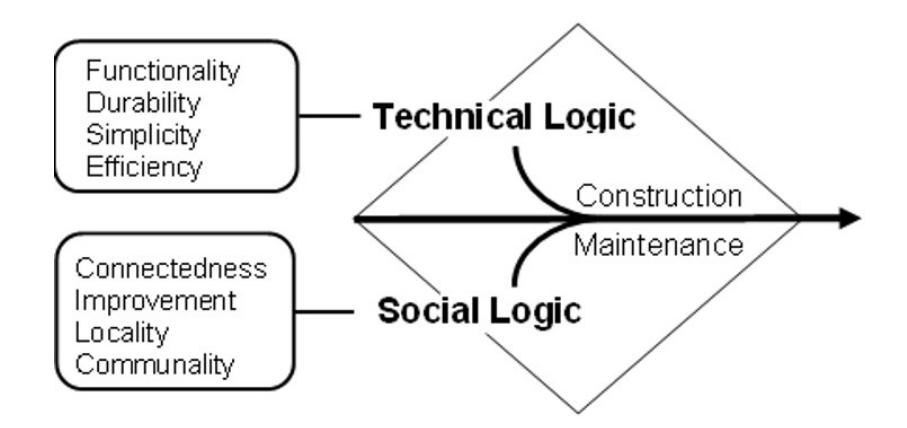
Figure 1 The structural amalgamation of technical logic and social logic in the bridge construction and maintenance
Firstly, the logic of social connectedness. Within the context of the economic aspect, the constraints faced in developing the economic life of the community include the absence of employment in the kampong and village, except for farming. The ability of the entrepreneurial community was limited to making mats. With the Hati 3 Bridge, access to entrepreneurial education was expected to be more developed. Secondly, religious life was very strong in Cipadung, with all the residents being Muslims. It was shown by the routine Holy Quran recitation activities performed by children and women. The children's Holy Quran recitation was not done in the mosque but at the house of the recitation teacher, either after Ashar prayer or after Maghrib prayer. Third, in the cultural context, martial art is one of the distinctive cultural forms in Cipadung, represented by the groups "Karuhun Sekar" and "Cimande." To preserve this cultural heritage, the teaching and practice of these arts must be spread throughout the kampong's isolated area. It can be seen that to properly perform economic, religious, and cultural activities in Kampong Cipadung, connectedness is a basic need for the area, and the bridge is a solution for connecting the local people.
Secondly, the logic of knowledge improvement. At this stage, it involves guidance and counseling on how to apply the principles of technoculture in bridge maintenance and community empowerment in Cipadung. It was expected that the guidance and counseling could improve the residents' knowledge of the principles of technoculture in maintaining Hati 3 Bridge. Along with the improvement of the community's knowledge, it was expected that it would improve their knowledge of extending the life of the bridge, thus affecting positively various other public facilities that the residents could enjoy, such as a low cost of transporting goods. From the informant data, it can be argued that the residents of Cipadung have already understood the socialization of maintaining Hati 3 Bridge, have realized the importance of bridge care and bridge maintenance, and are willing to participate in the maintenance of Hati 3 Bridge, and the establishment of Standard Operating Procedures (SOPs) for bridge maintenance.
Thirdly, the logic of locality. In line with counseling, there is a mentoring program for bridge care and installation using local language and symbols. The objectives are to encourage the active participation of the residents in caring for and maintaining bridges, to foster a sense of ownership and a desire to care for the bridge in the residents, so that the bridge can function properly and last longer. The use of local language and a symbolic system (Sunda) as a social communication system on the bridge, for example, the sign system, is an effective way of building a sense of belonging as well as cultural identity. How social networks run can indicate foresight concerning creativity, interaction, and expertise (Cachia et al., 2007; Georghiou, 2001). The reminder sign that persuades the local people to maintain the bridge, for example, is an effective medium for arousing a sense of local identity as well as a social medium for creating a sense of community.
Fourthly, the logic of commonality. The entire community of Cipadung is dependent on the existence of the Hati 3 Bridge to support their daily activities. Counselling and education in bridge maintenance are also welcomed by the residents with enthusiasm. Based on the field data, several aspects of bridge maintenance can be discussed. Within the context of the social aspect, people hoped that the bridge could last for a long time. Their hope was expressed in their bridge cleaning activity, which was done once a month and coordinated by the kampong administration. This bridge cleaning activity was realized through such activities as sweeping the bridge floor, removing iron and steel pieces from the road, cleaning the surrounding river, and lifting wood trash that crosses the river bridge. The social logic of cleaning and maintenance works and activities is a logic of commonality in which togetherness, commonness, and gotong-royong (the principle of working without any expectation of personal profit, reward, or benefit) play a role. This profitless type of work is the basis of communal life; its main aim is to perform a harmonious form of life (rukun) (Koentjaraningrat, 1974).
Conclusion
Empirical research in the future is likely to focus on concerns over the importance of network management forms in technological development processes and to what extent these various forms are equipped to find effective strategies for network management (Frishammar et al., 2015). The process of counseling about the inspection and treatment of Hati 3 Bridge received a positive response from the residents of Cipadung. This was indicated by their enthusiasm for monitoring the condition of the bridge. In addition, they were also pro-active in discussing the operational standards for bridge care and bridge maintenance. This success was determined by the role of the technoculture approach that gave emphasis on the relationship between the technologies of bridge infrastructure and the interactions among residents that used the technologies of bridge infrastructure. Furthermore, to support social innovators through incentives (for instance, prizes), more active roles of the government and interest groups are expected (Pol & Ville, 2009); space and resources for new social ideas, on the other hand, should be provided by the local government (Jing & Gong, 2012).
It can be concluded from the above discussion that the design, construction, and maintenance of the bridge in Kampong Cipadung are a logical consequence of the amalgamation of two mutual logics: a technical logic and a social logic. On the one hand, the technical logic of functionality, simplicity, efficiency, and durability is the logic that makes the bridge function in accordance with functional objectives and purposes. On the other hand, the social logic of connectedness, improvement, cohesiveness, and commonness is the logic that makes the spatial and environmental construction of the bridge conform to the social objectives of the local people.
Acknowledgment
The research and activities on Jembatan Hati were initiated by the alumni of STAN and stakeholders who are concerned with social problems in the countryside areas in Indonesia. This research was supported by P2MI-ITB 2017 (contract number 367/A/11.C11/PL/2017). The enthusiasm of the surrounding community in running the Jembatan Hati program has played a big role in completing the research and has strongly motivated us to finish writing this paper. We would like to acknowledge and show our gratitude for the valuable discussions with Ms Egy Sutjiati, Ms Nia Kurniasih, and Esa Hidayat who have taken their time to provide input to the authors in writing this article.
References
- Bart, G. (2012). Maintenance medication for opiate addiction: The foundation of recovery. In Journal of Addictive Diseases (Vol. 31, Issue 3). https://doi.org/10.1080/10550887.2012.694598
- Bento, N., & Fontes, M. (2015). The construction of a new technological innovation system in a follower country: Wind energy in Portugal. Technological Forecasting and Social Change, 99. https://doi. org/10.1016/j.techfore.2015.06.037
- Bijker, W. E. (1995). The Majesty of Daylight. The Social Construction of Fluorescent Lighting. In Of Bicycles, Bakelites, and Bulbs: Toward a Theory of Sociotechnical Change.
- Bijker, W. E., & Latour, B. (1988). Science in Action: How to Follow Scientists and Engineers through Society. Technology and Culture, 29(4). https://doi.org/10.2307/3105094
- Brighenti, A. M., & Castelli, A. (2016). Social camouflage: functions, logic, paradoxes. Distinktion, 17(2), 228–249. https://doi.org/10.1080/1600910X.2016.1217552
- Cachia, R., Compañó, R., & Da Costa, O. (2007). Grasping the potential of online social networks for foresight. Technological Forecasting and Social Change, 74(8), 1179–1203. https://doi. org/10.1016/j.techfore.2007.05.006
- Carvalho, A. D. P., Cunha, S. K. da, Lima, L. F. de, & Carstens, D. D. (2017). The role and contributions of sociological institutional theory to the socio-technical approach to innovation theory. RAI Revista de Administração e Inovação, 14(3). https://doi.org/10.1016/j.rai.2017.02.001
- Cherp, A., Vinichenko, V., Jewell, J., Brutschin, E., & Sovacool, B. (2018). Integrating techno-economic, socio-technical, and political perspectives on national energy transitions: A meta-theoretical framework. Energy Research and Social Science, 37. https://doi.org/10.1016/j.erss.2017.09.015
- Constant, E. W. (1994). Shaping Technology/Building Society: Studies in Sociotechnical Change. Edited by Wiebe E. Bijker and John Law (Cambridge, Massachusetts: The MIT Press, 1992. ix plus 341 pp. $29.95). Journal of Social History, 27(4). https://doi.org/10.1353/jsh/27.4.854
- Fahmy, A. S., El-Madawy, M. E. T., & Atef Gobran, Y. (2016). Using artificial neural networks in the design of orthotropic bridge decks. Alexandria Engineering Journal, 55(4), 3195–3203. https://doi. org/10.1016/j.aej.2016.06.034
- Frishammar, J., Söderholm, P., Bäckström, K., Hellsmark, H., & Ylinenpää, H. (2015). The role of pilot and demonstration plants in technological development: synthesis and directions for future research. Technology Analysis and Strategic Management, 27(1). https://doi.org/10.1080/0953732 5.2014.943715
- Georghiou, L. (2001). Third Generation Foresight: Integrating the Socio-economic Dimension.
- Hillier, B., & Hanson, J. (1988). The social logic of space. The Social Logic of Space. https://doi. org/10.4324/9780429450174-9
- Hyde, A., Howlett, E., Brady, D., & Drennan, J. (2005). The focus group method: Insights from focus group interviews on sexual health with adolescents. Social Science and Medicine, 61(12), 2588– 2599. https://doi.org/10.1016/j.socscimed.2005.04.040
- Jing, Y., & Gong, T. (2012). Managed social innovation: The case of government-sponsored venture philanthropy in Shanghai. Australian Journal of Public Administration, 71(2). https://doi. org/10.1111/j.1467-8500.2012.00767.x
- Klein, H. K., & Kleinman, D. L. (2002). The social construction of technology: Structural considerations. In Science Technology and Human Values (Vol. 27, Issue 1). https://doi. org/10.1177/016224390202700102
- Koentjaraningrat. (1974). Kebudayaan Mentalitas dan Pembangunan. Gramedia.
- Landeta, J., Barrutia, J., & Lertxundi, A. (2011). Technological Forecasting & Social Change Hybrid Delphi: A methodology to facilitate contribution from experts in professional contexts. Technological Forecasting & Social Change, 78(9), 1629–1641. https://doi.org/10.1016/j.techfore.2011.03.009
- Nogueira, F. D. F. V. (2017). REASSEMBLING THE SOCIAL: AN INTRODUCTION TO ACTOR-NETWORK THEORY, OXFORD UNIVERSITY PRESS, 2005. Formação (Online), 1(25). https://doi.org/10.33081/formacao.v1i25.5251
- Omar, T., & Nehdi, M. L. (2018). Condition assessment of reinforced concrete bridges: Current practice and research challenges. Infrastructures, 3(3). https://doi.org/10.3390/infrastructures3030036
- Pol, E., & Ville, S. (2009). Social innovation: Buzz word or enduring term? Journal of Socioeconomics, 38(6). https://doi.org/10.1016/j.socec.2009.02.011
- Prendergast, L. J., & Gavin, K. (2014). Journal of Rock Mechanics and Geotechnical Engineering A review of bridge scour monitoring techniques. Journal of Rock Mechanics and Geotechnical Engineering, 6(2), 138–149. https://doi.org/10.1016/j.jrmge.2014.01.007
- Selman, P. (2004). Community participation in the planning and management of cultural landscapes. Journal of Environmental Planning and Management, 47(3). https://doi.org/10.1080/0964056042000216519
- Söderholm, P., Hellsmark, H., Frishammar, J., Hansson, J., Mossberg, J., & Sandström, A. (2019). Technological development for sustainability: The role of network management in the innovation policy mix. Technological Forecasting and Social Change, 138(August), 309–323. https://doi. org/10.1016/j.techfore.2018.10.010
- Spile, S., Suzuki, T., Bendix, J., & Simonsen, K. P. (2016). Effective cleaning of copper-stained calcareous stone. Heritage Science, 1–6. https://doi.org/10.1186/s40494-016-0102-5
- Stewart, A. (1998). Ethnographer's Method. Sage Publication.
- Technoculture: the key concepts. (2009). Choice Reviews Online, 46(08). https://doi.org/10.5860/ choice.46-4399
- Vinck, D. (1998). Everyday engineering an ethnography of design and innovation (Dominique Vinck, Ed.). Massachusetts: The MIT Press.
- Walker, G., & Cass, N. (2007). Carbon reduction, "the public" and renewable energy: Engaging with socio-technical configurations. Area. https://doi.org/10.1111/j.1475-4762.2007.00772.x
- Yasunaga, Y., Watanabe, M., & Korenaga, M. (2009). Application of technology roadmaps to governmental innovation policy for promoting technology convergence. Technological Forecasting and Social Change, 76(1), 61–79. https://doi.org/10.1016/j.techfore.2008.06.004