

INFO ARTIKEL
Kata kunci:
arsitektur, makna, ragam hias, rumah tradisional Aceh
ABSTRAK
Rumah Tradisional Aceh (Rumoh Aceh) merupakan salah satu artefak kebudayaan masyarakat Aceh yang pada ornamennya mengandung nilai dan simbol identitas yang merepresentasikan lokalitas arsitektur Aceh. Penelitian ini bertujuan untuk mendeskripsikan eksplorasi ragam hias dan pemaknaannya. Eksplorasi ini berfokus pada letak, jenis, bentuk dasar geometris, dan makna setiap ornamen yang digunakan. Ragam hias ini menunjukkan setiap elemen desain dari fasad rumah yang menggunakan pola motif tertentu. Penelitian ini menggunakan metode studi komparasi dengan pendekatan studi kasus sebagai objek analisis yang dilakukan di Rumah Tradisional Aceh di Desa Lambunot. Hasil analisis membuktikan makna ragam hias pada rumah tradisional Aceh didominasi oleh motif flora, yaitu motif pucok rebong, on cirih, bungong seulanga, bungong awan-awan, bungong seuleupok, bungong tabue, bungong kipah, bulan bintang, bungong geulima, dan tapak catoe. Penelitian ini diharapkan dapat memberikan kemudahan bagi generasi mendatang dalam menjaga dan memaknai nilai-nilai dari rumah tradisional Aceh untuk melanggengkan eksistensi arsitekturnya.
https://doi.org/10.5614/sostek.itbj.2023.22.1.3
Introduction
Indonesia is a nation rich in cultural diversity. One of the cultural products in question is architecture as a place of residence in the form of a traditional house. Traditional architecture is a form of artifact from an area that represents the cultural elements of its community and goes hand in hand with the development of a tribe or nation (Putra & Ekomadyo, 2015). Traditional buildings generally contain social, religious, and cultural values so that their existence can be considered part of a region's identity (Maulin et al., 2019). One form of this traditional culture is the Aceh Traditional Architecture.
The Aceh traditional house reflects the culture, lifestyle, and values believed by the Acehnese people (Izziah et al., 2020). Aceh's traditional houses are the manifestation of the moral culture that functions as a place of residence for the Acehnese people, with all manifestations of the expression of belief in God and adaptation to the environment (Herman RN, 2018). The elements of this architecture can be seen in the design of the dwelling, with the concept of a stage supported by parallel poles and the orientation of the building facing north and south. The front of this house is decorated with ornaments or carved motifs, most of which are made of wood or other materials that have been carved (Mirsa, 2015).
The shape of the decorative pattern in the Aceh traditional house expresses the purpose or implied meaning of the previous ancestors, which is intended for the cultural and social benefit of the Acehnese people (Maulin et al., 2019). Through ornament, the basic values of a culture can be represented. Aceh traditional houses in general are indeed characterized by various ornamental motifs in the form of carving techniques on wood (Natasya, 2019). The existence of ornamental motifs also has different patterns and shapes in each region of Aceh, while the motifs still characterize the cultural values of each region. Based on this statement, admittedly the decoration is a determining element of the integrity of the form and function of an Aceh traditional house.
Along with the development of technology, Aceh's traditional houses also experienced gradual changes in their shape and construction. As a result, the visualization of an Aceh traditional house looks different from its original. Now, the traditional Aceh house is starting to look less appealing, which means that it is dying out and is rarely seen in the Aceh region (Sahputra & Arie Edytia, 2021). The presence of Utoeh (Aceh house building experts) is also decreasing because the skills that are usually taught from generation to generation to family and relatives are not supported by good documentation.
Therefore, information and knowledge related to traditional Acehnese houses need a complex explanation for the study of future generations. One of the elements of Aceh's traditional houses that needs to be preserved is the decoration that represents the meaning and integrity of Aceh's local culture. Therefore, this study focuses on the analysis of the ornaments used in traditional houses in Lambunot Village, Aceh Besar as a case study.
Method
The research was conducted using a comparative study technique, and the case study methodology served as the object of comparison for the comparative study. The research for the case was carried out at an Aceh traditional house in Lambunot Village, which is located in Aceh Besar. The processes that were carried out for the purpose of observation and documentation resulted in the collection of data as well as an examination and analysis of the ornament diversity based on the ornament hierarchy. This ornament
hierarchy included: (a) ornamental motifs; (b) the type of ornament; (c) the place of ornament; and (d) the meaning of ornament in the Aceh traditional house.
Result and Discussion
Acehnese Traditional Architecture
The Aceh traditional house is a residence for the Acehnese people with the concept of a house on stilts (also called pile dwellings or lake dwellings), as shown in figure 1, with the help of round wooden pillars.
The embodiment of the house is the implementation of the local wisdom in responding to the natural conditions, including (a) the existence of wild animal attacks, (b) natural disasters such as floods, earthquakes, and others, (c), as well as the resolute belief (religiosity) in the Islamic religion among the Acehnese people themselves. The concept of a stilt house is made possible by the distance between the ground and the floor of the Aceh house, which reaches 2.5 meters. In fact, some traditional houses in the village reach a distance of 3 meters (Herman RN, 2018).
Figure 1 Aceh Traditional House with the Stilt House (Rumah Panggung) Concept Source: (Sahputra et al., 2020)
The traditional house in Aceh is located longitudinally from east to west with the direction to the Qibla. This position is intended to make it easier for guests who come to the area to be sure of the Qibla direction without having to ask (Mirsa, 2015). Aceh's traditional houses consist of several types, which are distinguished by the number of pillars that make up the space. This condition is due to the fact that the type and number of house poles between one house and another are not always the same, depending on the size of the house being built (Iqbal et al., 2019). The types of houses commonly found in villages in the Aceh region are the limong ruweueng house (five rooms), which has 24 pillars; the peut ruweueng house (four rooms), which has 20 pillars; and the lhee ruweueng house (three rooms), which has 16 pillars, as it is shown in the picture below.
Figure 2 Illustration of the Number of Ruweueng in Aceh Traditional House Source: (Sahputra et al., 2020)
In terms of spatial configuration, the Aceh traditional house consists of three rooms, namely: (1) the front porch (seuramo keue) as a public space; (2) the middle porch (rumoh inong or transition space area) as a place dominated by women as an effort to instill and maintain the values of decency and ethics in the community; and (3) the back porch (seuramo likoet) as a kitchen area, as it is shown in the picture below.
Figure 3 Plans of Traditional Acehnese Houses Source: (Putra & Ekomadyo, 2015)
In this Acehnese residential model, the existence of the stairs not only serves as a tool to go up to the building but also functions as a boundary point that only guests who are not family members or relatives may visit (Mirsa, 2015). Therefore, stairs (reunyeun) have a function as a means of social control in carrying out daily interactions between people (Figure 1).
The structure of this house is supported by wooden poles (tameh). Each element forming the construction is united by using a continuous connection reinforced by pegs and palm fiber as a construction reinforcement bond. This connection system is a simple structural system found in traditional house construction. Each log and wooden plank is always assigned a number or a certain code to make it easier if one day the house will be demolished, making it easier for the Utoeh (Aceh house architect) to assemble the construction of each wooden element.
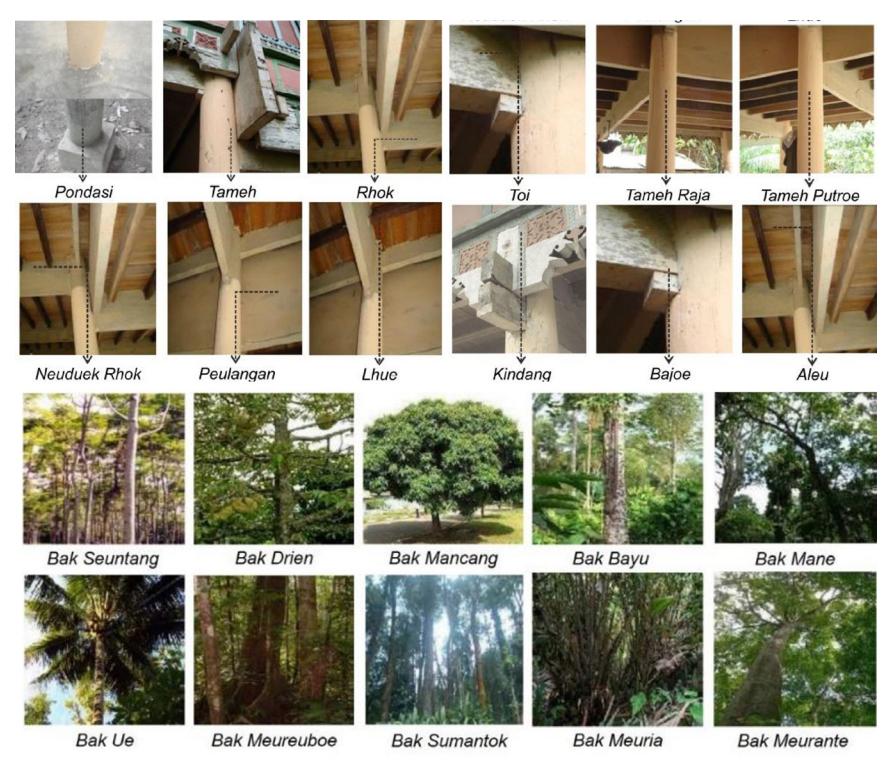
Figure 4 Details of Aceh House Construction Elements (above), Examples of Tree Species for Acehnese House Wood Materials (below)
Source: (Sahputra et al., 2020), (Rinaldi Mirsa, 2013)
The types of wood materials that are often used in the construction of an Aceh traditional house are plants from around the village that are good and durable (Figure 4). There are several types of wood trees that are often used, namely seuntang trees (bak seuntang), durian trees (bak drien), mancang trees (bak mancang), bayur trees (bak bayu), laban trees (bak mane), coconut trees (bak ue), merbau trees (bak meureuboe), resin trees (bak sumantok), thatch trees (bak meuria), and meranti trees (bak meurante).
When it is viewed in a cross-sectional image, this Aceh traditional house is divided into three parts, namely: (1) the legs (yup moh); (2) the body (space for activities); and (3) the head (roof), as it is shown in Figure 5. The legs include foundation elements, columns, and structural beams. The body includes elements such as floors, walls, doors, and windows, while the head only includes the roof element (Sahputra et al., 2020). The roof of the house is a roof with a roof (tampoeng), which extends from the left side to the right side (Figure 5).
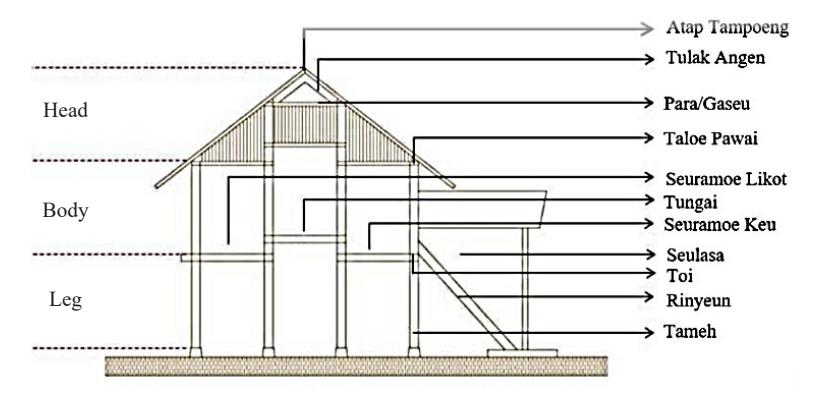
Figure 5 A Vertical View of Aceh Traditional House Source: (Putra & Ekomadyo, 2015)
The existence of space under the house (yup moh) is intended to keep people able to do activities such as standing, walking, and socializing among residents. In addition, the section under this house (Figure 6) is sometimes also used as a place for storing rice or rice barns (krong pade) as well as preventing the presence of wild animals. This fully reflects the local values of the life activities of the Acehnese people.
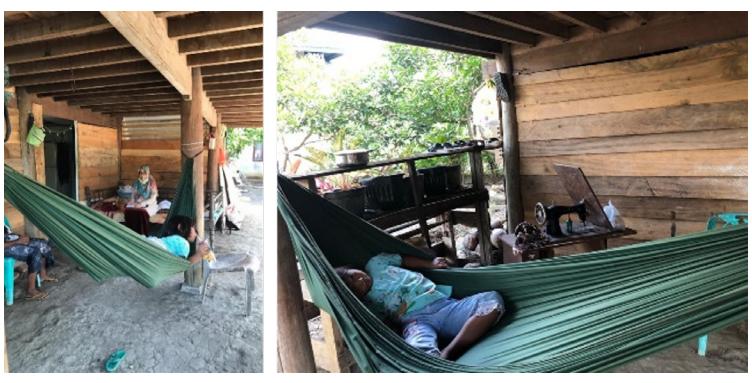
Figure 6 A View of Under The House (Yup Moh) of Aceh's Traditional House Source: Personal Documentation, 2022
Overview of Decorative (Ornamental) Material
1. Ornaments in Architecture
Architecture is a building object that not only displays functions but also visualizations of art, which are reflected in the various elements attached to it. Marcus Vitruvius, cited in Natasya (2015) explains that architecture consists of three elements: convenience, strength, and beauty. These factors make architecture a complex whole, both in terms of a work of art and as a place to take shelter. Referring to its intended beauty, architecture has a decorative art side that is made in such a way with certain shapes and patterns, especially in traditional architecture. In fact, the existence of decoration or ornaments in architecture represents the value and meaning of a particular region or area.
According to Gustami (2008) cited in Kusuma and Budiarti (2017) ornaments are a diversity of art products created with the aim of being a decoration. In addition, the decoration also consists of three other functions, including: 1) a purely aesthetic function, where the ornament serves to enhance the visualization or appearance of a decorated object so that it becomes a work of art; 2) a symbolic function, which is religious or content values and belief, accompanying its aesthetic values; and 3) constructive function, where the ornament is a support for link to strengthen the construction. Decorative art or ornament itself consists of various types of motifs, including motifs that are used as decoration. Therefore, motifs are a basis for decorating an ornament that cannot be separated from the socio-cultural background of the community concerned.
Figure 7 Types of ornament motifs Source: Personal analysis, 2022
The existence of motifs as the main elements of ornaments is the main point in the formation of ornaments. Therefore, the types of motifs shown in Figure 7 are ornaments that include:
- a. Geometric motifs, which use shapes like straight lines, circles, triangles, curves, and so on;
- b. Plant motifs, namely motifs that transform certain plant forms as inspiration from the artist;
- c. Most animal motifs, or pictures of animals, are made by changing the way things are put together so they don't look natural. Usually, only certain parts of the animal are combined with other motifs;
- d. Human motives, namely humans, as one of the objects of ideas in creating motifs, either separately, such as masks, or in whole, such as puppets;
- e. Natural object motifs, which are an inspiration that comes from natural objects such as stones, water, and clouds that are arranged in such a way;
- f. Creative motifs—these motifs are formed from an inspiration that does not come from the real world but comes from the human imagination for their perception.
2. Definition of Meaning in Ornaments
Architecture comes from the description of activities in relation to human needs, where understanding related to life is obtained because humans interpret space and time. The availability of space in human life includes how humans are able to interpret themselves and merge with the locality that is formed around them. The expressions that are created in everyday life, both in physical architecture as in housing, open spaces, and others, are sourced from the values that are the result of the representation of their cultural meanings. Architecture as an artifact is a sensory experience that has implicit meaning in the form of conceptual meaning, physical meaning related to social functions, and artifact meaning. This can be seen in various traditional buildings in various regions of Indonesia (Wardani, 2010).
Meaning is intersubjective because it is born individually but can be shared, approved, and accepted by the community (Wardani, 2010). Basically, human life in its cultural environment is based on four spheres of belief: trust, social ties, personality, and meaning. Therefore, the four spheres will influence patterns of thought, action, life, and work, one of which is related to expression in architectural works.
Architectural works will continue to develop because one of them serves to communicate and express psychological feelings and personal ideas as well as social needs to explain aspects of social existence regarding the way of life. The creation of a work is usually inseparable from certain functions and meanings, as well as the ornamental works found in traditional architecture. Some of the functions of ornaments are described in Table I.
Table I The Function of Ornaments in Traditional Architecture
| Function | Description | Example |
|---|---|---|
| Pure ornamental variety | works designed only to decorate or support the aesthetics of an object, such as architecture, clothing, and others | |
| Geometric motifs for clothing and other objects | ||
| Symbolic decoration | behind its function as beauty also contains symbolic values that include certain norms, religion, and social systems such as calligraphy motifs, phoenix motifs and other motifs that symbolize a meaning. | |
| Garuda motifs |
Therefore, the existence of the meaning and function of ornament in architecture is sacred as it contains values and norms of people's lives. This has been true since prehistoric times (although the concept was simple), Greek and Roman times, Renaissance times, etc. that the creation of work must be based on function and meaning so that the resulting work will not only look beautiful to the naked eye but actually be able to present noble emotions and expressions so that the work is worth more.
3. Ornaments in Traditional Acehnese Architecture
Ornaments are an important element in various traditional houses in the archipelago, especially in Aceh, which, through their ornaments, aim to convey the value and meaning of local culture. Ornaments are the soul of an Acehnese body, which is usually synonymous with an Islamic spirit and contains wise messages in accordance with Islamic culture (Dhuhri, 2018). Acehnese culture is strongly influenced by Islamic culture, so most of the motifs, patterns, and designs are sourced from Islamic values.
In Sahputra et al., (2018) it is said that Barbara Leigh distinguishes the motifs used in Aceh, which are divided into five categories, including (1) geometric motifs (2) plant motifs (3) bird motifs (4) animal motifs, and (5) Islamic motifs (Arabic calligraphy motif). The tendency to use decorative motifs and patterns in traditional Acehnese houses is the motif of plants, or flora, as it is shown in figure 9 (Fadhillah, 2017). On the other hand, motifs with patterns of human and animal shapes are prohibited from being applied as ornamental designs in Islamic values, except for shapes that have been transformed and abstracted into various geometric shapes.
Basically, the ornamental motifs in various regions of Aceh, apart from having differences, also have several parts with certain similarities. The difference sometimes only lies in the creativity of the pattern and the design technique of the ornament motif used by the sculptor. The similarity actually comes from the foundation of the noble philosophy of the community because creativity in designing
decorative motifs cannot be separated from the behavior patterns of the Acehnese people that form the identity of their local wisdom. In addition, the Acehnese ornaments also have functional, educational, moral, and spiritual values.
In the context of decorative arts in architecture, ornaments are decorations used to beautify the design elements of a building. The geometric patterns as shown in table I that formed in the ornaments of Aceh traditional house contain mathematical logic. Basically, this geometry is structured in a simple manner resulting from repetition, movement, rotation, scale, reflection, and a combination of each. The Acehnese house decoration is also equipped with various carvings carved directly on the boards and wood of the house walls or other variations of wood ornaments that are specifically embedded.
According to Aryo Sunaryo cited in (Sahputra & Arie Edytia, 2021), the existence of an ornament contains three functions, namely aesthetic functions, symbolic functions, and constructive functions. Based on decorative motifs or shape patterns, Aryo Sunaryo simply grouped them into 2 types of ornaments, namely, geometric motifs and organic motifs. Geometric motifs usually use various elements, such as lines and planes, by repeating points, lines, or planes of a certain pattern. The organic motif ornaments that are often made in traditional Aceh houses consist of:
Table II The Ornament Motif in Aceh Traditional Architecture
| Ornament | Description | Example |
|---|---|---|
| Ornaments with animal motifs (fauna) | This motif has a pattern of poultry animals that are generally favored by the people of Aceh, such as turtles and doves. | fauna motif |
| Ornaments with plant motifs (flora) | This pattern follows the shape of plants. Currently, plant ornaments are the main part of creating ornamental patterns that emphasize the beauty aspect. This motif utilizes all elements of plants, including roots, shoots, seeds, fruit, flowers, stems, and leaves | flora motif |
| Ornaments with natural and landscape motifs | These motifs take inspiration from nature such us cloud, stone, and others | natural motif |
| Ornaments with Islamic motifs | These motifs describe forms that emphasize Islamic aspects, such as calligraphy motifs and others | Islamic motif |
Identification of Traditional Aceh House Decorations
1. Description of Lambunot Village
Lambunot Village is in Indrapuri District, Aceh Besar District, Aceh Province, 21.6 km from the center of Kota Banda Aceh, which is on the inter-provincial road trajectory. It is one of the villages in Aceh that still has several traditional Acehnese houses. The existence of this house has functioned as a residence for village people, and it has been inhabited for generations. Among the selected dwellings for the case study, as shown in Figure 8, are houses that are hundreds of years old. As case studies show, the three houses have been inhabited for almost three generations.
Figure 8 Masterplan of Lambunot Village Source: google maps.
Most of the Aceh traditional houses are still residential for the people in Lambunot village, as some of the people still maintain the existence of traditional dwellings. This architecture is still used as a residence or has been converted to another use, such as a place of study (bale beut), and so on. Some buildings look well maintained, but there are some building elements or materials that have been replaced and don't look like their originals anymore. Difficulties in obtaining materials such as good and optimal quality wood also have an impact on changes in the use of house materials. There are even houses that have been completely replaced with other buildings due to weathered and destroyed materials. This explains the shift towards traditional values that has an impact on changes in Aceh's traditional houses caused by the economic factors of the community and cultural shifts in Aceh over time.
2. Ornaments on Mrs. Mahyuni's House
This house is the heritage house of the indatu (great-grandmothers) who were moved from Lampupok village to Lambunot village. These two villages are located next to each other in the Indrapuri sub-district. Mrs. Mahyuni is the fourth descendant of the owner of this house, and the age of this Acehnese house is around 150 years, as it is shown in Figure 9. Basically, this house has been moved several times. The first relocation was carried out because the building was located on the edge of the river in Lampupok village, which is a flood-prone location. The second move was made in 2014, when people moved from Lampupok village to Lambunot village.
Figure 9 A view of Mrs. Mahyuni's house Source: Personal Documentation, 2022
Mrs. Mahyuni's house applies several ornamental motifs to the facade elements of the building, as shown in Table 3. It can be seen in Figure 10 that the ornaments are only found on the wall (binteh), which is located on the body of the building. The door (pintoe), windows (tingkap), and stairs (rinyeun) are not decorated with carved designs. On each side of the building, the walls have several motifs and patterns that are combined into a single ornament for the building's facade. The number and shape of the ornaments also explain the throne of the owner of the house. The more and more complicated an ornament is, the higher the homeowner's status. On the other hand, the fewer and simpler the ornamental motifs are, the more the status of the homeowner is classified as sufficient or less well-off.
Figure 10 The elevation of the traditional Acehnese house in Lambunot Village Source: (Sahputra et al., 2018)
Table III Identification of The Types of Motifs and The Meaning of Ornaments on The Facades of Traditional Acehnese Houses (Case Study of Mrs. Mahyuni's House)
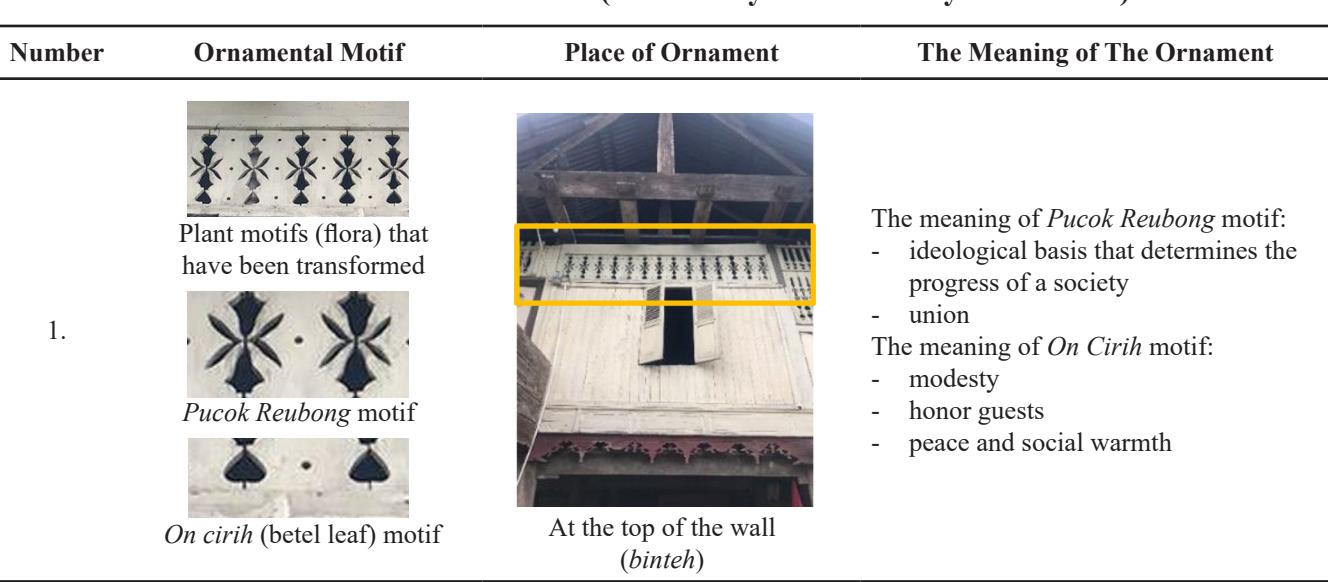
Plant motifs (flora) that have been transformed
2.
Pucok Reubong motif
In the kindang structure section
The meaning of Pucok Reubong motif:
- ideological basis that determines the progress of a society
- union
Plant motifs (flora) that have been transformed and combined with geometric motifs 3. On Cirih (betel leaf) motif
Bungong Seulanga motif
A mix of Bungong Seulanga motifs and geometric motifs
The meaning of On Cirih motif:
- modesty
- honoring guests
- peace and social warmth
The meaning of Bungong Seulanga motif:
- well-being
- prosperity
- harmony
- gentle
4. Plant motifs (flora) that have been transformed
Bungong Awan-awan motif At the top of the wall
(binteh)
The meaning of Bungong Awan-awan motif:
- The power and greatness of Allah SWT.
- As a servant, you should remember and be grateful to Him
Plant motifs (flora) that have been transformed
5.
Bungong Seuleupok motif
At the top of the wall (binteh)
The meaning of Bungong Seuleupok motif:
- Beauty
- Fertility
At the top of the wall (binteh)
- pluralism
Natural motifs (landscape) Bungong kipah motif
In the kindang structure section
- Warmth
3. Ornaments on Mrs. Putri's House
This house is more than 200 years old, and currently the site of the house has been moved to land beside the old site. As shown in Figure 11, this house still looks very good and has now been converted into a recitation place (bale beut) for children in Lambunot village. Even though no one lives in this house anymore, the current owner still takes care of it to keep up the tradition that has been passed down from generation to generation. Some of the elements that make up an Aceh traditional house have been replaced with new materials. The pillars (tameh) of this house are round logs from intact trees, but the current condition of the tameh has been partially eaten by termites, so the tameh is reconnected with another tameh.
Figure 11 A View of Mrs. Putri's house Source: Personal Documentation, 2022
Table IV Identification of The Types of Motifs and The Meaning of Ornaments on The Facades of Traditional Acehnese Houses (Case Study of Mrs. Putri's House)
Number Ornamental Motif Place of Ornament Meaning of the Ornament 1. The meaning of Bungong Awanawan motif: - The power and greatness of Allah SWT. - As a servant, you should remember and be grateful to Him Plant motifs (flora) that have been transformed Bungong Awan-awan motif At the top of the wall (binteh)
Natural motifs (landscape) Moon and star motif
2.
Star motif
Bungong Kipah motif
In the kindang structure section
The meaning of Moon and star motifs:
- Illumination from darkness
- Lamp
The meaning of Bungong Kipah motif:
- Warmth
4. Ornaments on Mrs. Nurasiah's House
Mrs. Nurasiah's house is still relatively new compared to the two previous buildings. This house is one that was passed over to her after she started her own household. As is customary in Acehnese life, the Acehnese house will usually belong to the daughter when she gets married, or the parents will give the house to her as a gift when she gets married. Therefore, this house was built on a land site and was the house of the first generation.
Figure 12 A View of Mrs. Nurasiah's house Source: Personal Documentation, 2022
The condition of this house is very unfit for living because the wooden walls (binteh) and floor (aleu) are rotten and damaged. In contrast to the previous house, which used a tin roof, the use of a thatched roof is still maintained, even though the situation is very alarming, as shown in Figure 14. In this house, the ornaments applied to the building are also found on the body of the building, as in Figure 12. This architecture also does not decorate the doors and windows with ornamental motifs, so that it seems that the house is only equipped with simple decorations. Furthermore, identification related to the decorations in Mrs. Nursiah's house can be seen in Table 5 as follows:
Table V Identification of The Types of Motifs and The Meaning of Ornaments on The Facades of Traditional Acehnese Houses (Case Study of Mrs. Nurasiah's House)
Number Ornamental Motif Place of Ornament Meaning of the Ornament 1. The meaning of Bungong Awan-awan motif: - The power and greatness of Allah SWT. - As a servant, you should remember and be grateful to Him The meaning of Pucok Reubong motif: - ideological basis that determines the progress of a society - union The meaning of Bungong Geulima motif: - Fertility - Beauty Bungong Awan-awan motif At the top of the wall (binteh) A mixture of motifs on Bungong Geulima (pomegranate) and Pucok Reubong Plant motifs (flora) that have been transformed
Geometric motifs Consists of a combination of intersecting straight lines
On the stair railing (rinyeun)
- Signs of life
Plant motifs (flora) that have been transformed
3.
4.
Mixed motifs of Bungong Geulima and Bungong Awan-awan
At the top of the wall (binteh)
The meaning of Bungong Geulima motif:
- Fertility
- Beauty
The meaning of Bungong Awan-awan motif:
- The power and greatness of Allah SWT.
- As a servant, you should remember and be grateful to Him
Plant motifs (flora) that have been transformed
Bungong Awan-awan motif
At the top of the wall (binteh)
The meaning of Bungong Awan-awan motif:
- The power and greatness of Allah SWT.
- As a servant, you should remember and be grateful to Him
5. The Ornament Analysis of The Traditional House in Lambunot Village
Based on the identification of various kinds of decorative motifs found in traditional Acehnese houses at the homes of Mrs. Mahyuni, Mrs. Putri, and Mrs. Nurasiah, it was found that the use of decorative motifs in buildings was not much and not complicated, but the pattern used was relatively simple. There are several types of motifs that adorn the facades of residential buildings, including floral motifs, natural motifs (landscape), and geometric motifs. Table VI illustrates the analysis of the grouping of various motifs found in traditional houses in Lambunot Village. The most visible trend is the use of floral motifs, which dominate traditional house decorations in Lambunot Village.
Table VI The Grouping Analysis of The Motifs on The Facades of Traditional Acehnese Houses in Lambunot Village
| Motif | Mrs. Mahyuni's house | Mrs. Putri's house | Mrs. Nurasiah's house |
|---|---|---|---|
| Plant motifs (floral) | |||
| Bungong Seulanga | Upper wall (binteh) | ||
| Bungong Geulima | Upper wall (binteh) | ||
| On Cirih | Upper wall (binteh) | ||
| Pucok Reubong | Upper wall (binteh) Kindang structure | Upper wall (binteh) | |
| Bungong Seuleupok | Upper wall (binteh) | ||
| Bungong Tabue | Upper wall (binteh) | ||
| Natural motifs (landscape) | |||
| Bungong Awan-awan | Upper wall (binteh) | Upper wall (binteh) | Upper wall (binteh) |
| Moon and star | Kindang structure | ||
| Bungong Kipah | Kindang structure | Kindang structure | |
| Geometric motifs | |||
| Tapak catoe | stairs (rinyeun) |
The following is an analysis of the meaning contained in the decorative motifs of the Aceh Traditional House in Lambunot Village, as described in Table VI.
Table VII The Meaning of The Ornament Motifs of Traditional Acehnese Houses in Lambunot Village
| No | Motif | Meaning |
|---|---|---|
| 1. | Bungong Seulanga | The Bungong Seulanga motif is symbolic of the tenderness of Acehnese women. Bungong Seulanga also has the meaning of beauty and fragrance, as the original form of the flower is very fragrant and is often used as a bun strand for brides in Aceh. This flower also contains the value of marital harmony, which symbolizes luxury for Acehnese women. Bungong Seulanga flower is the pride of the Acehnese people, and its presence cannot be separated from the culture and repertoire of the Acehnese people. |
| 2. | Bungong Geulima | The Bungong Geulima motif contains the meanings of beauty and fertility. In addition, the flowers that turn into pomade fruit are usually consumed by the people of Aceh because they are believed to be good herbal medicines for health. |
| 3. | Bungong Awan-awan | This is a motif that comes from the inspiration of nature. This motif describes the power and greatness of Allah SWT. And as a servant, obey and always be grateful for what He has given. |
| 4. | On Cirih | The motif of On Cirih can be interpreted as a symbol of humility and purposely to glorify guests, as there is a customary norm of the Acehnese society that guests are kings, so they must be served and respected. In addition, this motif also implies peace and social warmth. This is reflected in the customary deliberation to resolve problems in the Acehnese community. |
| 5. | Pucok Reubong | This motif is associated with the mental aspect of the original shape of the shoots themselves. In addition, it symbolizes the ideological basis as the progress of a nation is determined by the foundation of its life. This motif is also often associated with the term if it gets bigger, it gets stronger, meaning that humans will get bigger and stronger over time. |
| 7 | Bungong Seuleupok | Bungong Seuleupok radiates the meaning of beauty and fertility because this flower thrives in the land of Aceh. This floral motif is often used with a symmetrical shape and has four petals. |
| 8 | Bungong Tabue | Bungong Tabue contains the meaning of pluralism. Where it is likened to life, it is better to have choices that are in accordance with what is needed, and with that, the stability of the heart towards the choices that have been made must be intact. |
|---|---|---|
| 9 | Moon and star | The motif of the moon and stars means illumination and lighting, like the moon and stars. His philosophy is that Allah and Muhammad are merciful to the whole universe. |
| 10 | Bungong Kipah | This motif is a geometric motif whose shape is symmetrical. Bungong Kipah contains the meaning of warmth as the function of a fan to cool and provide coolness so that life feels more peaceful. |
| 11 | Tapak Catoe | This motif is a geometric motif with crossed lines. Tapak Catoe implies that life is a puzzle that contains many ways and choices. Therefore, the people of Aceh are meant to be smart in deciding things and taking the right steps and are prohibited from giving up under any circumstances as long as they still rely on faith, effort, and prayer. |
Conclusion
Acehnese traditional houses are Aceh's cultural treasures; they symbolize the identity of the Acehnese people and represent their local wisdom. Thus, its existence must be maintained both in its form and in understanding the science of Aceh traditional housing itself. This is intended so that the scarcity of traditional Acehnese houses that are getting lost with the development of the times will still be known and of interest to future generations, so that the values of local wisdom do not disappear. One of them is an understanding related to the variety of decorations or ornaments found in traditional Acehnese architecture.
Ornaments are a complement to the beauty and values of the integrity of the Acehnese house. Therefore, based on the above analysis, ornaments on traditional houses in Lambunot Village are formed from various motifs, namely plant motifs (flora), natural motifs (landscape), and geometric motifs. The decoration on the facade of the building is dominated by floral motifs, which are one of the main accent motifs in Acehnese houses. Besides that, every motif applied contains meaning and philosophy that represents the norms and values of Acehnese's life including: (a) Bungong Seulanga that symbolizes the value of marital harmony and the tenderness of Acehnese women; (b) Bungong Geulima that has the meaning of beauty and fertility as they are believed to be good herbal medicines for health; (c) Bungong awan-awan, which describes the power and greatness of Allah SWT; (d) On cirih, interpreted as a humility and symbolizes to glorify guests as Acehnese society norm; (e) Pucok reubong, implying the ideological basis as life foundation; (f) Bungong Seuleupok, which radiates the meaning of beauty and fertility; (g) Bungong Tabue, representing pluralism and likened to stability life; (h) Moon & stars, which means Allah and Muhammad are merciful to the whole universe; (i) Bungong Kipah, which contains the meaning of warmth life that feels more peaceful; (j) Tapak Catoe, which implies that life is a puzzle that contains many ways and choices.
Compared to the original Aceh traditional house, that means the authenticity is still maintained where the natural materials of the house have not been replaced, such as thatch roof material by metal material, wood material for walls with plywood, the structure of dowel joints by mechanical joints (iron nails), and the spaces of the houses have also been converted. As the house in Lambunot Village is not authentic, many parts of the house have been replaced. However, the house has genuine simple ornament patterns, and the decoration is only located on certain elements in the building facade area. Therefore, the existence of this ornament indicates that the ownership of this traditional house is indeed located in a village, with the conditions of the people who generally have a simple life status.
Acknowledgement
The research team expresses gratitude to everyone who participated in the writing this article, especially each of the author's families for their continuous support. We would especially like to thank Mrs. Mahyuni, Mrs. Putri, Mrs. Nurasiah, and their families for their permission and enthusiasm in giving us the information and data that played a big role in completing this article and strongly motivated us to finish writing this paper. We would also like to give special thanks to the surrounding community in Lambunot Village that allowed us to run this research efficiently.
References
- Dhuhri, S. (2018). Islamic arts and the expression of theology: Acehnese traditional house, its ornamentation and figurative motifs. Wacana Seni, 17, 1–39. https://doi.org/10.21315/ws2018.17.1
- Fadhillah, F. (2017). Ornaments on the Traditional Acehnese House in Central Aceh, Aceh Province. 4th International Conference on Technical and Vocation Education and Training, November 0-11, 365–368.
- Hamzah, M. (2018). Transformasi Ornamen Rumoh Aceh Teungku Chik Awee Geutah Pada Rapa ' I Aceh. Melayu Arts and Performance Journal, 1(2), 246–261.
- Herman RN. (2018). Arsitektur Rumah Tradisional Aceh. Kementerian Pendidikan dan Kebudayaan Badan Pengembangan dan Pembinaan Bahasa.
- Iqbal, M., Fahrizal, E., & Selmi, H. (2019). Dokumentasi Rumah Aceh sebagai Upaya Pelestarian Arsitektur Tradisional Aceh (Studi Kasus: Rumah T. Tjhik Muhammad Said). Jurnal Lingkungan Binaan Indonesia, 8(2), 116–123. https://doi.org/10.32315/jlbi.8.2.116
- Izziah, I., Sari, L. H., Meutia, E., & Irwansyah, M. (2020). Traditional Acehnese House: Constructing Architecture by Responding to the Power of Nature in Relation to the Local Wisdom Values. Aceh International Journal of Science and Technology, 9(3), 132–139. https://doi.org/10.13170/ aijst.9.3.17323
- Kusuma, Budiarti, K. (2017). Ornamen Islam pada Arsitektur Masjid Kampus UGM. Universitas Negeri Yogyakarta.
- Maulin, S., Zuriana, C., & Lindawati. (2019). Makna Motif Ragam Hias Pada Rumah Tradisional Aceh Di Museum Aceh. Jurnal Ilmiah Mahasiswa Program Studi Pendidikan Seni Drama, Tari dan Musik Fakultas Keguruan dan Ilmu Pendidikan Universitas Syiah Kuala, 4(1), 78–96.
- Mirsa, R. (2015). Rumoh Aceh. Graha Ilmu.
- Natasya. (2015). Tipologi Motif Ornamen Pada Arsitektur Rumah Vernakular Desa Lubuk Sukon dan Lubuk Gapuy Aceh Besar. Institut Teknologi Bandung.
- Natasya. (2019). Tipologi Motif Ornamen Pada Arsitektur Rumah Vernakular Desa Lubuk Sukon dan Lubuk Gapuy Aceh Besar. Jurnal Ilmiah Desain & Konstruksi, 18(2), 170–183. https://doi. org/10.35760/dk.2019.v18i2.2648
- Putra, R. A., & Ekomadyo, A. S. (2015). Elaboration of Sign (Decoding) of Rumoh Aceh Using Semiotics Approach. Tesa Arsitektur, Journal of Architectural Discourses, 13(1), 1–14. http://journal.unika. ac.id/index.php/tesa/article/view/354
- Rinaldi Mirsa. (2013). Rumoh Aceh (1st ed.). Graha Ilmu.
- Sahputra, Z., & Arie Edytia, M. H. (2021). A Comparison Study on Ornament of Rumoh Aceh in Aceh Besar and Umah Pitu Ruang in Aceh Tengah. Malaysian Journal of Sustainable Environment, 8(1), 1. https://doi.org/10.24191/myse.v8i1.12655
- Sahputra, Z., Meutia, E., Heru, M., & Edytia, A. (2020). Teknologi Konstruksi Arsitektur Rumoh Aceh. Prosiding Struktur Dalam Arsitektur 2020, 41–48.
- Sahputra, Z., Rauzi, E. N., & Mirza. (2018). Transformasi Ornamen Aceh untuk Ide Perancangan Arsitektur Kontemporer Dengan Menggunakan Software J-Batik. 1, 1–9.
- Wardani, L. K. (2010). Fungsi, Makna, dan Simbol (Sebuah Kajian Teoritik) Ruang Dalam Arsitektur-Interior. Seminar Jelajah Arsitektur Nusantara 101010, 1–10.