

INFO ARTIKEL
Kata kunci:
virtual experiential marketing (VEM), pengalaman pengguna, dunia maya, strategi pemasaran
ABSTRAK
Artikel ini bertujuan mengusulkan pendekatan untuk mengukur konsep virtual experiential marketing (VEM). Penelitian ini menawarkan skala untuk mengukur VEM berdasarkan teori Strategic Experiential Modules (SEM) dan telepresence. Sampel penelitian terdiri atas 140 pengguna dunia maya 'Second Life'. Analisis faktor konfirmatori (CFA) digunakan dalam penelitian ini untuk menguji tingkat variabel yang diukur mewakili konstruk. Hasil penelitian menunjukkan semua indeks kecocokan yang menunjukkan skala VEM memiliki enam faktor konstruk (Sense, Feel, Think, Act, Relate, dan Telepresence). Model tersebut sudah lengkap dan valid. Penelitian ini merupakan salah satu penelitian pertama yang menyelidiki pengukuran virtual experiential marketing di dunia maya.
https://doi.org/10.5614/sostek.itbj.2023.22.2.10
Introduction
The COVID-19 pandemic revolutionized the way humans interact with each other through a virtual platform known as the metaverse, which has developed rapidly to date (Yung et al., 2022). The metaverse is a single, three-dimensional virtual space that facilitates human interactions with other humans in ways they cannot in the physical world. Publications on the metaverse can be searched in 2020 - 2022, including by searching keywords or nodes related to the metaverse such as 'virtual world', 'virtual reality', 'augmented reality', 'blockchain', and 'Second Life' (Feng et al., 2022).
The rapid development of the study of the metaverse has yet to be matched by a comprehensive discussion of the metaverse concept itself. In addition, the development of technologies supporting the use of the metaverse, such as head-mounted displays and hand-based input devices, and applications supporting the application of the metaverse, such as virtual retail and virtual tourism, is still developing, so the understanding of the concept of the metaverse itself has not reached an understanding at this stage (Cheng et al., 2022; Yung et al., 2022).
Among the limitations on the concept of the metaverse, researchers agree that the emergence of virtual worlds under the brand name 'Second Life' is considered an early form or representation of the metaverse, but its existence at that time was not distinguished from online games (Cheng et al., 2022; Feng et al., 2022; Guo et al., 2023; Zainurin et al., 2023). The categorization of virtual worlds to distinguish game-oriented (such as World of Warcraft) from social-oriented virtual worlds (such as Second Life) was done by Tikkanen et al. (2009). Virtual worlds with games can be distinguished from their purpose for social interaction in a 3D environment that is simulated in real-time and has a structure within minimum limits so that users can build their own experiences in the virtual world (Paul et al., 2022; Zhou et al., 2018). Meanwhile, in the context of content creation, virtual worlds allow users to create objects or items up to an advanced level, called bricolage (MacKenzie et al., 2013). In more detail, Girvan & Savage (2019) explained that the virtual world of Second Life is an adequate environment because its construction tools and flexibility support bricolage so that it can build objects and items according to ideas without any restrictions from predetermined designs.
Due to the freedom of user goals and the flexibility in content creation (Girvan & Savage, 2019; MacKenzie et al., 2013; Paul et al., 2022; Tikkanen et al., 2009), the virtual world Second Life supports buying, selling, trading, and transaction activities (Zhou et al., 2018). In addition, business activities in Second Life are based on realistic simulations, so they are considered to have lower risks and allow business practitioners to gain knowledge and experience following actual market conditions (Noke & Chesney, 2014). This opens opportunities for business practitioners to bring real-world products into virtual worlds to increase product interaction (Peng & Ke, 2015) and enables turning interactions in virtual worlds into real-world transactions (MacKenzie et al., 2013).
Studies on virtual worlds of Second Life, however, focus on technological glasses such as headmounted displays and hand-based input devices (Cheng et al., 2022; Yung et al., 2022) and applicative/ utility perspectives such as the effectiveness of collaborative learning and virtual teams (Li et al., 2022; Minocha & Morse, 2010), the potential for enterprise and business creation (Noke & Chesney, 2014; Zhou et al., 2018), in the context of education: experiential learning, constructionist learning, and librarianship (Floyd & Frank, 2012; Girvan & Savage, 2019; Sidorko, 2009), in healthcare: as a virtual therapy tool to increase psychological resilience during the pandemic (Paul et al., 2022), while in marketing: exposure in Second Life positively influences brand attitude, consumer trust, user perception, and real-world purchase intention (Haenlein & Kaplan, 2009; Peng & Ke, 2015).
Based on this research, the virtual world can be considered a medium that can provide user experiences to produce specific outputs. However, virtual worlds only partially provide positive results. Some companies once (no longer) existed in Second Life, such as Toyota, Circuit City, Dell, Sears, and Adidas (Noke & Chesney, 2014). Given the content creation discussed earlier (Tikkanen et al., 2009), the virtual world of Second Life is just an open world without user content creation. Therefore, to deepen the understanding and enhance the positive potential of objects or items from content creation, an approach is needed to precisely examine the objects or items, users' perceptions, and the extent to which the experiences or stimuli users perceive influence virtual and real life.
This study replicates the experiential marketing approach identified by Schmitt (in Chen & Wu, 2022; Khan & Rahman, 2014; Yuan & Wu, 2008) and telepresence (Jahn et al., 2022; Peng & Ke, 2015) to be used in virtual worlds that have not been researched before. In addition, this study is useful to determine the perception, experience, or stimulus users feel so that creators or researchers can evaluate the objects or items created. More profoundly, this approach can be used to find out how far the experience provided by objects or items in the virtual world can be accepted as a real-world experience so that it can measure the effectiveness of virtual worlds as an alternative marketing medium.
The concept of experiential marketing is an activity to convince customers to achieve brand recognition or product purchases by presenting certain experiences that stimulate emotions (Xu et al., 2022). Experiential marketing has been researched for various products and organizational objects. Over the past decade, there have been developments in the concepts and constructs of experiential marketing that still stem from the approach identified by Schmitt. Such as research conducted on: Aviation sector (Pabla & Soch, 2023), resort businesses (Xu et al., 2022), heritage tourism (Chen & Wu, 2022), sports sponsorship media (Hsiao et al., 2021), cafes (Soliha et al., 2021), web-based pre-trip online tourism destinations (Köchling, 2021), leisure resort businesses (Rather, 2020), factory tourism (Yeh et al., 2019), B2B marketing techniques (Österle et al., 2018), leisure report business (Chen & Mathews, 2017), culinary tourism (Tsai & Wang, 2016), wine tasting rooms (Cuellar et al., 2015), the passenger car market in India (Khan & Rahman, 2014), e-retailer sites (Shobeiri et al., 2013), hospitality and tourism operations (Yuan & Wu, 2008), and fast food restaurants (Nigam, 2012).
The concept of telepresence refers to how users feel when they are in a spatial environment (Peng & Ke, 2015). Many studies on telepresence show that the higher the telepresence, the more the feeling of being in the virtual world will be felt and the closer it is to the real world. Such as research conducted on: social responsibility (CSR) campaigns, virtual stores and supermarkets utilizing 360-degree video (Han et al., 2020; Ruusunen et al., 2023; Zhao et al., 2023), online commerce, digital and streaming (Gao et al., 2023; Ye et al., 2020; Yoo, 2023), purchase behavior and travel intentions of virtual world users (Faiola et al., 2013; Huang et al., 2012; Peng & Ke, 2015), virtual agent interaction (Ben Saad & Choura, 2022), internet abuse (Stavropoulos et al., 2013), virtual fitting rooms and augmented reality-based smartphone users (Kim & Hyun, 2016; Lee et al., 2021), hotel website (Ongsakul et al., 2021), donation and usage behavior on social media (Algharabat et al., 2018; Pelet et al., 2017), and health behavior (chocolate consumption) (Jahn et al., 2022).
Method
This research is descriptive in nature and adopts a quantitative approach. Descriptive research aims to obtain an accurate description of the market environment, such as population proportion, consumer evaluation, and social characteristics (Kumar & Aaker, 2018). The research population is made up of virtual world users of Second Life. The sample determination in this study is non-probability sampling with convenience sampling, namely by contacting research units that are easy to meet (Kumar & Aaker, 2018). In the virtual world of Second Life, the questionnaire was distributed by connecting in Second Life and distributing questionnaire links to users who were active at that time until it reached the desired number of 130 respondents.
Measuring the sample size using the formula (Hair et al., 2014), namely getting the minimum value by calculating the scale of the number of indicators (26) observed by 1: 5 to get a minimum result of 130 respondents. This sample size measurement is carried out because the population of Second Life users is unknown both in terms of the number of registered accounts and the number of active users. The questionnaire is a self-administered survey via Google Forms. Using a Likert Scale of 1 to 5 to indicate the meaning of strongly agree to strongly disagree (5=strongly agree, 4=agree, 3=neither agree nor disagree, 2=disagree, 1=strongly disagree).
The analysis method uses Confirmatory Factor Analysis (CFA), which is a multivariate analysis. CFA is used to conduct tests on measurement theory so that measurement theory will show how a measured variable represents an unmeasured latent construct (Hair et al., 2014: 603). This study tests the second-order model (Figure 1), which aims to test and confirm the theoretical construction of virtual experiential marketing. The analysis process uses the help of Lisrel version 8.80.
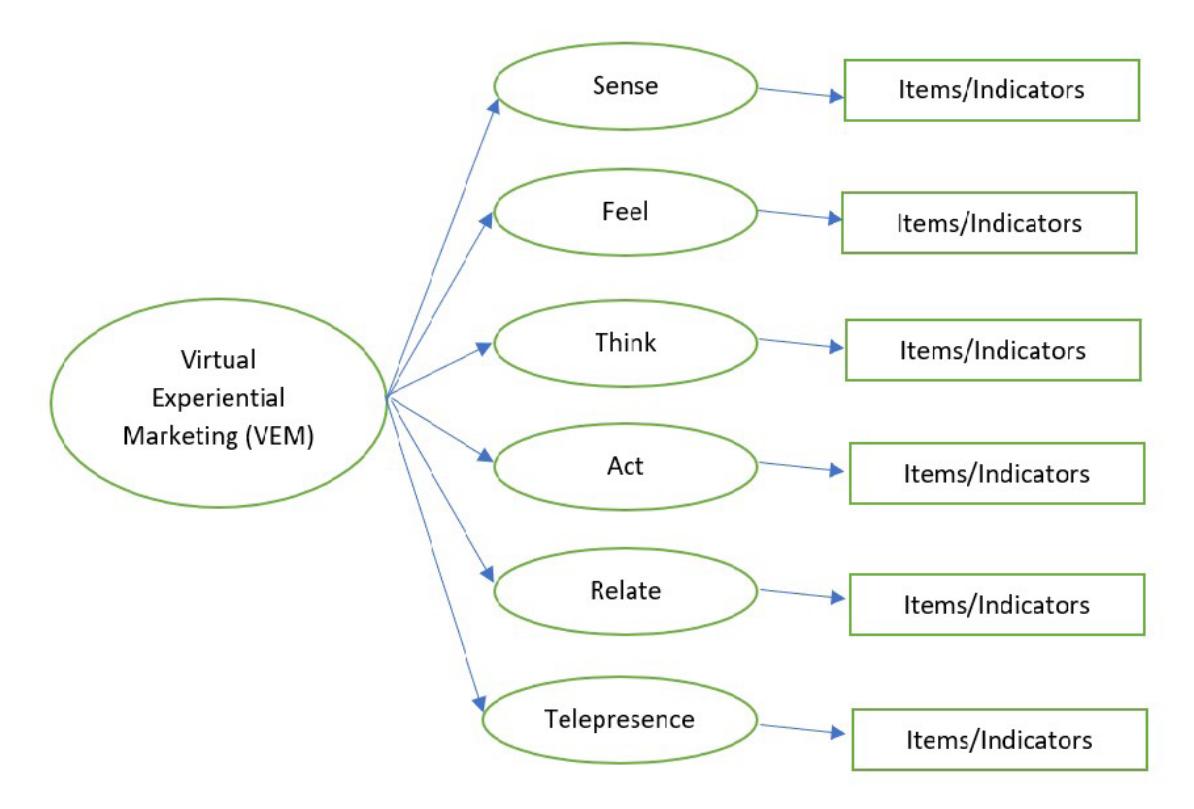
Figure 1 Second-order Model
Result and Discussion
The following is the result of the data collection and analysis using Confirmatory Factor Analysis (CFA) to show how a measured variable represents an unmeasured latent construct.
Respondents
Table I shows the profile of respondents obtained from 140 respondents. Based on the data obtained, users in Second Life are mostly female (59.3%), with the highest age range of 21-30 years (32.1%) and 31-40 years (37.1%). In terms of education, it is dominated by undergraduate degrees (47.1%) with private employee employment status (41.4%). Second Life users are dominated by old users who have joined for >5 years (65%), with an average playing time ranging from 1-2 hours (40%) and 2-4 hours (32.9) per day. The results of data acquisition show that users in Second Life are dominated by users in the adult category.
Table I Respondent Profile
| Profile | Frequency | Percent | ||
|---|---|---|---|---|
| Gender | Male | 57 | 59.3% | |
| Female | 83 | 40.7% | ||
| Age | < 20 | 4 | 2.9% | |
| 21-30 | 45 | 32.1% | ||
| 31-40 | 52 | 37.1% | ||
| 41-50 | 27 | 19.3% | ||
| > 51 | 12 | 8.6% | ||
| Education | High school or below | 12 | 8.6% | |
| Diploma/Certificate | 40 | 28.6% | ||
| Undergraduate Degree | 66 | 47.1% | ||
| Postgraduate Degree | 22 | 15.7% | ||
| Occupation | Junior/High school student | 1 | 0.7% | |
| College Student | 9 | 6.4% | ||
| Postgraduate Student | 1 | 0.7% | ||
| Private Employee | 58 | 41.4% | ||
| Public sector employee | 9 | 6.4% | ||
| Business owner | 31 | 22.1% | ||
| Other | 25 | 17.9% | ||
| Disabled | 1 | 0.7% | ||
| Retired | 5 | 3.6% | ||
| Second Life age | < 6 months | 1 | 0.7% | |
| 6-12 months | 4 | 2.9% | ||
| 1-3 years | 11 | 7.9% | ||
| 3-5 years | 33 | 23.6% | ||
| > 5 years | 91 | 65.0% | ||
| Online time (Per day) | < 1 hour | 14 | 10.0% | |
| 1-2 hours | 56 | 40.0% | ||
| 2-4 hours | 46 | 32.9% | ||
| 4-6 hours | 16 | 11.4% | ||
| > 6 hours | 8 | 5.7% | ||
Confirmatory Factor Analysis
The testing stage with CFA is first carried out by analyzing the loading factor and goodness of fit to estimate the suitability of the measurement model. Fit indices are referred to (Rufaidah, 2017) by measuring scores: GFI, AGFI, RMSEA, NFI, CFI, PNFI, and PGFI. Table II shows the results of the fit test that the model has a good fit: X2 = 137.48 with df = 121 (at α: 0.05), the critical value of the distribution: 147.6 > 137.48 (X2), the model has a good fit. RMSEA ≤ 0.05 (gain: 0.031) fit. RMR < 0.1 (obtained: 0.028) fit. CFI ≥ 0.9 (gain: 0.98) fit. NFI ≥ 0.90 (gain: 0.92) fit. GFI ≥ 0.90 (earned: 0.90) fit (Hair et al., 2014: 579).
Table II Results of Fit Indices
| X2/df | GFI | AGFI | RMSEA | NFI | CFI | PNFI | PGFI |
|---|---|---|---|---|---|---|---|
| 1.136 | 0.9 | 0.86 | 0.031 | 0.92 | 0.98 | 0.72 | 0.64 |
Hypothesis testing refers to Hair et al. (2014: 667); namely, the hypothesis is accepted if the t-value is smaller than 1.96 and the loading factor is greater than 0.50. As for the CFA process in the first order, eight items were eliminated because they did not meet the t-value and loading factor (figure 2), including indicators: S3 and S5 (for SENSE), T4 and T5 (for THINK), A2 and A4 (for ACT), R2 (for RELATE), and TP4 (for TELEP).
| First-order Latent | items (Likert 1-5) | t-value | loading | Adapted | |
|---|---|---|---|---|---|
| Dimension | factor | ||||
| SENSE | S1: catch my visual attention | 1.96 | 0.58 | ||
| CR: 0.806 | S2: perceptually attractive | 4.73 | 0.55 | ||
| AVE: 0.585 | S4: give a positive impression on the senses of sight | 5.65 | 0.73 | ||
| FEEL | F1: makes me respond to objects (items) emotionally, i.e., happy | 1.96 | 0.68 | ||
| CR: 0.819 | F2: makes me respond to objects (items) emotionally, i.e., dislike | 4.88 | 0.52 | (Chen & | |
| AVE: 0.534 | F3: evokes pleasant feelings towards certain objects | 5.8 | 0.58 | Wu, 2022; | |
| F4: I have positive emotions towards certain objects | 6.09 | 0.67 | Xu, Jung & | ||
| THINK | T1: This virtual world makes me think about the objects | 1.96 | 0.8 Han, 2022 0.73 Khan & | ||
| CR: 0.786 | T2: engage in a lot of thinking about the objects | 7.41 | |||
| AVE: 0.555 | T3: stimulates my curiosity about certain objects | 6.16 | 0.57 | Rahman, | |
| ACT | A1: I want to take pictures with objects | 1.96 | 0.67 | 2014; Yuan | |
| CR: 0.715 | A3: I want to share my experience on objects | 3.61 | 0.75 | & Wu, 2008) | |
| AVE: 0.558 | |||||
| RELATE | R1: Objects in this virtual world create a sense of identity within me | 1.96 | 0.6 | ||
| CR: 0.796 | R3: Objects in this virtual world make me feel connected to other users | 6.64 | 0.9 | ||
| AVE: 0.572 | R4: feel that I can connect more with other users when using certain objects | 6.54 | 0.72 | ||
| TELEP | TP1: Forgot immediate environment | 1.96 | 0.7 | (Jahn et al, | |
| CR: 0.740 | TP2: forget where I am | 6.38 | 0.89 | 2022; Peng | |
| AVE: 0.507 | TP3: creating a new world | 7.82 | 0.66 | & Ke, 2015) | |
Figure 2 First Order of Confirmatory Factor Analysis
While there are 18 items, based on the results of data processing in Figure 2, it is found that the measuring items can form six dimensions consisting of SENSE (3 items), FEEL (4 items), THINK (3 items), ACT (2 items), RELATE (3 items), and TELEP (3 items).
Table III Second Order of Confirmatory Factor Analysis
| Second-order Latent Variables | First-order latent | t-value | Loading Factor |
|---|---|---|---|
| SENSE | 4.92 | 0.77 | |
| FEEL | 6.67 | 0.84 | |
| virtual experiential marketing | THINK | 7.16 | 0.76 |
| (VEM) | ACT | 3.55 | 0.5 |
| RELATE | 4.78 | 0.58 | |
| TELEP | 5.22 | 0.64 |
Table III shows that the t-values of SENSE, FEEL, THINK, ACT, RELATE, and TELEP have values greater than 1.96, while all loading factor (β) values in Table 3 have values greater than or equal to 0.50. This indicates that virtual experiential marketing (VEM) can be operationalized as a second-order latent construct.
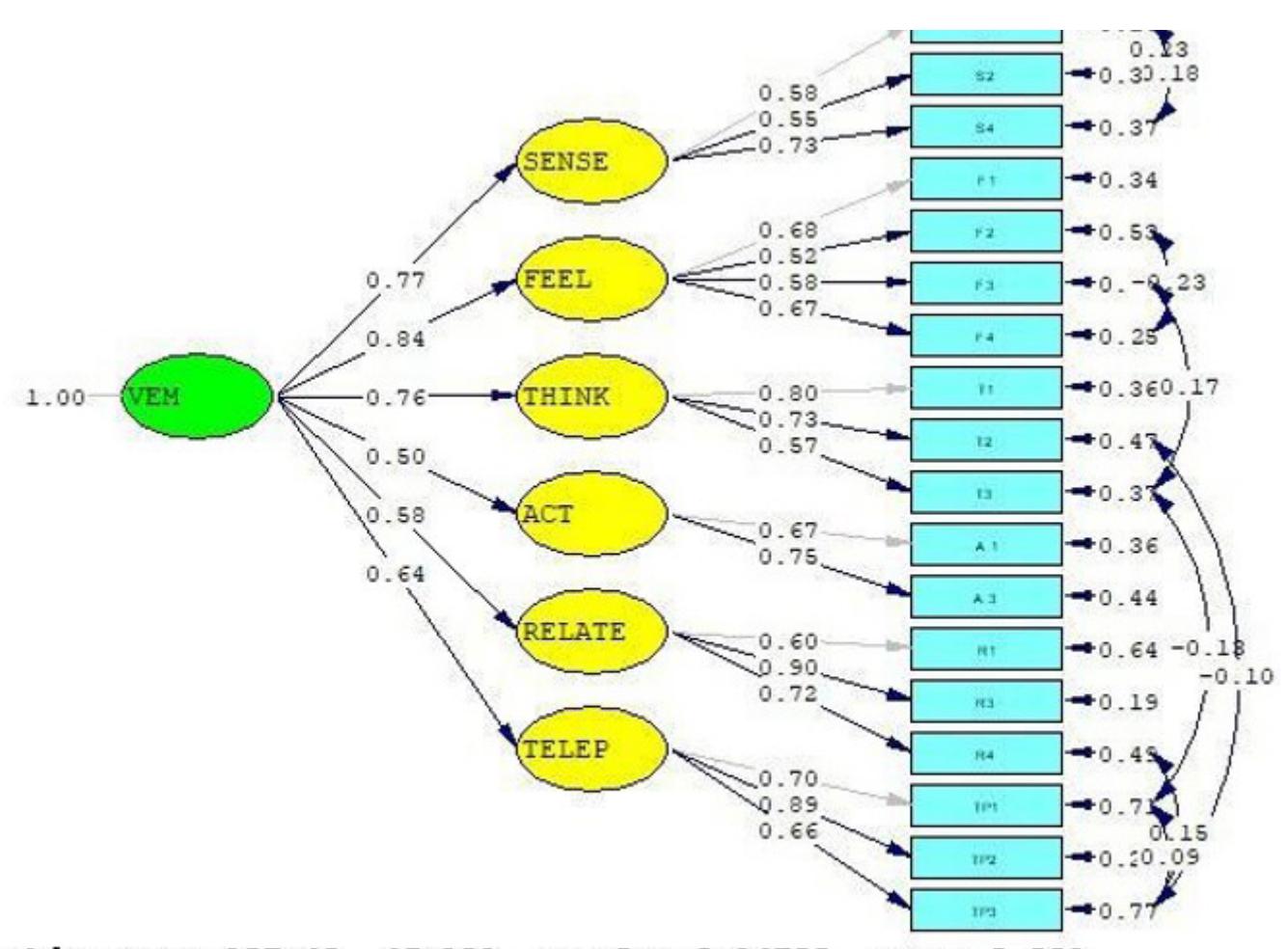
Figure 3 Standardized Loading Factor
Convergent Validity and Reliability
In developing a measurement model, reliable and valid construct measurements are required by checking reliability and validity (Rufaidah, 2017). Measurement of reliability and internal consistency of the measured table variables can be assessed from Construct reliability (CR) using the formula with a cutoff of 0.7 (Hair et al., 2014). Figure 2 shows that the CR value is greater than 0.7, namely SENSE CR: 0.806; FEEL CR: 0.819; THINK CR: 0.786; ACT CR: 0.715; RELATE: 0.796; and TELEP CR: 0.740. Therefore, the constructs are declared reliable.
In CFA, convergent validity can be measured from the average variance extracted (AVE using the formula VE = with a cut-off of 0.5 (Hair et al., 2014). Figure 2 shows that the AVE value is greater than 0.5, namely SENSE AVE: 0.585; FEEL AVE: 0.534; THINK AVE: 0.555; ACT AVE: 0.558; RELATE AVE: 0.0.572; and TELEP AVE: 0.507. Therefore, the constructs are declared valid.
Measurements involving more than two constructs need to pay attention to one-dimensionality. Referring to Rufaidah (2017), CFI values of 0.9 or higher indicate a strong unidimensional scale. Table II shows the acquisition of a CFI value of 0.98> 0.90.
Conclusion
The main finding in this study is the measurement of experiential marketing and telepresence, which is tested to form a latent construct of virtual experiential marketing (VEM) consisting of six dimensions, namely sense, feel, think, act, relate, and telepresence. The formation of the VEM construct allows businesspeople, researchers, companies, etc., to study and evaluate in depth how humans interact with objects, items, or prototypes, especially in virtual worlds. In addition, VEM can measure the extent to which the interaction can be considered a stimulus or real experience (penetrating the virtual world).
In today's customer-oriented marketing world, VEM cannot be ignored. Knowing how a product or product representation is perceived by customers is a must to get an evaluation and determine the next marketing strategy.
This study has limitations. As discussed earlier, the metaverse is still evolving, as is the virtual world as a representation of the metaverse. This development is spearheaded by the advancement of technology, which can increase the level of immersion. Therefore, the sense that is currently only effective in the sense of sight needs to be re-examined in the future. As technology develops, senses in the metaverse may involve hearing and touch.
References
- Algharabat, R., Rana, N. P., Dwivedi, Y. K., Alalwan, A. A., & Qasem, Z. (2018). The effect of telepresence, social presence, and involvement on consumer brand engagement: An empirical study of non-profit organizations. Journal of Retailing and Consumer Services, 40, 139–149. https://doi.org/10.1016/j. jretconser.2017.09.011
- Ben Saad, S., & Choura, F. (2022). Effectiveness of virtual reality technologies in digital entrepreneurship: a comparative study of two types of virtual agents. Journal of Research in Marketing and Entrepreneurship, 24(1), 195–220. https://doi.org/10.1108/JRME-01-2021-0013
- Chen, A. H., & Wu, R. Y. (2022). Mediating Effect of Brand Image and Satisfaction on Loyalty through Experiential Marketing: A Case Study of a Sugar Heritage Destination. Sustainability (Switzerland), 14(12). https://doi.org/10.3390/su14127122
- Chen, H.-L., & Mathews, S. (2017). Experiential Brand Deployment: Improving Tourism Brand Evaluations. Journal of Hospitality & Tourism Research, 41(5), 539–559. https://doi. org/10.1177/1096348014550866
- Cheng, X., Zhang, S., Fu, S., Liu, W., Guan, C., Mou, J., Ye, Q., & Huang, C. (2022). Exploring the metaverse in the digital economy: an overview and research framework. Journal of Electronic Business & Digital Economics, 1(1/2), 206–224. https://doi.org/10.1108/JEBDE-09-2022-0036
- Cuellar, S. S., Eyler, R. C., & Fanti, R. (2015). Experiential Marketing and Long-Term Sales. Journal of Travel & Tourism Marketing, 32(5), 534–553. https://doi.org/10.1080/10548408.2014.918925
- Faiola, A., Newlon, C., Pfaff, M., & Smyslova, O. (2013). Correlating the effects of flow and telepresence in virtual worlds: Enhancing our understanding of user behavior in game-based learning. Computers in Human Behavior, 29(3), 1113–1121. https://doi.org/10.1016/j.chb.2012.10.003
- Feng, X., Wang, X., & Su, Y. (2022). An analysis of the current status of metaverse research based on bibliometrics. Library Hi Tech. https://doi.org/10.1108/LHT-10-2022-0467
- Floyd, J., & Frank, I. (2012). New immersive worlds for educators and librarians: beyond Second Life. Library Hi Tech News, 29(6), 11–15. https://doi.org/10.1108/07419051211277940
- Gao, W., Jiang, N., & Guo, Q. (2023). How do virtual streamers affect purchase intention in the livestreaming context? A presence perspective. Journal of Retailing and Consumer Services, 73. https:// doi.org/10.1016/j.jretconser.2023.103356
- Girvan, C., & Savage, T. (2019). Virtual worlds: A new environment for constructionist learning. Computers in Human Behavior, 99, 396–414. https://doi.org/10.1016/j.chb.2019.03.017
- Guo, Y., Yuan, Y., Li, S., Guo, Y., Fu, Y., & Jin, Z. (2023). Applications of metaverse-related technologies in the services of US urban libraries. Library Hi Tech. https://doi.org/10.1108/LHT-10-2022-0486
- Haenlein, M., & Kaplan, A. M. (2009). Flagship Brand Stores within Virtual Worlds: The Impact of Virtual Store Exposure on Real-Life Attitude toward the Brand and Purchase Intent. Recherche et Applications En Marketing, 24, 3.
- Hair, J. F., Black, W. C., Babin, B. J., & Anderson, R. E. (2014). Multivariate Data Analysis (Seventh Edition). Pearson Education Limited.
- Han, S. L., An, M., Han, J. J., & Lee, J. (2020). Telepresence, time distortion, and consumer traits of virtual reality shopping. Journal of Business Research, 118, 311–320. https://doi.org/10.1016/j. jbusres.2020.06.056
- Hsiao, C.-H., Tang, K.-Y., & Su, Y.-S. (2021). An Empirical Exploration of Sports Sponsorship: Activation of Experiential Marketing, Sponsorship Satisfaction, Brand Equity, and Purchase Intention. Frontiers in Psychology, 12, 677137. https://doi.org/10.3389/fpsyg.2021.677137
- Huang, Y., Backman, S. J., & Backman, K. F. (2012). Exploring the impacts of involvement and flow experiences in Second Life on people's travel intentions. Journal of Hospitality and Tourism Technology, 3(1), 4–23. https://doi.org/10.1108/17579881211206507
- Jahn, K., Oschinsky, F. M., Kordyaka, B., Machulska, A., Eiler, T. J., Gruenewald, A., Klucken, T., Brueck, R., Gethmann, C. F., & Niehaves, B. (2022). Design elements in immersive virtual reality: the impact of object presence on health-related outcomes. Internet Research, 32(7), 376–401. https://doi.org/10.1108/INTR-12-2020-0712
- Khan, I., & Rahman, Z. (2014). Influence of Experiential Marketing on Customer Purchase Intention: A Study of Passenger Car Market. Management and Labour Studies, 39(3), 319–328. https://doi. org/10.1177/0258042X15572411
- Kim, H. C., & Hyun, M. Y. (2016). Predicting the use of smartphone-based Augmented Reality (AR): Does telepresence help? Computers in Human Behavior, 59, 28–38. https://doi.org/10.1016/j. chb.2016.01.001
- Köchling, A. (2021). Experiential marketing as a tool to enhance Tourists' pre-travel online destination experiences? A web-based experiment. Journal of Destination Marketing and Management, 22. https://doi.org/10.1016/j.jdmm.2021.100669
- Kumar, V., & Aaker, D. A. (2018). Marketing research (Thirteenth Edition). Wiley.
- Lee, H., Xu, Y., & Porterfield, A. (2021). Consumers' adoption of AR-based virtual fitting rooms: from the perspective of the theory of interactive media effects. Journal of Fashion Marketing and Management, 25(1), 45–62. https://doi.org/10.1108/JFMM-05-2019-0092
- Li, Y.-J., Cheung, C. M. K., Shen, X.-L., & Lee, M. K. O. (2022). Promoting collaborative learning in virtual worlds: the power of "we". Information Technology & People. https://doi.org/10.1108/ITP-11-2021-0870
- MacKenzie, K., Buckby, S., & Irvine, H. (2013). Business research in virtual worlds: possibilities and practicalities. Accounting, Auditing & Accountability Journal, 26(3), 352–373. https://doi. org/10.1108/09513571311311856
- Minocha, S., & Morse, D. R. (2010). Supporting distributed team working in 3D virtual worlds: A case study in second life. Interactive Technology and Smart Education, 7(4), 200–219. https://doi. org/10.1108/17415651011096021
- Nigam, A. (2012). Modeling the relationship between experiential marketing, experiential value, and purchase intention in organized quick service chain restaurant shoppers using a structural equation modeling approach. Paradigm, XV1(1).
- Noke, H., & Chesney, T. (2014). Prior knowledge: the role of virtual worlds in venture creation. Journal of Small Business and Enterprise Development, 21(3), 403–413. https://doi.org/10.1108/ JSBED-04-2014-0057
- Ongsakul, V., Ali, F., Wu, C., Duan, Y., Cobanoglu, C., & Ryu, K. (2021). Hotel website quality, performance, telepresence, and behavioral intentions. Tourism Review, 76(3), 681–700. https://doi. org/10.1108/TR-02-2019-0039
- Österle, B., Kuhn, M. M., & Henseler, J. (2018). Brand worlds: Introducing experiential marketing to B2B branding. Industrial Marketing Management, 72, 71–98. https://doi.org/10.1016/j. indmarman.2018.04.015
- Pabla, H., & Soch, H. (2023). Up in the air! Airline passengers' brand experience and its impact on brand satisfaction mediated by brand love. Journal of Air Transport Management, 107, 102345. https:// doi.org/10.1016/j.jairtraman.2022.102345
- Paul, I., Mohanty, S., & Sengupta, R. (2022). The role of the social virtual world in increasing psychological resilience during the ongoing COVID-19 pandemic. Computers in Human Behavior, 127, 107036. https://doi.org/10.1016/j.chb.2021.107036
- Pelet, J. É., Ettis, S., & Cowart, K. (2017). Optimal experience of flow enhanced by telepresence: Evidence from social media use. Information and Management, 54(1), 115–128. https://doi.org/10.1016/j. im.2016.05.001
- Peng, Y., & Ke, D. (2015). Consumer trust in 3D virtual worlds and its impact on real-world purchase intention. Nankai Business Review International, 6(4), 381–400. https://doi.org/10.1108/NBRI-03- 2015-0009
- Rather, R. A. (2020). Customer experience and engagement in tourism destinations: the experiential marketing perspective. Journal of Travel and Tourism Marketing, 37(1), 15–32. https://doi.org/10. 1080/10548408.2019.1686101
- Rufaidah, P. (2017). Branding strategy development based on innovative behaviour. International Journal of Business and Globalisation, 18(3), 396. https://doi.org/10.1504/IJBG.2017.083242
- Ruusunen, N., Hallikainen, H., & Laukkanen, T. (2023). Does imagination compensate for the need for touch in 360-virtual shopping? International Journal of Information Management, 70. https://doi. org/10.1016/j.ijinfomgt.2023.102622
- Shobeiri, S., Laroche, M., & Mazaheri, E. (2013). Shaping e-retailer's website personality: The importance of experiential marketing. Journal of Retailing and Consumer Services, 20(1), 102–110. https:// doi.org/10.1016/j.jretconser.2012.10.011
- Sidorko, P. E. (2009). Virtually there, almost: educational and informational possibilities in virtual worlds. Library Management, 30(6/7), 404–418. https://doi.org/10.1108/01435120910982104
- Soliha, E., Aquinia, A., Hayningtias, K. A., & Ramadhan, K. R. (2021). The Influence of Experiential Marketing and Location on Customer Loyalty. The Journal of Asian Finance, Economics and Business, 8(3), 1327–1338. https://doi.org/10.13106/JAFEB.2021.VOL8.NO3.1327
- Stavropoulos, V., Alexandraki, K., & Motti-Stefanidi, F. (2013). Flow and Telepresence Contributing to Internet Abuse: Differences according to Gender and Age. Computers in Human Behavior, 29(5), 1941–1948. https://doi.org/10.1016/j.chb.2013.03.011
- Tikkanen, H., Hietanen, J., Henttonen, T., & Rokka, J. (2009). Exploring virtual worlds: success factors in virtual world marketing. Management Decision, 47(8), 1357–1381. https://doi. org/10.1108/00251740910984596
- Tsai, C.-T. (Simon), & Wang, Y.-C. (2016). Experiential value in branding food tourism. Journal of Destination Marketing & Management, 6(1), 56–65. https://doi.org/10.1016/j.jdmm.2016.02.003
- Xu, W., Jung, H., & Han, J. (2022). The Influences of Experiential Marketing Factors on Brand Trust, Brand Attachment, and Behavioral Intention: Focused on Integrated Resort Tourists. Sustainability (Switzerland), 14(20). https://doi.org/10.3390/su142013000
- Ye, S., Lei, S. I., Shen, H., & Xiao, H. (2020). Social presence, telepresence, and customers' intention to purchase online peer-to-peer accommodation: A mediating model. Journal of Hospitality and Tourism Management, 42, 119–129. https://doi.org/10.1016/j.jhtm.2019.11.008
- Yeh, T.-M., Chen, S.-H., & Chen, T.-F. (2019). The Relationships among Experiential Marketing, Service Innovation, and Customer Satisfaction—A Case Study of Tourism Factories in Taiwan. Sustainability, 11(4), 1041. https://doi.org/10.3390/su11041041
- Yoo, J. (2023). The effects of augmented reality on consumer responses in mobile shopping: The moderating role of task complexity. Heliyon, 9(3). https://doi.org/10.1016/j.heliyon.2023.e13775
- Yuan, Y.-H. "Erin", & Wu, C. "Kenny". (2008). Relationships Among Experiential Marketing, Experiential Value, and Customer Satisfaction. Journal of Hospitality & Tourism Research, 32(3), 387–410. https://doi.org/10.1177/1096348008317392
- Yung, R., Le, T. H., Moyle, B., & Arcodia, C. (2022). Towards a typology of virtual events. Tourism Management, 92, 104560. https://doi.org/10.1016/j.tourman.2022.104560
- Zainurin, M. Z. L., Haji Masri, M., Besar, M. H. A., & Anshari, M. (2023). Towards an understanding of metaverse banking: a conceptual paper. Journal of Financial Reporting and Accounting, 21(1), 178–190. https://doi.org/10.1108/JFRA-12-2021-0487
- Zhao, W., Cheng, Y., & Lee, Y.-I. (2023). Exploring 360-degree virtual reality videos for CSR communication: An integrated model of perceived control, telepresence, and consumer behavioral intentions. Computers in Human Behavior, 144, 107736. https://doi.org/10.1016/j.chb.2023.107736
- Zhou, M., Leenders, M. A. A. M., & Cong, L. M. (2018). Ownership in the virtual world and the implications for long-term user innovation success. Technovation, 78, 56–65. https://doi. org/10.1016/j.technovation.2018.06.002