

Keywords:
jumping sideways, website, talent identification, Node MCU
Identification of children's talents in the world of sports is needed to produce maximum achievements. The talent identification program in this study focuses on a coordination test using a jumping sideways instrument. Instruments still had limitations in measurement, data processing, and data archiving. Therefore, a website-based jumping sideways instrument was developed. This study aims to determine the design specifications and performance specifications of the sideways jumping instrument, which is website-based. This study is research and Development. Data collection techniques are carried out directly and indirectly. The result of direct measurement is the number of jumps, and the result of indirect measurement is the accuracy and precision of the instrument. The first conclusion is that the performance specification consists of a NodeMCU ESP8266, pushbuttons, an LCD, other supporting electronic components, and a website. The two design specifications consist of a proper instrument accuracy of 99.6% and an accuracy of 100%.
INFO ARTIKEL
ABSTRAK
Kata kunci:
jumping sideways, website, pengidentifikasian, bakat, Node MCU
Identifikasi bakat anak dalam dunia olahraga sangat diperlukan agar dapat menghasilkan prestasi yang maksimal. Program pengidentifikasian bakat pada penelitian ini berfokus pada tes koordinasi menggunakan instrumen jumping sideways. Instrumen yang ada sebelumnya memiliki keterbatasan dalam pengukuran, pengolahan data, dan pengarsipan data. Oleh karena itu, dikembangkan instrumen jumping sideways berbasis website. Penelitian ini bertujuan menentukan spesifikasi desain dan spesifikasi performansi dari instrumen jumping sideways untuk tes koordinasi pada anak berbasis website. Penelitian ini merupakan research and development. Teknik pengumpulan data dilakukan secara langsung dan tidak langsung. Hasil pengukuran secara langsung berupa jumlah lompatan anak dan hasil pengukuran secara tidak langsung berupa ketepatan dan ketelitian instrumen. Simpulan penelitian ini adalah pertama, spesifikasi performansi yang terdiri atas NodeMCU ESP8266, pushbutton, LCD, komponen elektronika pendukung lainnya dan website. Kedua, spesifikasi desain terdiri atas ketepatan instrumen bernilai 99,6% dan ketelitian sebesar 100%.
Introduction
A person's performance in sports is strongly influenced by his or her talents. For this reason, it is necessary to identify talent from an early age in children before they are given training, because if they do not have talent in the field they are involved in, the chances of success are small, and if they are successful, the children will not achieve maximum performance. Talent identification is an effort that is carried out systematically to identify someone who has potential in sports so that it is estimated that the child will succeed in participating in training and achieve peak performance.
In general, a person's performance in sports is influenced by five elements of physical condition: strength, speed, endurance, flexibility, and coordination (Fitriady et al., 2020). Coordination is a very complex ability because it is interconnected with speed, strength, flexibility, and endurance (Bompa, 1983). Coordination is the combination of the functions of several muscles in a precise and balanced manner into a single movement pattern.
With good coordination, humans will be able to combine several movements without tension in the right sequence and perform complex movements smoothly without expending excessive energy; thus, the results of the movements being carried out are very efficient, smooth, and well-coordinated. The correlation of the coordination values obtained with the identification of suitable sports is shown in Table I.
Table I Jumping Sideways Characteristics for 9 Types of Sports
| Suitable Types of Sports | Value Jumping sideways | |
|---|---|---|
| Badminton | 105 ± 9 | |
| Basketball | 98±12 | |
| Gymnastics | 107 ±10 | |
| Handball | 95±11 | |
| Judo | 101±6 | |
| Soccer | 102±12 | |
| Table tennis | 107±9 | |
| Triathlon | 95±10 | |
| Volleyball | 96±9 | |
Source: (Johan Pion, 2015).
Measurements of jumping sideways for coordination tests have been carried out by previous researchers (Kiphard & S. Chilling, 2007). Measurements in this study were carried out by jumping to the left and right on the wood measuring 60x4x2 cm. Measurements are made by counting the number of jumps made in 215 seconds (Vandorpe et al., 2011).
However, this method of measurement still has drawbacks. First, in terms of assessment, it is still done manually, thereby reducing the level of accuracy in measurement. Second, in terms of administration, the recording of measurement results and data storage are still done manually, so there is a risk of losing data if at any time the data needs to be accessed for a long time after the measurement.
In this study, an automated instrument will be created to replace the human task of calculations, using push buttons instead. When given a step, the pushbutton will count it as one jump. The results of the measurements will be displayed on the Liquid Crystal Display (LCD) web page that has been connected to the MySQL database. The recording of results and identification of talent will be carried out directly on the website page.
Method
The tools and materials used in developing sideways jumping instruments consist of several components. The following components are used in the development of a website-based sideways jumping instrument:
Node MCU
Node MCU (Node Micro Controller Unit) is a type of microcontroller based on the Internet of Things (IoT). A microcontroller is a single-chip device containing memory for program information and data and logic for reading, controlling programmed inputs, manipulating, and sending outputs (Yohandri, 2010). MCU nodes can be programmed using the Arduino IDE application. The MCU node was chosen because if you use Arduino, you need an additional ESP8266 shield to connect to Wi-Fi. The physical description of the ESP8266 MCU Node is shown in Figure 1.
Figure 1 NodeMCU ESP8266 and Pin Schematic (Source: Einstronic, 2020)
Pushbutton
A pushbutton is a switch that functions to disconnect and reconnect electricity. The pushbutton is different from the switch; the difference lies in the working system that is unlocked. When it is pressed, the switch will remain in position because it does not have a return spring. Figure 2 shows the physical form of a pushbutton.
Figure 2 Pushbutton (Source: addicore, 2021)
Arduino IDE
Arduino IDE is an open-source program that can be downloaded for free at www.arduino.cc. The Arduino IDE is available for Windows, Mac OS X, and Linux (Kadir, 2017). The Arduino provides a C-like programming language for programming Arduino boards. The Arduino IDE is used to write code and upload it to the Arduino board (Javed, 2016:5). The Arduino IDE display is shown in Figure 3.
Figure 3 The Arduino IDE Display
LCD (Liquid Crystal Display)
LCD is a dot matrix display that serves to better display numeric, letter, or symbol characters with low current consumption [9]. The LCD is used to display the measurement results before they are sent to the website. The physical image of the LCD is shown in Figure 4.
Figure 4 4x20 LCD (Source: Siswanto, 72018)
Website
A website is a medium of information on the internet. The website consists of a web server and a web browser. Web servers are also known as web hosting. The web hosting used in this study is connected to a SQL database.
This research is classified as research and development, also known as R&D. The stages of R&D research for product manufacturing are shown in Figure 5.

Figure 5 R&D research steps for developing existing products (Sugiyono, 2012).
Figure 5 shows the stages of R&D research, starting with researching existing products so that aspects that can be innovated or updated are found to increase the usability of the jumping sideways instrument. After finding the aspects to be developed, we collect as much information as possible through literature studies and field studies. From the literature study, an idea of what components will be used in the development of a website-based jumping sideways instrument was obtained.
The next stage is the hardware design and working principle of the sideways jumping instrument. The block diagram of the website-based sideways jumping instrument system is shown in Figure 6.
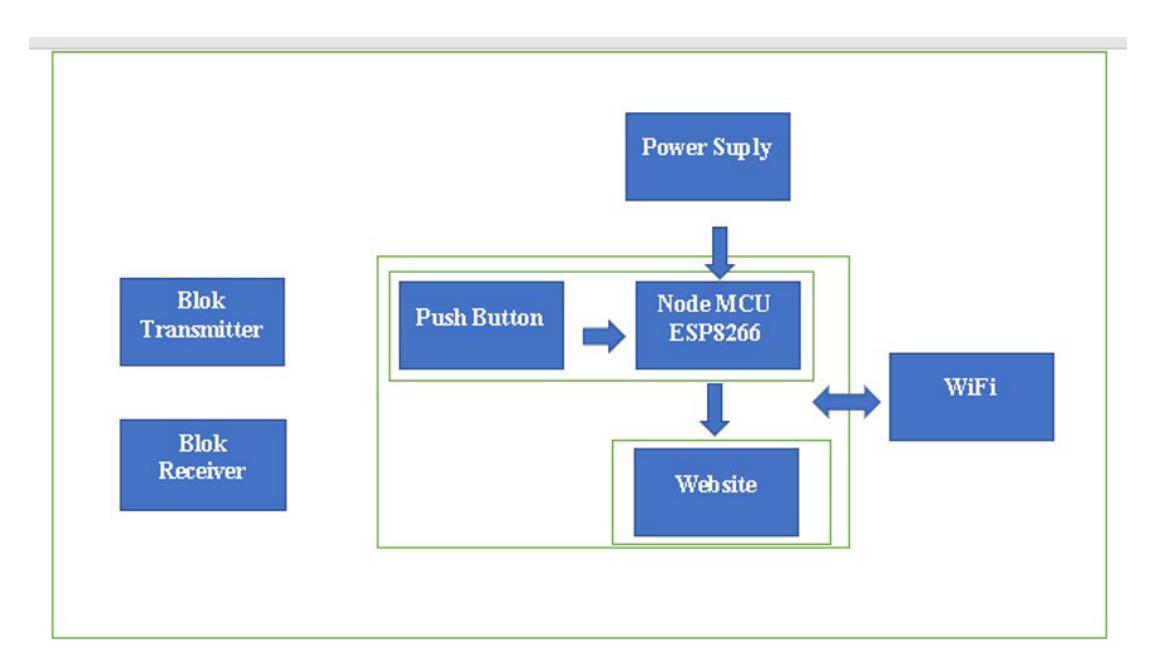
Figure 6 Block Diagram
Figure 6 shows how the output from the pushbutton is processed in the Node MCU ESP8266 microcontroller and sent to the website with the help of Wi-Fi. The system requires a power supply to work.
This design is then tested by parties who are considered experts and have educational backgrounds that are relevant to this research topic. If there are still deficiencies from the internal design test, a revision is made before entering the manufacturing stage. Furthermore, in the product manufacturing stage, revisions are also carried out after the manufacture of the tool if the work of the product does not meet the target to be achieved.
Result and Discussion
The results of this study are divided into two parts: the performance specification and the design specification. Performance specifications consist of the function of each component contained in the instrument, both on the jumping sideways instrument and on the website. The website-based sideways jumping instrument is similar to the previous sideways jumping instrument; the difference lies in the electronic components contained on the website-based sideways jumping instrument. For more details, ordinary sideways jumping instruments and website-based sideways jumping instruments are shown in Figures 7 and 8.
Figure 7 Jumping Sideways Instrument (Source: (Adriyani et al., 2020)).
Figure 8 Jumping Sideways Instrument
From Figures 7 and 8, the difference between the ordinary sideways jumping instrument and the website-based sideways jumping instrument is the additional foam on the board. The addition of this foam aims to protect the pushbutton that is placed under it, but it also serves to provide comfort to the feet when jumping. The box contained on the website-based jumping sideways instrument serves as a place to place the NodeMCU ESP8266 microcontroller, which will count the number of jumps and send data to the website via Wi-Fi (Wireless Firmware).
In the black box, there is also an LCD, which serves to display the measurement results. The results that appear on the LCD are sent to the website, which is then displayed, and the data is also used to determine the child's talent.
The performance specifications of website pages consist of visitor pages and admin pages. The visitor page can be accessed by anyone, while the admin page can only be accessed by the admin. To enter the admin page, you must first login. The visitor page, login page, and admin page are shown in Figures 9 and 10.
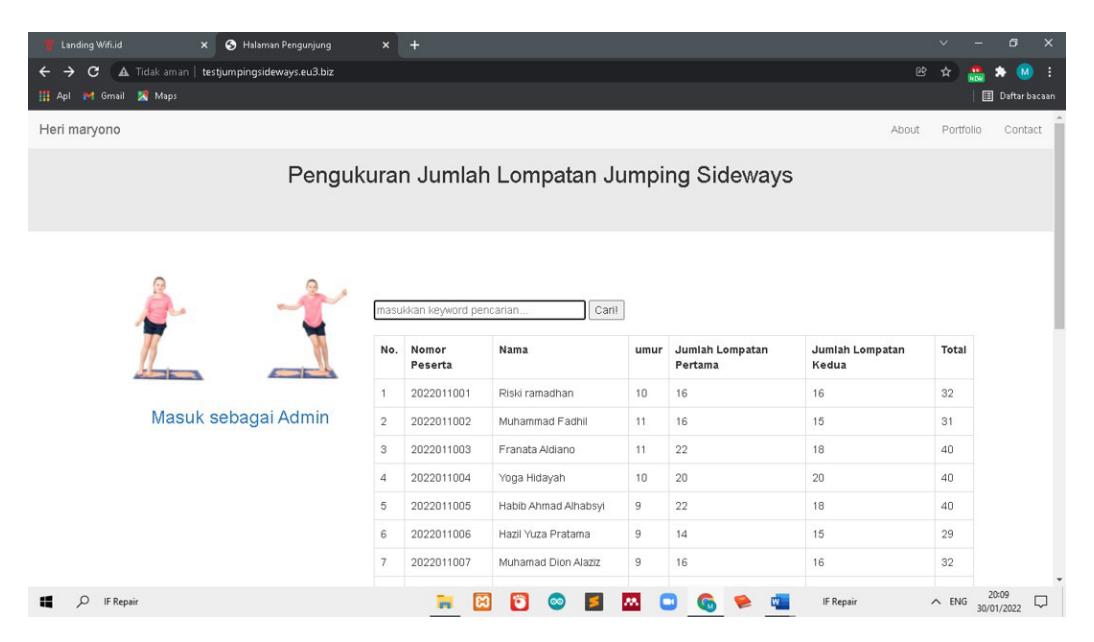
Figure 9 Visitor Page
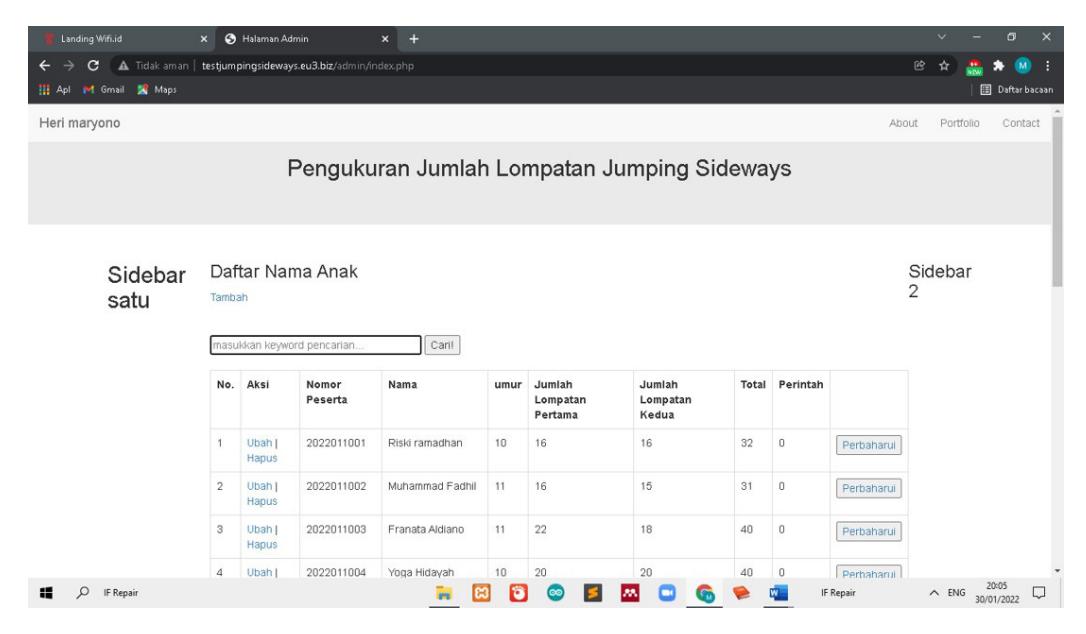
Figure 10 Admin Page
The design specifications include the precision and accuracy of the sideways jumping instrument. Accuracy is obtained by comparing the results of the calculation of the website-based jumping sideways instrument with the results of calculations carried out conventionally by humans. The result of calculating the average accuracy of the website-based jumping sideways product is 0.9964. Accuracy can be obtained by making repeated measurements. The jumping sideways instrument measures 20 repetitions. The accuracy of the website-based jumping sideways instrument is equal to 1. The precision and accuracy of the jumping sideways instrument are shown in Tables II and III.
Table II The Precision of Website-Based Jumping Sideways Instrument
| No | Child Name | Number of Website-Based Sideway Jumpings | Number of Conventional Sideway Jumpings | Precision | % of Error |
|---|---|---|---|---|---|
| 1 | Child 1 | 32 | 32 | 1 | 0% |
| 2 | Child 2 | 31 | 31 | 1 | 0% |
| 3 | Child 3 | 40 | 40 | 1 | 0% |
| 4 | Child 4 | 40 | 40 | 1 | 0% |
| 5 | Child 5 | 40 | 40 | 1 | 0% |
| 6 | Child 6 | 29 | 29 | 1 | 0% |
| 7 | Child 7 | 32 | 32 | 1 | 0% |
| 8 | Child 8 | 34 | 34 | 1 | 0% |
| 9 | Child 9 | 34 | 34 | 1 | 0% |
| 10 | Child 10 | 30 | 30 | 1 | 0% |
| 11 | Child 11 | 31 | 31 | 1 | 0% |
| 12 | Child 12 | 28 | 28 | 1 | 0% |
| 13 | Child 13 | 30 | 30 | 1 | 0% |
| 14 | Child 14 | 28 | 27 | 0.962963 | 4% |
| 15 | Child 15 | 33 | 33 | 1 | 0% |
| 16 | Child 16 | 34 | 34 | 1 | 0% |
| 17 | Child 17 | 29 | 27 | 0.964286 | 4% |
| 18 | Child 18 | 25 | 25 | 1 | 0% |
| 19 | Child 19 | 30 | 30 | 1 | 0% |
| 20 | Child 20 | 33 | 33 | 1 | 0% |
| 21 | Child 21 | 25 | 25 | 1 | 0% |
| Mean | 0.996418 | 0.36 % | |||
Table III The Accuracy of Website-Based Jumping Sideways Instrument
| No | Data | Number of Website- Based Sideway Jumpings | Number of Conventional Sideway Jumpings | Accuracy | % of Error |
|---|---|---|---|---|---|
| 1 | Data 1 | 6 | 6 | 1 | 0% |
| 2 | Data 2 | 6 | 6 | 1 | 0% |
| 3 | Data 3 | 6 | 6 | 1 | 0% |
| 4 | Data 4 | 6 | 6 | 1 | 0% |
| 5 | Data 5 | 6 | 6 | 1 | 0% |
| 6 | Data 6 | 6 | 6 | 1 | 0% |
| 7 | Data 7 | 6 | 6 | 1 | 0% |
| 8 | Data 8 | 6 | 6 | 1 | 0% |
| 9 | Data 9 | 6 | 6 | 1 | 0% |
| 10 | Data 10 | 6 | 6 | 1 | 0% |
| 11 | Data 11 | 6 | 6 | 1 | 0% |
| 12 | Data 12 | 6 | 6 | 1 | 0% |
| 13 | Data 13 | 6 | 6 | 1 | 0% |
| 14 | Data 14 | 6 | 6 | 1 | 0% |
| 15 | Data 15 | 6 | 6 | 1 | 0% |
| 16 | Data 16 | 6 | 6 | 1 | 0% |
| 17 | Data 17 | 6 | 6 | 1 | 0% |
| 18 | Data 18 | 6 | 6 | 1 | 0% |
| 19 | Data 19 | 6 | 6 | 1 | 0% |
| 20 | Data 20 | 6 | 6 | 1 | 0% |
| 21 | Data 21 | 6 | 6 | 1 | 0% |
| Mean | 0% | ||||
Based on the analysis that has been done previously, it can be seen that the results of this research have been successful in accordance with the objectives to be achieved. The results obtained are the first performance specification, which consists of the function of each component contained in the jumping sideways instrument and the function of each page contained on the website. The two design specifications consist of the accuracy of the website-based sideways jumping instrument, which is 0.996418, and the accuracy of the website-based sideways jumping instrument, whose value is equal to 1.
The accuracy value and the accuracy value close to one indicate that the website-based sideways jumping instrument is feasible to use in data collection for coordination tests. in children using the jumping sideways method. In addition to performance specifications and design specifications, the results of identifying talents in children are also obtained. The results of this identification are obtained after processing the value of the number of jumps obtained and converting it into the MQ score.
Value processing is carried out directly on the website. The talent of the child will be identified immediately after the jumping sideways measurement has been completed. This certainly makes it much easier to process values that previously had to be done by certain people on conventional sideways jumping instruments.
The advantage of the website-based sideways jumping instrument compared to conventional sideways jumping instruments is that the first calculation of the number of jumps and time measurements using a stopwatch is carried out by the instrument itself without the need for human assistance. This increases the accuracy of the measurement compared to being done by people, because if it is done by people, when the number of participants increases, the person taking the measurement can suffer from fatigue, which will cause the person's accuracy to decrease.
The second advantage is the mechanism for recording and archiving the measurement data that is automatically stored directly into the database, so that it no longer requires the help of people to record and store the data. The third advantage is that the results of identifying talent can be known immediately after the overall sideways jumping measurement is completed. The statistics on the identification of talent in this study are shown in Figure 11.
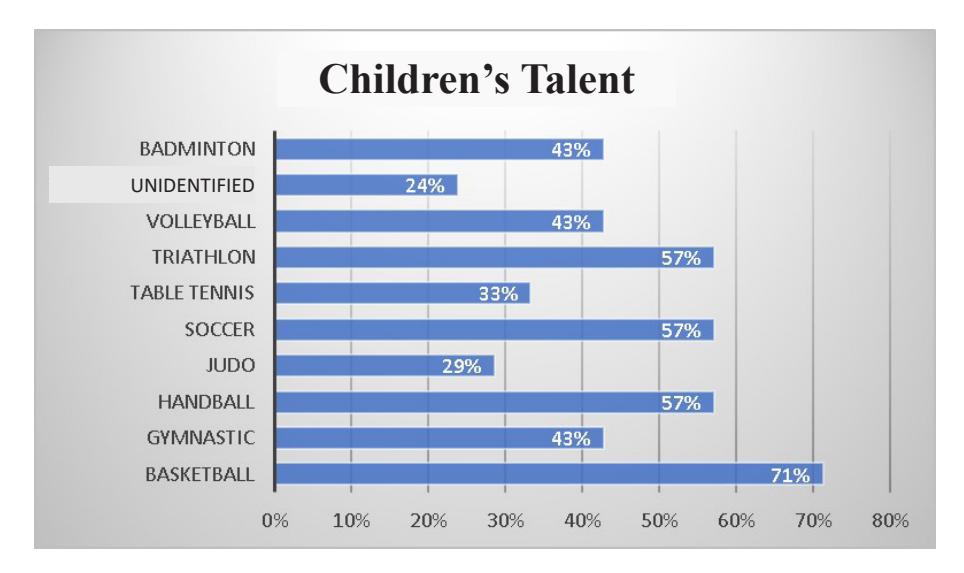
Figure 11 Presentation of the Results of Identifying Children's Talents
Conclusion
Based on the research that has been done, the following conclusions are drawn. The performance specifications of the website-based jumping sideways instrument consist of a 20x4 LCD that functions to display the time and measurement results, a pushbutton that counts the number of jumps, and a box containing a Node MCU microcontroller to embed the program. In addition to being displayed on the LCD, the measurement results will also be displayed and stored, and talent identification will be carried out on the website.
The results of the website-based jumping sideways instrument design specifications consist of three parts, namely the status of the pushbutton output, the accuracy, and the precision of the instrument. The value of each part is that the output status is high when it is given a low footing when there is no stamping, the accuracy is 0.996, and the accuracy is 1.
References
Addicore. (2021,December 27). Large Tact Pushbutton Switch (12x12x7mm). from https://www. addicore.com/
Adriyani, R., Iskandar, D., & Camelia, L. S. (2020). Gender Differences in Motor Coordination and Physical Activity. 21(Icsshpe 2019), 122–126.
Bompa, 1983. Power Training for Sport Plyometrics for Maximum Power Development. New York: Mosaic Press.
Einstronic. (2020, March 3). Introduction to NodeMCU ESP8266 from www.einstronic.com
Fitriady, G., Sugiyanto, & Sugiarto, T. (2020). Gelanggang Pendidikan Jasmani Indonesia. Gelanggang Pendidikan Jasmani Indonesia, 3(2), 82–90.
Javed, A. 2016. Building Arduino Projects for The Internet of Things. United States: Apress
Kadir, A. 2017. Pemrograman Arduino dan Android Menggunakan App Inventor. Jakarta: Elex Media Komputindo.
- Kiphard, E. J., & Schilling, F. Körperkoordinationstest für Kinder. (1974, 2007). Weinheim: Beltz Test GmbH
- Pion, J. 2015. Generic Anthropometric and Performance Characteristics among Elite Adolescent Boys in Nine Different Sports. European Journal of Science Sport.
- Siswanto, S., Utama, G. P., & Gata, W. 2018. Pengamanan Ruangan Dengan DFRDuino Uno R3, Sensor MC-38, PIR, Notifikasi SMS, Twitter. Jurnal RESTI (Rekayasa Sistem dan Teknologi Informasi), 2(3), 697-707.
- Sugiyono. 2012. Metode Penelitian Kuantitatif, Kualitatif, dan R&D. Bandung: Alfabeta.
- Vandorpe, B., Vandendriessche, J., Lefevre, J., Pion, J., Vaeyens, R., Matthys, S., Philippaerts, R., & Lenoir, M. (2011). The KörperkoordinationsTest für Kinder: Reference values and suitability for 6-12-year-old children in Flanders. Scandinavian Journal of Medicine and Science in Sports, 21(3), 378–388.
- Yohandri. 2010. Pengembangan Sistem Eksperimen Viskositas Berbasis Personal Komputer dan Mikrokontroler MCS-51. Jurnal Sainstek Vol. II No. 1: 46-55.