

INFO ARTIKEL
Kata kunci:
Pedagang kaki lima, vitalitas perkotaan, kawasan wisata, kawasan wisata perkotaan, kreativitas
ABSTRAK
Sejak tahun 1970-an Pedagang Kaki Lima (PKL) menghiasi wajah Malioboro sebagai ikon Kota Yogyakarta. Malioboro pun semakin ramai dikunjungi, beberapa orang menilai PKL ini justru menurunkan keindahan koridor Malioboro. Berdasarkan kondisi tersebut, maka terbitlah keputusan untuk merelokasi PKL Malioboro. Sebagian orang menganggap PKL merupakan sektor yang memengaruhi tingkat keramaian dan menjadi daya tarik tersendiri bagi kawasan Malioboro. Namun, tidak sedikit yang menganggap sebagai penghalang wajah asli Jalan Malioboro. Vitalitas lingkungan adalah aspek penting dalam meningkatkan ketertarikan pengunjung. Penelitian ini bertujuan untuk mengkaji dampak keputusan tersebut terhadap vitalitas Malioboro sebagai kawasan wisata. Dengan menggunakan metode kualitatif, penelitian ini membandingkan realita melalui survei lapangan dan kuesioner online yang dikumpulkan selama satu minggu dengan total 61 responden dan menggunakan teori vitalitas lingkungan dan kawasan wisata. Hal tersebut dilakukan untuk mendapatkan simpulan apakah keputusan untuk merelokasi PKL Malioboro dapat mempertahankan atau bahkan mengurangi vitalitas perkotaan kawasan Malioboro.
Introduction
Since the beginning of the 1970s, Malioboro has become the center of urban government and the economy. Malioboro Street is an attractive tourist destination for every visitor. The emergence of street hawkers was based on Patih Danureja's permission in 1970 for courtiers to trade. Then, several people from the Chinatown area also opened shops, until finally some of these street hawkers filled the front of Malioboro and blocked its façade. Seeing these conditions, a decision was issued to relocate the Malioboro street hawkers. In addition, the Regional Government of Yogyakarta wants to make the Malioboro tourist area one of the UNESCO cultural natural reserves. However, this decision also has pros and cons.
According to Yogyakarta Mayor Regulation Number 37 of 2010, "street hawkers have been regulated by the Yogyakarta City government", where the scope of the study area is classified as the location where street hawkers are allowed. However, over time, the DIY Regional Government (Pemda) has decided to relocate street hawkers (PKL) starting in early February 2022. Two new locations for street hawkers have been prepared, namely the former Indra Cinema Building and the former Yogyakarta Tourism Office Building, both of which are still in the Malioboro Tourism Area.
Before the relocation decision was made, street hawkers in the Malioboro street corridor filled the pedestrian walkway and facade of Malioboro. The pedestrian area becomes very narrow, with a width of 5 m, and is mostly filled with street vendors. Clearly, this is not inclusive and is less comfortable. However, this area is a meeting point for every visitor, with a variety of activities that can be carried out depending on the goods and snacks sold by the street vendors. At night, we can see several street markets, and not infrequently, there are art performances.
Figure 1 Art Performances for Uniting Street Hawkers (Source: Kompasiana.com)
By providing varied events and activities, such as concerts, art exhibitions, street theater, and street markets, people will be attracted to an area just to see what's going on. Also, by having people on the streets, in cafes, and moving through the public realm, urban vitality is stimulated (Montgomery, 1995). This statement is clearly the opposite of the Yogyakarta city government's decision. The most lively and interesting parts of cities are places of complex variety where small-scale business activity is well represented. Therefore, diversity is essential to the success of cities, supported by sizable populations with a variety of preferences and tendencies (Montgomery, 1995). The Malioboro Street corridor with street hawkers has been a landmark, a place where transactions, meetings, a diversity of activities, and discussions are held. In other words, they increased the urban vitality of the Malioboro Street corridor. So, the question that will arise is whether the Yogyakarta city government's decision to relocate the street hawkers from Malioboro Street can be maintained, or it reduces Malioboro's urban vitality instead.
Urban vitality is the life of an area for approximately 24 hours. Urban vitality is used to encourage more interaction between activities and public spaces (Montgomery, 1995). Vitality in urban public spaces refers to spaces that are safer, more desirable, and more attractive, and they can offer more choices for social activities as well as being venues for cultural exchange and creativity. The vitality of the area is formed from four categories of vitality: economic vitality, social vitality, urban vitality, and cultural vitality. However, this research focuses on the theory of urban vitality and its constituent aspects. Susiyanti (2003) says several aspects affect the vitality of the urban area, namely comfort, security, safety, and fun. The following are indicators for each aspect of assessing the urban vitality of the area:
Table I Indicators of Urban Vitality
| No | Aspects | Variable | Indicators |
|---|---|---|---|
| Protected from the weather and available shelter for pedestrians | |||
| The physical shape of the sidewalk is unbroken and sloping | |||
| Pedestrian Path | Freedom of movement, not hindered by the use of other lines | ||
| Disabled friendly | |||
| 1. | Comfort | The existence of public open spaces (parks, plazas) | |
| Green Open Space | Can absorb heat and noises | ||
| Close to trading activities | |||
| Motor vehicle parking | Public transportation facilities and bus stops are available | ||
| Accessibility | Ease of access to the trading area | ||
| Building Management | Adequate order and density of buildings | ||
| 2. | Pedestrian Path | Pedestrian activity to create an active corridor | |
| Security | Area Activities | All-day area activities | |
| Lighting | Adequate lighting, good visibility, and an unobstructed view | ||
| Safety | Building structure | Ensure human safety from possible accidents or injuries due to failure of the building structure | |
| Fire Danger | Equipped with instructions on how to prevent, overcome, rescue from fire, and clear signs indicating the way out | ||
| 3. | Equipped with fire stairs, 2-hour fireproof walls, and an available fire zone | ||
| Avoid conflicts between users of the area with motorized vehicles | |||
| Pedestrian Path | Avoid the danger of falling, crashing into poles, or trees | ||
| Pedestrian Path | An interesting pedestrian route in terms of activity creativity and beauty | ||
| 4. | Pedestrian paths are sought in the shortest and clearest paths, and not congested | ||
| Fun | Aesthetic, recreational, attractive, prestigious, and creative. | ||
| There are various unique attractions | |||
| Area Attraction | Landmark of a trade area that is different from other areas, available certain image-forming sculpture |
Source : (Jalaladdini et al, 2011; Pohan et al, 2018)
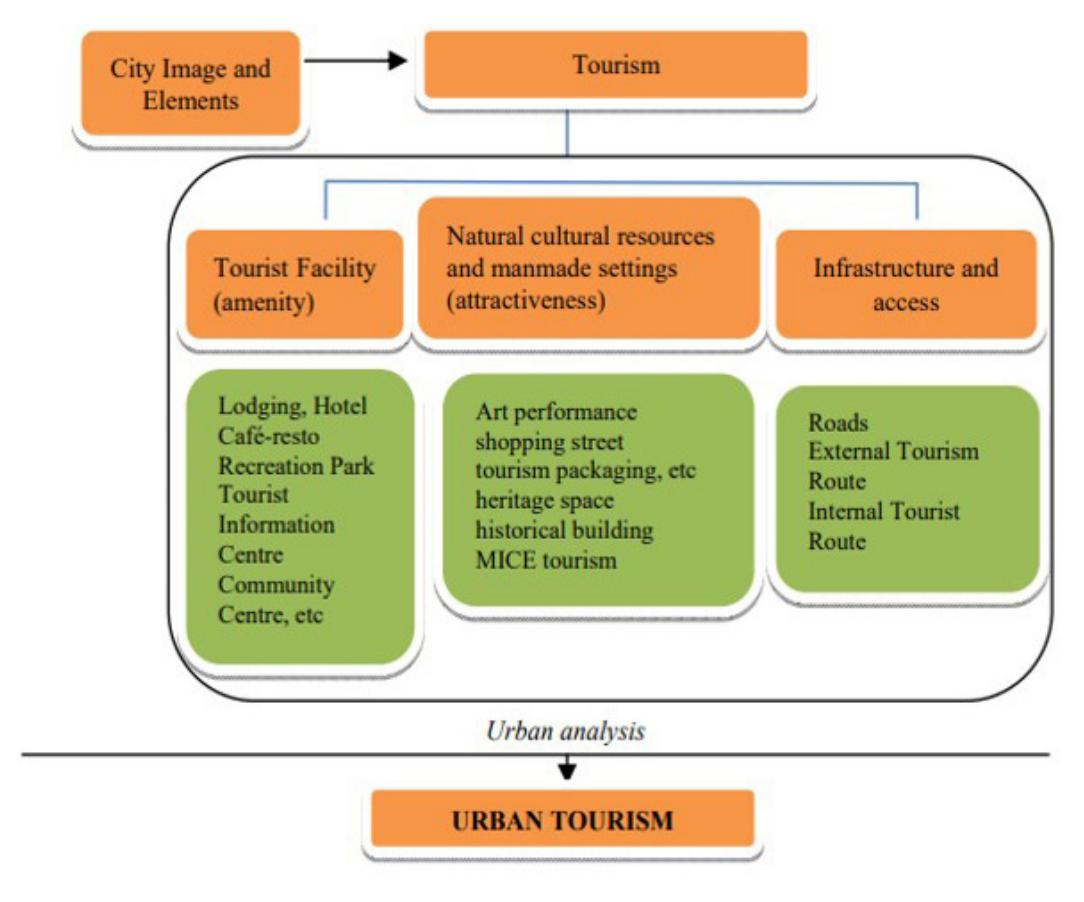
Figure 2 Urban Tourism Precincts Framework (Source: Jalaladdini et al,2011
These two related theories have the same goal, the number of visitors increases though the street hawkers are relocated.
Table II The Link between Urban Vitality and Urban Tourism Precincts
| No | Urban Tourism Precincts Indicators | Urban Vitality Indicators |
|---|---|---|
| 1 | Social interactions | Enjoyment |
| 2 | Safety | Security and Safety |
| 3 | Sense of Belonging & Sense of Place | Convenience and Fun |
| 4 | Have Different Facilities | Convenience and Security |
| 5 | Transformability | Convenience |
| 6 | Aesthetics | Enjoyment |
| 7 | Accessibility | Convenience and Fun |
Since there is a gap between Montgomery's 1995 statement that diverse activities can increase urban vitality and the relocation of street hawkers to the same place, the diversity of activities is reduced. This study aims to prove and examine further the relocation decision that affect the urban vitality of Malioboro Street and to find a link between the urban vitality of Malioboro Street and its role as an urban tourism precinct.
Method
This research used a grounded theory qualitative research method. Grounded theory is a qualitative research method that uses a set of systematic procedures to inductively develop a theory about a phenomenon. This method starts with a statement that is still vague and finally produces a theory that is collected from various data points. Qualitative research is research that is descriptive. Process and meaning are highlighted in qualitative research. The theoretical basis is used as a guide so that the research focus is on accordance with the facts in the field.
Procedure and Design
The following are the stages of this research:
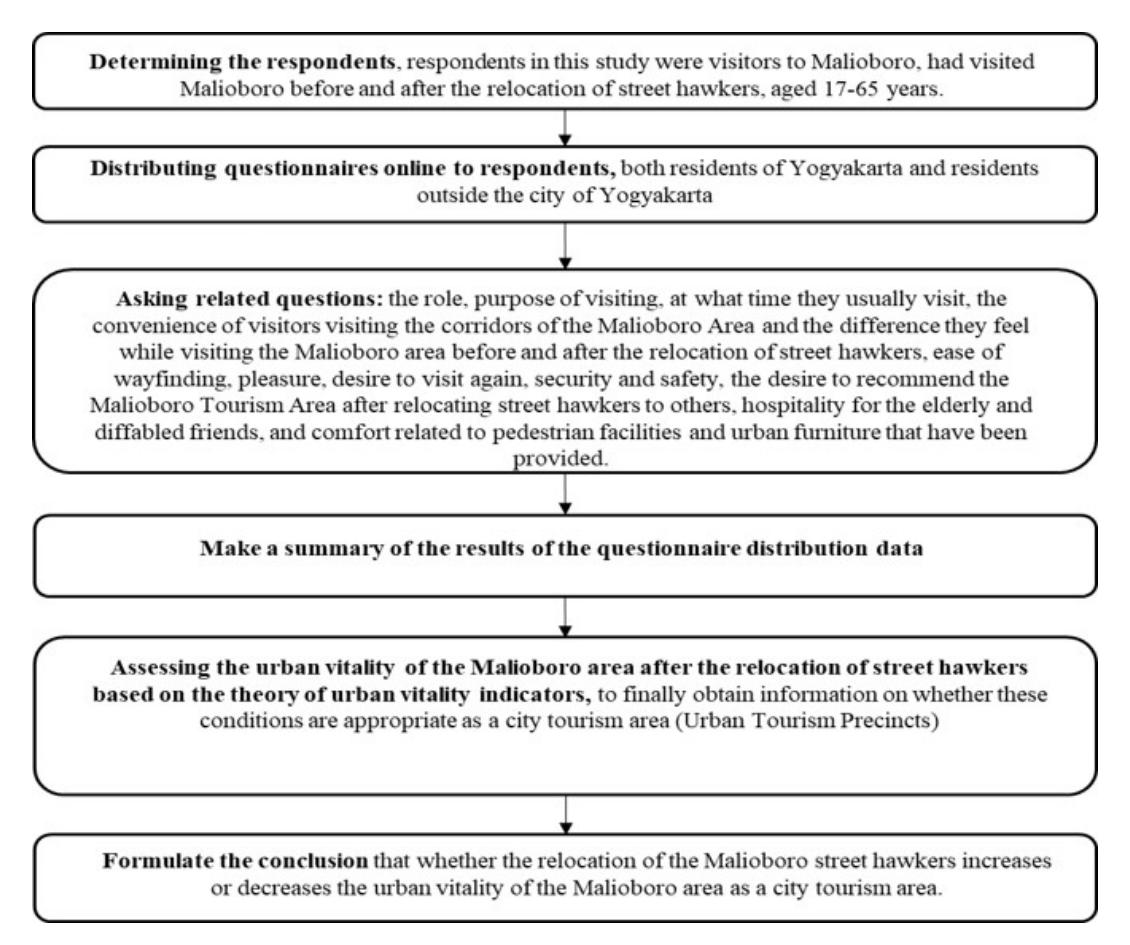
Figure 3 Research Stages
Data Collection
Data sources in this study are grouped into two categories: primary data and secondary data. The primary data in this study were obtained from the results of distributing online questionnaires with the following criteria: Malioboro visitors, aged 17–65 years, who have visited Malioboro before the relocation (meaning before February 2022) and after the relocation of street hawkers (after February 2022). In addition to the questionnaire, the primary data for this research will also be obtained from the researcher's documentation when visiting the Malioboro area after the street hawkers were relocated. Secondary data were obtained from a literature review, previous research, and comparative studies, including theoretical studies related to urban vitality and urban tourism in public places and a study of the Yogyakarta Street hawker arrangement policy.
The data collection techniques used were document analysis, observation, and questionnaire distribution. The observation technique used in this study was a field survey to observe the vitality of Malioboro Street after the street hawkers were relocated. For online questionnaires, researchers prepared a research instrument in the form of written questions with answers using a Likert scale (scale 1–5) to formulate the conclusions obtained.
The scope of this research area is the city of Yogyakarta, precisely on Malioboro Street. However, this research will focus on the Malioboro Street corridor, 1 km from the north, right at the Malioboro Kembang Market Park intersection, to the Marga Mulya Church intersection, Yogyakarta. This research was conducted in the period of March–May 2022, and field documentation was taken in March 2022.
Data Analysis
Based on this type of research, namely qualitative research, the data analysis technique used is descriptive qualitative, where the results of the data obtained will be processed into a description and study of the impact of the relocation of street hawkers on the vitality of Malioboro Street as a tourist area. Starting from data collection, processing data by concluding primary and secondary data, and ending at the conclusion.
The data sampling method that was used in this study was probability sampling. Proportionate stratified random sampling was done by making layers (strata), and then from each layer, several subjects were taken randomly. The number of subjects from each layer (strata) was the research sample. In this study, the strata referred to are classified based on the age classification and the role of visitors to the Malioboro tourist area.
Result and Discussion
At night, it can be seen that the activity along the Malioboro Street corridor is still bustling with visitors. However, there are no busy culinary activities, which are usually located in the pedestrian area. Activities tend to be quiet; the crowd point is in Teras Malioboro, the area where street hawkers are moved.
Field Observation and Survey Results
Documentation during the day was taken at 11.30 a.m. The condition of the Malioboro Street corridor tends to be quiet; there are not many activities to do, unlike the conditions before the relocation of street hawkers, where many activities could be carried out.
Figure 4 Pedestrian Night Conditions in Malioboro Street
Vehicle parking is provided at several points, but still along the Malioboro Street corridor. This is being done to avoid traffic jams and crowds of vehicles that used to fill Malioboro Street. This is considered quite good because this tourist corridor has become tidier.
Figure 5 Vehicle Parking Area on Malioboro Street
Optional transportation such as delman (horse carts) and pedicabs is provided at several points closest to the pedestrian area. This is available to support the economy of the city of Yogyakarta. Because horse carts and pedicabs are typical regional transportation, this is also considered to improve the visitor experience.
Figure 6 Pedicabs as Transportation Options around Pedestrian Routes
As for the pedestrian path itself, nowadays it feels quieter. A pedestrian path with urban furniture that is disabled-friendly has existed since before the relocation, but when there were street hawkers, the pedestrian path became narrower and was not flexible, so it tended to be dangerous for the disabled. The facade of this shopping arcade is neatly arranged and still maintains the uniqueness of the Yogyakarta cultural heritage building, although several shops carry a contemporary architectural style.
Figure 7 Pedicabs as Transportation Options around Pedestrian Routes
There are regional landmarks that are typical of the Malioboro Tourism Area with Javanese script and several new landmarks where visitors can take pictures with statues. These new landmarks also serve as zone markers. Lighting lamps for pedestrian paths scattered in the area can also become regional landmarks, considering their shape is very similar to Javanese carvings. Apart from landmarks, there is also signage or markers scattered in the Malioboro Tourism Area. These markers can make it easier for visitors to find their destination. In addition, there is uninterrupted vegetation to support the beauty of the pedestrian paths, although the vegetation in the form of trees and ornamental plants cannot absorb solar heat and noise.
Figure 8 Malioboro Street Corridor Markers, Landmarks, and Vegetation
The atmosphere of the pedestrian path now feels neater and more orderly, with urban street furniture that is scattered, which can provide comfort for visitors to relax and can be a point of interaction between visitors. Urban street furniture in the form of seats, bollards, trash cans, and hand washing areas is able to enhance the visitor experience when visiting the Malioboro Tourism Area. This urban street furniture is also used and well-maintained by visitors.
Figure 9 Urban Street Furniture on Pedestrian Path at Malioboro Street Corridor
Online Questionnaire
The online questionnaire had been distributed for one week, with a total of 61 respondents in the period March–May 2022. The respondents have the following criteria: Malioboro visitors who have visited Malioboro before the relocation (meaning before February 2022) and after the relocation of street hawkers (after February 2022) and are aged 17–65 years The age range used in this study aims to identify inclusivity. These are the following results:
| No | Category | Demographics |
|---|---|---|
| 1 | Age | 78.7% are respondents aged 17-29 years; 14.68% aged 45-65 years; and 6.6% aged 30-44 years |
| 2 | Role | 100% role as tourists/visitors |
| 3 | Destinations | 57.4% recreation; 27.9% shopped; 11.5% culinary, and 3.3% other activities |
| 4 | Activity time | 72.1% are active at 18.00-24.00; 26.2% are active at 11.00-17.00; and 1.6% are active at 05.00-10.00 |
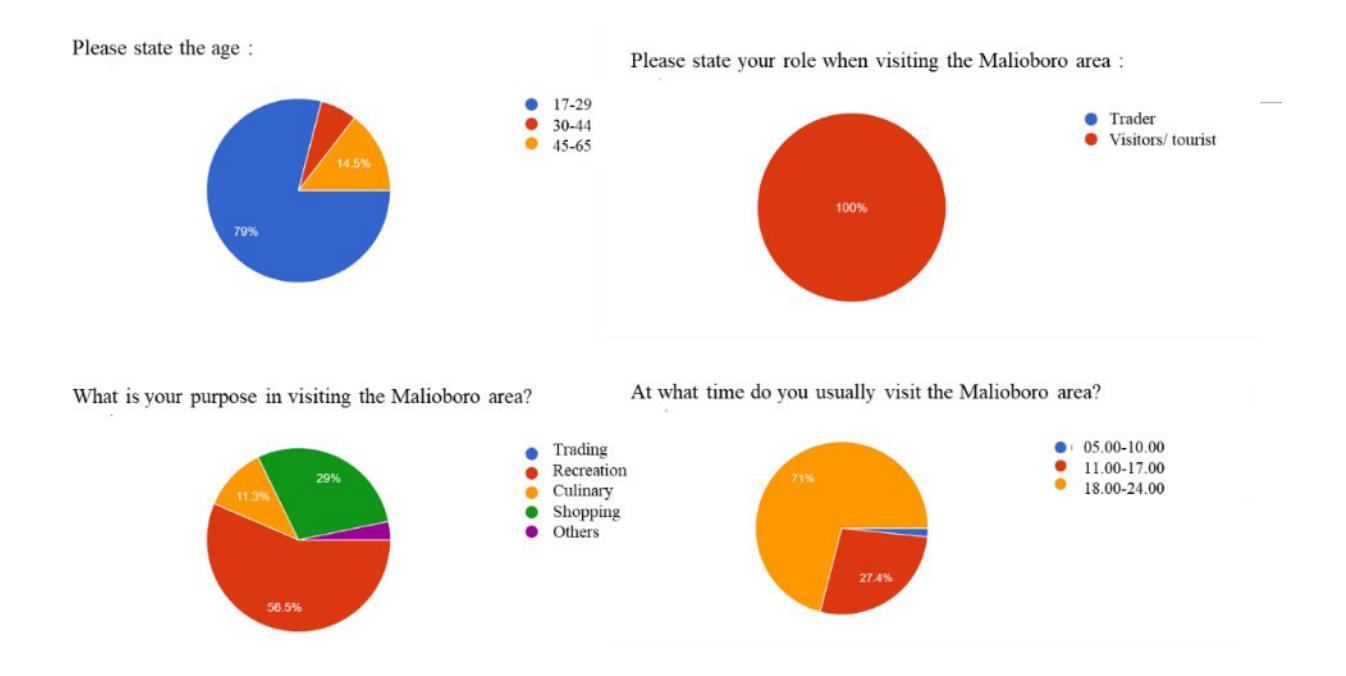
Figure 10 Respondents' Data
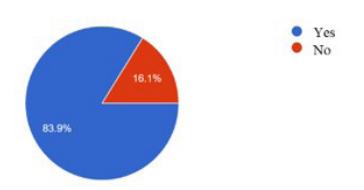
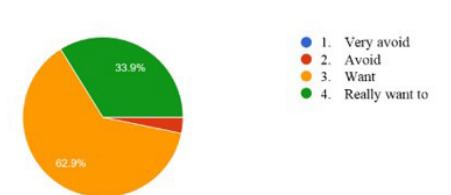
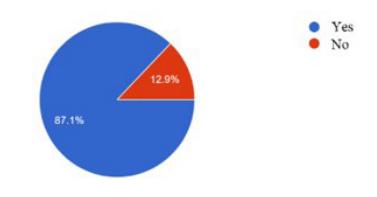
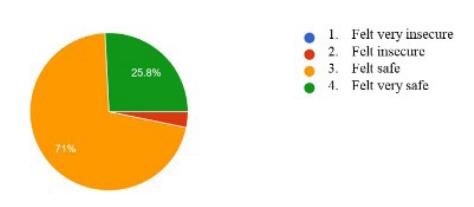
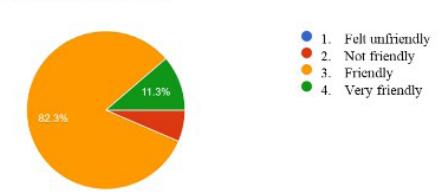
From these characteristics, with an assessment using a Likert scale (1–5), the results were obtained in an outline, such as convenience before and after the relocation: 67.2% felt more comfortable with the current conditions; 24.6% felt very comfortable; and 8.2% felt uncomfortable. Ease of wayfinding: 70.5% find it easy to find places of interest, roads, and landmarks they are going to; 19.7% find it very easy; and 9.8% find it difficult. The bustling area: 73.8% feel the current conditions are busier and livelier; however, 26.2% feel otherwise. Enjoyment: 83.6% feel happier with the current conditions, but 16.4% feel otherwise. Desire to visit again: 62.3% feel like visiting the Malioboro Tourism Area after experiencing the current conditions, 34.4% feel like they want to, and 3.3% feel they don't want to and tend to avoid it. Security: 72.1% feel safer visiting the Malioboro Tourism Area at this time, and 26.2% feel very safe. Inclusivity: 82% feel the current conditions are friendly enough for the elderly and disabled; 11.5% feel the current conditions are very friendly for the elderly; and 6.6% feel they are very unfriendly. Regarding urban street furniture, 95.1% feel the available urban street furniture enhances their experience, and 4.9% feel the opposite.
The Effect of Relocating Street Hawkers... | Eva, Woerjantari
Are you aware of the latest news regarding the relocation of 1,832 street hawkers who are usually located along the corridor of Jl. Malioboro?
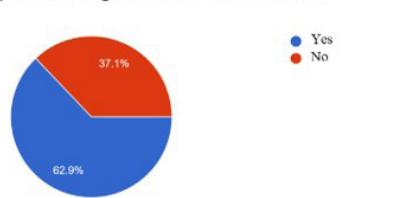
Have you visited the Malioboro Area corridor after the relocation of street hawkers in early February 2022?
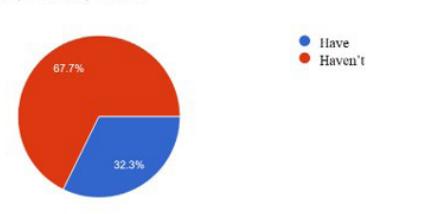
When compared with the previous conditions, how comfortable were you when visiting the Malioboro area after the street hawkers were relocated?
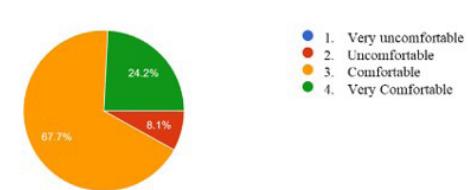
With conditions like this, do you find it easier to find roads, shops, or other destinations when visiting the Malioboro area?
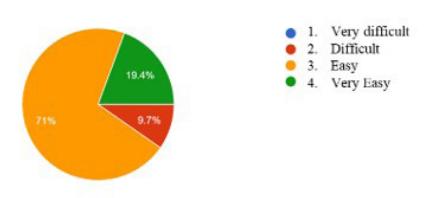
Do you feel that the corridor atmosphere in the Malioboro area is now busier and livelier?
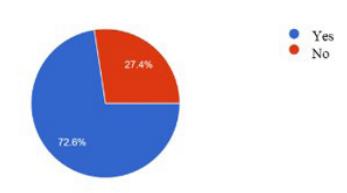
Do you feel happier with the current condition of the Malioboro area corridor?
How eager are you to revisit the Malioboro area in the next opportunity?
Would you recommend the Malioboro area to other people?
In terms of safety and security, do you feel safer when visiting the Malioboro area after the relocation of street hawkers?
Is the condition of the corridor Jl. Malioboro currently friendly enough for the elderly and friends with disabilities?
Do you feel that pedestrian facilities such as; chairs, shady areas, and greenery which are facilitated in the corridor of Jl. Malioboro at this time can make your visiting experience more enjoyable?
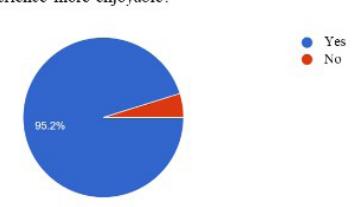
Figure 11 Online Questionnaires
Urban Vitality Assessment on Urban Vitality Indicators
This assessment method compares the results of the survey and the results of the questionnaire to the indicators of urban vitality that have been listed in Table 11. Indicators of urban viability. More details are explained in:
Table IV Urban Vitality Assessment Based on Urban Vitality Indicators
| No | Aspect | Variable | Indicators | Condition of Malioboro Street | |
|---|---|---|---|---|---|
| Before Relocation | After Relocation | ||||
| Pedestrian Path | Protected from the weather and available shelter for pedestrians | No | Yes | ||
| The physical shape of the sidewalk is unbroken and sloping | Yes | Yes | |||
| Freedom of movement, not hindered by the use of other lines | No | Yes | |||
| Disabled friendly | No | Yes | |||
| 1. | Convenience | Green Open | The existence of public open spaces (parks, plazas) | No | Yes |
| Space | Can absorb heat and noises | No | No | ||
| Close to trading activities | Yes | Yes | |||
| Motor Vehicle Parking Area | Public transportation facilities and bus stops are available | Yes | Yes | ||
| Accessibility | Ease of access to the trading area | Yes | Yes | ||
| Building Management | Adequate order and density of buildings | No | Yes | ||
| Security | Pedestrian Path | Pedestrian activity to create an active corridor | Yes | No | |
| 2. | Area Activities | All-day area activities | Yes | Yes | |
| Lighting | Adequate lighting, good visibility, and an unobstructed view | No | Yes | ||
| Safety | Building Structure | Ensure human safety from possible accidents or injuries due to failure of the building structure | No | Yes | |
| Fire Hazard | Equipped with instructions on how to prevent, overcome, rescue from fire, and clear signs indicating the way out | - | - | ||
| 3. | Equipped with fire stairs, 2-hour fireproof walls, and an available fire zone | - | - | ||
| Avoid conflicts between users of the area with motorized vehicles | Yes | Yes | |||
| Pedestrian Path | Avoid the danger of falling, crashing into poles, or trees | No | Yes | ||
| No | Aspect | Variable | Indicators | Condition of Malioboro Street | |
|---|---|---|---|---|---|
| Before Relocation | After Relocation | ||||
| Fun | Pedestrian Path | An interesting pedestrian route in terms of activity creativity and beauty | No | Yes | |
| Pedestrian paths are sought in the shortest and clearest paths, and not congested | Yes | Yes | |||
| 4. | Area Attraction | Aesthetic, recreational, attractive, prestigious, and creative. | No | Yes | |
| There are various unique attractions | Yes | No | |||
| Landmark of a trade area that is different from other areas, available certain image-forming sculpture | Yes | Yes | |||
From this table, it is found that the number of "yeses" in the current condition column is higher, so it can be concluded that the current situation is better based on urban vitality assessment indicators. However, there are some drawbacks, such as the lack of interesting activities in the Malioboro Street corridor, so the atmosphere of the Malioboro Tourism Area is not lively, and the selection of vegetation is not quite right, so it has not been able to reduce the sun's heat and noise.
Urban Vitality Assessment on Urban Tourism Precincts
This assessment was carried out to assess the urban vitality of Malioboro Street as a tourist area. This assessment method compares the results of the survey and the results of the questionnaire to the indicators of urban poverty in precincts, which are explained in more detail in the following table:
Table V Urban Vitality Assessment Based on Urban Tourism Precincts Indicators
| No | Aspects | Variable | Indicators | Condition of Malioboro Street | |
|---|---|---|---|---|---|
| Before Relocation | After Relocation | ||||
| 1. | Social Interactions | Invites the occurrence of communication between visitors | Available street furniture that supports visitors to sit and relax | Yes | Yes |
| Available unique area attractions | No | Yes | |||
| Safety | Safety against unwanted traffic, crime, and experiences | Available pedestrian activity so that corridor activity is active | Yes | No | |
| 2. | Available activities throughout the day | Yes | Yes | ||
| Adequate lighting, good visibility, and an unobstructed view | No | Yes | |||
| 3. | Sense of Belonging & sense of place | There is an image that is formed, and it feels like home | Formed interaction, social activity, and easy-to-spot landmarks. | Yes | Yes |
| Aspects | Variable | Indicators | Condition of Malioboro Street | ||
|---|---|---|---|---|---|
| No | Before Relocation | After Relocation | |||
| Various Facilities | There are various facilities so that the area feels important | Variety of activities and facilities, | No | Yes | |
| Protected from the weather and there is a shelter for pedestrians | No | Yes | |||
| 4. | The availability of commercial and entertainment facilities | Yes | Yes | ||
| Public open spaces (parks, plazas) | No | Yes | |||
| Aesthetic, recreational, attractive, and prestigious | No | Yes | |||
| Transformability | Can be a place for visitors to express their activities | Public transportation facilities and stops are available | Yes | Yes | |
| 5. | Ease of access to the trading area | Yes | Yes | ||
| Adequate order and density of buildings | No | Yes | |||
| Aesthetics | Satisfy the needs and visuals of visitors | Availability of unique area attractions | No | Yes | |
| 6. | New buildings must be able to visualize the old buildings | Yes | Yes | ||
| Accessibility | Stimulate mountaineers to be present in the region | Increase accessibility to public space | No | Yes | |
| The physical shape of the sidewalk is unbroken and sloping | Yes | Yes | |||
| Diffable friendly | No | Yes | |||
| Close to trading activities | Yes | Yes | |||
| 7. | Avoid the danger of falling, hitting a pole, or a tree | No | Yes | ||
| An interesting pedestrian route both in terms of activity and beauty | No | Yes | |||
| Pedestrian paths are sought in the shortest and clearest paths, and not congested | Yes | Yes | |||
It can be seen that the number of "yeses" in the current condition column is higher than in the previous condition column. It can be concluded that the urban vitality of Malioboro Street as a tourist area after the relocation of street hawkers is better than before the relocation of street hawkers.
Conclusion
The relocation can increase the urban vitality of the Malioboro area as a tourist area, with several notes that can be taken to increase the comfort of visitors, namely by increasing the variety of activities, creating a lively atmosphere in the pedestrian area, and choosing the right vegetation to minimize the sun's heat and noise. Because visitors have simply lost their sense of place and sense of belonging to the Malioboro Tourism Area, which they knew before, it has increased comfort and a variety of activities. Furthermore, it can also increase their attractiveness.
The relocation of Malioboro Street hawkers has succeeded in increasing pedestrian comfort and tidiness in the Malioboro corridor. The Malioboro Street corridor became cleaner and tidier after the relocation. Since the street hawkers vacated the front facade of Malioboro, the pedestrian area has become wider. There is a shaded area that can be used in the heat or rain. So that pedestrians have choices and feel more comfortable strolling around.
This research shows that there is harmony between theories of urban vitality and urban tourism and the actual conditions in the field. Because urban tourism has similar aspects to urban vitality, such as attraction, safety, accessibility, and so on, When the region's vitality improves, its role as an urban tourism precinct will also increase.
This study has some limitations. Such a questionnaire may not completely cover some questions to dig deeper for the information needed. When the research was conducted in the post-pandemic era, it was not possible to conduct interviews at the research location. It has been tried several times by the author, but none of the respondents wanted to be interviewed. For further studies, we need to do a face-to-face interview to get the right target respondents in the study location.
References
- Cahyana, Budi. (2022). Begini Sejarah Keberadaan PKL di Malioboro, Retrieved from https://jogjapolitan. harianjogja.com/read/2022/01/20/510/1093735/begini-sejarah-keberadaan-pkl-di Malioboro, on May 1st, 2022.
- Hayllar, Bruce. Griffin, Tony, Edwards, Deborah. (2008). City Spaces Tourist Places: Urban Tourism Precincts. Oxford: Elsevier.
- Indonesia. (2010). Peraturan Walikota Yogyakarta Nomor 37 Tahun 2010 Tentang Penataan Pedagang Kakilima Kawasan Khusus Malioboro – A. Yani. Walikota Yogyakarta. Yogyakarta. Indonesia.
- Jalaladdini, S. & Oktay, D. (2011). Urban Public Spaces and Vitality: A Socio-Spatial Analysis in the Streets of Cypriot Towns. North Cyprus: Elsevier, Procedia, ScienceDirect.
- Montgomery, J. (1995). Editorial Urban Vitality and the Culture of Cities, Planning Practice & Research, 10:2, 101-110, Doi: 10.1080/02697459550036649.
- Pohan, A.F., Ginting, N., & Wahyuni, Z. (2018). Kajian Vitalitas Lingkungan Kawasan Perdagangan. Medan: Jurusan Teknik Arsitektur
- Susiyanti & Aria, F. (2003). Strategi Perancangan Dalam Meningkatkan Vitalitas Kawasan Perdagangan Johar Semarang. Bandung: Laboratorium Perancangan Kota Departemen Teknik Planologi ITB
- Putri, Y. Namira, (2017). Revitalisasi Malioboro : Antara Sejarah dan Perubahan Zaman, Retrieved from : http://wargajogja.net/sosial/revitalisasi-malioboro-antara-sejarah-dan-perubahan-zaman.html, on May 10th, 2022.