

Keywords:
video games, millennials, conjoint analysis
For years, the world of games has impacted people's lives and become one of the largest industries in the world. In 2022, most gamers will be Millenials who know what kind of game they prefer and its effects on their lives, which might help them understand how the world of games evolved. For this reason, the conjoint survey is being conducted to understand the Millenials' game preferences. The quantitative data was gained from 111 respondents from Indonesia using the conjoint method, where the country holds the record of being the third-biggest country in the world in which gamers reside. The attributes of importance and the preference of levels analyzed by conjoint analysis showed that the most likable game preferences for Indonesian Millennials are singleplayer, free, online, computer, or mobile format games. The result of this research also recommends that the game industry reconsider its exposure to violence and sexualization toward gamers since a quarter of their consumers experienced disturbing effects on their mental health as a result of the game they played.
INFO ARTIKEL
ABSTRAK
Kata kunci:
gim video, milenial, analisis conjoint
Selama bertahun-tahun, dunia gim telah memengaruhi kehidupan banyak orang dan menjadi salah satu industri terbesar di dunia. Pada tahun 2022, sebagian besar pemain gim berasal dari generasi milenial, sehingga dapat diketahui jenis gim yang disukai milenial dan pengaruhnya terhadap kehidupan mereka. Hal ini dapat membantu industri gim untuk memahami perkembangan dunia gim yang berkembang seiring waktu. Berdasarkan hal tersebut, peneliti melakukan survey conjoint untuk memahami preferensi di kalangan generasi milenial. Data kuantitatif diperoleh dari 111 responden yang merupakan masyarakat Indonesia melalui metode conjoint, negara tersebut memegang rekor sebagai negara terbesar ketiga di dunia tempat tinggal para pemain gim. Atribut tingkat kepentingan dan preferensi level yang dianalisis dengan analisis conjoint menunjukkan preferensi gim yang paling disukai masyarakat milenial Indonesia adalah gim berformat single player, gratis, dan online di komputer atau mobile. Hasil penelitian merekomendasikan industri gim perlu mempertimbangkan kembali paparan kekerasan dan seksualitas terhadap para pemain gim. Hal ini karena seperempat persen konsumen mengalami efek gangguan mental yang dipengaruhi oleh gim yang dimainkan.
Introduction
Video games have become one of the largest industries with the highest gross net revenue. The whole industry is involved in developing, marketing, and monetizing the products. The global games market generated $175.8 Billion in 2021 (Wijman, 2021), and it is expected to grow by 4.4% per year (PWC, 2021), which will reach its peak at $272 Billion in net worth by 2030. Even with the pandemic caused by COVID-19, this industry is thriving, with 2.69 billion gamers worldwide by 2020 (Wijman, 2020). One of the most significant gamers residing in Indonesia, as the Data Reportal (Kemp, 2022) showed, is that 94% of internet users from age 16 to 64 play video games on any devices they have.
Video games, at their onset, are aimed at entertainment only (Quwaider et al., 2019). However, the games themselves are time-consuming, and there is an emergence of new behaviors caused by playing video games with positive or negative effects (Wright, 2011; Sourmelis et al., 2017; Prayogi et al., 2018; Quwaider et al., 2019). Several positive effects mentioned in past studies include enhanced communication skills, ICT literacy, and metacognition. However, on the other side, there are adverse effects that most touch on emotional states, such as anger and aggression. These states are sometimes correlated with internet game disorder (IGD) on each level to the point of harming the gamers themselves (Quwaider et al., 2019).
Besides the aggression concern, the sexualization exposures in the world of video games themselves have created a stereotype where women are sexually objectified (Conner, 2021; Ellwood, 2021; Kim, 2021) and subordinate to the male characters (Guggisberg, 2020). As the system of video games itself evokes the imagination (Brand et al., 2018), the beliefs gained from gaming sink into the real world rather than staying only for recreational purposes (Behm-Morawitz & Mastro, 2009). Hence, this objectification based on gender, each role, and stereotyping in video games has been deemed harmful where the beliefs about women might seep unfavorably into the real-world setting (Behm-Morawitz & Mastro, 2009) and are highly associated with sexist attitudes or even sexual violence in real-life (Fox & Potocki, 2015; Gabbiadini et al., 2016; Gestos et al., 2018).
However, in essence, most gamers usually choose the game they prefer to play based on the essential characteristics of the game, such as game dynamics, control settings, and play rate (Wood et al., 2004). However, this information was usually not explained in detail in the game promotion, so the gamers were usually misled into consuming the game without knowing or having proper consideration. Not only the game system but also the violence and sexualization exposures in video game promotion are usually not addressed in an accurate form due to the acculturation aspect of the rating system according to the territory they are in (Jean, 2020). And since most of the rating systems and game preferences are based on Western culture, the comparison studies of how this issue is seen in Eastern culture are still few.
While the worldwide data in 2022 showed that shooting genre and action-adventure games are most famous for the younger generations below 50 years old (Kemp, 2022), taking a more microscopic view of Indonesia's gamers' preferences would become a beneficial comparison to ascertain the result since it is one of the countries with the largest gaming numbers overall in the world. Especially, it would be beneficial to explore the Millenials' point of view since they reached the most productive ages (before 40 years old in 2022), which made them the highest game buyers and players within the industries (Kemp, 2022). Hence, this paper aimed to describe Indonesian Millenials' game preferences and attitudes toward the exposure they got from the games they played. Since most of the past similar studies have concentrated on the United States demographic and the countries with the highest gaming numbers overall, this study will see things from another perspective by taking Indonesia as the research target. This study also recommended the gaming industry by showing what kind of game characteristics Indonesian gamers preferred by using a product simulation.
Second, this study explored how their exposure to the game they played affected their reality and daily lives, especially their attitudes toward violence and sexualization. While games usually have rating standards based on age for their customers' protection (Jean, 2020), there is a concern from parents as past
studies have also mentioned how video games might develop aggression toward children's development (Han et al., 2020; Zhang et al., 2021). Therefore, it is also a concern for the Millennials to be aware of the games they and their family play since, if they married, it is considered that they would have children mostly in the golden age (children under 5 years old, UNICEF). In this golden age, the child is experiencing rapid growth and development as the basis for their character-building based on what they see and hear (Bimbingan & Konseling, 2012; Yulianingsih et al., 2020). This research mapped the attitude of Millennial gamers toward the sexualization and violent theme exposure within video games and their advertisements. By investigating the awareness of these gamers on such issues, the researcher expected to learn how the games they played might affect their belief systems and behaviors. This study also hopes to contribute to more ethical marketing in the gaming industry for better child development in Indonesia as the usage of video games within the country increases (Kemp, 2022).
Method
This study used a quantitative approach to understand the game preferences of Indonesian millennials. Hence, to understand what kind of game the respondents like to play and the type of game they might buy in the future, the choice-by-choice conjoint is suitable for depicting such an answer. Conjoint analysis is a method to gain insight into consumers' preferences for product packages, which could predict the application of new arrangements of products and services (Hair et al., 2014). While the preferences were based on the game characterizations, the attributes focused only on five indicators that were considered appealing for the game marketing and might trigger the intention to buy. The five attributes were modified from Wood et al. (2004), with each level of preference as follows:
Player: Single Player or Multi-Player
Duration: Short (one session), Medium (days or weeks), Long (months to infinity)
Device: Mobile, Computer, Game Console, Portable Game Console
Connection: Offline, Online
Price: Free, Fair (below IDR 100.000), Costly (over IDR 100.000)
The survey used conjointly; an advanced software specified for conjoint surveys (Trochim, 2022). The conjoint itself is a dependence technique where the researcher could assess the importance of attributes from consumer evaluation toward several product profiles (Hair, 2019). This evaluation of possible combinations of a subset will result in a product design simulator that shows a recommendation for product formulation based on consumer acceptance. As this method may understand the complex decision process toward users or customers, it was chosen as the method for data collection and analysis for this research.
For the number of samples, this research referred to Green and Srinavasan's (1978) direction that the data sampling numbers for conjoint analysis minimally need 100 respondents. Moreover, this research conducted three screening phases for each piece of data respondents gained to gain valid data. In the first phase, they were asked, "Do you like to play games?" and the answer "No" screened the respondent out. This question ensured that the respondents liked to play games and knew the games they played. The time for the respondent to answer the survey was also counted for each question, which determined the quality of the survey data gained. As answering the conjoint survey type might take time, the low-quality questionnaires were screened out of the data analysis. Afterward, the data were screened based on age 23–40 only for the analysis, as the research range topic was specified in the Millennials' behavior. On the other hand, the goodness of fit for each piece of data was also checked time by time to ensure the data gained was representative enough to give a helpful insight into the analysis.
Result and Discussion
Using conjoint analysis to find out consumers' preferences for product packages, the following is the result of the data collection and analysis, focusing on five indicators deemed appealing for the game marketing.
Respondents Demography
From 447 entries, the data gained for analysis is 111 respondents, which meets the standard of the recommended numbers from past studies. The demography of the total respondents is depicted in Table I. As the targeted age for this paper was focused more toward the 24–40 age range, the high number of certain age divisions showed that the data was representative of Millennials. The almost even percentage of gender and marriage status also showed that a general view could be represented, while the income demography showed that the respondents in this data belonged to middle- to high-class society (in comparison with the national highest minimum wage of Indonesia; Anwar, 2021). However, as the respondents targeted the general view more, the conjoint goodness fit could not get a high rate. The data showed 64.9%, which is defined as medium fit based on McFadden's pseudo-R2. This is due to the inclination to have more specific respondents for its analysis.
Table I Respondents' Demography
| Parameter | Indicator | Percentage | |
|---|---|---|---|
| 12 - 24 years old | 7% | ||
| Age | 25 - 40 years old | 84% | |
| Over 40 years old | 9% | ||
| Man | 56% | ||
| Gender | Woman | 44% | |
| Marriage Status | Single | 51% | |
| Married | 49% | ||
| < IDR 500.000 | 5% | ||
| IDR 500.000 – IDR 5.000.000 | 29% | ||
| Income per month | IDR 5.000.000 – IDR 10.000.000 | 40% | |
| > IDR 10.000.000 | 26% | ||
Descriptive Result of Indonesian Millennial Gamers Preferences
The data analysis of the Millennial group showed that the highest utility or level of attribute importance lies in the device used for playing the game (Fig. 1). Most respondents prefer to use the computer as their playing device, with the mobile phone being the second most popular choice (Fig. 2). This finding differed from the Data Report in January 2022 (Kemp, 2022), where most Indonesian people use mobile phones more than computers for playing games. This discrepancy is most likely caused by the mobile phone's affordability and practicality for the Indonesian people, showing the high number of mobile phone usage for gaming in Kemp's report.
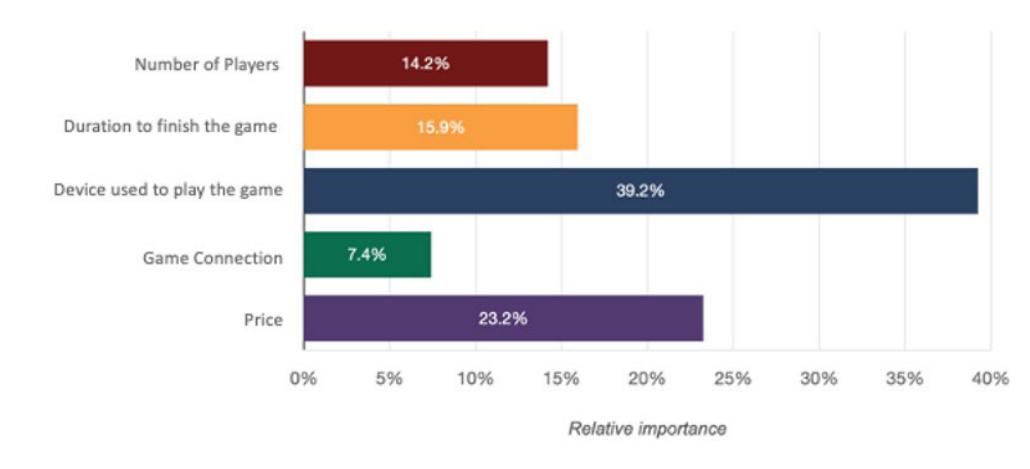
Figure 1 Attributes of Importance
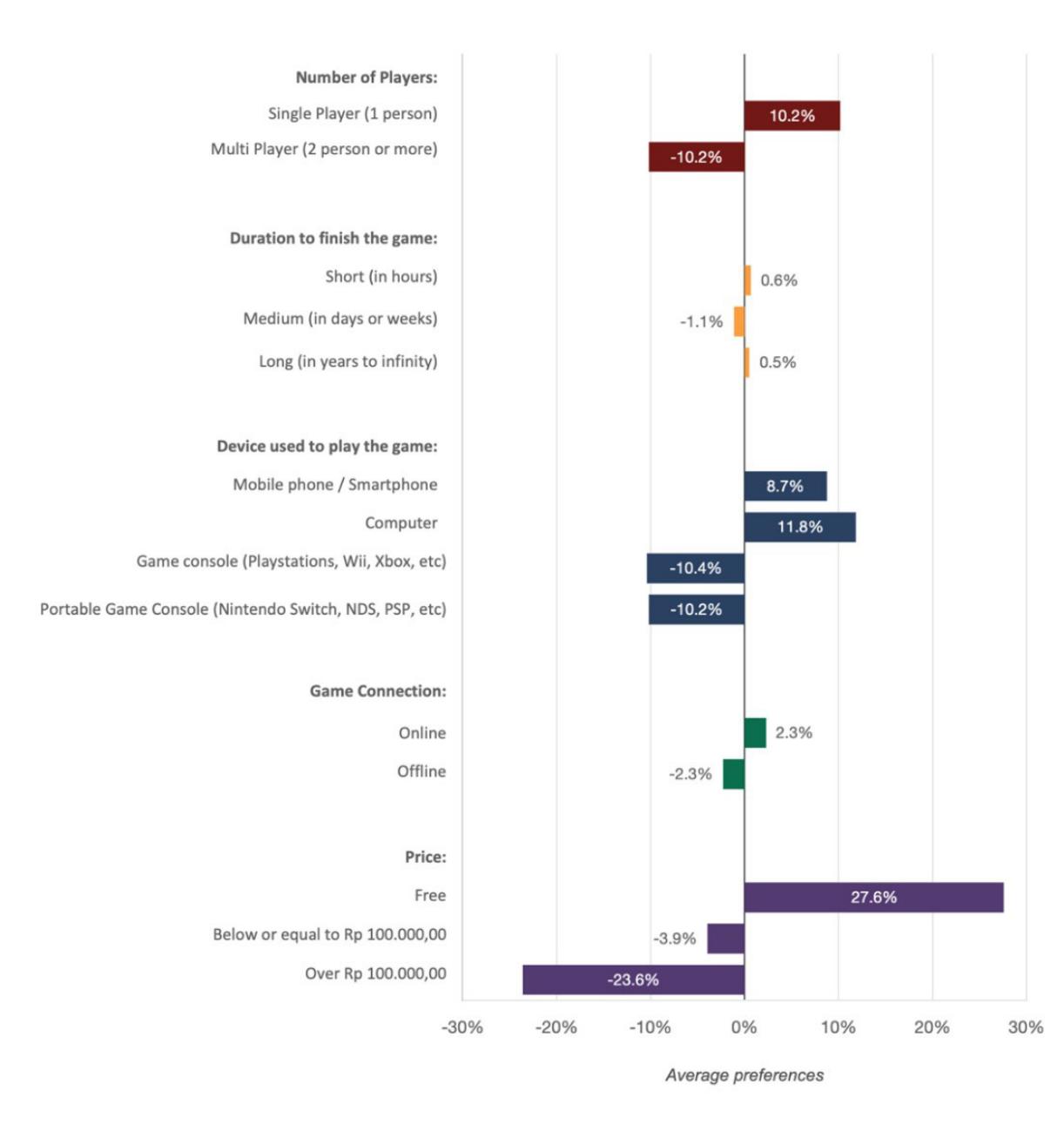
Figure 2 Preferences of Levels
On the other hand, the second-highest importance is the price of the games. Respondents tend to be attracted to free games, which explains a lot of free games developed on mobile phones with an in-app purchase strategy. However, how the gamers were experiencing these free games with in-app purchase strategies still needs to be investigated further.
| Number of Players | Duration to Finish the Game | Device Used to Play the Game | Game Connection | Price | Rank | Value to Customers | ||
|---|---|---|---|---|---|---|---|---|
| Single Player (1 person) | Short (in hours) | Computer | Online | Free | 1 | 17,23442 | ||
| Single Player (1 person) | Long (in years to infinity) | Computer | Online | Free | 2 | 17,18084 | ||
| Single Player (1 person) | Medium (in days or weeks) | Computer | Online | Free | 3 | 16,65080 | ||
| Single Player (1 person) | Short (in hours) | Mobile phone/ Smartphone | Online | Free | 4 | 16,22478 | ||
| Single Player (1 person) | Long (in years to infinity) | Mobile phone/ Smartphone | Online | Free | 5 | 16,17120 | ||
Table II Ranking of Preferences Level
From the attributes of importance and the preference for levels, it could be concluded that the most likable game preferences for Indonesian Millennials are single-player, free, online, computer, or mobile format games. This recommendation was gained from the highest value of gamers' data (Single Player, Short, Computer, Online, Free, Rank 1, Value to Customers = 17,234). The duration of playing games might also impact the intention to use the product. However, it is not as significant as the factors of players, devices, connections, and price attributes.
Genre Categories of Gamers' Preferences
When learning about what kind of game the respondents play nowadays, the weight data from the word cloud will be analyzed for each genre (Figure 3 and TABLE III). This conclusion is shown by how Mobile Legends, Elden Rings, and Genshin Impacts were noticed as popular games the respondents played compared with anything else.
Figure 3 Word Cloud
Mobile Legends is one of the most famous e-sports games in the genre of multiplayer online battle arenas and action role-playing games. Elden Rings is a game with the genres of open world, action role-playing games, adventure games, fighting games, platform games, and nonlinear gameplay. Genshin Impact is a game in the genre of action role-playing games and adventure games. From the data, it showed that the highest genre played by the respondents fits into the second rank from the Data Report, which is the action-adventure genre. This conclusion differed slightly if it was compared with the global data from Kemp, 2022, as the highest-played game is shooting games. However, from the most popular genre noted, there are several concerns about the violence within the games as all of them are not child-friendly, such as Mobile Legends ESRB rating of 12+, the same as Genshin Impacts' PEGI rating, while Elden Rings ESRB rating is categorized as mature because it specifically shows blood and gore, suggestive themes, violence, and offensive language within the game.
Table III Word Weight from Respondents
| Name of The Game | Word Weight | |||
|---|---|---|---|---|
| Mobile Legends | 15 | |||
| Genshin Impact, Candy Crush, Elden Ring | 5 | |||
| Hayday, The Sims, Valoran | 4 | |||
On the other hand, the survey also asked the respondents four open-ended questions regarding the exposure that gamers might receive from the games they played. The exposures asked focused on two major negative exposures: aggression and sexualization. According to past studies, these exposures are pointed out as the most troubling for the gamer's behavior (Beekman, 2012; Dowsett & Jackson, 2019; Gestos et al., 2018; Guggisberg, 2020; Li et al., 2020). Two questions investigated each construct with the indicator of "being disturbed or not." The other questions reflected the same questions for both constructs from another perspective. The respondents are divided into two extreme groups based on both aggression and exposure. The first group that did not feel disturbed by the harmful exposure will be called the non-Disturbed group (30% not disturbed by aggression, 30% not disturbed by sexualization in games). We called the opposite group here the Disturbed group (24% disturbed greatly by aggression, 23% disturbed greatly by sexualization in games). The others can be called the Neutral group.
The survey shows that the Non-Disturbed, disturbed, and neutral groups are mostly inclined not to have any impact from the aggression they had via games (53% do not have any influence at all). However, when discussing sexualization exposure, the ambiguity of normalization and inclination toward ethics are shown (35% neutral, 19% unethical). With the limitations of the closed-ended question approach, another qualitative approach to research is encouraged to gain deeper insight.
Conclusion
The video game industry has been noted as one of the most profitable industries globally, which has impacted people's lives. Most gamers in 2022 will be Millennials who will be the source of industry income as they reach the productive phase. Hence, finding their preferences will help develop new ideas for games that fit their needs.
From the result, it was shown from the quantitative analysis that a free single-player game format with a short-term play rate on a computer and online is more likable for Millennials to play. At the same time, it was noted that the action-adventure genre is the most popular among Indonesian gamers. This data is slightly different from the global data from Kemp (2022), with a difference in the device's usage and the genre that the people played. However, the exposures that the gamers had, especially toward violence and sexualization contained within the game, showed that the industry needed to consider the disturbing effect that was being experienced by a quarter of their consumers toward the violence and sexualization exposures.
There are several limitations to this study. The method used for this paper is a conjoint survey, which is sensitive to how specific respondents are in the data. The more specific the respondents, the larger the model fit that will be made. Hence, it is recommendable for future studies to find more specific respondents by enhancing the filtering questions in the survey. Second, as this research only targets Indonesian Millennials, comparing it with other Southeast Asian countries will help find similarities or differences in preferences. On the other hand, the exposure that gamers get from the games they play still needs further investigation using a qualitative approach, especially how the violence and sexualization exposure affected the behavior of the gamer.
Acknowledgment
The researchers would like to thank the conjoint analysis software team from Prof. William M.K. Trochim Knowledge-Based Research for helping us with the survey method. The researchers are also very grateful to the supervisors from Institut Teknologi Bandung and the editorial teams from Jurnal Sosioteknologi, who helped us make this manuscript published.
References
- Anwar, M. C. (2021). Ini Daftar Gaji UMR Tertinggi di Indonesia Tahun 2021. Kompas. https://money. kompas.com/read/2021/06/22/092138526/ini-daftar-gaji-umr-tertinggi-di-indonesia-tahun-2021?page=all
- Awalya, A. (2012). Benefits of Early Childhood Education for Personal Development and Children Social. Indonesian Journal of Early Childhood Education Studies. Vol 1 (2). http://journal.unnes. ac.id/sju/index.php/ijeces
- Beekman, D. (2012). NRA blames video games kindergarten killer for sandy hook elementary school slaughter. NYDailyNews https://tinyurl.com/ckfwrcd accessed on 16 October 2015
- Behm-Morawitz, E., & Mastro, D. (2009). The effects of the sexualization of female video game characters on gender stereotyping and female self-concept. Sex Roles, 61(11–12), 808–823. https:// doi.org/10.1007/s11199-009-9683-8
- Brand, J. E., Todhunter, S., & Jervis, J. (2018). Digital Australia Report 2018. Eveleigh, NSW: Interactive Games & Entertainment Association. Retrieved from http://www.igea.net/wp-content/ uploads/2017/07/Digital-Australia-2018-DA18-Final-1.pdf
- Conner, Peyton (2021). Why Are Female Video Game Characters Still Being Hypersexualized? Study Breaks. Indiana University. https://studybreaks.com/tvfilm/female-video-game-characters/
- Dowsett, A., & Jackson, M. (2019). The effect of violence and competition within video games on aggression. Computers in Human Behavior, 99, 22–27. https://doi.org/10.1016/j.chb.2019.05.002
- Ellwood, Beth (2021). Adolescents' exposure to sexualized content on Instagram and in video games is linked to increased body image concerns over time. Psy Post. https://www.psypost.org/2021/07/ adolescents-exposure-to-sexualized-content-on-instagram-and-in-video-games-is-linked-toincreased-body-image-concerns-over-time-61562
- Fox, J., & Potocki, B. (2015). Lifetime video game consumption, interpersonal aggression, hostile sexism, and rape myth acceptance: A cultivation perspective. Journal of Interpersonal Violence, 31, 1912–1931. https://doi.org/10.1177/0886260515570747
- Gabbiadini, A., Riva, P., Andrighetto, L., Volpato, C., & Bushman, B. J. (2016). Acting like a tough guy: Violent-sexist video games, identification with game characters, masculine beliefs, & empathy for female violence victims. PLoS One, 11, 1–14 (e0152121). https://doi.org/10.1371/journal. pone.0152121
- Gestos, M., Smith-Merry, J., & Campbell, A. (2018). Representation of women in videogames: A systematic review of literature in consideration of adult female well-being.Cyberpsychology, Behavior and Social Networking, 21, 535–541 https://doi.org/10.1089/cyber.2017.0376
- Green, P. E., & Srinivasan, V. (1978). Conjoint analysis in consumer research; issues and outlook. The Journal of Consumer Research, 5, 103-123. https://doi.org/10.1086/208721
- Guggisberg, M. (2020). Sexually explicit video games and online pornography The promotion of sexual violence: A critical commentary. In Aggression and Violent Behavior (Vol. 53). Elsevier Ltd. https://doi.org/10.1016/j.avb.2020.101432
- Hair, Joseph F., Anderson, Rolph E., Black, William C.. (2014). Multivariate Data Analysis (Ed. 7th). Harlow: Pearson.
- Hair, J. F., Black, W. C., Babin, B. J., & Anderson, R. E. (2019). Multivariate Data Analysis Eight Edition. Harlow: Pearson. www.cengage.com/highered
- Han, L., Xiao, M., Jou, M., Hu, L., Sun, R., & Zhou, Z. (2020). The long-term effect of media violence exposure on the aggression of youngsters. Computers in Human Behavior, 106 http://doi. org/11.10.1016/j.chb.2020.106257.
- Jean (2020). How to Get Age Ratings for Mobile Games: A Guide to International Rating Systems. Ad Colony. https://www.adcolony.com/blog/2020/08/20/how-age-ratings/
- Kemp, Simon (2022). Digital 2022: Global Overview Report. Data Reports. https://datareportal.com/ reports/digital-2022-global-overview-report
- Kim, Tae (2021). Video Game Industry Struggles to Shake Sexist Attitudes. Bloomberg. https://www. bloomberg.com/opinion/articles/2021-12-27/video-game-industry-struggles-to-shake-sexistattitudes
- Li, J. Y., Du, Q., & Gao, X. (2020). Adolescent aggression and violent video games: The role of moral disengagement and parental rearing patterns. Children and Youth Services Review, 118. https://doi. org/10.1016/j.childyouth.2020.105370
- Prayogi, D. D., Nasrawati, N., Darmawan, W., Suryadi, K., Abdullah, A. G., & Danuwijaya, A. A. (2018). Game Online on Adolescent's Social Behavior. http://dx.doi.org/10.5220/0007113011891192
- PWC (2021). PwC: Games grew 10% in 2020 and will grow 4.4% per year through 2025. Venture Beat. https://venturebeat.com/2021/07/11/pwc-games-grew-10-in-2020-and-will-grow-4-4-per-yearthrough-2025/
- Quwaider, M., Alabed, A., & Duwairi, R. (2019). The impact of video games on the players' behaviors: A survey. Procedia Computer Science, 151, 575–582. https://doi.org/10.1016/j.procs.2019.04.077
- Sourmelis, T., Ioannou, A., & Zaphiris, P. (2017). Massively Multiplayer Online Role Playing Games (MMORPGs) and the 21st-century skills: A comprehensive research review from 2010 to 2016. In Computers in Human Behavior (Vol. 67, pp. 41–48). Elsevier Ltd. https://doi.org/10.1016/j. chb.2016.10.020
- Trochim, William M.K.. (2022). The Research Methods Knowledge Base. Internet page at URL: https:// conjointly.com/kb/ (version current as of 27 October 2022).
- UNICEF. Tracking early childhood development https://www.unicef.org/early-childhood-development/ data-evidence-tracking
- Wijman, Tom (2020). The World's 2.7 Billion Gamers Will Spend $159.3 Billion on Games in 2020; The Market Will Surpass $200 Billion by 2023. Newzoo. https://newzoo.com/insights/articles/newzoogames-market-numbers-revenues-and-audience-2020-2023/
- Wijman, Tom (2021). Global Games Market to Generate $175.8 Billion in 2021; Despite a Slight Decline, the Market Is on Track to Surpass $200 Billion in 2023. Newzoo. https://newzoo.com/ insights/articles/global-games-market-to-generate-175-8-billion-in-2021-despite-a-slight-declinethe-market-is-on-track-to-surpass-200-billion-in-2023/
- Wood, R. T. A., Griffiths, M. D., Chappell, D., & Davies, M. N. O. (2004). The Structural Characteristics of Video Games: A Psycho-Structural Analysis. In Cyberpsychology & Behavior (Vol. 7, Issue 1).
- Wright, J. (2011). The effects of video game play on academic performance. In Modern Psychological Studies (Vol. 17, Issue 1).
- Yulianingsih, W., Susilo, H., & Nugroho, R. (2020). Optimizing Golden Age Through Parenting in Saqo Kindergarten. https://doi.org/10.2991/assehr.k.200217.039
- Zhang, Q., Cao, Y., & Tian, J. J. (2021). Effects of violent video games on players' and observers' aggressive cognitions and aggressive behaviors. Journal of Experimental Child Psychology, 203. https://doi.org/10.1016/j.jecp.2020.105005