

INFO ARTIKEL
Kata kunci:
sepeda motor listrik, identifikasi kebutuhan, target spesifikasi, modul tambahan, perancangan produk
ABSTRAK
Urgensi dari penelitian ini adalah masih rendahnya minat masyarakat Indonesia dalam menggunakan motor listrik. Hal ini ditandai penjualan motor listrik di Indonesia yang masih rendah. Masyarakat Indonesia ragu dengan sepeda motor listrik karena ketahanan baterai dan harganya relatif lebih mahal daripada sepeda motor konvensional. Penelitian ini dirancang produk modul tambahan EMs sebagai solusi untuk menjawab keraguan tersebut. Penelitian ini merupakan proses perancangan awal yang bertujuan untuk memperoleh target spesifikasi produk modul tambahan EMs berdasarkan dari hasil identifikasi kebutuhan pengguna sebagai dasar proses perancangan selanjutnya. Produk modul tambahan EMs menerapkan sistem konversi EMs yang dipasangkan pada produk ICEM tanpa menghilangkan kemampuan yang semula menggunakan sumber energi bensin. Hal ini mampu meminimalkan biaya pengadaan teknologi motor listrik pada sepeda motor konvensional dan tanpa harus khawatir kehabisan baterai saat digunakan. Penelitian ini menggunakan metode
perancangan front-end activities untuk merancang produk modul tambahan EMs yang menghasilkan 30 kebutuhan pelanggan dengan persentase tingkat kepentingan dan 24 metrik target spesifikasi produk dalam nilai marginal dan nilai ideal untuk digunakan sebagai dasar proses perancangan selanjutnya.
https://doi.org/10.5614/sostek.itbj.2023.22.3.10
Introduction
BEVs (Battery Electric Vehicles), especially EMs (Electric Motorcycles), will be the vehicles of the future, especially in developing countries in the Asia region, which can be seen from the high interest of PTWs (Powered Two-Wheelers) users in developing countries. The Asian region is now dominated by up to 60% of PTWs from all vehicles and continues to increase between 15% and 58% in most developing countries in the Asian area (Eccarius & Lu, 2020). The number of PTWs in Indonesia will be more than 120 million units in 2021 and has increased by more than 35% since 2015 (Badan Pusat Statistik, 2021). PTWs are widely adopted in Southeast Asian countries as the primary means of urban transportation due to relatively high work density, evenly distributed narrow roads, cheaper unit prices and operational costs, and spatially effective maneuverability (Adnan, 2014; Fan, 1990; Yeung, 2015) improved transportation technology and an expanding economy, additional roads and highways are built, in an effort to balance roadway capacity and demand. Knowledge of capacity of a road is essential in planning, design and operation of roads. To ascertain estimates of roadway capacity, Passenger Car Equivalent (PCE). The development of EM as future vehicles is supported by the trend of increasing fuel prices based on historical data and is projected to continue to grow in the future (Bentley & Bentley, 2015; Wachtmeister, 2018). The price of fuel oil in 2019 increased from 2016/17 to 1.14 US$ (gasoline) and 1.09 US dollars (diesel), or the equivalent of 17% and 25% on a global scale. Crude oil prices also increased to 65 US$ per barrel in mid-November 2018, up 43% from 2016/17 (GIZ, 2019) presenting fuel prices for 179 countries. This biennial study is conducted by GIZ on behalf of the Federal Ministry for Economic Cooperation and Development (BMZ). The environmental issue of global air emissions supports the shift towards electric vehicles. Based on historical data, from 1990-2010, global CO2 emissions from anthropogenic sources grew by around 60% (Amann, 2013) enhance the acceptance of mitigation measures for longlived greenhouse gas (GHG, and overall CO2 emissions from 1971-2016 have increased from 15.6 billion metric tons to 35.7 metric tons, or an increase of 128% (Worldometer, 2018). The transportation sector contributes 25.8% of CO2 emissions, and road transportation is responsible for 71.7% of the transportation sector's CO2 emissions (Union, 2021).
The electrification of motorbikes, or the Ems, trend is increasingly massive in Europe, with an increase of 104% (2019) and 50% (2020) (Millikin, 2021) compared to the previous year. However, the development of Indonesian EMs has been insignificant. Until October 2022, based on the Ministry of Transportation's Sertifikasi Registrasi Uji Tipe (SRUT), only 31,827 EMs were sold, even though there are >20 local and foreign EM producers in Indonesia, and the government's target is to produce 2,000,000 EM units in 2025 and 13,000,000 units in 2030. This is because the Indonesian are doubtful about EVs (electric vehicles), both because of their battery life and they have more expensive price than ICEs (internal combustion engines) (Desiawan, 2022, 2023). Efforts to increase the use of EVs can be made with two concepts: expanding the use of EVs and converting ICEs to EVs (Kaleg, 2015). The Indonesian government's support for these two businesses which has also been provided with Ministerial Industry Regulation No. 6 Year 2023 and Ministerial of Energy and Mineral Resources Regulation of No. 3 Th 2023, which provide a subsidy of IDR 7,000,000 for purchasing EMs and converting EMs (ESDM, 2015; Permenperin, 2023).
There are two types of EM, which, from the start, were designed as EM with lithium-ion batteries (pure EM), as has been done by several researchers (D. Chen et al., 2019; Lau et al., 2018; Spanu, 2018; Sutopo, 2018) the development of new battery systems with high energy densities has become the current research hotspot. Lithium-sulfur battery is considered as a promising candidate due to its high energy density and low cost. However, it suffers from the insulating nature of sulfur and the shuttle effect of polysulfide, which hinder its practical application. Selenium (Se and as a result of the conversion of ICEM (internal combustion engine motorcycle) into EM with lithium-ion batteries (Jodinesa, 2020) 030,793 units in 2017 with annual average increase of 4%. The technology used is the internal combustion engine (ICE. The advantages of pure EM are that they are ready to use, and the disadvantages are that they are relatively expensive (27- 28 million for the Gesit brand (WIKA, 2023)). The advantages of converted EM are cheaper, around 15 million rupiah (lithium-ion batteries) as it is done by the BRT (Bintang Racing Team) manufacturer (Gridoto, 2022) because it still uses ICEM components (frame, wheels, suspension, body, and etc.), but with the weakness of having to convert the ICEM and it can no longer use petrol.
From a financial perspective, EM conversion is a solution to reduce costs and greenhouse gas emissions compared to buying a new electric vehicle (Aggarwal & Chawla, 2020) which are measured by the amount of CO2 equivalents in the air. A major part of air pollution is attributed to the exhaust expelled by automobiles which can be reduced by converting existing vehicles to pure battery electric vehicles (BEV), but EM conversion completely means that motorbikes cannot use gasoline. This does not eliminate the doubts of the Indonesian people as users regarding the limited battery life, especially when the motorbike is used on long-distance travel routes due to limited battery charging facilities in Indonesia and the length of the charging time. Based on these shortcomings, this research aims to design and develop an EMs conversion kit module product that can be installed on an ICEM without losing its ability to use gasoline as an energy source. This research was carried out in several stages according to the roadmap in Figure 2. The product designed in this research is expected to be able to cover the shortcomings of pure EMs and converted EM products to answer the doubts of the Indonesian people regarding the application of electric motors. The research in this article is the initial stage of the entire product design and development process to obtain an initial study in the form of identifying user needs and translating user needs to get target product specifications for the EMs conversion kit module as a basis for the subsequent design process.
Research on EM and the conversion of ICEM into EM, or EMC (Electric Motorcycle Conversion), has been widely researched. Mostly, previous research discussed product design, EM simulation studies, and EM conversion. EMC is made from ICEM and added to Ems with a conversion kit. The conversion kit comprises a BLDC (Brushless Direct Current Motor), controller, and battery. The BLDC is usually installed on the rear wheel to generate motor energy after receiving electricity from the battery, while the controller functions to control the BLDC power. A larger battery capacity produces greater EM power. The battery is the main component of the conversion kit because it is the most expensive compared to the others. The differences between ICEM, EM, and EMC are shown in Table I, and the International Standard for EM is shown in Table II (Habibie & Sutopo, 2020). Indonesian EM's conversion standards are regulated in the Republic of Indonesia Minister of Transportation Regulation Permenhub RI No. PM 65 Year 2020 concerning converting motorcycles with combustion motor drives into battery-based electric motorcycles. The regulation explains that conversion components include a battery, battery management system, DC to DC converter, electric motor, controller/inverter, battery charging inlet, other supporting equipment, and the maximum conversion electric motor power. ICEm with engine capacity >=110 cc is 2 kw, 110-150 cc is 3 kw, and 150-200 cc is 4 kw (Kemenhub RI, 2020). Price ranges for conversion kit components include BLDC/electric motor (1,350,000 IDR/pcs), controller (850,000 IDR/pcs), BMS (Battery Management System) (350,000 IDR/pcs), and battery (8,500,000 IDR/pcs) depending on the required specifications (Habibie, 2020). In in-wheel electric motor applications, direct-drive motors are suitable for low-cost conversions with the advantages of minimal mechanical adjustment (no pulleys, belts, and supporting transmission components), installation time, vehicle traction redundancy, and wheel
traction support, and they do not require a lot of mechanical knowledge for their application (Alcoberro, 2021). The battery components must be placed as close as possible to the ground, securely attached with a lock so that they do not change position when it is used, away from the risk of impact in the event of an accident, and when using 2 batteries, they must be placed close together with a distance of at least 300 mm (Kemenhub RI, 2020).
Table I Differences between ICEM, EM, and EMCM (Habibie & Sutopo, 2020)
| Descriptions | ICEM | EM | EMC |
|---|---|---|---|
| Power Source | Gasoline | Battery/electricity | Gas tank to battery/electricity |
| Classification | Engine capacity | Battery capacity | Battery Capacity |
| Drivers | Combustion engine | BLDC | Combustion engine to BLDC |
| Expenses/costs | Less efficient | Up to 84% more efficient | Up to 84% more efficient |
| Environmental effects | Less environmentally friendly | More environmentally friendly | More environmentally friendly |
| Maintenance | More | Less | Less |
Table II International Standards EM (Habibie & Sutopo, 2020)
| Topics | International Standards | Topics | International Standards |
|---|---|---|---|
| Electrification safety | ISO 13063 | Cell safety | IEC 62660-3 |
| Charging system | IEC 60335-2-29(Rev.), IEC 61851-3, ISO 18246 | Battery testing and safety | ISO 18243 |
| DC charging connectors | IEC 62196-4 | Electricity usage | ISO 13064-1 |
| Cell testing and safety | IEC 62660-1-2 | Vehicle performance | ISO 13064-2 |
Indonesian consumers' purchase intention of EMs is influenced by several factors: attitude, subjective norms, perceived behavioral control, cost, technology, infrastructure, and purchase intention (Rahmawati, 2019). Factors that can be adopted in this research include: costs (the price of EM without subsidies, battery replacement, comparison of the price of electricity consumption with gasoline, and routine maintenance (Egbue & Long, 2012; How Should Barriers to Alternative Fuels and Vehicles be Classified and Abstract, n.d.; Kim et al., 2022; Sierzchula, 2014) externalities including the appropriability of knowledge and pollution abatement result in societal/economic benefits that are not incorporated in electric vehicle prices. In order to address resulting market failures, governments have employed a number of policies. We seek to determine the relationship of one such policy instrument (consumer financial incentives, and technology including: the longest distance travelled (once full battery charge ), maximum speed, the total time to fully charge the battery, feeling of driving safety related to sound (dB), and battery life (Egbue & Long, 2012; Graham-Rowe et al., 2012; Sovacool & Hirsh, 2009; Zhang et al., 2013), as well as the warranty sub-factor in the perceived behavioral control factor (Rahmawati, 2019).
Previous research carried out the conversion of ICE vehicles into EVs based on expected performance demands. The conversion is carried out considering the distance traveled; the maximum speed is determined first, and then the battery capacity is determined. Conversion is carried out based on speed considerations, and mileage is not a priority. When cost becomes an obstacle, the combination of distance, speed, and efficiency must remain optimal, a larger battery capacity is needed to obtain longer distances with the same battery voltage and electric motor performance. To achieve higher speed targets using higher-performance electric motors, the battery voltage must be increased; however, to keep the battery capacity balance (avoiding increasing vehicle weight and space), a battery with a higher voltage of smaller capacity can be applied. Approximately 20 - 50% of the cost of an EV conversion is batteries, depending on the type of battery used. If your EV conversion needs are based on cost, you should start by determining the battery and the drive components. Determining battery capacity (Wh)
is done by multiplying the battery voltage (v) by the battery's hourly current capacity (Ah) multiplied by the number of batteries used. Determining the distance traveled (km) is done by dividing the battery capacity (Wh) by the energy consumed (Wh/km). The battery capacity can be used only 70% before the battery performance decreases, so the possible driving distance of an EV is determined by multiplying the driving distance by 0.7 (Kaleg et al., 2015).
Previous research aimed to evaluate the replacement of ICEM with EMC through conversion and compare two other alternatives, namely ICEM and EM, using net present value (NPV) and payback period (PP) to measure economic aspects. Environmental aspects are calculated by simulating the carbon emissions of the three alternatives. Social aspects are measured by comparing noise levels, body health, well-being, and treatment time. The research results show that electric motorbike conversion is the best alternative to replace ICEM based on sustainability considerations (Habibie, 2021).
Previous researchers converted ICE to an EV by converting a car with a 624-cc petrol engine into a pure EV. The car engine was replaced with a 1,000W BLDC to move a passenger car (1,200kg) at an average speed of 25 km/hour. The motor is connected to the car's built-in gearbox via a clutch, replacing the role of the combustion engine. The battery uses thirteen 3.6V/3.4Ah lithium-ion battery cells arranged in series so that the target voltage is 48V, and each set consists of 13 batteries arranged in series arranged in parallel with 12 sets for a target capacity of 40Ah. The economic and environmental results of the conversion were proven to be successful in providing significant user benefits, and the conversion investment costs were recouped within 8 months (Aggarwal & Chawla, 2020). The conversion of ICE to EV has also been carried out on Bajaj vehicles. Converting Bajaj to EV is done by replacing the Bajaj petrol engine with a BLDC 48V/1,500W motor connected to the differential gearbox via sprockets to drive the two rear wheels. The batteries used are four 12V/26Ah batteries arranged in series, where each battery is connected to a solar panel as a battery charger. This conversion results in the Bajaj being able to travel up to 30 km/hr while carrying the load of a driver and one passenger and a distance of 17 km on a full charge of the battery (Mohammed, 2023).
Other previous research focused on the development of vehicle designs resulting from the conversion of pedicab-type EVs. The conventional pedicab vehicle developed by design results from the conversion with an electric motor with a capacity of 350W and a 48V 20Ah (0.96kWh) battery, capable of covering a distance of 40 km on one charge. Besides that, the pedicab can still be operated conventionally by pedaling manually. The development of the EV-converted pedicab design adapted Marvin Bartel's theory to identify and analyze pedicab designs with the characteristics of Yogyakarta pedicabs, which focus on shape and color. The development results obtained a new alternative design concept for electric pedicabs without losing the design characteristics of traditional Yogyakarta pedicabs (Haryanto, 2020).
In addition to full EV conversion, previous research added an EV device to an ICEM that works hybrid or HEM (hybrid electric motorcycle) with a gasoline engine with the aim of energy efficiency through a reverse differential gear device and power mode switching control. A reverse differential gear power splitter is installed to integrate the ICE engine power, resulting in single or dual power output. The transmission system is configured with a CVT transmission to adjust the speed reduction ratio and stabilize the power output. The result is that the three power modes (electric motor, ICE, and dual power) can be seamlessly switched between each other. The HEM was tested with a power meter, showing that the HEM consumes up to 41.1% less and emits 58.6% less than the ICEM. Regarding handling capabilities, the 0–100m acceleration time is 2.4 seconds shorter than the Taiwan E-scooter Standard (TES). The top vehicle speed was 2.1 times greater than the TES test (Chen, 2019).
Based on this explanation, previous research has never researched or designed additional EM modules that can be practically installed on the ICEM without disrupting the function of the ICEM operating on petrol and without many modifications to the motorbike's built-in components. The research topic of designing an additional electric motor drive kit product that can be installed on an ICEM is practically different from previous research topics and is worthy of being continued. In previous research (Chen, 2019), additional EM module products have been researched and applied to ICEM. Motorbikes
can still be used with petrol, but many modifications are required, so they are not practical for application to ICEMs. The additional EM module product designed in this research adopts a plug-in hybrid electric vehicle architecture with the advantage that when the electric motorbike battery is used up, the user can still use the petrol engine to increase the driving distance (Waraich et al., 2013; Waseem et al., 2023). This research product design process is a continuous design process carried out based on the product design and development process flow developed by Ulrich and Eppinger (2012). As the primary theoretical basis used to analyze research objects in a coherent and structured manner in designing products based on user needs until final specifications are formed and continuous development with the process stages shown in Figure 1. This research focuses on conducting a preliminary study first to obtain targets and product specifications for additional EM modules from the results of identifying user needs. The overall EMs module design and product development process roadmap are shown in Figure 2.
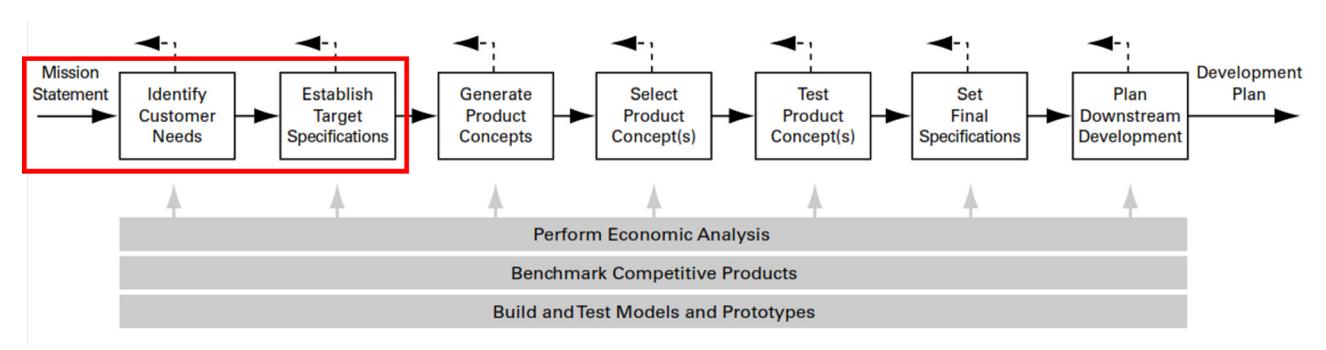
Figure 1 Stages of front-end activities consisting the concept development phase Source: Ulrich & Eppinger (2012)
| 20 | 23 → | 20 | 24 → | 2 | 025 → | 2026 |
|---|---|---|---|---|---|---|
| Identify customer needs and determine target product specifications | Generating product concepts and selecting product concepts | Product concept testing and set final specification | Product architecture study | Industrial design study | Design for manufacturing (DFM) evaluation | Prototyping and product testing |
Figure 2 EM module conversion kit product development roadmap Source: Personal documentation (2023)
Method
This research combines quantitative analysis during user needs identification and qualitative methods for setting product specification targets. Data collection includes interviews and surveys from individuals with motorcycle riding experience and a C-class driver's license (SIM C). However, the research sample is split into two groups: experts and novices, as detailed in the research flow chart.
This research process aims to define target specifications for the EMs module conversion kit product by identifying user needs and setting targets, following the product design and development flow outlined by Ulrich and Eppinger (2012). The research process begins with a mission statement, proceeds to identify user needs, and then formulates target specifications. Figure 3 illustrates the research stages.
The research began with the creation of a mission statement (step 0), providing clear guidance to the design team and outlining key product details, benefits, target markets, assumptions, and stakeholders. The process of identifying customer needs (activity A) starts with gathering raw data from customers (step A1) through one-on-one interviews and focus group discussions with a minimum of 15 expert motorcycle users, aged 25 - 50, holding a SIM C (driver's license) for at least 10 years (Di Stasi et al., 2011). According to Griffin and Hauser's theory, a minimum of 15 expert respondents were selected because it was found that this number is sufficient to capture over 80% of user needs within a specific product segment. Increasing the number of respondents beyond this threshold did not significantly yield new needs (Keil, 2010). The interviews were recorded, and the researcher carefully transcribed the raw
data, converting customer statements into more understandable customer needs (step A2). In the following design process (step A3), the needs are structured into primary-secondary categories and organized into a hierarchy. Then, in step A4, these user needs are condensed into a questionnaire format, allowing for the assessment of their relative importance using a 1-5 Likert scale (1: the feature is not desirable). I would not consider a product with this feature. 2: the feature is not important, but I would not mind having it; 3: the feature would be nice to have, but it is not necessary; 4: the quality is very desirable, but I would consider a product without it; 5: the feature is very important; I would not consider a product without this feature. The questionnaire was given to a minimum of 50 novice respondents, each with a driver's license (SIM C) for at least 2 years (Sakashita et al., 2014; Ulrich & Eppinger, 2012). The questionnaire responses were assessed for validity and reliability using SPSS software. Invalid or unreliable user needs were iteratively refined until all met the criteria and were ready for use in setting product specifications. Additionally, step 5 reflects the process of identifying customer needs and the results before proceeding to the next design phase.
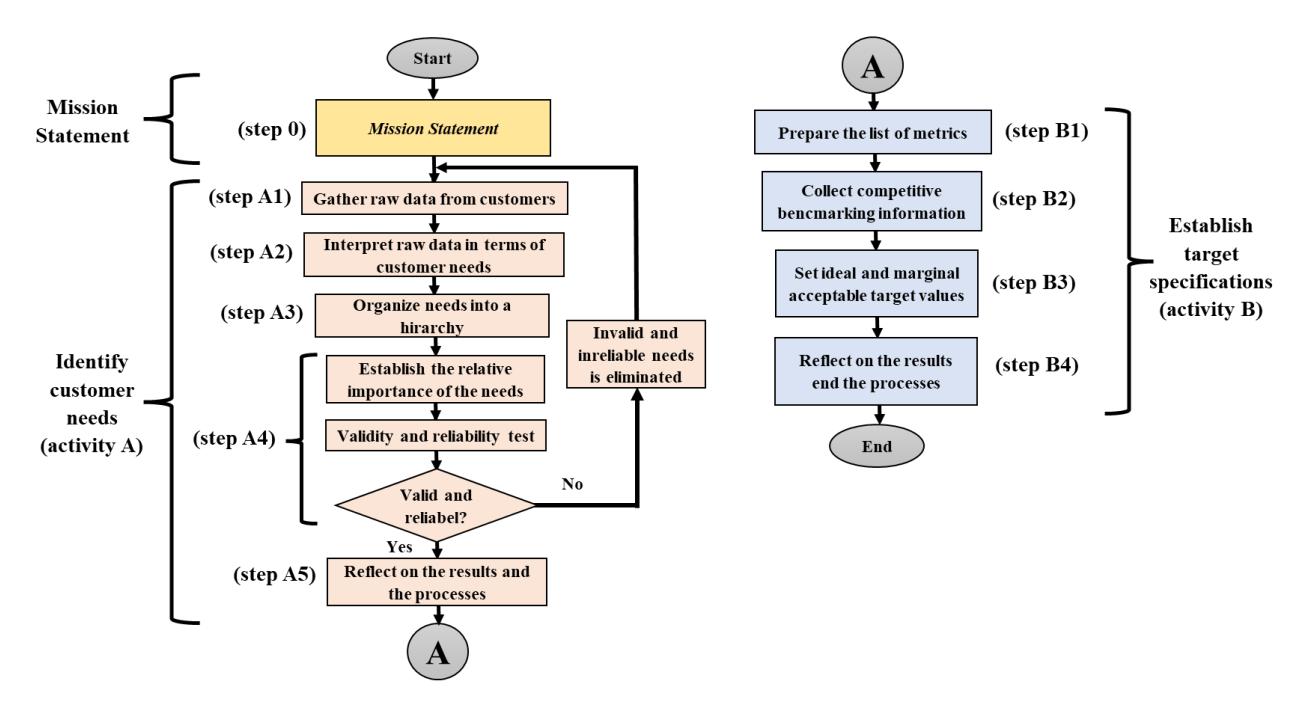
Figure 3 Process Flowchart: Identifying Customer Needs and Establishing Target Specifications
The subsequent design process (activity B) begins with step B1, preparing the list of metrics that translate each customer needs into measurable technical responses. This translation process was carried out in consultation with mechanical and electrical engineering experts, each with a master's or bachelor's degree and at least 10 years of practical experience. While the number of metrics may not match the total number of needs, each metric is designed to represent a specific need. Moving to step B2, the research team collected competitive product benchmark data from various EM marketplaces, which served as a reference to determine the specification value for each metric. Satisfaction levels for each specification were rated on a scale of 1 to 5. Next, step B3 is to set ideal and marginally acceptable target values for each metric, guided by comparisons with similar products in the market. These values aim to ensure that the product specifications exceed those of competitors, with the ideal value representing the best achievable outcome and the marginal acceptable value ensuring commercial viability. Both targets are essential for refining specifications in the subsequent stages of concept generation and selection. Finally, in step B4, the research reflects on the product specification targets, gathers feedback, and makes necessary corrections to enhance the quality of the final specifications.
Result and Discussion
Table III displays the outcomes of step 0, the mission statement for the EM module product kit that serves as the initial step in the design process. The mission statement guides the design team and ensures the subsequent stages align with objectives and customer needs. The following design process, activity A (identify customer needs), consists of steps A1, gathering raw data from customers through one-onone interviews and FGD methods with 22 expert respondents, and step A2, interpreting raw data from customers into needs statements, resulting in 97 needs statements (Table IV).
Moving to step A3, a hierarchy is established by categorizing and prioritizing these needs. Redundant and repetitive needs are eliminated, reducing the number of need statements to 30. Next, 30 customer needs are organized into 9 groups with essential labels highlighted in bold. Priority values, denoted by "*", "**", "***", and "!" are assigned to each secondary need within a group. More marks mean that the need is a priority from the design team's perspective, while "!" shows that this need is latent (not visible but potential). The organized hierarchy is presented in Table V.
Table III Mission Statement of EM Module Conversion Kit Products
| Mission Statement: EM Module Conversion Kit Products | ||
|---|---|---|
| Product Description | components. | An extra device can operate alongside the ICEM using electric power, keeping the ICE engine operational, requiring minimal modifications, and preserving the built-in |
| Proportion of Product Benefits | Convert ICEM into EM while retaining ICEM functionality, reducing costs and emissions, enabling easy module installation, and transferability to similar motorcycles. | |
| Key to Product Success | The ongoing increase in fuel prices Extensive queues for subsidized fuel at fuel stations The relatively high cost of electric motorcycles | Incentives for electric motor conversions (subsidy) Environmental concerns about carbon emissions |
| Primary Target Market | Daily motorcycle commuters, including workers, students, and college students. | |
| Secondary Target Market | Motorcycle users as a second vehicle | Automotive hobbyist |
| Assumptions | Ideal for a full day's commute on one charge Efficient and durable Lithium-ion batteries | Meets regulatory standards with performance like ICEM |
| Stakeholders | User Educational Institutions | Government Institutions Parts supplier Production workshop |
Table IV Need Statements of EM Module Conversion Kit Products
| No | Needs Statement | No | Needs Statement |
|---|---|---|---|
| 1 | EM module conversion kits ensure safety, even in short circuits. | 50 | Batteries in electric motorcycles can be charged at home. |
| 2 | They're designed for safe use in wet conditions. | 51 | These bikes cover 60 km on a single charge. |
| 3 | Users can easily monitor the battery status. | 52 | Ideal for daily work commutes. |
| 4 | Load limits are recommended for electric motor mode. | 53 | Responsive during use with minimal signal delay. |
| 5 | Gasoline engines aren't strained when using electric motors. | 54 | Suitable for day and night riding. |
| 6 | Battery placement complements the bike's design. | 55 | Lower operational costs in electric mode. |
| 7 | The electric motor comes at an affordable price. | 56 | Retain standard vehicle features. |
| 8 | These kits require minimal maintenance. | 57 | User-friendly maintenance and spare parts availability. |
| 9 | Maintenance costs are budget friendly. | 58 | Customizable riding modes. |
| 10 | Components support easy plug-and-play installation. | 59 | Competitive prices for electric motor conversion kits. |
| No | Needs Statement | No | Needs Statement |
|---|---|---|---|
| 11 | The electric motor covers 60 km on a single charge. | 60 | Electric bikes feature durable electric motors and wheel connections. |
| 12 | Electric motor modules offer 60 km of travel per charge. | 61 | Components designed for safety, avoiding short circuits. |
| 13 | They allow up to 60 km of travel in electric mode per day. | 62 | User-accessible component placement. |
| 14 | Electric mode matches gasoline bikes' range. | 63 | Removable, theft-resistant batteries. |
| 15 | Extra electric modules have access to widespread public charging. | 64 | Additional modules can be charged at government planned stations. |
| 16 | Charging stations for electric vehicles are readily accessible. | 65 | Use standard, readily available batteries. |
| 17 | These bikes stand out with their electric power source. | 66 | Compliance with regulations and safety standards. |
| 18 | They emit a sound similar to gasoline engines in electric mode for safety. | 67 | Rechargeable in gasoline mode or downhill. |
| 19 | The kits include safety signals for use. | 68 | Equipped with reliable, certified devices. |
| 20 | Commonly available, easily replaceable batteries are used. | 69 | Cost-effective electric mode operation. |
| 21 | Electric mode covers at least 30 km on one charge. | 70 | Comparable load capacity to gasoline motorcycles. |
| 22 | Electric mode accommodates two riders. | 71 | Simultaneous battery charging in gasoline mode. |
| 23 | They can carry charging equipment while riding. | 72 | Home installation using common electrical power. |
| 24 | Charging is cost-effective. | 73 | Aesthetic integration with the motorcycle's design. |
| 25 | Electric mode offers a 60 km range on one charge. | 74 | Futuristic design for a sleek look. |
| 26 | The kits are streamlined with minimal components and maintenance. | 75 | Attractive design for additional motor modules. |
| 27 | Batteries charge with standard home power. | 76 | Components withstand water exposure. |
| 28 | They work with most household electrical systems. | 77 | Battery monitoring with clear low battery alerts. |
| 29 | They don't hinder access to gasoline engine maintenance. | 78 | Predict remaining travel based on battery capacity. |
| 30 | Motorcycles easily switch between electric and gasoline power. | 79 | Multiple acceleration and speed modes. |
| 31 | Manual mode selection between electric and gasoline engines is available. | 80 | Authentic engine-like sound in electric mode. |
| 32 | Motorcycles provide a choice between electric and gasoline power. | 81 | Rapid, safe battery charging. |
| 33 | Kits deliver performance similar to gasoline engines. | 82 | Display remaining travel distance based on battery charge. |
| 34 | Motorcycles use electric and gasoline power separately or interchangeably. | 83 | Tunable for performance or efficiency. |
| 35 | Kits integrate aesthetically into the bike's design. | 84 | Calculate travel distance based on mode and usage. |
| 36 | Switching between power modes is straightforward. | 85 | Use readily available components. |
| 37 | Bikes transition seamlessly between power sources. | 86 | Electric motor assists gasoline engine at a constant speed. |
| 38 | Kit components are readily accessible. | 87 | Reliable performance even at 50% battery charge. |
| 39 | Motorcycles can carry charging equipment. | 88 | Aesthetic battery and controller placement. |
| 40 | Separate system units exist between the engines. | 89 | Secure battery positioning, shielded from heat. |
| 41 | They operate safely in wet conditions. | 90 | Electrical system compatibility. |
| 42 | Users can easily monitor indicators while riding. | 91 | Adherence to government regulations. |
| 43 | Electric motorcycles offer self-charging capabilities. | 92 | Seamless transition between electric and gasoline power. |
| No | Needs Statement | No | Needs Statement |
|---|---|---|---|
| 44 | Kits can charge the battery while riding. | 93 | Display mileage predictions based on usage. |
| 45 | They offer cost-effective mileage. | 94 | Durable, cost-effective components. |
| 46 | Batteries can be removed and charged separately. | 95 | Optimal battery placement for balance and aesthetics. |
| 47 | Batteries charge while the gasoline engine operates. | 96 | Consider center of gravity for component placement. |
| 48 | Electric power can carry two adult riders. | 97 | Coexist with existing gasoline motor components |
| 49 | Kits use low-maintenance components. | without disruption. |
Table V Hierarchical List of EM Module Conversion Kit Products
| Code | EM kits feature easily rechargeable batteries | |
|---|---|---|
| CN1 | *** | EM module batteries charge rapidly and safely |
| CN2 | * | Charging happens while riding downhill |
| CN3 | *** | Home and public charging options are widely available |
| CN4 | ** | Motorcycles can transport portable chargers |
| CN5 | * | The battery is easily detachable for separate charging, securely protected against theft |
| Code | EM kits closely match gasoline engine performance | |
| CN6 | *** | EM module kits provide adjustable settings for battery conservation or maximum motor performance |
| CN7 | *** | In electric mode, motorcycles cover a full day's activities, traveling up to 60 km on a single charge |
| CN8 | * | These conversion kits offer performance akin to gasoline engines |
| CN9 | ** | Electric motorcycles handle loads like gasoline ones |
| CN10 | *! | Electric motorcycles are very responsive with minimal signal delay |
| CN11 | * | Products are suitable for day, night, and rainy use |
| Code | EM kits are user-friendly and interactive | |
| CN12 | *** | The motorcycle seamlessly switches between gas and electric modes |
| CN13 | ** | EM module conversion kits show real-time battery range |
| CN14 | * | The product has a battery level indicator to alert users when it's low, eliminating the need for visual checks |
| Code | EM kits seamlessly blend with the motorcycle design, embodying a unique identity | |
| CN15 | *** | The product seamlessly integrates into the gasoline motorcycle, adding a futuristic touch to enhance its aesthetics |
| CN16 | *! | Motorcycles with this product are identifiable by their use of electrical energy. |
| Code | EM kits provide safety during use Top of Form | |
| CN17 | ** | The EM module conversion kit is rain-safe and puddle-friendly |
| CN18 | ! | The EM kit produces gasoline engine sound for safety |
| CN19 | * | The EM kit has an independent electrical system separate from gasoline motorcycles |
| CN20 | *** | It adheres to government regulations for electric motorcycle conversions. |
| Code | EM kits are economical | |
| CN21 | *** | EM kits are competitively priced for motor conversions |
| CN22 | *** | EM kits are more cost-effective than conventional motorcycles when in electric mode |
| Code | EM kits have low maintenance requirements | |
| CN23 | ** | EM kits require simple, affordable, and minimal maintenance |
| Code | EM kits use high-quality components | |
| CN24 | * | Product installs on a petrol motorbike without disrupting user accessibility or maintenance |
| CN25 | ** | Product employs reliable components for safety and durability |
| CN26 | *** | Product uses high-quality components |
| CN27 | ** | Product uses easily obtainable standard components with minimal parts |
| Kode | EM kits are easy to apply to conventional motorcycles |
|---|---|
| CN28 *** | EM kits easily install on gasoline motors |
| CN29 *** | Integration doesn't compromise handling, aerodynamics, or components, with minimal heat and vibration |
| CN30 * | When not in use, EMs kits don't burden the gasoline engine |
Hierarchical lists lack information on the relative importance of customer needs. To address this in the design process, step A4 assesses the relative importance of each customer's need from the perspective of potential users. This involved 70 novice respondents completing a closed questionnaire, ranking them on a scale of 1 to 5. Higher scale values indicate greater importance, as perceived by users. Figure 4 illustrates the results of determining the relative importance of customer needs for additional EM module products.
Based on the obtained relative importance results, the highest priority is accorded to Customer Needs number 11 (CN11), "Products are suitable for day, night, and rainy use," with an importance level of 4.786, followed by CN3, "Home and public charging options are widely available," at 4.729, and CN29, "Integration doesn't compromise handling, aerodynamics, or components, with minimal heat and vibration," at 4.686. Conversely, CN18, "The EM kit produces gasoline engine sound for safety," ranks lowest with an importance level of 3.186. These importance levels, depicted in Figure 4, require validation and reliability testing before serving as the basis for subsequent design. Validity tests verify the legitimacy of the questionnaire, declaring it valid if it effectively measures the intended aspects. In contrast, reliability tests assess the consistency of questionnaire results upon repeated use, deeming them reliable if responses are consistent and not random (Ghozali, 2018). In this study, validity is determined by comparing the calculated r for each customer need with the r table value for 70 respondents at a 5% significance level (0.235). Reliability is confirmed with a Cronbach's alpha value above 0.8 (Istiyono, 2020). Results reveal one invalid customer need, CN18, with a calculated r value of 0.173 below the required 0.235. The overall validity test results are depicted in Figure 5. Reliability testing yields a Cronbach's alpha value of 0.937, indicating reliability for all customer needs except CN18. Consequently, CN18 is excluded, leaving 29 reliable customer needs for the subsequent design phase.
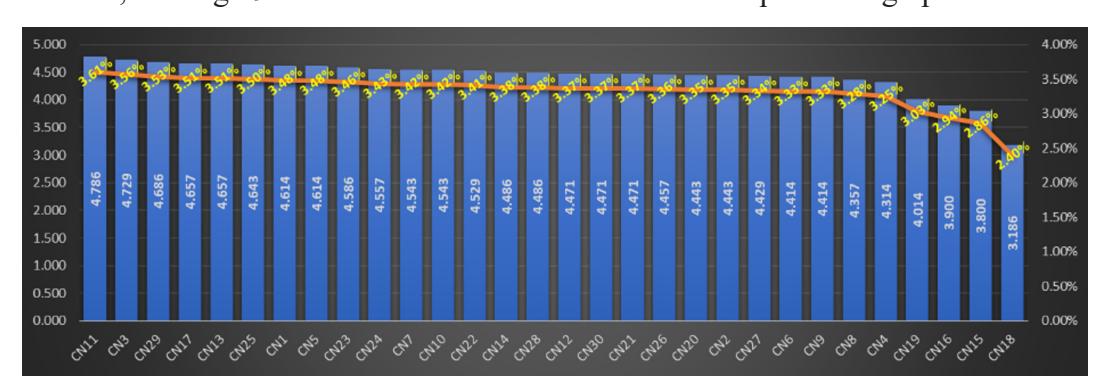
Figure 4 Results of relative importance of customer needs for the EM module conversion kit products
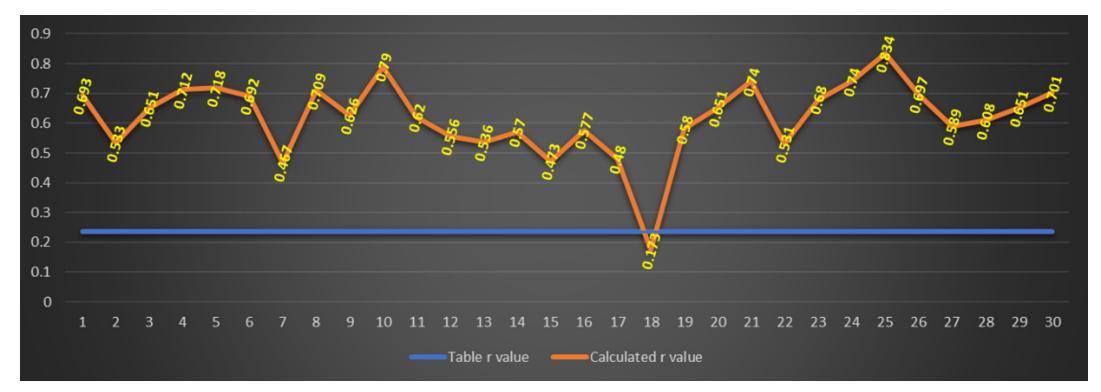
Figure 5 Validity test results
The final activity of identifying customer needs is step A5, which reflects the results and process. The entire process of identifying user needs has been carried out on the right respondents, starting from interviews with expert respondents, including practitioners, academics, electric vehicle competition team crew, and 2-wheeled automotive hobbyists, all of whom are also regular motorbike users with experience of having a SIM C of more than 10 years. In identifying customer needs through one-on-one interviews and FGD, several implied or latent needs were found, including CN10, CN16, and CN18. Identifying customer needs obtains more through FGD because discussions occur between respondents, which give rise to new needs not previously thought of in one-on-one interviews where the discussion only occurs between the interviewer and one respondent. In guiding the interview process, the development team, which is also a direct user of existing products, can better encourage respondents to express their needs and desires regarding the product being designed so that in identifying further user needs. This happens especially in the interview process; they can involve more of the development team who are also direct users of the designed product.
The following design activity establishes target specifications (activity B) for the additional EM modules kit product. In general, customer needs are still expressed in subjective and qualitative consumer language. Therefore, in this activity, it is necessary to establish a set of product specifications (plural) that describe precisely, in detail, and measurably what the designed product must be able to do. Product specifications do not show the design team how to meet user needs, but they represent a clear agreement about what the team wants to achieve so that the product designed can meet user needs. A set of product specifications (plural) consists of several individual specifications (singular). Individual specifications consist of metrics and values; metrics are one of the things the product must do, while values are targets that the metric must achieve. Values come in several forms, namely specific numbers, ranges of numbers, or inequalities. Values are always labeled with the appropriate units (seconds, kilograms, joules, and etc.) (Ulrich & Eppinger, 2012).
Activity B (establishing target specifications) is carried out in 4 steps. Step B1 is preparing a list of metrics. A list of metrics is created by translating each customer's need into metrics and values with their units. Translating a customer's needs into metrics is done by reflecting on each customer needs and considering appropriate and measurable product characteristics. A good metric directly reflects how additional EM module products can meet customer needs. The translation process also involves experts in mechanical and electrical engineering with master's or bachelor's degrees who have experience as practitioners >=10 years as considerations and input to the design team. The results of the metrics prepared for the EMs additional module products are shown in Table VI, as well as the relationship matrix between each customer's needs. Each metric that has been designed is shown in Table VII.
Table VI Product Metrics List of EM Module Conversion Kit Products
| No Metrics | Code of Customer Needs (CN) | Aspect Metrics | Metrics | Score of Important Metrics | Percent Important Metrics | Unit |
|---|---|---|---|---|---|---|
| 1 | 1, 3, 7, 8, 9, 11, 21, 22, 23, 25, 26, 27, | Battery set | Battery type | 341,51 | 9,65% | subj |
| 2 | 1, 2, 3, 6, 7, 8, 9, 11, 13, 14, 21, 22 | Battery capacity | 265,96 | 7,52% | kWh | |
| 3 | 3, 5, 9, 15, 17, 19, 20, 23, 28, 29 | Battery position | 200,69 | 5,67% | subj | |
| 4 | 3, 4, 5, 15, 17, 20, 23, 24, 25, 28, 29 | Battery holder and cover | 189,79 | 5,36% | subj | |
| 5 | 11, 17, 20, 21, 25, 26 | Battery IP rating | 186,22 | 5,26% | IP | |
| 6 | 1, 2, 3, 6, 7, 8, 9, 10 | Battery voltage | 134,44 | 3,80% | Volt | |
| 7 | 3, 5, 15, 21, 24, 28 | Battery dimensions | 114,89 | 3,25% | mm | |
| 8 | 5, 21, 24, 28, 30 | Battery weight | 92,56 | 2,62% | gram | |
| 9 | 4, 5, 20, 23, 28, 29 | Battery lock | 41,37 | 1,17% | subj |
| No Metrics | Code of Customer Needs (CN) | Aspect Metrics | Metrics | Score of Important Metrics | Percent Important Metrics | Unit |
|---|---|---|---|---|---|---|
| 10 | 1, 2, 3, 4, 5, 20, 21, 22, 25, 26, 27, | Electronic component | Charging device | 228,44 | 6,46% | Volt, Ampere |
| 11 | 6, 7, 11, 12, 13, 14, 17, 19, 21, 27, 28, 29 | set | Display panel | 150,81 | 4,26% | subj |
| 12 | 6, 12, 17, 19, 29 | Control panel | 83,44 | 2,36% | subj | |
| 13 | 14, 19, 21, 27, 28 | Notification sound | 56,26 | 1,59% | Db | |
| 14 | 1, 3, 19, 20, | MCB | 53,20 | 1,50% | Ampere | |
| 15 | 7, 8, 9, 10, 20, 21, 22, | Electric | Electric motor power | 171,53 | 4,85% | Watt |
| 16 | 10, 23, 25, 26, 27, | motor set | Type of electric motor | 153,67 | 4,34% | subj |
| 17 | 15, 20, 24, 29 | Electric motor position | 118,59 | 3,35% | subj | |
| 18 | 15, 20, 24, 26, 27, 28, 29 | Electric motor adapter | 97,69 | 2,76% | subj | |
| 19 | 11, 17, 20 | IP Rating of the Electric Motor | 94,18 | 2,66% | IP | |
| 20 | 2, 11, 22, 30 | Self-charging electric motor | 81,52 | 2,30% | Volt, Ampere | |
| 21 | 7, 8, 9, 10 | Electric motor voltage | 80,03 | 2,26% | Volt | |
| 22 | 15, 17 | • | Electric motor cover | 57,36 | 1,62% | subj |
| 23 | 1, 2, 6, 7, 8, 9, 10, 11, 12, 13, 14, 15, 17, 19, 20, 21, 22, 24, 25, 26, 27 | Controller set | Controller | 476,60 | 13,47% | volt, Ampere, Watt |
| 24 | 16, 20, 23 | Marker | Identification stickers | 66,95 | 1,89% | subj |
Table VII Needs Metrics - Metrics of EM Module Conversion Kit Products
| Bat | tery S | Set | Ele | ctroni | ic Coi Set | mpon | ent | Elec | tric N | lotor | Set | Con- troller Set | Marker | |||||||||||||
|---|---|---|---|---|---|---|---|---|---|---|---|---|---|---|---|---|---|---|---|---|---|---|---|---|---|---|
| Cu | istomer Needs / Metrics | Battery Type | Battery Capacity | Battery Position | Battery Holder and Cover | Battery IP Rating | Battery Voltage | Battery Dimensions | Battery Weight | Battery Lock | Charging Device | Display Panel | Control Panel | Notification Sound | MCB | Electric Motor Power | Type of Electric Motor | Electric Motor Position | Electric Motor Adapter | IP Rating of the Electric Motor | Self-Charging Electric Motor | Electric Motor Voltage | Electric Motor Cover | Controller | Identification Stickers | Percentage Customer's needs (%) |
| CN1 | EM module batteries charge rapidly and safely | 9 | 9 | 3 | 9 | 3 | 9 | 3,48 | ||||||||||||||||||
| CN2 | Charging happens while riding downhill | 3 | 1 | 9 | 9 | 3 | 3,35 | |||||||||||||||||||
| CN3 | Home and public charging options are widely available | 1 | 3 | 3 | 1 | 3 | 1 | 9 | 1 | 3,56 | ||||||||||||||||
| CN4 | Motorcycles can transport portable chargers | 9 | 1 | 1 | 9 | 1 | 3,25 | |||||||||||||||||||
| CN5 | The battery is easily detachable for separate charging, securely protected against theft | 9 | 9 | 9 | 9 | 3 | 3 | 3,48 |
Jurnal Sosioteknologi | Volume 22, No. 3, November 2023
| CN6 | EM module kits provide adjustable settings for battery conservation or maximum motor performance | 9 | 9 | 3 | 9 | 9 | 3,33 | |||||||||||||||
| CN7 | In electric mode, motorcycles cover a full day's activities, traveling up to 60 km on a single charge | 9 | 9 | 3 | 1 | 9 | 3 | 9 | 3,42 | |||||||||||||
| CN8 | These conversion kits offer performance akin to gasoline engines | 9 | 9 | 9 | 9 | 9 | 9 | 3,28 | ||||||||||||||
| CN9 | Electric motorcycles handle loads like gasoline ones | 9 | 9 | 3 | 9 | 9 | 9 | 9 | 3,33 | |||||||||||||
| CN10 | Electric motorcycles are very responsive with minimal signal delay | 3 | 3 | 9 | 3 | 9 | 3,42 | |||||||||||||||
| CN11 | Products are suitable for day, night, and rainy use | 9 | 9 | 9 | 3 | 9 | 3 | 3 | 3,61 | |||||||||||||
| CN12 | The motorcycle seamlessly switches between gas and electric modes | 3 | 9 | 9 | 3,37 | |||||||||||||||||
| CN13 | EM module conversion kits show real-time battery range | 3 | 9 | 9 | 3,51 | |||||||||||||||||
| CN14 | The product has a battery level indicator to alert users when it's low, eliminating the need for visual checks | 3 | 1 | 9 | 3 | 3,38 | ||||||||||||||||
| CN15 | The product seamlessly integrates into the gasoline motorcycle, adding a futuristic touch to enhance its aesthetics | 9 | 9 | 3 | 9 | 3 | 9 | 3 | 2,86 | |||||||||||||
| CN16 | Motorcycles with this product are identifiable by their use of electrical energy. | 9 | 2,94 | |||||||||||||||||||
| CN17 | The EM module conversion kit is rain-safe and puddle-friendly | 3 | 9 | 9 | 9 | 1 | 9 | 9 | 3 | 3,51 |
Initial Design Studies: Identify Customer... | Patrisius, Mars, M. Fahrudin
| Metrics importance percentage (%) | 10,7 | 8,3 | 6,3 | 5,9 | 5,8 | 4,2 | 3,6 | 2,9 | 1,3 | 7,1 | 4,7 | 2,6 | 1,8 | 1,7 | 5,4 | 4,8 | 3,7 | 3,1 | 2,9 | 2,6 | 2,5 | 1,8 | 14,9 | 2,1 | ||
|---|---|---|---|---|---|---|---|---|---|---|---|---|---|---|---|---|---|---|---|---|---|---|---|---|---|---|
| use, EMs kits don't burden the gasoline engine Importance level metrics | 342 | 266 | 201 | 190 | 186 | 134 | 115 | 93 | 41 | 228 | 151 | 83 | 56 | 53 | 172 | 154 | 119 | 98 | 94 | 82 | 80 | 57 | 476,6 | 67,0 | ||
| CN30 | handling, aerodynamics, or components, with minimal heat and vibration When not in | 9 | 3 | 3 | 3 | 3 | 3 | 9 | 9 | 9 | 3,53 3,37 | |||||||||||||||
| CN29 | Integration doesn't compromise | |||||||||||||||||||||||||
| CN28 | EM kits easily install on gasoline motors | 9 | 9 | 9 | 3 | 1 | 3 | 1 | 9 | 3,38 | ||||||||||||||||
| CN27 | Product uses easily obtainable standard components with minimal parts | 9 | 9 | 3 | 3 | 9 | 1 | 9 | 3,34 | |||||||||||||||||
| CN26 | Product uses high-quality components | 9 | 9 | 3 | 9 | 3 | 9 | 3,36 | ||||||||||||||||||
| CN25 | Product employs reliable components for safety and durability | 9 | 1 | 9 | 9 | 9 | 9 | 3,50 | ||||||||||||||||||
| CN24 | Product installs on a petrol motorbike without disrupting user accessibility or maintenance | 3 | 9 | 9 | 9 | 1 | 3 | 3,43 | ||||||||||||||||||
| CN23 | EM kits require simple, affordable, and minimal maintenance | 9 | 9 | 1 | 3 | 9 | 3 | 3,46 | ||||||||||||||||||
| CN22 | EM kits are more cost-effective than conventional motorcycles when in electric mode | 9 | 3 | 3 | 9 | 3 | 9 | 3,41 | ||||||||||||||||||
| CN21 | EM kits are competitively priced for motor conversions | 9 | 9 | 9 | 3 | 3 | 1 | 3 | 1 | 3 | 9 | 3,37 | ||||||||||||||
| CN20 | It adheres to government regulations for electric motorcycle conversions. | 3 | 3 | 9 | 1 | 3 | 9 | 9 | 9 | 3 | 9 | 3 | 9 | 3,35 | ||||||||||||
| CN19 | The EM kit has an independent electrical system separate from gasoline motorcycles | 3 | 3 | 3 | 3 | 3 | 3 | 3,03 |
The outcomes of the formulated metrics are designed to fulfill each customer's needs comprising 24 metrics. These metrics encompass various sectors: battery set, electronic component set, electric motor set, controller set, and marker. Each metric has a percentage of metric importance obtained from the correlation of each metric to meeting each customer's need. Each correlation that arises is given a value of "9" for a strong correlation, a value of "3" for an average correlation, and a value of "1" for a weak correlation. This scoring uses the Quality Function Deployment Method Theory (Maritan, 2015), which can determine the percentage importance of each metric to see which one is a priority for the product being designed. The correlation value for each metric is then multiplied by the percentage level of importance of each customer need, and the results of each multiplication are added up to form an importance level value for each metric and also displayed in the form of a percentage of metric importance. The function of the metric importance percentage is to know which metrics need to be prioritized in a product that is designed or developed with limited resources. However, each metric is also mandatory to fulfill.
Based on the results of calculating the percentage importance of metrics in Table VII, the battery set metric prioritizes battery type as priority 1 (10.7%), battery capacity as priority 2 (8.3%), and battery position as priority 3 (6.3%). A battery set is a collection of components that support the proper installation of the battery device on the ICEM, where EM module kit products are to be installed by meeting each correlated customer need. The electric motor set is a collection of components that support the electric motor to move the ICEM wheels. The electric motor set metric prioritizes electric motor power as priority 1 (5.4%), type of electric motor as priority 2 (4.8%), and electric motor position as priority 3 (3.7%). The controller is a device that regulates the performance of electric motors according to the input signal given by the user to consume electrical energy from the battery in movements that move the motorbike wheels. The controller is a metric with priority 1 (14.9%) of all existing metrics. Next is the electronic component set that connects the battery, controller, and electric motor to function correctly. The set's electronic components also include input devices to provide signals from the user to the controller so that the electric motor can operate and output devices in the form of buzzers and indicator panels to provide information about the battery's condition and other information to the user. The electronic component set metric prioritizes the charging device as priority 1 (7.1%), the display panel as priority 2 (4.7%), and the control panel as priority 3 (2.6%). The last group of metrics is a marker, which only contains 1 metric, namely an identification sticker with a metric interest percentage of 2.1%. This metric functions to follow government regulations regarding electric motorbike conversions, namely that every converted electric motorbike must include an identification sticker on the motorbike (Kemenhub RI, 2020).
The following design activity (step B2) collects competitive benchmark information from EM products. This step determines the value of each product metric, which is designed based on the metric values of competing products as a comparison. Competitive products at this step are determined based on electric motorbikes and conversion motorbike packages sold in Indonesia, which receive conversion subsidies from the government (TKDN > 40%), including: BRT (only BRT is a conversion product), Gesit G1, United T1800, United TX3000, United TX1800, Smoot Elektrik Tempur, Smoot Elektrik Zuzu, Volta 401, Selis E-Max, Selis Agats, Viar New Q1, Rakata X5, Rakata S9, and Polytron Fox-R (CNN Indonesia, 2023). The results of collecting information on competitive product benchmarks are carried out by collecting data related to specifications of similar products that are used as benchmarks from official websites, review results, and other sources. The results of the collection of competitive product benchmark information that has been summarized are shown in Table VIII.
Table VIII The EM Module Conversion Kit Products Benchmarks by Metric
| No Me- trics | As- pect me- trics | Metrics | % impor- tant metrics | Unit | BRT | Gesit G1 | United T 1800 | United TX 1800 | United TX 3000 | Smoot Elek- trik Tempur | Smoot Elek- trik Zuzu | Volta 401 | Selis E- Max | Selis Agats | Viar New Q1 | Rakata X5 | Rakata S9 | Polytron Fox-R |
|---|---|---|---|---|---|---|---|---|---|---|---|---|---|---|---|---|---|---|
| 1 | - | Battery type | 9,65% | subj | Lithium- ion | Lithium- ion | Lithium- ion | Lithium- ion | Lithium- ion | Lithium- ion | Lithium- ion | Lithium- ion | SLA/ Lithium- ion | SLA/ Lithium- ion | Lithium- ion | Lithium- ion | Lithium- ion / SLA | Lithium- ion |
| 2 | Battery capacity | 7,52% | kWh | 1,4169 | 1,4169 | 1,68 | 1,68 | 3,36 | 1,37 | 1,37 | 1,38 | 1,2 / 1,5 / 3 / 4,256 | 1,656 / 1,44 | 1,38 / 2,76 | 1,2 | 1,2 / 2,4 | 3,744 | |
| 3 | Battery position | 5,67% | subj | under the seat | under the seat | center deck | center deck | center deck & under the seat | under the seat | under the seat | under the seat | under the seat | under the seat | under the seat | under the seat | under the seat | under deck footrest | |
| 4 | Battery set | Battery holder and cover | 5,36% | subj | Iron plate, plastic cover & seat | Iron plate, plastic cover & seat | Iron plate, plastic cover | Iron plate, plastic cover & seat | Iron plate, plastic cover & seat | Iron plate, plastic cover & seat | Iron plate, plastic cover & seat | Iron plate, plastic cover & seat | Iron plate, seat | Iron plate, seat | Iron plate, seat | Iron plate, seat | Iron plate, seat | Frame, iron plate, lower deck body |
| 5 | set | Battery IP rating | 5,26% | IP | IP67 | IP67 | Info n/a | Info n/a | Info n/a | Info n/a | Info n/a | Info n/a | Info n/a | Info n/a | IP67 | Info n/a | Info n/a | Info n/a |
| 6 | Battery voltage | 3,80% | Volt | 73,8 | 73,8 | 60 | 60 | 60 | 64 | 64 | 60 | 60 | 72 | 60 | 60 | 60 | 72 | |
| 7 | Battery dimensions | 3,25% | mm | 120x 160x 420 | 120x 160x 420 | 198x 165x 280 | 198x 165x 280 | 198x 165x 280 (2 pcs) | Info n/a | Info n/a | Info n/a | Info n/a | Info n/a | 330x 230x 90 | Info n/a | Info n/a | Info n/a | |
| 8 | - | Battery weight | 2,62% | gram | 8.000 | 8.000 | 13.000 | 13.000 | 13.000 | 12.000 | 12.000 | Info n/a | Info n/a | Info n/a | Info n/a | 10.350 | 31.650 | |
| 9 | Battery lock | 1,17% | subj | - | - | plastic cover | plastic cover | plastic cover | Plastic lever lock | Plastic lever lock | Plastic crossbar | Info n/a | Info n/a | - | - | Plastic lid with plastic snap latch | - | |
| 10 | Charging device | 6,46% | Volt, Am- pere, Watt | 83, 5A, 200 & 450 W | 83, 5A, 200 & 450 W | 10A | 10A | 10A | 200W | 200W | 60, 5A | 60, 5A, 180W, 350W, 400W | 72, 3A, 220W, 420W | 71,4, 4A | Info n/a | 220W | 72-84, 10A | |
| 11 | Elect | Display panel | 4,26% | subj | Indicator light | Color screen (MID) | Mono- chrome screen | Mono- chrome screen | Mono- chrome screen | 7 segment | 7 segment | LCD 7 segment | 7 segment | Mono- chrome screen | Mono- chrome screen / 7 segment | Mono- chrome screen | 7 segment & led | Mono- chrome screen |
| 12 | Electronic component set | Control panel | 2,36% | subj | ICEm standard panel + add-ons | EMs standard panel | EMs standard panel | EMs standard panel | EMs standard panel | EMs standard panel | EMs standard panel | ICEm standard panel + add-ons | EMs standard panel | ICEm standard panel + add-ons | EMs standard panel | EMs standard panel | EMs standard panel | EMs standard panel |
| 13 | * | Notification sound | 1,59% | Subj | - | For error | on/off, artificial engine sound | on/off, artificial engine sound | on/off, artificial engine sound | Info n/a | Info n/a | Info n/a | Info n/a | Info n/a | anti-theft, on/off, alarm | alarm | alarm | Info n/a |
| 14 | МСВ | 1,50% | Ampere | Info n/a | 65A | Info n/a | Info n/a | Info n/a | Info n/a | Info n/a | 63A | 40A | Info n/a | 40A | Info n/a | 40A | Info n/a |
| No Me- trics | As- pect me- trics | Metrics | % impor- tant metrics | Unit | BRT | Gesit G1 | United T 1800 | United TX 1800 | United TX 3000 | Smoot Elek- trik Tempur | Smoot Elek- trik Zuzu | Volta 401 | Selis E- Max | Selis Agats | Viar New Q1 | Rakata X5 | Rakata S9 | Polytron Fox-R |
|---|---|---|---|---|---|---|---|---|---|---|---|---|---|---|---|---|---|---|
| 15 | Electric motor power | 4,85% | Watt | 2.000 | 2.000 - 5.000 | 1.800 | 2.000 | 3.000 - 4200 | 1.500 | 1.500 | 1.500 | 1.200 | 2.000 | 800 – 2.000 | 1.750 | 800 | 3.000 - 6.409 | |
| 16 | - | Type of electric motor | 4,34% | subj | BLDC mid- drive | BLDC mid- drive | BLDC hub- drive | BLDC hub- drive | BLDC hub- drive | BLDC hub-drive | BLDC hub- drive | BLDC hub- drive | BLDC hub- drive | BLDC hub- drive | BLDC hub- drive | BLDC hub- drive | BLDC hub- drive | BLDC hub-drive |
| 17 | • | Electric motor position | 3,35% | subj | Mid- drive (left crank case mop) | Mid- drive (center frame) | Hub- drive | Hub- drive | Hub- drive | Hub- drive | Hub- drive | Hub- drive | Hub- drive | Hub- drive | Hub- drive | Hub- drive | Hub- drive | Hub-drive |
| 18 | _ t | Electric motor adapter | 2,76% | subj | Iron plate adapter, mounting the left crank case | Placing the main frame | Swing arm | Swing arm | Swing arm | Swing arm | Swing arm | Swing arm | Swing arm | Swing arm | Swing arm | Swing arm | Swing arm | Swing arm |
| 19 | IP Rating of the Electric Motor | 2,66% | IP | IP54 | IP54 | IP67 | IP67 | IP67 | IP67 | IP67 | Info n/a | Info n/a | Info n/a | IP67 | Info n/a | Info n/a | IP67 | |
| 20 | Self- charging electric motor | 2,30% | Volt, Am- pere | Info n/a | Info n/a | Info n/a | Info n/a | Info n/a | Info n/a | Info n/a | Info n/a | Info n/a | Info n/a | Info n/a | Info n/a | Info n/a | Info n/a | |
| 21 | Electric motor voltage | 2,26% | Volt | 72 | 72 | 60 | 60 | 60 | 64 | 64 | 60 | 60 | 72 | 60 | 60 | 60 | 72 | |
| 22 | • | Electric motor cover | 1,62% | subj | - | Body mid | - | - | - | Cover swing arm | Cover swing arm | Cover swing arm | Cover swing arm | Cover swing arm | Cover swing arm | Cover swing arm | Cover swing arm | Cover swing arm |
| 23 | Controller set | Controller | 13,47% | volt, A, kW | 48-72, 300 A AC, 0,8- 3kW | 72, 100 | 60, 35A | 60, 40A | 60, 80A | 64, 40A | 64, 40A | 60, 38A | 60-72, 38 A | 72, 2.000 W | Info n/a | Info n/a | Info n/a | Info n/a |
| 24 | Marker | Identification stickers | 1,89% | subj | - | - | - | - | - | - | - | - | - | - | - | - | - | - |
In step B3, the design team analyzes the information collected in Table 8 to determine targets for each metric. There are two types of metric targets, namely ideal and marginal values. The ideal value target is the best value the design team expects (the most ideal). In contrast, the marginal value target is a metric value that is still acceptable so that the product remains commercially viable (Ulrich & Eppinger, 2012). The analysis results obtained target product specifications for the EM module kit in the ideal and marginal values shown in Table IX.
Table IX shows the ideal and marginal target values for product specifications obtained for each metric. Each target value for each metric is prioritized so that the ideal value can be met, but this will potentially result in many obstacles resulting in trade-offs in the subsequent design process, namely creating product concepts, selecting product concepts, and testing selected product concepts (Figure 1). This condition makes the target product specification value that has been obtained at this step will be reviewed again after the product concept chosen is obtained to determine the final product specification value.
The final step in determining product specification targets is step B4, reflecting on the results and process. Overall, the process of deciding specification targets has obtained 24 ideal and marginal values as product specification targets for the EM modules kit, each of which is described in quantitative and subjective value targets as metric requirements that the product must achieve. Quantitative value targets can be targets with specific quantitative values, vulnerable values greater or smaller than a particular value, and several discrete values according to the technical conditions of each matrix. Meanwhile, the subjective value target (subj) shows that the metric is subjective and has no quantitative value.
Table IX Target Marginal and Ideal Values of EM Module Conversion Kit Products
| No Metrics | Customer Needs (CN) Code | Needs (CN) Metrics | % Important Metrics | Unit | Marginal Value | Ideal Value | |||
|---|---|---|---|---|---|---|---|---|---|
| 1 | 1, 3, 7, 8, 9, 11, 21, 22, 23, 25, 26, 27, | Battery type | 9.65% | subj | Lithium-ion | Lithium-ion | |||
| 2 | 1, 2, 3, 6, 7, 8, 9, 11, 13, 14, 21, 22 | Battery capacity | 7.52% | kWh | >1,4 | >1,8 | |||
| 3 | 3, 5, 9, 15, 17, 19, 20, 23, 28, 29 | Battery position | 5.67% | subj | Outside the motor body, the lowest possible position | Under the seat/inside the motor body | |||
| 4 | 3, 4, 5, 15, 17, 20, 23, 24, 25, 28, 29 | Battery set | Battery holder and cover | 5.36% | subj | Mounts and covers made of thick plastic must be closed and have seals | The Holder Metal plate plastic/rubber cover must be closed and have a seal. | ||
| 5 | 11, 17, 20, 21, 25, 26 | Battery IP rating | 5.26% | IP | >IP54 | >IP67 | |||
| 6 | 1, 2, 3, 6, 7, 8, 9, 10 | Battery voltage | 3.80% | Volt | 60-72 | 72 - 73,8 | |||
| 7 | 3, 5, 15, 21, 24, 28 | Battery dimensions | 3.25% | mm | <= 140 x <=180 x <=420 | <120 <160 x <400 | |||
| 8 | 5, 21, 24, 28, 30 | Battery weight | 2.62% | gram | 8.000 – 13.000 | <9.000 | |||
| 9 | 4, 5, 20, 23, 28, 29 | Battery lock | 1.17% | subj | Plastic/string/rubber latch | Metal latch | |||
| 10 | 1, 2, 3, 4, 5, 20, 21, 22, 25, 26, 27, | Charging device | 6.46% | Volt, Ampere, Watt | Voltage and current to match battery, power <= 300 W | Voltage and current adjust to battery, standard charging <=200W & fast charging <=500W | |||
| 11 | 6, 7, 11, 12, 13, 14, 17, 19, 21, 27, 28, 29 | Electronic component set | Display panel | 4.26% | subj | Built-in ICEM, additional LED /7 segment light indicator, integrated with ICEM indicator panel | Built-in ICEM, additional MID display, integrated with ICEM indicator panel. | ||
| 12 | 6, 12, 17, 19, 29 | Control panel | 2.36% | subj | ICEM standard panel + additional integrated right/left panel part of ICEM | Standard ICEM + additional panel integrated into the right panel of ICEM, EM panel buttons have special features. | |||
| 13 | 14, 19, 21, 27, 28 | Notification sound | 1.59% | subj | Notification of battery less than 50% when not in use | Notification of battery less than 50% when not in use, alarm, electric motor on-off system | |||
| 14 | 1, 3, 19, 20, | MCB | 1.50% | Ampere | Customize depending final specification | Customize depending final specification | |||
| 15 | 7, 8, 9, 10, 20, 21, 22, | Electric motor power | 4.85% | Watt | 1.200 - 1.800 | 1.500 – Peak Power 3.000 | |||
| 16 | 10, 23, 25, 26, 27, | Type of electric motor | 4.34% | subj | BLDC mid-drive/hub-drive | BLDC mid-drive | |||
| 17 | 15, 20, 24, 29 | Electric motor position | 3.35% | subj | Mid-Drive / hub-drive, attaches to ICEM frame/engine/swing arm/wheels | Mid-drive, attached to the main frame | |||
| 18 | 15, 20, 24, 26, 27, 28, 29 | Electric motor set | Electric motor adapter | 2.76% | subj | Metal adapter, attached to swing arm/engine (metric type ICEM) | Metal adapter, attached to the main frame | ||
| 19 | 11, 17, 20 | motor set | IP Rating of the Electric Motor | 2.66% | IP | IP54 | IP67 | ||
| 20 | 2, 11, 22, 30 | Self-charging electric motor | 2.30% | Ampere | >3A | 4 – 6A | |||
| 21 | 7, 8, 9, 10 | Electric motor voltage | 2.26% | Volt | 60 - 72 | 72 | |||
| 22 | 15, 17 | Electric motor cover | 1.62% | subj | Full coverage of electric motors | Comprehensively covers the electric motor with seals to protect against dust and water. | |||
| 23 | 1, 2, 6, 7, 8, 9, 10, 11, 12, 13, 14, 15, 17, 19, 20, 21, 22, 24, 25, 26, 27 | Controller set | Controller | 13.47% | volt, Ampere | 60 – 72 V, 0,8 – 2 kW | 48-72, 0,8 - 3kW | ||
| 24 | 16, 20, 23 | Marker | Identification stickers | 1.89% | subj | Following the Standard of PERMENHUB RI NO PM 65 TAHUN 2020 | Following the Standard of PERMENHUB RI NO PM 65 TAHUN 2020 | ||
The process of establishing target specifications and setting target metrics for EM module kit products is carried out without setting aggressive values for the specification targets for each metric. This is because government regulations on electric motorbike conversion must be followed so that the conversion results can be legally used on public roads. Apart from that, if aggressive specifications are set for the components used in the electric motor conversion process, such as electric motors, batteries, and controllers, it could create a trade-off in increasing overall product prices. The EM module kit product is designed with only one variant, like similar conversion products on the market. This differs from pure electric motorbike products, which have various variants in the capacity or number of batteries and electric motor power. Apart from the existence of electric motorbike conversion regulations regarding the maximum power of electric motorbikes that is permitted according to the capacity of the ICEM engine before conversion. This happens also because ICEM products still have other sources of propulsion to operate besides the electric motorbike, so that when the electric motorbike battery runs out during use, the motorbike will still be capable of working with a petrol engine to continue the journey. In the process and results of establishing target specifications, there are no missing specifications because all the metrics formed have accommodated the fulfillment of all customer needs obtained from the previous design process, and the specifications that have been produced up to this activity reflect the characteristics that determine the commercial success of the product.
Conclusion
The design process in this research is still the initial design activity of the entire product design process. EMs module kit products are designed based on the product design and development process flow and front-end activities shown in Figure 1 (Ulrich & Eppinger, 2012). The process of identifying customer needs (activity A) and establishing product target specifications (activity B) has been carried out in this research to obtain 30 user needs with a percentage of the level of importance (priority) of each need (Table V & Figure 4), and based on these customer needs, it has been translated into 24 metrics with ideal and marginal values as target product specifications as well as the percentage level of importance of each metric (Table IX). The results of these two processes can be used as a basis for the following design process: creating product concepts, selecting product concepts, and testing product-chosen concepts in further research.
Acknowledgement
The author wishes to express gratitude to the Indonesia Institute of the Arts Yogyakarta, specifically the LPPM department, for their financial support of this research. The author also extends thanks to fellow research team members, study participants, and numerous contributors, whose individual mentions may not be exhaustive, for their valuable contributions to this research and its subsequent publication.
References
- Adnan, M. (2014). Passenger car equivalent factors in heterogenous traffic environment-are we using the right numbers? Procedia Engineering, 77, 106–113. https://doi.org/10.1016/j.proeng.2014.07.004
- Aggarwal, A., & Chawla, V. K. (2020). A sustainable process for conversion of petrol engine vehicle to battery electric vehicle: A case study. Materials Today: Proceedings, 38(xxxx), 432–437. https:// doi.org/10.1016/j.matpr.2020.07.617
- Alcoberro, R., Durakbasa, N., Bauer, J., & Kopacek, P. (2021). A low-cost integrated concept for the hybridisation and electric conversion of cars and other mechatronic vehicles. IFAC-PapersOnLine, 54(13), 511–516. https://doi.org/10.1016/j.ifacol.2021.10.500
- Amann, M., Klimont, Z., & Wagner, F. (2013). Regional and global emissions of air pollutants: Recent trends and future scenarios. Annual Review of Environment and Resources, 38, 31–55. https://doi. org/10.1146/annurev-environ-052912-173303
- Badan Pusat Statistik. (2021). Perkembangan Jumlah Kendaraan Bermotor Menurut Jenis (Unit). https:// www.bps.go.id/indicator/17/57/3/perkembangan-jumlah-kendaraan-bermotor-menurut-jenis.html
- Bentley, R., & Bentley, Y. (2015). Explaining the price of oil 1971-2014 : The need to use reliable data on oil discovery and to account for "mid-point" peak. Energy Policy, 86, 880–890. https://doi. org/10.1016/j.enpol.2015.04.028
- Browne, D., O'Mahony, M., & Caulfield, B. (2012). How should barriers to alternative fuels and vehicles be classified and potential policies to promote innovative technologies be evaluated? Journal of Cleaner Production, 35, 140–151. https://doi.org/10.1016/j.jclepro.2012.05.019
- Chen, D., Yue, X., Li, X., Wu, X., & Zhou, Y. (2019). Research progress of cathode materials for Lithium-Selenium batteries. Wuli Huaxue Xuebao/ Acta Physico - Chimica Sinica, 35(7), 667–683. https:// doi.org/10.3866/PKU.WHXB201806062
- Chen, P. T., Shen, D. J., Yang, C. J., & Huang, K. D. (2019). Development of a hybrid electric motorcycle that accords energy efficiency and controllability via an inverse differential gear and power mode switching control. Applied Sciences (Switzerland), 9(9), 1–17. https://doi.org/10.3390/app9091787
- CNN Indonesia. (2023). Asosiasi: Belum Ada Produsen Jual Motor Listrik Subsidi Rp 7 Juta. https:// www.cnnindonesia.com/otomotif/20230428153906-603-943137/asosiasi-belum-ada-produsenjual-motor-listrik-subsidi-rp7-juta
- Desiawan, V. A. (2022). Perkembangan Sepeda Motor Listrik di Indonesia. Association of Indonesia Motorcycle Industry. https://www.aisi.or.id/perkembangan-sepeda-motor-listrik-di-indonesia/
- Desiawan, V. A. (2023). Target Produksi 2 Juta Motor Listrik di 2025. Industry, Association of Indonesia Motorcycle. https://www.aisi.or.id/target-produksi-2-juta-motor-listrik-di-2025/
- Di Stasi, L. L., Contreras, D., Cándido, A., Cañas, J. J., & Catena, A. (2011). Behavioral and eye-movement measures to track improvements in driving skills of vulnerable road users: First-time motorcycle riders. Transportation Research Part F: Traffic Psychology and Behaviour, 14(1), 26–35. https:// doi.org/10.1016/j.trf.2010.09.003
- Eccarius, T., & Lu, C. C. (2020). Powered two-wheelers for sustainable mobility: A review of consumer adoption of electric motorcycles. International Journal of Sustainable Transportation, 14(3), 215– 231. https://doi.org/10.1080/15568318.2018.1540735
- Egbue, O., & Long, S. (2012). Barriers to widespread adoption of electric vehicles: An analysis of consumer attitudes and perceptions. Energy Policy, 48(2012), 717–729. https://doi.org/10.1016/j. enpol.2012.06.009
- ESDM. (2015). Permen ESDM Nomor 3 Tahun 2020. https://peraturan.bpk.go.id/Home/Details/141253/ permen-esdm-no-3-tahun-2020
- Fan, H. S. L. (1990). Passenger car equivalents for vehicles on Singapore expressways. Transportation Research Part A: General, 24(5), 391–396. https://doi.org/10.1016/0191-2607(90)90051-7
- Ghozali, I. (2018). Aplikasi analisis multivariete SPSS 25. Semarang: Universitas Diponegoro.
- GIZ. (2019). International Fuel Prices 2018/19. November, 1–8.
- Graham-Rowe, E., Gardner, B., Abraham, C., Skippon, S., Dittmar, H., Hutchins, R., & Stannard, J. (2012). Mainstream consumers driving plug-in battery-electric and plug-in hybrid electric cars: A qualitative analysis of responses and evaluations. Transportation Research Part A: Policy and Practice, 46(1), 140–153. https://doi.org/10.1016/j.tra.2011.09.008
- Gridoto. (2022). Biaya Konversi Motor Listrik di BRT, Modal Rp 15 Jutaan Sudah Termasuk Urus Surat. https://www.gridoto.com/read/223581892/biaya-konversi-motor-listrik-di-brt-modal-rp-15 jutaan-sudah-termasuk-urus-surat
- Habibie, A., Hisjam, M., Sutopo, W., & Nizam, M. (2021). Sustainability evaluation of internal combustion engine motorcycle to electric motorcycle conversion. Evergreen, 8(2), 469–476. https://doi.org/10.5109/4480731
- Habibie, A., & Sutopo, W. (2020). A Literature Review: Commercialization Study of Electric Motorcycle Conversion in Indonesia. IOP Conference Series: Materials Science and Engineering, 943(1). https://doi.org/10.1088/1757-899X/943/1/012048
- Habibie, A., Sutopo, W., & Hisjam, M. (2020). A manufacturer opening decision of electric motorcycle conversion kit due to tax reduction policy: A case study. Proceedings of the International Conference on Industrial Engineering and Operations Management, August, 940–950.
- Haryanto, L. W. O., Djati, I. D., & Larasati, D. (2020). Pengembangan desain becak listrik sebagai upaya pelestarian transportasi becak di kota Yogyakarta. Jurnal Sosioteknologi, 19(2), 226–236. https:// doi.org/10.5614/sostek.itbj.2020.19.2.7
- Istiyono, E. (2020). Pengembangan Instrumen Penilaian dan Analisis Hasil Belajar Fisika dengan Teori Klasik dan Modern (Kedua). UNY Press.
- Jodinesa, M. N. A., Sutopo, W., & Zakaria, R. (2020). Markov chain analysis to identify the market share prediction of new technology: A case study of electric conversion motorcycle in Surakarta, Indonesia. AIP Conference Proceedings, 2217. https://doi.org/10.1063/5.0000817
- Kaleg, S., Hapid, A., & Kurnia, M. R. (2015). Electric vehicle conversion based on distance, speed and cost requirements. Energy Procedia, 68, 446–454. https://doi.org/10.1016/j.egypro.2015.03.276
- Keil, O. R. (2010). Voice of the customer. Journal of Clinical Engineering, 35(3), 116–117. https://doi. org/10.1097/JCE.0b013e3181e6262a
- Kemenhub RI. (2020). Peraturan Menteri Perhubungan Republik Indonesia Nomor PM 65 Tahun 2020. 1124.
- Kim, S. Y., Swann, W. L., Weible, C. M., Bolognesi, T., Krause, R. M., Park, A. Y. S., Tang, T., Maletsky, K., & Feiock, R. C. (2022). Updating the Institutional Collective Action Framework. Policy Studies Journal, 50(1), 9–34. https://doi.org/10.1111/psj.12392
- Lau, J., DeBlock, R. H., Butts, D. M., Ashby, D. S., Choi, C. S., & Dunn, B. S. (2018). Sulfide Solid Electrolytes for Lithium Battery Applications. Advanced Energy Materials, 8(27), 1–24. https:// doi.org/10.1002/aenm.201800933
- Maritan, D. (2015). Quality Function Deployment (QFD): Definitions, History and Models. In Practical Manual of Quality Function Deployment. https://doi.org/10.1007/978-3-319-08521-0_1
- Millikin, M. (2021). IDTechEx: Sales of electric motorcycles in Europe grew 50% y-o-y in 2020. Congress, Green Car. https://www.greencarcongress.com/2021/02/20210219-electricmotorcycles.html
- Mohammed, A. S., Olalekan S. A., Sigweni, B., & Zungeru, A. M. (2023). Conversion and performance evaluation of petrol engine to electric powered three-wheeler vehicle with an onboard solar charging system. Energy Conversion and Management: X, 20(July), 100427. https://doi.org/10.1016/j. ecmx.2023.100427
- Permenperin. (2023). tentang Organisasi dan Tata Kerja Kementerian Bantuan Pemerintah untuk Pembelian Kendaraan.
- Rahmawati, T. S., Yuniaristanto, S. W., & Hisjam, M. (2019). Automotive Experiences. Automotive Experiences, 2(2), 41–46.
- Sakashita, C., Senserrick, T., Boufous, S., De Rome, L., Elkington, J., & Ivers, R. (2014). The Use of Self-Report Exposure Measures Among Novice Motorcyclists: Appropriateness and Best Practice Recommendations. Traffic Injury Prevention, 15(5), 491–500. https://doi.org/10.1080/15389588. 2013.837576
- Sierzchula, W., Bakker, S., Maat, K., & Van Wee, B. (2014). The influence of financial incentives and other socio-economic factors on electric vehicle adoption. Energy Policy, 68, 183–194. https://doi. org/10.1016/j.enpol.2014.01.043
- Sovacool, B. K., & Hirsh, R. F. (2009). Beyond batteries: An examination of the benefits and barriers to plug-in hybrid electric vehicles (PHEVs) and a vehicle-to-grid (V2G) transition. Energy Policy, 37(3), 1095–1103. https://doi.org/10.1016/j.enpol.2008.10.005
- Spanu, A., Stoenescu, F., Lorenzi, M., & Avram, M. (2018). Analysis of three wheeled electric vehicle with increased stability on the road. IOP Conference Series: Materials Science and Engineering, 444(4). https://doi.org/10.1088/1757-899X/444/4/042010
- Sutopo, W., Kurniyati, I., & Zakaria, R. (2018). Markov Chain and Techno-Economic Analysis to Identify the Commercial Potential of New Technology: A Case Study of Motorcycle in Surakarta, Indonesia. Technologies, 6(3), 73. https://doi.org/10.3390/technologies6030073
- Ulrich, K. T. & Eppinger, S. D. (2012). The Product Design and Development Process. In Reliable Design of Medical Devices, Third Edition. https://doi.org/10.1201/b12511-5
- Union, E. (2021). Statistical Pocketbook 2021 EU Transport in figures. https://doi.org/10.2832/27610 Wachtmeister, H., Henke, P., & Höök, M. (2018). Oil Projections in Retrospect: Revisions, accuracy and current uncertainty. Applied Energy, 220(September 2017), 138–153. https://doi.org/10.1016/j. apenergy.2018.03.013
- Waraich, R. A., Galus, M. D., Dobler, C., Balmer, M., Andersson, G., & Axhausen, K. W. (2013). Plug-in hybrid electric vehicles and smart grids: Investigations based on a microsimulation. Transportation Research Part C: Emerging Technologies, 28, 74–86. https://doi.org/10.1016/j.trc.2012.10.011
- Waseem, M., Amir, M., Lakshmi, G. S., Harivardhagini, S., & Ahmad, M. (2023). Fuel Cell-based Hybrid Electric Vehicles: An Integrated Review of Current Status, Key Challenges, Recommended Policies, and Future Prospects. Green Energy and Intelligent Transportation, 2(6), 100121. https:// doi.org/10.1016/j.geits.2023.100121
- WIKA. (2023). Produk Motor Gesit. PT. WIKA Industri Manufaktur 2022. https://gesitsmotors.com/ Global Fossil Carbon Dioxide Emissions by Year. (2018). https://www.worldometers.info/co2-emissions/ co2-emissions-by-year/
- Yeung, J. S., Wong, Y. D., & Secadiningrat, J. R. (2015). Lane-harmonised passenger car equivalents for heterogeneous expressway traffic. Transportation Research Part A: Policy and Practice, 78, 361–370. https://doi.org/10.1016/j.tra.2015.06.001
- Zhang, X., Wang, K., Hao, Y., Fan, J. L., & Wei, Y. M. (2013). The impact of government policy on preference for NEVs: The evidence from China. Energy Policy, 61(2013), 382–393. https://doi. org/10.1016/j.enpol.2013.06.114