

INFO ARTIKEL
Kata kunci:
Customer Portfolio Management, influencer, UMKM, target pasar
ABSTRAK
Tingkat persaingan dalam bisnis semakin ketat, sehingga UMKM memanfaatkan influencer marketing sebagai strategi pemasaran bagi produk atau jasa yang dimiliki. Aplikasi BrandQ merupakan sebuah ide aplikasi yang dirancang sebagai influencer marketing platform bertujuan menghubungkan UMKM dan influencer. BrandQ memiliki solusi yang dapat mempermudah UMKM menemukan influencer yang tepat berdasarkan kategori produk atau jasa, target pasar, dan demografi. Dalam pengembangan aplikasi BrandQ dibutuhkan analisis strategi manajemen hubungan pelanggan menggunakan metode Customer Portfolio Management (CPM). Metode ini bertujuan untuk menganalisis target pasar yang tepat untuk memperoleh peluang bisnis dan mengantisipasi risiko kegagalan bisnis Aplikasi BrandQ. Hasil analisis CPM berupa hasil analisis intuitif pengembang sistem dan hasil analitikal data berupa sistem dashboard segmentasi pasar. Sistem dibangun menggunakan Data mining dan algoritma K-Means dalam melakukan segmentasi pasar. Berdasarkan hasil pengujian terhadap sistem dashboard yang telah dibangun menggunakan black box testing, didapatkan hasil bahwa sistem sudah 100% berhasil dibangun sesuai dengan yang diharapkan pengguna.
Introduction
The internet today is not just for communication, but it has been used as a strategic tool in business, such as attracting and retaining profitable consumers. The promotional strategy that is developing rapidly through the Internet today is influencer marketing (Mulyono, 2022). Combining social media and CRM creates a huge opportunity to enrich customer interactions and engage with customers (Patil, 2014; Jalal et al., 2021). The form of influencer marketing can be in the form of videos and images uploaded to the influencer's social media account, which significantly influence viewers based on the content of the company's product or service marketing campaign (Girsang, 2020).
MSMEs are hampered by finding influencers based on geography, the influencer's field of expertise according to the business field, and the type of content to be created. If you choose the wrong influencer who does not suit the target market in the business sector being offered, there will be lost. From these problems, the BrandQ application business idea was developed. The BrandQ application is an application that can be designed in line with the rapid development of marketing strategies implemented by businesspeople, especially MSMEs, to increase the existence of their business brand through being endorsed by influencers. The BrandQ application business idea requires further CRM strategy analysis so that application development does not result in losses or is not on target. CRM is a core strategy in business that creates and realizes value for quality customers, supported by customer data and utilizing information technology (Oktariana et al., 2012). There are four levels of system in CRM: strategic, operational, analytical, and collaboration (Peppers & Rogers, 2004).
This research focuses on the strategic CRM level, namely efforts to develop a customer-oriented business culture to attract customers by creating and providing value for customers to outperform competitors. The strategic CRM component aims to optimize business performance by strengthening consumer profitability and sales growth, namely customer portfolio management (CPM) (Oktariana et al., 2012). CPM is carried out by grouping customers into several different groups. The services provided by each group are varied according to their respective value propositions (Saputra, 2023). Each stage of CPM can use several tools, divided into perceptual/intuitive analysis and data analysis. The output of the perception analysis is the results of the analysis using SWOT analysis and PEST analysis. Meanwhile, the output of the data analysis results is a dashboard system that, in the process, uses the concept of data mining using the K-Means algorithm.
Data mining is the process of obtaining information that can be utilized from an extensive database and needs to be extracted to become new information that can help decision-making. K-Means is the data mining algorithm used to determine customer segmentation clusters (Hidayatullah et al., 2018). This study used k-means for three groups: low, medium, and high clusters, related to the number of micro, small, and medium enterprise (MSMEs) per sub-district. In this research, data processing was carried out from MSME data and population data, which is displayed in graphs including graphs of total MSMEs based on the business sector, percentage distribution of MSMEs, percentage of MSMEs to the area, percentage of MSMEs aware of influencer marketing, rate of MSMEs who have used influencer marketing, percentage of MSMEs based on business fields that have used influencer marketing, budget for using influencers based on MSME business fields, influence of influencer marketing on brand awareness based on MSME business fields, and total MSMEs using marketing methods through brochures.
With the K-Means algorithm, you can determine potential sub-districts and potential customers, which will be helpful for the BrandQ sales team. Apart from processing data from MSME and population data, data processing is based on questionnaire data distributed to get direct feedback from the target market. Using data and perception analysis, BrandQ can identify promising market opportunities, design appropriate marketing strategies, and provide solutions that suit customer needs. This helps the BrandQ app build a strong reputation and gain customers' trust.
Method
Customer relationship management (CRM) is a business strategy and a process related to the search for optimizing long-term value in selecting and managing customers for an organization. CRM in organizations is functional for identifying, attracting, satisfying, and maintaining good relationships with partners, potential customers, and regular customers (Kundre et al., 2013). According to Soliman (2011), there is a positive relationship between CRM implementation and marketing performance in terms of increasing financial profits. CRM uses advanced technology involving databases, data warehouses, and data mining derived from company strategy and philosophy to increase customer retention rates and profitability (Astuti & Ratnawati, 2020). CRM can be classified into several levels: strategic, operational, analytical, and collaborative. This research focuses on CRM strategy. The essence of strategic CRM lies in a customer-focused business culture through which competitive advantages are gained. One method that can be used in formulating strategic CRM is customer portfolio management (CPM) (Buttle & Maklan, 2015). CPM is carried out by grouping customers into several different groups. The services provided by each group are varied according to their respective value propositions (Ong, 2013). The CPM stages are started by identifying the business you are involved in, then determining market segmentation variables, conducting market analysis using variables, assessing the value of market segmentation, and finally selecting the target market to be served (Figure 1).
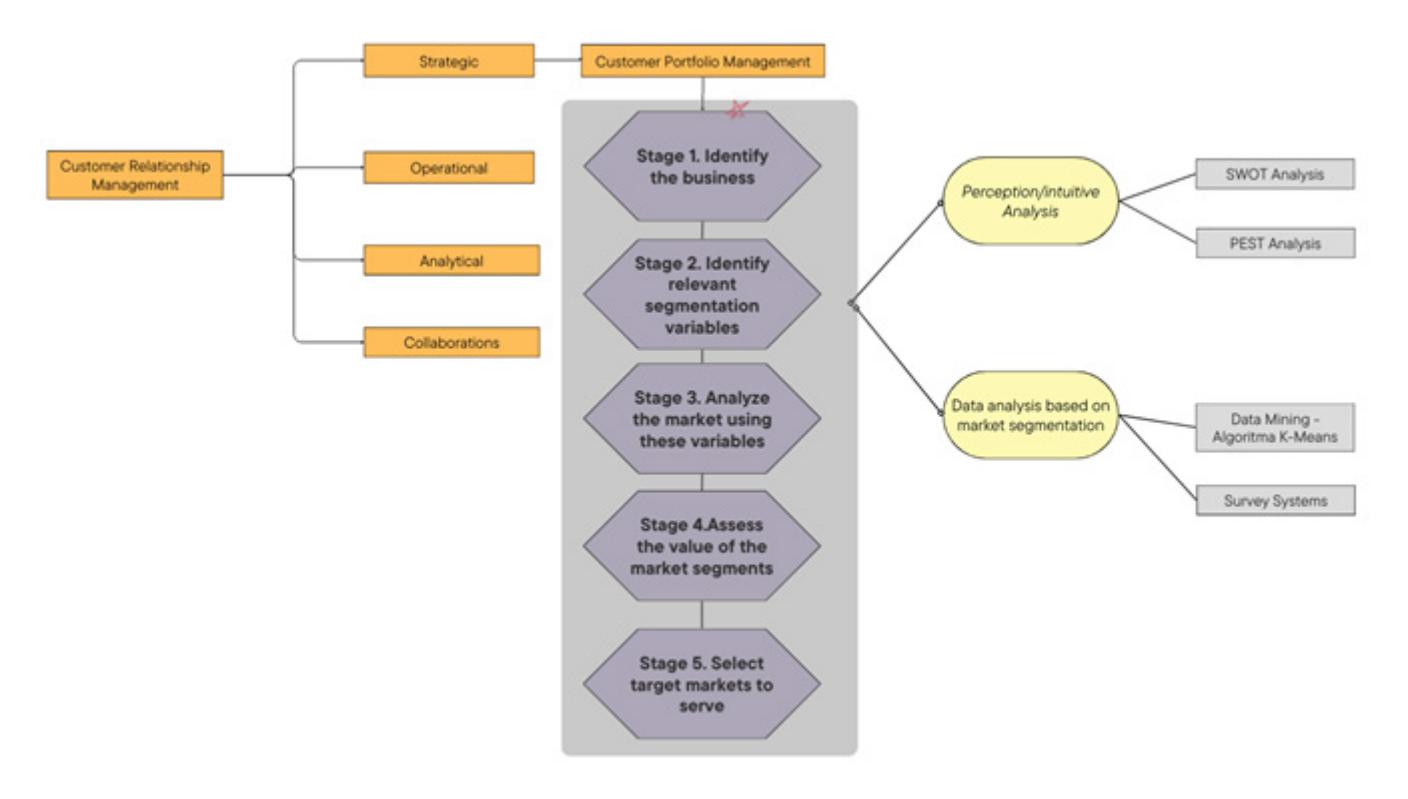
Figure 1 Research Methodology
Each stage of CPM can use several tools, which are divided into perceptual/intuitive analysis and analysis based on data analysis (Buttle & Maklan, 2015). This research uses SWOT analysis (Strengths, Weaknesses, Opportunities, and Threats) and PEST analysis (politics, economics, socio-cultural, and technology). To formulates perception analysis, it uses data mining with the K-Means algorithm, processes market surveys in the system, and develops a dashboard. Clustering using the K-Means algorithm aims to optimize the experimental similarity within clusters and maximize the dissimilarity between clusters (Tabianan et al., 2022).
In designing this system, the data needed is MSME data from the Pekanbaru City Cooperative & SME Service in .xls or .csv format, which contains registered MSME data in 2021, population data from the Pekanbaru City Central Statistics Agency, and data from questionnaires. The market segmentation grouping process is carried out using the k-means clustering algorithm, which will be processed for dashboard visualization, making it easier to understand market segmentation analysis.
Results and Discussion
This perception analysis uses the discipline of CPM to help the BrandQ application manage its customer portfolio. It is segmenting customers using CPM based on customer characteristics, behavior, and values (Edyansyah et al., 2022). This helps identify different customer groups with different needs and preferences.
Results of Perceptional Analysis
The following are the results at each stage of CPM. The first stage is business identification. The BrandQ application operates in the Android application platform business sector. The business model of the BrandQ application adopts a B2B (business-to-business) approach with influencers and a B2C (businessto-consumer) approach with MSMEs. MSMEs that have limited resources in terms of marketing and promotion or need a large internal marketing team or sufficient budget for an extensive marketing campaign so that MSMEs can take advantage of the influence and involvement of influencers to promote products and reach a broader market. MSMEs that operate in specific industries or business fields want to direct marketing campaigns more specifically. Hence, they need the BrandQ application to find influencers relevant to the MSME target market. In a B2B approach, the BrandQ application collaborates with influencers and a broad audience on various social media platforms. On the B2C side, the BrandQ application provides services to MSMEs who want to strengthen their brand and expand their reach in the consumer market. MSMEs can create brand profiles, manage content, launch promotions, and interact directly with influencers through the BrandQ platform.
The second stage is identifying relevant market segmentation variables. The variables used are geographic, demographic, psychographic, and usability attributes. Geographically, the initial BrandQ application system implementation will be planned to operate from the Pekanbaru city area, Riau, Indonesia. The BrandQ application targets areas with a population of MSMEs and regions with a low population ratio. Demographically, the BrandQ application focuses on the MSMEs segment. Small businesses have limited marketing budgets but are ambitious to increase brand visibility, want to reach a wider audience, and gain exposure through influencer marketing. Medium enterprises already have an established market share and want to improve their visibility nationally or regionally. These mediumsized businesses have larger marketing budgets and want to reach a wider audience through influencer marketing. Psychographically, the BrandQ application offers services that can provide information about influencers. The expected market segment is the match between the influencer profile and the business field to be marketed. For example, the MSMEs segment in the culinary business sector makes it possible to find culinary influencers who are interested in and know about food and can attract an audience of culinary lovers. Meanwhile, regarding usability attributes, BrandQ helps increase the number of influencer marketing uses in MSMEs by more effectively generating increased sales.
The third stage is analyzing the market, which is done by analyzing competitors who offer similar services. The results of the competitor analysis carried out can be seen in Table I. Currently, business is profit-oriented and must create intangible added value for all parties, such as employees, consumers, and society (Lestari et al., 2020). BrandQ is in a red ocean environment that operates in a highly competitive industry where many competitors each capture the same market share, so continuous market evaluation and competitor analysis become very important to identify opportunities, assess competitor strategies, and adjust customer approaches according to rapid market changes.
Table I Competitor Analysis
| Competitor | Advantages | Disadvantages |
|---|---|---|
| Sociabuzz | 1. Provide a choice of influencers with affordable rate cards. 2. Offer photography and make-up services. 3. Reaching Indonesian territory. | 1. Website based. 2. It only displays the number of followers and influencer contacts. |
| Phlanx | 1. Reach influencers from several countries. 2. Provide analysis of the development of social media influencer followers. | 1. Paid registration. |
| Lemon | 1. Provide campaign options to business owners. 2. Can manage essential aspects of awareness level in marketing. | 1. Website based. 2. You have to create a campaign first before choosing an influencer. |
| Partipost | 1. Application errors often occur. 2. Campaigns fill up quickly. 3. Some brands must pay and are not necessarily accepted. | 1. Many campaigns available 2. Easy to contact customer service if a problem occurs. 3. If an error occurs, the user will be emailed regarding the brief that needs to be revised. |
| A Team Management | 1. Provides a choice of influencers from various categories. 2. Attach the influencer's portfolio. 3. Attractive influencer portfolio display. | 1. Communication is done via email. 2. Non-transparent payments 3. The service must wait for a response from the admin |
| BFF Management | 1. Providing influencer services from various categories 2. The service is responded to directly by the admin quickly | 1. Transactions are only carried out via WhatsApp. 2. Users need a long time to find influencers according to business field and location. 3. Payments are not transparent. |
In this case, the fourth stage is an assessment of market segmentation using SWOT and PEST analyses. PEST and SWOT analyses reveal the BrandQ application development environment from external and internal areas (Hasugian et al., 2019). SWOT analysis and PEST analysis were conducted by interviewing three MSME actors and two influencers. The MSME actors interviewed represent the MSME business categories, such as small businesses (co-founder of Dibantuin.id), medium businesses (CEO of one street food Pekanbaru), and micro businesses (Jagoan Dimsum). Meanwhile, influencers are based on the number of Instagram followers and specialize in beauty and food. The results of the SWOT strategy analysis can be seen in Table II, and the results of the PEST analysis can be seen in Table III.
Table II SWOT Strategy Analysis
| Strategic | Descriptions |
|---|---|
| SO Strategic | 1. Providing services follows developments in customer interests. 2. Expand the target market. 3. Provide 24-hour service. |
| ST Strategic | 1. Develop competitive qualities. 2. Focus on customer satisfaction. 3. Arrange cooperation policies between the BrandQ Application and BrandQ Application Partners, namely influencers. |
| WO Strategic | 1. Develop the BrandQ application in line with technological developments based on customer needs. 2. Establish cooperation by collaborating with BrandQ application partners to increase customer attraction. 3. Create innovation through features in the BrandQ application according to customer needs. |
|---|---|
| WT Strategic | 1. Improve the quality of Human Resources 2. Good company administration management follows regulations imposed by the government. 3. Implementing a live chat feature on the BrandQ Application so customers can interact directly with BrandQ application partners or influencers. |
Table III PEST Analysis
| Factor | Descriptions |
|---|---|
| Politics | 1. Regulations related to online service transactions based on Law No. 7 of 2014 concerning Trade regulate all matters related to offline and online trade. Regarding online businesses, Article 65 of the Trade Law regulates the data/information online businesses provide. 2. Protection of personal data and bank account data. |
| 3. Law (UU) Number 27 of 2022 concerning the Protection of Personal Data. | |
| 4. Regulations regarding online advertising taxes. | |
| 5. The administration system determines online advertising services as Taxable Services (JKP) because this type of activity is not included in the negative list or services that are not subject to value-added tax (VAT). | |
| Economy | 1. Provide job opportunities for influencers. |
| 2. Influencer marketing is included in the category of native ads or paid content that displays the same attractive form, quality, and function as organic content created by other promotional media. | |
| 3. Increasing selling power to financially support MSMEs, as many as 70% of MSMEs in Pekanbaru will gain influence in brand awareness and sales through influencer marketing. | |
| 4. Empowering MSMEs in areas with high ratios to compete each other by bringing in customers from other regions based on sub-districts. | |
| Social | 1. Strengthen consumer behavior to follow an influencer as a reference if they want to buy something. |
| 2. There is a need for consistency in a product by using influencer marketing. | |
| Technology | 1. Reduce the circulation of paper money with digital payments. |
| 2. Reducing crimes that can be committed conventionally, such as fraud in transactions with the influencersafter making payments, but they are not responsible with the agreements they have made with the MSMEs. |
Market Segmentation Dashboard System Results
This research discusses a dashboard that displays visualizations related to the results of the CPM method analysis, which is supported by the K-Means algorithm. Data visualization can display data or information in a graphical context, such as charts, maps, or other visual formats, to make it easier to understand (Ismail et al., 2022). Based on the visualization displayed, market segmentation grouping patterns will be visible. The following is a block diagram for designing dashboard visualization in the system.
Figure 2 System Architecture
This system was built based on a website with the PHP (Hypertext Preprocessor) programming language. PHP is an open-source programming language (Tabrani & Suhardi, 2021). The system provides a ratio analysis feature between the population and MSMEs and graphs and visualizations that support market segmentation analysis. Below is additional information regarding these features:
1. Overview Page
The overview page (Figure 3) contains information regarding city segmentation, the number of MSMEs, total business fields, average turnover, and the ratio between the number of MSMEs and the number of sub-district residents in Pekanbaru.
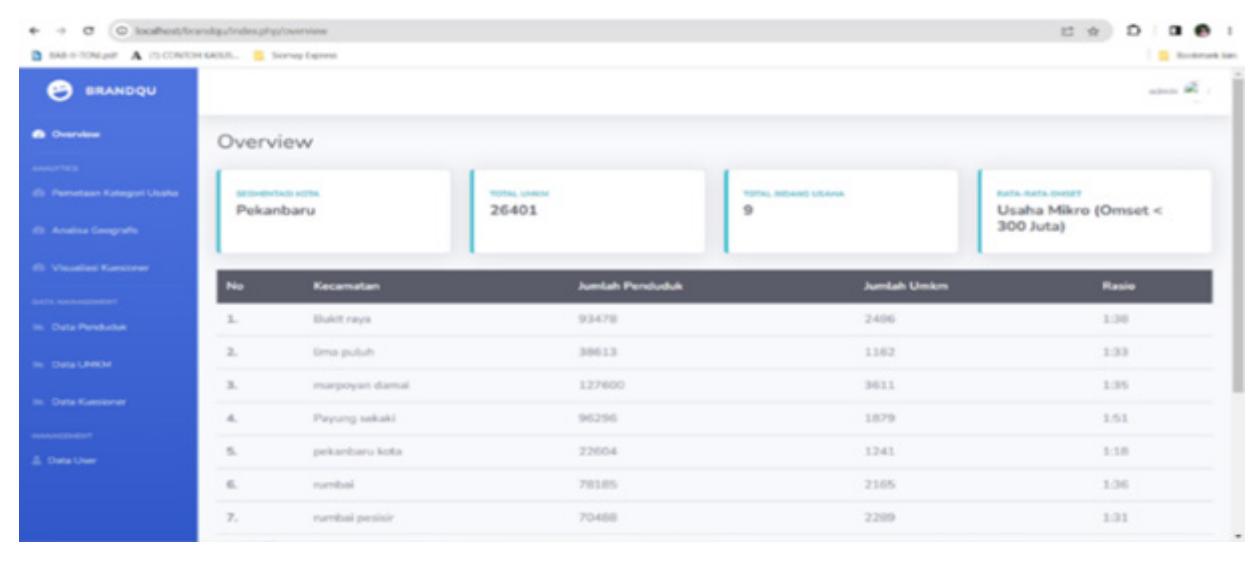
Figure 3 Overview Page
2. Analysis of the ratio between population and number of MSMEs
This system allows users to analyze the ratio between the population and the number of MSMEs in various sub-districts in Pekanbaru City. Users can view and compare these ratios to identify sub-districts with higher market potential. Furthermore, users can find opportunities to market the BrandQ application in the sub-district by carrying out a ratio analysis with the highest factors.
3. Geographical analysis graph of the distribution of MSMEs
This system presents a graph that depicts the geographical distribution of MSMEs in Pekanbaru City (Figure 4). It provides a visual understanding of the location of MSMEs in the city of Pekanbaru. Using this information, it can help users understand the distribution patterns of MSMEs, identify sub-districts with a high concentration of MSMEs, and see opportunities in certain areas.
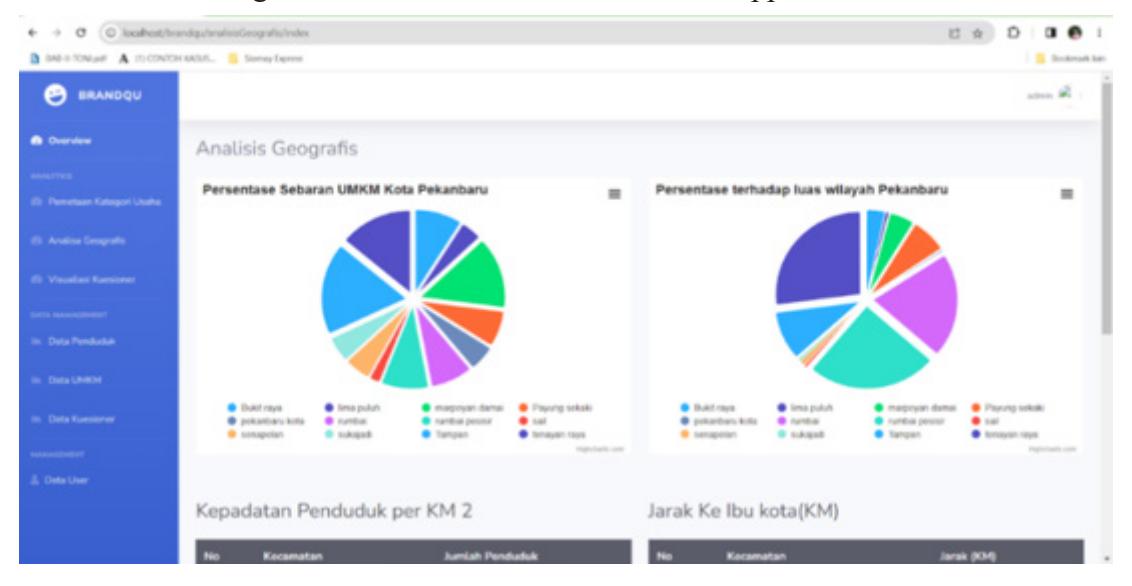
Figure 4 Geographic Analysis Page
4. Mapping graph for MSME business categories
This system uses the K-Means algorithm to map MSME business categories based on data from the Pekanbaru City SME Service (Figure 5). Based on the graph, it shows a visual overview of the most dominant business categories in Pekanbaru City. By using this information, it can help users to understand existing business profiles in Pekanbaru and can identify potential business sector opportunities to be given more attention in marketing the BrandQ application. This graph also shows the number of sub-district business categories divided into three groups: low, medium, and high. On this business category mapping page, you can filter by sub-district to see in more detail the total business sectors, population ratio, and number of MSMEs in the selected sub-district and know the number of business categories in the selected sub-district.
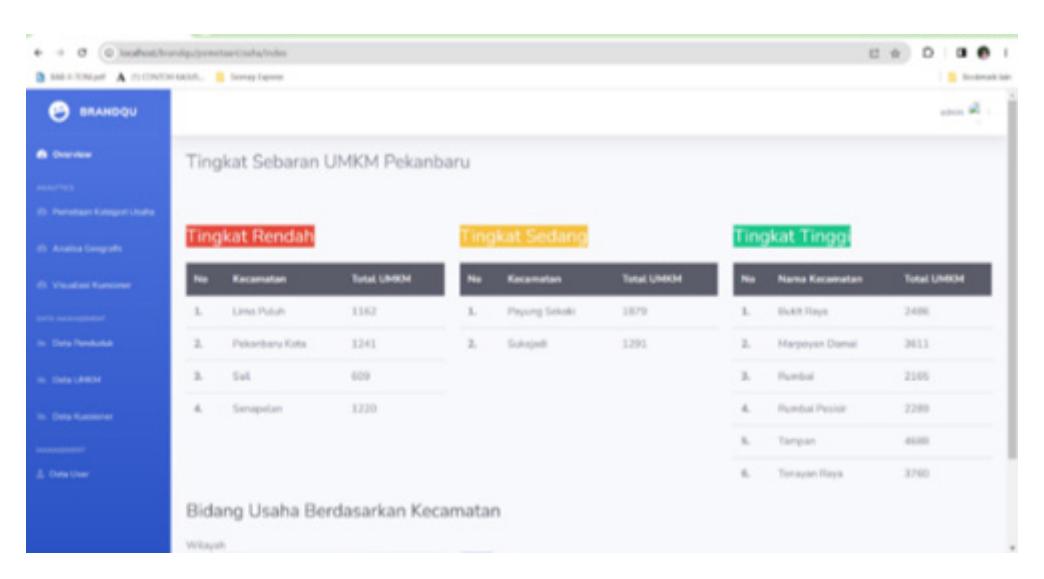
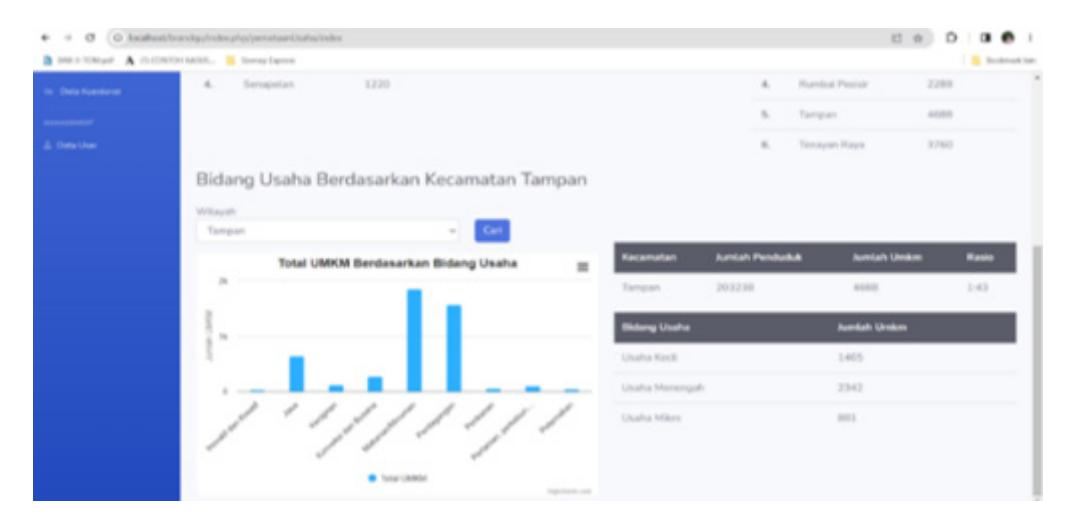
Figure 5 Business Category Mapping
5. Visualization of Questionnaires for Analysis of MSME Needs for Influencers Marketing This system also presents visualizations of questionnaires conducted on MSME actors in Pekanbaru City (Figure 6). The visualization provides an understanding of the percentage of MSMEs considering influencer marketing important for their business. This information helps users to identify how much MSMEs need influencer marketing so that BrandQ can design appropriate marketing strategies and provide added values.
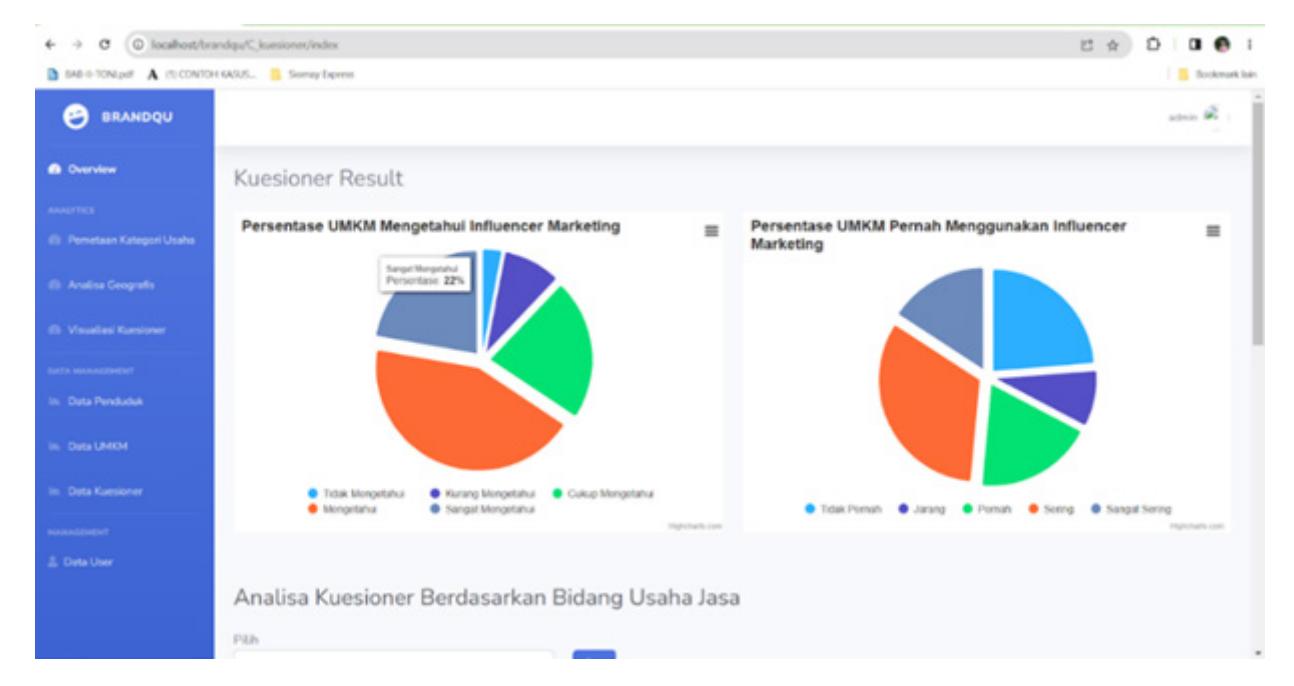
Figure 6 Questionnaire Visualization Page
The silhouette accuracy index (Silhouette Score) is an evaluation metric used to measure how well the objects in a cluster are grouped (Monalisa, 2018). This metric ranges from -1 to 1, where higher values indicate that things in that cluster are grouped well. In contrast, negative values indicate that objects may be better suited to grouping in another cluster. The accuracy of the results from the K-Means data mining algorithm in this research is 0.51, indicating that the group of objects produced by the K-Means algorithm has a reasonably good value.
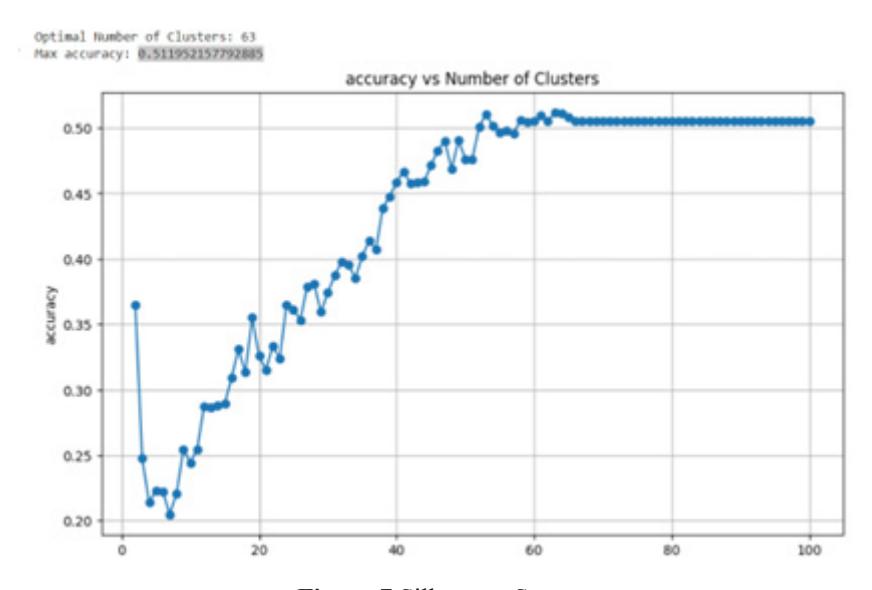
Figure 7 Silhouette Score
Data Analysis Results
Based on the results of data mining analysis using the K-Means algorithm, CPM results were obtained based on geographic, demographic, psychographic, and usability attribute variables. Based on geographical attributes, it is known that sub-districts with smaller areas, namely Senapelan, Sukajadi, Sail, Lima Puluh, and Pekanbaru, are limited in reaching more customers. So, it needs to reach a broader market than other sub-districts. MSMEs in sub-districts far from the capital are Bukit Raya, Rumbai Pesisir, and Payung Sekaki, remote areas. Influencer marketing allows access to markets that are difficult to reach physically due to long distances.
Based on demographic attributes, MSMEs located in sub-districts with low population density, namely Rumbai, Tenayan Raya, and Rumbai Pesisir, have a limited population, which means they have a limited number of potential customers. The lowest ratio factor between MSMEs and the population in Pekanbaru, Sail, and Rumbai Pesisir sub-districts indicates that the business environment in these subdistricts does not support the growth of MSMEs, and therefore, it requires a broader market reaching than other sub-districts. The distribution of MSMEs that are grouped at a high level is Bukit Raya, Marpoyan Damai, Rumbai, Rumbai Pesisir, Tampan, and Tenayan Raya, so the higher the distribution of MSMEs in the area, the higher the level of competition between MSMEs.
Based on psychographic attributes and the questionnaire results, 43% of MSMEs were aware of influencer marketing, and 3% were unaware of influencer marketing. Furthermore, according to the questionnaire results, MSMEs in Pekanbaru City issued an influencer marketing budget between 500,000 - 2,500,000 and < 500,000. This budget, between 500,000-2,500,000, shows that MSMEs have a commitment to allocate resources to leveraging the power of influencers in marketing strategy. It recognizes the value and potential of working with influencers to increase brand awareness, reach, and sales. MSMEs with this budget can look for influencers with more significant or well-known followers in the MSME business sector. A budget of <500,000 shows that MSMEs understand the importance of influencers in their marketing strategy and they still want to utilize the potential of influencers to build brands and reach target consumers. This MSME makes it possible to find influencers who have relevant followers at a more affordable price. According to research conducted by Elpanso et al. (2022), there is a link between sales promotion and brand image, brand quality, and the decision to purchase MSME products. According to Arwachyntia & Sijabat (2022), social media influencers positively and significantly influence brand image and consumers' intentions to buy products.
Based on the usability attribute, the questionnaire results show that the business sectors that often use influencer marketing are the food and beverage business sector (68%), convection and clothing (38.9%), and food (30.4%). Based on the questionnaire results, 77% of MSMEs use influencer marketing < 3 times in 1 month.
MSMEs located far from city centers may have a more limited market reach and, therefore, need social media and influencer marketing to reach a broader range of customers. MSMEs located close to the city center emphasize the benefits of their businesses being close to the city center. These can include ease of accessibility, access to potential customers, and the benefits of a thriving business environment around the city center. Explain how collaborating with local influencers can help build deeper relationships with local communities and loyal customers.
If the population ratio is low, then the BrandQ team will let MSMEs know that an influencer campaign is a long-term investment in the growth of their brand. This also can explain how the impact and visibility of this campaign can build brand awareness over time as part of your offer. This includes education about the benefits of influencer marketing and how to leverage it for business growth.
MSMEs in the micro and small business categories are offered economical prices in collaboration with micro-influencers. While the influencer's follower count may be smaller, engagement and relevance with their audience can have a positive impact. By proposing possible collaborations which involves the exchange of services or products with the influencercan reduce the cash costs incurred. Furthermore, MSMEs should consider to work with macro-influencers who have high influence and large followings to have a more significant impact. This also includes an exclusive collaboration with influencers who have high relevance to MSME products or services.
Black Box Testing is a valuable testing method to discover all the system's functions. This test is carried out to determine functional errors in the system when it is operated, whether the system can run according to its function, or whether an error occurs in the system. Based on the results of Black Box testing, it is known that all the expected functionality or output of the system is based on the results obtained.
Conclusion
Based on the CPM analysis, the BrandQ application is confident in starting its business based on several factors. CPM analysis shows that there is geographic market segmentation in Pekanbaru City, with the Tampan, Marpoyan Damai, and Tenayan Raya sub-districts having the highest ratio and a significant number of MSME distributions. This shows an excellent opportunity to market BrandQ services in these sub-districts.
CPM analysis also highlights market segmentation in the micro MSME category in the food/ beverage and fashion business sectors which shows an excellent opportunity for BrandQ to provide branding and marketing solutions specifically for MSMEs in these sectors. MSMEs tend to prefer promotion through influencer marketing rather than through brochures and thus it shows the need and interest of MSMEs in utilizing influencer marketing as a marketing strategy.
BrandQ can take advantage of this preference as an influencer marketing agency and offer relevant services. CPM analysis also revealed that as many as 3% of MSMEs did not know about influencer marketing, 9% did not know enough, 22% knew quite a bit, 43% knew, and 22% knew very well about influencer marketing. This trend shows that most MSMEs have realized and experienced the benefits of using influencer marketing. In this case, BrandQ can provide specific services and solutions according to the needs and experiences of MSMEs in terms of influencer marketing. After carrying out testing using the black box testing method, which uses a test scenario of 10 questions where the test scenario discusses the system's functionality for users, it shows that all the functionality or expected output of the system follows the results obtained. So, this test can be used as evidence that the system is running as expected.
References
- Arwachyntia, S. S., & Sijabat, R. (2022). Analisa Pengaruh Social Media Influencer dan Social Media Marketing Terhadap Brand Image Serta Dampaknya Pada Purchase Intention (Studi Kasus Pada Perawatan Wajah Pria). Jurnal Perilaku dan Strategi Bisnis, E-jurnal.Mercubuana-Yogya.ac.id., 10(1), 1–20.
- Astuti, A. M. I., & Ratnawati, S. (2020). Analisis SWOT Dalam Menentukan Strategi Pemasaran (Studi Kasus di Kantor Pos Kota Magelang 56100). Jurnal Ilmu Manajemen, 17(2), 58–70.
- Buttle, F., & Maklan, S. (2015). Customer relationship management: concepts and technologies. In Routledge Taylor & Francis Group (3rd ed.). https://doi.org/10.1201/9780203997512
- Edyansyah, T., Ahyar, J., Ilham, R. N., Chalirafi, C., & Ikramuddin, I. (2022). The Influence of Segmenting, Targeting and Positioning Strategies on Purchase Decisions at Zhalsa.Id Stores in Lhoksukon City. Jurnal Ilmiah Manajemen, Ekonomi, & Akuntansi (MEA), 6(3), 1253–1262. https://doi.org/10.31955/mea.v6i3.2540
- Elpanso, E., Helmi, S., & Lestari, A. (2022). Pengaruh Sales Promotion Terhadap Keputusan Membeli Produk UMKM Di Kota Palembang dengan Brand Image dan Brand Quality Product Sebagai Mediasi. Mbia, 21(2), 140–148. https://doi.org/10.33557/mbia.v21i2.1849
- Girsang, C. N. (2020). Pemanfaatan Micro-Influencer pada Media Sosial sebagai Strategi Public Relations di Era Digital. Ultimacomm: Jurnal Ilmu Komunikasi, 12(2), 206–225. https://doi.org/10.31937/ ultimacomm.v12i2.1299
- Hasugian, L. P., Sidik, R., Putra, Y. H., Kerlooza, Y. Y., & Wahab, D. A. (2019). Analisis Kebutuhan Sistem Informasi Pemantauan Pekerja Migran Indonesia. Jurnal RESTI (Rekayasa Sistem Dan Teknologi Informasi), 3(2), 216–226. https://doi.org/10.29207/resti.v3i2.978
- Hidayatullah, D. P., Rokhmawati, R. I., & Perdanakusuma, A.R., (2018). Analisis Pemetaan Pelanggan Potensial Menggunakan Algoritma K-Means dan LRFM Model Untuk Mendukung Strategi Pengelolaan Pelanggan (Studi Pada Maninjau Center Kota Malang). Jurnal Pengembangan Teknologi Informasi dan Ilmu Komputer, 2(8). http://j-ptiik.ub.ac.id/index.php/j-ptiik/article/ view/1769
- Ismail, N. I., Abdullah, N. A. S., & Omar, N. (2022). Exploring Alumni Data using Data Visualization Techniques. International Journal of Advanced Computer Science and Applications, 13(9), 188– 195. https://doi.org/10.14569/IJACSA.2022.0130922
- Jalal, A. N., Bahari, M., & Tarofder, A. K. (2021). Transforming traditional CRM into social CRM: An empirical investigation in Iraqi healthcare industry. Heliyon, 7(5), e06913. https://doi.org/10.1016/j. heliyon.2021.e06913
- Kundre, J, A., Wisnubadhra, I., & Suselo, T. (2013). Penerapan Customer Relationship Management Dengan Dukungan Teknologi Informasi Pada Po. Chelsy. Seminar Nasional Teknologi Informasi Dan Multimedia, 28, 7–11.
- Lestari, S. D., Leon, F. M., Widyastuti, S., Brabo, N. A., & Putra, A. H. P. K. (2020). Antecedents and consequences of innovation and business strategy on performance and competitive advantage of SMEs. Journal of Asian Finance, Economics and Business, 7(6), 365–378. https://doi.org/10.13106/ JAFEB.2020.VOL7.NO6.365
- Monalisa, S. (2018). Klusterisasi Customer Lifetime Value dengan Model LRFM menggunakan Algoritma K-Means. Jurnal Teknologi Informasi Dan Ilmu Komputer, 5(2), 247–252. https://doi. org/10.25126/jtiik.201852690
- Mulyono. (2022). Influencer Marketing Sebagai Strategi Pemasaran di Era Pandemi Covid-19. In Jurnal Web Informatika Teknologi (J-WIT (Vol. 7, Issue 2).
- Oktariana, Y., Fauzi, A., & Kumadji, S. (2012). Faktor-Faktor Customer Relationship Management (Manajemen Hubungan Pelanggan) dalam Mewujudkan Kepuasan Anggota dan Dampaknya terhadap Loyalitas Anggota (Survey pada Anggota Koperasi Nusantara Cabang Malang di Kantor Pos Besar Malang). Profit: Jurnal Administrasi Bisnis, 6(2), 149–162.
- Ong, J. O. (2013). Implementasi Algoritma K-means Clustering untuk Menentukan Strategi Marketing President University. Jurnal Ilmiah Teknik Industri, vol.12 (Juni), 10–20.
- Patil, M. Y. (2014). Social Media in Customer Relationship Management. IOSR Journal of Business and Management (IOSR-JBM), 173–180.
- Peppers, D., & Rogers, M. (2004). Managing Costumer Relationships: A strategic framework. in Mechanical Engineering.
- Saputra, R. S. (2023). Analisis Manajemen Usaha Mikro Kecil dan Menengah (UMKM) dalam Meningkatkan Minat Konsumen Studi Kasus Wardomie X Warunk17 Pekanbaru Ditinjau dari Perspektif Ekonomi Universitas Islam Negeri Sultan Syarif Kasim Riau-Pekanbaru 1444 H / 2023 M.
- Soliman, S. H. (2011). Customer Relationship Management and Its Relationship to Marketing. International Journal of Business and Social Science, 2(10), 166–182.
- Tabianan, K., Velu, S., & Ravi, V. (2022). K-Means Clustering Approach for Intelligent Customer Segmentation Using Customer Purchase Behavior Data. Sustainability (Switzerland), 14(12), 1–15. https://doi.org/10.3390/su14127243
- Tabrani, M., Suhardi, H. P. (2021). Sistem Informasi Manajemen Berbasis Website pada Unl Studio dengan Menggunakan Framework Codeigniter. Jurnal Ilmiah M-Progress, 11(1), 13–21. https:// doi.org/10.35968/m-pu.v11i1.598