

INFO ARTIKEL
Kata kunci:
batik, belajar, canting, gerak tangan, motion capture
ABSTRAK
Keterampilan membatik merupakan suatu aktivitas yang diwariskan secara turun temurun dari generasi ke generasi secara lisan. Pendokumentasian aktivitas membatik dengan canting menggunakan alat motion capture menghasilkan data pola gerak pembatik secara akurat dalam bentuk digital. Tujuan penelitian ini adalah mengidentifikasi gerak tangan pada kegiatan membatik dengan canting sebagai dasar pembelajaran membatik secara tradisional bagi para pemula. Penelitian ini diawali dengan pendekatan etnografi, yaitu observasi dan wawancara ke beberapa rumah batik di daerah Jawa Tengah. Kemudian dilanjutkan dengan eksperimentasi di laboratorium Ergonomi ITB. Melalui analisis motion capture, diketahuilah dalam melakukan aktivitas membatik dengan canting, seorang pembatik menghasilkan sebuah pola gerak tangan yang khas yang kemudian diistilahkan dengan kata Pola Layangan. Pola Layangan ini merupakan sebuah siklus yang terdiri atasi empat buah fase, yaitu Fase Malam Panas, Fase Tiup, Fase Gambar dan Fase Akhir. Dokumentasi digital terhadap pola gerak tangan pembatik dapat dijadikan acuan dalam mempelajari aktivitas membatik dengan canting sebagai dasar pembelajaran membatik secara tradisional bagi para pemula.
Introduction
Etymologically, the art of batik can be described as a collective art using wax-resist dyeing a piece of fabric using malam or hot wax by one practiced artisan or a group of practiced artisans (Kudiya, 2019). During the batik-making process, the artisans require a variety of equipment, including mori fabric, canting (a small copper cupped spout with a wooden or bamboo handle), a cap, malam (hot wax), gawangan (a traditional hanger to place the fabric on), a small stool, and a stove to heat the wax (malam). Canting is the most critical tool, especially for traditional hand-drawn batik. Canting comprises a malam container made of copper, a spout from which the hot wax comes out, and a handle made of bamboo or wood, which does not conduct heat (Hasanudin, 2001). The types of canting vary depending on the functions to draw on the fabric (Lewis, 1921), and usually, the spout makes one type of canting differ from another. The spout has the form of a small pipe facing downward with different tips. For example, some canting has a small tip to draw fine lines. Another type of canting uses a larger tip to create bolder lines, while a smaller tip is necessary to create dots or different lines. Europeans interested in Indonesian culture have studied batik and its processes for years.
Since UNESCO recognized batik as a masterpiece of humanity's oral and intangible heritage in 2009, various levels of Indonesian society have contributed to its preservation. Furthermore, this preservation effort can reach new heights with technology. Widyasari et al. (2017) introduce the Batik Fractal software in an effort to preserve batik designs and patterns. The software allows for the digital redrawing and modification of batik patterns. Electric canting, stoves, and dipping tools, among other batik-making tools, have also undergone modification.
Several studies have learned how artisans utilize the tools, especially the modified ones. For example, the most effective working layout for a group of batik artisans is sitting in a circle with the stove at the center. While they are working, they can interact intensively, share malam from the stove, and perform their job (Widyasari et al., 2018). Interaction between artisans and adapting specific postures, such as shifting the position of their feet, are some of the compensations they make. Another study finds that they modify the dipping tools by raising the platform around 75 centimeters to ease dipping their canting. (Widyasari, Sachari, Sriwarno, & Adhitama, 2020). The within-reach distance between the stools they sit on, the stove, and their postural comfort help them to work more productively. This is based on the theory of personal space (Sommer, 2007) and proxemics (Hall, 1990) introduced earlier about the compositional layout of a person sitting down.
Central Java is the center of batik production in Indonesia, meaning the province is also the most significant center of the batik industry globally. The coastal region of Java produces Pesisiran batik, while the inland region of the province produces Pedalaman batik or Keraton batik (Ishwara et al., 2012). Pekalongan and Lasem, located in the coastal area of Central Java, and the Surakarta region, influenced by Keraton Surakarta (Surakarta Palace), are notable regions in Central Java known for their distinctive and unique batik patterns. Traditionally, these three regions' batik was known as Batik Tiga Negeri, or Batik of the Three Lands. Its fabric boasts three specific colors—brown or sogan from Surakarta, blue from Pekalongan, and crimson from Lasem (Ishwara, 2013). Lasem is a region that still maintains the tradition of producing Batik Tiga Negeri. This study will use several batik studios in Pekalongan, Lasem, and Surakarta as the objects for the case studies. Oey Soe Tjoen Batik Studio in Kedungwuni, in the south of the city of Pekalongan, is a batik studio that produces the best batik peranakan in Indonesia (Liong, 2014). Batik Peranakan from Oey Soe Tjoen demonstrates strong work ethics as the result of the acculturation between Chinese and Javanese descents and cultures. The result is a high-quality batik with beautiful details and coloring. Go, Tik Swan is a batik studio in Surakarta assigned by Indonesian First President Ir. Soekarno to come up with a batik design that combined batik pesisiran and batik pedalaman, and Batik Indonesia is the result of this endeavor (Wronska-Friend, 2016). Batik from this studio features specific characters from coastal and Javanese cultures. On the northern coast of Java Island, Lasem is known as Acculturation Town. As the name suggests, Lasem batik is rife with acculturation between
Chinese and Javanese cultures. Maranatha Batik Studio is another traditional Lasem studio still going strong, producing Batik Tiga Negeri.
Figure 1 The Circular Layout at Go Tik Swan Batik Workshop Source: Widyasari, 2018
The government and the Indonesian public have always supported preserving the art of batik and batik-making. One form of support is giving awards to batik artisans, industry players, and preservation activists. In addition, many batik workshops are now being run, teaching the art to batik enthusiasts and the young generation. As a result, children can now learn about batik and how to make it. There are at least seven locations where people can learn the art of batik: the Textile Museum in Jakarta, the Batik Museum in Pekalongan, the Palbatu Batik Village in Jakarta, the Laweyan Batik Village in Solo, the Giriloyo Batik Village in Yogyakarta, the Batik Village in Semarang, and the Komar House of Batik in Bandung. This is how the preservation process happens.
With the world in the grip of a pandemic, is there a way to learn the craft remotely? One way to achieve this is by incorporating audio-visual media, such as tutorial videos for batik students, into the curriculum (Endriyani, 2015). Using this method, students can better observe the process by looking into the details and repeating specific parts if necessary. Improving batik-making skills in a region has boosted regional income and lowered the unemployment rate (Sumarsih et al., 2017). The same documentation method explores the students' level of thought and fitness through observation, video recordings, and photos supported by a literature study, questionnaires, and journals (Suhadi et al., 2020). Using this method, the researcher can evaluate the competence of PE teachers at the elementary school level. This documentation process has become the basis for further study to provide a reference for beginner learners of traditional batik art.
We have previously introduced the use of motion capture in documenting movements. One example of this method is capturing dancers' movements to learn the interaction in various types of dance, particularly ballet, contemporary dances, flamenco, and Greek folk dance (Camurri et al., 2016). Tommi & Marc R., 2011 also used motion capture to determine whether cultural blends were present in dance rhythms or movements. Another example is the Indonesian culture preservation project documenting the Silat Tuo Minangkabau movements (Nuriman, 2018). In short, this study aims to document the movements and behaviors of batik artisans at the three batik studios in Pekalongan, Surakarta, and Lasem. We used the three batik studios to comprehensively represent traditional batik preservation.
Method
This study used several ethnographic approaches to observe the artisans' daily work activities and interactions. The phases were as follows:
Field Observation
This involved observing batik artisans' behavior in the traditional batik studios in Central Java, namely Oey Soe Tjoen, Maranatha Ong's Art, and Go Tik Swan batik studios. It was done in the canting workstation area in the workshop and the artisans' homes. The observation was done in stages, from April 2017 to March 2020. The observation of the behaviors used the time and motion study method (Wignjosoebroto, 2003) with the help of three cameras. The cameras recorded videos and captured visuals in 3600 and recorded data of the movement to another workstation in a batik workshop. Through the audio-visual data collected by the three cameras, observers could better watch the process of making batik with canting and the actions and behavior of the batik artisans.
Data on the behavior was observed and analyzed based on time units. There were three cycles in this data analysis: initial, middle, and final cycles. The initial cycle was a period that happened and was observed in the first minutes when the artisans did their work. The mid-cycle refers to the period that happened and was observed when the artisans performed their jobs. The final cycle was when the artisans entered their final observation phase. The cycles were determined based on the efficient working time for the artisans, namely, two hours before the lunch break or two hours after the lunch break. This efficient time was established following the initial study conducted at the Oey Soe Tjoen studio, from around 08:30 in the morning until 04:00 in the afternoon.
Ergonomic Participatory
The next phase was ergonomic participation (Hendrick & Kleiner, 2001). In this phase, the researcher participated in the batik-making process at one of the studios, Oey Soe Tjoen Batik Studio. The researcher worked at a canting workstation, using the same tools the batik artisans used, shared malam from the same stove, and experienced the same environment and work hours. This ergonomic participatory phase became the basis for reconstructing the work using canting in the ergonomic laboratory.
Experimentation
The experimentation phase in the ergonomic laboratory used the motion capture device from Qualisys, and the data was analyzed using Qualisys Track Manager (QTM). The experiment was done in two phases, and in each phase, data were collected. The equipment used is similar to that used at the case study locations, except for the gawangan and stove. For the experiment, gawangan was made of bamboo with an adjustable height. This was to adjust the height of the study's subjects to their work area. The stove in the experiment was an HSE-approved electric stove for working in a laboratory. The experiment used a healthy subject with basic knowledge of using canting according to the previous ergonomic participatory phase and used a motion capture device.
The experiment began by attaching reflective markers to several points at the initial measuring points, which were attached to both the device and the subject's body. Reflective markers were captured by eight infrared cameras and a video camera. All of them were integrated. They produced data on the coordinate shifts of the X, Y, and Z axes (Qualisys, 2018). The markers attached to the subject's parts of the body whose movements the researcher wanted to observe are shown in the following figure:
Figure 2 Reference for Marker Placement on The Subject's Body Source: Cappozzo, Catani, Della Croce, & Leardini, (1995); van Sint Jan, (2007)
The marks on the head, neck, and shoulders were used to detect the movement of the head and upper body, on the right part of the body, which handled and actively used canting, and on the right foot, which was not covered by the batik fabric. Based on the first and second stages of the experiment, the markers were attached to the following points:
- 1. Glabulla (SGL)
- 2. Right just above the ear (R_HEAD)
- 3. Left just above the ear (L_HEAD)
- 4. Cervical Vertebrae (CV7)
- 5. Right Scapula Acromial Edge (R_SAE)
- 6. Left Scapula Acromial Edge (L_SAE)
- 7. Right Humerus Lateral Epicondyle (R_ HLE)
- 8. Left Humerus Lateral Epicondyle (L_ HLE)
- 9. Right Radius Styloid Process (R_RSP)
- 10. Right Ulna Styloid Prosess (R_USP)
- 11. Right Basis of Forefinger (R_HM2)
- 12. Posterior superior iliac spine (IPS)
- 13. Right anterior superior iliac spine (R_IAS)
- 14. Left anterior superior iliac spine (L_IAS)
- 15. Right lateral epicondyle (R_FLE)
- 16. Right lateral prominence of the lateral malleolus (R_FAL)
- 17. Right medial prominence of the medial malleolus (R_TAM)
- 18. Dorsal margin of the first metatarsal head (R_FM1)
- 19. Axis near the stove
- 20. At gawangan (six points)
- 21. At stool (four points)
- 22. At the fabric
- 23. At front and back canting
The movements, especially on the hands, were observed, and the researcher tried to recognize the pattern to understand the subject's behavior when he or she was working with canting. The marker on the front canting served as a reference point, allowing the researcher to observe the working envelope of the resulting movement pattern.
The first experiment focused on layout. The objective of the experiment was to establish a connection between the tool arrangement and the batik-making process, utilizing canting and the subject's movement throughout the process. The researcher tried two layouts in the experiment: Layout A and Layout B. Both had different orientations. The difference in orientation was necessary to understand the connection between the position of the tools and the outcome of the hand movement pattern. The figure below clearly illustrates the difference.
Figure 3 Layout A and B Source: Widyasari, (2018)
The subject was asked to make movements consisting of four phases, namely:
- 1. Phase 1 (hot wax phase): Getting malam with canting is the initial phase in the hand-drawn batikmaking process. This phase starts with the hand movement above the stove's hot wax. Then, the hand scoops some Malam using canting and brings the canting toward the subject.
- 2. Phase 2 (blowing phase): The phase of blowing canting contains hot wax. The hand holding the canting moves from the stove to the subject and stops at a point close to the subject's mouth. The subject then blows the tip of the canting containing hot wax, or Malam. In this phase, the subject wants to lower the temperature of the wax so it will not drip easily. Then, the hand moves toward the fabric on the gawangan.
- 3. Phase 3 (drawing phase): This is where canting touches the starting point of the batik pattern on the fabric. The artisan draws on the fabric using canting with hot wax as the "ink."
- 4. Phase 4 (finishing phase): This is where canting for the last time touches the fabric, as Malam in the canting is almost gone, and the hand that holds the canting moves back toward the stove.
- 5. Phases one through four create a cycle. This cycle repeats until the work is done.
Results and Discussions
This part starts with the result of the field observation, followed by the result of the ergonomic participatory method, and then the result of the experiments in the ergonomic laboratory. Following the explanation of the results is the discussion based on theories introduced in the introduction part.
Results
The following is a description of the results of the study, starting from the field study to the experiment phase:
Ethnography through the observation of the batik artisans' behavior at the canting workstation The observation was made on batik artisans working at the canting workstation in Oey Soe Tjoen, Maranatha, and Go Tik Swan batik studios. The data analysis used the micromotion study method. Using the method, the researcher analyzed their movements and behavior when they are working on the predetermined cycles. The cycles may vary depending on the adequate time of each artisan when the artisans are working and are divided into three: the initial cycle, mid-cycle, and final cycle, and are described in Table I:
Table I The Hand Movement Patterns of Batik Artisans from Field Research Observations
| Data Collecting | ||||
|---|---|---|---|---|
| Subject | Initial Cycle | Middle Cycle | Final Cycle | Description |
| 1. | Location: Workstation canting batik Oey Soe Tjoen Task: Correction | |||
| 2. | Location: Batik Artisan's House (subject 2) Task: Ngiseni | |||
| 3. | Location: Batik Artisan's House (subject 3) Task: Ngiseni | |||
| 4. | Location: Workstation canting batik Maranatha Task: Ngiseni | |||
| 5. | Location: Workstation canting batik Maranatha Task: Nemboki | |||
Source: Widyasari, (2018)
From the observation, using the micromotion method, it was learned that the view was limited when monitoring the artisan's movements due to the lack of a camera viewpoint.
Subjects 1, 2, and 3 were batik artisans from the Oey Soe Tjoen batik studio (OST). Artisan 1 worked with canting at the workstation in the OST workshop, while artisans 2 and 3 worked at their respective homes. During the data collection period, they worked independently. Artisan 1 corrected the canting work before she started the dipping process. The correction process involves meticulous work across the entire surface of the fabric to ensure the desired outcome. This is why hand movement on the fabric only happens in small areas. This resulted in a triangle-shaped hand movement pattern. Subject 2 was a batik artisan with a high level of skill. The type of work she was engaged in was ngiseni, in which an artisan fills the empty spaces on the fabric with dots or specific motifs using the smallest size of canting. This type of work requires high concentration and precision. Thus, the hand movement on the fabric is minimal. The resulting hand movement pattern is also in the form of a triangle. Subject 3 experienced a similar outcome. When the batik artisan was creating ngiseni, the hand movement pattern, specifically a triangle pattern, tended to remain consistent.
Subjects 4, 5, and 6 were batik artisans from the Maranatha batik studio. They worked simultaneously at a canting workstation in the studio's workshop. Subject 4 worked on ngiseni, a detailed task that required the smallest canting. Subject 4 produced the same pattern as subjects 1, 2, and 3, forming a triangle. Subject 5 worked on the nemboki, covering the fabric with large canting before coloring it. Subject 5 was not engaged in the blowing phase because the malam used for the nemboki had a different quality than ngiseni or nglowongi. Therefore, the hand movement pattern was not a triangle but looked like two straight and almost parallel lines. As a result, the movements on the fabric were more accessible and covered a wider area than ngiseni. Subject 6 molani worked with medium-sized canting. The artisan usually uses canting to draw a pattern or even draws directly on the fabric. This skill is ordinary among
artisans in Lasem. Subject 6 followed the same pattern as the previous subjects, resulting in a triangleshaped hand movement pattern. Subject 7 did nglowongi. In klowongan, an artisan uses medium-sized canting to draw outer lines following the pattern. Subjects 4, 6, and 7 also made the triangle pattern.
Subjects 8 and 9 were batik artisans from the Go Tik Swan batik studio. They did different kinds of work, such as ngiseni and nemboki, so they used different malams. At Go Tik Swan Batik Studio, the two types of malam were placed in different pans and on different stoves. Subject 8 worked separately from other artisans at one canting workstation because she was doing nemboki using malam with a quality that was different from the malam used by other artisans. Similar to Subject 5, in nemboki, an artisan used canting with a big spout and did not go through the blowing phase. That is why the hand movement pattern resulted in two almost parallel lines. Subject 9 did nglowongi using medium-sized canting. Subject 9 followed the same phases as other subjects; however, the triangle movement pattern was not visible because of the limited camera angle during the documentation.
From observing the artisans in three different batik studios, we learned that those doing nemboki worked with big-spouted canting and did not go through the blowing phase. So, the hand movement pattern resulted in two almost parallel lines. These came from the hand movement from the starting point at the stove to the fabric and directly back to the stove. Meanwhile, artisans who worked with small-spouted canting usually needed to blow the canting (the blowing phase). That is why they made a triangle-shaped hand movement pattern different from the pattern made by the previous artisans.
Ergonomic Participatory at Oey Soe Tjoen Batik Studio
Before working in the ergonomic laboratory, the researcher needed to complete the ergonomic participatory phase to further study the hand movements of the artisans. The experiment asked the subjects to replicate the batik-making activities they had learned at the Oey Soe Tjoen batik studio. The subjects learned to use the batik-making tools, notably canting, copying the movements and habits of the artisans in the studio. They performed the activities in the same room as the artisans without interfering with the production process, and they acquired the basic skills of working with canting practiced in the studio.
Experiment and Reconstruction of the Batik-Making Movements using Canting in the Ergonomic and Human Factor Laboratory, Bandung Institute of Technology
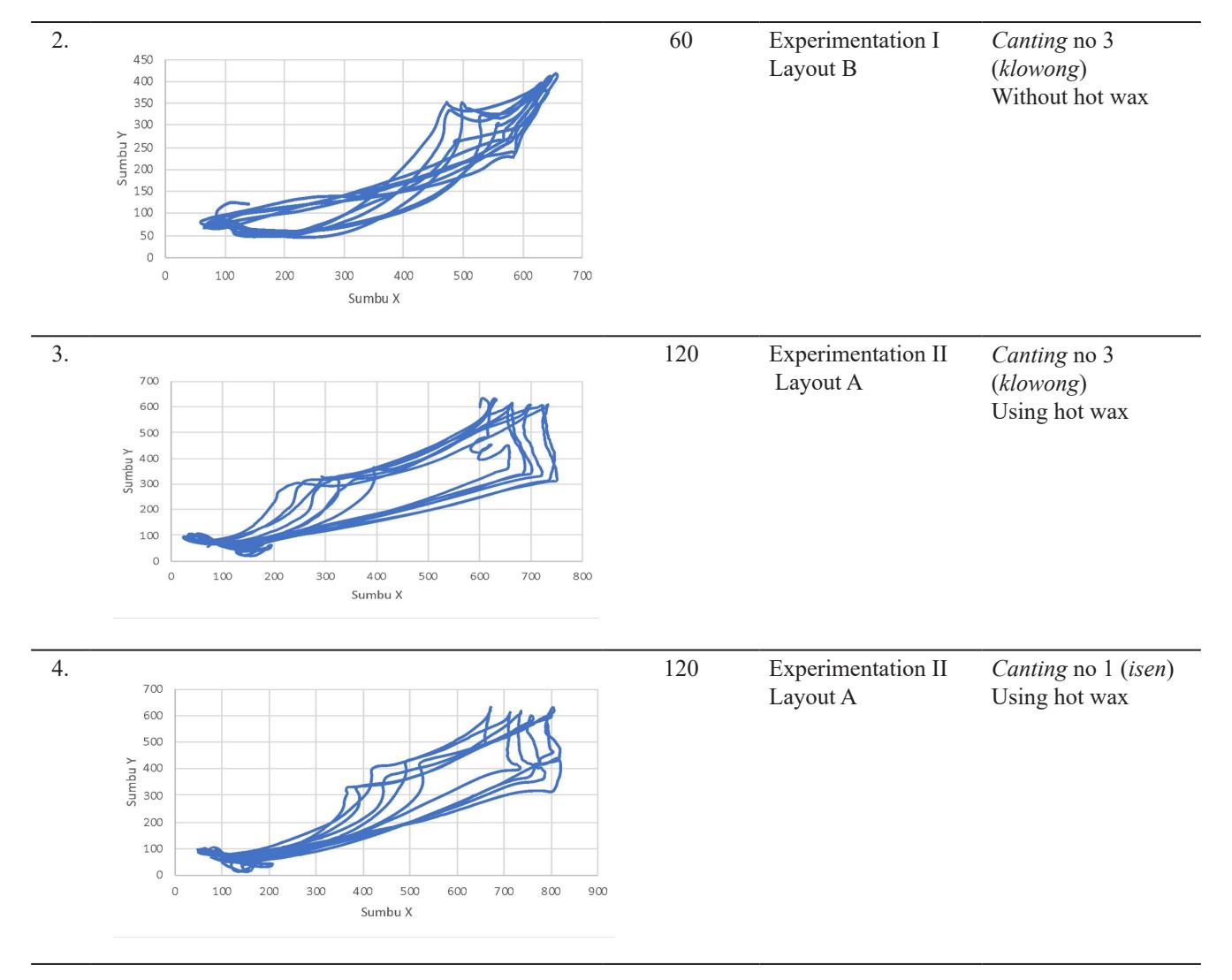
Following the ergonomic participatory stage, the subjects proceeded to the movement reconstruction stage, where they experimented with canting and manipulated the tools and layout within their workstations. Based on the first and second experiments using the motion capture system, the patterns from the movement of the front canting dots produce the displacement data. The data shows the movement of canting, measured starting from the origin point (0.0) on the X and Y axes. These axes represent the coordinate points used to measure the distance generated from the canting movement. The measurement also ends at the origin point, as shown in the following (Table II).
Table II The Hand Movement Patterns of Batik Artisans from Field Motion Capture Tool No. Hand Movement Chart Duration (second) Layout Experimentation Tool Experimentation 1. 60 Experimentation I Layout A Canting no 3 (klowong) Without hot wax
Source: Widyasari, (2018)
The experiments used different tools and layouts, layout A and layout B, with several different variables, from the time of data collection to the use of both canting and hot wax (malam). In the first data collection, the hand movement pattern started from the stove toward the blowing point or position, stopped at the initial point on the fabric, and moved toward the final point before moving back toward the stove as the starting point to get more malam. This pattern repeated itself to create a cycle. The first data collection produced six complete cycles in 60 seconds. The graph shows the shift in the blowing point because the subject's head moved during the blowing phase.
The second data collection resulted in a different hand movement pattern with the same number of cycles in 60 seconds. The movement pattern was different because of the different layouts applied. The third data collection used the same layout as the first data collection (layout A). That is why the result of the hand movement pattern tended to be the same. The difference was in the location of the blowing spots. The blowing spots shifted because the subject's head moved during the experiment. The number of cycles in the third experiment was also six, but the time was twice that of the first and second experiments (120 seconds). In other words, using malam affected the speed of hand movement. The fourth data collection resulted in a hand movement pattern similar to the one from the first and third, with the blowing spots shifting because of the subject's body movement. The significant difference from the previous data collection was the number of cycles; the number of cycles in the fourth data collection was five. This was due to the use of hot malam in a smaller-sized canting, usually used in ngiseni work.
From the hand movement patterns recorded, it appeared that the pattern from the same layout (layout A) produced the form of graphs, which was almost similar, as seen in the hand movement graphs numbers 1, 3, and 4. However, from layout B, the graph—the hand movement graph number 2—was different. Nevertheless, both graphs still showed the same pattern. A significant difference was seen at the blowing spots, which shifted because the subject's head moved.
If the hand movement when doing the batik-making activities is seen from above (bird's eye view), we will see a specific movement pattern, which creates a cycle as shown in the following figure:
Figure 3 Layout A and B Source: Widyasari, 2018
The canting movement was formed at varying distances but with a similar curve pattern. The length of the phase-I curve was determined by the distance between the stove and the subject's position. The distance between the subject and the fabric (media) determined the Phase-II curve. The length of the phase III curve was determined by the length of the lines made on the fabric. Finally, the length of the phase IV curve was determined by the distance from the last point on the fabric to the stove. This four-sided shape formed from these four phases is called Pola Layangan. The shape of Pola Layangan will greatly depend on the layout arrangement of the canting workstation, the placement of tools and equipment, the anthropometry and posture of the batik artisan, as well as the task being performed on the fabric.
Discussions
Analysis of data collected from observing the movements and behavior of the artisans in the three batik studios shows. The results show that the movements and behavior of artisans when working with canting depend on the type of work and habit of each artisan. For the data collection, the subjects were professional batik artisans with dozens of years of experience in the craft and who have produced highquality batik. Furthermore, the subjects used for the experiment in the ergonomic laboratory went through the ergonomic participatory phase in the Oey Soe Tjoen Batik studio. The subjects reconstructed the movements of the artisans and worked with batik-making tools, especially canting. They also learned the method of batik-making using klowongan and ngiseni techniques.
During the experiment phase, the subjects reconstructed the movements learned in the previous phase to gather digital data, one of which was displacement. The analysis results in a hand movement pattern, known as the kite pattern or Pola Layangan. Other factors that influenced this pattern are the layout of the tools, anthropometry, body position, and the work done on the fabric. Therefore, the documentation method using motion capture technology can identify the movements based on their type of work, such as molani, nglowongi, ngiseni, or nemboki, and each generates different patterns but with the same cycle (Camurri et al., 2016). Moreover, the method can identify the different habits of the artisans when they are working (Tommi & Marc R., 2011). For example, the difference was whether an artisan included the blowing phase or replaced the phase with the drawing phase with canting on the fabric on her lap.
The motion capture method is expected to document other processes of making traditional crafts, such as woven clothes, woven crafts, and sculptures, to help preserve the culture and educate the next generation (Nuriman, 2018).
Conclusion
This is an initial study through which the researcher wanted to introduce a method of learning a work process, which in this case is the art of hand-drawn batik using canting with the help of motion capture equipment. The method allows for the scientific identification of the hand movement pattern during the production of hand-drawn batik. The collected data, specifically the direction and pattern of movement, are cinematic. The specific pattern is essential information, as it helps us understand the best way to create batik. Nevertheless, there are numerous ways we can enhance the data collection process through the use of equipment. For instance, data on speed and displacement can serve as a foundation for measuring the productivity of batik-making processes through canting and determining the required area.
The limitations found in this study were the number of subjects involved in the experiments, the types of canting used in the process, and the variety of tasks the subjects needed to perform. We can use the same method for further study to identify the movements in other traditional arts like woven fabric, woven crafts, and sculptures, ensuring thorough documentation of the work process that creates these cultural heritages. Finally, the researcher hopes that all stakeholders involved in culture preservation, craftsmanship, anthropology, and design can use and benefit from this study's results.
Acknowledgement
We would like to express our sincere gratitude to Ibu Widianti Wijaya from Oey Soe Tjoen Batik, Ibu Renny Priscilla from Maranatha batik and Ibu Supiyah from Go Tik Swan batik for their guidance and mentorship throughout the project. Their expertise and insights have been invaluable in shaping the direction of our work. We are also grateful to all lecturers and staff in the Ergonomic and Human Factors Lab, Bandung Institute of Technology, for their technical assistance and support in various aspects of the research. Their expertise greatly facilitated the execution of experiments and data analysis.
References
- Camurri, A., El Raheb, K., Even-Zohar, O., Ioannidis, Y., Markatzi, A., Matos, J. M., … Whatley, S. (2016). WhoLoDancE: Towards a methodology for selecting Motion Capture Data across different Dance Learning Practices. ACM International Conference Proceeding Series, 05-06-July, 1–2.
- Cappozzo, A., Catani, F., Della Croce, U., & Leardini, A. (1995). Position and orientation in space of bones during movement: Anatomical frame definition and determination. Clinical Biomechanics, 10(4), 171–178.
- Endriyani, E. (2015). Upaya meningkatkan ketrampilan mencolet dan hasil belajar membatik melalui model pembelajaran Contextual Teaching and Learning berbantuan video. Scholaria: Jurnal Pendidikan dan Kebudayaan, 5(2), 36-45.
- Hall, E. T. (1990). The hidden dimension. New York: Anchor Books, a Division of Random House Inc.
- Hasanudin. (2001). Batik pesisiran: melacak pengaruh etos dagang santri pada ragam hias batik. Kiblat Buku Utama.
- Hendrick, H. W., & Kleiner, B. M. (2001). Macroergonomics: An introduction to work system design. Human Factors and Ergonomics Society.
- Ishwara, H. (2013). Benang raja. Kepustakaan Populer Gramedia.
- Ishwara, H., Yahya, L. R. S., Moeis, X., & Rambe, A. (2012). Batik Pesisir: An Indonesian heritage: collection of Hartono Sumarsono. Kepustakaan Populer Gramedia.
- Kudiya, K. (2019). Kreativitas dalam desain batik. ITB Press.
- Lewis, G. C. (1921). First lessons in batik: a handbook in batik, tie-dyeing and all pattern dyeing. The Prang company.
- Liong, W. K. H. (2014). Oey Soe Tjoen: Duta Batik Peranakan. Kementrian Pariwisata Republik Indonesia dan Red & White Publishing.
- Nuriman, H. (2018). Gerak digital Silat Tuo Minangkabau melalui pemanfaatan teknologi motion capture. The Journal of Society & Media, 2(2), 109-120.
- Qualisys. (2018). Analyzing gait with Qualisys, 1–4. Retrieved from https://cdn-content.qualisys. com/2020/04/PI_Gait_Module.pdf
- Sommer, R. (2007). Personal space. The Behavioral Basis of Design. ERIC.
- Suhadi, S., Soegiyanto, S., Rahman, H. A., & Sulaiman, S. (2020). Evaluation of the bodily-kinesthetic intelligence model in physical education teaching in Indonesia Primary School. Jurnal Cakrawala Pendidikan, 39(2), 471–479.
- Sumarsih, U., Arifin, D. H. Y. S. S. M., & Julius, D. H. H. J. (2017). Kegiatan belajar membatik merupakan potensi tambahan penghasilan bagi masyarakat Desa Wisata Giriloyo, Kecamatan Imogiri, Kabupaten Bantul Daerah Istimewa Yogyakarta. Retrieved from http://repository.unpas. ac.id/id/eprint/29084
- Tommi, H., & Marc R, T. (2011). Learning and synchronising dance movements in South African songs- -cross-cultural motion-capture study. Dance Research, 29(supplement), 305–328.
- van Sint Jan, S. (2007). Color atlas of skeletal landmark definitions e-book: guidelines for reproducible manual and virtual palpations. Elsevier Health Sciences.
- Widyasari, R. K., Sachari, A., & Sriwarno, A. B. (2017). Peranakan Batik Oey Soe Tjoen; Cultural heritage conservation in the age of technology and information. International Journal of Multidisciplinary Thought, 06(02), 143–149.
- Widyasari, R. K., Sriwarno, A. B., & Adhitama, G. P. (2018). The analysis of centralized layout on traditional batik tulis workshop in Central Java. In The Asian Conference on Arts & Humanities 2018 Official Conference Proceedings. Retrieved from http://papers.iafor.org/wp-content/uploads/ papers/acah2018/ACAH2018_40314.pdf
- Widyasari, R. K., Sachari, A., Sriwarno, A. B., & Adhitama, G. P. (2020). The effects of worker's behavior changes on batik equipment in traditional batik process of Oey Soe Tjoen. Arts and Design Studies, 80, 1–8.
- Wignjosoebroto, S. (2003). Ergonomi studi gerak dan waktu. Surabaya: Guna Widya, 283.
- Wronska-Friend, M. (2016). Batik Jawa bagi dunia. Komunitas Lintas Budaya Indonesia/Indonesian Cross-Cultural Community.