

INFO ARTIKEL
Kata kunci:
desain produk, pengembangan ide, alat, digital, non-digital
ABSTRAK
Perkembangan teknologi digital yang pesat memberikan dampak yang sangat besar terhadap proses desain, termasuk dalam merancang produk fungsional. Studi ini menyelidiki penggunaan metode dan alat digital dan nondigital dalam proses desain produk fungsional, terutama pada tahap pengembangan ide. Investigasi ini dilakukan dengan menyebarkan kuesioner online kepada praktisi desain produk sebagai responden. Dalam kuesioner ini, responden diminta menjawab pertanyaan terkait pengembangan idenya. Wawasan baru yang ditemukan dalam penelitian ini adalah penggunaan alat-alat digital (komputer, tablet, smartphone, dll) dan nondigital (pensil dan kertas, kayu, logam, tanah liat, dll) yang digunakan secara bersamaan. Oleh karena itu, alat nondigital tidak ditinggalkan oleh responden dan tetap menjadi bagian penting dari proses desain produk fungsional. Implikasinya, meskipun alat digital berkembang pesat, keterampilan menggunakan alat digital dan nondigital sama pentingnya bagi seorang desainer produk, dan sebagai bagian dari pendidikan desain.
Introduction
Design education has formulated stages in the design process to guide designers in developing products. Despite these stages, the absorption and interpretation of information by the designer as an individual remain a significant driver in the design process. The ability to conceive concepts, carry out development, and specify details to produce goods and systems with optimized function and appearance is one of the core skills of the industrial design profession (Aldoy & Evans, 2021). Cognitive processes in the conceptual design process involve finding solutions, working memory, operators, reasoning processes, memory, semantic, associative, visual perceptual, and mental imagery processes (Hay et al., 2017). This shows the role of the designer and non-quantified cognitive processing of information in the design process. This thought process acts as the main driving factor in designing; it is an interesting topic for further research.
The design process according to Design Thinking theory can be divided into three main stages: understanding, exploring, and materializing. These three main stages can be further broken down into several stages: empathize and define (understanding), ideate and prototype (explore), and testing and implementing (materialize) (IDEO, 1998). The understanding stage focuses on definition and empathy for the problems faced and the design/user subject; the explore stage involves the process of developing ideas and making prototypes; the materialize stage focuses on testing and implementing designs to ensure the designs produced are right on target. In the context of product design, more practical stages of designing are as follows: concept generation (idea development), design development, and design specification (Aldoy & Evans, 2021).
In the design process, the creative process is involved, especially at the ideation stage. The ideation process itself can be understood as a process for generating, developing, and communicating ideas. Ideas can be abstract or concrete and can involve multiple modalities (Liuza et al., 2019). Ideas in this case are visual, concrete, or abstract elements that form the basis of thought (Jonson, 2005). Technological developments, including digital tools, offer various means/tools for designers to develop ideas and prototypes. Digital technology facilitates the interaction between designers and clients, facilitates collaboration (Aldoy & Evans, 2021; Kohl, 2015), allows effective modifications to concepts, and facilitates the production of detailed, accurate, and reliable objects. Digital technologies also aid in designing complex products and simplify the modeling and prototyping process, thus increasing efficiency (Aldoy & Evans, 2021). The prevalence of digital tools in the design process raised concerns about whether design education should lean more toward digital skills or completely change its approach to full digital design education (Gonzalez-Zamar & Abad-Segura, 2021; RAND Corporation, 2018). Furthermore, digital tools that facilitate the design process raise the question: how big is the role of digital tools in the product design process? Have digital tools replaced non-digital tools in the product design process? And what is the implication in design education?
This study focuses on the idea development stage. It investigates the process of developing and exploring ideas carried out by designers. Furthermore, this research seeks to investigate the digital and non-digital processes of developing and exploring ideas carried out by professional designers. The study investigates how product designers use digital and non-digital tools during the idea development stage. It delves into the ideation stages of the design process as defined by design thinking theory and examines how this stage is executed with both digital and non-digital tools. The study involves surveys and interviews with professional product designers to gather insights on their preferred methods and tools for idea generation and development. The novelty of this study lies in several areas: (1) Comparison of digital and non-digital tools: The study provides a comprehensive comparison between the use of digital and non-digital tools in the ideation stage of the design process, including a detailed examination of how these tools aid in idea formulation and collection; (2) Current practices in design: The study updates older studies by considering the advancements in digital tools and their current use in the design industry, highlighting how the balance between digital and non-digital tools has shifted; (3) Practical insights from practitioners: Through surveys and interviews, the study captures real-world practices and preferences of contemporary product designers, offering practical insights into the modern design process; (5) Impact on design education: The findings raise questions about the implications for design education, specifically whether it should lean more towards digital skills or maintain a balance with traditional, non-digital methods.
Method
In the last 20 years, design thinking has become one of the main methods used in designing. Compared to traditional innovation methods, design thinking enhances the feasibility, relevance, and precision of new product concepts, though not their novelty. (Meinel et al., 2020). In the theory of design thinking, the design process can be divided into three main stages: understanding, exploring, and materializing. These three main stages can be further broken down into several stages: empathize and define (understanding), ideate and prototype (exploring), and testing and implementing (materializing) (IDEO, 1998).
Today's design industry itself has rapidly developed in digital, where many design practitioners use digital for designing (Frich et al., 2021). Design activities in all stages can be done digitally. Facilities/ devices such as computers, tablets, and smartphones, supported by software intended for design activities such as Adobe Illustrator, CAD, Max, Rhino, Maya, and so on, have been commonly used by design practitioners in developing designs. Collaborative design activities have also been supported by internetbased digital facilities such as MIRO, GoogleDocs, as well as teleconference facilities such as Zoom, GoogleMeet and so on. Nonetheless, a study from Runco cited in Frich et al. (2021) also found that design activities such as brainstorming and ideation are still survive with the use of non-digital media such as paper, pencil and blackboard. Furthermore, while it is found that the use of digital tools increases focus of attention in sketching, the use of non-digital tools facilitates exploration, reflection, and the development of proposed solutions that support the activity of ideation and conceptualization (Self, Evans, & Kim, 2016). Non-digital tools such as pen and paper also help designers creating body and cognitive processes as the hands transforming ideas to physical representation in form of sketches (Webb, 2015). Considering the minds and bodies of humans are designed to interact with the physical world and perception is made from the interaction with the physical world (Marmeira & Santos, 2019), it can be argued that similar cognitive and body connections also form in three-dimensional methods of idea processing, such as experimenting and modeling. In light of these arguments related to digital and non-digital tools, this research was conducted to better understand the role for both digital and non-digital tools in the idea development stage of the design process.
This research was carried out by carrying out surveys related to the design process carried out by product designers. The product designers that participated in this survey are not limited in demographics such as age, gender, and domicile, but rather the product designers must experience a bachelor level of design education at minimum. Furthermore, since the research focuses on the use of digital and nondigital tools in design practices, the participants should at least be familiar with and use both modes of design tools. The tools are divided into two categories: digital tools and non-digital tools. Digital tools selection in this survey are common digital tools involved in the idea development stage of the design process: computers, laptops, tablets, printers, scanners, and software programs used with the tools. For non-digital tools, the selection was grouped into two-dimensional operations such as sketching, drawing, and rendering: pen, paper, pencil, eraser, and etc. (sketching or two-dimensional modeling); and threedimensional exploration tools such as paper, clay, wood, metal, etc. (three-dimensional modeling).
The survey was conducted by means of an online questionnaire using the SurveyMonkey platform in August 2021. The data obtained from this survey included the demographics of the respondents, the design process carried out by the respondents, the tools used in designing, and an evaluation of the processes carried out by the respondents. The collected data were then analyzed using descriptive quantitative methods to understand the design process carried out by the respondents. Further interview with product designers was also conducted to seek deeper insights of design process and the use of tools in idea development stage.
Results and Discussion
Below are the results of digital and non-digital tools use for idea development in practising product designers, divided into some sections of respondents, questionnaire results, and interviews.
Results: Digital and Non-Digital Tools Use for Idea Development in Practicing Product Designers
Respondents
Respondents who completed the questionnaire were 31 people, with the demographics of 24 men (77.42%) and 7 women (22.58%), with an age distribution of 25 years to over 65 years. All of these respondents have educational product design backgrounds and work in fields related to product design, professional product design practitioners, artists, entrepreneurs, educators, and researchers. The length of the respondents' careers in product design varied from under five years to more than twenty years.
The works produced by the respondents varied, covering various products related to human life. The works produced include works of art, works of crafts, automotive products, furniture, jewelry, electronic devices, medical devices, lifestyle products, fashion, UX designs, game products, research works, and so on.
Questionnaire Results: Formulation and Collecting of Ideas
This section of the questionnaire asked respondents to choose their preferred idea formulation and idea collection methods. The methods selected were conceptual text (T), in which designers elaborated their ideas in the form of textual narrative; Sketches, in which designers explore and formulate their ideas by visualizing the ideas in the form of two-dimensional sketches; Narrative/Sketch (N/S), in which designers elaborate their ideas through textual narratives and visual sketches; Three-dimensional elaboration (3D), in which designers use three-dimensional materials to explore the form and shape of their ideas; a combination of two-dimensional (sketches) and three-dimensional methods (S/3D); a combination of textual narrative and three-dimensional methods (T/3D); and a combination of textual narrative, twodimensional, and three-dimensional methods (T/3D/S).
In formulating ideas at the beginning of the work process, the initial steps taken by the respondents varied between creating a textual/narrative concept first, making sketches, conducting 3-dimensional exploration, and combining two or more of these steps. Figure 1(a) showed that based on the survey, as many as 10 people (32.26%) of respondents made textual/narrative concepts as the first step in the creative process. A total of 8 people (25.8%) combined the methods of creating narrative concepts and sketching, as many as 7 people combined the methods of textual/narrative concepts, sketches, and 3-dimensional exploration, and as many as 4 people (12.9%) combined the sketching and three-dimensional exploration methods. dimensions. Respondents who started by making three-dimensional study or exploration models were 1 person (3.23%), combining methods of creating narrative textual concepts and direct 3-dimensional exploration by 1 person (3.23%), and no respondents started by making a drawing/sketch as the first step in creation. In other words, the majority of respondents formulated a design brief as the first step in the creative process. This design brief is narrative and textual in nature, and for the majority of respondents, it is also supported by sketching and 3-D exploration.
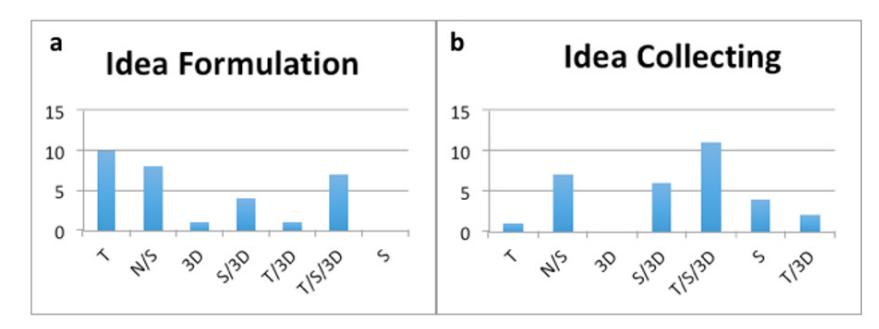
Figure 1 Idea formulation chart (a); Idea collecting chart (b)
(Exp: Conceptual text (T); Sketches (S); Narrative/Sketch (N/S), textual narrative and sketches; Three-dimensional elaboration (3D); Combination of two-dimensional (sketches) and three-dimensional methods (S/3D); Combination of textual narrative and three dimensional methods (T/3D); Combination of textual narrative, two and three- dimensional methods (T/3D/S))
Figure 1(b) explained that 11 respondents (35.48%) thought that the most effective way to collect ideas was to combine textual/narrative concepts, sketches, and 3D exploration. Furthermore, as many as 7 respondents (22.58%) thought that combining textual/narrative and sketching conceptual methods was the most effective method, 6 respondents (19.35%) thought that combining sketching and 3D exploration methods was the most effective method, 4 respondents (12.9%) thought that drawing or sketching was the most effective method for collecting ideas, and 2 respondents (6.45%) thought that combining textual/narrative methods and 3D exploration was the most effective method. 1 respondent thought that conceptualizing textually/narratively was the most effective method of collecting ideas, and no respondents thought that 3D exploration was the most effective method of collecting ideas. Based on the results of this questionnaire, combining two or more methods (textual/narrative, sketching, and 3D exploration methods) is considered effective for accommodating ideas.
Questionnaire Result: Tools in Idea Exploration and Formulation
In this part of the questionnaire, the respondents were asked to select their preferred tools in the idea exploration and idea formulation stage of designing. The tool selections were digital tools, non-digital tools, and the combination of digital and non-digital tools. Furthermore, the respondents were asked to select specific tools used: laptop, PC, tablet, smartphone, scanner, printer, and software (digital); drawing tools such as pen, paper, pencil, eraser, etc. (sketching/two-dimensional modeling); and three-dimensional exploration tools such as paper, clay, wood, metal, etc. (three-dimensional modeling).
Figure 2 showed that in formulating ideas, as many as 23 people (74.19%) use a combination of digital and non-digital tools as a means of creative exploration. Meanwhile, as many as 6 people used non-digital tools such as paper, wood, metal, clay, and other supporting tools as a means of creative exploration, and as many as 2 people (6.45%) only used digital tools.
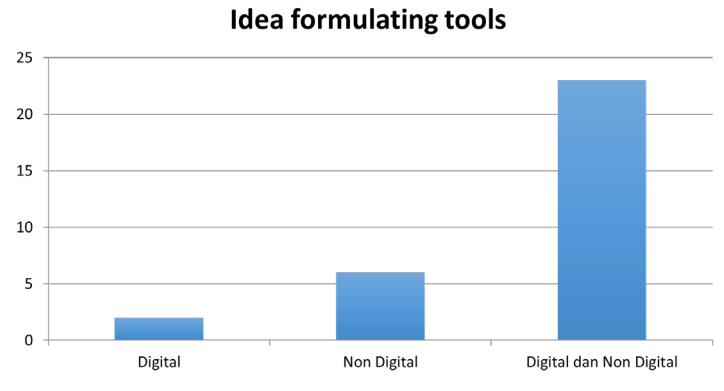
Figure 2 Idea formulating tools chart
The digital tools used were dominated by laptops/computers, with a response of 30 respondents (96.77%) who stated that they used laptops or computers. In addition to laptops, respondents also use tablets, mobile phones/smartphones, scanners/printers, and various software alongside their laptops/ computers. Meanwhile, the non-digital tools used by the respondents were dominated by drawing tools (paper, pencil, pen, and other drawing equipment) for sketching by 27 people (87.10%), and as many as 20 people (64.52%) respondents also used three-dimensional exploration tools such as media paper, wood, metal, clay, etc., simultaneously.
Interviews: Idea Development Practices for Practicing Product Designers
In this part, two professional product designers were interviewed for deeper insight into the practiced idea development process and the tools used. The interview was conducted to know how the process of ideation and the tools used in the idea development stage of designing.
Figure 3 Designer A: Team discussion in developing ideas (a); tools used in idea development (b)
The first designer (A) interviewed was a board director in an accessories and merchandise company that is heavily involved in research and development of its product. Idea development in A's case is a group work, which A and the research and development team discuss and share ideas. The group started the idea development process by studying the recent trend in social media, such as on Instagram and TikTok. The tools used in this stage were mainly smartphones and tablets. Based on the trend research, the team moved to further planning by discussing the existing product mapping and their production capacity. After the initial planning stage was completed, they moved to idea sketching to develop the design and visual of the products.
In the ideation stage, A and the team used mainly digital tools: tablets (for idea sketching and mood boards). The digital sketches were then presented to the team using laptops, screens, and projectors to be discussed (figure 3(a)). The printer was also used to print sketches. At this stage, pen and paper were used to make notes and adjustments to the design. The use of non-digital tools was minimal; the reason was cited as digital tools made it easier for idea sharing by way of discussing the projected images of the sketches. The use of digital tools also simplified the process of documenting and storing the sketches and ideas (figure 3(b)).
The second designer (B) interviewed was an independent designer who specializes in craft-based home décor and accessories. Ideation for B was mainly a solo endeavor, with clients all over Indonesia. He based his design on several factors: client brief, references, and/or production partner. The sketches were made with digital tools, primarily a laptop, tablet, and digital pen (figures 4(a) and 4(b)). B used several programs in the idea development stage: SketchUp for the laptop and Huion Sketch, Infinite Painter, and Adobe Sketchbook for sketching on a tablet. Non-digital tools such as pen and paper were still used, if necessary, although not as the main tools. The three-dimensional method was also used when developing products with unfamiliar new materials to study the materials and how to best utilize them. While B still used non-digital tools in the idea development stage, the main tools used were digital tools. The use of non-digital tools was more on a case-by-case basis. The main use of digital tools was cited because the digital tools enabled idea and design sharing via the internet, considering the clients were from various parts of Indonesia. The use of digital tools also aided in the documentation of ideas, design, and discussion between B and his clients.
Figure 4 Digital sketching and idea visualization using digital tools (tablet (a) and laptop (b))
Despite mainly using digital tools in developing their ideas, A and B cited the importance of developing conventional skills with non-digital tools as a basis to use the digital tools. A and B also still used non-digital tools such as pen and paper for spontaneous idea generation and exploration. Other tools and materials were also used depending on the projects.
Discussion
The development of digital technology introduces a variety of new tools in the design process. Digital technology allows designers to explore shapes digitally. In this case, developing ideas with digital tools can be equated with the stages of developing ideas with sketches and visualization of the final idea. The development of ideas and digital visualization can be in the form of two- or three-dimensional images. The convenience brought about by this digital technology allows designers to visualize ideas as close as possible to the final result/prototype. Nonetheless, the results of the questionnaire show that apart from the convenience provided by digital means, non-digital exploration of ideas is still the main means for designers in accommodating and formulating ideas. This stage of accommodating and formulating ideas is the next stage of the brainstorming process, in which the ideas that arise during brainstorming are organized into a coherent idea in the form of a narrative, sketch, or object.
One way to formulate ideas is to express ideas in narrative text. At this stage, the designer expresses ideas and development possibilities in relation to the design problems faced. At this stage, the design requirements and features to be developed are explored and organized to get an overview of the various possible solutions to the problem. Research by Jonson (2005), focuses on ideation processes by considering ideation processes verbally, narratively, sketchingly, modelizingly, and digitally. This study shows that the process of ideation is mostly initiated by verbalization (narration). This finding is consistent with the results of the questionnaire in this study. This finding also points to lower cognitive load experienced by the designer while communicating the ideas by narration compared to physical representation such as sketches and three-dimensional models (Khrishnakumar et al., 2023).
Apart from expressing ideas narratively, another way to formulate ideas is to explore ideas by making sketches. In this stage, ideas are explored visually in two dimensions by making sketches of possible development ideas. In making sketches, designers can visualize products, uses, users, and other aspects related to the ideas and problems being developed. Another way to accommodate and formulate ideas is to explore ideas in three dimensions. In this stage, ideas are expressed by interacting directly with the material. The materials used can be original materials according to product projections based on ideas or modeling materials, e.g., clay and plasticine. This three-dimensional exploration is visual and tactile.
Based on the questionnaires, the largest percentage is from the early stages of designing, namely, collecting and formulating ideas, which were carried out by respondents starting from making textual narratives related to the ideas to be developed. This shows that organizing ideas as the first step in formulating ideas is an option for some designers. Even so, most (64.4%) of the respondents thought that combining two or three ways to accommodate and formulate ideas is preferable as the first step in designing. This shows that most designers need not only to organize ideas narratively but also to have visual and tactile exploration in developing ideas as an early stage of the design process. Furthermore, based on the questionnaire, the respondents argued that the combination of the three methods was considered the most effective in collecting ideas.
The results of the questionnaires regarding the use of digital and non-digital tools show that most respondents (74.19%) use both digital and non-digital means in developing ideas and processing further designs (figure 2). Another finding from this questionnaire is that the non-digital tools used by the respondents are not limited to sketching tools (two-dimensional visual exploration) but also modeling tools (three-dimensional visual and tactile exploration).
A deeper interview with two professional designers lends more insight into the idea development process practiced by designers. In the case of these designers (A and B), the idea development stage starts with a design brief generated from trend research (A) and a client brief (B) highlights the narrative/ textual method in idea development. The idea development and exploration stage through the twodimensional method (sketching) is done mainly using digital tools for the ease of sharing and discussion. Three-dimensional methods using material experimentation are done in a case-by-case basis, mainly when dealing with new kinds of materials used in the design. These findings support the result of the initial survey in which a textual/narrative, two-dimensional and three-dimensional method, is used in idea development.
Despite the difference in work styles (group vs. independent), the interviews with two professional product designers offer similar insight regarding the use of digital and non-digital tools. The interviews with two professional product designers suggest that while non-digital tools are still used, the use of digital tools is more prevalent compared to the non-digital tools. Both designers cite the ease of sharing ideas and information as the main reason for the shift of tools used in idea development. These findings also support the initial survey in which the combination of digital and non-digital tools is used in developing ideas. The designers also highlight the importance of conventional skills in non-digital tools to use the digital tools. As digital tools continue to evolve and advance, designers need to have a good basis in conventional skills in adapting to the rapid development of digital tools.
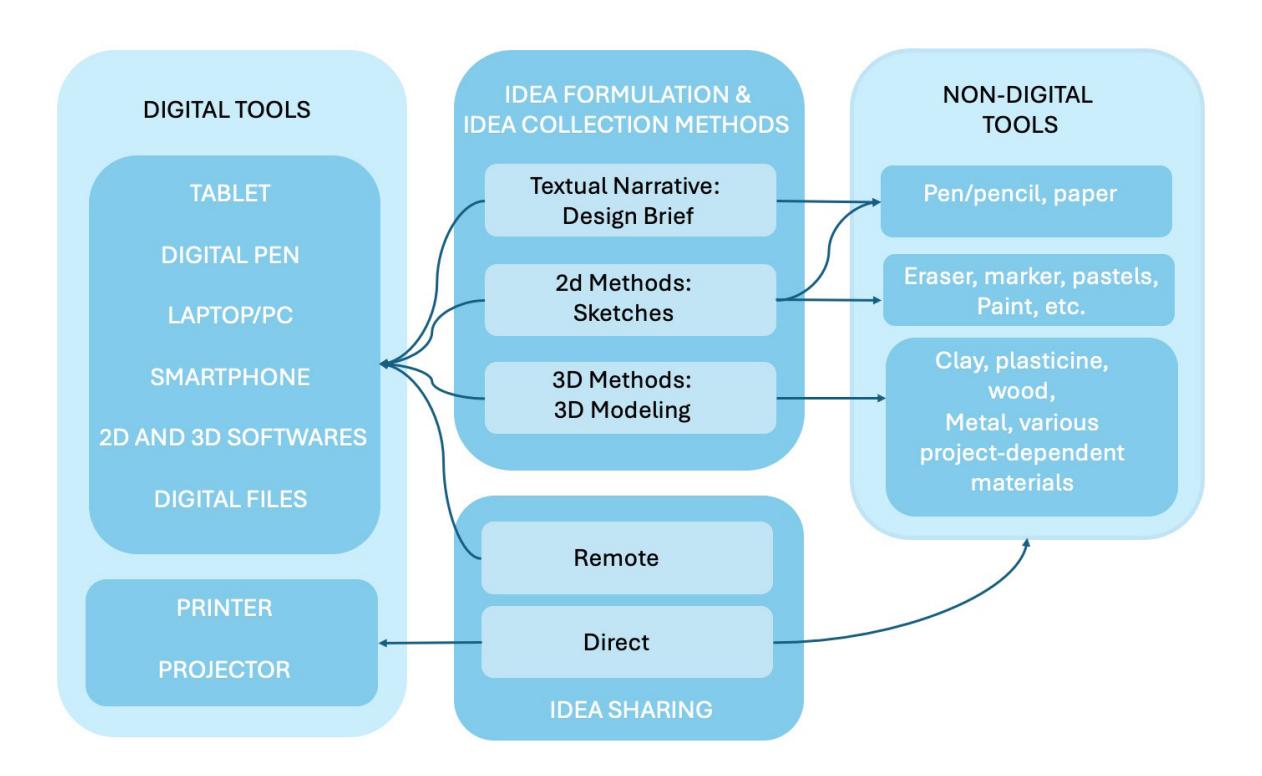
Figure 5 Mapping of the use of digital and non-digital tools in idea development stage of product design
Figure 5 shows the mapping of non-digital and digital tools used in the idea development of the product design process based on the survey and designers' interview. The map shows that the digital tools are more versatile compared to the non-digital tools. The methods of idea formulation and idea collection—whether they are textual narrative, two-dimensional, or three-dimensional methods—are able to be facilitated by digital tools. Non-digital tools proved to be versatile are pen and paper, in which pen and paper could facilitate textual narrative method, two-dimensional exploration method, and direct idea sharing. In the design process, the ideation stage should be done quickly and freely. In this way, pencil and paper are superior as tools of idea development compared to digital tools, considering supporting programs often are delayed in processing information input from the tools to a visual representation, although the advance in technology (hardware and software) nowadays is closing the gap quickly. The importance of pencil and paper in the creative process lies in their versatility and the way they quickly translate ideas to physical form. Digital technology recognizes the importance of pen and paper; thus, digital tools that mimic the method of utilizing pen and paper are developed in the form of tablets and digital pens. This development in digital tools enables the spontaneous nature of freehand sketching with the ease of sharing and editing. Thus, the result of digital sketching is comparable to non-digital sketching, if not better (Kwon, Camba, & Kimbrough, 2018). However, the learning curves to use the tools and their supporting software remain a barrier to cross for many designers. Of course, the rapid development of digital tools and their supporting software also increasingly makes the use of digital tools as an idea development tool faster and easier.
Furthermore, while sketching as a two-dimensional non-digital skill is digitally facilitated by the development of digital tools—tablet and digital pen—three-dimensional skill necessitates more nondigital tool involvement. For example, more specialized design projects necessitate initial experiments as a part of the idea development process. This is exhibited in the idea development by designer B, in which projects involving new or special materials are common. The preexisting knowledge of materials could be translated into digital sketches or models; however, the preexisting knowledge also stems from the initial experiment involving the materials. The experiments not only generate knowledge related to the shape, dimension, potential, texture, and characteristics of the material, but also the processes involved in using the material to use in design, including—but not limited to—production technique and material procurement. This necessity points toward non-digital skills in the form of the ability to explore materials and objects as an important skill to be possessed by designers—among other three-dimensional nondigital skills such as a sense of shape, texture, dimension, etc.
The versatility of digital tools also entails the skill of utilizing the tools. In some contexts, nondigital tool skills are translated to digital tool skills. For example, proficiency in sketching using paper and drawing tools such as pencil, pen, marker, etc., is translated directly to skills in digital sketching using tablets and digital pens. On the other hand, the skills involved in three-dimensional exploration and modeling are transformed into the skill of three-dimensional digital visualization in the form of a sense of shape, texture, and proportion, among others. Therefore, in the context of product design education, proficiency in utilizing non-digital skills is still important to be part of the education. Designers need to have a solid base in non-digital skills to have a good sense of the physical attributes of a product or design and transform them to digital form. Conversely, the sense of how an idea could be materialized in threedimensional form—through digital or non-digital ways—is also an important skill for designers. In this way, digital and non-digital skills are complementary in the creative process.
Conclusion
This research shows that despite the increasingly digitized world of product design, non-digital methods are still an important part of the product design process, especially the idea development process. The synergy of digital and non-digital methods supports each other in creating works. The need for ease to share and discuss favors the use of digital tools compared to non-digital tools. Non-digital tools still hold their place in spontaneous idea formulation and collection. Furthermore, digital technology is constantly evolving and advancing, introducing new tools and methods of designing. As such, the skill to use nondigital tools is still an important skill for a designer to possess as a basic skill that could always be adapted to digital tools. Therefore, in the context of product design education, the skills to use non-digital tools are still an important part of design education. However, it is imperative that product design education also consider the increasing digital literacy in its curriculum.
Furthermore, digital and non-digital methods each have strong positions in the design process. This research only focuses on digital and non-digital methods and means of developing ideas in the product design process. Therefore, additional research is required to explore the application of digital and nondigital methods and tools in the overall design process. Since the study was conducted, the technological advancement in the form of artificial intelligence has risen and offered new tools and methods for design practices. This study has yet to explore the role of artificial intelligence in the idea development stage of designing a product and its implication on design education. The issue of digital tools and artificial intelligence in design and design education requires further investigation.
Acknowledgement
This research was funded by the Research, Community Service, and Innovation (PPMI) program of Institut Teknologi Bandung, year 2021.