

INFO ARTIKEL
Kata kunci:
perbedaan gender, continuance intention, persepsi ancaman penyakit, self-efficacy, aplikasi kesehatan seluler
ABSTRAK
Penggunaan aplikasi kesehatan seluler (mHealth) yang berkelanjutan di era pascapandemi semakin relevan karena adanya kekhawatiran kesehatan yang terus berlangsung dan persepsi ancaman penyakit (perceived disease threats/PDT). Penelitian ini mengisi kesenjangan dalam pemahaman tentang bagaimana self-efficacy dan perbedaan gender memengaruhi continuance intention (CI) untuk menggunakan aplikasi mHealth. Dengan menggunakan protection motivation theory (PMT) sebagai dasar teoritis dikaji hubungan antara PDT, self-efficacy, dan CI, dengan gender sebagai variabel moderasi. Data dari 415 pengguna mHealth di Indonesia dianalisis
menggunakan metode partial least squares structural equation modeling (PLS-SEM). Hasil penelitian menunjukkan PDT berpengaruh signifikan terhadap CI, sementara self-efficacy secara langsung meningkatkan CI. Selain itu, gender memoderasi hubungan antara PDT dan CI, pengguna perempuan menunjukkan hubungan yang lebih kuat. Namun, self-efficacy tidak memediasi hubungan antara PDT dan CI. Implikasi praktis penelitian ini adalah pentingnya pengembangan aplikasi mHealth yang ramah pengguna, sensitif gender, dan mampu meningkatkan self-efficacy untuk meningkatkan keterlibatan pengguna. Batasan penelitian mencakup desain cross-sectional dan fokus geografis di Indonesia, sehingga penelitian di masa depan disarankan menggunakan desain longitudinal dan mengeksplorasi konteks demografis serta budaya yang lebih beragam. Temuan ini memperluas aplikasi teoritis PMT dan memberikan wawasan praktis untuk meningkatkan adopsi serta retensi aplikasi mHealth.
Introduction
Although the COVID-19 pandemic has largely subsided, its effects continue reverberating across various societal aspects. During the height of the pandemic over the past two years, numerous challenges emerged due to this global crisis. These challenges spanned a wide spectrum, from social and economic disruptions to health-related complications that stemmed directly from the virus itself. Consequently, it is unsurprising that the health sector has witnessed significant growth, with the industry adapting to meet new demands. In recent years, the healthcare landscape has undergone profound transformations (Amelia, 2020). A key factor driving this evolution has been the integration of technology as a pivotal tool in healthcare delivery, which has significantly enhanced the accessibility and efficiency of medical services for patients (Hasyim & Suroso, 2020). Historically, patients were required to physically visit healthcare facilities to receive care. However, the advent of digital health solutions has reversed this dynamic, enabling healthcare providers to proactively reach out to patients. This shift from traditional in-person care to online healthcare services has not occurred instantaneously but has instead developed progressively. Over time, this gradual transition has facilitated broader acceptance and more thoughtful implementation of digital health innovations.
The COVID-19 pandemic has profoundly impacted individuals' perceptions of health and safety, instilling a heightened sense of vulnerability to a wide array of diseases and health threats across the globe. This newfound anxiety surrounding perceived disease threats (PDT) became especially pronounced during the pandemic and has persisted into the post-pandemic era, largely due to the drastic alterations in daily life that many people experienced. The widespread fear was fueled significantly by the constant stream of alarming news from various media outlets, which relentlessly highlighted the dangers posed by the virus and other potential health risks (Susetiowati et al., 2022). This continuous exposure to distressing information kept the public in a state of heightened alertness, making the perception of disease threats a central concern in their everyday lives.
Even though the immediate threat of the pandemic has subsided, the residual fear of disease remains deeply rooted in the collective consciousness. This ongoing concern continues to drive individuals to adopt and maintain self-protection measures that became routine during the height of the pandemic. Among these measures, the use of mobile health applications has emerged as a particularly significant practice. These digital tools, initially adopted as a necessity to manage health-related challenges during the pandemic, have now become an integral part of how people approach their health and well-being.
The relevance of these mobile health applications in a post-pandemic world cannot be overstated. They serve not only as a means of managing existing health conditions but also as tools for monitoring and preventing potential future health threats. The habits and practices that were adopted during the pandemic—such as regularly using health apps to track symptoms, manage appointments, and access health information—are likely to persist, given the ongoing concerns about health vulnerabilities. This continuation of pandemic-induced habits underscores the enduring impact of the COVID-19 crisis on how individuals perceive and manage their health, highlighting the importance of digital health solutions in the modern healthcare landscape.
One of the most prominent habits that has endured beyond the pandemic is the widespread use of mobile health applications. These applications, initially adopted as a necessary tool for managing health during the pandemic, have now become a staple in many people's lives. The necessity of maintaining ongoing self-care has ensured that these mobile health applications continue to be an integral part of users' daily routines. There is substantial evidence indicating that user interest in these applications has not only persisted but may have even strengthened over time. Service providers, particularly those in the mobile health application sector, are optimistic about the continued demand for their services in the postpandemic era (Burhan, 2021a, 2021b).
This optimism is bolstered by findings from a McKinsey survey conducted in 2021, which revealed a significant shift in user behavior. The survey reported that approximately 40% of respondents expressed their intention to continue using mobile health applications in the future. This represents a remarkable increase from the mere 11% of respondents who used such applications before the onset of COVID-19 (Bestsennyy et al., 2021). This growing reliance on mobile health applications is reflected in the concept of continuance intention (CI), which refers to users' intention to persist in using these applications over time. The trend suggests that the habits formed during the pandemic have not only taken root but are likely to shape the future of health management, emphasizing the critical role that digital health solutions will play in a post-pandemic world.
Research findings have consistently demonstrated a direct relationship between perceived disease threats and continuance intention, as shown by studies such as those conducted by C.C. & Prathap (2020). This correlation aligns with earlier research, including that of Luo & Mou (2022), which further substantiates the connection between these variables. This leads to a critical research question: How do perceived disease threats influence continuance intention (CI) to use mobile health applications in the post-pandemic era?
A critical aspect of this relationship is the mediating role of self-efficacy, which Luo & Mou (2022) identified as a key factor influencing the strength of the connection between perceived disease threats and continuance intention. In this context, self-efficacy refers to an individual's belief in their ability to effectively use mobile health applications, relying on their skills and confidence. The level of selfefficacy varies among individuals, significantly impacting their user experience. For some, especially those with limited technological proficiency, using mobile health applications can be challenging and frustrating. These users might struggle with navigation, understanding features, or feeling confident in their ability to use the applications correctly. Conversely, individuals who possess a higher degree of technological expertise typically find using these applications to be straightforward and intuitive. Their confidence in their abilities enables them to engage more fully with the applications, thereby reinforcing their continuance intention. Thus, self-efficacy not only influences how perceived disease threats affect an individual's decision to continue using mobile health applications but also highlights the importance of technological literacy in ensuring that mobile health applications are accessible and beneficial to all users. This sets the stage for another research question: What role does self-efficacy play as a mediator between perceived disease threats and continuance intention in the context of mobile health applications?
Variations among individuals, such as gender differences, have been observed to lead to distinct perceptions of emerging technologies, consequently influencing how individuals adopt and utilize technology and computer-related devices (Celik, 2016; Dewi et al., 2020; Kahttab et al., 2012; Panda & Swar, 2016). This underscores that when gender differences exist, individuals are likely to hold diverse views on new technology, thereby affecting their behaviors in its usage. These individual disparities are also anticipated to act as moderators in the relationships between various constructs. In recent years, there has been an increasing utilization of moderator variables, particularly in the field of consumer behavior, to enhance our comprehension of relationships between pertinent variables (Chiagouris &
Williams, 2014). Several researchers have highlighted disparities between males and females concerning innovativeness and behavioral intentions (Dewi et al., 2020), yet the existing literature lacks adequate documentation of gender distinctions, especially in the context of health application usage. In addition to examining the impact of perceived disease threats on continuance intention, mediated by self-efficacy, this study also aims to investigate deeper into the role of gender as a moderator in the context of mobile health applications. This leads to another research question: How does gender moderate the relationships among perceived disease threats, self-efficacy, and continuance intention?
This research is firmly anchored within the theoretical framework of the Protection Motivation Theory (PMT), particularly as it applies to the domain of mobile health applications. A noteworthy aspect of this study is the incorporation of gender as a moderating variable that influences the relationships among the various constructs within the model. According to Luo & Mou (2022), "The Protection Motivation Theory primarily centers on the interplay between security motivation and human behavior, and it is widely utilized in the field of health behavior." This theory explicates that individuals are likely to adopt protective behaviors in response to perceived threats, detailing the processes by which they assess and address these threats. Similarly, Sarstedt & Mooi (2019) underscore that this theory functions as a beliefbased model in the health domain, offering predictive insights into how individuals may respond to healthrelated threats. This observation also supports a theoretical contribution by expanding the Protection Motivation Theory (PMT) framework into digital health applications by integrating perceived disease threats as a critical construct. By examining these relationships through the lens of gender, this research aims to contribute to a deeper understanding of how different demographic factors can influence health behavior in the context of mobile health applications. This highlights another theoretical contribution: the integration of gender as a moderator to explore demographic variations in the relationships among perceived disease threats, self-efficacy, and continuance intention.
Table I State of The Art
| Category | Existing Literature | This Article's Contribution |
|---|---|---|
| Framework/ Theory | Protection Motivation Theory (PMT) applied to general health behavior and technology adoption (Luo & Mou, 2022). | Extends PMT to mobile health applications by examining perceived disease threats, self efficacy, and gender. |
| Variables Studied | Focus on perceived disease threats and continuance intention (C.C & Prathap, 2020). | Incorporates self-efficacy as a mediator and gender as a moderator in the relationships between key constructs. |
| Demographic Focus | Limited focus on demographic variables, especially gender differences in technology adoption (Panda & Swar, 2016). | Highlights gender differences in continuance intention for mobile health apps. |
| Methodology | Traditional regression and basic structural modeling techniques. | Employs PLS-SEM for advanced structural modeling and analysis, enhancing robustness of findings. |
| Context/ Region | Studies primarily conducted in Western or global contexts. | Focuses on mobile health app users in Indonesia, providing region-specific insights. |
| Post-Pandemic Dynamics | Studies often emphasize the immediate effects of the pandemic on health behavior. | Examines long-term post-pandemic continuance of mobile health application usage and its implications. |
| Practical Implications | Generic recommendations for mobile health app design. | Provides targeted strategies for mobile health app providers, addressing gender specific and region-specific needs. |
As presented in Table I, the current study advances the field of mobile health applications through significant theoretical, methodological, and practical contributions. By extending the Protection Motivation Theory (PMT), this research integrates perceived disease threats, self-efficacy, and gender into the framework. While previous literature, such as Luo & Mou (2022), applied PMT to general health behavior and technology adoption, this study specifically tailors it to mobile health applications, adding depth and specificity to the theoretical understanding of continuance intention.
In terms of variables studied, earlier works predominantly focused on the direct relationships between perceived disease threats and continuance intention (Sreelakshmi & Prathap, 2020). This study builds on this foundation by incorporating self-efficacy as a mediator and gender as a moderator. This nuanced perspective uncovers new dimensions in the relationships among these constructs, particularly emphasizing the importance of gender differences.
The research addresses a critical gap in the demographic focus of previous studies, which often neglected gender differences or gave limited attention to demographic variables (Panda & Swar, 2016). By demonstrating that female users in Indonesia exhibit stronger links between perceived disease threats and continuance intention, this study highlights the significance of demographic segmentation in health technology adoption.
On the methodological front, this research employs advanced PLS-SEM modeling techniques, moving beyond the traditional regression and basic structural modeling approaches. The robust analytical framework provides a deeper and more accurate understanding of the relationships between variables, setting a benchmark for future research in this domain.
The contextual focus of this study also sets it apart from prior work, which has largely been conducted in Western or global settings. By focusing on Indonesian mobile health application users, this research offers region-specific insights, enhancing its relevance to local stakeholders and providing a model for other developing regions.
A key contribution lies in its examination of post-pandemic dynamics, shifting the narrative from the immediate effects of the pandemic to long-term behavior. While existing literature often emphasized short-term health behaviors during the pandemic, this study explores the sustained use of mobile health applications in the post-pandemic era, identifying enduring habits and motivations.
Finally, the study has practical implications that go beyond generic recommendations. It provides targeted strategies for mobile health application providers, particularly addressing gender-specific and region-specific needs. These insights can help developers and policymakers refine their approaches to better cater to diverse user groups, enhancing the adoption and effectiveness of mobile health solutions.
In conclusion, this research makes significant theoretical and practical advancements by building on existing literature and addressing critical gaps. It offers a comprehensive understanding of continuance intention in mobile health applications, grounded in theory, enriched by demographic insights, and tailored to the unique context of Indonesia.
In this context, the use of the mobile health application acts as a crucial preventive measure against the potential emergence and spread of disease threats. Individuals who are at an elevated risk of contracting diseases often demonstrate a pronounced tendency to protect themselves proactively. Additionally, the Protection Motivation Theory (PMT) suggests that as individuals perceive the threat of disease to be more severe and imminent, there is a corresponding increase in the likelihood that they will engage in behaviors aimed at safeguarding their health. This theory emphasizes the direct correlation between perceived risk levels and the motivation to take preemptive health actions.
Perceived disease threats refer to the sense of disease-related risks experienced by each individual and can instigate panic responses (Pascual-Miguel et al., 2015; Shahin & Hussien, 2020). When it comes to using mobile health applications, these perceived disease threats encompass categories of diseases that can be addressed as initial treatment, such as mild cases like COVID-19 symptoms, flu, skin issues, or mental health concerns. However, for diseases requiring medical intervention, mobile health applications alone may not suffice for treatment. Several studies (Sreelakshmi & Prathap, 2020; Luo & Mou, 2022)
have investigated how perceived disease threats impact the intention to continue using mobile health applications. These studies have provided evidence that individuals facing health threats or illnesses tend to persist in their use of mobile health applications. According to the research conducted by Luo & Mou (2022), the indicators used to assess perceived disease threats encompass the following measurements:
- 1. Belief in being at risk of a serious illness.
- 2. Perception of the possibility of falling into a serious illness in the future.
- 3. Recognition of suffering from a disease or the potential for it.
The user's determination to continue using a related application (in this context, mobile health applications) is commonly referred to as continuance intention (CI). Continuance intention (CI) is a procedure in which an individual option persists in utilizing specific services or products provided by entities rather than transitioning to alternative offerings (Inan et al., 2023). As explained in Luo & Mou (2022), the intention to continue using mobile health applications, as a means of ongoing safeguarding, involves individuals forming a favorable judgment regarding the efficacy of engaging in this protective behavior, particularly when they perceive a significant disease threat to their health. As per the research by Luo & Mou (2022), the indicators employed to measure continuance intention include the following:
- 1. Desire to persist in using mHealth applications.
- 2. Actively continuing to use mHealth apps.
- 3. Willingness to recommend mHealth applications to others.
Besides perceived disease threats, in the context of mobile health applications, the continuance intention is also influenced by self-efficacy. The concept of self-efficacy was first put forward by Bandura in 1997. Self-efficacy refers to the perception of an individual's ability to organize and carry out actions to demonstrate certain skills (Susetiowati et al., 2022). Self-efficacy has a positive effect on continuance intention, which means paying attention to the process of using the mobile health application. Everyone's set of countermeasures is different, which then results in different levels of continued use of mobile health applications (Luo & Mou, 2022). Regarding self-efficacy indicators concerning the use of applications as a means of personal protection against perceived disease threats, the self-efficacy of everyone can be evaluated through the ease and convenience of using mobile health applications. This is because, based on Bandura's explanation of the self-efficacy aspect, people's levels of competence may vary when it comes to protecting themselves. While some individuals may find it straightforward, others may not necessarily share the same perception of ease.
The indirect relationship between perceived disease threats and continuance intention via selfefficacy is statistically significant (Luo & Mou, 2022). While an individual's perception of disease threat can directly lead to protective behaviors, it's important to note that, instead of directly causing protective behavior, the assessment of coping abilities (self-efficacy) can serve as a mediator in the link between perceived disease threats and the intention to persist in using mobile health applications (Luo & Mou, 2022).
Gender is a vital variable for research segmentation. Gender pertains to the unique distinctions among users, which are classified as either male or female (Pascual-Miguel et al., 2015). The divergence in gender can be elucidated through the lens of gender role theory, wherein males and females are anticipated to fulfill distinct societal roles, consequently encountering dissimilar social pressures (Kahttab et al., 2012). The notion of gender distinctions within the mobile health applications context can be integrated into the research to reveal that decision-making processes differ between males and females. These individual differences problems ultimately impact individual technology adoption and usage intentions (Dewi et al., 2020). These individual disparities are also anticipated to influence the connections between different constructs, adding complexity to the analysis.
Method
This study follows an explanatory and quantitative approach, with the objective of elucidating and forecasting the anticipated connections among the variables. Based on the related work discussions, the study crafted a framework and formulated hypotheses.
As we can see from Figure 1, based on the explanation, the related hypotheses of this study were developed:
- H1: Perceived disease threats have a significant relationship with self-efficacy.
- H2: Self-efficacy has a significant relationship with continuance intention.
- H3: Perceived disease threats have a significant relationship with continuance intention.
- H4: Self-efficacy mediates the relationship between perceived disease threats and continuance intention.
- H5a: Gender moderates the relationship between perceived disease threats and continuance intention.
- H5b: Gender moderates the relationship between self-efficacy and continuance intention.
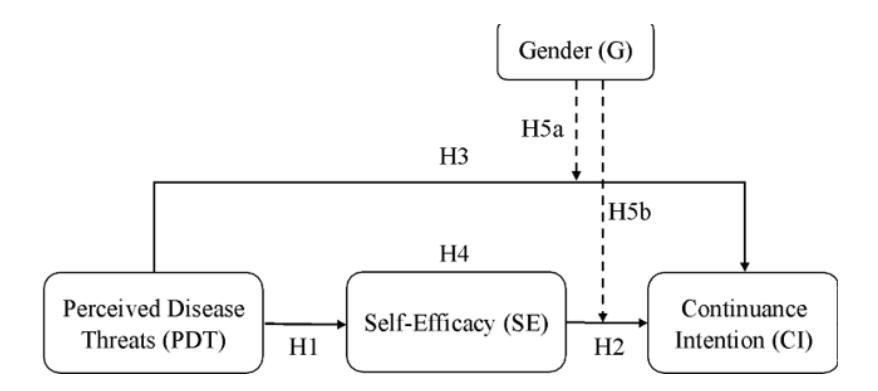
Dotted Line: Moderation Relationships Intact Lines: Direct Relationships
Figure 1 Research Model
Subsequently, a questionnaire was designed to collect essential data for scrutinizing the proposed hypotheses and verifying the ultimate framework for continuance intention to use mobile health applications in Indonesia. In line with the study's objectives, the study's focus is on mobile health application users in Indonesia, comprising the target population of interest.
The questionnaire utilized in this study comprises structured or closed-ended questions and was derived from a previous source. Respondents were asked to express their agreement or disagreement with each statement related to perceived disease threats, self-efficacy, and continuance intention using a fivepoint Likert scale (1 = strongly disagree, 3 = uncertain, 5 = strongly agree). Respondents were also asked to provide basic information, including gender, education level, professional or employment status, and experience with mobile health applications.
A pilot study was conducted, involving 30 respondents who participated through personal interviews. The primary objective of this pilot study was to identify any questions that were unclear or difficult to comprehend. The results of this pilot study demonstrated reliability, as assessed by Cronbach's alpha. Subsequently, the refined questionnaire was employed for the final data collection phase. For the actual data collection, the target respondents were mobile health application users in Indonesia.
To test the hypotheses, a sample of mobile health application users in Indonesia was surveyed with an online survey. Snowball sampling, also known as network or respondent-driven sampling, was selected as the sampling method for this study. This choice was made because respondents were encouraged to distribute the survey to their friends and colleagues and share the survey link using the approach outlined by Ramayah et al. (2016) and Sarstedt & Mooi (2019).
This study employs G*Power 3.1 as a program for power analysis and sample size calculations. This study uses the typical significance level in business research, which is 5% (0.05), and two predictors. The computed minimum acceptable sample size for this study is 107. Data were collected from 415 respondents. About 57% of the respondents were men, and 47.5% of them were around 25-35 years old. In terms of education, most of them held a university degree (44.8%) and worked in the private sector (39.8%).
To test the theories and concepts and to analyze the cause-effect relationship that is used in this study, one of the techniques that can be employed is Structural Equation Modeling (SEM). The PLS-SEM approach is used as it is primarily used to develop theories in exploratory research or an extension of an existing structural theory (Ramayah et al., 2018). The data analysis method used is the SEM-PLS approach based on the SmartPLS version of 4.0.9.6, following several steps for analyzing the effects of a moderator on a mediation model (Chua, 2023). The first step is creating a project, importing the data, and drawing the PLS-SEM model. The second step is analyzing the measurement models for validity and reliability. The third step is analyzing the mediating effect. The fourth step is analyzing the main effects, the simple effect, and the moderating effect. The last step is reporting the results of the PLS-SEM analysis.
To analyze the moderating effect, this study employed a two-stage approach. Given that the moderator is gender, the study used a categorical moderator, specifically on a nominal or ordinal scale. This study also includes a simple slope analysis when examining the moderating impact. A simple slope illustrates the relationship between the independent variable and dependent variable at the high level (+1.0 standard deviation) and the low level (-1.0 standard deviation) of the moderator (Chua, 2023).
Results and Discussion
Following the creation of a project, importing the data, and constructing the PLS-SEM model, the subsequent step involves analyzing the measurement models to assess their validity and reliability. In accordance with Ramayah et al. (2018), the assessment of a reflective measurement model relies on three primary criteria: internal consistency reliability, convergent validity, and discriminant validity. In this study, both convergent validity and discriminant validity are integral components of construct validity. Construct validity assesses how well the outcomes derived from using the measure align with the underlying theories that the test is designed to evaluate, and this assessment is conducted through the examination of convergent and discriminant validity (Sekaran & Bougie, 2019). The evaluation of convergent validity for reflective constructs considers factor loadings, composite reliability (CR), and the average variance extracted (AVE) (Hair et al., 2022). The results on convergent validity can be observed in Table II. All item loadings surpass the recommended threshold of 0.5. CR values exceed the acceptable threshold of 0.708, and the AVE values surpass the recommended benchmark of 0.5.
Table II The Result of the Convergent Validity and Reliability
| Constructs | Items | Loading | CR | AVE | Cronbach's Alpha |
|---|---|---|---|---|---|
| PDT | PDT1 | 0.945 | 0.962 | 0.893 | 0.941 |
| PDT2 | 0.952 | ||||
| PDT3 | 0.939 | ||||
| SE | SE1 | 0.914 | 0.949 | 0.861 | 0.919 |
| SE2 | 0.942 | ||||
| SE3 | 0.927 | ||||
| CI | CI1 | 0.935 | 0.946 | 0.853 | 0.914 |
| CI2 | 0.932 | ||||
| CI3 | 0.903 |
Discriminant validity was evaluated by scrutinizing the correlations between the assessments of constructs that could potentially overlap. Table III illustrates that the items predominantly load more strongly on their respective constructs within the model. Regarding reliability, it can be inferred that the measurements are dependable, as evidenced in Table I, where all Cronbach's alpha values exceed 0.90, indicating that the measurements are highly reliable and can be considered satisfactory (Hair et al., 2022).
| Table III The Result of the Discriminant Validity |
|---|
| CI | PDT | SE | |
|---|---|---|---|
| CI | 0.924 | ||
| PDT | 0.178 | 0.945 | |
| SE | 0.796 | 0.040 | 0.928 |
The next step involves analyzing the mediating effect, alongside the main effects, simple effects, and moderating effects, which necessitates path analysis to scrutinize all the hypotheses generated. Given that this study employs moderation analysis, the change in R2 assumes significance. The initial R2 for the main effect model stands at 0.646. As observed in the interaction effect model depicted in Figure 2, the R2 has risen to 0.655. The R2 change, which amounts to 0.009, signifies that the inclusion of gender as a moderator has led to an additional 0.9% variance in R2 . The R2 value for continuance intention stands at 0.655, indicating that 65.5% of the variance in the level of continuance intention can be elucidated by perceived disease threats and self-efficacy.
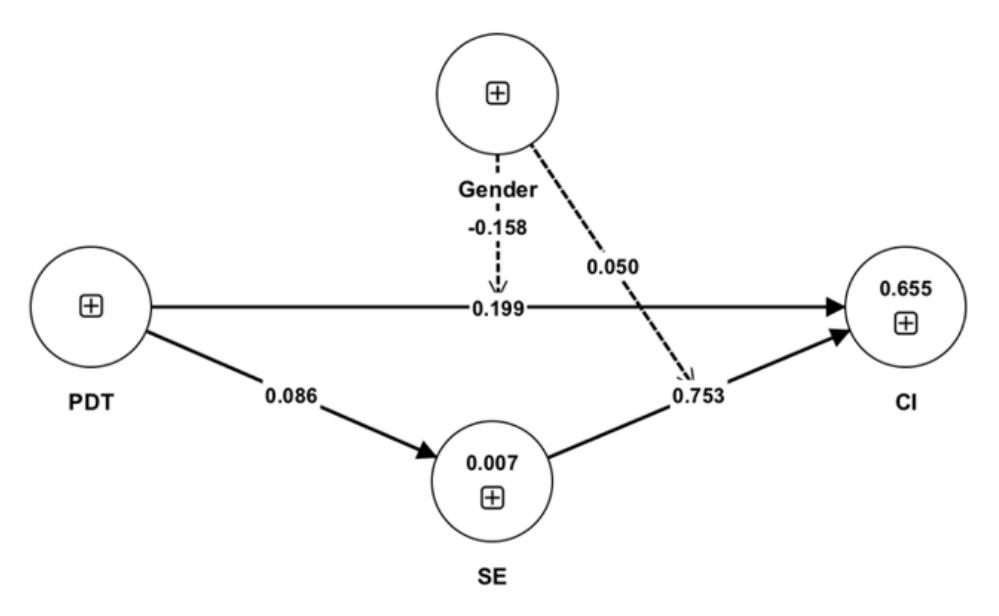
Figure 2 PLS Path Diagram of Beta Values and R-squared Values
Based on the hypothesis testing results in Table 4, H2, H3, and H5a were supported. This indicates that self-efficacy indeed has a significant relationship with continuance intention. When individuals have high self-efficacy in using mobile health applications, they are more likely to believe that their actions will lead to positive outcomes, such as improved health or well-being. This increased confidence in their ability to use health apps effectively can enhance their intention to continue using them, as they perceive them as valuable tools for their health management. Therefore, the positive relationship between selfefficacy and continuance intention suggests that individuals with higher self-efficacy are more inclined to continue using mobile health applications because they believe in their capacity to do so effectively. The findings of this study reinforce the assertions made by earlier research or support the conclusions drawn by previous studies (Luo & Mou, 2022).
Likewise, this study also demonstrates that perceived disease threats exhibit a significant relationship with continuance intention. When individuals perceive a high threat of disease, they are more motivated to take actions to protect themselves, such as using mobile health applications to monitor their health or access health-related information. The perceived threat of disease can serve as a strong motivator for individuals to continue using mobile health applications as a means of ongoing protection and health management. Thus, the significant relationship between perceived disease threats and continuance intention suggests that individuals who perceive a higher threat of disease are more likely to continue using mobile health applications as a preventive measure.
However, it has been established that self-efficacy does not mediate the relationship between perceived disease threats and continuance intention. The sample of participants in the study may have unique characteristics or experiences that deviate from the expected relationships found in previous research. Furthermore, the context of the study, such as the specific mobile health applications being used, the timing of data collection, or the prevailing health conditions, could influence the relationships between these variables.
Gender moderates the relationship between perceived disease threats and continuance intention, according to the moderation findings. The negative coefficient means that the relationship between perceived disease threats and continuance intention is stronger for female mobile application users. This argument is also strengthened by the result from the simple slope in Figure 3, which shows the direction lines for the female (gender at zero) have a steeper gradient when compared to the male (gender at one). Females, as a general trend, exhibit a higher degree of health consciousness and proactivity in their pursuit of health-related information and services. Consequently, they may regard disease threats as more significant motivators for the continued use of mobile health applications to safeguard their wellbeing. Cultural norms and gender roles within specific Indonesian societies may also contribute to this phenomenon. In some Indonesian communities, women often assume the role of primary caretakers for their families' health and overall well-being. This heightened responsibility can lead to an increased perception of disease threats and a stronger intention to utilize mobile health applications as tools for health protection. Also, in certain instances, females may encounter greater difficulties when it comes to direct access to healthcare services, which makes mobile health applications a convenient and accessible alternative.
Table IV Path Coefficients and Hypothesis Testing
| Hypothesis | Relationship | Coefficient | t value | P value | Supported |
|---|---|---|---|---|---|
| H1 | PDT SE | 0.086 | 1.489 | 0.137 | NO |
| H2 | SE CI | 0.753 | 14.106 | 0.000 | YES |
| H3 | PDT CI | 0.199 | 3.313 | 0.041 | YES |
| H4 | PDT SE CI | 0.065 | 1.506 | 0.132 | NO |
| H5a | Gender*PDT CI | -0.158 | 2.216 | 0.027 | YES |
| H5b | Gender*SE CI | 0.050 | 0.896 | 0.421 | NO |
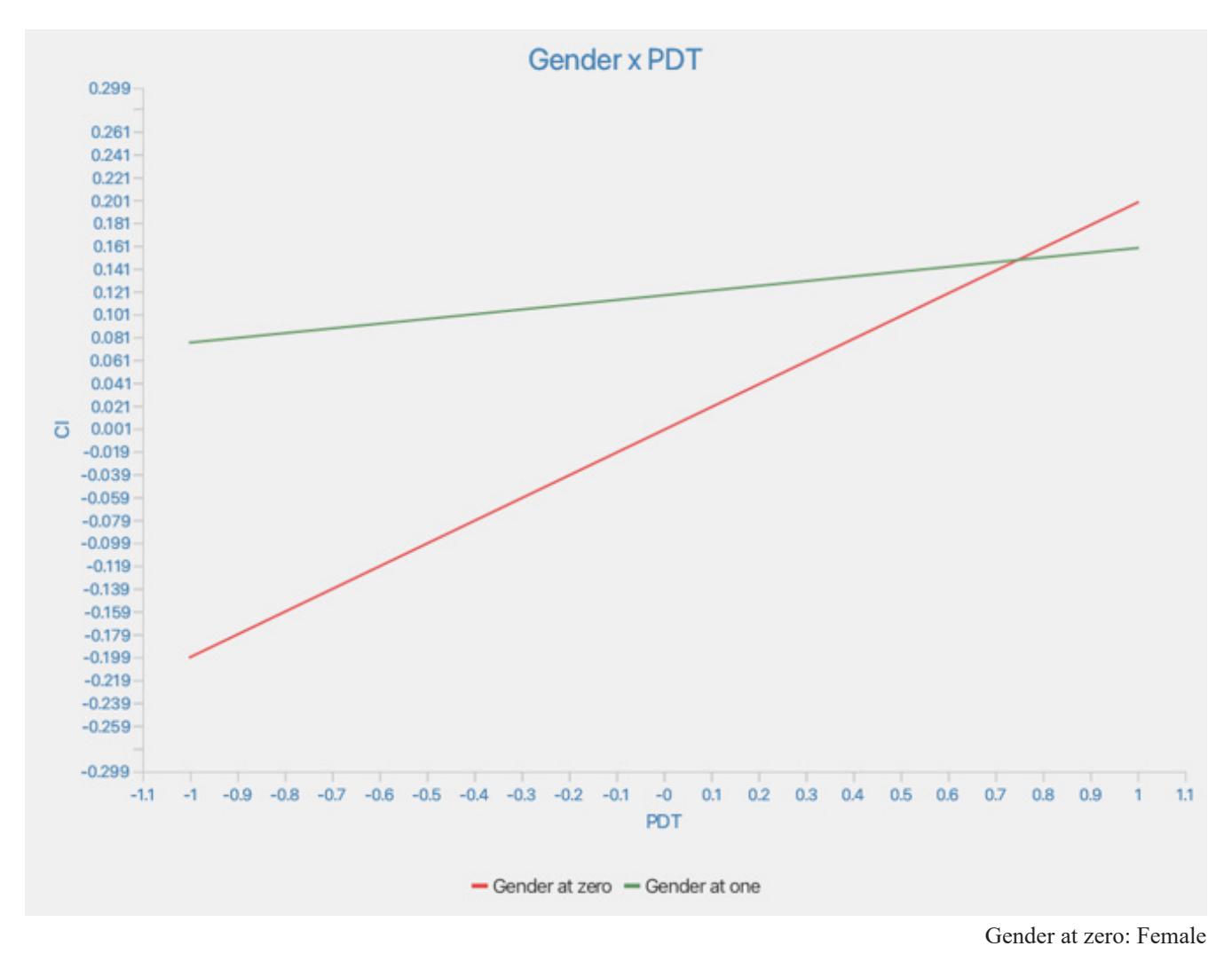
Gender at one: Male
Figure 3 Moderating Effect of Gender between Perceived Disease Threats and Continuance Intention.
Conclusion
This study provides valuable insights into the factors influencing the continued use of mobile health applications (mHealth) in the post-pandemic era. The findings reveal that perceived disease threats significantly influence continuance intention. Users who perceive higher risks of disease are more motivated to use mHealth applications as tools for health monitoring and prevention, emphasizing the importance of addressing health-related concerns in mHealth design and promotion.
While self-efficacy plays a direct role in enhancing continuance intention, the study indicates that it does not mediate the relationship between perceived disease threats and continuance intention. The finding suggests that the effect of disease threats on users' decisions to continue using mHealth applications is more immediate and direct, rather than mediated by their confidence in using the technology. Furthermore, gender moderates the relationship between perceived disease threats and continuance intention, with female users demonstrating a stronger connection. This finding suggests that women are more likely to perceive disease threats as a significant motivator for continued mHealth application use, possibly due to greater health awareness or caregiving responsibilities within their social roles.
The research contributes to the literature by extending the Protection Motivation Theory (PMT) to include gender as a moderating variable, providing a more profound understanding of demographic influences in health-related technology adoption. It also enriches the literature by highlighting the direct influence of perceived disease threats on continuance intention, especially in a post-pandemic context.
Additionally, the study explores the role of self-efficacy in mHealth application use, offering new insights into how user confidence affects sustained usage. By focusing on Indonesia, the research addresses the gap in studies from non-Western settings, offering region-specific insights and contributing to a more global understanding of mHealth adoption and retention. These contributions provide a foundation for future research and practical applications in mHealth technology development and public health strategies.
From a practical perspective, the study underscores the importance of designing user-friendly mobile health applications that improve users' self-efficacy through intuitive interfaces, tutorials, and accessible customer support. Additionally, the findings highlight the need for gender-specific strategies, such as personalized health content and features that address the unique concerns of female users. Policymakers can leverage these insights to promote mobile health applications as public health tools, addressing the diverse needs of users and enhancing equitable access to digital healthcare solutions.
However, the study has certain limitations. Its geographic focus on Indonesian users may restrict the generalizability of the findings to other cultural or regional settings. The cross-sectional design limits the ability to capture causal relationships or changes in behavior over time. Furthermore, the reliance on selfreported data introduces potential biases, such as social desirability or inaccuracies in self-assessment.
Future research could address these limitations by conducting longitudinal studies to track changes in perceived disease threats, self-efficacy, and continuance intention over time. Incorporating objective usage data from mobile health applications could enhance the reliability of findings and reduce selfreporting biases. Exploring additional demographic variables, such as age, education, income, and ruralurban differences, could provide a more nuanced understanding of user segmentation. Expanding the research to include other mediators and moderators, such as trust in technology, health literacy, and perceived usefulness, could offer a more comprehensive view of the factors influencing continuance intention. Additionally, comparative studies across different cultural or geographical contexts could help identify universal versus localized factors affecting mobile health application usage.
Overall, this study emphasizes the enduring role of mobile health applications in promoting health behaviors and managing perceived health threats. By addressing its limitations and pursuing future research directions, scholars and practitioners can further refine their understanding of this field and contribute to the effective integration of digital health solutions into global healthcare systems.