

INFO ARTIKEL
Kata kunci:
asertif, gaya bahasa, NVivo 12 Plus, repetisi, tindak tutur
ABSTRAK
Penelitian ini menyelidiki peran repetisi sebagai strategi linguistik dalam tindak tutur asertif dalam wacana debat empat calon wakil presiden menjelang Pemilu 2024. Secara khusus, penelitian ini menganalisis hubungan tematik antara majas repetisi dan tindak tutur asertif yang digunakan oleh calon wakil presiden pertama, kedua, dan ketiga, dengan memanfaatkan NVivo 12 Plus untuk visualisasi data. Dengan menggunakan metode deskriptif kualitatif, penelitian ini mengidentifikasi kemunculan repetisi dalam tindak tutur asertif yang dikategorikan ke dalam dua fungsi utama: "menyatakan" (tiga kali kemunculan) dan "menjelaskan" (tiga kali kemunculan). Analisis pragmatik menunjukkan bahwa repetisi terjadi pada tingkat kata dan frasa, terutama berfungsi untuk memperkuat penekanan dan mempertegas sikap penutur dalam wacana politik.
Selain itu, analisis menggunakan NVivo 12 Plus mengungkapkan adanya struktur hierarkis yang menghubungkan majas repetisi, tindak tutur asertif, dan fungsi komunikatifnya. Temuan ini menegaskan peran strategis repetisi sebagai alat persuasif dalam debat politik, yang menunjukkan efektivitasnya dalam memperkuat argumen dan meningkatkan daya ingat audiens. Studi ini memberikan wawasan praktis tentang strategi komunikasi politik, khususnya bagi penulis pidato, analis debat, dan politisi yang ingin mengoptimalkan kejelasan serta dampak pesan mereka.
Introduction
The vice-presidential debate, organized by the Komisi Pemilihan Umum (KPU) ahead of the 2024 General Election, is a crucial component of Indonesia's democratic process. These debates are held five times, with the first, third, and fifth debates featuring presidential candidates, while the second and fourth debates involve vice-presidential candidates (cawapres). The fourth vice-presidential debate in 2024 addressed themes highly relevant to Indonesia's challenges, including sustainable development, natural resource management, environmental protection, energy, food security, agrarian issues, and the empowerment of Indigenous peoples and rural communities.
During this debate, the vice-presidential candidates not only presented their visions and missions but also engaged in arguments and expressed diverse perspectives on these critical issues. Each candidate aimed to demonstrate their competency and understanding of matters crucial to Indonesia's future. This debate serves as a pivotal moment in shaping voter decisions by providing direct insights into the candidates' stances and commitments on national concerns. Additionally, it offers voters an opportunity to compare candidates in terms of ideology, strategy, and public speaking abilities. Consequently, the debate functions as both an educational platform and a strategic opportunity for candidates to build their public image and garner electoral support.
Political debates are not merely a means of conveying information but also a stage for candidates to frame their arguments persuasively to influence public opinion. Candidates employ various rhetorical strategies, including repetition, to reinforce their statements and persuade the audience. The use of repeated words in discourse is referred to as a repetition rhetorical style, while speech acts expressing intended actions if elected as vice president fall under assertive speech acts. Assertive speech acts serve to affirm or state something as true, aligning with the speaker's beliefs and intentions (Purlilaiceu et al., 2023). Effective language use, including repetition, plays a vital role in strengthening arguments and enhancing audience engagement in political discourse.
Repetition is frequently employed in political speeches as it reinforces opinions, improves message retention, and fosters an emotional connection with the audience. Previous studies have explored repetition in various contexts. For instance, Sukendar and Susilawati (2021) analyzed repetition in song lyrics, demonstrating its role in creating emotional and aesthetic effects. Similarly, Roveneldo (2019) examined repetition in the Lampung song Sanak Aruk, highlighting its function in emphasizing emotional meanings such as sadness and sincerity. While these studies focus on repetition in cultural and artistic expressions, the present study extends this analysis to political debates, investigating how repetition strengthens arguments and clarifies candidates' positions.
Political communication through rhetorical devices significantly influences public perception and candidates' images. Fizriyani et al. (2024) examined figures of speech in Anies Baswedan's speech as a presidential candidate, identifying repetition as the dominant rhetorical device for emphasizing key messages and eliciting emotional responses. However, research on figures of speech in Indonesian political
debates, particularly in vice-presidential debates, remains limited. Sigalingging (2024) analyzed public responses to the 2024 vice-presidential debate on social media, revealing the role of digital platforms in shaping political opinions. However, the study did not explore in depth the rhetorical strategies employed by the candidates or their effectiveness in influencing public perception.
Based on these research gaps, this study aims to describe the forms of repetition in assertive speech acts and analyze their thematic connections using the NVivo 12 Plus application. This research contributes theoretically to the study of pragmatics and political discourse, while its practical benefits extend to political communication strategies. The findings offer insights for speechwriters, campaign teams, and politicians on the strategic use of repetition to enhance argumentation, improve message clarity, and increase audience engagement. Understanding the role of repetition in political debates can also help voters critically assess candidates' communication strategies, leading to more informed decision-making in elections.
Method
This study employs a descriptive qualitative research method to analyze the use of repetition as a rhetorical figure of speech in assertive speech acts. The primary data source consists of excerpts from the fourth vice-presidential debate of the 2024 Indonesian General Election. The dataset includes discourse segments that contain repetitive figures of speech within assertive speech acts.
To conduct a structured analysis, this study adopts a pragmatic stylistics approach, which integrates pragmatics and stylistics to examine both the function of speech acts and the rhetorical strategies used by the candidates. Pragmatics, as defined by Cummings (2005), provides the theoretical foundation for analyzing speech acts, while stylistics, as outlined by Keraf (2007), serves as the basis for identifying and interpreting rhetorical strategies.
For a systematic examination of the relationship between rhetorical style and speech act function, NVivo 12 Plus, a qualitative data analysis software, is utilized (Bandur, 2019). The software enables hierarchical visualization and categorization of thematic relationships within the dataset.
The data collection follows these systematic steps:
- 1. The vice-presidential debate recording was transcribed and carefully reviewed.
- 2. Coding Speech Acts and Figures of Speech: Speech segments are coded based on rhetorical figures of speech, identifying 14 types of figures of speech within five speech act categories (assertive, directive, expressive, commissive, and declarative). The identified figures of speech include hyperbole, irony, repetition, litotes, paradox, metonymy, personification, synecdoche, depersonalization, euphemism, climax, tautology, anticlimax, and antithesis.
- 3. Narrowing the Scope: To maintain focus, the analysis is limited to repetition in assertive speech acts, which appears 48 times across the three vice-presidential candidates. The distribution of occurrences is as follows: 14 instances (candidate 1), 11 instances (candidate 2), and 13 instances (candidate 3)
- 4. Classification of Speech Functions: Assertive speech acts containing repetition are further classified into specific functions, revealing the following distribution:
Candidate 1: Stating (3), Explaining (7), Proposing (2), Informing (1), Claiming (1)
Candidate 2: Stating (5), Explaining (4), Predicting (1), Refuting (1)
Candidate 3: Stating (3), Explaining (4), Proposing (3), Informing (3)
To ensure a focused and in-depth analysis, this study applies the following selection criteria. Since the debate data is oral discourse, one representative utterance is selected from each dataset based on communicative effectiveness. Speech functions such as claiming, predicting, and refuting are represented by only one example each to maintain balance.
A total of ten utterances are analyzed, distributed as follows: Stating: 3 examples; explaining 3 examples; proposing 2 examples; and informing 2 examples.
For a better understanding, Figure 1 illustrates the data collection process.
Figure 1 Project Map of the Relationship between Figure of Speech, Speech Acts, and Speech Functions Based on the NVivo 12 Plus Application.
This research needs to be more focused because the discourse used as the data source is the oral discourse, and from each data point, one data point is selected, which is considered the most communicative speech. In addition, the speech functions of "claiming," "predicting," and "refuting" because only one data appears each. So, the data analyzed amounted to ten (10) data. The form of repetition language style in assertive speech functions to "state" and "explain" each of the three (3) data. Also, the form of repetition language style in assertive speech functions to propose and inform each of the two (2) data.
Results and Discussion
In the fourth debate of the 2024 election, the three vice presidential candidates discussed crucial issues related to sustainable development, natural resources, energy, and indigenous and rural communities. In this context, repetition is important in assertive speech acts, helping candidates strengthen their arguments and emphasize their positions.
Forms of Repetition in Assertive Speech Acts Used by Vice Presidential Candidates One, Two, and Three in the 2024 Vice Presidential Debate
This analysis will identify the forms of repetition used by each vice-presidential candidate and how the function of repetition helps convey statements effectively to the public. Furthermore, this discussion will describe the forms and functions of repetition in assertive statements delivered by vice presidential candidates one, two, and three during the debate as an effort to strengthen messages in complex debate topics.
This discourse appears in the fifth segment as part of a response from the second vice-presidential candidate, addressing why the first candidate pair promotes lithium iron phosphate. The response is as follows:
"Singkatan kita levelnya adalah polsek, dan kebijakan prinsipnya sederhana, prinsipnya sederhana, semua kembali kepada etika pak cawapres dua (1). Etika sekali lagi etika (2). Etika itu adalah etika lingkungan, apa pun yang menjadi kebijakan kita menyangkut produksi, pengambilan tambang, sumber daya alam, juga apa pun yang kita gunakan seluruh potensi bangsa ini rujukannya adalah etika lingkungan" (3).
"Our abbreviation is on a police level, and the policy principle is simple, the principle is simple, it all goes back to ethics Mr. vice presidential candidate two (1). Ethics, once again ethics (2). Ethics here is environmental ethics, whatever be our policy relates to production, mining, natural resources; also, whatever we use the entire potential of this nation, the reference is environmental ethics" (3).
This discourse consists of three sentences. The word kita appears three times—once in sentence (1) and twice in sentence (3)—functioning as an indexical marker of second-person deixis, referring to the second pair of presidential and vice-presidential candidates. Additionally, the word kebijakan in sentence (2) is reiterated from sentence (1), serving as a definitional reference to second-person deixis kita (we). The repetition of the nominal phrase prinsipnya sederhana in sentence (1) establishes a reinforcing relationship (Alwi, 2000). Similarly, the repetition of etika lingkungan (environmental ethics) in sentences (2) and (3) reinforces the emphasis on ethical principles.
This discourse begins with an emphasis on the principle of simple policies, followed by the repetition of etika (ethics) to highlight the central role of environmental ethics. The concluding section clarifies that environmental ethics must be foundational in policy formulation, particularly in natural resource management and national potential development. The vice-presidential candidate underscores that environmental ethics should guide policy decisions concerning production, mining, and resource utilization.
The function of this discourse is explanatory. The speaker articulates that all public policies, particularly those related to natural resources, should be grounded in environmental ethics. The repetition of etika (ethics) serves to reinforce its significance as a fundamental policy principle. Through this rhetorical device, the discourse affirms the necessity of moral guidelines in decision-making. The structured and repetitive nature of the discourse strengthens the argument that all policies related to production and natural resources must align with environmental ethics.
The second vice-presidential candidate responded to the first vice-presidential candidate's remarks regarding strategies to mitigate climate change's impact on food production and nutritional quality with the following statement:
"Kemarin, tahun lalu kita sudah bangun pabrik pupuk di Fakfak kuncinya untuk meningkatkan produktivitas, ya (1). Kita harus genjot kawasan industri pupuk (2). Kita dekatkan pupuknya dengan lahan-lahan pertaniannya, kuncinya pupuk, dan pupuk harus didekatkan dengan lahan-lahan pertanian" (3).
"Yesterday, last year we built a fertilizer factory in Fakfak, the key is to increase productivity, yes (1). We have to boost the fertilizer industrial area (2). We bring the fertilizer closer to the agricultural lands, the key is fertilizer, and fertilizer must be brought closer to the agricultural lands" (3).
This discourse consists of three sentences. The word kita (we) appears three times—once in sentence (1) and twice in sentence (3)—functioning as an indexical marker referring to the second pair of presidential and vice-presidential candidates. The repetition of pupuk (fertilizer) across sentences (1),
(2), and (3) underscores its importance in agriculture and productivity. Similarly, the repetition of harus (have to) in sentences (2) and (3) as an epistemic modality marker indicates obligation. This aligns with Alwi (1992, as cited in Karsana, 2015), who describes epistemic modality as expressing concepts such as possibility, prediction, necessity, or certainty. Modal verbs such as must, have to, necessary, and should convey a sense of obligation (Syartanti, 2022).
By repeating pupuk (fertilizer), the vice-presidential candidate emphasizes its essential role in improving agricultural output and stresses the necessity of optimizing fertilizer accessibility. The repetition highlights the crucial relationship between fertilizers and agricultural lands. The candidate asserts that fertilizers must be more accessible to farmers to enhance productivity.
The discourse explains efforts to establish a fertilizer factory in Fakfak and enhance fertilizer accessibility to agricultural lands. The vice-presidential candidate employs a repetitive rhetorical strategy to reinforce the argument that fertilizer is indispensable for agricultural productivity. The repeated use of pupuk (fertilizer) and lahan-lahan pertanian (agricultural lands) underscores the need for targeted agricultural policies. By employing assertive speech acts and strategic repetition, the candidate emphasizes that fertilizer accessibility is pivotal for optimizing agricultural lands.
This discourse took place during a question-and-answer session in which candidates presented their vision, mission, and programs. The third vice-presidential candidate responded to the second candidate's remarks on strategies to restore indigenous land rights, which have been subject to dispossession, criminalization, and the marginalization of indigenous women. The response was as follows:
"Terima kasih moderator, jadi kalau melihat ketimpangan, penguasaan tanah itu memang (1). Coba lihat bisnis sawit itu 39 hektar, sementara hanya segelintir orang di bisnis sawit, sementara para petani kita sebanyak 17 juta orang itu kalau dirata-ratakan itu hanya menguasai setengah hektar" (2).
"Thank you, moderator, so if you look at the inequality, land ownership indeed happens. Just look at the palm oil business, it's 39 hectares, while only a handful of people are in the palm oil business, while our 17 million farmers, if averaged out, only control half of a hectare" (2).
This discourse consists of two sentences. The repetition of bisnis sawit (the palm oil business) in sentence (2) emphasizes the significance of the palm oil business in economic and land control discussions. By reiterating bisnis sawit (the palm oil business), the candidate highlights systemic injustices in land distribution. The term hektar (hectare) provides a quantifiable comparison between the extensive land ownership of palm oil businesses (39 hectares) and the limited land access of farmers (0.5 hectares).
The candidate underscores stark disparities in landownership within the palm oil sector, contrasting the large-scale control of land by corporations with the limited land available to small-scale farmers. This assertive rhetorical approach presents empirical data to highlight systemic inequality. The repetition of bisnis sawit (the palm oil business) reinforces the argument regarding the concentration of land ownership. The use of hektar (hectare) as a unit of measurement enhances the clarity of the disparity, making the comparison tangible for the audience.
The vice-presidential candidate employs a direct and data-driven approach to address land inequality in the palm oil sector. Through strategic repetition and numerical specificity, the candidate effectively conveys the urgency of redistributive policies. This rhetorical strategy ensures that the audience grasps the extent of inequity in land ownership and the necessity of policy interventions to address it.
Conflicts arising from natural resource distribution. The vice-presidential candidate employs repetition to highlight the multifaceted nature of these disputes, reinforcing the message that natural resources, while valuable, also serve as sources of contention. By presenting these issues assertively, the candidate encourages critical engagement with governance and resource management.
The Interconnection Between Themes Based on the NVivo12 Plus Application between the Repetition Figure of Speech and Assertive Speech Acts
A figure of speech is a key element in this structure, serving as a means by which a speaker conveys a message in a particular way to create a specific effect on the listener. One prominent figure of speech used is repetition, which serves to emphasize the message, highlight key points, and ensure that the listener remembers the conveyed information (Sulistyarini et al., 2020).
Speech acts refer to communicative actions performed by speakers through utterances. In this context, the rhetorical style of repetition is linked to speech acts, demonstrating that repetition is employed to achieve specific communicative goals. Assertive speech acts, also known as representative speech acts, are linguistic actions intended to convey truth or bind the speaker to the truth of the expressed proposition (Searle, 1999). This speech act implies that the speaker believes in the conveyed message and aims to provide information or assurance to the listener.
The rhetorical style of repetition aligns with assertive speech acts, meaning that the repetition of words or phrases is often used in statements or claims to reinforce the speaker's expressed beliefs. Repetition is a stylistic device characterized by the recurrence of the same word or group of words. It can occur within a single sentence or across multiple sentences and may appear at the beginning, middle, or other structural positions (Yolanda et al., 2023). The diagram symbolically represents this relationship, illustrating how repetition reinforces the function of assertive speech acts.
Assertive speech acts serve various functions, categorized in the diagram as branches of assertive speech acts. These functions represent distinct communicative purposes, including:
- Describing: Providing an image or description of an object, situation, or concept to enable the listener or reader to form a clear visualization.
- Informing: Conveying specific facts or information.
- Claiming: Making a statement that the speaker considers to be true. The information conveyed is typically objective, aimed at enhancing understanding.
- Proposing: Presenting a suggestion or recommendation.
- Explaining: Elaborating on a topic to clarify its meaning.
- Stating: Expressing a clear and firm declaration (Widyawati et al., as cited in Fanesha et al., 2024).
The vice-presidential candidates—one, two, and three—are central in the diagram, signifying that the analysis focuses on the statements made by these candidates. The study examines how the first vice-presidential candidate employs repetition within assertive speech acts to achieve communicative functions. Each function of speech acts directly connects to the utterances of the first vice-presidential candidate, illustrating that repetition is consistently used across various communicative functions to reinforce messages.
Repetition serves as an effective rhetorical tool for strengthening statements, explanations, claims, and proposals. Assertive speech acts are employed to convey beliefs or facts, with repetition ensuring that the audience clearly understands the message. The diagram also highlights the interconnectedness of different communicative functions resulting from assertive speech acts—ranging from describing to stating—all contributing to a strong and repetitive message within political discourse. The interrelation between repetition as a rhetorical device, speech acts, and their communicative functions is depicted in Figure 2.
Figure 2 Project Map of the Relationship between Figure of Speech and Speech Acts and Speech Functions Based on the NVivo 12 Plus Application between Repetitive Figure of Speech and Assertive Speech Acts Used by Candidate First Vice President in the 2024 Vice Presidential Debate. (Source: Authors Data)
Figure of speech, particularly repetition, is a key linguistic element analyzed in the discourse of Vice-Presidential Candidate two and is related to assertive speech acts. Repetition, as a rhetorical device, plays a crucial role in emphasizing ideas or messages, reinforcing the assertive speech acts employed by the candidate. It is a form of emphatic language used to highlight or strengthen meaning within sentences, phrases, or words (Diana et al., 2022).
Assertive speech acts, as utilized by Vice-Presidential Candidate two, involve conveying information, facts, or opinions with the intent of stating or explaining a particular point. These speech acts serve several specific communicative functions:
- Predicting: Demonstrates the candidate's ability to make statements about expected future events.
- Describing: Provides a detailed explanation, which is particularly significant in political discourse where the presentation of facts is essential.
- Claiming: Involves making firm statements or assertions, such as those regarding policies or political positions.
- Proposing: Suggests solutions or recommendations in response to issues discussed in a speech or debate.
- Explaining: Aims to clarify or elaborate on a specific topic, offering a deeper understanding.
- Denying: Used to reject or refute statements, accusations, or opposing claims.
- Stating: Provides direct declarations of facts or information to ensure clarity in communication.
The interconnection between repetition as a figure of speech, assertive speech acts, and the communicative functions of Vice-Presidential Candidate Two's discourse is illustrated in Figure 3.
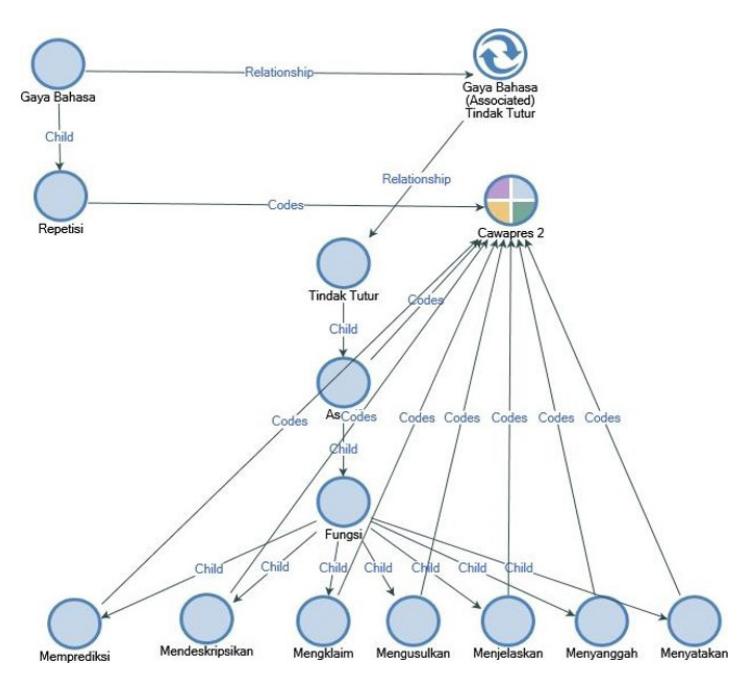
Figure 3 Project Map of the Relationship between Figure of Speech and Speech Acts and Speech Functions Based on NVivo12 Plus Application between Repetitive Figure of Speech and Assertive Speech Acts Used by the Second Vice Presidential Candidate in the 2024 Vice Presidential Debate.
(Source: Authors Data)
In Figure 3, the third vice-presidential candidate is the central focus of this analysis. All key elements of speech, speech acts, and communication functions—are interconnected and related to the candidate's utterances.
The figure of speech in this diagram is analyzed within the framework of speech acts. Specifically, the third vice-presidential candidate employs repetition, which involves the repeated use of words, phrases, or sentence structures within discourse. Repetition serves to emphasize key messages, reinforcing the commitments or issues highlighted by the speaker. In speech and text, repetition enhances the prominence of the repeated element (Gorys, 2006, as cited in Armet, 2023).
Repetition in this context is used to underscore important messages, strengthening the assertive speech acts performed by the candidate. Assertive speech acts function to convey statements, information, or claims that the speaker considers true. Through assertive speech acts, the third vice-presidential candidate communicates facts or truths, using repetition to reinforce the intended message.
The assertive speech acts used by the third vice-presidential candidate fulfill various communicative functions, including:
- Informing: Used to deliver key facts or policies to the audience. Repetition in this function reinforces important details, ensuring they are more memorable.
- Proposing: Serves to introduce suggestions or policy proposals. Repetition highlights the significance of the proposed solutions, signaling their importance.
- Explaining: Aims to clarify or elaborate on a particular issue. Repetition emphasizes the essential aspects of the explanation, helping the audience grasp key points.
- Stating: Utilized to make firm and clear statements regarding political positions or stances. Repetition strengthens the assertiveness and clarity of the statement.
The diagram illustrates that all analyzed components are linked through "Codes," which represent the categorization of stylistic elements, speech acts, and communication functions in the speeches of the three vice-presidential candidates. The use of repetition in assertive speech acts plays a crucial role in enhancing the effectiveness of communication.
By examining the relationship between repetition as a figure of speech and assertive speech acts, it becomes evident that repetition not only reinforces the speaker's message but also fosters a stronger connection with the audience. The repetition of words or phrases ensures that the audience retains and comprehends the key points conveyed.
The interconnection between repetition, speech acts, and their communicative functions is visually represented in Figure 4.
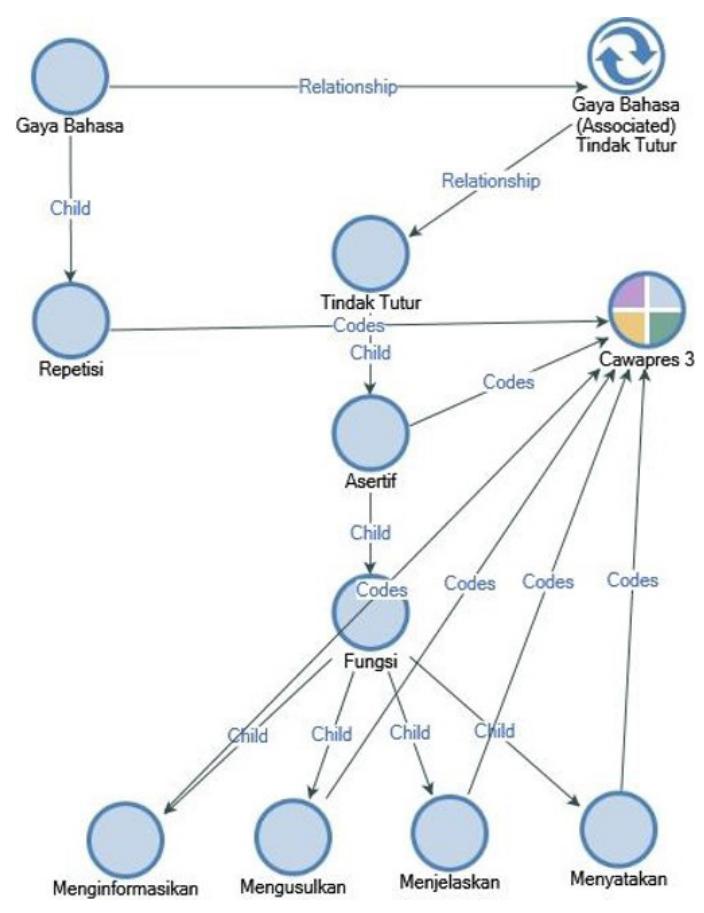
Figure 4 Project Map of the Relationship between Figure of Speech and Speech Acts and Speech Functions Based on NVivo 12 Plus Application between Repetitive Figure of Speech and Assertive Speech Acts Used by the Third Vice Presidential Candidate in the 2024 Vice Presidential Debate. (Source: Authors Data)
Codes and Relationships Between Elements
The diagram illustrates that all analyzed elements are interconnected through "Codes," which represent coding systems or logical relationships between different components. This coding helps identify recurring patterns and key themes in the conversations of Vice-Presidential Candidates One, Two, and Three, particularly in their use of repetitive figures of speech and assertive speech acts.
Furthermore, the diagram highlights the strong relationship between language uses specifically repetition—and the speech acts performed by the vice-presidential candidates. Repetition plays a crucial role in reinforcing the speaker's message across various speech acts, including explaining, proposing, and claiming. The repeated use of ideas or words enhances the audience's ability to comprehend and retain the information presented.
The interconnection between repetitive figures of speech, speech acts, and the functions of speech acts—as demonstrated in the speech of the third vice-presidential candidate—is visually represented in Figure 1.
Conclusion
The analysis of repetitive figures of speech in the speeches of the vice-presidential candidates reveals a strategic use of repetition to reinforce key messages. The first vice-presidential candidate frequently repeats words such as "etika (ethics)" (8 times), "kita (we)" (4 times), and "lingkungan (environment)" (2 times). The second vice-presidential candidate emphasizes "hilirisasi (downstream)" (3 times), "kita (we)" (4 times), and "zaman now (present era)" (2 times). Meanwhile, the third vice-presidential candidate frequently uses "sumber (source)," "sumber sengketa (source of dispute)," "rakyat (people)" (2 times), "pemerintah (government)" (2 times), and the phrase "bisnis sawit (the palm oil business)" (2 times). These patterns suggest that repetition serves as a persuasive strategy, strengthening the assertive speech acts used to convince and engage both interlocutors and the broader audience. The NVivo 12 Plus visual analysis provides a comprehensive view of the assertive speech acts employed by all candidates. The findings highlight that repetition plays a significant role in enhancing the effectiveness of communication by reinforcing statements, claims, and explanations. This rhetorical technique ensures that key messages are retained by the audience while emphasizing critical aspects of the candidates' political discourse. While this study provides useful insights, there are some limitations: limited data (only examines selected speeches from the vice-presidential candidates), lack of context (audience reactions, media influence). To build upon these findings, future research should be conducted by expanding the dataset and examining audience perception.