
INFO ARTIKEL
Kata kunci:
media sosial, tempat kerja, krisis, pandemi, COVID-19, kebiasaan baru, tinjauan literatur sistematis
ABSTRAK
Media sosial di tempat kerja merupakan fenomena kontemporer yang memainkan peran penting dalam berbagai aspek kehidupan organisasi. Namun, dinamikanya selama pandemi COVID-19 dan kondisi normal baru yang terjadi setelahnya jarang dieksplorasi dalam literatur. Penelitian ini bertujuan untuk mengisi kesenjangan dengan menganalisis literatur yang ada mengenai penggunaan media sosial di tempat kerja selama masa-masa yang belum pernah terjadi sebelumnya. Penelitian ini secara sistematis mengidentifikasi dan meninjau publikasi terpilih dari database Web of Science (WOS) dan Scopus. Melalui penelusuran mendalam, penelitian ini memaparkan dinamika media sosial di tengah krisis yang berdampak pada seluruh aspek kehidupan.
Hasil penelitian ini tidak hanya mengungkap, merangkum, dan mengkaji secara kritis berbagai fenomena media sosial di tempat kerja selama pandemi COVID-19 dan masa kebiasaan baru, tetapi juga menyoroti implikasinya terhadap penelitian di masa depan. Temuan penelitian ini menunjukkan beberapa peluang yang menjanjikan untuk eksplorasi lebih lanjut dan menekankan perlunya pemahaman yang lebih mendalam tentang topik ini. Pada bagian akhir merekomendasi peluang penelitian di masa depan yang dapat meningkatkan pemahaman tentang peran media sosial dalam lanskap tempat kerja yang terus berkembang.
Introduction
As a crisis, the COVID-19 pandemic has compelled people and organizations to adapt to their new circumstances (Lachlan et al., 2016). Given that the COVID-19 pandemic affected many countries (Fakhri et al., 2022), analyzing how communication occurs during and after this pandemic emergency is relevant. Despite numerous studies on the use of social media for communication during crises (Maresh-Fuehrer & Smith, 2016; Spence et al., 2016; Stewart & Gail Wilson, 2016), there is still a need for more extensive research and review papers on social media communication within organizations (Högberg, 2018; Nascimento & Silveira, 2017), particularly in the context of the COVID-19 pandemic as an extreme situation (Spence, 2016).
Social media is becoming popular rapidly all over the world (Leftheriotis & Giannakos, 2014) and is now the most influential information technology in various aspects of life (Grover et al., 2022; Huang & Fan, 2022). It can alter the way individuals think, behave, and live in the global society (Suryandari, 2021). According to Kepios' findings, more than half (59.3%) of the world's population used social media in October 2022. Social media is "a group of Internet-based applications that builds on the ideological and technological foundations of Web 2.0 and that allows the creation and exchange of user-generated content" (Kaplan & Haenlein, 2010).
Because of the potential benefits and implications, social media has reached the workplace (Holland et al., 2022; Huang & Fan, 2022; Resmadi, 2021). Social media in the workplace refers to the use of social media platforms by members of professional organizations for purposes related to or occurring within the work environment. Large corporations have started implementing enterprise social media in their portfolio of IT applications (Wehner et al., 2017). Within an organization, social media allows for knowledge exchange and social engagement (Leonardi et al., 2013; Oksa et al., 2021; Wehner et al., 2017). Digital skills and perceived organizational support determine working citizens' work performance from home (Saputra et al., 2022). These changing boundaries are an aspect of the emerging workplace that leaders must manage effectively (Holland et al., 2022). The 'honeycomb' model can be one of the social media analysis frameworks (Kietzmann et al., 2011).
The COVID-19 epidemic has increased the need for social media usage for various objectives (Gunaningrata et al., 2021). This surge in social media use results from behavioral changes caused by COVID-19 lockdowns (Kemp, 2020). People are trying to find ways to connect with others, especially with the implementation of social distancing (Nabity-Grover et al., 2020). Despite uncertain circumstances and health risks, many essential workers, including service industry workers, have continued working throughout the pandemic (Owens et al., 2022). Many are teleworking full-time for the first time and are physically isolated from coworkers (Nanath et al., 2022). The pandemic of COVID-19 has resulted in a massive shift toward remote employment, with many businesses depending on social media and various digital platforms to ease communication and cooperation.
These may be the defining human resource management (HRM) issues of the next decade and the defining point of the transformation in creating what is increasingly being called the 'new normal' (Holland et al., 2022). Firms accelerated their digitalization efforts during the global pandemic to an emergency speed. This speed of implementation of digital technologies left organizations needing more time to adapt their structures, processes, and culture to the new environment (Reuschl et al., 2022).
Furthermore, new media could negatively influence cultural interactions (Suryandari, 2021). While social media may be a helpful resource in the workplace during the pandemic, the COVID-19 pandemic crisis has compelled people and organizations to adapt to their new circumstances (Lachlan et al., 2016). Given that the COVID-19 pandemic affected many countries (Fakhri et al., 2022), analyzing how communication occurs during and after this pandemic emergency is relevant. Despite numerous studies on the use of social media for communication during crises (Maresh-Fuehrer & Smith, 2016; Spence et al., 2016; Stewart & Gail Wilson, 2016), there is still a need for more extensive research and review papers on social media communication within organizations (Högberg, 2018; Nascimento & Silveira, 2017), particularly in the context of the COVID-19 pandemic as an extreme situation (Spence, 2016). Among the opposing sides is the emergence of an addiction to losing information, which results in a fear of missing out (Tandon et al., 2021), making a person dependent on social media or causing exhaustion and anxiety (Cao et al., 2023) and ultimately disrupting their work in the organization. On the positive side, the findings suggest that an employee's job satisfaction is positively related to the amount of time they spend on Facebook speaking with coworkers (Robertson & Kee, 2017), improving innovation performance (Cheng et al., 2020), and needing a post-work communication tool (Yue, 2022).
Public organizations face challenges in balancing policies that encourage the use of social media for communication and regulations that prevent its misuse (Fusi & Zhang, 2020). Social media can have both positive and negative effects (Alshare et al., 2022). Baccarella et al. (2018) acknowledge that studies on the negative aspects of social media, such as those conducted by Huang & Fan (2022), are still very rare compared to studies on the positive aspects, which are more numerous, such as those by Gensler et al. (2013) and Malthouse et al. (2013). When it comes to customer relationship management and brand management, social media can be a valuable tool. The challenge for organizational managers is to respond proportionally.
Further research is essential to map and understand the evolving role of social media in the workplace during and beyond the COVID-19 pandemic, particularly to advance future research agendas. To achieve the objectives of this research, we must meet two primary goals: (i) explain the subjects, sectors, locations, platforms, functionality, impact, and levels of formality of social media during and post-COVID-19 and (ii) explore the gaps in research for the future of social media in the workplace. These two goals are operationalized by the following research questions:
- 1. Which objects, sectors, and workplace locations use social media?
- 2. What social media platforms are used in the workplace?
- 3. What is the functionality and implication of social media in literature based on the 'honeycomb framework'?
- 4. What is the impact of social media on the workplace?
- 5. What are the levels of formality for social media use at work?
- 6. What is the possible research direction for social media in the workplace?
Although social media has been at the top of the agenda for many companies to date, there seems to be a very limited understanding of its usage for work purposes (Leftheriotis & Giannakos, 2014). Although social media emerged in the early years of this century, its reach, impact, and potential have only been fully recognized and utilized in the last decade (Holland et al., 2022). The impact of social media on users and the way users react during a pandemic has not been fully studied (Alshare et al., 2022). A clear understanding of the effect of social media in amplifying or dampening pandemic-induced mental health issues is critical for governments and businesses to decide whether to rely heavily on social media as part of their COVID-19 response strategy (Nanath et al., 2022). Although Cato et al. (2021) have examined social media in the context of the COVID-19 pandemic, studies specifically focusing on its
use in workplace settings remain limited. This study aims to investigate the phenomenon of social media from the beginning to the post-COVID-19 period and gather various possibilities for future research on social media in the workplace.
Method
The study employed the method of systematic literature review (SLR) to address research questions regarding social media during and post-pandemic (Snyder, 2019). To gather comprehensive data and conduct a thorough analysis, we selected this method to identify relevant literature (Liberati et al., 2009), which can further strengthen the foundation of knowledge (Paul & Rialp, 2020). SLR is characterized by its methodological rigor in replication and transparency of the review process (Hiebl, 2021; Raghu & Rodrigues, 2020; Siddaway et al., 2018). We adhered to the Preferred Reporting Items for Systematic Reviews and Meta-Analyses (PRISMA) guidelines (Liberati et al., 2009) in our SLR.
The review process began with defining specific research questions. Following the PRISMA steps, we conducted a literature search using two database sources: Web of Science (WOS) and Scopus. These databases are well-known and widely used in academia (Dhir et al., 2020) and accessible to authors. The literature search was performed using three keywords: 'Social media,' 'Workplace,' and 'Covid' in the title, keywords, and abstract of the database. We limited our search to include only English-language articles indexed in the Social Sciences Citation Index (SSCI) database. Articles were selected based on title relevance and the availability of full papers. Databases without accessible full paper were excluded (Sibuea et al., 2022). Finally, we established the selected papers as the core of the review process. Additionally, we included two articles from deliberate searches to enrich future research findings. Figure 1 and Table I illustrate the process of article selection and listing.
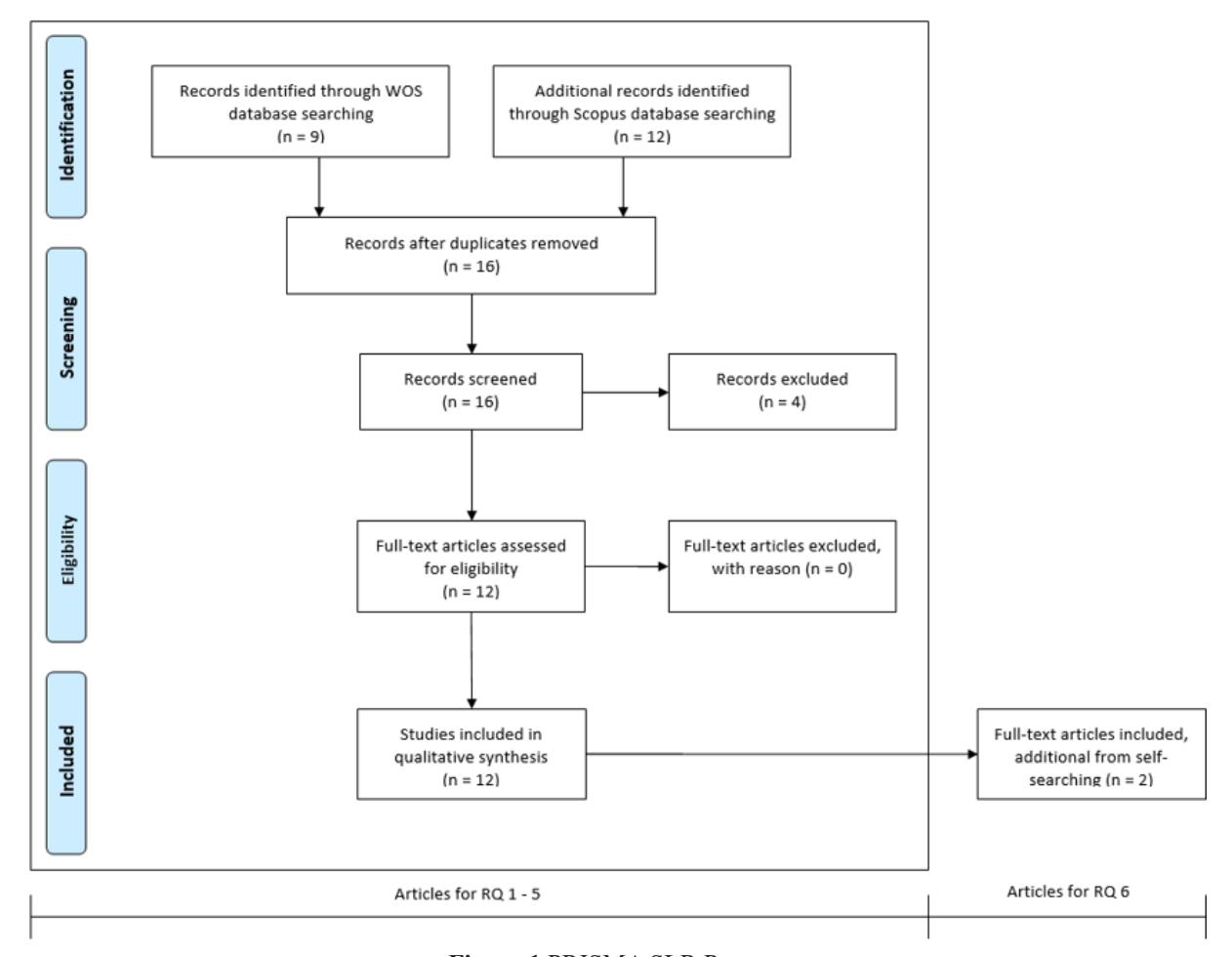
Figure 1 PRISMA SLR Process
Table I List of Reviewed Articles
| No | Journal Name | Author(s), Year | Source |
|---|---|---|---|
| 1 | Scientific Annals of Economics and Business | (Özen et al., 2021) | Scopus |
| 2 | International Journal of Manpower | (Mahmoud et al., 2021) | Scopus & WOS |
| 3 | Asian Journal of Business Ethics | (Nayak & Chandiramani, 2022) | Scopus |
| 4 | Technological Forecasting and Social Change | (Nanath et al., 2022) | Scopus & WOS |
| 5 | International Journal of Workplace Health Management | (Lunt et al., 2022) | Scopus |
| 6 | IEEE Transactions on Professional Communication | (Janssen & Carradini, 2021) | Scopus |
| 7 | BMJ Leader | (Ananda-Rajah et al., 2021) | Scopus |
| 8 | Journal of Enterprise Information Management | (Alshare et al., 2022) | WOS |
| 9 | Journal of Nursing Management | (Halcomb et al., 2020) | WOS |
| 10 | Journal of Business Research | (Zutshi et al., 2021) | WOS |
| 11 | Journal of Applied Psychology | (Shao et al., 2021) | WOS |
| 12 | Journal of Career Assessment | (Owens et al., 2022) | Scopus & WOS |
Result and Discussion
In line with one of the research questions, the following is a summary of the analysis performed to identify the subjects, sectors, and locations using social media in the workplace. The literature reveals that studies focusing on workers dominate compared to other groups.
Table II Social Media in Workplace Literature Review
| Author(s) & (Year) | Object | Sector | Location | Platform | Functionality | Impact | Formality |
|---|---|---|---|---|---|---|---|
| (Alshare et al., 2022) | Social media users in MidEast | n.m. | MidEast | Sharing Pandemic Info (Sharing) | Negative | Informal | |
| (Ananda Rajah et al., 2021) | Healthcare Worker | Healthcare | Australia | n.m. | Health Workers' Promotion Media (Sharing, Relationship, Communication) | Positive | Formal |
| (Özen et al., 2021) | Employee in Financial Sector | Financial | Turkey | n.m. | Survey Distribution Media (Sharing, Relationship, Communication) | Positive | Formal |
| (Halcomb et al., 2020) | Primary Healthcare Nurses | Healthcare | Australia | Facebook, Twitter, | Survey Distribution Media (Sharing, Relationship, Communication) | Positive | Formal |
| (Janssen & Carradini, 2021) | Generation Z | Multi | US | LinkedIn, Snapchat | Communication (Conversations) | Positive and Negative | Formal and Informal |
| (Lunt et al., 2022) | UK Workers recovering from COVID-19 | Health, Social Care & Education | UK | n.m. | Survey Distribution Media (Sharing, Relationship, Communication) | Positive | Formal |
| (Mahmoud et al., 2021) | 600 workers | Various service industries | Canada | Survey Distribution Media (Sharing, Relationship, Communication) | Positive | Formal | |
|---|---|---|---|---|---|---|---|
| (Nanath et al., 2022) | 3 Million Global Tweets | General | Global | Data Source Media (Sharing) | Positive and Negative | Informal | |
| (Nayak & Chandiramani, 2022) | Punjab and Maharashtra Cooperative (PMC) Bank (depositor) | Banking | India | Google, Facebook, LinkedIn, Twitter and WhatsApp | Study Object (Sharing, Presence, Reputation) | Negative | Informal |
| (Owens et al., 2022) | 320 Workers | Service Industry | US | Reddit, Facebook, and | Data Source Media (Sharing) | Positive | Formal |
| (Shao et al., 2021) | Full-time employees | Multi | Canada | n.m. | Explanation of Data Access Sources for COVID-19 (Sharing) | Positive | Formal |
| (Zutshi et al., 2021) | Higher education civitas | Higher Education | General | n.m. | Fact Explanation Reinforcement (Sharing) | Positive | Formal |
*n.m. = not mentioned
Objects, Sectors, and Location
In terms of sectors and workplace locations, there is a wide diversity spread across various fields and regions globally. Studies on healthcare workers (Alshare et al., 2022; Halcomb et al., 2020) were conducted in Australia, while other studies (Lunt et al., 2022) included subjects from the social and education sectors in the United Kingdom, in addition to healthcare. Furthermore, studies on workers in other sectors, such as banking in India and Turkey (Özen et al., 2021), and the service sector in Canada and the United States (Mahmoud et al., 2021; Owens et al., 2022), were also noted. Research also covered various sectors and regions (Janssen & Carradini, 2021; Shao et al., 2021) in the US and Canada.
Additionally, studies focused on investors in the banking sector in India (Nayak & Chandiramani, 2022), academic communities in higher education across various locations (Zutshi et al., 2021), and various groups in workplaces in the Middle East (Nanath et al., 2022). With this data on subjects, sectors, and regions, we can identify the dynamics of social media studies in the workplace during and after the COVID-19 pandemic.
Platforms
This section describes the results of identifying the types of social media platforms used in the workplace. The literature reveals that the platforms used include WhatsApp (Alshare et al., 2022; Nayak & Chandiramani, 2022), Facebook (Halcomb et al., 2020; Nayak & Chandiramani, 2022; Owens et al., 2022), Twitter (Halcomb et al., 2020; Nanath et al., 2022; Nayak & Chandiramani, 2022), LinkedIn (Halcomb et al., 2020; Janssen & Carradini, 2021; Mahmoud et al., 2021; Nayak & Chandiramani, 2022), Snapchat (Janssen & Carradini, 2021), Google (Nayak & Chandiramani, 2022), Reddit (Owens et al., 2022), and Instagram (Owens et al., 2022). However, some studies (e.g., Ananda-Rajah et al., 2021; Özen et al., 2021) do not explicitly mention the types of social media observed and used in the studied subjects.
It appears that the use of platforms is quite diverse and highly dependent on the type of workplace and the habits of a particular group regarding which social media platforms are most frequently used or implemented.
Functionality
The functionality of social media within the work environment largely determines its impact on the workplace. To analyze this, we use the Honeycomb framework by Kietzman (2009), which is widely used in various literature as an analytical framework for social media functionality. Kietzman (2009) classifies social media into seven functions and implications: presence, sharing, relationships, identity, conversations, groups, and reputation.
Based on our literature review, the functionality of social media in various workplaces is implemented in several forms: (i) Sharing: Employees use social media to share various information related to promotions, pandemic updates, and data, and as a medium for distributing online surveys, which became an effective alternative during the pandemic to avoid direct contact with respondents (Alshare et al., 2022; Ananda-Rajah et al., 2021; Halcomb et al., 2020; Nanath et al., 2022; Nayak & Chandiramani, 2022; Owens et al., 2022; Özen et al., 2021; Shao et al., 2021; Zutshi et al., 2021). (ii) Relationships: In crisis situations, the role of social media in building relationships becomes more significant. Employees use it to reach out to other users as research respondents (Ananda-Rajah et al., 2021; Halcomb et al., 2020; Lunt et al., 2022; Mahmoud et al., 2021; Özen et al., 2021). (iii) Conversations: social media is used for conversations, helping maintain communication during crises (Ananda-Rajah et al., 2021; Halcomb et al., 2020; Janssen & Carradini, 2021; Lunt et al., 2022; Mahmoud et al., 2021; Özen et al., 2021). (iv) Presence: Besides building new relationships, during crises, employees increasingly rely on social media for conversations (Nayak & Chandiramani, 2022). (v) Reputation: social media also plays a role in managing and enhancing reputation (Nayak & Chandiramani, 2022). This framework helps us understand the diverse ways social media is utilized in the workplace and its significant impact during and after the COVID-19 pandemic.
Impact
The impacts of social media in the workplace can be categorized into two main groups: positive and negative. Positive impacts include enhanced communication, relationship building, and information sharing, as evidenced by studies from Ananda-Rajah et al. (2021), Halcomb et al. (2020), Janssen & Carradini (2021), Lunt et al. (2022), Mahmoud et al. (2021), Nanath et al. (2022), Owens et al. (2022), Özen et al. (2021), Shao et al. (2021), and Zutshi et al. (2021) (2021). These studies highlight benefits such as improved collaboration, increased employee engagement, and better information dissemination.
On the other hand, negative impacts, such as increased stress and distraction, are highlighted in studies by Alshare et al. (2022), Janssen & Carradini (2021), Nanath et al. (2022), and Nayak & Chandiramani (2022). These studies point out issues like reduced productivity, privacy concerns, and the potential for misinformation. While the literature predominantly shows positive effects, it is crucial to explore the negative aspects, especially considering the higher risks and lower supervision associated with remote work compared to on-site work.
Level of Formality
In the context of social media usage in the workplace, informal communication refers to the casual and unstructured exchange of information among employees. Studies by Alshare et al. (2022), Janssen & Carradini (2021), Nanath et al. (2022), and Nayak & Chandiramani (2022) highlight how informal communication through social media can facilitate quick information sharing, foster relationships, and create a sense of community among employees. This type of communication is not bound by formal
organizational structures or protocols, allowing for more spontaneous and personal interactions. Informal communication can be particularly beneficial in building team cohesion and providing a platform for employees to share ideas and feedback in a relaxed environment.
On the other hand, formal communication involves the structured and official exchange of information within an organization. Studies by Ananda-Rajah et al. (2021), Halcomb et al. (2020), Janssen & Carradini (2021), Lunt et al. (2022), Mahmoud et al. (2021), Owens et al. (2022), Özen et al. (2021), Shao et al. (2021), and Zutshi et al. (2021) demonstrate how social media can be used for formal communication purposes, such as disseminating official announcements, conducting professional discussions, and maintaining organizational records. Formal communication through social media ensures that information is conveyed in a clear, consistent, and professional manner, adhering to organizational policies and standards. This type of communication is essential for maintaining transparency, accountability, and a structured flow of information within the workplace.
Future Research Agenda
The findings of this study provide a comprehensive overview of empirical research literature on social media in the workplace. This study addresses existing research gaps and offers practical insights and guidance for future research on gamification based on prevalent themes. By achieving the first three objectives, we present researchers with a structured and thorough understanding of the domain and the current state of knowledge, which can help prevent redundant research and identify research gaps. The review uncovered several academic gaps in the literature, as well as conceptual and methodological limitations. Considering these shortcomings and the current literature on social media in the workplace, we have outlined agendas for further research in this field.
Table III Future Research Agenda
| Author(s) & Years | Future Research Directions / Topics / Questions | ||||
|---|---|---|---|---|---|
| (Alshare et al., 2022) | Raising awareness about the negative aspects of social media usage is essential for both the public and employees. | ||||
| Link between social media use and cultural dimensions, highlighting the need for comparative studies. | |||||
| Investigate additional factors influencing social media use at work and home. | |||||
| Measuring social media's effects through physical indicators, such as stress levels and blood pressure, is a promising research area. | |||||
| The impacts of social media on employee productivity, both direct and indirect, should be examined. | |||||
| Analyzing different social media platforms is also crucial for understanding their varied effects. | |||||
| (Janssen & Carradini, 2021) | Communication habits may significantly impact business practices, requiring employers and educators to adapt to these changes. | ||||
| Understanding Generation Z's tech-savvy nature can help to dispel negative stereotypes about young workers. | |||||
| Awareness of technology's drawbacks, such as the need for self-regulation, is vital; some | |||||
| individuals mitigate usage by removing distracting apps like games and certain social media platforms. | |||||
| (Mahmoud et al., | Social media research on Generation X, Generation Y, Generation Z | ||||
| 2021) | Research should focus on the direct and indirect effects of social media usage on employee productivity. | ||||
| Analyzing different social media platforms is essential for understanding their impact in the workplace. | |||||
| (Nayak & Chandiramani, | Best practices for fostering ethical behavior in virtual workplaces and explores pedagogical strategies for information management in the new normal. | ||||
| 2022) | There is insufficient research on whether ethics education should be different for remote stakeholders compared to those in on-site environments. | ||||
| (Reuschl et al., 2022) | The study introduces **organizational elasticity** as a framework for managing the pandemic's long-term impacts. Organizational elasticity is vital for corporate success, allowing integration of short-term actions into sustainable transformations for a volatile post-pandemic landscape. |
|---|---|
| (Suryandari, 2021) | Research on intercultural communication and globalization focuses on themes like cultural values in new media, cultural identity, and intercultural interactions. Further studies are needed on cultural variations in new media for communication. Exploration of new media's impact on intercultural dialogue is essential. Investigating the potential of new media to resolve intercultural conflicts requires more research. |
Conclusion
Our systematic review synthesizes and presents an overview of the literature in the field of social media in the workplace. Despite a thorough and systematic approach, the review has limitations. We used general keywords within the timeframe of the pandemic, focusing on general workplace settings rather than solely profit-oriented organizations. The implications of this study suggest that during crises similar to the pandemic, post-pandemic work patterns can become more effective and efficient, as organizations are compelled to quickly adapt to using social media technologies. However, this research still has limitations, such as only taking English language references and not involving articles with SSCI indexation from more diverse fields. Future research should consider cross-cultural and longitudinal studies and focus on aspects such as research methods and objects, sectors, regions, platforms, impacts, and levels of formality. Many executives may eschew or ignore social media due to a lack of understanding. Therefore, we recommend that firms develop strategies for monitoring, understanding, and responding to various social media activities. Social media introduces substantial and pervasive changes to communication between organizations, communities, and individuals.
Acknowledgment
This research was fully funded by Universitas Widyatama under the Internal Grant Scheme of the Lembaga Penelitian, Pengabdian Kepada Masyarakat & Modal Intelektual (LP2M) for the research cluster group with contract No. 03/SPC1/P/LP2M-UTAMA/XI/2022.