

INFO ARTIKEL
Kata kunci:
rekomendasi pelanggan, rating pelanggan, pengalaman pelanggan, loyalitas pelanggan, kepuasan pelanggan
ABSTRAK
Industri kopi merupakan salah satu sektor yang mengalami pertumbuhan berkelanjutan di Indonesia. Kedai kopi sebagai salah satu bisnis yang berkembang pesat di negara ini. Kepopuleran dan transformasi industri kedai kopi menjadi sektor yang sangat kompetitif. Hal tersebut dapat dilihat melalui kepuasan pelanggan. Penelitian ini bertujuan untuk mengetahui pengaruh rekomendasi, penilaian, dan pengalaman pelanggan terhadap loyalitas pelanggan. Dari total 326 kuesioner yang dikirimkan oleh partisipan, 282 kuesioner dianggap dapat digunakan. Penelitian ini menggunakan teknik Purposive
Sampling non-probabilitas. Analisis data tambahan dilakukan menggunakan analisis deskriptif dalam studi penelitian dengan menggunakan perangkat lunak pengolah data SPSS yang hubungannya dengan analisis regresi hirarkis. Loyalitas konsumen secara signifikan dipengaruhi oleh penilaian, rekomendasi, dan pengalaman konsumen sesuai dengan temuan analisis hirarkis. Demikian pula, loyalitas konsumen secara substansial dipengaruhi oleh kepuasan pelanggan. Namun, kepuasan pelanggan tidak memoderasi hubungan antara rekomendasi, penilaian, dan pengalaman konsumen terhadap loyalitas konsumen harena hasil penelitian menunjukan tidak signifikan. Temuan penelitian ini menunjukkan rekomendasi, penilaian, dan pengalaman pelanggan di Mosslife Coffee memiliki pengaruh yang signifikan terhadap loyalitas pelanggan terhadap Mosslife Coffee. Kepuasan pelanggan juga memiliki pengaruh yang penting terhadap loyalitas pelanggan, tetapi tidak mengurangi korelasi antara rekomendasi, penilaian, dan pengalaman pelanggan terhadap loyalitas di Mosslife Coffee.
Introduction
The coffee industry is one of the sectors that is experiencing sustained growth in Indonesia, with coffee shops being among the swiftly expanding businesses in the country. Presently, 300,000 tons of coffee are consumed in Indonesia, representing an 8% increase since the previous year (Indonesia.go.id, 2022). This circumstance fosters the emergence of diverse coffee shops, encompassing both conventional and contemporary designs, each providing its distinctive qualities (Department of Investment & One-Stop Integrated Services Kepbabel, 2024). Given the increasing prominence and transformation of the coffee shop industry into a highly competitive sector, entrepreneurs are striving to devise novel approaches to retain consumers (Jang et al., 2015). Coffee shops serve as important social venues, providing patrons with the chance to enjoy coffee and participate in leisure activities. Among younger generations (Toffin.id, 2024), particularly Generation Z and millennials, coffee shops are preferred destinations for socializing with friends and family (Kompas.id, 2024).
Customer satisfaction, which is a sentiment that emerges from a purchase evaluation and is determined by the discrepancy between actual perceptions and expectations, is crucial in a competitive market because it influences the retention of current customers and the acquisition of new ones (Zaid & Patwayati, 2021). Customer loyalty, conversely, pertains to the disposition of a consumer concerning a particular service or product, which is established through iterative customer interactions with said service or product (Ertemel et al., 2021). Consumer loyalty is significantly influenced by the level of consumer satisfaction. Customers who express contentment with a particular product or service are inclined to maintain their purchases and may even advocate for it to others (Lucini et al., 2020). This conclusion is consistent with the findings of Akbar and Parvez (2009), who discovered a significant and positive correlation between customer satisfaction and customer loyalty. Consequently, a high degree of satisfaction can inspire great loyalty.
Customer referral is the verbal endorsement or promotion of a product or service by a customer (Chatterjee, 2019). Customer recommendation refers to the voluntary act of consumers endorsing or promoting a particular brand, product, or service to others. Using "word of mouth," this promotion is conducted, either in person or via social media. Customer loyalty and customer recommendation are interdependent. By promoting customer referrals, organizations can enhance customer loyalty. This assertion is substantiated by the findings of Yoon et al. (2013), who discovered that customer referrals constitute a significant component of customer loyalty.
Customer rating, alternatively referred to as customer appraisal of a product or service, is an evaluation method that employs quantitative scores (Camilleri & Filieri, 2023). In essence, customer ratings hold significant value for both organizations and clients, as they facilitate informed decisionmaking, enhance product excellence, and improve customer support. Customer loyalty and customer rating are interdependent. Businesses can increase sales and client loyalty by boosting customer ratings. Heras-Saizarbitoria et al. (2015) state that customer ratings are frequently preceded by metrics or factors that are relatively limited in scope. However, customer satisfaction is the criterion most frequently applied when assessing customer ratings.
In contrast, the customer experience encompasses all aspects of a brand and is constructed through the interplay among different products within that line (Abdelkader, 2023). Furthermore, customer experience includes a wide range of behaviors and responses that occur during the service provider-client relationship (Guyader et al., 2022). In other words, customer experience includes the complete interaction between a consumer and a brand. This experience encompasses all the products and services provided by the brand, not just a single item. Customer loyalty will be directly influenced by the development of the customer experience, according to research by Zaid & Patwayati (2021), which demonstrates a significant and positive direct correlation between the two variables. Conversely, Pekovic and Rolland (2020) assert that no single aspect of customer experience meets the criteria necessary for enhancing customer loyalty. Through the lens of customer satisfaction, this study aims to determine how customer recommendations, customer ratings, and overall customer experience influence customer loyalty.
Customer Recommendation
According to Keiningham et al. (2007), customer recommendations serve as an indicator of the extent to which consumers are loyal to a particular company or brand. Furthermore, Kotler and Keller (2016) stated customer recommendations, including those "recommended by relatives or friends" and "recommendations from consumers," continue to have the most significant impact on consumer decisionmaking. Feedback from fellow consumers is regarded as a more reliable source of information than that provided by specialists (Bonabeau, 2004). Chen (2008), who also referenced this finding in his research, discovered that recommendations from fellow consumers had a more significant influence compared to those from experts. According to a study conducted by Simonson (2003), customer recommendations have the potential to establish customer loyalty and encourage repetitive purchases of goods and services. For customers to experience satisfaction, the product must be customized to their antecedents and requirements, thereby eliciting their acceptance of the offer and fostering a commitment to the marketercustomer relationship.
González-Viralta et al. (2023) define customer loyalty as either the frequency of repeat purchases or the relative volume of purchases of the same brand, both of which impact consumer cognition, affection, and behavior. Customer recommendation and customer loyalty are intricately intertwined, with the former being encouraged to continue using the latter by positive recommendations from dependable individuals, such as family and friends, who endorse the former's or the brand's products or services. This conclusion is corroborated by the findings of Reichheld (2003), who discovered that the intention to recommend is the most accurate indicator of customer loyalty. Additionally, Yoon et al. (2013) discovered that recommendations constitute a significant component of consumer loyalty. According to the description above, the author proposes the following hypothesis:
H1: Customer recommendation influences customer loyalty.
Customer Rating
To elucidate customer ratings, it is critical to incorporate consumer-generated content that is relevant to the data collected. To determine the factors that influence consumer ratings, a combination of qualitative and quantitative data is utilized in conjunction with evaluation, sentiment, and emotion as customer rating dimensions (Chatterjee, 2019). Customer evaluations often begin with a relatively narrow set of metrics or factors. However, customer satisfaction is the criterion most frequently applied when assessing
customer ratings. Heras-Saizarbitoria et al. (2015) state that organizations that receive favorable customer evaluations demonstrate improved performance. Customer ratings serve as indicators of a company's past quality performance and its commitment to improving quality in future endeavors (Sayfuddin & Chen, 2021). As a result, the classification provides a more comprehensive view of the quality of service rendered, reflecting diverse perspectives from various aspects of the service combined.
Loyal customers are more inclined to engage in repeat purchases, offer positive evaluations and ratings of the brand, and are even more willing to pay premium prices (Kwon & Lennon, 2009). There is an interdependence between customer loyalty and customer ratings, meaning that favorable evaluations given by existing customers may encourage new customers to engage with and continue using the product. It is supported by Chatterjee's (2019) research, which indicates that customer ratings can increase sales, repeat sales, and referral behavior, as well as foster a customer-loyal attitude. Based on the description above, the author proposes the following hypothesis:
H2: Customer rating affects customer loyalty
Customer Experience
Customer experience, as a broad concept, encompasses various dimensions such as cognitive, emotional, behavioral, sensorial, spiritual, social, and physical aspects (Lemon & Verhoef, 2016). Customer experience is defined by Johnston and Clark (2005) as the customer's cognition, emotions, and behavior about interactions that generate mental images. The touchpoint, customer journey, and partner dimensions of customer experience have been designated by Gahler et al. (2023) as the foundational elements for assessing customer experience. In addition to the aforementioned, Shaw et al. (2010) define customer experience as the correlation between an organization and its clientele, as assessed by the customer's volitional and unconscious cognitions. Customer satisfaction can be readily assessed by evaluating the extent to which rational organizational performance, sensory stimulation, and emotional evocation are integrated into each interaction.
There are two distinct forms of customer loyalty: behavioral loyalty and attitudinal loyalty. Behavioral loyalty indicates that a customer frequently purchases the same product, whereas attitudinal loyalty signifies the customer's devotion to the product (Liu et al., 2021). Consumer loyalty and consumer experience are interdependent. Enhancing the customer experience will directly influence the development of consumer loyalty. A study conducted by Zaid and Patwayati (2021) revealed a statistically significant and positive direct correlation between customer loyalty and customer experience. Customer experience, which encompasses subjective reactions after a customer engages with a company, brand, service, or product, is classified as a psychological construct (Barbu et al., 2021). Based on the description provided above, the author proposes a hypothesis:
H3: Customer experience influences customer loyalty.
Customer Satisfaction
Satisfaction is the degree of gratification or discontentment an individual experiences when comparing the perceived performance (or outcomes) of a product or service to their initial expectations (Kotler & Keller, 2016). Customer satisfaction refers to the degree of gratification or discontentment an individual experiences when evaluating the extent to which the actual performance of a product meets their anticipated standards. Customer satisfaction can be defined as how customers evaluate the quality of a product; this evaluation is influenced by the perceived value of the product and is adjusted by customer expectations (Yoon et al., 2013). Customer loyalty is significantly influenced by customer satisfaction; repeat purchases are the consequence of consumers being pleased with the service or product offered by the organization (Khan et al., 2020). The degree of disparity between the perceived quality of products or services and the quality expectations held before the purchase can serve as an indicator of customer satisfaction (Lucini et al., 2020).
Customer loyalty is a critical component of a successful business strategy. Customer loyalty in the business world is established when initial purchasers are content with the product or service they initially select and subsequently maintain a long-term commitment to purchasing it (Zaid & Patwayati, 2021). Customer loyalty and satisfaction are regarded as the most significant indicators of a business's success. A robust correlation has been identified by scholars between customer loyalty and satisfaction (Agarwal & Dhingra, 2023). Repeated purchases of products or services are more probable when customers have a favorable experience (Gazi et al., 2024). This assertion is substantiated by a study conducted by Chatterjee (2019), which demonstrated that customer satisfaction leads to consumer loyalty. Furthermore, an investigation conducted by Akbar and Parvez (2009) revealed that customer loyalty is positively and significantly impacted by customer satisfaction. According to the description above, the author proposes a hypothesis:
H4: Customer satisfaction influences customer loyalty.
Customer Loyalty
Customer loyalty can be defined as an individual's resolute dedication to consistently repurchase or subscribe to a preferred product or service in the future. This commitment manifests as repeated purchases of the same brand or a series of brands, even in the face of situational factors and marketing initiatives that may attempt to alter consumer behavior (Yuksel et al., 2010). Scholars have discovered that customer loyalty is comprised of customers' attitudes and actions. Customer attitudes encompass various factors, such as the willingness to recommend the company to others, the intention to repurchase goods or services from the same provider, and the desire to purchase additional goods or services from the same provider (Schoorman et al., 2007). Customer loyalty can also be observed through the ongoing use of a company's products or services by customers who are loyal and advocate for the business to others (Akbar & Parvez, 2009). Customer loyalty is a critical determinant in forecasting market share and profit levels, and it is also regarded as a competitive advantage for a business (Chen, 2012). Thus, it can be inferred that customer loyalty consists of a customer's inclination to purchase products from a specific brand regularly. It also enables customers to voluntarily engage in positive discourse regarding the brand, attributing it to their inherent contentment and preference for the product's advantages, as well as recommending it to their networks. According to the description above, the author proposes a hypothesis:
H5: Customer satisfaction moderates the relationship between customer recommendations, ratings, and experience in terms of customer loyalty.
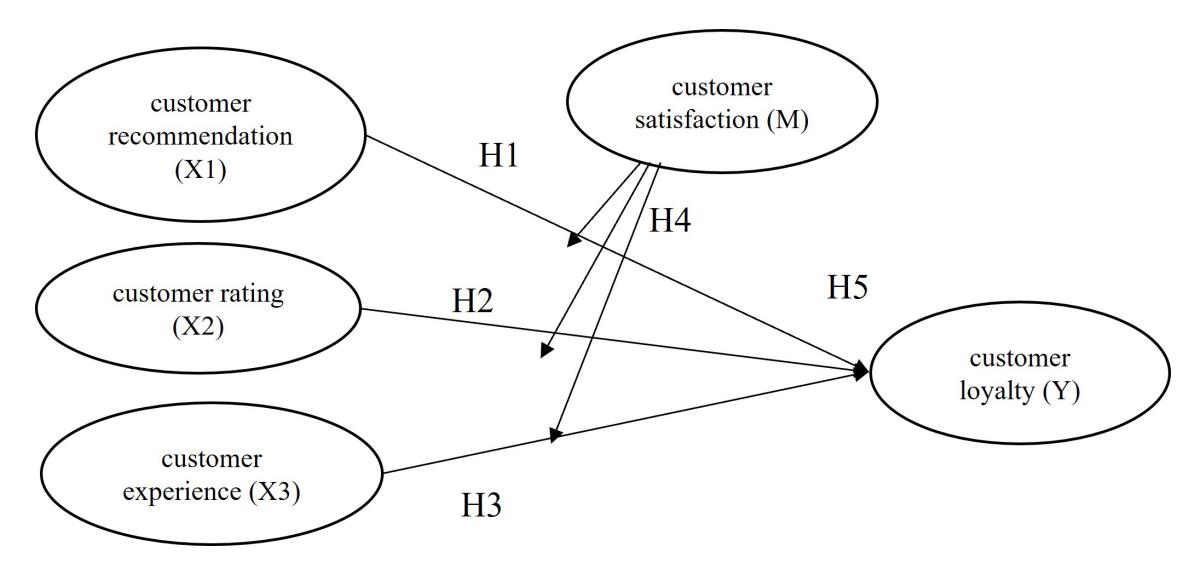
Figure 1 Thinking Framework
Method
The research population includes Mosslife Coffee customers who are located in Jakarta. Instances of Mosslife Coffee establishments can be found in Central Jakarta and South Jakarta. The data for this study was gathered via a survey employing a questionnaire as the measuring instrument; the approach utilized is quantitative in nature. Out of the total 326 questionnaires submitted by the participants, 282 were deemed usable. Purposive sampling, a non-probability random sampling technique, was employed in this investigation. Additional data analysis was conducted using descriptive analysis in the research study. The data processing software, SPSS, was used in conjunction with hierarchical regression analysis.
Abrams (1999) proposed a hierarchical multiple regression model. He formulated a hierarchical multiple regression model to predict the relationships among various components. At different stages, this model integrates various predictor variables, including moderators, intervening factors, and independent variables. Through hierarchical regression, the predictor categories account for the distinctive variation in the dependent variable, and the increase in R² is examined through the entry of each predictor variable category.
The mediator effect was assessed and defined by Baron and Kenny (1986). A mediator is a variable that satisfies the following three criteria: (a) changes in the level of the independent variable significantly explain changes in the expected mediator; (b) changes in the level of the mediator significantly explain changes in the dependent variable; and (c) the previously negligible relationship between the independent and dependent variables becomes significantly reduced or disappears when a and b are controlled.
A three-level linear regression was implemented to evaluate the moderator variable's influence (Ndubisi & Richardson, 2002). The independent dimensions are introduced at the first level, the moderator at the second level, and the interaction terms at the third level.
Results and Discussion
Out of the total 326 surveys submitted by respondents, only 282 were deemed usable. Among the respondents, 51.8% identified as female and 48.2% as male. The majority of respondents were between the ages of 21 and 30 (37.6%) and 31 and 40 (41.8%), according to the data. Jakarta constitutes 24.5% of the overall consumer base, while Bekasi accounts for a smaller percentage that is not specified. In contrast, a significant proportion of the participants (50.7%) dined at the Mosslife Coffee establishment in Central Jakarta, while 49.3% visited the location in South Jakarta. A proportional 21.8% of the respondents were employed, whereas 26.2% were enrolled as students. A total of 33.9% of the respondents indicated that they were visiting either to meet clients (30.9%) or simply to socialize (33.7%). 58.5 percent of the respondents visited twice, while 34.4 percent visited three to five times. The respondents rated the ambiance of Mosslife Coffee as their favorite aspect, while 27.3% mentioned the products and 35.5% highlighted the atmosphere.
To ensure the reliability of these variables, Cronbach's alpha test is implemented. Based on the gathered data, it can be concluded that the experience (\(\alpha = 0.871\)), recommendation (\(\alpha = 0.887\)), and rating (\(\alpha = 0.867\)) are all suitable. The Cronbach's alpha values for delight and loyalty are (\(\alpha = 0.835\) and \(\alpha = 0.827\)), respectively. The average values for the subsequent dimensions are as follows: loyalty (35.88), satisfaction (31.32), experience (26.87), rating (26.71), and recommendation (26.99). According to these results, the majority of respondents are satisfied with the products and services provided by Mosslife Coffee.
Table I Descriptive Statistics
| N | Minimum | Maximum | Mean | Std. Deviation | Cronbach's Alpha Coefficient | |
|---|---|---|---|---|---|---|
| X1=RECOMMENDATION | 282 | 18 | 30 | 27 | 1.813 | 0.887 |
| X2=RATING | 282 | 18 | 30 | 26.7 | 1.888 | 0.867 |
| X3=EXPERIENCE | 282 | 21 | 30 | 26.9 | 1.657 | 0.871 |
| M=SATISFACTION | 282 | 24 | 35 | 31.3 | 2.081 | 0.835 |
| Y=LOYALTY | 282 | 24 | 40 | 35.9 | 2.182 | 0.827 |
| Valid N (listwise) | 282 |
Source: Data processed by author (2024)
Measurement Model Comparison Table
Tabel II Model Summary
| , | Model Summary | |||||||||
|---|---|---|---|---|---|---|---|---|---|---|
| A d:4- d | Ctd Eman of | Change Statistics | ||||||||
| Model | R | R Square | Adjusted R Square | Std. Error of the Estimate | R Square Change | F Change | df1 | df2 | Sig. F Change | |
| 1 | .711ª | .505 | .500 | 1.543 | .505 | 94.727 | 3 | 278 | .000 | |
| 2 | .729b | .531 | .524 | 1.505 | .025 | 14.944 | 1 | 277 | .000 | |
| 3 | .730° | .533 | .525 | 1.504 | .002 | 1.441 | 1 | 276 | .231 | |
| 4 | .730d | .533 | .523 | 1.507 | .000 | .059 | 1 | 275 | .808 | |
| 5 | .730e | .534 | .522 | 1.509 | .000 | .127 | 1 | 274 | .722 | |
Source: Data processed by author (2024)
The information in Table II suggests that Model 1 may provide an explanation of customer loyalty. Model 1 exclusively utilizes three variables—X1 (customer referral), X2 (customer rating), and X3 (customer experience)—to forecast customer loyalty. The results indicate that these three variables have a significant impact on customer loyalty, as indicated by the adjusted R-squared value of 0.500 and the statistical significance of the F test (p-value = 0.000). The R-squared value of 0.505 indicates that this model can explain 50.5% of the variation in customer loyalty. Model No. 2, Model 1, is supplemented with the variable M, which represents customer satisfaction. The results suggest that customer satisfaction has a substantial effect on customer loyalty. By increasing the R-squared value to 0.531, the M variable accounted for 2.6% of the variance in Y that was explained. Additionally, the value of adjusted R-squared increased to 0.524. The addition of variable M is statistically significant, with a p-value of 0.000, as determined by the F test.
Model 3 integrates the interaction between variable X1 and variable M (ITE1) from model 2. According to the findings from the analysis, this interaction is deemed insignificant. The R-squared value experienced a marginal increase, rising to 0.533, while the adjusted R-squared value remained virtually unchanged at 0.525. The statistical analysis using the F test reveals that the inclusion of the ITE1 variable does not make a difference (p-value = 0.231). Model 4 integrates the interaction between variable X2 and variable M (ITE2) into model 2. According to the findings, this interaction is insignificant. The adjusted R-squared value is 0.523, which is identical to model 3. Furthermore, the inclusion of the ITE2 variable does not yield a statistically significant result (p-value = 0.808). Model 5 integrates the ITE3 interaction between X3 and M with Model 2. According to the findings, this interaction is insignificant. R-squared and adjusted R-squared increased marginally to 0.534 and 0.522, respectively, and the inclusion of the ITE3 variable did not yield a statistically significant result (p-value = 0.722).
Customer loyalty is significantly impacted by customer rating, customer recommendation, and customer experience, according to the findings of the hierarchical analysis. Similarly, consumer loyalty is substantially impacted by customer satisfaction. On the other hand, the relationship between customer satisfaction, customer recommendation, customer rating, and customer experience has no discernible impact on customer loyalty. Model 2 has the highest R-squared value among the five models generated, indicating its superior ability to predict consumer loyalty (0.531).
A hierarchical regression analysis was conducted to examine the potential moderating effect of customer satisfaction on customer loyalty. The outcomes of this investigation are presented in the table titled "The Moderating Effect of Customer Satisfaction." The significance of customer experience, rating, and recommendation about customer loyalty is not moderated by customer satisfaction, as shown in the table below.
Table III presents the results of a hierarchical regression analysis examining the moderating influence of customer satisfaction on the association between the dependent and independent variables.
Tabel III The Moderating Effect of Customer Satisfaction in the Relationship between the Independent Variable and the Dependent Variable
| Step 1 | Step 2 | Step 3 | ||||
|---|---|---|---|---|---|---|
| Variable | B | Sig. | B | Sig. | B | Sig. |
| Customer recommendation | .336 | .000 | .279 | .000 | .810 | .338 |
| Customer rating | .275 | .000 | .198 | .003 | .570 | .551 |
| Customer experience | .438 | .000 | .348 | .000 | 022 | .983 |
| Customer satisfaction | .231 | .000 | .688 | .183 | ||
| Customer recommendation*satisfaction | 017 | .526 | ||||
| Customer rating*satisfaction | 012 | .691 | ||||
| Customer experience*satisfaction | .012 | .722 | ||||
| R2 | .505 | .531 | .534 | |||
| Adj R2 | .500 | .524 | .522 | |||
| Change of R2 | .505 | .025 | .000 | |||
| F | 94.727 | 78.435 | 44.776 | |||
| F change | 94.727 | 14.944 | .127 | |||
| A significant change in F | .000 | .000 | .722 | |||
Source: Data processed by author (2024)
As illustrated in Table III, the independent variable enter into the equation in step 1. Customer Loyalty (Y) is significantly and positively influenced by Customer Recommendation (X1), as indicated by the regression coefficient of 0.336 and the p-value of 0.000. Mosslife Coffee's loyalty is strongly
influenced by positive recommendations from customers. The more customers who recommend Mosslife Coffee to others, the more likely they are to become loyal customers. This is why Mosslife Coffee should use a referral program strategy, offer loyalty rewards for recommendations, or provide special discounts for customers who bring new friends. Customer Loyalty (Y) is significantly and positively influenced by Customer Rating (X2), as indicated by the regression coefficient of 0.275 and the p-value of 0.000. Customer ratings have a significant impact on customer loyalty. Positive customer ratings lead to increased loyalty and positive reviews, which in turn enhance a business's reputation and customer satisfaction. Therefore, Mosslife Coffee should focus on encouraging positive online reviews to enhance its reputation and customer satisfaction. Customer Loyalty (Y) is significantly and positively influenced by Customer Experience (X3), as indicated by the regression coefficient of 0.438 and the p-value of 0.000. Mosslife Coffee's loyalty is significantly influenced by customer experience. Positive interactions with the company, fast and professional service, and easy access contribute to customer loyalty. To achieve this, Mosslife Coffee should focus on enhancing service quality, customer service, and staff interaction and also improve staff training and innovation.
Proceed to step 2 of the equation by including all independent variables and inserting the mediator variable. Customer recommendation (X1) still has a significant and positive effect on Customer loyalty (Y), as indicated by a regression coefficient of 0.279 and a p-value of 0.000. Customer loyalty (Y) is still significantly and positively influenced by customer rating (X2), as indicated by a regression coefficient of 0.198 and a p-value of 0.003. Customer loyalty (Y) is still significantly and positively influenced by Customer experience (X3), as indicated by a regression coefficient of 0.348 and a p-value of 0.000. At this stage, the model includes Customer satisfaction (M); it shows a statistically significant impact on Customer loyalty (Y), as indicated by a regression coefficient of 0.231 and a p-value of 0.000. Customer recommendations, customer ratings, customer experience, and customer satisfaction are all positively and significantly related to customer loyalty, as supported by these findings. Customer satisfaction is a significant determinant of loyalty, as it shapes customer loyalty to the company. Positive feedback, such as "I like Mosslife Coffee because it suits my taste" and "Mosslife Coffee offers consistently good value," indicates a robust relationship between service quality and loyalty. Regular and timely customer satisfaction surveys are important to preserve high service quality.
In step 3, to examine the moderation hypothesis, a moderating variable is introduced: the interaction between consumer satisfaction. Customer loyalty is not significantly affected by the regression coefficient from interaction 1 (customer recommendation x customer satisfaction) (β = -0.017; p-value 0.526). In cases where customer loyalty is not supported by customer satisfaction as a moderator of the relationship between customer recommendation and customer loyalty. Customer loyalty is not significantly affected by the regression coefficient from interaction 2 (customer rating x customer satisfaction) (β = -0.012; p-value 0.691). Customer satisfaction fails to moderate the association between customer rating and customer loyalty in certain instances. In this instance, the impact of the regression coefficient resulting from interaction 3 (customer experience x customer satisfaction) on customer loyalty is not statistically significant (β = 0.012; p = 0.722). Customer satisfaction fails to moderate the relationship between customer experience and customer loyalty. Therefore, this interaction model has no bearing on the relationship between customer loyalty. F = 44.776, F change = 0.127, Sig. F change = 0.722, R² = 0.534, adj R² = 0.522, R² change = 0.000.
Without moderation, the independent variable and the mediator coexisted in this investigation. We followed the methodology described by Ndubisi & Richardson (2002) to assess our hypothesis and demonstrate that customer loyalty is significantly and positively related to the independent variables (customer recommendation, customer rating, and customer experience), indicating that mediation exists. The equation should incorporate interaction variables such as customer experience reciprocal with customer satisfaction, customer recommendation x customer satisfaction, and customer rating x customer satisfaction. Customer rating (β=0.570, p=0.551), customer experience (β=-0.022, p=0.983), customer recommendation (β=0.810, p=0.338), and customer satisfaction (β=0.688, p=0.183) were ascertained from Table 3 in step 3. The results of step 3 indicate that there is no compelling evidence to suggest that customer satisfaction has a significant impact on the strength of the relationship between customer recommendation, rating, or experience and customer loyalty. In other words, although customer satisfaction is an important variable in and of itself, as a moderator in this relationship, it does not prove significant in this analysis. While customer satisfaction is important, Mosslife Coffee's management needs to focus on strengthening the direct experiences and interactions that drive positive recommendations and reviews, rather than relying on satisfaction as a variable that amplifies these other effects.
Discussion
The results demonstrated that customer recommendation, customer rating, customer experience, and customer satisfaction have a positive effect on customer loyalty. However, the results of the moderation of customer satisfaction cannot be accepted because customer satisfaction cannot moderate the relationship between customer recommendation, customer rating, and customer experience with customer loyalty. This is because customer satisfaction is a more effective direct influence on customer loyalty, without the need to involve customer satisfaction as a moderator. The loyalty of clients is significantly influenced by client ratings, reviews, and experiences. Similarly, customer satisfaction significantly influences customer loyalty. Heras-Saizarbitoria et al. (2015) state that customer ratings are often preceded by rather narrow metrics or factors. However, the factor most often used to evaluate customer ratings is customer satisfaction. Yoon et al. (2013) also found that recommendations are an important aspect of customer loyalty.
Readers of recommendations from other consumers may develop a preference for a particular product or service. This finding suggests that patrons are more likely to remain loyal to a business when they are referred by others, provide favorable reviews, and have overall positive experiences. Consumers use recommendations as a guide when making decisions; user satisfaction increases when the type of recommendation corresponds to the user's purchasing objectives (He et al., 2024). Recommendation systems are extensively implemented across diverse e-commerce platforms. Active user interaction with the system upon entering an online purchasing site contributes to a more pleasant and comfortable shopping experience (Eunjoo & Matthew, 2023).
Further research revealed that customer loyalty is not mediated by satisfaction. This contradicts the findings of earlier studies, which indicate that increased customer satisfaction correlates positively with brand loyalty (Brilliant & Achyar, 2013). Customer satisfaction is typically a subjective evaluation of the customer experience that can be influenced by various extraneous variables that are not directly related to the product or service itself. These variables may include the impact of previous experiences or expectations that are either overly optimistic or pessimistic. It can be reasonably deduced that customers who are happier with a brand will be more loyal to it. Nevertheless, consumer loyalty is not significantly influenced by the correlation between customer ratings, customer recommendations, customer experience, and customer satisfaction. It is recommended that further research consider additional variables, including perceived value, brand image, and emotional attachment. Furthermore, analysis of customer segments, such as age, gender, and consumption preferences, is also advised. Additionally, external factors, such as market competition, consumer trends, and economic changes, should be investigated. By examining new variables, utilizing diverse methodologies, and conducting comprehensive research, customer loyalty can provide more precise and relevant recommendations for business strategies.
Conclusion
The results confirm that customer recommendations, ratings, and the experiences at Mosslife Coffee have a significant impact on customer loyalty to Mosslife. This suggests that customers' decisions to be loyal to Mosslife are influenced by customer ratings, recommendations, and experiences. However, customer satisfaction does not moderate the relationship between these three variables and loyalty, indicating that these factors affect loyalty independently. Consequently, in the strategy of increasing customer loyalty at Mosslife Coffee, the company should prioritize enhancing the customer experience, encouraging positive ratings and recommendations, and guaranteeing that every aspect of service aligns with customer expectations to achieve high levels of satisfaction.
This research has significant theoretical implications. The framework demonstrates the significance that businesses place on customer contentment when conducting online marketing. The impact of product recommendations from other consumers who have had positive experiences with the offerings is substantial. This means that while the company's efforts to publish consumer feedback may pique the interest of new customers, preserving the sentiments of previous clients for the benefit of future clients is of the utmost importance. Ratings or evaluations provided by prior customers significantly impact the inclination of prospective customers to visit as well. Achieving a high rating on the points provided by customers establishes a standard against which future customers can expect to improve outcomes. The third factor is the extent to which the gratification consumers derive from their experience can encourage them to return. The gratification that these three independent variables are capable of eliciting in consumers ultimately results in the development of feelings of loyalty.
Acknowledgement
Mrs. Stella Prana, the general manager of the Cordela Hotel where Mosslife Coffee Senen is situated, is thanked by the author.