

Keywords:
TikTok, lazy glasses, motion capture, body discomfort, eye discomfort
Indonesia is among the countries with the largest number of TikTok users worldwide, with a difference of about 3.52 million users compared to the country ranked first. The widespread use of smartphones for social media activities may influence users' body posture and visual comfort. This study examined the effect of using lazy glasses on body posture and eye discomfort while operating the TikTok application on a smartphone in sitting and lying positions. Ten university students (mean ± SD age = 23.4 ± 0.97 years) participated in the experiment. Four experimental conditions were evaluated: lying without lazy glasses (WOLZB), lying with lazy glasses (LZB), sitting without lazy glasses (WOLZD), and sitting with lazy glasses (LZD). Body segment angles and perceived discomfort were analyzed for each condition. The results showed that LZD tended to produce smaller neck angles, while WOLZD resulted in smaller angles in the left elbow. Higher discomfort in the head and neck regions was observed in WOLZD, whereas LZD tended to increase pressure around the eyes. Overall, lazy glasses may reduce physical discomfort in certain viewing positions but do not always produce the most neutral posture.
INFO ARTIKEL
ABSTRAK
Kata kunci:
Tiktok, lazy glasses, motion capture, ketidaknyamanan tubuh, ketidaknyamanan mata
Indonesia merupakan negara terbesar kedua di dunia dengan pengguna aplikasi Tiktok terbanyak selisih 3.52 juta pengguna. Penelitian ini bertujuan untuk mengevaluasi penggunaan lazy glasses terhadap tingkat ketidaknyamanan tubuh dan mata saat mengoperasikan aplikasi Tiktok melalui smartphone pada posisi duduk dan berbaring. Sepuluh orang mahasiswa (rata-rata ± SD usia = 23.4±0.97 tahun) berpartisipasi dalam penelitian ini. Empat kondisi eksperimen: berbaring tanpa menggunakan lazy glasses (WOLZB), berbaring sambil menggunakan lazy glasses (LZB), duduk tanpa
menggunakan lazy glasses (WOLZD), dan duduk sambil menggunakan lazy glasses (LZD), melakukan analisis terhadap sudut segmen tubuh dan tingkat ketidaknyamanan. Hasil penelitian menunjukkan kondisi LZD cenderung menghasilkan sudut leher yang lebih kecil, sedangkan kondisi WOLZD menghasilkan sudut yang lebih rendah pada siku kiri. Tingkat ketidaknyamanan yang lebih tinggi pada area kepala dan leher ditemukan pada kondisi WOLZD, sementara kondisi LZD cenderung meningkatkan tekanan di sekitar mata. Secara umum, penggunaan lazy glasses berpotensi mengurangi ketidaknyamanan fisik pada beberapa posisi penggunaan smartphone. Namun, penggunaan alat ini tidak selalu menghasilkan postur tubuh yang lebih netral.
Introduction
As of April 2023, the United States boasted the largest TikTok user base, with 116.49 million users. Indonesia was not far behind, with roughly 112.97 million users. The gap between the two nations is a mere 3.52 million users. With the platform's continued expansion, users are dedicating more time to engaging with its short video format.
Spending long periods using smartphones may also influence body posture. Previous studies have reported that continuous smartphone use for several hours can lead to neck flexion angles greater than 30 degrees (Lee & Son, 2025). Teenagers and young adults represent one of the most active groups of TikTok users, and some reports indicate that daily usage can exceed four hours. When such habits continue over long periods, they may contribute to discomfort in several body regions, including the neck, shoulders, arms, and fingers (Ashraf et al., 2025). In many cases, smartphone users naturally adopt a forward head posture while focusing on the screen, a position that has frequently been associated with cervical discomfort. For example, studies have reported that a considerable proportion of college students in the United States experience neck or back discomfort related to smartphone use (D'Anna et al., 2021; Chen et al., 2022). The COVID-19 pandemic intensified the pre-existing prevalence of smartphone utilization. Data revealed a substantial surge in daily smartphone engagement, with certain individuals reportedly exceeding ten hours of device usage per day, a marked departure from the prior average of under an hour. Indonesian adolescents appeared particularly impacted, as evidenced by an approximate 19% escalation in their social media consumption. This figure significantly surpasses the increases observed among adolescents in other nations, including China (4%) and Mexico (11%) (Batara et al., 2021).
Several studies have explored the connection between extended smartphone use and neck pain (Tapanya et al., 2021). These issues are often linked to the forward head posture that often occurs when using smartphones (Chen et al., 2024). However, much of the existing research mainly looks at general smartphone use, without specifically examining how different viewing positions during daily activities affect body alignment. Consequently, our comprehension of how posture shifts during typical smartphone-related behaviors, including social media engagement, is still constrained. A potential strategy for mitigating excessive neck flexion involves the application of assistive devices designed to alter the screen's viewing angle (Fan et al., 2023). Lazy glasses, occasionally termed horizontal prismatic glasses, exemplify this category of devices (Tang et al., 2021).
These glasses employ a prism system that redirects the user's line of sight by roughly 90 degrees. Consequently, users can observe objects while supine, thereby minimizing excessive neck bending, which could contribute to a more neutral cervical posture. While clinical investigations specifically examining consumer-grade lazy glasses remain somewhat scarce, the fundamental optical principle aligns with prior ergonomic research concerning prismatic lenses utilized in professional environments. Furthermore, recent studies have indicated that analogous optical modifications may facilitate improvements in viewing posture (Fan et al., 2023).
Lazy glasses are commercially available products designed with a prism-based design, allowing users to observe objects without excessive neck flexion. Various brands of lazy glasses are currently available in the market (Figure 1), often with similar designs but potential variations in prism structure and viewing angle. Although prior investigations have yielded significant findings concerning the physiological consequences of extended smartphone usage, the impact of various viewing postures on physical and visual discomfort during social media engagement has received comparatively little attention. Furthermore, empirical data supporting the ergonomic advantages of supplementary viewing devices like lazy glasses is scarce. Consequently, this study assesses alterations in body posture and perceived discomfort across different viewing scenarios, contrasting sitting and lying positions with and without the application of lazy glasses.
Figure 1 Lazy glasses/prism glasses
Method
In this study, we used commercially available lazy glasses designed to redirect the viewing angle of approximately 90°, allowing users to observe objects without excessive neck flexion. The device represents a generic lazy glasses product commonly available in the marketplace. All participants used the same device during the experiment to ensure consistency in the viewing configuration.
Participants
The study analyzed participants who were active users of the TikTok social media platform, with an average (mean ± SD) age of 23.4 ± 0.97 years, using the site for at least one hour daily or more. To effectively control possible confounding factors, all participants were required to meet basic health criteria. Their health was checked, and they had no nearsightedness or farsightedness, and they did not have any skeletal muscle disorders during the experimental sessions. Ten participants were included in the final sample. The study employed a repeated-measures (within-subject) design in which each participant was exposed to all experimental conditions. In this design, each participant served as their own control, reducing inter-individual variability and increasing statistical sensitivity. Furthermore, methodological literature emphasizes that sample size should be justified based on the inferential goals of the study rather than relying on universal numerical thresholds, particularly in within-subject designs (Lakens, 2022).
Experiment Protocol
This study extensively evaluated the influence of two significant factors: body position on the skin and use with a helper device, such as lazy glasses. The variables combined create four distinct experimental conditions for all participants: (1) lie down without lazy glasses (WOLZB), (2) recline with glasses (LZB), (3) sit without lazy glasses (WOLZD), and (4) sit with lazy glasses (LZD). To ensure dependable data and consistent exposure, these four conditions were maintained for each 30 minutes. During the experiment, participants were able to view TikTok videos solely from the entertainment domain on their mobile phones. The participants were given a 10-minute intermission between consecutive conditions, which provided them with enough time to rest and reduce any potential effects of the previous session. Additionally, the sequence in which these four conditions were administered was systematically balanced among participants to minimize the impact of any possible order effects.
The comprehensive effects of these ergonomic conditions were assessed using both objective and subjective instrumentation. A motion capture system (joint angles) was employed to impartially evaluate the dynamics of movement and posture, recording data continuously throughout the experimental sessions to identify any biomechanical changes or deviations caused by different positions and device use. Similarly, the Corlett and Bishop Body Part Discomfort scale is used to measure subjective physical discomfort. On a scale of 1 to 5 (1 indicating no discomfort and 5 stating severe pain), participants rated symptoms in nine specific body regions, including the head and neck, shoulders (excluding generalized pain), hands, middle back, lower back, buttocks, thighs, knees, and groin. The ODAS was utilized to measure the extent of ocular discomfort (Figure 2) (Kang et al., 2021).
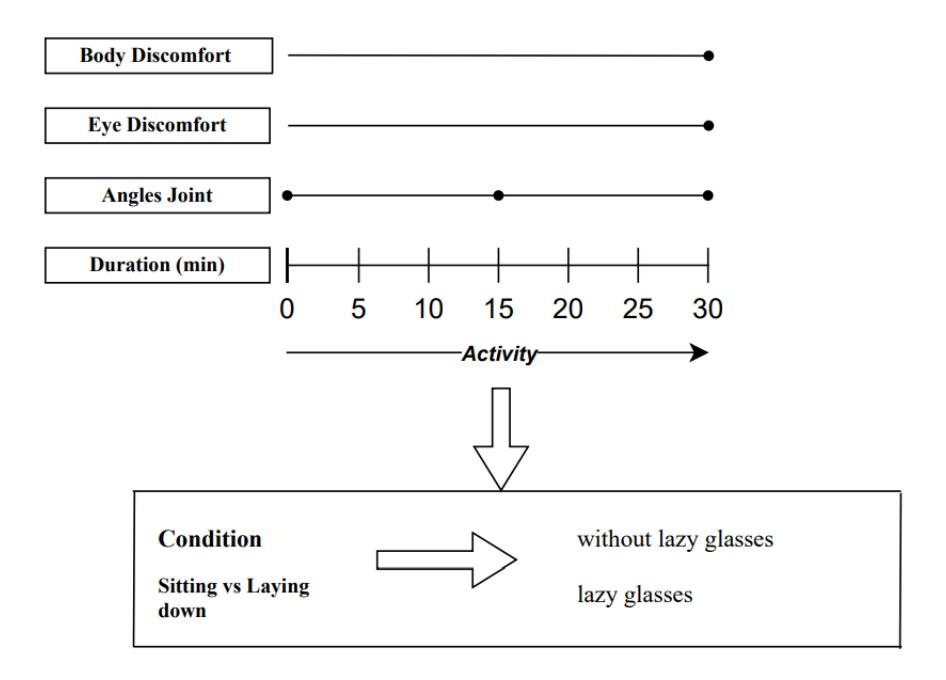
Figure 2 Experimental protocol
Data Analysis
Parametric testing of motion capture data was the starting point for the data analysis. To determine if the fundamental conditions for analysis were parametric, a normality test was used to examine the objective measurement of body segment angles. The tests then proceed, and it is confirmed that the data matches these assumptions. The statistical analysis employed a repeated-measures ANOVA to compare the four experimental conditions within the same group of participants. A Friedman test was chosen as an alternative non-parametric measure to detect any significant variation in the angles of body segments
across different conditions. A descriptive analysis of data from subjective assessments, such as the ODAS and the Corlett and Bishop Body Part Discomfort Scale, was conducted. The objective task was to gather information about eye strain in different settings. To determine the most significant reported discomfort, this analysis primarily compared the highest mean scores achieved for each condition and indicator. The statistical software packages JASP version 0.18.3.0 and IBM SPSS Statistics version 23 were used to compare objective measurements and subjective assessments across the four experimental conditions.
Results and Discussion
The results from the Repeated Measures Analysis of Variance (RM-ANOVA) conducted on the angle measurements of the neck segment clearly demonstrated a statistically significant difference in the average segment angle (Figure 2.a), among the four distinct experimental treatments (WOLZB, LZB, WOLZD, and LZD).
Motion Capture
Specifically, the subsequent data analysis revealed that the LZD treatment induced a significantly lower segment angle of -10.96° when directly compared against the other three conditions, namely WOLZB, LZB, and WOLZD (with a high level of significance indicated by p < 0.001). However, no significant difference was found between WOLZB, LZB, and WOLZD (p < 0.05).
Analysis of the lumbar segment angle (Figure 2.b) showed no significant difference among all conditions (WOLZB, LZB, WOLZD, and LZD; p < 0.05). However, the WOLZD condition demonstrated a tendency to be the lowest (7.61°) compared to the others. Similarly, for the right elbow (Figure 2.c), there were no significant differences across all conditions (p < 0.05), yet the angle recorded in the LZD treatment was lower than the rest (9.59°). In contrast, the analysis for the left elbow (Figure 2.d) revealed a significant difference between the WOLZD and WOLZB conditions, where WOLZD was found to be significantly lower (23.59°) compared to WOLZB (p < 0.05).
Measurements of the wrist and hip segments indicated no significant differences across all tested conditions. Nevertheless, on the left wrist (Figure 2.e), the LZB conditions tended toward the lowest angle (106.92°) when compared to the other conditions, while WOLZD recorded the lowest angle on the right wrist (22.04°) (Figure 2.f). Conversely, for the hips, the WOLZD consistently showed smaller angular values on both the left (Figure 2.g) (-4.15°) and right (Figure 2.h) sides compared to the remaining conditions (-7.20°).
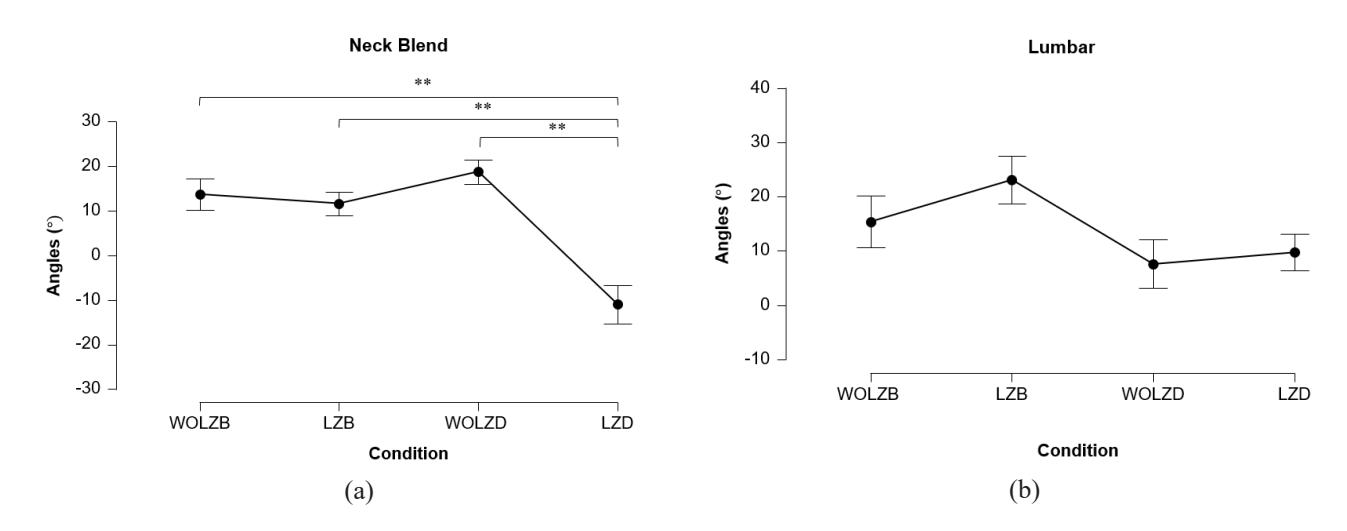
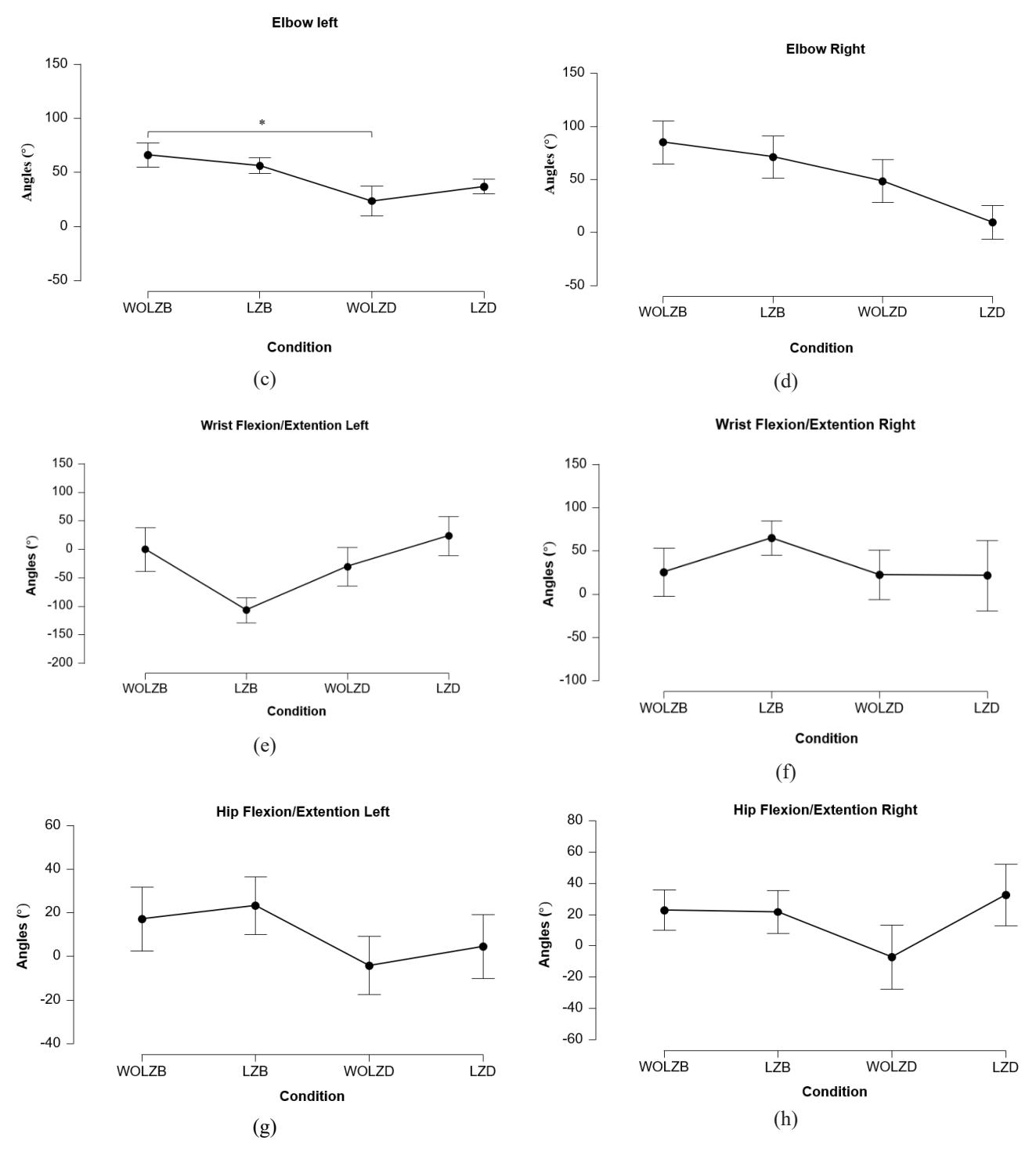
Figure 3 Body segment angles: a). Neck, b). Lumbar, c). Left elbow, d). Right elbow, e). Left wrist, f). Right wrist, g). Left hips, h). Right hips. *Represent a significant level at p < 0.05. **Represent a significant level at p < 0.001.
Body Discomfort Subjective Assessment
Body discomfort scores (mean and SD) were examined, and it was found that the average values for each body part varied significantly, depending on the type of treatment given. Measuring the head and neck segment revealed that the WOLZD condition had the highest discomfort score (3 ± 0.82). In contrast, the LZB condition recorded the lowest score (1.6 ± 0.70), suggesting that higher scores were frequently found for these conditions. Additionally, WOLZD and LZB received an equivalent score of 2.5 ± 1.18 for the shoulder segment, while LZB had the lowest score (1.8 \(\pm\) 1.03). Similarly, WOLZB had the highest score in the arm segment (2.6 \(\pm\) 1.35), while LZD had the lowest score (1.8 \(\pm\) 1.03).
Analysis of the lower body segments revealed further variations. For the mid-back-segment, WOLZB recorded the highest discomfort score (\(2.3 \pm 1.25\)), whereas LZB reported the lowest (\(1.7 \pm 1.06\)), moving to the lower back. The highest scores were found equally in WOLZB and LZD (\(2 \pm 1.15\)). With LZB again showing the lowest (\(1.8 \pm 1.03\)). Conversely, the buttocks segment showed that WOLZB had the lowest score (\(1.6 \pm 0.97\)), while the highest score was found in WOLZD (\(1.8 \pm 1.32\)). Continuing downward, the thigh segment showed the highest scores in both WOLZD and LZD (\(1.7 \pm 0.95\)), and the lowest in LZB (\(1.3 \pm 0.67\)). Finally, the knee segment showed WOLZB with the highest score (\(1.9 \pm 0.99\)) and LZB with the lowest (\(1.4 \pm 0.84\)), while the feet and soles segment demonstrated the highest score for WOLZD (\(2.2 \pm 1.4\)) and the weakest for LZD (\(1.9 \pm 1.29\)) (Table I).
| Treatment | Head and neck | Shoulder | Arm | Middle back | Low back | Buttock | Thigh | Knee | Leg and foot |
|---|---|---|---|---|---|---|---|---|---|
| WOLZB | 2,4 ± | 2,1 ± | 2,6 ± | 2,3 ± | 2 ± | 1,6 ± | 1,6 ± | 1,9 ± | 2 ± |
| 1.51 | 1.10 | 1.35 | 1.25 | 1.15 | 0.97 | 0.84 | 0.99 | 1.05 | |
| LZB | 1,6 ± | 1,8 ± | 2,1 ± | 1,7 ± | 1,8 ± | 1,8 ± | 1,3 ± | 1,4 ± | 1,9 ± |
| 0.70 | 1.03 | 1.29 | 1.06 | 1.03 | 1.14 | 0.67 | 0.84 | 1.29 | |
| WOLZD | 3 ± | 2,5 ± | 2 ± | 2,2 ± | 1,9 ± | 1,8 ± | 1,7 ± | 1,7 ± | 2,2 ± |
| 0.82 | 1.18 | 1.25 | 1.14 | 1.29 | 1.32 | 0.95 | 1.06 | 1.4 | |
| LZD | 2,3 ± | 2,5 ± | 1,8 ± | 2,1 ± | 2 ± | 1,9 ± | 1,7 ± | 1,7 ± | 1,9 ± |
| 1.57 | 1.18 | 1.03 | 1.20 | 1.15 | 1.10 | 0.95 | 1.16 | 1.29 |
Table I Body Discomfort Subjective Assessment
Ocular Discomfort Scale
LZD had the highest average scores for photophobia and eye strain, as indicated by the results. This implies that the use of lazy glasses while sitting has a greater impact on these symptoms. Additionally, WOLZD and LZD were found to have high scores for dry eyes and burning/stinging sensations, suggesting that sitting in a particular position can intensify these discomforts. Specifically, the foreign body sensation was enhanced by sitting without glasses (WOLZD). Conversely, WOLZB exhibited the highest score for blurred vision, suggesting that lying down without glasses has a significant impact on visual clarity. Among the groups with the highest scores for eye fatigue, WOLZD and LZD showed that both sit better when sitting with or without lazy glasses and are more tired when their eyes are not in contact with the lenses. The use of lazy glasses was associated with higher scores for photophobia, eye strain, and eye fatigue, whereas WOLZD had the highest scores when paired with non-lensing frames. On the other hand, utilizing lazy glasses while lying down was typically associated with lower scores for burning/stinging sensations and blurred vision compared to not using lazy glasses (Table II).
| Table if Descriptive imarysis of the Scalar Discomfort issessment Scale | ||||||||||
|---|---|---|---|---|---|---|---|---|---|---|
| Treatment | Photophobia | Pressure around the eye | Eye dries | Foreign Body Sensation | Burning / Stinging | Blurred Vision | Eye Fatigue | |||
| WOLZB | \(2.5 \pm 2.76\) | \(2.5 \pm 2.37\) | \(2 \pm 2.11\) | \(2.1 \pm 2.33\) | \(1.4 \pm 1.51\) | \(2.3 \pm 2.5\) | \(3.2 \pm 2.78\) | |||
| LZB | \(2.8 \pm 2.3\) | \(2.2 \pm 1.4\) | \(2.4 \pm 1.51\) | \(1.7 \pm 1.06\) | \(1.2 \pm 1.4\) | \(1.3 \pm 1.49\) | \(2.4 \pm 1.84\) | |||
| WOLZD | \(2.5 \pm 2.95\) | \(2.1 \pm 2.33\) | \(2.9 \pm 1.66\) | \(3.2 \pm 2.7\) | \(2.1 \pm 2.18\) | \(2 \pm 2.75\) | \(3.3 \pm 2.63\) | |||
| LZD | \(3.1 \pm 2.23\) | \(3.7 \pm 2.54\) | \(2.9 \pm 2.38\) | \(3.1 \pm 2.85\) | \(2.1 \pm 2.38\) | \(2.2 \pm 2.15\) | \(3.3 \pm 2.45\) | |||
Table II Descriptive Analysis of the Ocular Discomfort Assessment Scale
Discussion and Recommendations
A statistical analysis of the neck joint angle revealed notable differences among the four treatment groups. In the WOLZB, LZD, and WOLZD conditions, the mean neck angle differed significantly compared with the LZD condition, suggesting that the neck tended to be more flexed downward in conditions without lazy glasses compared with sitting while using lazy glasses. A more detailed comparison also showed that participants in the lying position achieved greater neck flexion than those in the sitting position. The greater difference observed between sitting with and without lazy glasses indicates that the absence of lazy glasses tends to promote a more extended or upward-tilted neck posture. These changes in neck flexion appear to be largely influenced by the activity performed and the body posture adopted while using the smartphone (Chen et al., 2022).
The statistical analysis revealed no significant differences in the lumbar angle across all experimental conditions. This finding may indicate that participants tended to maintain a relatively stable lumbar posture regardless of whether lazy glasses were used or not. Such consistency may reflect an unconscious effort to maintain a comfortable and stable lumbar position during smartphone use to minimize discomfort or strain in the lower back region (Cho et al., 2023; Abdel et al., 2025).
The result of the motion capture analysis also revealed a distinct pattern in the elbow joint angles. In general, the elbow angle in the sitting position tended to be smaller than in the lying position. This pattern likely occurs because users typically hold the smartphone closer to their eyes when sitting to view the screen clearly. In contrast, when participants used lazy glasses, no significant difference was observed between the right and left elbow angles. This may be explained by the optical characteristics of lazy glasses, which incorporate prism lenses with approximately a 90° viewing redirection. This design allows users to maintain a more vertical eye orientation while viewing the smartphone, thereby requiring the device to be positioned farther away from the eyes.
The WOLZD condition showed higher head and neck angle measurements compared with the other conditions. This finding corresponds with the body discomfort assessment results, in which the highest discomfort scores were reported in the head and neck region during the WOLZD condition. During smartphone use, the head and neck must actively maintain balance and stability, particularly in postures that require sustained visual focus (Tao et al., 2022). In contrast, the LZD condition (lazy glasses in the sitting position) produced the highest level of eye discomfort, particularly related to pressure around the eyes. Participants reported that the weight of the lazy glasses created additional pressure around the orbital area, which may explain the increased eye discomfort reported under this condition.
The limitations of this study relate to several aspects of experimental design. First, the type of lazy glasses used during the experiment represents a commonly available generic design rather than a specific branded product. Lazy glasses available on the market may differ in terms of frame structure and prism configuration and adjust their body posture. Therefore, the findings of this study should be interpreted within the context of the lazy glasses design used in this experiment. Future studies may examine different designs or models of lazy glasses to determine whether similar ergonomic effects are observed across various product configurations.
Another limitation concerns the relatively small sample size, which may restrict the generalizability of the findings to broader populations. However, the repeated-measures design helps reduce interindividual variability because each participant serves as their own control, thereby increasing statistical sensitivity. Nevertheless, future studies with larger and more diverse samples are recommended to confirm and extend the present findings.
In addition, this study only includes a fundamental kinematic analysis of smartphone use in sitting and lying postures, including conditions involving lazy glasses. Other postures, such as standing while using a smartphone, were not examined. Furthermore, the kinematic analysis focuses primarily on various body segment angles and does not include measurements of muscle activity using electromyography (EMG). Previous studies have indicated that posture changes are associated with differences in muscle
activation. For instance, Yoon et al. (2021) reported that neck muscle activity increased by approximately 40% in sitting compared with standing positions. Similarly, Tapanya et al. (2021) showed that greater neck flexion angles are associated with increased muscle activity. Therefore, future research should investigate the effect of smartphone use and lazy glasses on neck muscle activity and the potential for compensatory muscular responses during prolonged use.
Finally, it should be emphasized that this study does not intend to suggest that prolonged smartphone use is beneficial. Excessive smartphone use has been associated with various physical and psychological risks, including increased anxiety. Future studies may therefore expand the investigation of lazy glasses to more productive contexts, such as office tasks that involve prolonged document reading. Such applications may be particularly relevant in occupational settings where workers frequently adopt sustained downward viewing postures. For example, healthcare workers often perform tasks such as surgery, injections, or patient care in bent or static positions, which increases the risk of musculoskeletal disorders (Matuszewska et al., 2025). In this context, ergonomic innovations such as lazy glasses may potentially contribute to maintaining a more neutral neck posture and reducing biomechanical strain during tasks requiring downward visual focus.
Despite these limitations, the findings of this study provide preliminary evidence regarding the potential ergonomic benefits of using lazy glasses during smartphone use. The results contribute to the growing body of research on smartphone-related posture and may serve as a foundation for future investigation examining ergonomic interventions aimed at reducing neck flexion and musculoskeletal strain during prolonged visual tasks.
Conclusion
This study investigated the use of lazy glasses during smartphone interaction with the TikTok application under different viewing positions. The findings indicate that the use of lazy glasses may influence body posture and perceived discomfort during smartphone use. Specifically, using lazy glasses while sitting tended to produce smaller neck angles, whereas sitting without lazy glasses resulted in smaller left elbow angles. In terms of discomfort, higher discomfort in the head and neck regions was observed when participants sat without lazy glasses, whereas the use of lazy glasses while sitting tended to increase pressure around the eyes. Overall, lazy glasses may help reduce physical discomfort in certain viewing positions. However, their use does not always result in the most neutral body posture.