

PENDAHULUAN
Indonesia's textile and fashion industry sector has experienced significant development in recent years. At the New Balance Material Summit in Jakarta, the Coordinating Minister for Maritime Affairs and Investment, Luhut B Pandjaitan, said that after the Covid-19 pandemic, there was a significant increase in the export and import sector of Indonesian textile products.
However, data from the Central Statistics Agency (BPS) shows that Indonesia's textile export volume decreased by 14.52% during January-September 2022, reaching 1.19 million tons compared to the same period in 2021 (Year On Year/YOY). Despite the decline in the national textile industry sector, Indonesia's economy grew positively by 5.31% (YOY) in 2022, despite severe challenges and the threat of recession. One of the main
sectors of national economic growth is the Textile and Textile Products (TPT) and footwear industry. This statement shows that although some sectors face obstacles, several key sectors can positively contribute to Indonesia's economic performance (Sutrisno, 2023).
The dynamic growth reflects an increasingly dominant position in the global creative industry. Industry players, from designers to manufacturers, continue to make impressive innovations, making Indonesia the centre of attention in the international fashion scene. This growth is reflected in the increasing number and quality of products and involves advances in increasingly sophisticated production and marketing technologies (Siagiam et al., 2023). However, behind this remarkable achievement lies a serious environmental impact that needs to be addressed. Inadequate waste handling during textile production is a critical issue that must be resolved (Sofianti et al., 2023).
In this context, while continuing to enjoy the progress of the industry, awareness of environmental responsibility is also important. Implementing innovative and sustainable measures is key to balancing industrial growth and environmental preservation. Thus, Indonesia's textile and fashion industry can continue to grow economically and ensure its ecological responsibility for long-term sustainability.
The negative impact arising from the textile and fashion industry in Indonesia is a serious problem in waste management, resulting in environmental pollution. This pollution is a major concern because the production process in this sector often produces waste that is not managed properly. The main problem is the need for more awareness and implementation of adequate waste management practices, adversely impacting the surrounding ecosystem (Putra, 2016).
Improper waste handling allows various hazardous substances and chemicals to pollute water, soil, and air. On a broader scale, the impact can affect human health, natural resource sustainability and biodiversity (Nugraha et al., 2023). Therefore, it is important to understand that environmental pollution is not just a sectoral problem but a cross-cutting problem that requires holistic solutions. Improving waste management through implementing more environmentally friendly practices is essential to reduce the negative impact caused by the textile and fashion industry in Indonesia.
Based on the problem of environmental pollution arising from inadequate waste handling in Indonesia's textile and fashion industries, a systematic approach is needed to find effective and sustainable solutions. Such efforts are limited to mitigating negative impacts and involve
substantive innovations in waste management to reduce ecological burdens.
One of the proposed solutions to overcome these problems is through innovation in utilizing natural potential and integrating technology in processing natural materials. The method chosen in this context is the jelami technique, known as natural imprint. This approach emphasizes using jasmine flowers as a motif-forming element in fabrics and natural dyes of high wood as color trail formers. The tannin content of these plants is a key element that can leave traces of motifs and colors on fabrics and be environmentally friendly.
The innovative process is geared towards creating textile products that are aesthetically pleasing and have minimal negative impact on the environment. Through the use of renewable natural products, a more sustainable production model is created. In this context, sustainability does not only refer to ecological aspects but also includes economic and social sustainability in the value chain of the textile and fashion industries. Applying the jelami technique as an innovation-based solution is expected to positively contribute to overcoming environmental problems in the textile and fashion industry sectors. A new paradigm in industrial practice is expected to emerge through a deep understanding of this process, where sustainability and diversity of natural
resources become the main foundation in product development and production processes.
The research focuses on the experimentation and exploration of fabric materials, jasmine flowers and natural dyes of high wood with the technique of jelami (Natural Traces). The jelami technique (Natural Footprint) is a way of transferring traces of motifs and colours on fabric, using jasmine flowers (Jasminum sambac) as a motif builder and natural dyes of tingi wood (Ceriobs tagal) as a colour trail builder by utilizing the tannin content of the plant. This study uses jasmine flower plants (Jasminum sambac) and natural dyes of high wood (Ceriobs tagal) because both plants contain strong dyes, one of which is a high enough tannin content so that it can produce sharp shapes and color traces. The textile production process using natural fibers and natural fabric motif-making techniques aligns with sustainable fashion, utilizing natural products. The purpose of this study is to produce a variety of new colors, motifs and compositions through the jelami technique on ATBM silk fabric using tingi wood (Ceriobs tagal) and jasmine flowers (Jasminum sambac).
METODE
The research method used in this study is descriptive qualitative through
experimental and exploratory approaches to jelami, Jasmine flowers (Jasminum sambac), natural dyes of high wood (Ceriobs tagal) and supported by an understanding of the potential diversity of plant richness in Indonesia's natural environment. The next stage is data analysis and potential technique development through stages of experimentation and exploration.
The experimental and exploration process consists of 2 processes, namely the pre-mordanting and post-mordanting processes in jasmine flowers (Jasminum sambac), natural dyes of tingi wood (Ceriobs tagal) and jelami which is the combination that is the focus of this study.
Troubleshooting
Some steps that will be carried out in this activity:
a. Observation.
At this stage, researchers collect data using several techniques, namely direct observation and literature study and conduct interviews with related experts. Before determining whether or not the materials to be used in the experimental and exploration process are valid. One is a validity test through research that has been done before.
b. Analysis.
At the researcher stage, data analysis is carried out using descriptive analysis to be used as a reference in determining the next steps (experiments and exploration)
c. Perimen (Pre-Mordanting)
This stage aims to produce various colour and pattern results, carried out systematically and gradually until the most effective, optimal, and quality method can be concluded.
d. Exploration (Post-Mordanting)
This stage aims to multiply the type of colour after going through the premordanting stage, namely by taking several samples of existing experimental results to be tested again at the postmordanting stage.
e. Evaluation
This stage aims to evaluate the quality of fabrics from the results of experiments by testing several components at the Bandung Textile Center. The tests carried out are tests of the resulting fabric against:
- Colourfastness to washing
- Colourfastness to acid sweat
- Colourfastness to alkaline sweat
- Colourfastness to dry rubbing
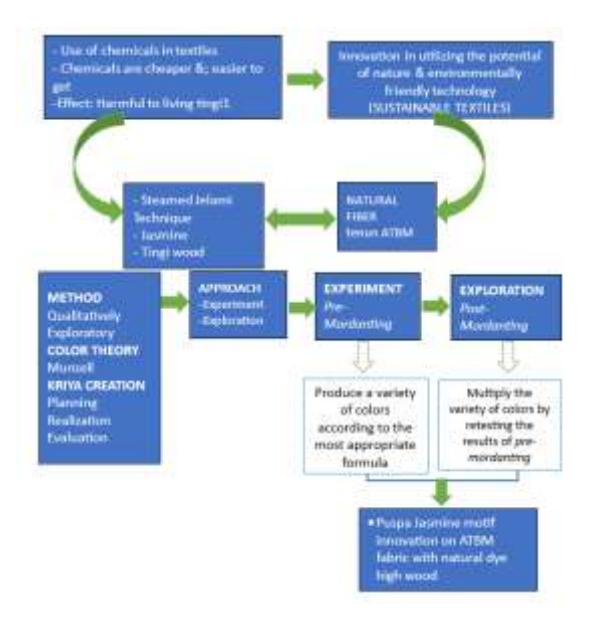
Figure 1. Research Framework
Source: Author
RESULTS AND DISCUSSION (12pt, bold)
Nature Colouring Substances
Natural dyes are obtained from nature or plants either directly or indirectly (Lestari & Suprapto, 2001). Every plant can be a source of Natural Coloring Substances (ZPA) because it contain natural pigments. Natural Dyes (ZPA) have been known and used by the people of Indonesia for generations. Before knowing synthetic dyes, this nation knew of natural dyes used to dye fabricant, cosmetics, food, and regional crafts (Anonim, 2002). They use leaves, flowers, wood, roots, seeds, fruits and twigs of plants. Natural dyes are also considered cheaper because the raw materials are widely available in Indonesia, with an easy extraction process and a unique and elegant color direction (Mukhlis, 2011). However, coloring using natural dyes also has
disadvantages because it takes a long time and requires patience and perseverance. Another disadvantage of natural dyes is that they are less fat than synthetic dyes. To get a quality fabric colour, there needs to be a fixation process (colour locking) to sharpen and hold the colour so it does not fade easily. Fixation is a procedure for binding dyes or locking colours on fabric fibers to produce good textile colours (Astuti & Subiyati, 2020).
Although natural dyes have weaknesses, they are environmentally friendly, while chemicals are not environmentally friendly, and imported materials will burden the country's foreign exchange (Jati, 2017).
Tingi Wood Nature Colouring Substances
Natural dyes are mostly brownish without any variation in the direction of the primary colour (Suheryanto, 2010). Natural dyes from wood species in Indonesia have been widely used and developed as batik dyes, weaving and textile crafts. One type of natural dye from wood is Tingi wood (Ceriops tagal), which produces a brownish-red color (Andriamanantena et al., 2021). Tingi wood has the scientific name Ceriops tagal, a natural dye included in the type of mangrove plant and produces a brownish-red colour on the fabric. At the same time, the bark of the high or landmark trunk belongs to the species Ceriops tagal condolent b. Robinson. This tree
has a height of approximately 25 meters with greyish-brown bark, not rough texture and large size at the tree's base. The wood is powerful and can be used for furniture. Tingi bark produces strong tannins or natural dyes that can be used in tanning leather and dyeing agents for paints. This high-quality tannin will give it a reddish-brown colour for fabric dyeing. (Jansen et al., Handayani et al., 2013). Tannins from high bark (Ceriops tagal) vary from 13% to more than 40%, including viscous tannins of the procyanidin type, so staining with high bark gives a reddish-brown colour. The old age of the tree is characterized by thicker bark. Thick bark will produce highquality tannins or dyes (Gusmailina in Hidayani, 2012).
Fabrics with natural high wood dyes have good colour fastness in washing. A fixation process supports it, which helps bind or lock the dye with fabric fibers. Astuti and Subiyati's (2020) research states that fixation is binding or locking dyes on fabric fibers to obtain good dyeing results or do not fade easily. Tunjung binders are better at maintaining fabric colour with natural high wood dyes when compared to lime.
Jasmine Flowers
Jasmine flowers are used as prints of Puspa Jasmine motifs. Jasmine is generally white. In 1665, in England, Duke Casimo de' Meici introduced the existence of white
jasmine (Jasminum Sambac), which was later cultivated. White jasmine (Jasminum sambac) is a species of jasmine native to South Asia (India, Myanmar, and Sri Lanka). It spread to the Malay Archipelago through Hindustan. Jasmine is a plant from the Oleaceae spread from South Asia to Southeast Asia.
The plant is originally from Tropical Asia. Jasmine flowers vary in colour. Some are white (forest jasmine, king jasmine, Australian jasmine/Jasminum Simplicafolium), bright yellow (Jasminum Revolutum, Jasminum Mensyi atau Jasminum Primulinum), light pink (jasmine hybrid cross between Jasminum Beesianum and Jasminum Offciale), Heerdjan in pergola (2005: 33).
This study used white jasmine flowers known by the Latin name Jasminum sambac. White jasmine is a plant that symbolizes the flora of the archipelago. Become Puspa Bangsa. This is among the types of jasmine that are best known to the public. White jasmine is native to Asia and Sri Lanka but has now spread to different parts of the world.
Figure 2. Jasminium Sambac
Silk
Silk is a natural animal fiber with excellent properties, high strength, large
absorption, soft grip, wrinkle resistance, shine and good hanging properties (Puslitbang Kriya dan Batik, 1992).
Silk fabric is a natural fiber in the form of filaments derived from silkworm cocoon fibers (Poespo, 2005: 9). Through various ways, these fibers are formed into types of yarn that are ready to be woven or knitted into sheets of fabric. New fibers have meaning or meaning when put together, formed into yarn or rope, compacted, or woven into sheets of fabric (Anas, 2013: 5-6).
Silk fibers are produced by silkworm larvae when forming cocoons. Silkworm cocoons have two types:
- 1. Natural silk cocoon (bombyx mori): A white silkworm cocoon (murbey silk) that farmers cultivate indoors.
- 2. Wild silk cocoons: cocoons cultivated by farmers outdoors or called tussah caterpillars (Soeprijono et al., 1974)
Experimental Process
Mordan
Plants used as dyes can be obtained around our environment so that they are cost-effective. However, there are several disadvantages behind these advantages, one of which is that not all natural dyes can directly colour fabric fibers. Therefore, an auxiliary substance called mordant is needed (Atmaja, 2011). Mordant is also a special
substance that can increase the attachment of various dyes to fabrics (Hasanudin, 2001).
Mordant bridges natural dyes and fabric fibers to bond well, increasing their colour fastness (Vankar, 2000). (The word mordant comes from the French "mordere" which means to bite because mordant eats away at the surface of the fiber so that the dye can seep in) is a chemical form of metal salt commonly used to create affinity between fibers and pigments. The main purpose of mordant, when used with adjective dyes, is to open the pores so that the dye can penetrate the fibers, thus aiding the fixation of the dye on the substrate. (Bhajan, et al, 2014). However, mordants can also be used with dyes that can be applied directly. In this case, its function is to form insoluble compounds with dyes within the fiber itself, thereby increasing the fastness of the colouring material. Mordant can be considered an integral part of the natural dyeing process (Natural dyes B.H. Patel, in Handbook of Textile and Industrial Dyeing, 2011)
In the dyeing process, the dye cannot interact directly with the dyed material. Natural dyes are substantive and require a mordant to blend with fabrics and prevent colour from fading due to light exposure or washing. This compound binds to natural dyes in fabrics. Mordan compounds help chemical reactions between dyes and fibers so that dyes can be absorbed easily (Siva, 2007). The effect of using mordant can accelerate colour absorption in fibers, bind colours, even out colours on the surface of fibers, improve colour quality, and provide colour change effects.
At the beginning of dyeing, the fabric is processed pre-mordanting and wetting. In such conditions, fabric fibers will experience bubbles so that the fiber pores are open, and natural colours can be absorbed by the fibers until the fibers experience saturation (Rosyida & Zulfiya, 2013). The colour that has entered the fiber will be bound and settled with metal salt salts added as the final mordant (Sunaryati et al., 2000).
Post-mordanting or fixation will increase fastness and give a certain colour direction according to the properties of the metal ions contained in it. Some of these factors are related, affecting the final result. Post-mordanting will increase fastness and give a certain colour direction according to the properties of the metal ions contained in it. Some of these factors are related, affecting the final result.
In this study, the mordant used are mordant that are acidic and alkaline, namely tunjung, alum, and salt, with a different weight content per 1 liter of water.
Mordanting Method
One of the decisive processes in dyeing fabrics is the mordanting process. Mordanting is the initial treatment of the fabric to be dyed so that the fat, oil, starch, and dirt left behind in the weaving process can be removed, and the fabric can directly absorb the dye. Besides aiming to increase the attractiveness of natural dyes to textile materials, mordanting is also useful for producing good evenness and sharpness of colour (Fitriah, 2013).
Mordanians commonly used in dyeing include soda ash, alum, tunjung and Turkish Red Oil (Sunarya, 2014). The success of dyeing on fabrics is determined by the accuracy of the type of mordant used and the mordant process chosen. The mordanting process can be done before, after, or simultaneously with dyeing, otherwise known as pre-mordanting, post-mordanting, and simultaneous mordanting (Yi Ding, 2013).
This mordanting process is also a fixation that strengthens the colour and changes the natural dye according to the type of metal that binds it and locks the dye that has entered the fiber. The principle is to condition dyes that have been absorbed for a certain time so that there is a reaction between the fabric dyed with dyes and the materials used for fixation (Lestari et al., 2015).
In this study, the pre-mordanting process and the post-mordanting process in the pre-mordanting process using tunjung mordant, alum and salt and in the postmordanting process using the same mordant. The difference is only in the weight of each type of mordant used and the length of soaking time.
Stages of Experimentation
At the experimental stage of the soomy technique, jasmine flowers, natural dyes consist of 2 processes: pre-mordanting and post-mordanting.
1. Pre-Mordanting Process : Alum
The pre-mordanting process explained below is a simulation using one of the Mordan alum samples against natural high wood dyes. Furthermore, in other mordants, namely tunjung and salt, the premordanting process is the same as in Mordant alum.
Figure 3. Natural Coloring Substances and Mordant Used a.Alum is 10 grams dissolved in 1 liter of water
b.200 grams of wood is boiled in 1 liter of water until 500 ml remains
c.The main fabric (ATBM silk weaving) is immersed in the solution at point a for 30 minutes
d.The blanket fabric (main fabric covering fabric) is soaked into point b solution for 24 hours
TABLE 1. PRE MORDANTING EXPERIMENT PREPARATION PROCESS USING ALUM
| Stage | Activity | Picture |
|---|---|---|
| 1 | Mordant alum 10 g dissolved in 1 liter of water | |
| 2 | High wood 200g/1 liter of water boiled until remaining 500 ml | |
| 3 | The main cloth is soaked into an alum solution per 1 liter of water for 30 minutes |
4 The striped cloth is soaked into the boiled Highwood solution until 500 ml remains
| Stage | Activity | Picture |
- 1 Soak the silk cloth in the mordan alum solution for 30 minutes
- 2 Lift the cloth, rinse clean, spread it on the table, arrange it with Jasmine
3 Cover the jasmine cloth with a cotton cloth stripe that has been soaked in high wood
4 Roll with plastic, tie tight
5 Steam on top for 2 hours
6 Final Results
The next stage is to conduct premordanting experiments using other mordant, namely Tunjung and salt. The process is the same as carried out on mordant alum samples.
2. Pre-Mordanting Process (Tunjung or Ferrous Sulfate / Fe2So4 and salt) Types of mordants used:
- Tunjung or Ferrous Sulfate / Fe2So4 3-15 grams/liter of water
- Alum 10-50 grams/liter of water
- Salt 20-60 grams/liter of water
Types of Nature dyes used:
• Tingi wood (ceriops tagal) 200 gram
Other materials:
- Fresh jasmine flowers
- ATBM bombyx mori silk woven fabric 55 grams/m
- Plastic, raffia rope, scissors, winding pipe
- Steamer pot, stove
The following are the results of Pre-Mordanting experiments resulting from the jelami technique with natural dyes of high wood:
Experiment 1
Pre-mordanting: Tunjung or Ferrous Sulfate / Fe2So4 3-15 grams/liter of water
Mordanting soaking time: 15 minutes
Wood 200 grams/litter of water: Boiled
until remaining 500 ml
Long steaming of fabric: 1.5 hours
TABLE 3. JELAMI TECHNIQUE EXPERIMENTS WITH NATURAL DYES WITH TUNJUNG/ FERROUS SULFATE PRE-MORDANTING
| No | Ferrous | Sulfate | Result | |
|---|---|---|---|---|
| (gram) | ||||
| 1 | 3 gram | |||
| 2 | 6 gram | |||
| 3 | 9 gram | |||
| 4 | 12 gram | |||
| 5 | 15 gram |
Experiment 2
Pre-mordanting: Alum 10-50 gram/liter air Mordanting soaking time: 15 minutes Wood 200 grams/liter of water: Boiled
until remaining 500 ml
Long steaming of fabric: 1.5 hours
TABLE 3. JELAMI TECHNIQUE EXPERIMENTS WITH NATURAL DYES WITH ALUM PRE-MORDANTING
| No | Alum (gram) | Result |
|---|---|---|
| 1 | 10 gram | |
| 2 | 20 gram | |
| 3 | 30 gram | |
| 4 | 40 gram | |
| 5 | 50 gram |
Experiment 3
Pre-mordanting: Salt 20-60 gram/liter air Mordanting soaking time: 15 minutes
Wood 200 grams/liter of water: Boiled until remaining 500 ml
Long steaming of fabric: 1.5 hour
TABLE 4. JELAMI TECHNIQUE EXPERIMENTS WITH NATURAL DYES WITH SALT PRE-MORDANTING
| No | Salt (gram) | Result |
|---|---|---|
| 1 | 3 gram | |
| 2 | 6 gram | |
| 3 | 9 gram | |
| 4 | 12 gram | |
| 5 | 15 gram |
Pre-mordanting Experimental Analysis (3 Mordant on Tingi Wood Nature Colouring)
- The use of different types of mordant in the pre-mordanting process can produce different colours, although it still uses one type of natural coloring.
- The addition of the large number of mordants in each experiment did not cause significant colour changes (very little change)
- In the pre-mordanting process, jasmine floral motifs are obtained, clearly showing their character on the fabric.
After the pre-mordanting stage is carried out and produces various colour
variations, the next stage is multiplying the type of colour through the postmordanting stage by taking samples of experimental results from the premordanting results.
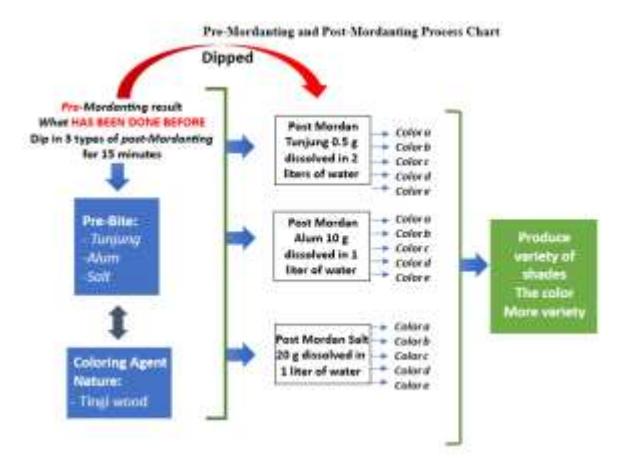
Figure 4. Process Chart
Pre-Mordanting and Post-Mordanting Process
After a pre-mordanting 3-mordant experiment was carried out on the natural dye of high wood, some of the experimental results were used as samples to be tested again through the post-mordanting process of 3-mordant on the natural dye of high wood. The type of mordant used in the pre-mordanting and post-mordanting processes is the same.
Pre-Mordanting Process (There are already results in the previous table)
Types of mordants used during Pre-Mordanting:
• Tunjung 3-15 grams/liter of water
- Alum 10-50 grams/liter of water
- Salt 20-60 grams/liter of water
Post-Mordanting Process:
Types of mordants used at the time of Post-Mordanting
- Tunjung 0.5 gram/ 2 liters of water
- Alum 20 grams/liter of water
- Salt 40 grams/liter of water
Types of Nature Colouring used:
• tingi wood 200 gram
Provisions used:
- Fresh jasmine flowers Silk woven fabric ATBM bombyx mori 55 gram
- Rayon cotton fabric
- Plastic, raffia rope, scissors, winding pipe
- Steamer, gas stove
The following are the results of premordanting and post-mordanting experiments resulting from the jelami technique with natural dyes of tingi wood:
Experiment 1
Pre-Mordanting: Tunjung: 3 grams-15 grams/liter of water
Post-Mordanting: Per liter of water: Tunjung 0.5 g, Alum 20 g, Salt 40 g, Soda Ash 20 g, Vinegar 40 ml
Post-Mordanting Soaking Time: 15 minutes
TABLE 6. JELAMI TECHNIQUE EXPERIMENTS WITH NATURAL DYES OF TINGI WOOD WITH PRE-MORDANTING TUNJUNG;POST-MORDANTING 5 MORDANT
| No | Mordant | Result | |
|---|---|---|---|
| 1 | Tunjung Sulfate) | (Ferrous | |
| 2 | Alum | ||
| 3 | Salt | ||
| 4 | Soda Ash | ||
| 5 | Vinegar |
Experiment 2
Pre-Mordanting: Alum: 10 gram - 50
gram/liter air
Post-Mordanting: Per liter of water: Tunjung 0.5 g, Alum 20 g, Salt 40 g, Soda Ash 20 g, Vinegar 40 ml
Post-Mordanting Soaking Time: 15 minutes
TABLE 7. JELAMI TECHNIQUE EXPERIMENTS WITH NATURAL DYES OF TINGI WOOD WITH PRE-MORDANTING ALUM; POST-MORDANTING 3 MORDANT
| No | Mordant | Result |
|---|
| 1 | Tunjung | (Ferrous | |
|---|---|---|---|
| Sulfate) | |||
| 2 | Alum | ||
| 3 | Salt | ||
| 4 | Soda Ash | ||
| 5 | Vinegar | ||
| Experiment 3 |
Pre-Mordanting: Salt: 10 gram - 50 gram/liter air
Post-Mordanting: Per liter of water: Tunjung 0.5 g, Alum 20 g, Salt 40 g, Soda Ash 20 g, Vinegar 40 ml
Post-Mordanting Soaking Time: 15 minutes
TABLE 8. JELAMI TECHNIQUE EXPERIMENTS WITH NATURAL DYES OF TINGI WOOD WITH SALT PRE-MORDANTING; POST-MORDANTING 3 MORDANT
| Tunjung (Ferrous Sulfate) | No | Mordant | Result |
|---|---|---|---|
| 1 | |||
Analysis of Pre-Mordanting and Post-Mordanting Experiments (3 Mordant on Natural Dyes of Tingi Wood)
- Through the pre-mordanting and post-mordanting processes, a more diverse range of colours can be produced compared to the colours resulting from the pre-mordanting process alone.
- These colours can also serve as a data bank in the form of a colour catalogue.
- The colour produced by the soda ash mordant is the strongest and most visible (concentrated).
Evaluation
This stage aims to evaluate the quality of fabrics from the results of experiments by testing several components at the Bandung Textile Center. The tests carried out are tests of the resulting fabric against:
- Color fastness to washing
- Color fastness to acid sweat
- Color fastness to alkaline sweat
- Color fastness to dry rubbing
The complete test result can be found here:
https://drive.google.com/file/d/15DB3GxCaK55jAtSsBS27I5awI9gNQUF/view?usp= sharing
Yellow Fabric
1. Color Fastness to Laundering (SNI ISO 105C06:2010)
The fabric has excellent resistance to color fading and staining during washing, making it suitable for blouse quality standards.
2. Color Fastness to Sweat (SNI ISO 105- E04:2010)
While the fabric maintains its overall color under sweat exposure, it does not fully meet blouse standards due to poor color staining resistance on polyester and cotton in both acidic and alkaline conditions. This may cause color bleeding or fade when worn in sweaty conditions, reducing durability.
3. Color Fastness to Rubbing (SNI 08- 0288-08)
The fabric performs well in dry rubbing, and wet rubbing is slightly below perfect but still acceptable, meaning it has good resistance to color transfer when rubbed.
Green Fabric
1. Color Fastness to Laundering (SNI ISO 105C06:2010)
The fabric exhibits excellent resistance to color fading and staining when subjected to laundering. This means it will maintain its appearance well after washing.
2. Color Fastness to Sweat (SNI ISO 105E04:2010)
The fabric maintains good resistance to color change and staining under acidic sweat conditions, making it suitable for everyday wear.
While the color staining resistance is strong, the color change rating (3-4) is slightly below the requirement (4), indicating a slight risk of fading under alkaline sweat conditions.
3. Color Fastness to Rubbing (SNI 08- 0288-08)
The fabric performs well in rubbing tests, meaning color transfer is minimal in both wet and dry conditions. This suggests good durability when worn and handled.
Brown Fabric
1. Color Fastness to Laundering (SNI ISO 105C06:2010)
The fabric has excellent resistance to fading and staining during washing, making it suitable for long-term use and regular laundering.
2. Color Fastness to Sweat (SNI ISO 105E04:2010)
The fabric is slightly below standard in color change under acidic sweat conditions, which means there may be a minor risk of fading over time.
The fabric maintains good resistance to alkaline sweat, indicating durability in long-term wear.
3. Color Fastness to Rubbing (SNI 08- 0288-08)
The fabric shows good resistance to color transfer, meaning minimal risk of staining other fabrics or objects when worn.
Red Fabric
1. Color Fastness to Laundering (SNI ISO 105C06:2010)
The fabric exhibits excellent resistance to fading and staining during washing, making it durable for regular laundering.
2. Color Fastness to Sweat (SNI ISO 105E04:2010)
The fabric does not fully meet the standard for acidic sweat resistance, as color change and staining on cotton are below the required level, which may
result in fading and discoloration over time.
While the fabric meets the color change requirement under alkaline sweat conditions, color staining on cotton is below standard (3 instead of 4), indicating a risk of discoloration when exposed to sweat.
3. Color Fastness to Rubbing (SNI 08- 0288-08)
The fabric shows good resistance to rubbing, meaning minimal color transfer in both wet and dry conditions.
After analyzing the textile test results from Bandung Textile Center, we found that
- a. All fabrics are suitable for garments that require frequent washing.
- b. yellow and red fabrics may fade or stain (red fabrics have the weakest performance in sweat resistance)
- c. All fabrics have good resistance to rubbing.
- d. Best options for blouses are Green and Brown Fabrics because they meet the standards, and are suitable with only minor improvement needed.
CONCLUSION
After the research was carried out through systematic stages, it can be concluded that by utilizing the natural potential of jasmine flowers (Jasminum sambac) and natural dyes of tingi wood (Ceriops tagal) as innovations to form motifs and color traces on ATBM silk fabrics, an environmentally friendly technique has been introduced, namely the jelami technique. Through the Jelami technique, color variations are produced in ATBM silk fabrics using high wood (Ceriobs candolleana) and jasmine flowers (Jasminum sambac), which can be used as a data bank arranged in a colour catalogue.
ACKNOWLEDGMENTS
This research can be carried out well thanks to assistance from various parties; for that, the researcher would like to thank Mrs. Dr. Nuning Yanti Damayanti, Dipl. Art as the main promoter, Mr. Dr. Yan Yan Sunarya S.Sn., M.Sn as co-promoter 1, Mrs. Dr. Dian Widiawati, S.Sn., M.Sn as copromoter 2 who has provided guidance and direction. Thank you to the seminar speakers and friends who participated in the research process.
REFERENCES
Balai Besar Kerajinan dan Batik. 2007. Natural Dyes. Yogyakarta: MU:3 Communication.
- Boruah, S., Kalita, B., & Baishya Kalita, & B. (2015). Eco-Printing of Eri Silk with Turmeric Natural Dye. International Journal of Textile and Fashion Technology, 5(4), 27-32.
- Boutrup, Joy and Catharine Ellis, 1st edition (2018), The Art and Science of Natural Dyes, Principles, Experiments and Results, Schiffer
- Dean, Jenny. (2010). Wild Colour. London: Octopus Publishing Group Ltd.
- Dean, Jenny. (2011). Colours from Nature. Wellwood: Search Press Limited.
- Felix (2002), Teknik Eco Dyeing dengan Memanfaatkan Tanaman sebagai Pewarna Alam
- Fletcher, K., Lynda Grose. (2012). Fashion & Sustainability, Design for Change. London: Laurence King Publishing Ltd.
- Flint, India, (2010). Eco Colour: Botanical Dyes for Beautiful Textiles, Murdoch Books, Australia
- Flint, India, (2012). Second Skin: Choosing and Caring for Textiles and Fabricing, Murdoch Books, Australia
- Forshee, J. (2006). Culture and Customs of Indonesia. Greenwood Press.
- Hamidi, Y. K., Yalcinkaya, M. A., Guloglu, G. E., Pishvar, M., Amirkhosravi, M., & Altan, M. C. (2018). Silk as a natural reinforcement: Processing and properties of silk/epoxy composite laminates. Materials, 11(11), 1–21. https://doi.org/10.3390/ma11112135
- Lestari, P., & Sakti, A. W. (2021). Application of Alum Fixator for Eco Print Batik Making Using a Pounding Technique in
- Fine Arts Learning in Junior High School. ASEAN Journal of Science and Engineering, 2(2), 167–172. https://doi.org/10.17509/ajse.v2i2.386 76
- Liles, J.N. (2010). The Art and Craft of Natural Dyeing: Traditional Recipes for Modern Use. Knoxville: The University of Tennessee Press.
- Liliana, I., Julieta. I., & Zlatin Z. (2020). Nature-Inspired Colors and Shapes in Fabricing Design. International Journal
- Musdalifah, Maulina, R.D., Nurmasitah, S., Damayanti, A IOP Conference Series: Earth and Environmental Science (2022). Using siam weed (Eupatorium odoratum I) as Natural Dyie in Eco-Print with Pounding Technique.
- Mistaram, A. & Agung.A, 1991. Ragam Hias Indonesia. Malang: Departemen Pendidikan dan Kebudayaan, IKIP Malang.
- Nugraha, A. (2018). Transforming Tradition in Indonesia. Design Roots: Culturally Significant Designs, Products, and Practices, London, Bloomsbury Publication, pp. 147–161.
- Nugraha A. (2012). Transforming Tradition. Helsinki, Finland Creswell, J.W. (2019).
- Nafisah, B., Mayliana, E., & Sukanadi, I. M. (2021). Batik Buketan Motif Bunga Nasional Indonesia Dan Penerapannya Dalam Busana Bernuansa Vintage [Indonesian National Flower Motif Bouquet Batik and Its Application in Vintage Style Fabricing]. Style : Journal of Fashion Design, 1(1), 24. https://doi.org/10.26887/style.v1i1.210 9
- Nugraha, A. (2002). Asian Ways of Creativity: Keeping Traditions Alive? Asia Design Journal, 4(4), 190–215.
- Nugroho, A., Silalahi, A. N., & Azzahra, A. (2023). Pengelolaan Sampah Rumah Tangga, Pembuatan Pupuk Kompos dan Kerajinan Tangan dari Limbah Plastik. Uwais Inspirasi Indonesia.
- Nuraeni, S., Nasri, N., Hamzah, A. S., & Wahyudi, W. (2022). Exploring the Flora of South Sulawesi, Forest Vegetation, and Karst Areas as Bundle Dyeing on Silk Fabrics. International Journal of Forestry Research, 2022, 1–12. https://doi.org/10.1155/2022/4971977
- Putra, D. M. (2016). Kontribusi industri tekstil dalam penggunaan bahan berbahaya dan beracun terhadap rusaknya sungai Citarum. Jurnal Hukum Lingkungan Indonesia, 3(1), 133-152.
- Pisitsak, P., Tungsombatvisit, N., & Singhanu, K. (2018). Waste protein from Antarctic krill oil production and natural dye imparts durable UV-properties to cotton textiles. Journal of Cleaner Production, 174, 1215–1223. https://doi.org/10.1016/j.jclepro.2017.1 1.010
- Ratuannisa, T., dkk. (2016). The Adapted Ethical Fashion Trend in Indonesia's Tradition-based Modern Textile. Prosiding: The 5th International Seminar on Nusantara
- Sachari, A., & Sunarya, Y. Y. (2001). Desain dan Dunia Kesenirupaan Indonesia dalam Wacana Transformasi Budaya. Penerbit ITB.
- Siagian, N. S. B., Sirait, N. A. G., Wardahlia, F., & Khazanah, K. (2023). Analisis
- Pengaruh Impor Baju Bekas Terhadap Pengusaha Tekstil Dalam Negeri di Indonesia. Madani: Jurnal Ilmiah Multidisiplin, 1(4).
- Sofianti, S., Ardiansyah, A., & Susaldi, S. (2023). Analisis Kualitas BOD, COD, Dan TSS Dalam Pengelolaan Limbah Cair Setelah Proses Koagulasi Dan Flokulasi Pada Instalasi Pengolahan Air Limbah (Studi Pada Industri Kosmetik X Di Kota Depok) Tahun 2022. Student Scientific Creativity Journal, 1(3), 81-92.
- Suheryanto, Dwi. 2016. Natural Dyes: Ensiklopedia Zat Warna Alami dari Tumbuhan untuk Industri Batik. Yogyakarta: Penerbit ANDI
- Sulolipu, A. A., Soetjipto, B. E., Wahyono, H., & Haryono, A. (2022). Silk weaving business sustainability as a cultural heritage of Indonesia: A case study in Wajo Regency, South Sulawesi. Industria Textila, 73(2), 184–190. https://doi.org/10.35530//IT.073.02.20 2056
- Sulolipu, A.A., Soetjipto, B.E., Wahyono, H., Haryono, A. Silk Weaving Business Sustanability as a Cultural Heritage of Indonesia: A Case Study in Wajo Regency, South Sulawesi
- Sutrisno, E. (2023). Ekspor tekstil Indonesia bertumbuh. https://indonesia.go.id/kategori/editori al/7146/ekspor-tekstil-indonesiabertumbuh?lang=1. Diakses pada 7 Januari 2024.
- Toekio, S. 2000. Mengenal Ragam Hias Indonesia. Penerbit Angkasa: Bandung
- Wahyuningsih, SE, Kusumastuti, A, Krisnawati, M, Yuniar, M, Ruri, M.R IOP Conference
Series (2021). Earth and Environmental Science Quality of motif, colors and fastness of Sekar Ayu ecoprint products in terms of mordant tipe, natural dyes, ang types of leaves on silk fabrics