

1. Introduction
Teak is one of the most popular wood species used since many decades ago for its characteristics, i.e., unique, elegant, stable, and easy to process. Teak is classified as fancy wood and durable class II which were resistant to termites and fungi [1]. Until now, teak is still considered a luxury commodity that received a great public demand, even though the selling price is expensive [2,3].
The efficiency of overall timber utilization in the hope of meeting the increasing demand for wood in Indonesia has been encouraged by several factors, i.e., the limited availability of the high-quality teak wood on the market for the last 5-10 years, the tendency of declining natural forest resources and plantations, and the increasing demand for wood. The efficient use of wood depends on how much knowledge of the wood is available. Every wood has different properties, as well as for similar woods with unequal usage times. Even wood from one tree has a somewhat different nature. In this case, it is better if the nature of wood is adjusted in its use as building materials, household furniture, wood processing, and wood energy. The intended characteristics are anatomical, physical, mechanical and chemical properties [4, 5]. bioaccumulator agent.
Many properties of wood have directly and indirectly related to wood properties and the architecture of its compilation at the macroscopic and microscopic levels. Chemical properties have a considerable influence on the general nature of wood [6]. In other words, the chemical composition of wood has an important meaning because it determines the use of a certain type of wood. These chemical components are the main constituent components of wood cell walls which consist of cellulose, hemicellulose, lignin, and its accompanying components or components of wood cell micromolecules, (i.e., extractive substances). Also, the chemical compounds of plants are the result of the plant metabolism themselves [5]. Several researches have shown that these chemical compounds often have physiological and pharmacological effects that are beneficial to humans [3]. These chemical compounds are better known as secondary metabolites which are the result of irregularities in the primary metabolites of plants. These compounds are groups of alkaloids, steroids, terpenoids, phenols, flavonoids, saponins, etc.
Research on the wood chemical components and chemical compounds of after a certain period of use is still not widely known, especially for teak wood after a 2-year and 60 years of usage period. Therefore, it is important to know how much the wood samples differ according to their usage period.
The purpose of this study is to analyze and compare the chemical and phytochemicals components of teak (T.grandis Linn. F.) which grew in West Java based on usage period differences as one of the basic properties of wood. The results of this study are expected to be useful for stakeholders who need information about the levels of chemical and phytochemicals components of teak (T. grandis Linn. F.) based on differences in usage period.
2. Experimental design
2.1. Sample preparation
The teak wood used in this study was taken from a house building in Sumedang, West Java, where the wood was obtained from a local (family-owned) community teak plantation. The raw material preparation procedure was as follows: the wood material obtained is cleaned, cut into chips with a thickness of ± 2 cm, dried and put into a plastic bag clip, made into particles in the form of powder using a hammer mill and sieved using a 40-60 mesh size and then put into a plastic bag clip.
2.2. Wood chemical component analysis
The method used refers to the TAPPI standard, such as Moisture Factor measurement (TAPPI T-264 om-88) [7], extractive free analysis of the sample (TAPPI T-204 om-84) [8], lignin Classon testing (TAPPI T- 222 om-88) [9], the solubility of extractive substances in cold water (TAPPI T-207 om-88) [10], the solubility of extractive substances in hot water (TAPPI T-207 om-88) [10], solubility of extractive substances in 1% NaOH (TAPPI T-212 om-93) [11], solubility of extractive substances in Alcohol-benzene (1: 2) (TAPPI T-204 om-88) [8] and testing of ash content (TAPPI T-211 om-85) [12].
2.3. Phytochemical analysis
Before the test is carried out, the sample is previously extracted and concentrated. Phytochemical tests were done on bioactive compounds, i.e., alkaloids, flavonoids, flavonoids, saponins, tannins, triterpenoids and steroids, carotenoids, coumarin, and carbohydrates.
2.4. Chemical compound analysis
The gas chromatography-mass spectrum (GC-MS) determination of the chemical compound of the teak wood extractives was performed using a Shimadzu GC MS-
QP2010 Ultra. An elastic quartz capillary column Rtx-5ms coated with a neutral phase was used. The injection port temperature was 300oC, and the carrier gas helium. The program of Mass Spectrometer (MS) was scanned over the 1.5 AMU to 1090 AMU (m/z), with an ionizing voltage of 70 eV and an ionization current of 150 µA of electron ionization [1].
3. Results and discussion
3.1. Teak chemical component determination
The chemical component determination test was conducted to compare the percentage of chemical component content in teak wood. The wood chemical components tested include lignin, the solubility of extractive substances in cold water, solubility of extractive substances in hot water, solubility of extractive substances in 1% NaOH, the solubility of extractive substances in al-ben (1: 2), and ash content. The value of the average content of wood chemical components is shown in Figure 1.
The results of the analysis of the chemical components indicate that teak wood used for 2 years (T2) has a lower lignin content (28.41%) compared to teak wood used for 60 years (T60; 29.82%). Extractive substance content of T2 was higher than T60 (Figure 1), i.e., 4.26% soluble in cold water, 5.12% soluble in hot water, 19.40% soluble in 1% NaOH, and 6.21% soluble in alcohol:benzene (1:2). The original compounds of T60 were volatilized [15]. While the ash content was higher in T60 (1.36%). One possible explanation is that a high lignin content of wood with a high proportion of guiasyl monomers will be more condensed, therefore it will increase the density and hardness of wood [13].
The solubility of extractive substances in teak wood showed the lowest value in the solubility of cold water and the largest in NaOH 1%. Coldwater only dissolves substances that exist on the outside such as dyes, tannins, and less carbohydrates. The components of extractive substances that are soluble in cold water, i.e., glucose, fructose, carbohydrates, sugars, pectins, dyestuffs, and certain acids [14]. The extraction using cold water will produce components i.e., inorganic salts, gums, ingredients that resemble pectin, galactans, tannins, and pigments. Extractive substances that dissolve in hot water includes fats, dyestuffs, tannins, resin, and phlobatanin. The Alben-soluble extractive substances include tannins, phlobatanin, essential oils, dyes, resins, fats, fatty acids, waxes, gums, and some water-soluble substances. The content of extractive substances which are soluble in 1% NaOH are fatty acids consisting of fatty acids, waxes, resins, resin acids, sterols, unsaturated fatty acids, oleic acid, and linoleic acid. NaOH also dissolves most of the hemicellulose, especially its branch chains from pentose, hexose and organic acids.
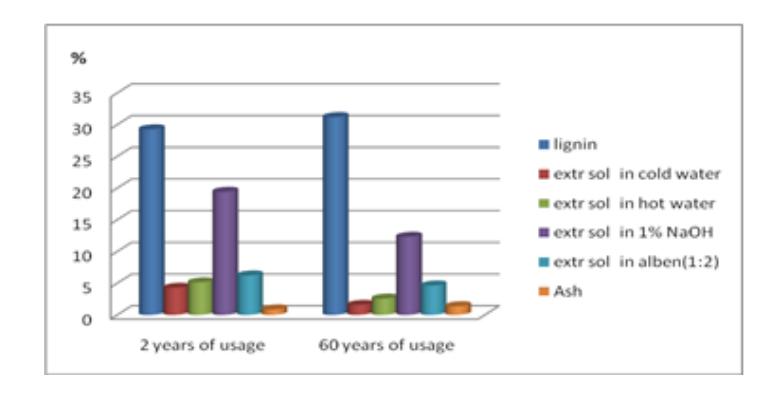
Figure 1 Chemical components of Teak wood of 2 and 60 years of use
Extractive substances generally consist of a group of volatile compounds. The longer wood being used and exposed to air, the more extractive compounds will be evaporated into the air. Therefore, the extractives content decrease in the wood [15].
The ash content of T60 is higher compared to T2. The determination of ash content is a way of estimating the mineral content of food material. The ash contains salts or oxides of K, P, Na, Mg, Ca, Fe, Mn and Cu; also very small molecules such as Al, Ba, Sr, Pb, Li, Ag, Ti, As and others. Moreover, there are still some inorganic substances in the wood called parts of ash, i.e., ash-forming minerals that are left behind after lignin and cellulose are burned. This mineral content varies between 0.2-1% content based on the weight of wood.
3.2. Phytochemical analysis
3.2.1. Extraction
Extraction was carried out using a maceration method with acetone solvent to extract the active compound in wood samples. The sample powder was soaked for 2 × 24 hours then concentrated to obtain a crude extract. The weight and yield of extracts from two types of samples is shown in Table 1.
The data presented in Table 1 showed that the highest yield of 1.95% was found in T2 and the smallest yield of 1.85% was found in T60.
3.2.2. Phytochemicals
The phytochemical test was done to identify the plant active compounds content. In this study, the test was carried out by taking a small sample of the maceration extract and adding the reagent according to the identified compound. Qualitative phytochemical tests on T2 and T60 showed the positive results of flavonoids, tannins, triterpenoids, coumarin, and carbohydrates compound. While alkaloids, saponins, steroids, and carotenoids showed negative results. Test results can be seen in Table 2.
Some studies indicated the extractives function was responsible for wood durability, antioxidants, and protect the wood against photodegradation. The plant chemical compounds that refer to secondary metabolites play a role as a protector against pests or other disturbances and also have bioactivity. In economic terms, secondary metabolites can be used as antimicrobials, stimulants, toxicity, attractants, plant breeding, allelopathic effects, and physiological stress responses [16].
3.3. Analysis of chemical compound with GC-MS
Analysis of Teak wood extractives was done to identify the chemical compound that occurred in acetone soluble extractives [17]. The analysis was conducted using gas chromatography-mass spectrometry (GC-MS) due to some volatility extractives chemical compounds that can be elucidated by the mobile phase of GC-MS gas [18]. The results of GC-MS analysis is shown in Table 3.
The GC-MS chromatogram did not reveal the volatile compounds in T2. This means that a considerable part of the extractive substances in wood may be present in a macromolecular (insoluble) form or firmly bound to the skeleton component lignin or polysaccharides that it is not extractable by means of a neutral solvent. Another possibility, the greater part of the wood is made of polysaccharides. The major component is cellulose, which constitutes approximately one half of the wood substance.
On the other hand, GC-MS chromatogram reveals some the volatile compound in T60 as presented in Table 4.
Table 1 Results of Teak wood maceration using acetone solvents
| No | Time of usage | Initial weight (g) | MF | Extracts weight (g) | Yield (%) |
|---|---|---|---|---|---|
| 1 | 2 years | 50 | 0,9247 | 1.0572 | 1.9551 |
| 2 | 60 years | 50 | 0,9213 | 1.0023 | 1.8468 |
Table 2 Phytochemical testing of Teak Wood (Tectona grandis Linn. F.) originated from Sumedang West Java with 2 and 60 years of usage
| Presence of compound | ||||||
|---|---|---|---|---|---|---|
| No | Phytochemical | Teak wood after 2 years usage | Teak wood after 60 years usage | |||
| 1. | Alkaloid | - | - | |||
| 2. | Flavonoid | + | + | |||
| 3. | Saponin | - | - | |||
| 4. | Tannin | ++ | + | |||
| 5. | Triterpenoid | ++ | + | |||
| 6. | Steroid | - | - | |||
| 7. | Carotenoid | - | - | |||
| 8. | Coumarin | ++ | + | |||
| 9. | Carbohydrate | + | ++ | |||
Remark : (+) Identified compounds (++); strong, (+); weak. (-) Not identified compounds
Table 3 Analysis of extractives chemical compounds from teak wood after 2 years usage
| Peak | R. Time | Area | Area% | Height | A/H | Name |
|---|---|---|---|---|---|---|
| 2nd | 1.375 | 14606 | 0.11 | 14554 | 1.00 | Methanethiol (CAS) Merchaptomethane |
Table 4 Analysis of extractives chemical compounds from teak wood after 60 years usage
| Peak | R. Time | Area | Area% | Height | A/H | Name | |
|---|---|---|---|---|---|---|---|
| 16th | 22.209 | 2455133 | 9.78 | 887697 | 2.77 | 9,10-Anthracenedione, 2-Methylanthraquinone | 2-methyl-(CAS) |
The extractive components comprise an extraordinary diversity of compounds. The proportions exhibit wide variation and some of these components are found in significant quantities in only a few species or genera. Thus, wood is more definitely characterized by the nature and amounts of the extractives than by the proportions of the cell wall component.
T60 sample reveals some extractive components such as 2-methylanthraquinone (2-MeA) or tectochinon or else tectoquinone, and 1,3-Indandione, 2 phenyl. A representative GC-MS chromatogram of the 2-methylanthraquinone mass spectrum is shown in Fig. 2. The chromatographic peak of 2- MeA was detected at R.time 22.209, area 9.78%, height 887697.
For many years, 2-MeA has been well-known and mentioned often as a chemical compound found in teak extracts [5]. The extractive components comprise an extraordinary diversity of compounds. The proportions exhibit wide variation and some of these components are found in significant quantities in only a few species or genera. Thus, wood is more definitely characterized by the nature and amounts of the extractives than by the proportions of the cell wall component. The extraneous substance may be present in wood, residing largely in the cell cavities. These include the extractives which can be removed from wood with neutral solvents, and other extraneous materials such as tannins, acids, fats, oils, sugar, proteins and pectic substances and others [5].
Figure 2 Extractives compound from teak wood after 60 years of use
4. Conclusions
The results of the analysis showed that the longer the wood is being used, the lignin content and ash content increase, while the extractive substance solubility decreases. The phytochemical analysis showed the longer the use of wood, the tannin, triterpenoid, and coumarin content decreased. The 2-Metylanthraquinone is a chemical component detected in teakwood of 60 years old of use.
Acknowledgments
The authors would like to thank The Ministry of Research, Technology, and Higher Education for providing the research grant for financial support through Program Dosen Merenung – DIKTI Project 2019. Grant Number: T/128/D2.3/KK.04.03/2019. September 27, 2019.