

1. Introduction
Melon (Cucumis melo L. var. Merlin) is a horticultural plant with an annual life cycle, known for its sweet taste, which is popular among the public. This plant is rich in vitamins and minerals, making it a potentially profitable commodity for farmers. Melon production reached 479 tons in 2018, increased to 494 tons in 2019, and further rose to 622 tons in 2020 [1]. This increase indicates a significant potential in the agricultural sector, particularly in fruit production, which can contribute to food security and the national economy [2,3]. This increase reflects the growing public interest in melon consumption [4]. The increase in melon production also implies a rise in post-harvest waste. This waste consists of unused parts of the plant after the main yield is harvested, which can pose environmental challenges if not properly managed [5]. The importance of post-harvest waste management lies in minimizing negative environmental impacts and maximizing the potential use of this waste [6], including for the production of liquid organic fertilizer [7].
The proportion of harvest waste that can be utilized ranges from 25-75%, making it a significant form of recycling in reducing agricultural waste [8]. Fertilizer produced from agricultural waste not only helps reduce pollution but also supports sustainable farming practices by repurposing discarded waste [8,9]. However, people tend to prefer inorganic fertilizers due to their ease of access and use, despite being relatively more expensive. Excessive use of inorganic fertilizers can degrade soil quality and reduce fertility in the long term, making their use highly discouraged [9]. Therefore, it is important to raise public awareness about the benefits of using organic fertilizers produced from agricultural waste, as well as to provide training and education on how to process them [8,10]. Agricultural waste that is not utilized can become a source of environmental pollution, making it important to process it into useful products. One effective way is by producing eco-enzyme, which can be used as liquid organic fertilizer. Eco-enzyme has various benefits, including functioning as a multi-purpose cleaner, biopesticide, and biofertilize. Research shows that eco-enzyme can be used to enhance plant growth, control pests, and has potential as a natural disinfectant [11–14]. Eco-enzyme can also help
reduce the amount of organic waste generated by households, contributing to better waste management and supporting a circular economy [15–17].
Eco-enzyme, as a liquid organic fertilizer, has great potential in enhancing soil fertility and supporting plant growth. It contains various microorganisms that assist in the decomposition of organic matter and improve nutrient availability in the soil. Bacillus sp. bacteria have the ability to fix nitrogen, solubilize phosphate, and synthesize phytohormones that promote plant growth [18]. In addition, eco-enzyme can enhance the activity of microorganisms in the soil, contributing to the decomposition of organic matter and improving overall soil fertility [19]. Thus, the use of ecoenzyme as a liquid organic fertilizer not only provides essential nutrients for plants but also supports soil health and the broader agricultural ecosystem. The production of ecoenzyme can raise public awareness about waste management and the utilization of organic waste [15]. This study aims to examine the effect of eco-enzyme on the vegetative growth of
2. Methodology
This study was conducted in Bandar Agung Village, Bandar Sribhawono District, East Lampung Regency, from May to June 2024. The tools and materials used in the research included 40x40 cm polybags, seed trays, 15-liter gallon containers, knives, digital scales, buckets, gloves, rulers, measuring tape, camera, writing tools, notebook, melon peels, melon stems, melon leaves, brown sugar, water, and melon seeds of the Merlin variety. The research employed an experimental method with a completely randomized design (CRD), consisting of 7 treatments and 4 replications. The treatments were as follows: P0: 0 mL (negative control), P1: 10 mL eco-enzyme solution/L water, P2: 20 mL eco-enzyme solution/L water, P3: 30 mL eco-enzyme solution/L water, P4: 40 mL eco-enzyme solution/L water, P5: 50 mL eco-enzyme solution/L water, and P6: commercial liquid fertilizer (positive control).
2.1. Preparation of Tools and Materials
All materials and tools were prepared, cleaned thoroughly, and cut into small pieces
2.2 Production of Eco-enzyme
The ingredients for making the eco-enzyme liquid follow the ratio of sugar: organic waste: water, which is 1: 3: 10. In this study, 1 kg of brown sugar, 250 g of melon stems, 750 g of melon leaves, 2 kg of melon peels, and 10 L of water were used. The process involves cutting all the melon plant waste into small pieces, mixing them with the measured amount of water, and adding molasses into a used gallon container. The mixture is stirred thoroughly, then tightly sealed, but can be opened occasionally to release gas. The eco-enzyme will be fermented for 3 months, after which it is ready for application.
During fermentation, gas needs to be released periodically to prevent excessive pressure buildup in the container [20–22].
2.3 Observation Parameters
The observed parameters include plant height, leaf area, number of leaves, fresh weight of the plant, and fresh weight of the roots. Plant height, leaf area, and number of leaves were measured weekly over 4 weeks. Plant height was measured from the soil surface to the plant's tip. The fresh weight of the plant and the fresh weight of the roots were measured at harvest. Leaf area was calculated using the following formula:
\[Leaf\ area = P\ x\ L\ x\ c\]
In which P is length, L is width, and c is constant value (1,09)
2.4 Data Analysis
One Way ANOVA test was conducted to determine the effect of eco-enzyme liquid organic fertilizer made from melon plant waste on the vegetative growth of melon plants. Additionally, Duncan's multiple range test was performed to determine the significance of each treatment. Secondary data were collected by testing the contents of nitrogen (N), phosphorus (P), potassium (K), organic carbon (C-organic), and pH in the eco-enzyme.
3. Results and Discussion
The parameters observed in the vegetative growth of melon plants included plant height, leaf area, number of leaves, fresh weight of the plant, and fresh weight of the roots. Data on plant height, leaf area, and the number of leaves were recorded weekly for 30 days, while the fresh weight of the plant and the roots were measured at harvest, 30 days after planting. The average data for plant height, leaf area, and the number of leaves are presented in Figure 1, while the average fresh weight of the plant and roots are presented in Figure 2.
Figure 1 (B) shows the leaf area parameter, which is often the primary focus when examining the effect of nitrogen on plant growth. Leaf area is a key indicator in the photosynthesis process and plant growth, where nitrogen plays a crucial role in leaf biomass formation. Research indicates that nitrogen application can significantly increase leaf area, as demonstrated in studies that show a direct relationship between increased nitrogen levels and the enlargement of leaf area across various plant species [23].
In certain contexts, the effect of nitrogen on leaf area can vary depending on environmental conditions and the plant species studied. Leaf area is influenced by various factors such as light intensity, water availability, nutrient content, and hormonal balance. In this context, the availability of ecoenzyme supports nutrient absorption and enhances metabolic activity, which in turn contributes to increased leaf area. Low levels of eco-enzyme can hinder a plant's ability to efficiently
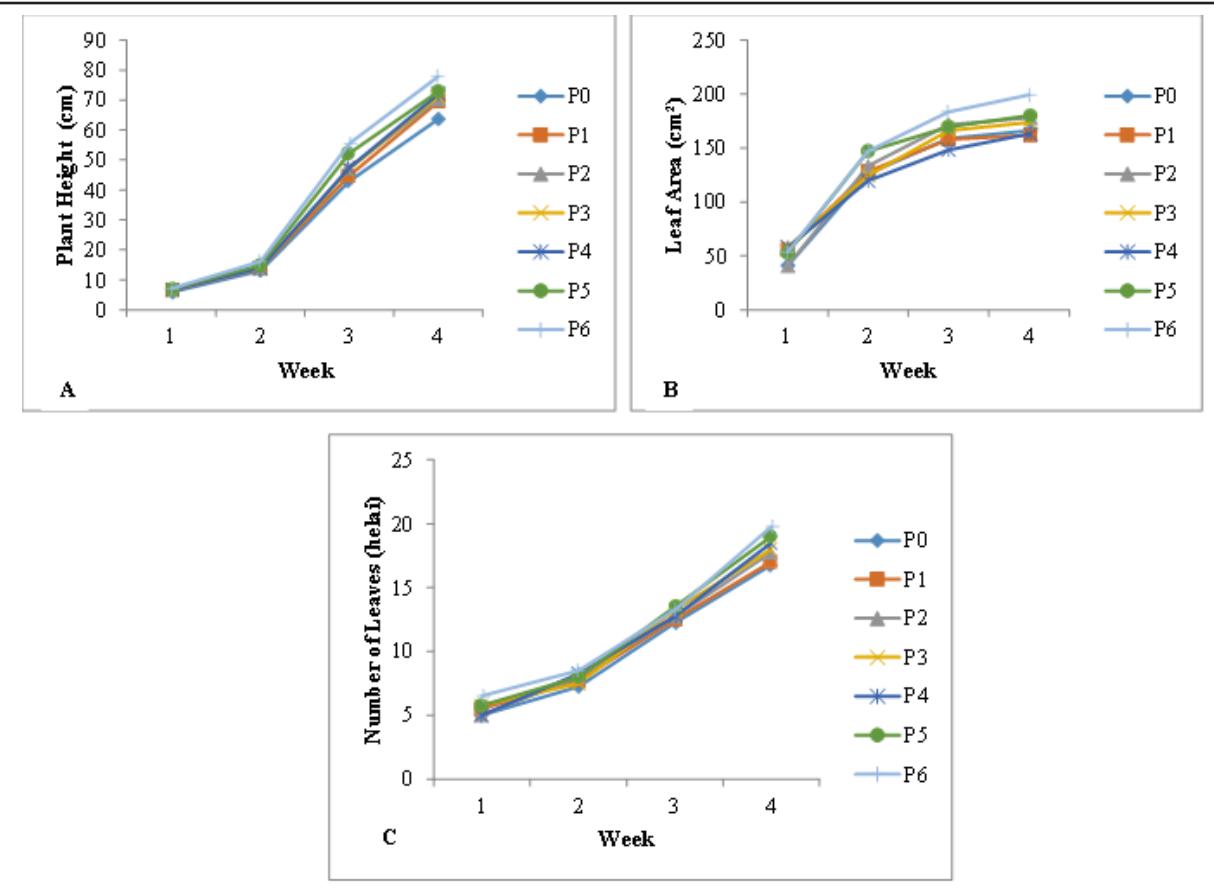
Figure 1. [A] Average plant height of melon per week. [B] Average leaf area of melon per week. [C] Number of melon leaves per week. P0: negative control (0 mL eco-enzyme solution/L); P1: 10 mL eco-enzyme solution/L; P2: 20 mL eco-enzyme solution/L; P3: 30 mL eco-enzyme solution/L; P4: 40 mL eco-enzyme solution/L; P5: 50 mL eco-enzyme solution/L; P6: positive control (commercial liquid organic fertilizer).
utilize nitrogen, which in turn may result in suboptimal leaf area growth. Research shows that when eco-enzyme levels are low, plants may not be able to maximize their leaf growth potential, even if sufficient nitrogen is available [23]. This indicates that there is a complex interaction between nitrogen availability, eco-enzyme levels, and leaf area growth that needs to be further understood. Additionally, research shows that an increase in leaf area can occur in response to different light conditions. In low light situations, plants tend to allocate more biomass to increase leaf area as an adaptation to capture more light [23,24]. However, if eco-enzyme levels are insufficient, this response may not be enough to result in a significant increase in leaf area.
Figures 1 and 2 show that the average values for each vegetative growth parameter in P5 and P6 are higher than in the other treatments. The application of 50 mL eco-enzyme
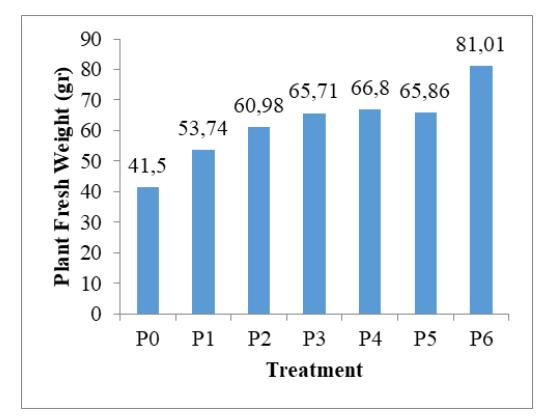
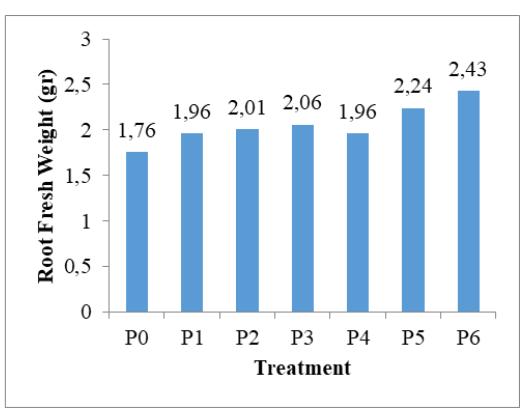
Figure 2. Average plant fresh weight and average root fresh weight of melon plants. P0: negative control (0 mL eco-enzyme solution/L) P1: 10 mL eco-enzyme solution/L; P2: 20 mL eco-enzyme solution/L; P3: 30 mL eco-enzyme solution/L; P4: 40 mL eco-enzyme solution/L; P5: 50 mL eco-enzyme solution/L; P6: positive control (commercial liquid organic fertilizer).
| Sample | N | 1 | 2 | 3 | 4 | 5 |
| P0 | 4 | 31,0250𝑎 | ||||
| P1 | 4 | 33,6375𝑏 | ||||
| P2 | 4 | 34,5813𝑐 | ||||
| P3 | 4 | 34,7625𝑐 | ||||
| P4 | 4 | 35,0188𝑐 | ||||
| P5 | 4 | 36,6875𝑑 | ||||
| P6 | 4 | 39,1063𝑒 | ||||
| Sig. | 1,000 | 1,000 | ,220 | 1,000 | 1,000 | |
Table 1. Duncan's post-hoc test results for plant height
solution/L had a significant effect on the vegetative growth of melon plants. This is also evident from the Duncan test results for each observed growth parameter. The Duncan test data for each observed vegetative growth parameter are presented in Table 1, Table 2, Table 3, and Table 4. Numbers followed by the same letter indicate no significant difference. The Duncan test is used to determine the most effective treatment [25], and other studies evaluating the effects of various treatments on plant growth also highlight the importance of using this test to obtain valid and reliable results [26].
Table 1 shows that treatments with higher concentrations of eco-enzyme (P5 and P6) resulted in greater plant height compared to the other treatments. The eco-enzyme at a concentration of 50 mL/L produced results similar to commercial liquid fertilizer in enhancing the height of melon plants.
Based on Table 2, treatments P5 (50 mL/L eco-enzyme) and P6 (commercial fertilizer) showed a significant increase in leaf area compared to the other treatments. The application of 50 mL/L eco-enzyme was nearly as effective as the commercial fertilizer.
In Table 3, treatment P6 produced the highest number of leaves (12.4375), followed by P5 (11.5625), both of which were significantly different from the control treatment (P0). This indicates that P5 and P6 had a significant effect on increasing the number of leaves.
Table 4 also shows that treatment P6 resulted in the highest plant fresh weight (81.0125 g), followed by P5 (66.8050 g). These results indicate that the eco-enzyme at a concentration of 50 mL/L is nearly as effective as commercial fertilizer in increasing plant fresh weight. Thus, the concentration of the eco-enzyme solution as liquid organic fertilizer greatly influences vegetative plant growth. The concentration of ecoenzyme as liquid organic fertilizer has a significant effect on the vegetative growth of melon plants. Research shows that the proper use of eco-enzyme at the right dosage can significantly enhance the growth and yield of melon plants. The optimal liquid organic fertilizer concentration for melon plants is 8 mL/L, demonstrating a positive interaction between fertilizer type and concentration [27]. The application of ecoenzyme enhances plant productivity in agroforestry systems [21]. The variation in liquid organic fertilizer concentrations between 1% and 25% in melon plants resulted in different growth outcomes, emphasizing the importance of the correct concentration [7]. The appropriate concentration also promotes the growth of shallots, suggesting potential benefits for the
Table 2. Duncan's post-hoc test results for leaf area
| Sample | N | 1 | 2 | 3 |
|---|---|---|---|---|
| P0 | 4 | 123,1169𝑎 | ||
| P1 | 4 | 125,8950𝑎𝑏 | 125,8950𝑎𝑏 | |
| P2 | 4 | 130,4569𝑎𝑏 | 130,4569𝑎𝑏 | |
| P3 | 4 | 130,8538𝑎𝑏 | 130,8538𝑎𝑏 | |
| P4 | 4 | 132,7506𝑎𝑏 | 132,7506𝑎𝑏 | |
| P5 | 4 | 137,3394𝑏𝑐 | 137,3394𝑏𝑐 | |
| P6 | 4 | 145,8925𝑐 | ||
| Sig. | ,161 | ,098 | ,166 |
| Sample | N | 1 | 2 | 3 | 4 |
| P0 | 4 | 10,4375𝑎 | |||
| P1 | 4 | 10,6875𝑎𝑏 | 10,6875𝑎𝑏 | ||
| P2 | 4 | 10,8750𝑎𝑏 | 10,8750𝑎𝑏 | ||
| P3 | 4 | 11,1250𝑏𝑐 | 11,1250𝑏𝑐 | ||
| P4 | 4 | 11,1250𝑏𝑐 | 11,1250𝑏𝑐 | ||
| P5 | 4 | 11,5625𝑐 | |||
| P6 | 4 | 12,4375𝑑 | |||
| Sig. | ,079 | ,088 | ,079 | 1,000 | |
Table 3. Duncan's post-hoc test results for number of leaves
growth of melon plants [28]. Eco-enzyme concentrations that are too low or too high can inhibit growth, making the selection of the correct dosage crucial. This aligns with other research showing that the appropriate liquid organic fertilizer dosage enhances plant growth and yield [29].
Based on Table 5, the nutrient content of the tested eco-enzyme shows that most parameters do not meet the Indonesian National Standard (SNI). The levels of nitrogen, total phosphorus (P), potassium (K), and organic carbon (C-organic) are still below the thresholds set by SNI. However, the pH parameter of the eco-enzyme meets the SNI standard, and the C/N ratio exceeds the SNI standard, indicating a value that is too high. Overall, the quality of this eco-enzyme needs improvement to meet SNI requirements for optimal use as a fertilizer [14]. The nitrogen, phosphorus, and potassium (N, P, K) content in the eco-enzyme is also a contributing factor to why concentrations below 50 mL of eco-enzyme solution/L did not have a significant effect on the vegetative growth of melon plants. Therefore, the quality of the eco-enzyme must be improved to meet standards and enhance its effectiveness.
Improving the quality of this eco-enzyme can be influenced by various factors, including the raw materials used in the fermentation process. The nutrient content, such as nitrogen (N), phosphorus (P), and potassium (K), which should be present in fertilizers, is also a concern, as the eco-enzyme solution produced may not yet meet these requirements. Additionally, the duration of the fermentation process also affects the quality of the resulting eco-enzyme [30,31]. In this study, the raw materials used were waste from melon leaves, stems, and peels. Previous research has shown that the composition of organic materials in the production of liquid organic fertilizer can affect the content of essential nutrients such as nitrogen (N), phosphorus (P), and potassium (K), which are vital for plant growth [32]. Additionally, the fermentation duration plays a crucial role in determining the quality of the eco-enzyme produced. The right fermentation time can enhance the availability of nutrients in the ecoenzyme solution [32]. The proper fermentation process can increase the nutrient content in organic waste, making it a more effective fertilizer [33]. Therefore, it is important to consider factors such as the type of raw materials and the fermentation duration in the development of high-quality ecoenzyme [15,34]. The NPK content in eco-enzyme is crucial as it serves as a key indicator of the quality of organic fertilizer. Research has shown that eco-enzyme produced from certain organic materials, such as banana peels and pineapple, can
Table 4. Duncan's post-hoc test results for plant fresh weight
| Sample | N | 1 | 2 | 3 |
|---|---|---|---|---|
| P0 | 4 | 41,5075𝑎 | ||
| P1 | 4 | 53,7400𝑎𝑏 | 53,7400𝑎𝑏 | |
| P2 | 4 | 60,9825𝑏 | ||
| P3 | 4 | 65,7100𝑏𝑐 | 65,7100𝑏𝑐 | |
| P4 | 4 | 65,8600𝑏𝑐 | 65,8600𝑏𝑐 | |
| P5 | 4 | 66,8050𝑏𝑐 | 66,8050𝑏𝑐 | |
| P6 | 4 | 81,0125𝑐 | ||
| Sig. | ,145 | ,161 | 0,96 |
| No | Test Parameter | Unit | Result | SNI | Description |
|---|---|---|---|---|---|
| 1 | Nitrogen | % | 0,05 | 2 | Not meeting SNI |
| 2 | P-total | % | 0,03 | 2 | Not meeting SNI |
| 3 | Kalium | % | 0,18 | 2 | Not meeting SNI |
| 4 | C-Organik | % | 2,13 | 10 | Not meeting SNI |
| 5 | pH | - | 7.4 | 4-9 | Meeting SNI |
| 6 | Rasio C/N | - | 40.36 | ≤25 | Exceeding SNI |
Table 5. Nutrient content of eco-enzyme
meet the standards required for liquid organic fertilizer to support plant growth [32]. However, if the raw materials used are not suitable or the fermentation time is not optimal, the nutrient content in the eco-enzyme may be insufficient, reducing its effectiveness as a fertilizer [32].
4. Conclusion
The results showed that treatment P5 (50 mL/L) produced the best outcomes, with a plant height of 36.68 cm, leaf area of 137.33 cm², 11.56 leaves, plant fresh weight of 67.1 g, and root fresh weight of 2.24 g. These results were not significantly different from the positive control (P6). Thus, eco-enzyme has a significant effect on the vegetative growth of melon plants.
Acknowledgements
We would like to express our stakeholders, including students Program Studi Pendidikan Biologi Universitas Islam Negeri Raden Intan Lampung and community of the sampled locations, that have contributed to the survey and collection of data.