

1. Introduction
Dragon fruit (Selenicereus costaricensis (F.A.C. Weber) S.Arias & N. Korotkova ex Hammel, formerly Hylocereus costaricensis (F. A. C. Weber) Britton & Rose) [1] is one of the horticultural commodities with high demand. Dragon fruit contains high nutritional content, including fiber, water, fat, protein, carotene, calcium, phosphorus, iron, sugar, carbohydrates, magnesium, vitamin B1, B2, vitamin C, and betalain pigments that give dragon fruit its red or purple color [2–4]. In addition to being natural antioxidants [2,3], betalains can also be used in pharmaceuticals and cosmetics and have therapeutic properties for disease prevention [5].
Dragon fruit plants originate from Mexico, South America, and Central America and have since spread to Asian countries, including Indonesia [6]. In Indonesia, dragon fruit
cultivation began in 2000, and the super red variety became the most widely cultivated. However, dragon fruit production in Indonesia has decreased from 3,174 tons in 2023 to 2,760 tons in 2024 [7]. This decline is attributed to land conversion, extreme environmental changes, and limited use of cultivation technologies, such as additional lighting to stimulate flower growth.
The flowering process can be influenced by environmental conditions such as temperature changes, water availability, rainfall, and light. Light factors include photoperiod [8,9]. Based on the plant's response to photoperiod, dragon fruit plants are long-day plants [10], which will flower when exposed to a photoperiod longer than its critical photoperiod [11], which will flower when exposed to a photoperiod longer than their critical photoperiod [12]. Supplemental lighting that extends the photoperiod to approximately 18–20 hours
has been shown to accelerate floral induction by modulating circadian rhythm–regulated flowering genes [12]. Empirical evidence further demonstrates that continuous supplemental lighting enables dragon fruit plants to flower within 33–48 days and produce fruit within 46–59 days, substantially earlier than plants grown without light supplementation [13].
Yellow light with a wavelength of 580–600 nm has been shown to stimulate flower bud formation in red dragon fruit (Hylocereus polyrhizus), thereby enhancing productivity compared to blue or white light [14]. In contrast, red light has been reported to inhibit flower induction and development in both long-day and short-day plants [15].
In addition to lighting, nutrition is important for supporting growth and development. At a local dragon fruit orchard in Sumedang, West Java, known as Haurngombong Orchard, fruit cracking before harvest was observed, leading to a decline in fruit quality [16]. In pomegranates, fruit cracking can be caused by water stress resulting from imbalances in rainfall, humidity, and temperature. The measured environmental conditions at Haurngombong Orchard, i.e., rainfall, air humidity, and soil moisture, exceeded optimal levels for dragon fruit plants. In addition to water stress, deficiencies in potassium, calcium, and boron are also among the causes of fruit cracking [17]. However, soil analysis results from this orchard indicate that potassium and calcium are present in sufficient quantities, suggesting that the fruit cracking in the orchard is likely due to a boron deficiency.
As one of the important micronutrients for plants, boron plays a role in cell division and enlargement, maintenance of cell wall structure, pollination, biosynthesis, and translocation of sugar [18,19]. Boron deficiency can inhibit flower formation because cell division in the apical meristem area is disrupted, and the quality of the fruit produced is poor. The application of boron at a concentration of 50 mg/m2 significantly affects fruit ripening and the quality of dragon fruit (Selenicereus costaricensis) [6].
Research on the effect of combining yellow light and boron on dragon fruit productivity and quality has been limited. Therefore, this study was conducted to evaluate strategies to improve flowering and dragon fruit quality by optimizing cultivation techniques through the combination of yellow light and boron supplementation. The findings of this study will contribute valuable insights to dragon fruit cultivation practices.
2. Methodology
The research was conducted from November 2023 to April 2024 at the Haurngombong Orchard in Sumedang, Indonesia, and at the Natural Materials Analysis Laboratory, SITH, ITB. The Haurngombong Orchard measures 25 m x 15 m, and the dragon fruit plants used consist of three age groups: 2 years old, 3 years old, and 7 years old (Figure 1). The location is at an elevation of 800 meters above sea level with an average rainfall of 219 mm per month.
Dragon fruit plants were watered once a week. Fertilization used manure applied every 6 months at 1.6 kg/m², NPK fertilizer at 32 g/m², and boron at 1.38 g/m², all applied together every 3 months [20]. Pest (i.e., ants and fruit flies) was controlled using the insecticide Demolish at a rate of 1 ml/liter, applied a maximum of once per week. The soil in the Haurngombong Dragon Fruit Orchard was covered with gravel to control weeds.
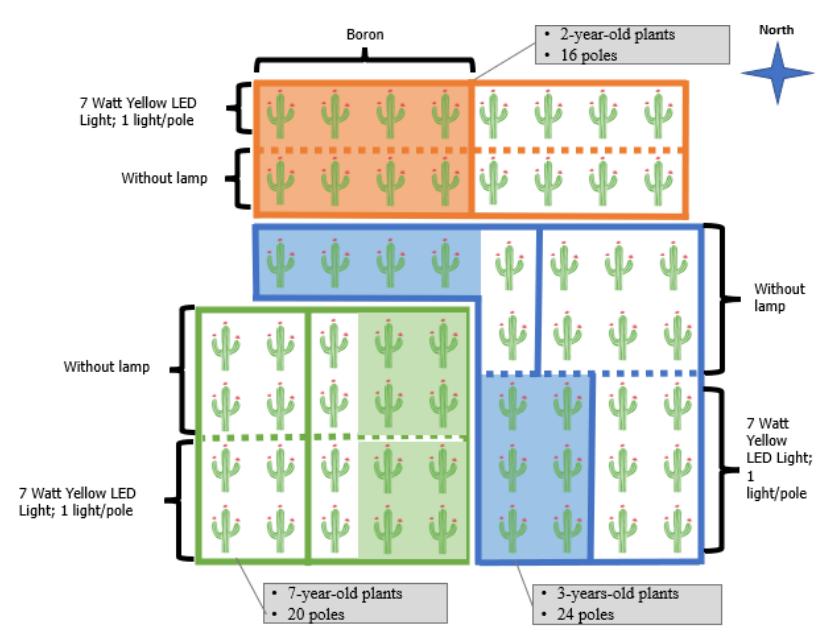
Figure 1. Map of the Haurngombong Dragon Fruit Orchard
This study used a three-factor split-plot randomized block design. The first factor was the provision of additional light with 7-watt yellow LEDs for 12 hours (6:00 p.m. to 5:00 a.m.) daily. Yellow LED lights were placed 30 cm above the plants, with one light per pole. Plants that received light treatment were separated from those that did not using a paranet to minimize light interference with the groups that did not receive light treatment. The second factor was the provision of 0.5 g/pole of boron. Boron was sprinkled into holes 30 cm deep from the surface, then the holes were filled back with soil. The flowers and fruits of these plants were not observed. The third factor was the plant's age. The lights were placed 30 cm above the plants, with one light used per plant. The experimental treatments—light + boron, light only, boron only, and control—were administered across three plant age groups (2-, 3-, and 7-year-old).
Sampling was conducted on three poles, with two individual plants per pole, yielding six replicates. The three experimental factors generated 12 treatment combinations, yielding a total of 72 experimental units. The parameters observed included the number of flower buds, number of flowers, fruit set percentage, number of fruits, individual fruit weight, total fruit weight, edible part percentage, and fruit flesh and skin firmness tests.
2.1 Environmental Conditions
Environmental parameters, including light intensity, air humidity, air temperature, and soil temperature, were measured directly throughout the study period. Additional data, including duration of sunshine, air humidity, and air temperature during the study period, were obtained from the Meteorology, Climatology, and Geophysics Agency (Table 1).
Table 1. Environmental Conditions of the Haurngombong Dragon Fruit Orchard
| Parameters | Value |
|---|---|
| Light intensity (lux) | 208.5-301.6 |
| Sunlight intensity (lux) | 18,300-84,000 |
| Irradiation duration per 12 hours (%) | 41-86 |
| Soil moisture (%) | 45-70 |
| Air humidity (%) | 85-92 |
| Air temperature (°C) | 22-28 |
| Soil temperature (°C) | 25-28 |
2.2 Soil quality
Soil quality from two points in the orchard, namely the southern point and the northern point, was measured at a depth of 30 cm from the soil surface (Table 2). It appears that the soil pH (6.92-6.99) was within the optimal range for dragon fruit plants (pH 6.5-7) [5]. Based on the organic carbon content, macronutrients, cation exchange capacity, and aluminum saturation, the orchard soil is classified as fertile. The soil texture is silty clay loam and clay loam. The soil type is not an issue, as dragon fruit plants can grow in a variety of soil types [5].
2.3 Flower and Fruit Observation
Flower observation includes the number of flower buds and the number of flowers. Fruit observation includes the number of fruits, cracked fruits, fruit weight, and edible parts. Harvested fruits were checked for cracks, and their weight was measured using an Osuka-2000 digital scale. Fruit firmness was measured using a fruit penetrometer. The flesh or skin of
Table 2. Soil quality at the Haurngombong Dragon Fruit Orchard
| No. | Parameter | Sampling Point | Value | Description |
|---|---|---|---|---|
| 1. | pH | North South | 6.99 6.92 | Neutral Neutral |
| 2. | Organic - C | North South | 4.09% 3.06% | High High |
| 3. | Total - N | North South | 0.42% 0.33% | Medium Medium |
| 4. | C/N | North South | 10 9 | Low Low |
| 5. | P2O5 (Olsen) | North South | 99.13 ppm P 99.80 ppm P | Very High Very High |
| 6. | K2O HCL 25% | North South | 99.20 mg/100g 97.65 mg/100g | Very High Very High |
| No. | Parameter | Sampling Point | Value | Description |
|---|---|---|---|---|
| 7. | K-exchangeable | North South | 2.92 cmol.kg-1 2.99 cmol.kg-1 | Very High Very High |
| Na-exchangeable | North South | 0.09 cmol.kg-1 0.16 cmol.kg-1 | Poor Low | |
| Ca-exchangeable | North South | 8.05 cmol.kg-1 9.92 cmol.kg-1 | Medium Medium | |
| Mg-exchangeable | North South | 7.40 cmol.kg-1 8.19 cmol.kg-1 | High Very High | |
| 8. | Cation exchange capacity (CEC) | North South | 38.30 cmol.kg-1 32.86 cmol.kg-1 | High High |
| 9. | Base Saturation | North South | 48.19% 64.67% | Medium High |
| 10. | Al-saturation | North South | 1.86% 3.52% | Bad Poor |
the fruit was placed on a table and pierced with a probe. The depth of the puncture indicates the softness of the dragon fruit. The hardness of the flesh or skin of the fruit was expressed in kg/cm².
2.4 Data Analysis
The data obtained was analyzed statistically using analysis of variance (ANOVA). If the treatment had a significant effect, Duncan's New Multiple Range Test (DNMRT) was performed at the 5% level using SPSS 25.
3. Results and Discussion
3. 1 Number of flower buds, number of flowers, and number of fruits
The combination of yellow light and boron significantly increased the number of flower buds, flowers, and fruits, particularly in 3-year-old and 7-year-old plants, compared to the treatments of light without boron, boron without light, and control (Figure 2). The number of flower buds produced from the combination of light and boron in 3-year-old and 7-year-old plants differed significantly from the treatments of light without boron, boron without light, and the control. The combination of light and boron applied to 7-year-old plants resulted in significantly more flowers and fruits than in 2-yearold and 3-year-old plants, as well as in single treatments and the control. These results proved an interaction between light, boron, and plant age in increasing the number of flower buds, flowers, and fruits.
Under the combined light and boron treatment, as well as the boron-only treatment, all flowers developed into fruits in 2-, 3-, and 7-year-old plants, achieving a 100% fruit set. In contrast, the light-only treatment resulted in lower fruit set
percentages of 67%, 93%, and 96% in 2-, 3-, and 7-year-old plants, respectively.
The combination of light and boron has been proven to be optimal for increasing the number of flower buds, flowers, and fruits in dragon fruit plants. As a long-day plant, a light period of more than 18–20 hours can trigger flowering [12]. Light exposure can influence the plant's circadian rhythm by activating the expression of the ELF1 (early flowering 1) gene. The presence of the ELF1 gene increases the expression of the CO (constans) gene [12]. The CO gene then triggers the expression of the LFY (leafy), FT (flowering locus t), and SOC1 (suppressor of overexpression of constans1) genes [12]. These genes induce flowering [12]. Additionally, nighttime light exposure optimizes stomatal opening, thereby increasing CO2 uptake for photosynthesis [21].
Similarly, boron plays a role in carbohydrate biosynthesis and translocation [22], thereby supporting the accumulation of assimilates in meristematic tissues and promoting flowering [23]. In addition to light and boron, plant age also influences flowering: seven-year-old plants produce more flower buds, flowers, and fruits than three-year-old and two-year-old plants. These results align with the flowering phase of dragon fruit plants, which begins two years after planting, stabilizes by three years, and reaches optimal levels between 5 and 20 years [24].
The number of flowers that develop into fruit (fruit set) is related to the number of fruits produced. The application of a combination of light and boron, as well as boron without light, can prevent flower drop in dragon fruit plants, ensuring that all flowers develop into fruit. These results are consistent with research stating that boron can reduce the percentage of flower and fruit drop in mango plants [25]. The reduction in flower drop percentage is due to boron's role in maintaining cell wall strength and stability through cross-linking with RG-
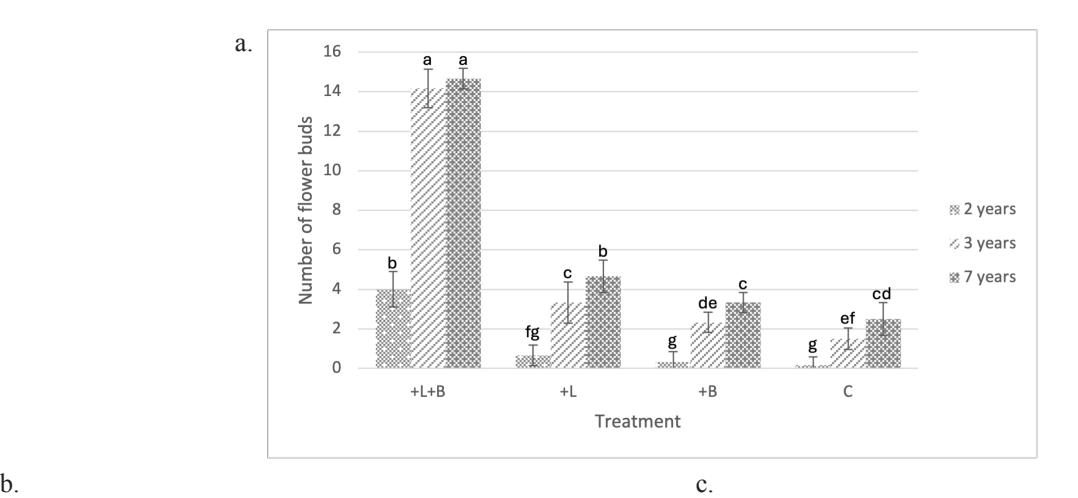
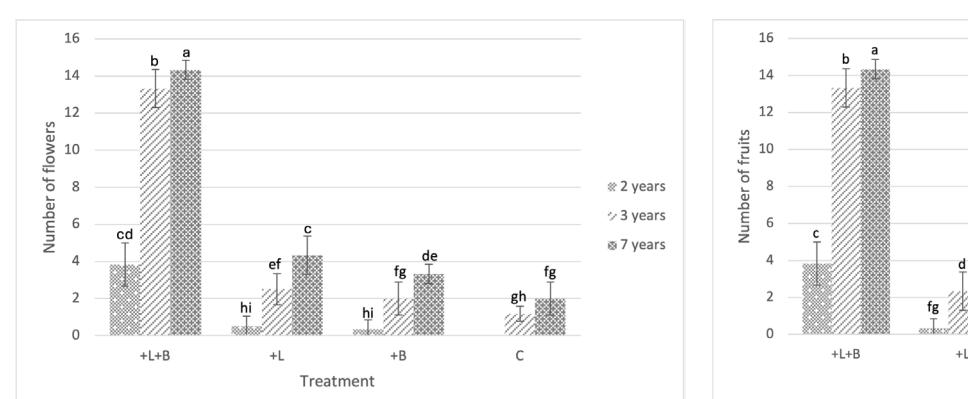
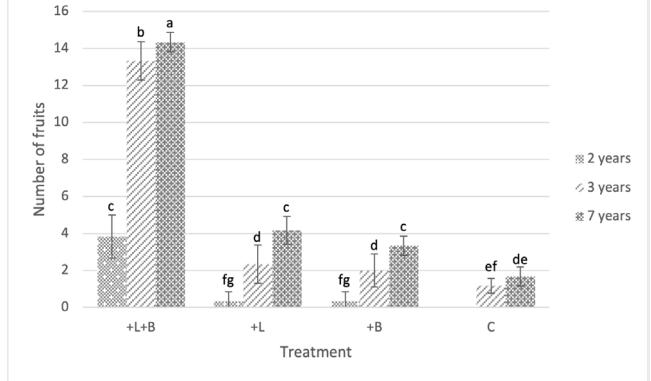
Figure 2. Effect of yellow light and boron application on the number of flower buds (a), number of flowers (b), and number of fruits (c) in dragon fruit (Hylocereus costaricensis) plants of different ages. Values are expressed as means ± standard deviation (n=6).
Legend: +L+B: combined yellow light and boron treatment; +L: yellow light without boron; +B: boron without yellow light; C: control. Different lowercase letters (a–g) indicate statistically significant differences based on the DNMRT test (α = 0.05).
II (rhamnogalacturonan-II) in the middle lamella of the flower cell wall, thereby preventing flower drop [26]. Boron plays a crucial role in pollen germination and pollen tube growth, enabling it to reach the ovule [18]. Boron also enhances carbohydrate translocation and transformation into flowers, making them more attractive to pollinating insects, thereby improving pollination and increasing fruit formation [19,27]. However, light alone is insufficient to prevent flower drop and the failure of flowers to develop into fruit at all stages of dragon fruit plant growth.
3.2 Fruit Weight
The combination of light and boron treatment produced the highest individual fruit weight compared to single treatments and controls (Figure 3). It appears that the individual fruit weight produced by the combination of light and boron in 3-year-old and 7-year-old plants differs significantly from that of single treatments and controls.
The combination of light and boron treatment produced the greatest total fruit weight in 7-year-old plants, reaching 41,418 g (Table 3). The number of fruits is related to the fruit mass produced. However, a large number of fruits reduces the total fruit mass. The number of fruits produced by 7-yearold plants is the highest among the treatments, but 3-year-old plants produce the heaviest fruits. Plants that produce many fruits have smaller fruit size and fruit mass [28]. The results of this study are consistent with previous research, indicating that H. costaricensis has a fruit mass of 250-0 g, with the proportion of dragon fruit peel ranging from 25% to 30% of the total fruit mass [29].
During fruit ripening, osmotic pressure draws water from the skin into the fruit flesh, resulting in skin thinning. The continuous loss of water causes a gradual decrease in skin mass as the ripening process progresses [30]. Light exposure reduced the percentage of banana peel weight by 13% compared to the control group at 35%, as light can increase ethylene production in bananas, thereby accelerating the ripening process [30]. Similarly, light treatment without boron applied to three-year-old plants resulted in the highest
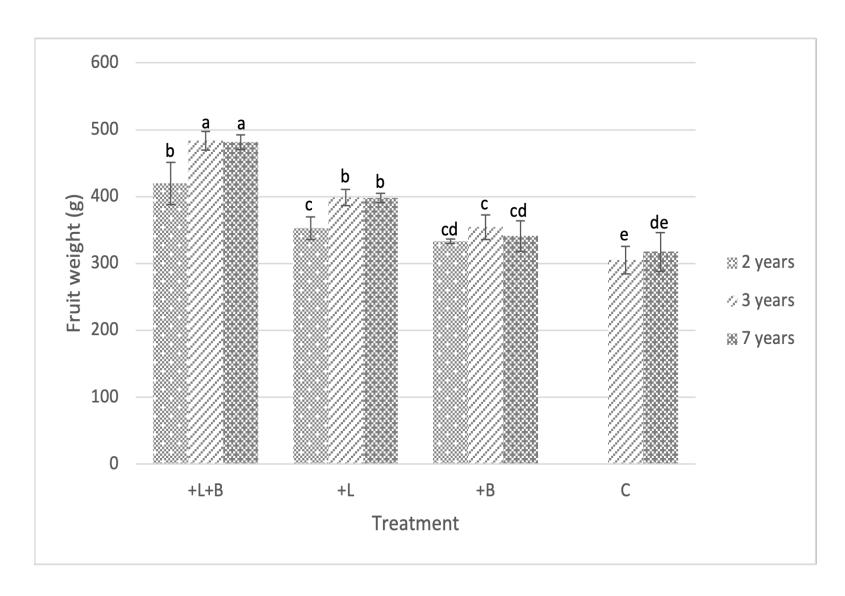
Figure 3. Effect of yellow light and boron treatments on fruit weight of dragon fruit under different treatment combinations. Data are presented as means ± SD from 6 replicates.
Legend: +L+B: combined yellow light and boron treatment; +L: yellow light without boron; +B: boron without yellow light; C: control. Different letters (a–e) indicate significant differences according to the DNMRT test.
Table 3. Effect of light and boron on total fruit weight (g) and percentage of edible part (%) in red dragon fruit plants at different ages. Legend: +L+B: combined yellow light and boron treatment; +L–B: yellow light without boron; –L+B: boron without yellow light; C: control.
| Plant age | +L+B | +L-B | -L+B | C | ||||
|---|---|---|---|---|---|---|---|---|
| Total fruit weight | Edible part | Total fruit weight | Edible part | Total fruit weight | Edible part | Total fruit weight | Edible part | |
| 2 years | 9,581 | 89.97 | 706 | 88.72 | 667 | 87.5 | n.a | n.a |
| 3 years | 38,715 | 90.1 | 5,614 | 90.79 | 4,254 | 88.57 | 1,813 | 88.8 |
| 7 years | 41,418 | 90.08 | 9,942 | 90.14 | 6,759 | 90.75 | 3,036 | 90.28 |
* There is no data available (n.a.) regarding the control treatment for two-year-old plants because they did not produce fruit.
Table 4. The effect of light and boron treatments on the percentage (%) of cracked fruit in red dragon fruit plants at different ages. Legend: +L+B: combined yellow light and boron treatment; +L–B: yellow light without boron; –L+B: boron without yellow light; C: control.
| Plant age | +L+B | +L-B | -L+B | C |
|---|---|---|---|---|
| 2 years | 8 | 33 | 0 | - |
| 3 years | 6 | 21 | 8 | 14 |
| 7 years | 3 | 24 | 15 | 10 |
proportion of edible parts compared to other treatments. Meanwhile, the highest percentage of the edible part from the light treatment without boron, given to 3-year-old plants, was 90%. These results are consistent with previous studies showing that the proportion of edible parts of dragon fruit generally ranges from 70–90% [28]; the proportion of edible parts of super red dragon fruit from the 7-watt yellow light treatment was 82% [31]; and the proportion of edible parts of yellow dragon fruit from the 50 mg/m² boron application treatment was 71% [32].
3.3 Cracked Fruit
The highest percentage of fruit cracking was observed in 2-year-old plants treated with light without boron, reaching 33% (Table 4). In contrast, the lowest percentage (0%) was observed in 2-year-old plants treated with boron in the absence of light. Based on the ANOVA test, only boron application had a significant effect on the proportion of cracked fruit. Meanwhile, plant age and light exposure had no significant effect on the proportion of cracked fruit (p>0.05).
Cracked fruit is common in pomegranates, lychees, apples, avocados, oranges, tomatoes, and dragon fruit. Fruit cracking is caused by several factors, such as high evapotranspiration, low relative humidity, water imbalance, sharp temperature fluctuations between day and night, and nutrient deficiencies, especially boron, calcium, and potassium, during fruit growth and development. Pomegranate fruit cracking occurs due to imbalances in soil moisture, relative humidity, transpiration rate, and fruit skin flexibility. Imbalances in moisture cause the fruit flesh and meristem tissue to expand rapidly, while the fruit skin, which has undergone cell wall thickening, cannot keep pace with this growth [17].
Light treatment without boron at all plant age levels resulted in the highest fruit cracking. This is possibly due to excessive rainfall, high soil moisture, and elevated air humidity, which, when combined with supplemental light exposure, may create an imbalance in internal water pressure and accelerate fruit enlargement. When the fruit peel lacks sufficient elasticity to accommodate this expansion, cracking becomes more likely. In contrast, both the combined light and boron treatment and the boron-only treatment consistently produced the lowest levels of fruit cracking. These findings indicate that boron application plays a critical role in preventing cracking by enhancing cell wall integrity and maintaining fruit firmness by reducing cell wall–degrading enzyme activities, such as cellulase, pectin methyl esterase, and polygalacturonase [19,33]. Additionally, boron has been reported to increase fruit flesh thickness in melon, further supporting its role in improving structural resilience and reducing susceptibility to cracking [34].
3.3 Fruit Firmness
The combination of light and boron treatment resulted in the highest fruit skin and flesh firmness levels at all plant ages compared to the control (Figure 4). The highest fruit skin firmness was observed in 2-year-old plants. The highest fruit flesh firmness was observed in 7-year-old plants. The skin and fruit flesh firmness levels produced by the combination of light and boron differed significantly from the control. Additionally, there was a significant interaction between light and boron, where the combination of light and boron significantly increased skin and fruit flesh firmness levels.
Fruit ripening is accompanied by physical changes such as a decrease in fruit firmness. Fruit firmness is an indicator of post-harvest quality and can be improved by applying boron, which plays a role in maintaining plasma membrane integrity and cell wall formation [35]. Fruit softening is caused by the degradation of protopectin into water-soluble pectin by the enzyme protopectinase as the fruit ripens [36].
Light treatment without boron increased skin firmness in 2-year-old plants and fruit flesh firmness in 7-year-old plants compared to the control. These results are consistent with
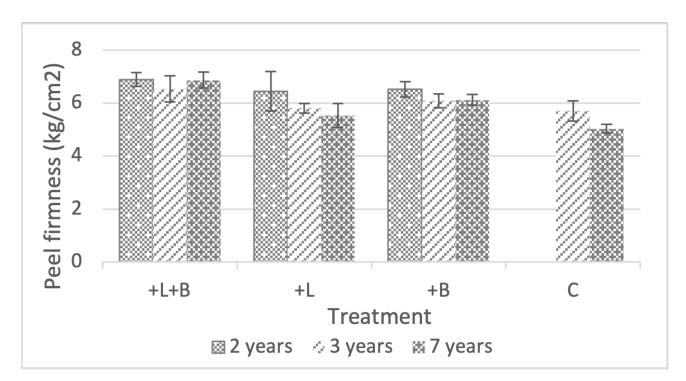
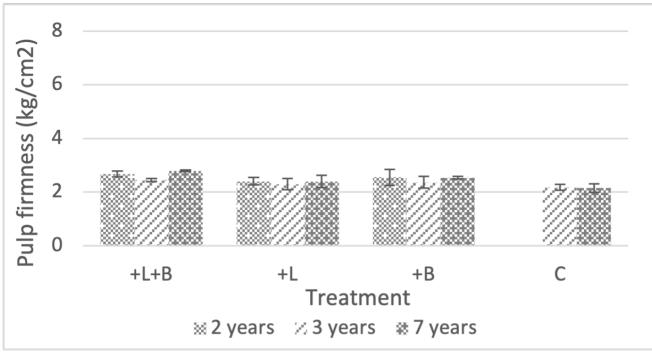
Figure 4. Effect of yellow light and boron treatments on the fruit firmness of dragon fruit under different treatment combinations. Data are presented as means ± SD from 6 replicates.
Legend: +L+B: combined yellow light and boron treatment; +L: yellow light without boron; +B: boron without yellow light; C: control.
research stating that yellow light treatment increased skin firmness by 5.48 kg/cm² and fruit flesh firmness by 3.64 kg/ cm² [37]. Meanwhile, boron treatment without light applied to 2-year-old plants increased skin and fruit flesh firmness levels higher than light without boron or the control. Light alone or boron alone had a significant effect on the firmness levels of the skin and fruit flesh produced. These results are higher than those reported in a study stating that boron application at 50 mg/m² increased the skin firmness of yellow dragon fruit by 3.11 kg/cm² and flesh firmness by 2.74 kg/cm² [32].
Boron application has been shown to increase fruit firmness through cross-linking with pectin in the middle lamella of the cell wall [38]. Boron significantly improves the quality and ripening of yellow dragon fruit (Selenicereus costaricensis) [30]. Meanwhile, increased light exposure accelerates ripening and softens the fruit's skin and flesh [30]. Additionally, the skin firmness of the fruit is higher than that of the flesh. The same results were obtained in studies, with the flesh firmness of dragon fruit at 2.25 kg/ cm², softer than the skin firmness of dragon fruit at 4.6 kg/cm² [29]. These findings indicate that integrating supplemental yellow light with boron application can effectively enhance fruit firmness, thereby improving post-harvest quality and extending shelf life in commercial dragon fruit production.
4. Conclusion
Supplemental lighting significantly enhances dragon fruit production, while boron application effectively reduces flower abscission and fruit cracking. Overall, the combined application of yellow light and boron proved to be the most effective strategy for promoting flowering and improving generative performance, particularly in 3- and 7-year-old plants. Increasing plant age up to 7 years was also associated with greater reproductive output and higher fruit weight. Collectively, these results underscore the importance of integrating light management and micronutrient supplementation to optimize flowering induction and fruit quality. Future research should investigate the longterm physiological mechanisms underlying light–nutrient interactions and evaluate the scalability of this approach under diverse environmental and commercial production settings.
Acknowledgements
The authors would like to express their gratitude to the School of Life Sciences and Technology, ITB, for providing research equipment and research locations, particularly to Mr. Tetep Ginanjar and the staff of the Haurngombong Educational Orchard for their assistance and for providing the research locations. The authors would also like to thank the Meteorology, Climatology, and Geophysics Agency (BMKG) for providing supporting data for the research.