Noor Dzulaikha Daud, Shu Wen Lim, Soo Siang Teoh, Mohamad Kamarol Mohd Jamil, and Noramalina Abdullah*
School of Electrical & Electronic Engineering, Universiti Sains Malaysia, Nibong Tebal, Penang, Malaysia ndzulaikha@usm.my, eeteoh@usm.my, eekamarol@usm.my, eenora@usm.my
Abstract: The rising global demand for electricity and continued reliance on fossil fuels makes efficient household energy management crucial for promoting sustainability. This paper introduces a cost-effective Internet of Things (IoT)-based system designed to monitor, analyze, and control household power consumption in real time. The system utilizes current and voltage sensors, namely SCT013-030, ZMPT101B, and PZEM-004T, integrated into the NodeMCU ESP32 microcontroller, to gather accurate energy usage data from household appliances. The collected data is transmitted through Wi-Fi to cloud platform, Blynk, where users can access an interactive dashboard. This dashboard allows for real-time monitoring, data visualization, remote control of appliances, and push notifications for energy usage alerts. The system integrates load scheduling, consumption limits, and voltage tracking, enabling users to optimize energy use, reduce electricity bills and enhance overall efficiency. Operational effectiveness was validated through comparative measurements using digital multimeters. Ultimately, this IoT-based solution offers a scalable approach for Malaysian households to adopt smarter energy practices, leading to significant economic savings while contributing to environmental sustainability.
Keywords: Energy management; Internet of Things (IoT); Real-time Monitoring; Sustainability; Household appliances
1. Introduction
Over time, technological advancements have contributed to an increase in global electricity demand. However, most of the country still relies heavily on fossil fuels like coal, oil and natural gas to produce energy, causes the increased levels of air pollution [1]. The burning of fossil fuels to generate electricity, releases carbon dioxide and greenhouse gases released into the atmosphere [2]. To meet electricity demands that are rising, it is necessary for the construction of new power plant [3]. However, these actions required a higher utility cost for construction and also lead to greenhouse gas emissions contributing to possible air pollution. Therefore, it is important to change the energy consumption behaviour of the consumer while seeking efficient delivery and electricity [4]. Previous studies recommended that the specification on household electrical demand can help to save electrical energy consumption, the propose real-time power energy consumption system to help the consumers to control and monitor flow of energy consumption [5].
Recently, the demand for electricity consumption has increased which has resulted in higher electricity bills and consumers intend to reduce power consumption usage for own premises [6, 7]. In Malaysia, the consumption of electrical energy for individual households were measured by energy meter, but precise data and real-time feedback on the household power consumption is limited [8, 9]. Due to the lack of power consumption information, consumers are unable to make changes to lower on energy usage by time [10] and have to hold off until end of the month to monitor the electricity bills. Therefore, it is difficult for the consumers to improve electrical energy efficiency and electricity cost.
A smart home energy monitoring system using Internet of Things (IoT) technology allows real-time tracking and optimization of energy consumption. Recent literature highlights the integration of sensors, smart meters, and cloud-based analytics to track patterns in energy usage, providing feedback to homeowners [11, 12, 13]. IoT systems often use wireless communication
Received: July 6th, 2025. Accepted: December 5th, 2025
DOI: 10.15676/ijeei.2025.17.4.6
protocols like Zigbee [14], Wi-Fi [15], or LoRa to transmit data to a central platform, enabling remote control of devices [16].
Y. Bai and C. Hung [17] developed smart electricity meters that use Zigbee communication as control module to remotely regulate household electric outlets. The sensing module returns measured current and delivers a notification when overload is achieved. However, the implementation is limited because of the costly and difficulty of installation. K. Luechaphonthara and A. Vijayalakshmi [18], designed a low cost and easy electricity monitoring device that allows for automated load energy readings. The device has a Wi-Fi module that uses wireless network to communicate power consumption data to the cloud server for storage and subsequent monitoring. In 2020, A. Salisu [19] utilized a ESP32 microcontroller to develop an IoT based household power energy monitoring and electric bulb remote control system to encourage energy conservation and reduce electricity waste. The real-time energy usage data, temperature readings, and electric bulb data acquired by the sensors are wirelessly transmitted to the ThingSpeak cloud server through built in Wi-Fi and then displayed and monitored by the MATLAB GUI App. Additionally, when electricity consumption or temperature readings exceeded the threshold, an email notification was sent out to consumers. In 2021, R. S. Hariharan et al. [20] designed an energy consumption monitoring system for home appliances that uses an Android app. The designed system employs ACS712 current sensor to calculate energy consumption, transmitting data to Thingspeak cloud via NodeMCU and notify the user of the electricity usage at the end of each month. This paper introduces a novel and cost-effective IoTbased energy management system that integrates SCT013-030, ZMPT101B, and PZEM-004T sensors with the powerful NodeMCU ESP32 microcontroller and the Blynk cloud platform. The system offers real-time monitoring, intelligent load scheduling, voltage tracking, and pushnotification alerts, enabling efficient control of household appliances. Furthermore, the system's ability to estimate electricity bills, visualize consumption trends, and execute remote commands through a user-friendly mobile interface enhances accessibility and operational effectiveness for non-technical users. These features combined with scheduled load control, energy tracking, and an intuitive dashboard significantly improve usability, affordability, and scalability, making the system practical for large-scale residential adoption compared to existing IoT-based power distribution solutions.
2. Methodology
A. System Configuration
The proposed system combines hardware and software components to enhance functionality and user convenience in smart home automation and energy management. It features a NodeMCU ESP32 microcontroller, a PZEM-004T current voltage multimeter module, SCT-013 AC current sensor split core current transformer, ZMPT101B 250V AC voltage sensor, switches, relays, and Blynk Server. This integrated setup offers a comprehensive solution for single-phase power measurement supporting a voltage rating of 250 VAC, a current rating of 30 A and power rating of 7.5 kW, making it compatible for standard residential electrical systems.
The SCT013-030 is a split-core AC current sensor that supports non-invasive current measurement up to 30 A, with an output voltage range of 1V. It is ideal for residential appliances due to its safety and ease of installation. The ZMPT101B voltage sensor provides accurate AC voltage measurement up to 250 V and includes a built-in operational amplifier for signal conditioning. The PZEM-004T module supports the measurements of RMS voltage, RMS current, active power, apparent power, reactive power, frequency and energy consumption. It communicates via UART and offers higher precision and better integration for real-time applications.
The NodeMCU ESP32 microcontroller is equipped with a dual-core processor, 240 MHz clock speed and integrated WiFi and Bluetooth. Its multiple GPIOs and low-power consumption make it suitable for IoT applications requiring sensor interfacing, real-time control and wireless data transmission. These components were selected for their affordability, accuracy, compactness and seamless compatibility in a household environment
The system accurately monitors RMS voltage, RMS current, active power, reactive power, energy consumption and calculates the power factor, reflecting appliance efficiency. It offers a high update rate of 1-5 seconds, enabling real-time monitoring. Users can remotely access the system through the Blynk mobile application, which offers a user-friendly interface for monitoring energy consumption, controlling appliances and accessing historical data. The application displays real-time power consumption, total energy consumption over specific periods, power factor, remote appliance control options and energy consumption trends for better decision-making.
Main functionalities of the proposed system include remote monitoring of real-time power and energy consumption, electricity bill estimation and remote control home appliances through the Blynk Mobile Application. Additionally, the users can schedule appliance operation to optimize energy usage and enhance overall comfort.
B. Block diagram
The block diagram in Fig. 1 illustrates that the ESP32 board functions as the microcontroller, regulating inputs, actuating corresponding outputs, and transmitting data to the application software server via its built-in Wi-Fi module.
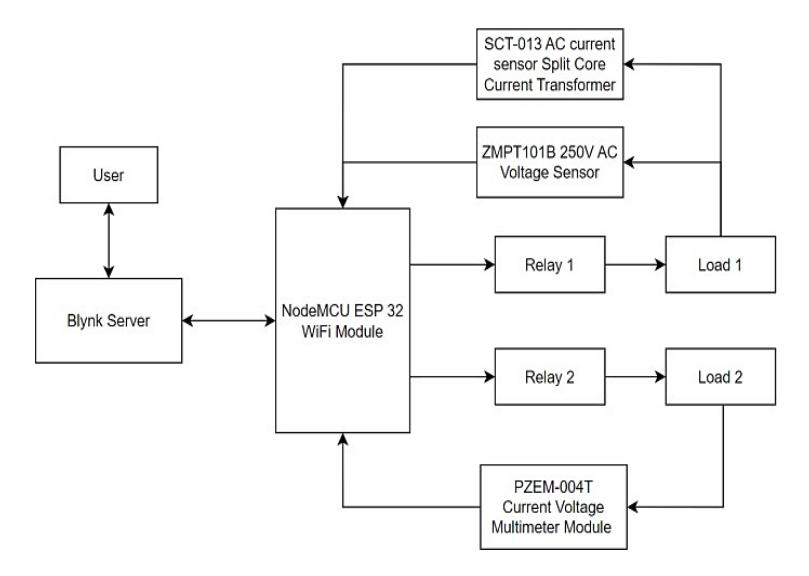
Figure 1. Block diagram
The block diagram also illustrates the interconnection of all components. The user interacts with the server, Blynk, through a smartphone application. Subsequently, the Blynk server transmits commands to the NodeMCU ESP32 Wi-Fi Module. This microcontroller manages the system's relays and collects data various sensors, PZEM-004T current voltage multimeter module, SCT-013 AC current sensor (split core current transformer) and ZMPT101B 250V AC voltage sensor. Data from the sensors is transmitted to the NodeMCU ESP32 and the server, which relays the information back to the user's device. This continuous cycle enables user control and real-time data monitoring through seamless connectivity.
C. Circuit Design
Fig. 2(a) and 2(b) present the schematic diagram and the constructed circuit design of the IoT-based Home Appliance Control and Power Consumption Analysis System. The system features a circuit design that integrates various components to enable remote monitoring of power consumption and control the status of individual home appliances. The core elements of the
design include microcontrollers, sensors, actuators and communication modules, all interconnected to operate cohesively and efficiently.
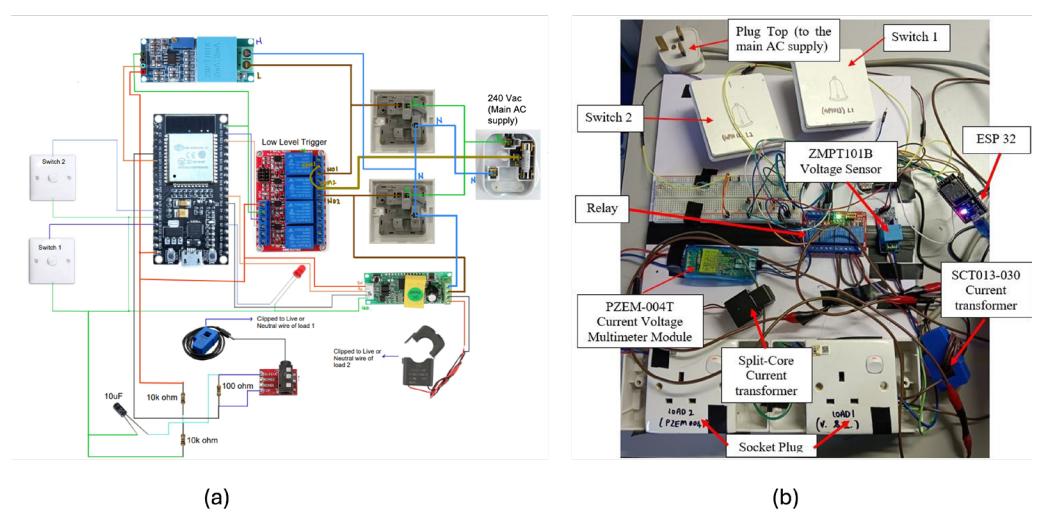
Figure 2. (a) Schematic diagram (b) Designed circuit of proposed system
D. Experimental Design and Testing
The Blynk mobile application was configured and the system was tested in two main phases: controlling and monitoring. The controlling phase focused on verifying the remote operation of home appliances through the Blynk Legacy mobile application and switches. This involved setting up the Blynk application with control elements assigned to specific virtual pins. Each control feature was tested for responsiveness and accuracy, while feedback mechanisms like status updates and event schedulers were evaluated for seamless communication with the ESP32 microcontroller.
Next, the monitoring phase was tested to validate real-time data visualization from the connected sensors or appliances. The Blynk application was configured with widgets to display parameters such as power consumption, energy consumption (kWh), RMS current, RMS voltage, and estimated electricity bills. Test data was collected and compared with multimeter readings to verify measurement accuracy. Any discrepancies were addressed through sensor calibration and code adjustments. After individual testing, the controlling and monitoring phases were integrated and tested as completed system to ensure seamless communication and functionality.
To enable energy-aware automation, the system implements three key-features: load scheduling, allowing users to configure timers for appliances through the Blynk interface; voltage tracking, where real-time RMS voltage is displayed on graphs to detect anomalies or instability; consumption limits, where users are notified via push notifications when power or energy crosses user-defined thresholds. These functions work in tandem to prevent overloading, improve safety and support more efficient appliance operation.
E. Data Analysis and Performance Evaluation
The designed system gathered data through testing and experimentation underwent comprehensive processing to extract meaningful insights and evaluate system performance. Various analysis techniques were applied to assess the system's effectiveness in achieving the objectives. Data from the controlling phase, the analysis focused on the responsiveness and accuracy of appliance control through the Blynk Legacy mobile application. This involved testing individual controls such as turning appliances on and off, adjusting settings and scheduling events. Feedback mechanisms, including status updates and notifications, were also evaluated to ensure seamless communication between the application and the ESP32 microcontroller.
For the monitoring phase, data on real-time parameters including power consumption, RMS current, RMS voltage and estimated electricity bills was analyzed. The accuracy of data (RMS voltage and current) was verified by comparing the values displayed on the Blynk application with measurements obtained from the multimeters. Any discrepancies were resolved through sensor calibration and code adjustments. The system's performance was evaluated against the stated objectives by assessing functionality, usability and reliability. The system's ability to provide real-time information on appliance usage and insights into energy consumption patterns was examined. Usability testing focused on the intuitiveness and user-friendliness of the interface. Additionally, the system was tested under various scenarios such as simultaneous control and monitoring, remote scheduling and performance including no load and load conditions and network conditions, to ensure robustness and reliability.
3. Results and discussion
A low-cost, user-friendly IoT system for monitoring, controlling, and analyzing home appliance power consumption has been developed. It demonstrates the system's implementation, evaluates its performance, and assesses its effectiveness in achieving the project objectives.
The data accuracy was verified by comparing sensor measurements displayed on the Blynk app with digital multimeter readings, tested under no-load conditions and with load (hair dryer and phone charger)
A. No Load Condition
The system was tested without any connected load to verify electrical parameters. Fig. 3(a) illustrates the RMS voltage measurements, while Fig. 3(b) shows the RMS current readings obtained using the PZEM-004T sensor and the ZMPT101B voltage sensor paired with the SCT013-030 current sensor, respectively. Fig. 3 compare system measurements with a digital multimeter as a reference.
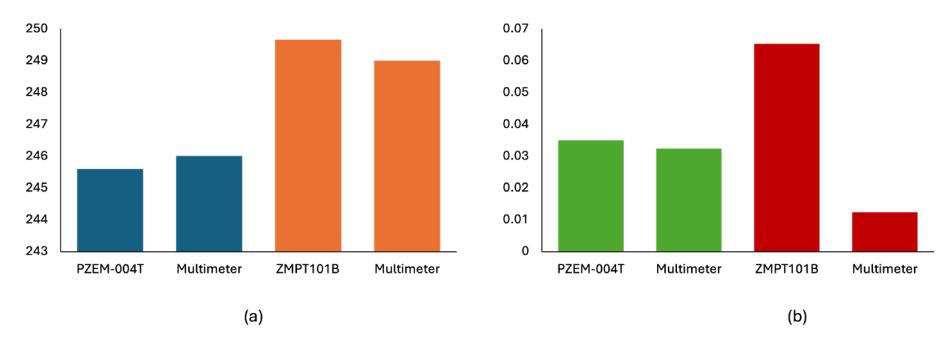
Figure 3. Measurement of (a) RMS voltage and (b) RMS Current at No-load
The measurements recorded percentage errors of 0.16% and 8.02% for RMS voltage and RMS current, respectively, using the PZEM-004T sensor, compared to 0.27% and 427% for the ZMPT101B and SCT013-030 sensor pair. These results indicate that the PZEM-004T sensor exhibits significantly lower measurement errors and provides higher measurement accuracy than the ZMPT101B and SCT013-030 combination.
B. Load Condition- Xiaomi Ionic Hair Dryer
Table 1 summarizes electrical parameter and the percentage error of RMS voltage and current measurements by PZEM-004T and ZMPT101B with SCT013-030 sensors at various temperatures and speeds of the Xiaomi Ionic Hair Dryer.
Table 1. Measurement of Percentage error at Different Temperature and Speed
| Temperature | Speed | Average value measured | Percentage error | ||
|---|---|---|---|---|---|
| DZEM 004T | ZMPT101B & | DZEM 004T | ZMPT101B & | ||
| PZEM-004T | SCT013-030 | PZEM-004T | SCT013-030 | ||
| Hot | 1 | RMS voltage: 243.62V | RMS voltage: 245.02V | RMS voltage: | RMS voltage: |
| RMS current: 6.19A | RMS current: 7.07A | 0.16% | 0.01% | ||
| Real Power:1205.4W | Real Power:1005.426W | RMS current: | RMS current: | ||
| Reactive | Reactive | 2.06% | 10.28% | ||
| Power:669.99Var | Power:1435.91Var | ||||
| Power Factor: 0.852 | Power Factor:0.56 | ||||
| 2 | RMS voltage: 243.84V | RMS voltage: 245.33V | RMS voltage: | RMS voltage: | |
| RMS current: 7.097A | RMS current: 7.78A | 0.07% | 0.07% | ||
| Real Power:1459.58W | Real Power:1131.59W | RMS current: | RMS current: | ||
| Reactive | Reactive | 0.99% | 10.06% | ||
| Power:934.874Var | Power:1584.62Var | ||||
| Power Factor: 0.846 | Power Factor: 0.564 | ||||
| Warm | RMS voltage: 244.6V | RMS voltage: 245.87V | RMS voltage: | RMS voltage: | |
| 1 | RMS current: 6.236A | RMS current: 8.54A | 0.25% | 0.36% | |
| Real Power:964.72W | Real Power:1204.12W | RMS current: | RMS current: | ||
| Reactive | Reactive | 4.04% | 46.23% | ||
| Power:1166.81Var | Power:1762.50Var | ||||
| Power Factor: 0.622 | Power Factor: 0.55 | ||||
| RMS voltage: 243.6V | RMS voltage: 245.03V | RMS voltage: | RMS voltage: | ||
| 2 | RMS current: 6.76A | RMS current: 7.63A | 0.25% | 0.01% | |
| Real Power:1340.92W | Real Power:1140.31W | RMS current: | RMS current: | ||
| Reactive | Reactive | 2.11% | 2.8% | ||
| Power:699.87Var | Power:1571.65Var | ||||
| Power Factor:0.87 | Power Factor: 0.61 | ||||
| Cold | RMS voltage: 246.7V | RMS voltage: 247.97V | RMS voltage: | RMS voltage: | |
| 1 | RMS current: 1411A | RMS current: 1.612A | 0.12% | 0.39% | |
| Real Power: 241.22W | Real Power: 278.71W | RMS current: | RMS current: | ||
| Reactive Power: | Reactive Power: | 14.53% | 32.02% | ||
| 247.46Var | 292.88Var | ||||
| Power Factor: 0.69 | Power Factor: 0.68 | ||||
| RMS voltage: 246.2V | RMS voltage: 246.79V | RMS voltage: | RMS voltage: | ||
| 2 | RMS current: 1.552A | RMS current: 1.870A | 0.08% | 0.09% | |
| Real Power: 378.5W | Real Power: 394.14W | RMS current: | RMS current: | ||
| Reactive Power: | Reactive Power: | 0.98% | 18.34% | ||
| 53.98Var | 241.48Var | ||||
| Power Factor: 0.99 | Power Factor: 0.86 | ||||
The measurement results under both no-load and load-conditions confirmed that the PZEM-004T sensor exhibits significantly lower percentage error across all parameters compared to the ZMPT101B and SCT013-030 sensor pair. Specifically, the PZEM-004T maintained RMS current errors below 4.5% across all tests, while SCT013-030 showed errors as high as 46% under low current. This disparity reflects the SCT013 sensor's limited accuracy below 10% of its rated input current. Therefore, the PZEM-004T is better suited for precise residential monitoring applications. This validation, conducted using a digital multimeter as reference, confirms the proposed system's accuracy and operational effectiveness. Overall, the system accurately measured parameters under load, ensuring reliable data for energy applications. Additionally, the proposed system's real-time voltage measurement capability enhances the accuracy of energy consumption data, distinguishing it from existing solutions by Hariharan et al. [20], which rely on assumed voltage values, potentially leading to inaccuracies. Compared to previous works, the proposed system shows superior accuracy and reliability in measuring electrical parameters, especially RMS voltage and current.
C. User Interface Evaluation
As shown in Fig. 4, the Blynk mobile application served as the user interface for this project, providing three main tabs: "Electrical Parameters," "Bill," and "Automation". The Electrical Parameters Tab allowed users to monitor real- time electrical parameters such as RMS voltage,
RMS current, energy consumption (kWh), real power, reactive power, and power factor. Graphical displays enhanced the user's ability to comprehend and track their home's energy efficiency. The Bill Tab enabled users to check estimated monthly energy consumption and bills, facilitating better energy management and budgeting. This feature provided clear insights into energy usage, helping users plan and reduce their electricity expenses. The Automation Tab provided users the ability to set automation rules for their appliances based on specific conditions such as time of day, presence detection, or energy consumption thresholds. This functionality optimized energy usage and reduced waste by allowing users to automate appliance operations according to their needs and preferences.
The integration of real-time monitoring, automation and bill estimation allows users to make informed decisions on energy use. By identifying high-consumption appliances and applying schedule-based control, users can shift usage to off-peak hours and minimize unnecessary energy waste. The bill estimation feature provides transparency and encourages behavioral changes to reduce consumption. As a result, the system helps optimize energy usage patterns, reduce monthly electricity bills and improve overall household energy efficiency.
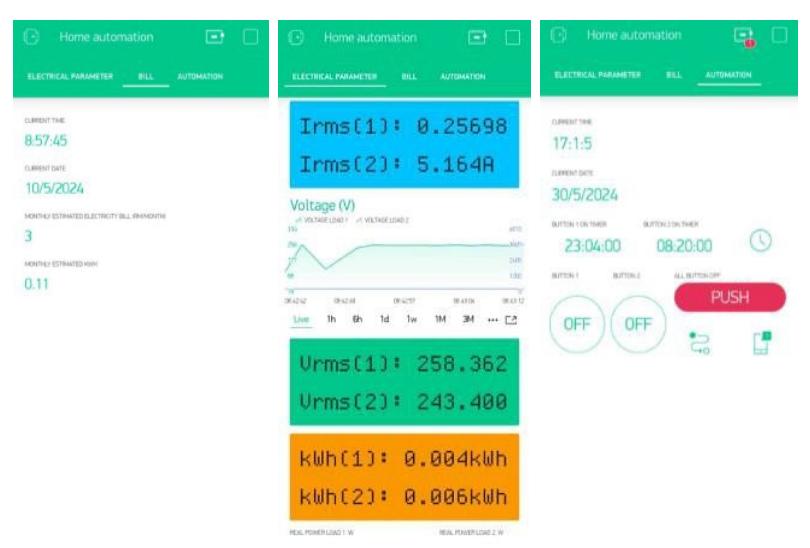
Figure 4. Blynk User Interface
D. Real-Time Monitoring and Control
D.1. Real-Time Data Display
The system employs various techniques, including graphical interfaces and dashboards, to enhance the user experience. Fig. 5(a) demonstrates the real-time display of electrical parameters for two different loads, including real and reactive power, power factor, and energy consumption. The graphical display in Fig. 5(b) provides a comprehensive overview of power and energy consumption, enabling users to identify patterns, diagnose issues, and plan maintenance activities.
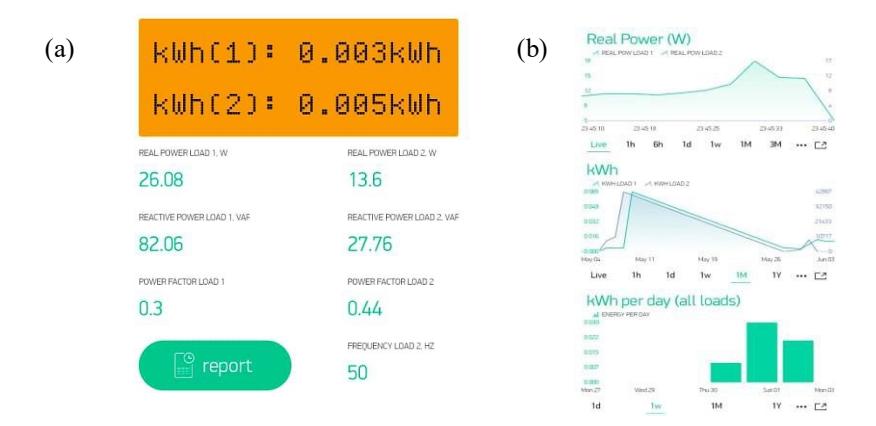
Figure 5: (a) Real-time electrical parameters for two different loads (b) Overview on real power and energy consumption of the loads
Fig. 6 showed the real-time graphical displays of RMS current and voltage, crucial for spotting anomalies and taking quick action to prevent damage. These insights help manage energy use, reveal trends, and enable proactive maintenance. Overall, the real-time data ensures safe, efficient, and reliable system performance.
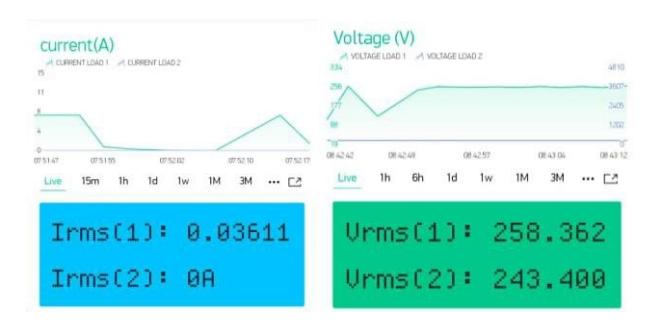
Figure 6. Graphical and real-time display for RMS current and RMS voltage of Load 1 and Load 2
D.2. Control Capabilities and User Interaction
The results from the Load 1 and Load 2 controlling systems, as well as the Blynk Button 1 and 2 controlling systems, demonstrate the effectiveness and reliability of the system in managing electrical loads through both physical switches and the Blynk app. Each scenario highlights the interactions between physical and digital controls, ensuring real-time synchronization and seamless transition of load statuses. The system showcases the ability to turn loads on or off via physical switches, with immediate status updates in the Blynk app, and to control loads independently using the app, providing users with enhanced flexibility and convenience.
The integration of the Blynk app with the relays allows for remote control and monitoring, crucial for modern IoT-based home automation systems. Table 2 showed the results of two timers (Load 1 and Load 2) in the Blynk application, each with a different start and end time. The Timer feature in the Blynk app further enhances the system's functionality, enabling automated control of devices based on time schedules. The time schedule can be changed depending on the user's preferences, allowing for flexibility and customization. For example, the user can adjust the start and end times of the timer to suit their specific needs, such as turning on a light at dawn and
turning it off at dusk. While the legacy version of Blynk has limitations in scheduling complexity, Blynk 2.0 addresses these with the capability to set timers for specific days of the week or dates, offering greater customization and adaptability.
Overall, the results confirm that the system performs reliably under various conditions, providing a comprehensive and user- friendly interface for managing home appliances. The dual-control mechanism, encompassing both physical switches and app commands, contributes to better energy management and operational efficiency, underscoring the system's suitability for smart home applications. The proposed system integrates schedule load control, allowing users to customize operating schedules for individual appliances or groups.
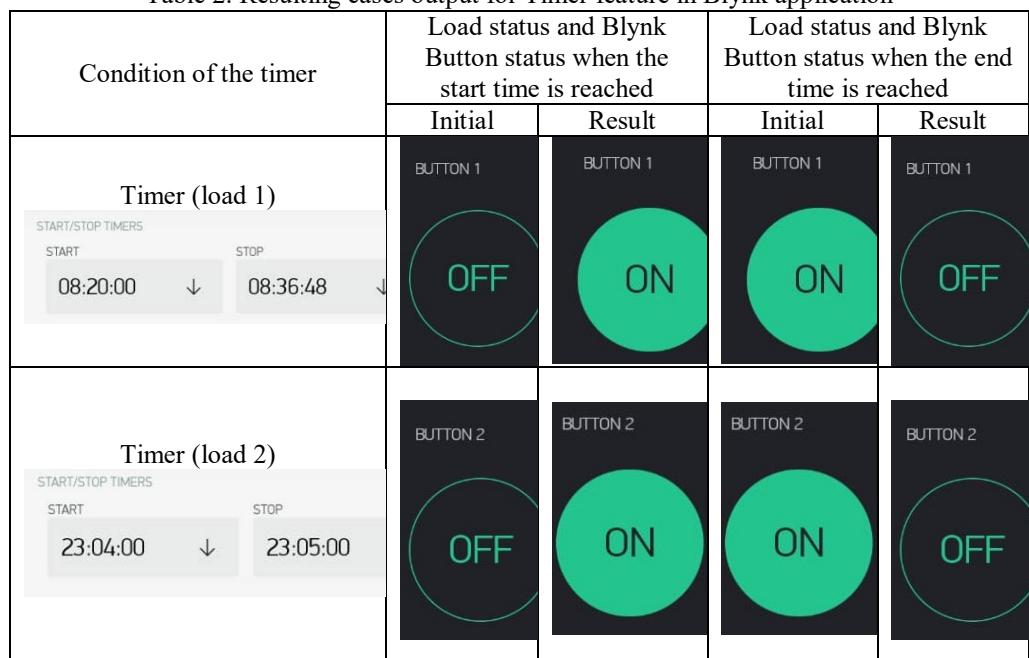
Table 2. Resulting cases output for Timer feature in Blynk application
D.3. Monthly Estimated Electricity Bill and Energy Consumption Features
Fig. 7 illustrates a Blynk application feature that displays monthly estimated electricity bills and energy consumption, providing real-time data to users. This tool is designed to help users make informed decisions about their energy usage and manage their costs effectively. The real-time data encourages energy-efficient habits, helps users plan budgets, and identifies areas for reducing energy consumption and costs.
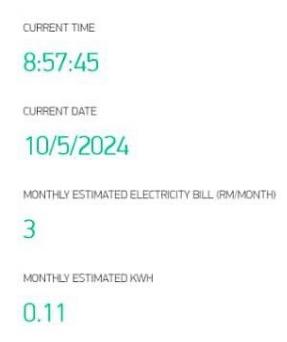
Figure 7. Monthly Estimated Electricity Bill and Energy Consumption
4. Conclusion
This system offers real-time monitoring and control, helping users identify high-energy consuming devices and optimize their usage patterns to save energy. Unique features such-as real-time voltage tracking, consumption alerts and bill estimation enhance user engagement and operational effectiveness, particularly for non-technical users. Compared to prior systems, our approach introduces a cost-effective and scalable IoT solution with improved accuracy and functionality. Its integration with the Blynk platform ensures accessibility, while the sensor validation ensures data reliability. This project contributes to smarter home energy management by promoting energy efficiency, reducing electricity bills and supporting sustainable practices in residential environments. Despite some limitations, such as reliance on a stable internet connection and scalability challenges, the system provides a practical and affordable solution. Future research should focus on enhancing Blynk connection stability, improving sensor calibration, and integrating machine learning for appliance identification and predictive maintenance to further advance IoT-based energy management systems.
5. Acknowledgment
Appreciation and gratitude are to be given to the authority of the School of Electrical and Electronics Engineering University Sains Malaysia for providing the materials and guidance to complete the project. The research and implementation of the project would never be completed without the facilities provided by the school.
6. References
- [1] Wang, J., & Azam, W. (2024). Natural resource scarcity, fossil fuel energy consumption, and total greenhouse gas emissions in top emitting countries. Geoscience Frontiers, 15(2), 101757, https://doi.org/10.1016/j.gsf.2023.101757.
- [2] Beaudin, M., & Zareipour, H. (2015) Home energy management systems: A review of modelling and complexity. Renewable and sustainable energy reviews, 45, 318-335, https://doi.org/10.1016/j.rser.2015.01.046.
- [3] Sutopo, A. M., Prastomo, N., & Bayuntara, P. G. A. (2024) IoT-Based Automatic Transfer Switch System Design on Solar Home System. International Journal of Integrated Engineering, 16(5), 265-274, https://publisher.uthm.edu.my/ojs/index.php/ijie/article/view/14861.
- [4] Zhou, K., & Yang, S. (2016) Understanding household energy consumption behavior: The contribution of energy big data analytics. Renewable and Sustainable Energy Reviews, 56, 810-819, https://doi.org/10.1016/j.rser.2015.12.001.
- [5] Raza, A., Jingzhao, L., Ghadi, Y., Adnan, M., & Ali, M. (2024) Smart home energy management systems: Research challenges and survey. Alexandria Engineering Journal, 92, 117-170, https://doi.org/10.1016/j.aej.2024.02.033.
- [6] Nie, Y., Zhang, G., Zhong, L., Su, B., & Xi, X. (2024) Urban‒rural disparities in household energy and electricity consumption under the influence of electricity price reform policies. Energy Policy, 184, 113868, https://doi.org/10.1016/j.enpol.2023.113868.
- [7] Ahmadizadeh, M., Heidari, M., Thangavel, S., Al Naamani, E., Khashehchi, M., Verma, V., & Kumar, A. (2024). Technological advancements in sustainable and renewable solar energy systems. In Highly Efficient Thermal Renewable Energy Systems (pp. 23-39). CRC Press.
- [8] Tee, W. H., Gan, C. K., & Sardi, J. (2024). Benefits of energy storage systems and its potential applications in Malaysia: A review. Renewable and Sustainable Energy Reviews, 192, 114216, https://doi.org/10.1016/j.rser.2023.114216.
- [9] Alkawsi, G. A., & Baashar, Y. (2020) an empirical study of the acceptance of IoT-based smart meter in Malaysia: The effect of electricity-saving knowledge and environmental awareness. IEEE Access, 8, 42794-42804, 10.1109/ACCESS.2020.2977060.
- [10] Ryu, D. H., & Kim, K. J. (2024). The influence of information privacy concerns and perceived electricity usage habits on the usage intention of advanced metering infrastructure. Renewable and Sustainable Energy Reviews, 189, 113851. <a href="https://doi.org/10.1016/j.rser.2023.113851">https://doi.org/10.1016/j.rser.2023.113851</a>.
- [11] Sayeduzzaman, M., Hasan, T., Nasser, A. A., & Negi, A. (2024). An Internet of Things-Integrated Home Automation with Smart Security System. Automated Secure Computing for Next-Generation Systems, 243-273. https://doi.org/10.1002/9781394213948.ch13.
- [12] Rathee, N., Rathee, V., Kumar, S., Das, A., Ivchuk, Y., & Liudmyla, C. (2022). An efficient IoT-based novel design for home automation using node MCU controller. In Mobile Computing and Sustainable Informatics: Proceedings of ICMCSI 2022 (pp. 233-246). Singapore: Springer Nature Singapore, https://doi.org/10.1007/978-981-19-2069-1 17.
- [13] Stolojescu-Crisan, C., Crisan, C., & Butunoi, B. P. (2021). An IoT-based smart home automation system. Sensors, 21(11), 3784. <a href="https://doi.org/10.3390/s21113784">https://doi.org/10.3390/s21113784</a>.
- [14] Taiwo, O., Ezugwu, A. E., Rana, N., & Abdulhamid, S. I. M. (2020, July 1-4). Smart home automation system using Zigbee, Bluetooth and Arduino technologies. [Computational Science and Its Applications–ICCSA 2020]: 20th International Conference, Cagliari, Italy. Part VI 20 (pp. 587-597). Springer International Publishing. <a href="https://doi.org/10.1007/978-3-030-58817-5">https://doi.org/10.1007/978-3-030-58817-5</a> 43.
- [15] Affum, E. A., Agyeman-Prempeh, K., Adumatta, C., Ntiamoah-Sarpong, K., & Dzisi, J. (2021). Smart home energy management system based on the internet of things (IOT). International Journal of Advanced Computer Science and Applications, 12(2).
- [16] H., M. K., M.A.M., I., N., A., R.A., D., S., S., N.A., M., Mohamed, N., Jalil, S., & M.A., A. K. (2023). A Smart IoT-Based Prototype System for Rehabilitation Monitoring. International Journal of Integrated Engineering, 15(3), 104-111. https://penerbit.uthm.edu.my/ojs/index.php/ijie/article/view/12878.
- [17] Bai, Y. W., & Hung, C. H. (2008, April). Remote power On/Off control and current measurement for home electric outlets based on a low-power embedded board and ZigBee communication [IEEE International Symposium on Consumer Electronics]. (pp. 1-4). IEEE. 10.1109/ISCE.2008.4559539.
- [18] Luechaphonthara, K., & Vijayalakshmi, A. (2019) IOT based application for monitoring electricity power consumption in home appliances. International Journal of Electrical and Computer Engineering, 9(6), 4988, 10.11591/ijece.v9i6.pp4988-4992.
- [19] Salisu, A., Bugaje, A., & Loko, A. Z. (2020) IOT Based Household Electricity Energy Monitoring and Control. FUDMA Journal of Sciences, 4(4), 77-84, https://doi.org/10.33003/fis-2020-0404-466.
- [20] Hariharan, R. S., Agarwal, R., Kandamuru, M., & Gaffar, H. A. (2021, February). Energy consumption monitoring in smart home system [IOP Conference Series: Materials Science and Engineering]. (Vol. 1085, No. 1, p. 012026). IOP Publishing. 10.1088/1757-899X/1085/1/012026.
Noor Dzulaikha Daud earned a Bachelor's degree in Electrical System Engineering from Universiti Malaysia Perlis. She earned both her Master's degree in Electrical Power Engineering, in 2013 and her Ph.D. in Electrical Engineering in 2022 from Universiti Teknologi Malaysia. Currently, she is a senior lecturer at School of Electrical & Electronics, Universiti Sains Malaysia. She has authored and co-authored several journal and conference papers. Her research focuses on Surface discharge machining, Electrical Power System and Renewable Energy.
Shu Wen Lim received the Bachelor's degree in Electrical Engineering from Universiti Sains Malaysia in 2024. She is currently working as an Equipment Automation Engineer at AlphaX, where she focuses on SECS/GEM integration and system automation for semiconductor manufacturing. Her interests include factory automation, embedded systems, and software-system integration. Beyond engineering, she is passionate about endurance sports and continuous selfdevelopment.
Soo Siang Teoh received the B.Eng. degree in electronic engineering from Universiti Putra Malaysia, in 1993, the M.S. degree in digital electronics from the University of Manchester, U.K., in 1995, and the Ph.D. degree in computer engineering from the University of Western Australia, in 2012. He is currently an Associate Professor at the School of Electrical and Electronic Engineering, Universiti Sains Malaysia. His research interests include image processing and machine learning for industrial and biomedical applications.
Mohamad Kamarol Mohd Jamil (Senior Member, IEEE) received the B.Eng. degree (Hons.) in electrical engineering from Universiti Technology MARA, Malaysia, in 2000, and the M.Eng. and D.Eng. degrees from the Kyushu Institute of Technology, Japan, in 2005 and 2008, respectively. In 2002, he joined as a University ASTS Fellow with Universiti Sains Malaysia (USM), where he was a Senior Lecturer, in 2008, an Associate Professor, in 2014, and was promoted to Professor in Dec 2024. He was a Senior Engineer with Sankyo Seiki (M) Sdn. Bhd., for almost eight years. He was a Visiting Researcher with the High Voltage
Laboratory, Kyushu Institute of Technology, from 2013 to 2014, and the Chiba Institute of Technology, Japan, in February 2020. His research interests include the insulation properties in oil palm, solid dielectric material, insulation properties of environmentally benign gas, and PD detection technique for insulation diagnosis of power apparatus and electrical machine. He is also involved in temperature rise and shortcircuit electromagnetic study of bus bar systems and HVDC systems. Professor Ir. Dr. Mohamad Kamarol is a Professional Engineer and a member of the Board of Engineers Malaysia and the Institution of Engineers Malaysia. He received the Chatterton Young Investigator Award from the IEEE International Symposium Discharges and Electrical Insulation in Vacuum, in 2006.
Noramalina Abdullah received her first degree at USM, graduating in 2002 with a B.Tech. in Quality Control and Instrumentation. Then in 2009, she went to do her Master's in Mechatronic Engineering at UTM. A couple of years later, she was fortunate to receive a scholarship for her Ph.D. through a sandwich program between Chulalongkorn University in Bangkok and the University of Tokyo. She is currently a senior lecturer at School of Electrical and Electronics Engineering, Universiti Sains Malaysia. Her research interest includes power system, fault identification, and internet of things.