

I. INTRODUCTION
Sustainable Development Goals are a development objective that includes 17 interrelated global goals to achieve stability, security and human prosperity in the present and future. Some of the main goals in the SDGs are goal 13-climate action, goal 15-life on land, and 17 partnership for the goals, which specifically discuss comprehensive cooperation from every social aspect of society in carrying out sustainable development in land areas to prevent and reduce impacts of climate change.
Indonesia, which is also part of the countries committed to the SDGs, has made efforts to control the impacts of climate change, one of which is through the Climate Village Program (Proklim) under the auspices of the Ministry of Environment and Forestry. This Proklim has been implemented since 2012 with the main aim of increasing the capacity and involvement of the community and other stakeholders in adapting to the impacts of climate change and reducing greenhouse gas (GHG) emissions. By 2024, Indonesia targets the creation of 20,000 climate villages (1). The main components of the Climate Village Program are divided into two, namely adaptation and mitigation. The adaptation component consists of aspects such as: controlling drought, floods and landslides; increasing food security; handling or anticipating sea level rise, tidal waves, sea water intrusion, abrasion, ablation or erosion due to wind, high waves; then controlling climate-related diseases. Meanwhile, the mitigation component consists of aspects of waste management, solid and liquid waste; use of new, renewable energy and energy conservation; agricultural cultivation with low GHG emissions; increasing vegetation cover and preventing and controlling forest and land fires (2).
Bodeyan Hamlet, which is located in Nguter District, Sukoharjo Regency, is one of the villages selected as Proklim with the title of Main Proklim in 2020. Apart from that, Bodeyan Hamlet also won 1st place in the 2022 Central Java Province Proklim Location Profile Competition and 1st Place for Environmental Cadres Sukoharjo. Proklim Bodeyan has been implemented since 2017 based on residents' concerns about the village which is often affected by flooding due to inappropriate waste management patterns. To date, Proklim Bodeyan has expanded its coverage by providing assistance to 13 other locations, 12 of which are located in Sukoharjo and 1 other is located in the Sragen area.
Implementing adaptation and mitigation to climate change is an effort that cannot be carried out individually, but requires collaboration between government actors, private actors and also the community so that the goal of reducing emissions can be truly achieved. Proklim emphasizes active participation between the five elements of regional development (penta helix) which include government, society, business institutions, academics and media. In this case, the government and also elements of business institutions play an important role in financial support and facilities for the running of Proklim. Meanwhile, academics play a role in transferring knowledge to further develop Proklim in accordance with current developments. Then, the media has a main role as a means of publicizing Proklim to the general public in order to motivate other villages to participate. The community acts as a direct implementer of Proklim itself. These five elements need to go hand in hand to maintain the smooth implementation of Proklim, the absence of any one element can hinder the achievement of the expected sustainable goals.
This is related to the theory used in this research regarding Collaborative Governance. The theory states that the government's position as the holder of power is not the only actor but there are other actors outside the government who also have the power to formulate public policy decisions. (3) Meanwhile, Stoker stated that one of the goals is to involve parties outside the government to help resolve policy ambiguities in solving social and economic problems. (4) Meanwhile, collaboration from a public administration perspective is understood as working together or can be said to be working together with several parties involved in an activity to achieve goals. (5)
In this research, Collaborative Governance is an effort carried out jointly which not only involves parties from the government, but also parties outside it, especially the community in overcoming climate and environmental problems, which in this case took the research location in Bodeyan hamlet, Pondok, Nguter, Sukoharjo. Meanwhile, Proklim in the SDGs is related to goals number 13, 15 and 17. Goal number 13 is to take immediate action to combat climate change and its impacts. Then, goal number 15 relates to efforts to protect, restore and encourage sustainable use of terrestrial ecosystems, sustainably manage forests, combat desertification, and stop and reverse land degradation and stop the loss of biodiversity. Meanwhile, goal number 17 is related to actions to strengthen the means of implementation and revitalizing the Global Partnership for Sustainable Development. (7) Collaborative governance in this case is related to the penta helix model, where this model is based on five types of stakeholders, which include the private, public and population sectors. local, academics and the media. (8) The Penta Helix economic and social development model promotes a culture of innovation and creative synergy, which in this case is related to Proklim.
II. METHODS
This study used a descriptive qualitative method. Descriptive research aims to accurately describe the nature of a certain symptom, situation, individual or group, or to determine the distribution of a symptom or the existence of a certain relationship with a symptom or condition with a symptom, or other conditions in society (Silalahi, 2009). This research will analyze the aspects in implementing several goals in the SDGs, which are related to climate change in Bodeyan hamlet, Sukoharjo. Meanwhile, data and information were obtained through field observations, in-depth interviews, and literature studies from various existing literature such as books, journal articles, mass media articles and so on. One of the sources who was a respondent for this article was Warsini, as chairman of Proklim Bodeyan.
III. RESULT AND DISCUSSION
1. Proklim Bodeyan Profile
Bodeyan Hamlet is one of the villages that has joined the Climate Village Program (Proklim). According to data from official documents, Proklim in Bodeyan hamlet was initiated and implemented in 2017. The implementation of Proklim in Bodeyan was motivated by problems that often arise, namely, the occurrence of floods that hit the hamlet every year, thus encouraging the community to make various efforts to reduce flooding. and changing waste disposal behavior. In 2020, Proklim Bodeyan was registered in the National Registration System for Climate Change Control (SRN PPI) with the title "Proklim Utama" and is currently moving towards 'Lestari" level. (9)
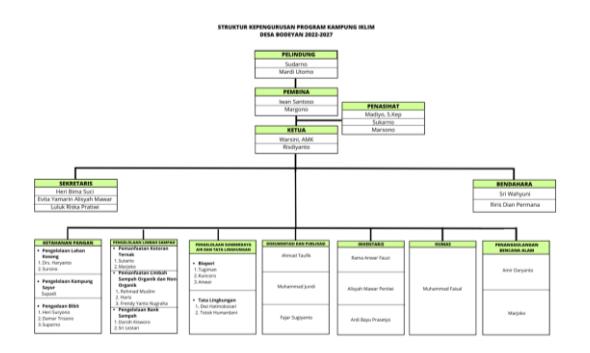
FIGURE 1. ORGANIZATION STRUCTURE OF PROKLIM BODEYAN
The management of Proklim Bodeyan is carried out by the Working Group (Pokja), which continues to increase climate change adaptation/mitigation actions and disseminate Proklim to at least 10 (ten) other locations.
FIGURE 2. BODEYAN HAMLET MAP
In Bodeyan hamlet there is 1 village house and approximately 70 women who are active in the Family
Welfare Empowerment (PKK) program, where all forms of activities are combined to cover that 1 house village. (10)
2. Identification of Bodeyan Hamlet Problems
Based on interviews with sources, of the 22 RTs in the area, 18 of them were affected by flooding, while 4 of them were not affected. However, people from the 4 affected villages also contributed to Proklim. In other words, Proklim Bodeyan relies on self-help in its operational activities. The flooding that occurred in this area began when the majority of residents' yards in 2017 were still open land, where rainwater was still able to seep into their yards. However, as the community's economic level developed, people changed their yards to paving blocks, where 80% of residents' yards were already paving blocks. This is what causes the rainwater catchment area to decrease, which then becomes the cause of flooding. Some of the conditions in the area that are vulnerable to flooding can be seen in the following images. (10)
FIGURE 3. BODEYAN FLOOD IN 2018-2021
This flooding problem then becomes the cause of various health problems. In 2019 there was an increase in the number of dengue fever from 1 incident in 2018 to 3 incidents. Then, in 2020 there were 3 cases, of which 1 was a resident of Bodeyan. Meanwhile, in 2021, there were no or no dengue fever cases and in 2022 there was 1 case with the KK address of Bodeyan residents, but domiciled in Tengkek. One of the steps taken by the Proklim Bodeyan Working Group was to organize 22 RT heads and 9 RW heads in Pondok Village to carry out a river dredging movement. This is also one of the 4 areas that were not affected by flooding. This step was marked by the formation of the "Jogo Kali Jelantah Lama" community, where "Jogo Kali Jelantah Lama" is also committed to protecting and maintaining the river so that it is not polluted by rubbish and other waste. Apart from flooding, Dukuh Bodeyan has another threat, namely the threat of drought due to the closure of irrigation canals in October every year. Quoted from the official report, this situation has been made worse by the shift in seasons over the last 10 years, where the rainy and dry seasons sometimes have unequal duration. In 2017, the dry season was 2 months longer, which caused several wells to dry up and residents had to save on clean water. The real impact of the closure of the irrigation canals is the reduction in water supplies on the ground surface. On average, the well water level recedes 35 m when the irrigation canal is closed compared to when the irrigation canal has not been closed. This is due to the irrigation system not being airtight and the high porosity of the soil, resulting in a lack of surface air reserves in the dry season. (10)
The next problem faced by the community was crop failure in 2018 and 2019. With this incident, Pondok Village farmers who are members of Gapoktan Pondok Makmur, conducted an evaluation of the occurrence of crop failure which included an increase in the population of plant pests (especially rice pests), in 2018 due to planthopper attacks, and in 2019 due to rat pests. Other causes include a decrease in soil fertility levels with monoculture farming systems and the continuous use of chemical fertilizers, the development of plant diseases in both fruit and vegetables in people's homes, and rice planting that is not synchronous. The last problem that previously often appeared was waste management. Previously, for generations, people solved the waste problem by burning and throwing household waste into the river. This then also became the cause of pollution of the irrigation river in 2016. Finally, residents made an unwritten agreement to prohibit throwing rubbish into the river. Based on these various problems, in 2017 the community was launched by the village government with the Climate Village Program (Proklim). The community then learns a lot about how to manage waste properly and educates other people. However, the community's need is not just education, but also to be invited together to find solutions to these problems. (10)
IV. DISCUSSION
1. Bodeyan Proklim Governance
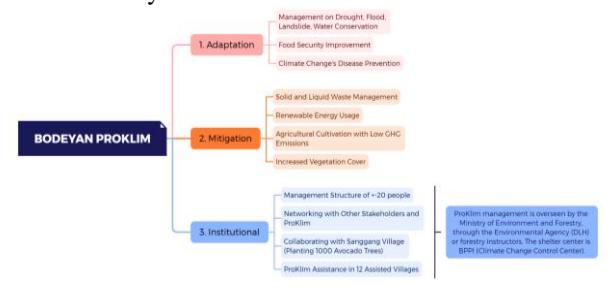
FIGURE 4. PROKLIM BODEYAN MANAGEMENT
After examining and analyzing about the situation and condition of Proklim Bodeyan, it can be seen that the programs of Proklim Bodeyan is done in a certain levels, in the adaptation level, the basic and relatively general programs are implemented; such as management on drought, water conservation, food security improvement, and prevention of disease caused by climate change. This level is not yet specific on mentioning the actions that have to be done by the community in Bodeyan, as the actions
can be tailored to the needs of the hamlet's community. Actions including the addition of water catchment tanks, or cleaning the ditch for the waste water regularly, is done in this stage. Next, the mitigation phase is conducted, as the community has already adapted with the 'preserving the environmental' mindset. More detailed actions like waste management, the initiation of renewable energy, and ensuring low greenhouse gas on agricultural activities is done in this phase. These two parts on Proklim Bodeyan also represent the realization of SDGs 13 and 15, as the programs are created based on the impacts of climate change, and carried on with the mind Last but not least, in the institutional stage, Proklim Bodeyan is empowered by more than 20 people from the community which are already networking with other stakeholders. In this phase, the penta helix model is implemented which embodies the very principle of collaborative government. The elements of governments, private sectors, community, academics, and media are involved and collaborating together to ensure the success of Proklim Bodeyan, as can be seen on the picture below:
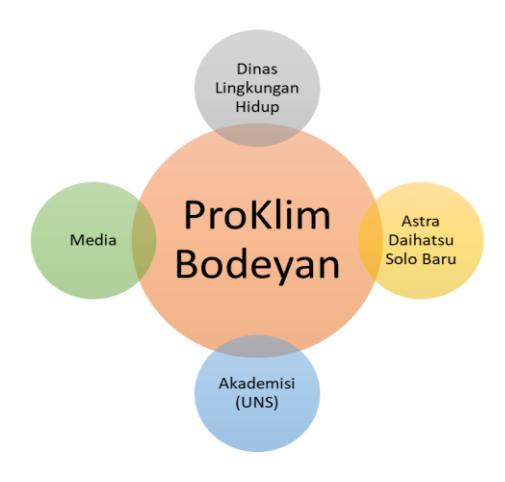
FIGURE 5. PENTA HELIX COOPERATION MODEL IN PROKLIM BODEYAN
However, there are some interesting findings regarding the implementation of collaborative governance on Proklim Bodeyan. As for the elements on the model, the government is represented by Dinas Lingkungan Hidup (DLH) or Agency for Environment of Sukoharjo Regency. This is considered an interesting finding, as the governmental level of village administration is not involved actively in this model. In fact, the initiation of Proklim Bodeyan is mostly carried out by the community with the support from DLH in the regency level. Meanwhile, the support that came from the private sector is done by Astra Daihatsu in Solo Baru through the Corporate Social Responsibility (CSR) program. In this part, Astra Daihatsu Solo Baru provides the designated waste bin for wet waste and recycle waste. This CSR program is also maintained regularly as the commitment of cooperation between Astra Daihatsu Solo Baru and the
Bodeyan Hamlet. Academics from Universitas Sebelas Maret Surakarta are also involved through research and observation on Proklim Bodeyan, as academics are needed for the science-based actions regarding the progress and sustainability of the Proklim. Unfortunately, the media sector is not yet optimized in this model, as the coverage of Proklim Bodeyan is not regularly done, causing the dwindling reputation of Proklim itself. This is quite regrettable, as Proklim Bodeyan already obtained the award on national level as "Utama" in 2020, but only people that involved in the Proklim-related business know about it. The rural location of Proklim Bodeyan might also contribute to this factor, as not many of the media will cover this area of Sukoharjo regency.
Bypassing the village-level administration, and collaborating with regency-level agencies, with the support from private sector and academics, shows that Proklim Bodeyan is a byproduct of a collaborative governance between parties. While indirectly done, it is still considered as a success to solve the problems related to the environment in the community, while at the same time leveling up the living quality of the people and ensuring the fulfillment of the SDGs 13,15, and 17.
V. CONCLUSION
Proklim Bodeyan in Sukoharjo regency represents a success story of a community that can empower themselves especially in the environmental sector. This empowerment is interesting as it also has a corresponding impact on other (related) sectors, according to the SDGs 13, 15, and 17. In this study the aspect of Collaborative Governance is found on Proklim Bodeyan as an effort carried out jointly which not only involves parties from the government, and is represented by a penta helix model between parties. The step to take immediate action to combat climate change, efforts to protect, restore and encourage sustainable use of terrestrial ecosystems, is done cooperatively between parties involved in the penta helix pattern, involving private, public, community, academics, and media. Although the element of media is not yet optimally involved, and the public (government) in the village administration level is not the one that mobilized Proklim in the first place, this model of cooperation regarding Proklim Bodeyan is definitely showing implementation and revitalizing the Global Partnership for Sustainable Development.
ACKNOWLEDGEMENT
This study is being funded by the Innovative Governance Research Group, Faculty of Social and Political Science, Universitas Sebelas Maret Surakarta, during the 2023 research year.
REFERENCES
- [1] KLHK. KLHK Ajak Semua Pihak Sukseskan Pencapaian Target Terbentuknya 20.000 Kampung Iklim [Internet]. ppid.menlhk.go.id. PPID KLHK; 2022 [cited 2023 Sep 25]. Available from: http://ppid.menlhk.go.id/berita/siaranpers/6490/klhk-ajak-semua-pihak-sukseskan-pencapaian-targetterbentuknya-20000-kampung-iklim
- [2] KLHK. Tentang PROKLIM [Internet]. Perpustakaan KLHK. KLHK; 2017 [cited 2023 Sep 25]. Available from: http://perpustakaan.menlhk.go.id/pustaka/images/docs/PROKLI M%20PROGRAM%20KAMPUNG%20IKLIM.pdf
- [3] Agus Dwiyanto. Manajemen Pelayanan Publik: UGM PRESS; 2018.
- [4] Stoker G. Governance as theory: five propositions. International Social Science Journal [Internet]. 1998 Mar;50(155):17–28. Available from: https://onlinelibrary.wiley.com/doi/abs/10.1111/1468-2451.00106
- [5] Noor M, Suaedi F, Mardiyanta A. COLLABORATIVE GOVERNANCE: Suatu Tinjauan Teoritis dan Praktik. Bantul: BILDUNG; 2022.
- [6] Silalahi U. Metode Penelitian Sosial. Bandung: Refika Aditama; 2009.
- [7] United Nations. The 17 sustainable development goals [Internet]. United Nations. 2015. Available from: https://sdgs.un.org/goals
- [8] S Halibas A, Ocier Sibayan R, Lyn Maata R. The Penta Helix Model of Innovation in Oman: An HEI Perspective. Interdisciplinary Journal of Information, Knowledge, and Management. 2017;12(12):159–74.
- [9] Warsini. Tata Kelola Program Kampung Iklim Bodeyan. 2023.
- [10] Proklim Bodeyan. Profil Proklim Bodeyan. 2023.