

I. INTRODUCTION
The availability of clean water is an important aspect of human survival. However, for some people, especially those who live in rural areas, the lack of clean water availability forced them to use polluted water to accommodate their daily water needs. As an example, people who live in Cinangsi village, Cianjur district, West Java collected their water from a contaminated river near their village and store it in a pond to wash clothes and dishes. The water contamination is caused by the disposal of fish farming waste directly into the river by local communities. The water quality has been deteriorating over the past 20 years, as mentioned by the Asian Development Bank and the International Bank for Reconstruction and Development in [1]. The data show that the Citarum River is in a critical condition because of the poor quality of its water, which cannot be used directly.
To overcome these problems, a water quality improvement system and a better wastewater management system are needed. In this paper, the implementation of constructed wetland combined with aquaponic system is carried out to accommodate both systems that are needed. Constructed wetland is a water treatment system using natural processes to improve water quality. Meanwhile, aquaponic is a cultivation system that combines aquaculture systems (fish farming) with hydroponics (plant cultivation with water as a growing media). The implementation of constructed wetland in the aquaponic system can help
improve the water quality and also create a sustainable cultivation system for the local communities. In the year 2022, a prototype of constructed wetland in the aquaponic system was made in Cinangsi village. By making this prototype, it is hoped that it can become an example for the surround surrounding communities to make bigger installation of this system so that a sustainable cultivation system can be formed and better water quality can be provided for the communities.
Constructed wetland systems (CWs) can be identified as artificially created ecosystems with partially to completely saturated soils planted with submergent, emergent or floating macrophytes or combining these three types (Kadlec and Wallace, 2009) [2]. Constructed wetlands have been used to treat a wide range of wastewater including domestic industrial effluent, storm runoff, municipal and domestic sewage, dairy waste, and even swine effluent [3], [4], [5]. Since CWs utilize natural vegetation and microorganisms, they are viewed as low-cost technologies with low operation and maintenance requirements that can be applied in various socioeconomical conditions [6].
II. METHOD
The constructed wetland is built as a river water purification. This construction was motivated because the water pollution level from the Cikundul river is worrying and can cause bad health impact for the residents. With the construction of this prototype, the water can be used to fulfill resident's daily needs such as bathing and washing.
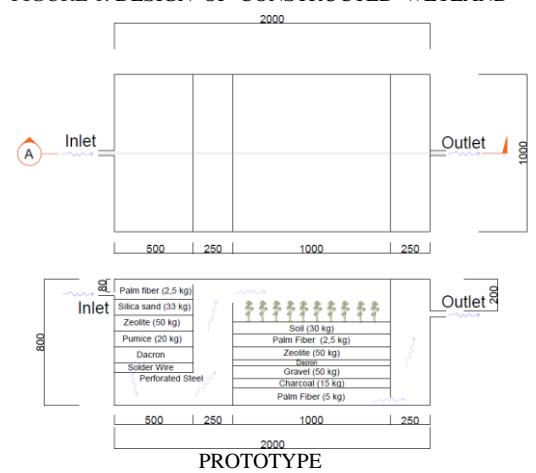
The prototype of the constructed wetland that we made was built from concrete. The dimensions of this prototype are 2 m long, 1 m wide and 0,8 m deep. The water purification system consists of the filter system and the constructed wetland system. The filter consists of palm fiber, silica, zeolite, pumice and dacron by order. The constructed wetland consists of plants as a phytoremediation agents such as Typha angustifolia, Canna indica, and Cyperus papyrus. Media used in CWL is soil, palm fiber, zeolite, gravel, charcoal, and palm fiber by order. The purification system is equipped with perforated steel, so it become easier to maintain the filter system.
FIGURE 1. DESIGN OF CONSTRUCTED WETLAND
Soil is used as the main filtration material in many CWs where reasonable efficiencies in removing heavy metals were achieved due to the soil cation exchange, as reported by Zahi et al [7]. Several researchers investigated, [8] the use of differentfilter media materials such as crushed rock and gravel to deliver appropriate hydraulicconductivity that supports the growth of plants and effective retention of suspended solids.
FIGURE 2. CONSTRUCTED WETLAND PROTOTYPE
Aside from being a source of purification system, the aquaponic system also build after the constructed wetland so it can produce vegetable for residents such as spinach or lettuce and help improve the water quality for fisheries. The vegetables can be harvested after around4-5 weeks. In Auroville, India, when CWs plants are harvested, which does not occur in everysite, they are used for different purposes: animal fodder, mulch against erosion, compost for agriculture, whenever they are not burnt [9].
The costs for the construction of this prototype are around IDR 10.259.000,00 (ten milliontwo hundred and fifty-nine thousand rupiahs), which includes the purchase of the materials and cost of manufacturing services. The details is mention on Table 1.
TABLE 1. COST FOR CREATING A CONSTRUCTED WETLAND
| Items | Unit | Amount | Price / | Total Price | |
|---|---|---|---|---|---|
| Unit Pipe | |||||
| Wood | pcs | 8 | 15,000 | 120,000 | |
| Pipe repairing | pcs | 1 | 500,000 | 500,000 | |
| Net pot | pcs | 100 | 512 | 51,200 | |
| Zeolite | kg | 100 | 2,000 | 200,000 | |
| Pumice | kg | 20 | 5,000 | 100,000 | |
| Dacron | kg | 2 | 50,750 | 101,500 | |
| Styrofoam | pcs | 1 | 180,000 | 180,000 | |
| Wetland plants | pcs | 1 | 375,000 | 375,000 | |
| Silica sand | kg | 50 | 3,000 | 150,000 | |
| Waring cloth | pcs | 1 | 46,800 | 46,800 | |
| Charcoal | kg | 1 | 75,000 | 75,000 | |
| Palm fiber | kg | 10 | 10,000 | 100,000 | |
| Perforated steel | pcs | 1 | 600,000 | 600,000 | |
| Plants seed | pcs | 1 | 100,000 | 100,000 | |
| Concrete bricks | pcs | 2000 | 1,000 | 2,000,000 | |
| Cement | pcs | 15 | 60,000 | 900,000 | |
| Split stone | kg | 0,5 | 300,000 | 150,000 | |
| Pipe 6 inches | pcs | 1 | 195,000 | 195,000 | |
| Pipe 3 inches | pcs | 4 | 50,000 | 200,000 | |
| Solder wire | pcs | 1 | 165,000 | 165,000 | |
| Nail 7 cm | pcs | 1 | 18,000 | 18,000 | |
| Nail 5 cm | pcs | 1 | 18,000 | 18,000 | |
| Thread | pcs | 1 | 5,000 | 5,000 | |
| Hoe | pcs | 2 | 70,000 | 140,000 | |
| Bucket | pcs | 3 | 12,500 | 37,500 | |
| Trowel | pcs | 2 | 20,000 | 40,000 | |
| Pipe | pcs | 2 | 10,000 | 20,000 | |
| Sand | pcs | 1 | 700,000 | 700,000 | |
| Knee drats 3 inches | pcs | 2 | 8,000 | 16,000 | |
| Socket 3 inches | pcs | 3 | 6,000 | 18,000 | |
| Connector pipe | pcs | 1 | 6,000 | 6,000 | |
| Pipe Glue | pcs | 3 | 10,000 | 30,000 | |
| Delivery | pcs | 1 | 10,000 | 10,000 | |
| Service const worker | man day - | 2,730,000 | 2,730,000 | ||
| Service assistant | man day - | 100,000 | 100,000 | ||
*Price in Indonesian Rupiah (Rp)
The prototype gets its water supply from the river. Captured water is flowed through pipesto the purification system. From the inlet, the water goes to the filtration system. The filtrationsystem consists of palm fiber, silica, zeolite, pumice, and dacron with the thickness around 10 cm each. Then, the water level rises and goes to the CWL system after it goes through the phytoremediation plants. Later, the water goes to the second filtration system consists of soil,palm fiber, zeolite, gravel, charcoal, and palm fiber. This process is the final purification systems and the water goes to another piping system and ended at the aquaponic system. Integrated wetland techniques(such as hydroponic, constructed treatment wetland or floating island) with food production processes, coupled with polyculture of different fish species or other organisms including shrimps, are able to promote ecosystem health and achieve sustainability, mainly via its wastewater purification and nutrient recycling capability [10].
Maintenance is done periodically, namely cleaning the pipes or and cleaning the filtrationsystem. Cleaning the pipes is done to make sure the water run through freely without any disturbance in the pipes. Checking also needs to be done to prevent the pipes from leaking and reduce the incoming water. The filtration system also needs to be checked regularly every3 months. The cleaning process include cleaning the perforated steel by removing smaller particle like gravel, sand, and mud or changing the filtration filler. Another thing to maintain is to check the plants. Plants that have been used serve as a phytoremediation agent so it mustbe prevented from the unnecessary bugs.
FIGURE 3. INSTALATION OF CONSTRUCTED WETLAND
III. RESULT AND DISCUSSION
Our constructed wetland system is Horizontal Subsurface Flow Constructed Wetlands (HFCWs) where the wastewater flows into the inlet and flows slowly through the porous medium under the surface of the bed planted with various type of vegetation towards the outlet [11]. After the wastewater runs into the inlet, the vegetation will work as a phytoremediation and treating the various contaminants including organics, suspended solids, microbial pollution, and heavy metal. Then, wastewater runs into second filter system for second purification from residual waste or sediment until the water becomes clear and can be used for daily activities.
In this constructed wetland systems, the water speed must be well considered because this system depends on filter speed to filter sediments and the wastes that contained in the water. If the filter that is used is better, the filter speed will also be better. The constructed wetland system also utilizes natural water flow from irrigation channels so there is no need forpumps or other tools to direct water into the inlet. This flow is considered economical and more natural. Besides, our constructed wetland is also combined with an aquaponic system to create more benefit for the society, however it has not been channeled and accommodated specifically for daily need such as bathing or washing dishes.
We have conducted tests related to the contents of wastewater. Arsenic, cadmium, and chromium are vital pollutants discharged in wastewater, and the industrial sector is a significant contributor to harmful pollutants [12]. Taking Child Loess Plateau as an example, the concentration of trace elements in water quality is higher than the average world level, andtrace elements come from natural weathering and manufacture causes. Poor river water quality is associated with high sodium and salinity hazards [13].
In this research, the tests have been carried out twice, before purification and after purification with constructed wetland. Test result before purification is mention on Table 2 and after purification is mention on Table 3.
TABLE 2. THE TEST RESULT OF WATER BEFORE PURIFICATION
TABLE 3. THE TEST RESULT OF WATER AFTER PURIFICATION
| lo | Parameter | Satuan | Hasil Pengujian A.1.22XI21.1078.01 | Metode Pengujian | |
|---|---|---|---|---|---|
| 1 | BOD *) | mg/L | 3 | SNI 6989:72-2008 | |
| COD *) | mg/L | 8 | SNI 6989.2:2019 | ||
| 3 | Amonia | mg/L | 0,2 | SNI 06-6989.30-2005 | |
| ļ | Nitrit, sebagai N *) | mg/L | 0,02 | SM APHA 23rd Ed, 4500 NO2B, 2017 | |
| 5 | Nitrat, sebagai N *) | mg/L | 1 | IK-22-PVM-TP (Spektrofotometri) | |
| ; | Total P | mg/L | < 0,07 | IK-44-PVM-TP (Spektrofotometri) | |
Based on the test results, it was found that the BOD value contained in water decreases when it was filtered by the constructed wetland system. BOD is the amount of degraded biochemistry in water or the amount of oxygen required by aerobic microorganism processesto oxidize it into inorganic materials. The smaller the BOD value, the better the water quality. Meanwhile, for the COD value, the opposite applies. It is found that detention time increases,removal of BOD also increases. The detention time helps bacteria to consume the organic matter and convert into simple substances thereby BOD5 removal happens [14].
As for ammonia, nitrate, and phosphate, it was found that the filtered water had a lower concentration than the non-filtered water. Therefore, aerobic decomposition is unlikely to occur in HCWs and contaminants' removal takes place more often through anaerobic processes [15]. This has limited the capacity of HCWs in removing
ammonia-N due to the lackof oxygen whilst making HCWs effective in the denitrification process. However, the nitrite value is increasing. In the Decree of Minister of Health in Indonesia No. 907 of 2002 concerning drinking water quality requirements, the maximum allowable levels of nitrate are 50mg/L, nitrite 3 mg/L, and ammonia 1.5 mg/L. Thus, the nitrite concentration are still safe and have not exceeded the maximum level. In this study, removal of phosphorous is low. Phosphorous removal is mainly by adsorption on filter media, bind or precipitate the incoming phosphorous [16].
The output of water purification is limited to water that can be used for non-consumption purposes. For water that can be consumed, further tests are needed to detect contents that are harmful for human body. Visually, the results of water purification can be seen on Figure 3.
FIGURE 4. WATER PURIFICATION RESULTS BY CWL SYSTEM. [A] NON-PURIFIED WATER. [B] WATERTHAT HAS PASSED THROUGH THE FIRST FILTER. [C] WATER THAT HAS PASSED THROUGH THE SECOND FILTER.
The filter materials are useful in filtering sediment or mud carried by water, while the plants are useful for absorbing harmful contents in wastewater. Canna Indica can decrease the COD value contained in wastewater because it has wide roots and leaves [17]. Typha Angustifoliais effective in reducing the BOD value and phosphate concentration in wastewater. The surface of plantsrootsin constructed wetlandsis a habitatfor bacteria, and the plants that areused will help degrade the organic compounds contained. Typha Angustifolia secretes the rhizosphere zone and exudate which triggers the process of degradation by bacteria. Meanwhile, phosphate will be absorbed and stored in the tissuesfor plantsto growth [18].
Cyperus plants can reduce the concentration of ammonia, nitrite, and nitrate based on theamount of the plants that are used. The more plants used, the more organic contents can bedecreased because there will be more root tissue and expansion of the rhizosphere zone. Theplants itself cannot absorb nitrite because it is harmful for the plants. The nitrite concentration will decrease because of the nitrification and denitrification process so it
will form nitrate oxidation and plants are able to absorb the concentration of the nitrate [19].
After five decades of research and implementation, CWs have been recognized as a reliable wastewater treatment technology and, at present, they represent a suitable solution for treatment of many types of wastewater [20].
IV. CONCLUSION
From the project that was conducted in Cinangsi village, the constructed wetland works as a water purification system that was proven to reduce harmful compounds contained in the water and make the water clearer. The constructed wetland is made of eco-friendly material. Thus, combined with aquaponic system, it can provide better water quality as well as a sustainable cultivation system that can benefit the nearby communities. However, the water purification results are limited to a non-consumed water and further tests are needed to ensurethat the water can be consumed. The constructed wetland system also needs regular maintenance to maintain its effectiveness. Considering the results, it is possible that the use of this system on a larger scale can solve the problem of clean water shortages, especially in Cinangsi village.
ACKNOWLEDGMENT
The project to build a prototype of constructed wetland for river water treatment in CianjurArea was funded by the LPPM-ITB Community development program for the year of 2022.
REFERENCES
- [1] Garcia, J.; Rousseau, D.P.; Morato, J.; Lesage, E.L.; Matamoros, V.; Bayona,J.M.Contaminant Removal Processes in Subsurface-Flow Constructed Wetlands: A Review. Crit. Rev. Environ. Sci. Technol. 2010, 40, 561–661.
- [2] Kadlec, R. H., Wallace, S. D. (2009).Treatment Wetlands. Second Edi. ed. Boca Raton, FL.
- [3] Gunasekara, S.; Dissanayaka, D. Treatment Wetlands. Second Edi. ed. Boca Raton, FL. Journal of Use of Constructed Wetland Systems for Greywater Treatment: A Review. International Journal of Trend in Scientific Research and Development (IJTSRD). Vol. 6. Issue. 4. June, 2022.
- [4] Chen RZ, Wong M-H. Integrated Wetlands for Food Production. Environ Res 148:429–442. 2016
- [5] Lee, C-Y., Lee, C-C., Lee, F-Y., Tseng, S.K. and Liao, C.J. 2004. Performance of subsurface flow constructed wetland taking pretreated swine effluent under heavy loads. Bioresource Technology 92: 173–179
- [6] Chavan, R.; Mutnuri, S. Domestic wastewater treatment by constructed wetland and microalgal treatment system for the production of value-added products. Environ. Technol. 2020, 42, 3304–3317.
- [7] Kouki, S.; M'hiri, F.; Saidi, N.; Belaïd, S.; Hassen, A. Performances of a constructed wetland treating domestic wastewaters during a macrophytes life cycle.Desalination 2009,
- 246, 452–467.
- [8] Hdidou, M.; Necibi, M.C.; Labille, J.; El Hajjaji, S.; Dhiba, D.; Chehbouni, A.; Roche, N. Potential Use of Constructed Wetland Systems for Rural Sanitation and WastewaterReuse in Agriculture in theMoroccanContext. Energies 2022, 15, 156.
- [9] F. Fardin, A. Hollé, E. Gautier, A. Da Lage, P. Molle and J. Haury. Tropical plants of constructed wetlands for wastewater treatment on looking at human and social sciences. International IWA Conference, Italy, pp. 1079-1080. October, 2010.
- [10] Asian Development Bank and the World Bank., Downstream Impacts of Water Pollution in the Upper Citarum River, West Java, Indonesia,Water and Sanitation Program: Technical Paper, 2013.
- [11] S. Vanitha. Study on suitability of single and hybrid constructed wetland for treating sewage for a small community. IOP Conference Series: Materials Science and Engineering, vol. 955, 2020
- [12] Sim, C.H., Yusoff, M.K., Shutes, B. Ho, S.C. and Mansor, M. 2008. Nutrient removal in a pilot and full scale constructed wetland, Putrajaya City, Malaysia. Journal of Environmental Management 88: 307-317.
- [13] Chen, B., Wang, M., Duan, M., Ma, X., Hong, J., Xie, F., et al. (2019). In Search ofKey: Protecting Human Health and the Ecosystem from Water Pollution in China. J. Clean. Prod. 228, 101–111. doi:10.1016/j.jclepro. 2019.04.228
- [14] S. Vanitha, "Performance of different types of constructed wetlands for treating wastewater in short time Horizon," IOP Conference Series: Materials Science andEngineering, vol. 955, no. 1, p. 012095, 2020.
- [15] Vymazal, J.; Zhao, Y.; Mander, Ü. Recent research challenges in constructed wetlands for wastewater treatment: A review. Ecol.
- Eng. 2021, 169, 106318.
- [16] A. Gupta, M. Barman, and S. Naiding. Laboratory Greywater Treatment In A Constructed Wetland Microcosm Using Aquatic Macrophytes. WAC-IC 2015. May,2016.
- [17] Oktavia Audina and Erina Rahmadyanti, "Kinerja Hybrid Constructed Wetland Sebagai Upaya Pelestarian Sumber Daya Air Pada Pengolahan Limbah Cair Industri Batik Di Sidoarjo," Rekayasa Teknik Sipil, vol. 3, no. 1, Dec. 2019.
- [18] R. Wimbaningrum, I. Arianti, and H. Sulistiyowati, "Efektivitas Tanaman Lembang (Typha angustifolia L.) di Lahan Basah Buatan dalam Penurunan Kadar TSS, BODdan Fosfat pada Air Limbah Industri Laundry," BERKALA SAINSTEK, vol. 8, no. 1, p. 25, Mar. 2020
- [19] Sari, P.; Sudarno; Wisnu, I. Pengaruh Jumlah Tanaman Cyperus Alternifolius Dan Waktu Tinggal Limbah Dalam Penyisihan Kadar Ammoniak, Nitrit, Dan Nitrat. (Doctoral dissertation, Diponegoro University).
- [20] Xiao, J., Wang, L., Deng, L., and Jin, Z. (2019). Characteristics, Sources, Water Quality and Health Risk Assessment of Trace Elements in River Water and Well Water in the Chinese Loess Plateau. Sci. Total Environ. 650 (Pt 2), 2004–2012. doi:10.1016/j.scitotenv.2018.09.322