

I. INTRODUCTION
The condition of agricultural product marketing in Indonesia is marked by the dominance of large traders who significantly influence the pricing of agricultural goods. This situation is further exacerbated by weak institutional cooperation networks among marketing stakeholders and the sub-optimal performance of farmer groups and cooperatives. Consequently, most subsistence farmers choose to sell their produce to middlemen, inevitably becoming price takers who are unable to determine the selling price of their own harvest [1]. Subsistence farmers also face greater difficulty in marketing their products due to the inconsistency of their commodity production. Thus, the farm input costs borne by subsistence farmers are generally higher than the revenue generated from the resulting produce. Ultimately, this prevents subsistence farmers from cultivating optimally, as sales revenue is insufficient to cover the input costs for the subsequent season [2].
Farmers frequently encounter obstacles in the marketing process, particularly concerning their low bargaining power when selling their produce. This stems from their limited market access, including lack of price information, buyer data, and insufficient capital to manage harvesting and marketing independently. Consequently, farmers often choose to sell their harvest directly to middlemen without thoroughly assessing the total yield. Selling to middlemen is considered more practical because farmers avoid the costs of harvesting and the burden of arranging distribution channels, given the large volume of their harvests. However, this practice places farmers in a weak position, forcing them to accept the price dictated by the middleman [3].
In light of these challenges, technology offers a crucial pathway toward realizing food security and sovereignty by ensuring that farmers, especially subsistence farmers, can sustain their livelihoods through agriculture and preserve their farming lands. Technology encompasses a concept related to the tools and skills employed, and its impact on human ability to control and transform their environment. The utilization of technology as a marketing tool has been extensively developed and proven to create more efficient marketing systems. From the consumer's perspective, leveraging digital platforms helps save time and energy, while for producers or business actors, it helps reduce promotion costs and shorten the marketing chain [4]. Digital platforms allow subsistence farmers to periodically offer the commodities they are cultivating.
However, a recurring obstacle is the farmers' limited proficiency in using digital platforms, primarily because the majority of farmers are past the age range considered productive for adopting new technologies [5]. One strategy to help increase the selling price of the harvest is the empowerment of farmer groups or the Village-Owned Enterprise (BUMDes) to aggregate the harvest and facilitate sales by establishing partnerships with potential buyers [6]. This effort requires commitment and consensus among the farmers. Another common hurdle is the farmers' immediate need to sell the harvest to obtain direct income [7]. Therefore, farmer groups or BUMDes must maintain a reliable list of potential buyers who can be contacted routinely. These potential buyers can include traders, stall or shop owners, supermarket managers, cooperative members, or general consumers committed to supporting local farmers.
II. METHODS
The Digital Platform Utilization Program was implemented in Haurngombong Village, Pamulihan District, Sumedang Regency. The Center for Rural Empowerment (P2D), in collaboration with the Village-Owned Enterprise (BUMDes) Berbudi, invited contributions from farmers, woman farmer groups, and MSEs (Micro and Small Enterprises) around Haurngombong for this program. The activities ran from March 13 to November 30, 2023. The methodology employed in this activity was Participatory Learning Activity (PLA), which is a method of community learning and empowerment through a learning process involving lectures, discussions, and direct implementation [8]. PLA is also defined as an interactive group learning process conducted within a work process [8, 9].
The implementation of this community service activity broadly followed a planning phase and an execution phase. The planning phase involved the initial socialization of the Digital Platform Utilization Program in Haurngombong Village. Furthermore, on the same day, initial data was collected using the Focus Group Discussion (FGD) method. The topic discussed was the development of agricultural product marketing through the role of BUMDes Berbudi. The goal of the FGD activity was to gather input from the BUMDes, Women Farmers Group (KWT), and MSEs actors around Haurngombong Village. Following this was the execution phase, which involved creating a website design containing information related to product types, prices, and producers. Website has been created through WordPress by IDWebHost for hosting. The information suppliers featured on the website originated from the ITB Haurngombong Educational Garden, BUMDes representatives, the Women Farmers Group, and MSEs actors. The completed website was then socialized to the community, accompanied by training on digital marketing and the daily recording of product sales activities.
III. RESULT AND DISCUSSION
The assistance for utilizing the digital platform was carried out through several stages: socialization activities, Focus Group Discussion (FGD), website design creation, product information collection, followed by the website socialization and training on digital marketing and the daily recording of product sales activities.
3.1 Socialization Activities
The socialization activities targeting village officials, BUMDes management, and the community were the initial step in the implementation phase of the digital marketing utilization program for agricultural products, processed goods, and services offered by the BUMDes in Haurngombong Village. These activities aimed to introduce the digital marketing utilization program and explain the plan and stages to be carried out throughout the program.
Socialization with Village Officials: Socialization with village officials was conducted through a visit to the village office, followed by a discussion with the village head and the village secretary. The discussion included an explanation of the purpose and objectives of P2D ITB in helping to strengthen the village economy through the BUMDes by utilizing a digital marketing platform. Digitalization efforts in rural economic development have been shown to increase transparency, improve coordination, and accelerate service delivery [10]. During the meeting, the team also gathered information regarding the existing partnership between the BUMDes and a farmer group in managing the village treasury land, which is planted with Cavendish bananas. A profit-sharing scheme between the BUMDes and farmers will be implemented at harvest time. Partnerships of this nature are aligned with the principles of collaborative village enterprise development, which emphasize institutional synergy to increase economic outcomes [11].
Socialization with BUMDes Management: The socialization with BUMDes management involved a meeting with the BUMDes director to conduct a questionand-answer session regarding existing programs and to secure approval for implementing the digital platform utilization program. The discussion outlined how the program aims to support farmers and MSEs actors in digitally marketing their products through the central role of the BUMDes. Digitally centralized marketing through village-owned enterprises is increasingly recognized as an effective strategy for rural economic development because it enhances product visibility, reduces intermediaries, and increases the competitiveness of local products [12]. BUMDes, as a village-owned institution, is also strategically positioned to act as a digital aggregator and market intermediary [13].
Socialization with the Community: Finally, socialization with the community was conducted by visiting the residents and farmers—a total of 10 individuals at a time—and collecting data on the commodities planted by farmers and the products produced by the MSEs. During this session, the community was asked questions about digital marketing and its current implementation within the community itself. This session served to assess the community's digital readiness, which is a critical factor influencing the adoption of digital marketing in rural areas [10]. Additionally, the team explained that a digital marketing assistance program would be implemented to help farmers and MSEs expand their market reach. Community-level engagement is crucial to ensure program acceptance and sustainability, as supported by previous studies on participatory rural development [9].
The utilization of a digital platform as a marketing tool was proposed due to the advantages it offers in optimizing the marketing process. These advantages include establishing effective communication with consumers, especially in identifying the target consumers, which subsequently helps to make marketing costs more efficient [4]. Digital marketing, tools such as social media, websites, and online marketplaces, have been widely proven to enhance outreach, increase sales potential, and improve competitiveness, especially for MSEs in rural areas [9]. The growing number of internet users further strengthens the potential for adopting digital marketing strategies in villages.
3.2 Focus Group Discussion
The Focus Group Discussion (FGD) was conducted after the completion of the socialization phase. The session took place on March 27, 2023, at the Haurngombong Village Multipurpose Room and involved the BUMDes management. The purpose of the FGD was to identify and formulate key problems related to the marketing of agricultural and MSEs products in Haurngombong Village. FGDs are widely used in community development programs because they provide opportunities for stakeholders to collectively identify issues, exchange perspectives, and reach consensus on proposed solutions [14].
The results of the FGD revealed that the marketing reach of agricultural and MSEs products in Haurngombong Village remains limited. Most farmers and MSEs actors only sell their products within the surrounding community or at nearby local markets. This condition aligns with previous research showing that rural MSEs frequently face constraints such as limited market access, dependence on traditional selling methods, and minimal exposure to broader consumer networks [15].
Moreover, it was found that many farmers were unfamiliar with digital selling platforms. Only one MSEs had experience marketing its products digitally, which was through the Facebook platform. Limited digital literacy and low utilization of digital marketing tools remain common challenges in rural communities [16], affecting their ability to expand market reach and increase competitiveness.
Therefore, the ITB Haurngombong Garden team and the BUMDes decided that the village shop products (warung desa), agricultural products, and MSEs products would be marketed through a dedicated website and via a WhatsApp Group Chat. Websites have been shown to enhance product visibility, strengthen branding, and support consumer trust by providing structured and easily accessible information [17]. WhatsApp has become one of the most effective and widely used digital marketing
channels in rural areas due to its accessibility, low cost, and real-time communication features [18].
The website will serve as a visual display, containing information about the products with images, as well as information about the product producers, such as Joint Farmers Group (Gapoktan), Women Farmers Group (KWT), and MSEs. In the WhatsApp Group Chat, marketing will be conducted by offering photos and lists of products ready for sale. Subsequently, product ordering will also be done through the WhatsApp Group and via Personal Chat to the Village Shop or ITB Haurngombong Garden WhatsApp accounts.
The adoption of this two-platform approach aims to bridge the digital gap, increase market outreach, and provide farmers and MSEs actors with practical and easyto-use digital marketing tools. This strategy aligns with the growing body of literature emphasizing that simple, familiar, and low-cost technologies often yield the highest adoption rates in rural digital transformation initiatives [19].
3.3 Website Design
After the decision to create a website was finalized, the next step was to develop a website design that could effectively serve as a digital marketing platform for agricultural products, processed goods, and services offered in Haurngombong Village (Figure 1). The website was intended to present comprehensive information about the ITB Haurngombong Educational Garden and the BUMDes as the main institutions facilitating digital marketing in the village.
The Header would display three logos: the Sumedang Regency logo, the ITB logo, and the BUMDes logo. The menu would subsequently feature Home, About the Village, Village Products, GAPOKTAN (Joint Farmers Group), Village News, and ITB Educational Garden (Figure 1).
The Home or main page would contain a hero section featuring a background photo of the village scenery and the latest news from Haurngombong Village. This news could also include products offered by farmers, KWT (Women Farmers Group), MSEs, or the ITB Educational Garden. The subsequent section would provide an explanation of the displayed menu items.
The section for Village Products (Village Shop, agricultural produce, livestock products, and processed products) would contain a catalog with product photos, price information, and the producer. The other sections would contain information about the village and BUMDes activities, the members of the farmer groups and KWT, and information about the facilities and activities at the ITB Educational Garden. The page dedicated to the ITB Educational Garden provides information not only on the products generated but also on the activities and facilities available. Similarly, the BUMDes and Village Shop pages offer detailed descriptions of the services and products managed by BUMDes Haurngombong. The inclusion of institutional information is essential, as transparency and completeness of website content have been shown to increase user trust and support digital purchasing decisions [20].
Website development is a critical component in digital marketing because a well-designed website serves as a digital storefront that can enhance product visibility, support branding, and improve customer accessibility, particularly for rural MSEs seeking to expand market reach
[21]. In rural digital transformation initiatives, websitebased catalogs have also been shown to assist in standardizing product information and facilitating communication between producers and potential buyers.
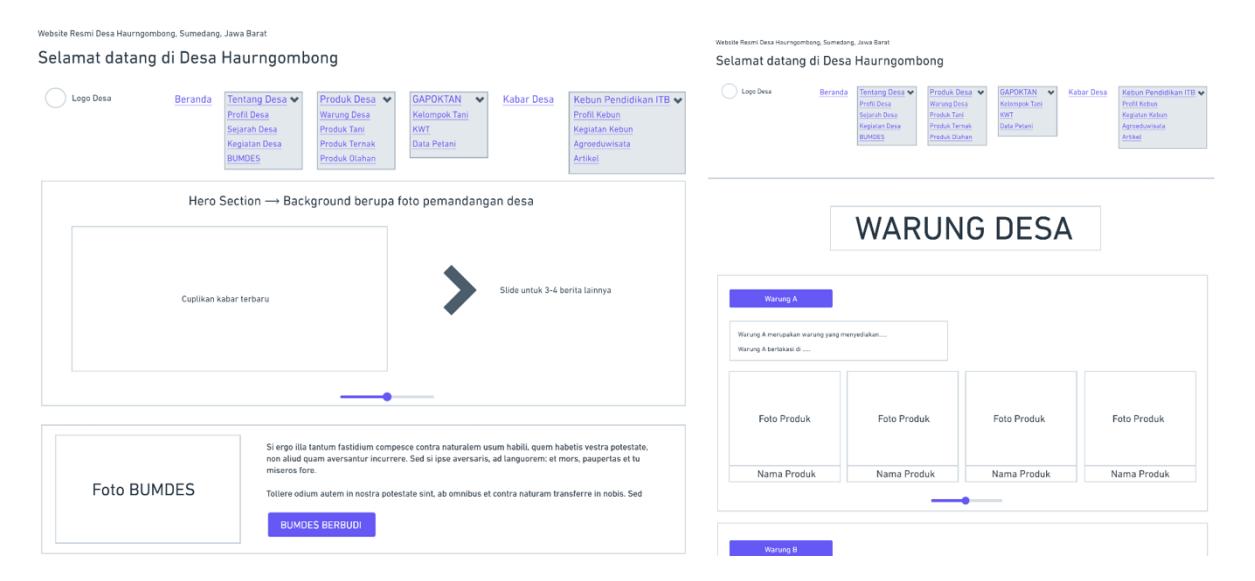
Figure 1. The website design framework
3.4 Product Information Collection
After the website design was completed, the next stage involved collecting comprehensive information on the products and services to be displayed on the digital platform. Accurate and well-organized product data is critical for building an effective digital catalog, as it enhances consumer understanding, strengthens credibility, and improves overall user experience [22]. The collection process included gathering product names, descriptions, prices, and visual documentation in the form of photos.
a. Products from ITB Haurngombong Educational Garden
The first stage of data collection focused on products cultivated and produced by the ITB Haurngombong Educational Garden. The agricultural commodities offered include: a) Cherry Tomatoes; b) Aquaponic Lettuce; c) Aquaponic Pakcoy; d) Various Citrus Fruits (including lemon); f) Mint Leaves; g) Chayote; h) Scallions; i) Avocado; j) Mango; k) Dragon Fruit; l) Banana; m) Guava; n) Vermicompost; o) Compost
These products were displayed on the website along with standardized prices. Product photos were included to enhance visual appeal and to help potential buyers evaluate product quality. Visual content is an essential element in digital marketing, as clear and attractive product images significantly influence consumer trust and purchase intention [23].
b. Products and Services from the Village Shop and BUMDes
The second stage involved collecting information about the products and services offered by the Village Shop and BUMDes Haurngombong. The Village Shop sells various items, including snack foods, basic household necessities, and daily household goods.
Additionally, BUMDes Haurngombong provides several services, including: a) Rental of the Multipurpose Building/Sports Hall (GOR); b) WiFi installation services; c) Payment services of Land and Building Tax; d) BRI-Link financial services; e) Savings and Loan Cooperative; f) Waste Management Services; g) Clean Water Services; h) Management of Village Treasury Land.
Presenting both products and service offerings in a digital catalog supports the concept of integrated digital marketing, enabling rural enterprises to broaden their consumer base and improve service accessibility.
c. Agricultural Products from Farmers and KWT
The next component of data collection focused on products sold by farmers, the Women Farmers Group (KWT), and MSEs.
Most commercial farmers in Haurngombong Village cultivate sweet potatoes and cassava, although production fluctuates due to limited water access, especially during the dry season. Some farmers and livestock breeders also sell goats and raw dairy milk, which is distributed through the village's dairy cooperative.
The KWT offers weekly-varying products, such as water spinach, pakcoy, chili, processed aloe vera drinks, and other seasonal vegetables. Previously, these products were sold only to neighbors or to passing vegetable
vendors, reflecting the commonly limited market access faced by rural women farmer groups.
d. MSEs Products
The MSEs in Haurngombong Village produce a variety of processed foods, including flavored sweet potato chips, cassava chips, banana chips, crispy sweet potato, freshwater snails. Processed food products are among the most common MSEs commodities in rural areas, and they have strong potential for digital marketing due to their shelf stability and consumer appeal.
e. Product Photo Documentation
In addition to collecting product descriptions and pricing, photos of all products were taken to be included in the digital catalog. High-quality images help communicate product quality and increase consumer engagement. Visual product documentation must be updated periodically, especially when new products emerge or when packaging changes. Regular updates are essential for maintaining website relevance and supporting consumer trust [24].
3.5 Website Socialization and Training on Digital Marketing and Daily Sales Activity Recording
The website socialization was held on July 26, 2023, at the Haurngombong Village Multipurpose Building/Sports Hall (GOR). This event invited the BUMDes management, farmers, KWT (Women Farmers Group), and MSEs actors to inform them that a digital platform—the website and WhatsApp Group—was now available for marketing their products.
The homepage of the Haurngombong Village Shop website features several information sections listed in the menu: ITB Educational Garden, Village Products, GAPOKTAN, About the Village, and Village News, along with explanations for each menu item. The Hero Section contains a brief explanation of the website, followed by a search column with a scenic photo background (Figure 2).
Subsequently, the Village Shop page displays product and service information offered by the BUMDes, in collaboration with the farmers and MSESs in Haurngombong Village. The ITB Educational Garden page showcases the garden profile, facilities, activities, and the products offered by the ITB Educational Garden (Figure 3).
Figure 2. The Hero Section of of the Haurngombong Village Shop Website
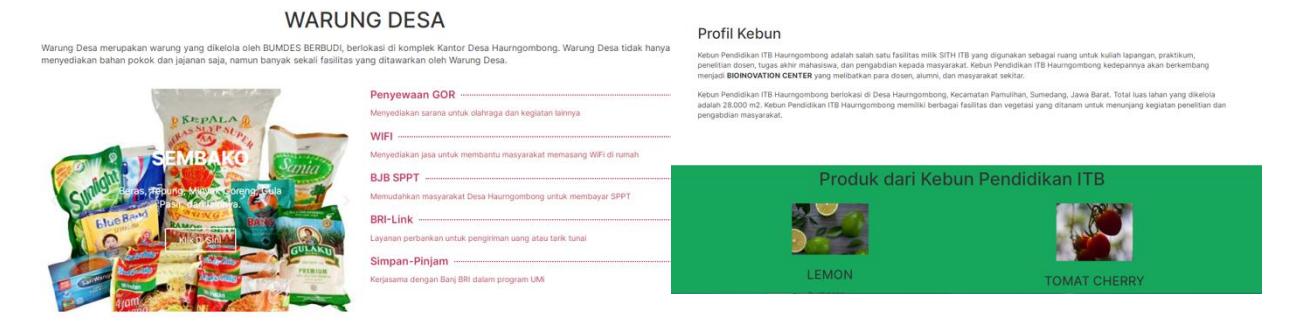
Figure 3. Page of Displays Product
The socialization, which also served as the website launch, was attended by three lecturers from ITB who provided material to the business actors. The first material covered BUMDes Go Digital: Explain how we choose a digital platform to improve marketing activity. This session explained the importance of choosing an efficient platform for marketing agricultural products. WhatsApp was highlighted as the most frequently used platform by the community; therefore, WhatsApp was also incorporated into this program as a means of marketing agricultural products in Haurngombong. The second material was Mathematical Calculation for Business: The importance and how to make daily recordings of product sales activities. This material focused on educating business actors on how to calculate profit and loss from production and provided tips for producers on achieving profitability. The session concluded with a Q&A between the business actors and the presenters (Figure 4).
Figure 4. Workshop and Training Utilization of digital platforms to improve the economy of the Haurngombong village community, Sumedang.
Following this socialization, the farmers, KWT, and MSES actors received updated information regarding the internet. The business actors now also know how to offer their products digitally, from the planning stage to implementation. Most importantly, the community of Haurngombong Village now has a platform for marketing and purchasing products digitally. The flow and delivery of products from the farmers, KWT, and MSEs are still limited to delivery or pick-up facilitated by the BUMDes only when a consumer places an order. The BUMDes will inform the farmers, KWT, and MSEs upon receiving an order from the website or WhatsApp Group. However, product collection is currently only possible at the Village Shop, located next to the village office.
The results of this program were followed up by the BUMDes Berbudi actively assisting farmers in marketing agricultural products by participating in bazaars, such as the Haurngombong Village Anniversary (Milangkala Desa Haurngombong), Jatifest 2023 at the ITB Jatinangor Campus, and the International Conference ENDINAMOSIS 2023 at the ITB Ganesha Campus.
IV. CONCLUSION
The core problem in Haurngombong Village was the limited marketing reach of agricultural and MSEs (Micro and Small Enterprise) products, which were largely
marketed only to the surrounding community and the nearest local market. The solution implemented was the marketing of products through a website and a WhatsApp Group Chat. The website serves as a display, containing information about the products as well as information about the producers, such as GAPOKTAN (Joint Farmers Group), KWT (Women Farmers Group), and MSEs. Further efforts to ensure the program's sustainability included providing socialization on the utilization of the digital platform and training on how to calculate cost requirements to determine appropriate pricing.
ACKNOWLEDGEMENT
We are thankful to Agency of Research and Community Service community (LPPM) Institut Teknologi Bandung, fiscal year 2023 for funding the project. We also thankful to BUMDes Berbudi, Haurngombong Village for facilitating the program.
REFERENCES
- [1] Rosiana, N. (2020). Dinamika Pola Pemasaran Kopi pada Wilaya Sentra Produksi Utama di Indonesia. Jurnal AGROSAINS dan TEKNOLOGI, 5(1), 1-9.
- [2] [2] Cristovao, C. D. S., Adhi, A. K., & Rifin, A. (2015). Analisis Efisiensi Pemasaran Dan Pilihan Saluran Pemasaran Kopi Organik Di Kabupaten Ermera, Timor-Leste. IPB University.
- [3] [3] Rahayu, H.S., Dewi, M. and Febrianti, T., 2021. Farmers's Choice to Risk Management Strategies of Corn Farming in Sigi District Central Sulawesi. In E3S Web of Conferences (Vol. 232, p. 02016). EDP Sciences.
- [4] [4] Natania, A. T., & Dwijayanti, R. (2023). Pemanfaatan Platform Digital Sebagai Sarana Pemasaraan bagi UMKM. Jurnal Pendidikan Tata Niaga (JPTN), 11(3), 343-350.
- [5] [5] Bolfe, É.L., Jorge, L.A.D.C., Sanches, I.D.A., Luchiari Júnior, A., da Costa, C.C., Victoria, D.D.C., Inamasu, R.Y., Grego, C.R., Ferreira, V.R. and Ramirez, A.R., 2020. Precision and digital agriculture: Adoption of technologies and perception of Brazilian farmers. Agriculture, 10(12), p.653.
- [6] [6] Hanggana, S., 2024. Farmer Assessment of the Effectiveness of Empowerment Strategies to Increase Farming Profits. AGRARIS: Journal of Agribusiness and Rural Development Research, 10(2), pp.156-172.
- [7] [7] Stone, S., Langford, Z., Arsyi, R., Lapong, I., Zach, Z., Ruhon, R., Julianto, B., Siradjuddin, I., Wong, A. and Waldron, S., 2025. Technology adoption by smallholder farmers: the case of drying technology in the Indonesian seaweed industry. Journal of Agribusiness in Developing and Emerging Economies, 15(3), pp.486-499.
- [8] [8] Anandita, S. R., Rahmawati, T., Aviana, A., Haq, M. A. M., Arifin, M. Z., & Darmawan, M. F. (2023). Optimalisasi Ketrampilan Desain Karang Taruna Desa Sumbersari Jombang Melalui Pelatihan Penggunaan Aplikasi Canva. Jumat Informatika: Jurnal Pengabdian Masyarakat, 4(1), 9-12.
- [9] [9] Chambers, R. (2015). PRA, PLA and pluralism: Practice and theory. The SAGE handbook of action research, 31-46.
- [10] [10] Latupeirissa, J. J. P., Dewi, N. L. Y., Prayana, I. K. R., Srikandi, M. B., Ramadiansyah, S. A., & Pramana, I. B. G. A. Y. (2024). Transforming public service delivery: A comprehensive review of digitization initiatives. Sustainability, 16(7), 2818.
- [11] [11] Harsanto, B. T., & Wahyuningrat, W. (2024). Investigating the keys to the failure of inter-village government collaboration
- in developing rural economic potentials in Indonesia. Regional Science Policy & Practice, 16(5), 100023.
- [12] [12] Purnomo, S., & Purwandari, S. (2025). A comprehensive micro, small, and medium enterprise empowerment model for developing sustainable tourism villages in rural communities: A perspective. Sustainability, 17(4), 1368.
- [13] [13] Karmiyati, D., & Ruhtata, R. (2022) Bumdes Services Can Improve the Community's. Yogyakarta: CV. Bildung Nusantara.
- [14] [14] Shoko, J., Muboko, N., & Gandiwa, E. (2024). Focus Group Discussion Method as a Tool for Eliciting Local Community Views for Decision Making; a Case of the Save Valley Conservancy in the Southeast Lowveld of Zimbabwe.
- [15] [15] Cahya, H. N., Isthika, W., Pramitasari, R., & Ingsih, K. (2025). Marketing and MSMEs dynamics in Indonesia and Malaysia: strategies, challenges, and cultural influences. Penerbit P4I.
- [16] [16] Khan, S. (2023). Issues, challenges and opportunities in the digitalization of rural markets. Human Systems Management, 42(1), 73-87.
- [17] [17] Panjaitan, R., & Purba, C. B. (2020). Boosting Brand Awareness: Leveraging Content Marketing and Social Media For Greater Visibility And Engagement in Property Business. Jurnal Manajemen dan Bisnis, 247-256.
- [18] [18] Taqiyya, R., & Riyanto, S. (2020). Strategi Pemanfaatan Media Sosial Facebook Dan Whatsapp Untuk Memperluas Jaringan Pemasaran Digital Benih Sayuran Oleh Wafipreneur Di Masa Pandemi Covid-19. Syntax Idea, 2(10), 813-826.
- [19] [19] Díaz-Arancibia, J., Hochstetter-Diez, J., Bustamante-Mora, A., Sepúlveda-Cuevas, S., Albayay, I., & Arango-López, J. (2024). Navigating digital transformation and technology adoption: A literature review from small and medium-sized enterprises in developing countries. Sustainability, 16(14), 5946.
- [20] [20] Nilashi, M., Jannach, D., bin Ibrahim, O., Esfahani, M. D., & Ahmadi, H. (2016). Recommendation quality, transparency, and website quality for trust-building in recommendation agents. Electronic commerce research and applications, 19, 70-84.
- [21] [21] Luz, A. (2025). The Role of Digital Platforms in Enhancing the Market Reach of Small Businesses in Rural America.
- [22] [22] Fawwaz, N. (2024). Mobile-Based Library Catalog Web Service Development. Journal Mobile Technologies (JMS), 2(1), 50-58.
- [23] [23] Sunarso, B., & Mustafa, F. (2023). Analysing the role of visual content in increasing attraction and conversion in MSME digital marketing. Journal of Contemporary Administration and Management (ADMAN), 1(3), 193-200.
- [24] [24] Hasbiah, S., & Hasdiansa, I. W. (2025). Building consumer trust through information system integration in e-commerce. International Journal of Economics, Management and Accounting (IJEMA), 3(1), 1-10.